For me, there’s nothing better than a good old fashioned adventure story, be it in fiction (Hercules to Horatio Hornblower) or in actual history (the Conquistadors, Lord Cochrane, William Walker or Baron von Ungern). One of my favorite historical figures whose life reads like an historical adventure novel was Don Juan of Austria, illegitimate son of an emperor, a savior of Christendom, soldier, sailor and would-be rescuer of a certain damsel in distress. His very name and blood speaks of an earlier Europe before rigid nationalism became all the rage. The son of a German-born mother, a Belgian-born father, inheriting an Austrian name and being raised in Spain. Don John was born in Bavaria, the result of a fling between a singer named Barbara Blomberg and the Holy Roman Emperor Charles V, who was also King Carlos I of Spain. Shortly after his birth his Hapsburg father sent him to Spain where he essentially grew up Spanish. Being of imperial blood, however, he was given the best education possible, taught French and Latin, history, geography and, of course, the manly arts.
He did not see much of his father until his abdication when he left Brussels to retire to Spain. The former emperor hoped the boy would become a priest, which was not an uncommon expectation for someone in his position. He actually had no idea who his real father was until he was dead and gone and his half-brother, then King Philip II of Spain, told him so. He was not allowed to live at the palace but was taken care of, ranked behind the legitimate members of the Royal Family but ahead of the ranks of the Spanish aristocracy. He was sent to university to further his expected goal of becoming a cleric, but the consecrated life was not the life for Don Juan of Austria. He dreamed of adventure and military glory. When the Knights of St John were enduring their heroic siege on Malta in 1565, Don Juan left Barcelona to join the fleet King Philip was sending to their rescue.
It was the beginning of an illustrious naval career, fighting the Ottoman Turks, masters of the most powerful naval forces in the Mediterranean and advancing with seemingly unbeatable might. In 1566 the King made Don Juan a Knight of the Golden Fleece and in 1568, upon turning 21, his half-brother made him Captain-General of the Spanish naval forces in the Mediterranean. He gained experience and respect in numerous engagements against the Barbary corsairs who plagued Hapsburg shipping along the Spanish and African coasts. For such a swashbuckling figure, with a reputation already as something of a ladies man, it might be tempting to think Don Juan was lacking in concern for more serious matters but such was not the case. Once past his youthful indiscretions he took his religion seriously as well as the political situation facing Christendom and the Hapsburg empire at the heart of it. When his nephew Don Carlos (son of Philip II) turned against his father, Don Juan told his brother of the deranged plan of his son. When Don Carlos died while under arrest, Don Juan was deeply saddened, as he was also at the death of the Queen. The whole situation caused a slight falling out between the two brothers and Don Juan retreated to a monastery to spend time in prayer and sort things out.
However, when Spain was threatened, Don Juan was quick to ride to the rescue as he did in 1569 when a rebellion broke out in Granada amongst the Moorish population there. King Philip gave him command and Don Juan set to work, educating himself on strategy, logistics, siege tactics and so on. He left nothing to chance and showed great care in his preparations for battle. He crushed the rebellion thoroughly and showed such courage, leading his troops at the front with little regard for his own safety, that he became immensely popular with the common soldiers who were inspired by his coolness under fire, heroism and willingness to share the dangers of battle with them. He had started out at sea, gained great fame as a general on land but he would soon be back to sea again where he was to earn his most famous place in history.
Ottoman naval forces were on the advance and southern Europe was shocked when Cyprus (previously a possession of the Republic of Venice) fell to the Turkish forces. Pope Pius V immediately began trying to organize a Christian naval coalition to stop their advance. Finally, a Spanish and Italian fleet of galleys was organized with contingents from Spain, Genoa, Venice, Savoy, Parma, Malta and the Papal States. Don Juan of Austria was given command and sailed out to meet the much larger Turkish fleet at the battle of Lepanto in the Gulf of Corinth in 1571. A seemingly miraculous change in the wind, some better weapons and a lot of heroism combined to give victory to the Christian forces, ending the Turkish threat in the Mediterranean. Don Juan was the hero of Catholic Europe for this daring naval victory and nothing seemed impossible for him.
After continuing his fight against the Turks in the Mediterranean, in 1576 he was appointed to command the Spanish forces in the long, grueling war in the Netherlands. This offered many opportunities for success but was also a terrible appointment too. Supporting the army had proved difficult, the fighting was fierce and the Low Countries had become, in many ways, the epicenter of the Catholic-Protestant religious struggle across northern Europe. He had to assume a disguise just to reach the Netherlands but he had lost none of his zeal and audacity. After crushing the rebels in the Netherlands he planned to lead an invasion of England where he would liberate Mary Queen of Scots, then being held prisoner by her cousin Queen Elizabeth, and, who knows, perhaps marry the widow renowned as such a beauty and rule England, Scotland and Ireland alongside her.
However, that was not to be. He won many battles for the Hapsburg Crown in the Netherlands and Belgium but was hampered by a lack of support from Spain. Worn out and increasingly ill he died of typhus on October 1, 1578 near Namur, Belgium. He was only 31-years-old. Still, the fame he acquired in his short lived earned him a degree of immortality. He had crushed rebel forces in Spain, beat back a Turkish invasion at sea and planned to sail across the Channel to rescue an imprisoned queen; it is no wonder his short life has been the subject of numerous books, plays, poems and so on. He was one of the great heroes of the Catholic countries in Renaissance Europe, rightly credited with saving Italy from Islam and saving Belgium from Protestantism.
Wednesday, May 11, 2011
Tuesday, May 10, 2011
Favorite Royal Images: A May King and Queen
The future Queen Maria Jose and King Umberto II of Italy on the occasion of the birth of their firstborn. They were certainly a royal couple made for the cameras.
Mad Rant: A World Gone Mad
I am constantly reminded that, despite my own occasional thoughts to the contrary, the certificated, educated professionals in the psychiatric fields in both civilian and military hospitals were correct in their assessment of my damaged mental state -because if the rest of the world has not gone absolutely barking mad then I must have! Our civilization is crumbling around us and just at the moment when we most require the sterner stuff of which past generations were made, we are going suicidal soft! Perhaps things are better in the place where you bide, reading this rant (too many of which, I am sure, I subject you to), but it is painfully the fact here in the good old U.S. of A. to be sure. And that goes for foreign relations, the economy and domestic laws -really the only things government is supposed to handle. However, how can the government not screw all of these things up when it seems that so many people have taken leave of their senses?! Yes, yes, it is simply that I am the one with the problem -but what a massive one it must be.
Take the recent offing of Osama bin Laden, arch-terrorist and public enemy number one. Here was a man who proudly boasted of being responsible for the murder of thousands of people around the world and yet, when someone stepped up and sent this cowardly, bloodthirsty bastard to meet his 72 virgins some people in this country actually complained! There was even a Catholic priest on TV who said that we shouldn’t say Osama was evil because that is only for God to decide (he was probably a Jesuit…)! Aaaaarrrrggghhhh! Is everyone trying to play a joke on me? Whatever happened to the Church that was home to the “fighting faith”? Where is Torquemada when we need him? If we cannot say that Osama bin Laden was evil we might as well give up on any semblance of religion or morality because it does not exist and there is no point to any of it. As for the lay population, we have got the usual whining that he should have been captured, he should have been given a “fair trial” (like that would have been possible) and, my personal favorite, that America had no “right” to kill Osama because it was America that created him.
(head banging on desk)
That is so asinine that I hardly know how to go about addressing it -it just makes my head hurt. In the first place, America did not “create” Osama bin Laden -he was responsible for his own life and his own decisions, not anyone else. Secondly, even if he were a totally American creation I still think we would have the “right”, yes, even the *responsibility* to put a bullet between his eyes. Tim McVeigh was ‘American made’ but that didn’t stop us from shooting his veins full of poison after he blew up a few hundred people in Oklahoma City. Osama bin Laden was a bad guy who got what was coming to him -it should not be a complicated subject. He was also a gutless wimp who died cowering behind his wife. Think about this: he complained about the U.S. having a base in Saudi Arabia and used that to try to justify his actions. So, why did he not go to his homeland and lobby the government to order the U.S. to leave? Why didn’t he try to force their hand instead of coming to America and butchering thousands of innocent people? Because if he had, the Saudi government would have stomped on him and his death would have been far worse than two shots in the head. He probably would have been separated from his head. Coward.
Okay, moving on, I mentioned the economy. This won’t take long. When it comes to the economy I knew my doctors must have been right all along as soon as I heard Vice President Joe Biden say, in all seriousness, that in order to get out of the mountain of debt we were under the government needed to spend more money. And no one called him on it. Everyone just went along like that made complete sense. [hold on a second, blood’s coming out of my ears] The bill was passed, and the same pattern continues to repeat. We have about fourteen trillion dollars of debt in this country and the government wants to “fix” it by spending more money. Again, the fact that roughly half the country agrees with this, hell the fact that ANYONE would go along with this proves that, yes, I must be totally out of my mind because if I am not then our entire civilization is suffering from nothing less than an absolute plague of madness.
Just today, I was reminded of another example. You know election time is getting close when immigration starts to be important again and this time is no different. There is a bill currently going through Austin by which the Governor wants to outlaw so-called “sanctuary cities”. For those of you who don’t know, these are cities where illegal aliens are welcome, where police and civic authorities are not allowed to check the status of anyone’s citizenship or to report them to the U.S. Department of Immigration. These are cities where the local government says, “On these particular laws, we are going to look the other way and refuse to enforce them”. The debate over these cities is nothing new, nor is the talking points of both sides but what really makes my head explode is the line we always get from the local police. They say that enforcing immigration laws would destroy the “trust” between illegal aliens and the police and make it harder to stop more “serious” crimes in their neighborhoods because they will not report anything or want to talk to the police at all for fear of being found out and (though I can’t imagine why) extradited back to their country of origin.
Please, help me! Does this make sense to anyone? Can someone tell me how? How is this any different than if the police stopped arresting people who stole cars because that would mean the thieves wouldn’t help them catch the murderers in the area? Do police have a similar relationship of “trust” with the child molester community, the vandal community or the rapist community? Here I was thinking that the police were supposed to uphold the law, all of it, regardless of all else. I’m sure people will be upset by some of these comparisons, but I cannot see it any other way. Illegal aliens, *broke the law* as soon as they crossed the border, they committed a crime and I see no reason why one group of criminals should be overlooked while other criminals are not. The police should be arresting criminals -period. Whoever they are, wherever they are from, whatever crime they committed. You commit a crime - the police take you away. Seems simple to me, but, lest I forget, I am the crazy one so, perhaps the system makes perfect sense to everyone else.
There are, of course, other issues in other countries I could go into. Such as the element in Canada which is utterly devoted to depriving that country of their greatest, most lucrative, natural resource or the fact that while the United Kingdom is so short of cash they will downsize the military and gut the Royal Navy but never think of making people responsible for their own doctor bills. Of course, on that score, I might also mention that there are people in Britain who see nothing wrong with paying the government over forty million pounds a year to treat men with erectile dysfunction but find it outrageous to pay the security bill for the wedding of their future king. One might think that things like sovereignty and national security would take precedence over a crowd of aging old men who can’t chase skirt like they used to but, then one might just be a … Mad Monarchist.
Take the recent offing of Osama bin Laden, arch-terrorist and public enemy number one. Here was a man who proudly boasted of being responsible for the murder of thousands of people around the world and yet, when someone stepped up and sent this cowardly, bloodthirsty bastard to meet his 72 virgins some people in this country actually complained! There was even a Catholic priest on TV who said that we shouldn’t say Osama was evil because that is only for God to decide (he was probably a Jesuit…)! Aaaaarrrrggghhhh! Is everyone trying to play a joke on me? Whatever happened to the Church that was home to the “fighting faith”? Where is Torquemada when we need him? If we cannot say that Osama bin Laden was evil we might as well give up on any semblance of religion or morality because it does not exist and there is no point to any of it. As for the lay population, we have got the usual whining that he should have been captured, he should have been given a “fair trial” (like that would have been possible) and, my personal favorite, that America had no “right” to kill Osama because it was America that created him.
(head banging on desk)
That is so asinine that I hardly know how to go about addressing it -it just makes my head hurt. In the first place, America did not “create” Osama bin Laden -he was responsible for his own life and his own decisions, not anyone else. Secondly, even if he were a totally American creation I still think we would have the “right”, yes, even the *responsibility* to put a bullet between his eyes. Tim McVeigh was ‘American made’ but that didn’t stop us from shooting his veins full of poison after he blew up a few hundred people in Oklahoma City. Osama bin Laden was a bad guy who got what was coming to him -it should not be a complicated subject. He was also a gutless wimp who died cowering behind his wife. Think about this: he complained about the U.S. having a base in Saudi Arabia and used that to try to justify his actions. So, why did he not go to his homeland and lobby the government to order the U.S. to leave? Why didn’t he try to force their hand instead of coming to America and butchering thousands of innocent people? Because if he had, the Saudi government would have stomped on him and his death would have been far worse than two shots in the head. He probably would have been separated from his head. Coward.
Okay, moving on, I mentioned the economy. This won’t take long. When it comes to the economy I knew my doctors must have been right all along as soon as I heard Vice President Joe Biden say, in all seriousness, that in order to get out of the mountain of debt we were under the government needed to spend more money. And no one called him on it. Everyone just went along like that made complete sense. [hold on a second, blood’s coming out of my ears] The bill was passed, and the same pattern continues to repeat. We have about fourteen trillion dollars of debt in this country and the government wants to “fix” it by spending more money. Again, the fact that roughly half the country agrees with this, hell the fact that ANYONE would go along with this proves that, yes, I must be totally out of my mind because if I am not then our entire civilization is suffering from nothing less than an absolute plague of madness.
Just today, I was reminded of another example. You know election time is getting close when immigration starts to be important again and this time is no different. There is a bill currently going through Austin by which the Governor wants to outlaw so-called “sanctuary cities”. For those of you who don’t know, these are cities where illegal aliens are welcome, where police and civic authorities are not allowed to check the status of anyone’s citizenship or to report them to the U.S. Department of Immigration. These are cities where the local government says, “On these particular laws, we are going to look the other way and refuse to enforce them”. The debate over these cities is nothing new, nor is the talking points of both sides but what really makes my head explode is the line we always get from the local police. They say that enforcing immigration laws would destroy the “trust” between illegal aliens and the police and make it harder to stop more “serious” crimes in their neighborhoods because they will not report anything or want to talk to the police at all for fear of being found out and (though I can’t imagine why) extradited back to their country of origin.
Please, help me! Does this make sense to anyone? Can someone tell me how? How is this any different than if the police stopped arresting people who stole cars because that would mean the thieves wouldn’t help them catch the murderers in the area? Do police have a similar relationship of “trust” with the child molester community, the vandal community or the rapist community? Here I was thinking that the police were supposed to uphold the law, all of it, regardless of all else. I’m sure people will be upset by some of these comparisons, but I cannot see it any other way. Illegal aliens, *broke the law* as soon as they crossed the border, they committed a crime and I see no reason why one group of criminals should be overlooked while other criminals are not. The police should be arresting criminals -period. Whoever they are, wherever they are from, whatever crime they committed. You commit a crime - the police take you away. Seems simple to me, but, lest I forget, I am the crazy one so, perhaps the system makes perfect sense to everyone else.
There are, of course, other issues in other countries I could go into. Such as the element in Canada which is utterly devoted to depriving that country of their greatest, most lucrative, natural resource or the fact that while the United Kingdom is so short of cash they will downsize the military and gut the Royal Navy but never think of making people responsible for their own doctor bills. Of course, on that score, I might also mention that there are people in Britain who see nothing wrong with paying the government over forty million pounds a year to treat men with erectile dysfunction but find it outrageous to pay the security bill for the wedding of their future king. One might think that things like sovereignty and national security would take precedence over a crowd of aging old men who can’t chase skirt like they used to but, then one might just be a … Mad Monarchist.
Monday, May 9, 2011
Monarch Profile: King Umberto II of Italy
Officially the last King of Italy and last reigning member of the venerable royal house of Savoy, Umberto II occupied the throne for so short a time that he has gone down in popular memory as the “King of May”. His life was one of great early promise and high hopes for the future which ended in one of the (many) gross injustices following World War II. He was born on September 15, 1904 in Racconigi, Piedmont to Their Majesties King Vittorio Emanuele III and Queen Elena of Montenegro. He was their third child but only son and was raised with the certain destiny that he would become King of Italy. From early in his youth he was given a practical education and extensive military training to prepare him to carry on the illustrious military tradition of the House of Savoy. The importance of the monarchy to the unity of Italy and the glorious history they were expected to live up to were heavily stressed on the young man and he became very meticulous about royal protocol and presenting just the right public appearance for any occasion.
As he grew up, his attention to detail paid off as the Italian press hailed him as the handsomest prince in Europe. The tall, dashing, soldierly Prince of Piedmont had mastered perception but he still needed a proper, royal beauty to be his princess. After World War I, the number of reigning Catholic royals had been considerably reduced but an ideal candidate was found in the strong-willed and stunning Princess Maria Jose of Belgium. By this time, Italy was under the rule of the fascist party but radical socialists were still a problem and when Prince Umberto went to Brussels to propose to his Belgian bride one tried to assassinate him. Of course, the effort was unsuccessful and on January 8, 1930 the couple were married in Rome in a magnificent ceremony with all of the pomp and pageantry the ancient House of Savoy could muster. Still, there were problems. The couple were initially happy enough but were not well suited to each other and the antagonism between the new Princess of Piedmont and Mussolini was evident from the start.
In keeping with Italian tradition, Prince Umberto stayed strictly out of political matters. He was expected to deal with those when he became king and not a day before. Nonetheless, Mussolini was wary enough of him to keep him closely watched and under tight control. Aside from the usual royal engagements Prince Umberto was mostly kept busy with his military career becoming commander of the Northern Armies and later of the Southern Armies. He was a good soldier, despite some claims to the contrary, but was kept from active service in most campaigns by the government, due both to concerns over his security as well as (perhaps even more so) worries that he was insufficiently supportive of the fascist regime. Nonetheless, he could not be ignored and in 1942, with the Second World War well under way, he was promoted to the rank of Marshal of Italy. However, by that time it was all too clear that the war was going against Italy.
A sense of duty and deferment to his father kept Prince Umberto out of politics but he was well aware that Princess Maria Jose was working through the Vatican, trying to coordinate anti-fascist elements in Rome with representatives of the United States, to take Italy out of the Axis and into the Allied camp. The Prince himself could not be involved in this but he supported the efforts of his wife and kept silent about the whole affair. A single report could have ended it all but the Prince showed his support by saying nothing even though suspicions were eventually raised enough for the Princess to be sent away. By that time, Allied forces had overrun Italian East Africa, Libya (Italy’s “Fourth Shore”) and when British and American forces invaded Sicily there was no longer any doubt as to the outcome of the conflict. Support for Mussolini fell away and King Vittorio Emanuele III was finally in a strong enough position to dismiss the dictator and have him arrested, after which Italy made a separate peace and shifted to the Allied nations.
However, the Germans quickly occupied northern Italy while the Allies moved into the south. The King was urged by others in the House of Savoy to step aside as many considered him tainted for having been so long associated with the old fascist regime. Torn between what he regarded as his sacred duty and the practical reality of the situation the King declined to abdicate but stepped aside from political affairs in favor of Prince Umberto, naming him Lieutenant General of the Realm with full power to act in his name. The King then left for what he hoped would be a temporary relocation to Egypt where King Farouk had been friendly toward the Italians and had a rather tense relationship with the British. In his absence Prince Umberto won praise from every quarter for his astute handling of the situation, cooperation with the Allies and continued resistance to the German occupation and the fascist puppet-state set up in the north by Mussolini following his rescue by Nazi special forces.
Under Prince Umberto the Royal Italian forces joined the war again to assist the Allies as much as possible, continuing to the final defeat of the Nazis in 1945. Yet, the republican revolutionaries had again come out of hiding once the fascist presence was gone and there were the occupying Allied forces who often were prejudiced against the House of Savoy. A new clique began to push for the overthrow of the monarchy, whether by democratic or violent means, and they had a great deal of Allied support. Finally, King Vittorio Emanuele III was persuaded that the only hope to save the monarchy was to abdicate in favor of his son. He did so on May 9, 1946 at which time his son became King Umberto II. However, the new political factions had already pushed the Royal Family aside and ugly accusations were abounding as the abdication brought back painful memories from the time of Italian defeat. Instead of focusing on King Umberto II and his record of success since 1944 attention shifted back to his father, the fall of Rome and the fascist regime.
Within weeks a referendum was held on the abolition of the monarchy. King Vittorio Emanuele III had once said that no nation was less suited for a republic than Italy and the referendum which created the Italian Republic was enough to prove his words prophetic. The entire process made a farce of the democratic concept. Voters were intimidated, poll numbers skewed and the decision announced before all the votes had even been counted. Indeed, many had been prevented from casting a vote and disenfranchisement was worst in the south where monarchist sentiment was the strongest. Nonetheless, the powers that be had spoken and on June 12, 1946 the Savoy reign and the Kingdom of Italy came to an end.
King Umberto II and Queen Maria Jose were forced into exile and soon separated. King Umberto II spent most of his years in exile in Portugal. He traveled extensively, winning probably more friends and admirers than he had ever had before. However, the new political class in Italy only hardened their position and banned any male heirs of the Savoy dynasty from setting foot on Italian soil. The excuse given for this was that the government had decided to blame the rule of Mussolini on the Royal Family and yet, in the ultimate show of hypocrisy, the Mussolini family itself was not barred from the country or suffered any loss of liberties at all. The true reason, of course, was that a strong royalist element remained and the republican government wanted to see it suffocated by the absence of any Savoy royal in the country. His Majesty Umberto II, the last King of Italy, died still in exile, in Switzerland, on March 18, 1983. It was noteworthy that kings, queens and princes from across Europe came to his funeral to pay their respects, even from countries which had been the enemies of the Kingdom of Italy during the war but not one representative of the Italian government was present.
As he grew up, his attention to detail paid off as the Italian press hailed him as the handsomest prince in Europe. The tall, dashing, soldierly Prince of Piedmont had mastered perception but he still needed a proper, royal beauty to be his princess. After World War I, the number of reigning Catholic royals had been considerably reduced but an ideal candidate was found in the strong-willed and stunning Princess Maria Jose of Belgium. By this time, Italy was under the rule of the fascist party but radical socialists were still a problem and when Prince Umberto went to Brussels to propose to his Belgian bride one tried to assassinate him. Of course, the effort was unsuccessful and on January 8, 1930 the couple were married in Rome in a magnificent ceremony with all of the pomp and pageantry the ancient House of Savoy could muster. Still, there were problems. The couple were initially happy enough but were not well suited to each other and the antagonism between the new Princess of Piedmont and Mussolini was evident from the start.
In keeping with Italian tradition, Prince Umberto stayed strictly out of political matters. He was expected to deal with those when he became king and not a day before. Nonetheless, Mussolini was wary enough of him to keep him closely watched and under tight control. Aside from the usual royal engagements Prince Umberto was mostly kept busy with his military career becoming commander of the Northern Armies and later of the Southern Armies. He was a good soldier, despite some claims to the contrary, but was kept from active service in most campaigns by the government, due both to concerns over his security as well as (perhaps even more so) worries that he was insufficiently supportive of the fascist regime. Nonetheless, he could not be ignored and in 1942, with the Second World War well under way, he was promoted to the rank of Marshal of Italy. However, by that time it was all too clear that the war was going against Italy.
A sense of duty and deferment to his father kept Prince Umberto out of politics but he was well aware that Princess Maria Jose was working through the Vatican, trying to coordinate anti-fascist elements in Rome with representatives of the United States, to take Italy out of the Axis and into the Allied camp. The Prince himself could not be involved in this but he supported the efforts of his wife and kept silent about the whole affair. A single report could have ended it all but the Prince showed his support by saying nothing even though suspicions were eventually raised enough for the Princess to be sent away. By that time, Allied forces had overrun Italian East Africa, Libya (Italy’s “Fourth Shore”) and when British and American forces invaded Sicily there was no longer any doubt as to the outcome of the conflict. Support for Mussolini fell away and King Vittorio Emanuele III was finally in a strong enough position to dismiss the dictator and have him arrested, after which Italy made a separate peace and shifted to the Allied nations.
However, the Germans quickly occupied northern Italy while the Allies moved into the south. The King was urged by others in the House of Savoy to step aside as many considered him tainted for having been so long associated with the old fascist regime. Torn between what he regarded as his sacred duty and the practical reality of the situation the King declined to abdicate but stepped aside from political affairs in favor of Prince Umberto, naming him Lieutenant General of the Realm with full power to act in his name. The King then left for what he hoped would be a temporary relocation to Egypt where King Farouk had been friendly toward the Italians and had a rather tense relationship with the British. In his absence Prince Umberto won praise from every quarter for his astute handling of the situation, cooperation with the Allies and continued resistance to the German occupation and the fascist puppet-state set up in the north by Mussolini following his rescue by Nazi special forces.
Under Prince Umberto the Royal Italian forces joined the war again to assist the Allies as much as possible, continuing to the final defeat of the Nazis in 1945. Yet, the republican revolutionaries had again come out of hiding once the fascist presence was gone and there were the occupying Allied forces who often were prejudiced against the House of Savoy. A new clique began to push for the overthrow of the monarchy, whether by democratic or violent means, and they had a great deal of Allied support. Finally, King Vittorio Emanuele III was persuaded that the only hope to save the monarchy was to abdicate in favor of his son. He did so on May 9, 1946 at which time his son became King Umberto II. However, the new political factions had already pushed the Royal Family aside and ugly accusations were abounding as the abdication brought back painful memories from the time of Italian defeat. Instead of focusing on King Umberto II and his record of success since 1944 attention shifted back to his father, the fall of Rome and the fascist regime.
Within weeks a referendum was held on the abolition of the monarchy. King Vittorio Emanuele III had once said that no nation was less suited for a republic than Italy and the referendum which created the Italian Republic was enough to prove his words prophetic. The entire process made a farce of the democratic concept. Voters were intimidated, poll numbers skewed and the decision announced before all the votes had even been counted. Indeed, many had been prevented from casting a vote and disenfranchisement was worst in the south where monarchist sentiment was the strongest. Nonetheless, the powers that be had spoken and on June 12, 1946 the Savoy reign and the Kingdom of Italy came to an end.
King Umberto II and Queen Maria Jose were forced into exile and soon separated. King Umberto II spent most of his years in exile in Portugal. He traveled extensively, winning probably more friends and admirers than he had ever had before. However, the new political class in Italy only hardened their position and banned any male heirs of the Savoy dynasty from setting foot on Italian soil. The excuse given for this was that the government had decided to blame the rule of Mussolini on the Royal Family and yet, in the ultimate show of hypocrisy, the Mussolini family itself was not barred from the country or suffered any loss of liberties at all. The true reason, of course, was that a strong royalist element remained and the republican government wanted to see it suffocated by the absence of any Savoy royal in the country. His Majesty Umberto II, the last King of Italy, died still in exile, in Switzerland, on March 18, 1983. It was noteworthy that kings, queens and princes from across Europe came to his funeral to pay their respects, even from countries which had been the enemies of the Kingdom of Italy during the war but not one representative of the Italian government was present.
Sunday, May 8, 2011
MM Video: The Queen Mum
A special salute to all the mothers out there on their special day from ... The Mad Monarchist
Saturday, May 7, 2011
Royal News Roundup
Last weekend royals gathered in Rome for the beatification of HH Pope John Paul II. Among those on hand at the Vatican for the event (which attracted record crowds not seen since the funeral of the late, beloved pontiff) were representatives of most of the Catholic royal houses of Europe such as HSH Prince Hans-Adam II and Princess Marie of Liechtenstein, Their Royal Highnesses the Grand Duke and Grand Duchess of Luxembourg, Hereditary Grand Duke Guillaume of Luxembourg, Their Royal Highnesses Prince Felipe and Princess Letizia of Asturias, Their Majesties King Albert II and Queen Paola of the Belgians and Their Royal Highnesses the Duke and Duchess of Gloucester. A notable absentee was HSH Prince Albert II of Monaco (one of the few remaining officially Catholic monarchies in the world). Perhaps wedding preparations are taking up all of his spare time. Also on the Mediterranean front, America had an Italian royal visit. On Thursday, April 28, HRH Prince Emanuele Filiberto of Venice and Piedmont was in the United States, showing up in Hollywood, California at Graumanâs Chinese Theatre for the TCM Classic Film Festival opening night gala and the world premiere of the newly restored movie “An American in Paris”.California is a hot place for royals this year it seems. HRH Princess Madeleine of Sweden visited San Francisco, California recently in connection with her charity work. St James Palace announced that the newlywed Duke and Duchess of Cambridge will be visiting the Golden State July 8-10. In June HM Queen Margrethe II of Denmark and HRH Prince Henrik will visit the United States, stopping at Washington DC and New York City. And, German royal fans can take cheer that the invitations to the August wedding of HIRH Prince Georg Friedrich of Prussia and HSH Princess Sophie of Isenberg have gone out which promises to be a very happy event. Some 1500 people have been invited.
April 30 was National Day in the Kingdom of the Netherlands and HM Queen Beatrix and the rest of the Royal Family turned out, as did much of the country, for all sorts of celebrations. The Dutch public was awash in Orange as the crowds celebrated the official birthday of their Queen. There were also events on May 5 to commemorate the liberation of the Netherlands by American and Canadian Allied troops from Nazi occupation at the end of World War II. The Dutch underground, inspired by Queen Wilhelmina, played a key role in the Allied offensive on the continent and Prince Bernhard (father of the current monarch) was also heavily involved in the conflict as a wing commander in the Royal Air Force and later as commander of the Dutch armed forces in the liberation campaign.
This week, new problems arose for the monarchy in the troubled Kingdom of Belgium when journalists from a Flemish and a Walloon newspaper put out a new book (“King Without a Country”) revealing confidential discussions between the King and high-ranking politicians. The most controversial issues have been the claim that HM King Albert II told party leaders he would not allow new elections and the King taking sides on certain issues. The Royal Palace quickly denounced the publication saying that the breach of confidentiality could have disastrous consequences. A statement said, “Some excerpts contain manifest untruths, in particular accounts of conversations on 16 June and 8 October 2010”. They also stated that such a breach of confidentiality undermined the capability of the King to be an effective, neutral, head of state. The authors said the King was refusing to call new elections out of fear that Flemish nationalists would gain even more support. Personally, I don’t see what is so outrageous about that; the King must swear to maintain the nation and so will obviously be opposed to those who wish to break it up. However, the issue was quickly taken up by those enemies of the monarchy who wish to see the King removed from any political role at all. If that happens, I think it is safe to say, the total loss of the Kingdom of Belgium would not be far behind.
Friday, May 6, 2011
Consort Profile: Empress Maria Theresa of Austria
One of my favorite royal figures, and a reigning monarch in all but name, was the Holy Roman Empress Maria Theresa of Austria. During a time when Europe seemed overrun with rulers so taken by the ideas of the “Enlightenment”, who delighted in attacking organized religion, lived lives of sin and debasement and who accepted eagerly every new liberal trend that came along, God provided at least one monarch who set an example for all people in the person of Archduchess Marie Theresia von Habsburg. Born on May 13, 1717, she was the daughter of the Holy Roman Emperor Charles VI, who had hoped for a son but was never given one. Desperate to secure the succession for his daughter, he spent vast sums of money influencing the crowned heads of Europe to agree to the “Pragmatic Sanction” which they did, promising to recognize Maria Theresa as heiress to the Hapsburg empire and to respect her rights and territory. Sadly, this agreement did not have the effect that the Kaiser hoped and his fortune would probably have been better spent beefing up the Austrian army instead of trusting in the goodwill of his neighbors as Prince Eugene of Savoy had advised him.
In 1740 Emperor Charles VI died, leaving behind a daughter he had never really prepared for the role of Empress and a state that was almost bankrupt. Given the character of the new wave of liberal “enlightened despots”, it is perhaps not surprising that the Emperor was hardly cold in the ground before King Frederick the Great of Prussia broke his word and marched 30,000 men into Silesia. To oppose him, the greatest soldier in Europe, was the 23-year-old Empress Maria Theresa, pious and inexperienced, who could have hardly seemed like a very imposing figure to the famous old warrior. Furthermore, the British were pushing the new Empress to give in to Prussian demands for territory and the French were backing Karl Albrecht, Graf von Bayern (Bavaria) as a claimant to the Austrian throne.
Against all of these enemies, and with her own court lacking in faith in the young woman and urging her to submit to Frederick, Maria Theresa held her ground and turned for support to the Hungarians. In a show of chivalry that should inspire pride in every Magyar heart, the Hungarians defied the odds and rushed to her side with enthusiastic loyalty. Heartened by the support of the fierce and faithful Hungarians, the Empress wrote to the ambassador of Great Britain, “Not only for political reasons, but from conscience and honor, I will not consent to part with much in Silesia. No sooner is one enemy satisfied than another starts up; another, and then another must be appeased, and all at my expense.” If the nations of Europe were determined to take advantage of Maria Theresa, they would certainly have a fight on their hands. During the War of Austrian Succession the Empress gained the grudging respect and recognition of the rest of Europe. Austria became a great power and Maria Theresa’s husband, Franz Stefan von Lothringen (or Francis Stephen of Lorraine) was elected Holy Roman Emperor though Maria Theresa continued to rule as she was simply far more suited to the task than her husband, to whom, nonetheless, she was lovingly devoted.
As Empress consort, Maria Theresa certainly succeeded in securing the succession of the Hapsburg throne, having 16 children, 9 of whom lived to adulthood. She also set an example of moral and devout Catholic leadership when most of the rest of Europe had fallen prey to ideas of nationalistic tyranny, influenced by the “Enlightenment”. Maria Theresa also cared deeply for her people and would visit them in disguise to learn the true state of affairs in her realm and hear the honest opinion of her people. She greatly improved the lives of her people and the economy of Austria by cutting taxes for the poor and, for the first time in Austrian history, taxing the nobility. She built up a strong and efficient military so that Austria would not be caught at a disadvantage again, she improved the justice system, gave the poor the opportunity for an education and allowed peasants to own their own land rather than constantly being at the mercy of the landed aristocracy. She also provided a refuge for the Jesuits when her son, Emperor Joseph II, and even the Church turned against them.
In the Seven Years War (known as the French & Indian War in America) she took Austria in on the side of France and Russia against Portugal, Great Britain and Prussia. Silesia was retaken for a time but a change in leadership in Russia saved Frederick the Great from defeat. Empress Maria Theresa was greatly distressed by the huge losses for France, particularly their eclipse by Britain in North America but Austria at least broke even in the conflict. The military campaigns Maria Theresa undertook were not always unqualified successes but she certainly surprised everyone by her determination and under weaker leadership the Hapsburgs would have certainly lost a great deal more. So courageous and strong-willed was the Austrian empress that she once said, in all honesty, that had she not been constantly pregnant (16 children remember!) she would have taken to the battlefield herself and led her forces in person, which would certainly have been a sight to see. She was a formidable woman in every way.
Aside from going along with Prussia and Russia in the unfortunate partition of Poland, which she did against her better judgment, Empress Maria Theresa stands in sharp contrast to other rulers of her time for her courage, piety and true concern for the welfare of her people. While other “enlightened” government officials in foreign lands ruled with an iron fist, Maria Theresa earned the loyalty of her people through her benevolent policies and by improving their lives. Likewise, while others (we will mention no names) were living lifestyles marked by scandal, murder and debauchery, Maria Theresa set an example of Christian virtue and as a loyal daughter of the Church. All of these rulers, whether Frederick the Great or Catherine the Great, had their own personal talents which cannot be ignored, but Maria Theresa sets an example as one who was able to rule with wisdom and compassion, being both a clever monarch and an example of morality for her people, which is truly the mark of a great leader.
In 1740 Emperor Charles VI died, leaving behind a daughter he had never really prepared for the role of Empress and a state that was almost bankrupt. Given the character of the new wave of liberal “enlightened despots”, it is perhaps not surprising that the Emperor was hardly cold in the ground before King Frederick the Great of Prussia broke his word and marched 30,000 men into Silesia. To oppose him, the greatest soldier in Europe, was the 23-year-old Empress Maria Theresa, pious and inexperienced, who could have hardly seemed like a very imposing figure to the famous old warrior. Furthermore, the British were pushing the new Empress to give in to Prussian demands for territory and the French were backing Karl Albrecht, Graf von Bayern (Bavaria) as a claimant to the Austrian throne.
Against all of these enemies, and with her own court lacking in faith in the young woman and urging her to submit to Frederick, Maria Theresa held her ground and turned for support to the Hungarians. In a show of chivalry that should inspire pride in every Magyar heart, the Hungarians defied the odds and rushed to her side with enthusiastic loyalty. Heartened by the support of the fierce and faithful Hungarians, the Empress wrote to the ambassador of Great Britain, “Not only for political reasons, but from conscience and honor, I will not consent to part with much in Silesia. No sooner is one enemy satisfied than another starts up; another, and then another must be appeased, and all at my expense.” If the nations of Europe were determined to take advantage of Maria Theresa, they would certainly have a fight on their hands. During the War of Austrian Succession the Empress gained the grudging respect and recognition of the rest of Europe. Austria became a great power and Maria Theresa’s husband, Franz Stefan von Lothringen (or Francis Stephen of Lorraine) was elected Holy Roman Emperor though Maria Theresa continued to rule as she was simply far more suited to the task than her husband, to whom, nonetheless, she was lovingly devoted.
As Empress consort, Maria Theresa certainly succeeded in securing the succession of the Hapsburg throne, having 16 children, 9 of whom lived to adulthood. She also set an example of moral and devout Catholic leadership when most of the rest of Europe had fallen prey to ideas of nationalistic tyranny, influenced by the “Enlightenment”. Maria Theresa also cared deeply for her people and would visit them in disguise to learn the true state of affairs in her realm and hear the honest opinion of her people. She greatly improved the lives of her people and the economy of Austria by cutting taxes for the poor and, for the first time in Austrian history, taxing the nobility. She built up a strong and efficient military so that Austria would not be caught at a disadvantage again, she improved the justice system, gave the poor the opportunity for an education and allowed peasants to own their own land rather than constantly being at the mercy of the landed aristocracy. She also provided a refuge for the Jesuits when her son, Emperor Joseph II, and even the Church turned against them.
In the Seven Years War (known as the French & Indian War in America) she took Austria in on the side of France and Russia against Portugal, Great Britain and Prussia. Silesia was retaken for a time but a change in leadership in Russia saved Frederick the Great from defeat. Empress Maria Theresa was greatly distressed by the huge losses for France, particularly their eclipse by Britain in North America but Austria at least broke even in the conflict. The military campaigns Maria Theresa undertook were not always unqualified successes but she certainly surprised everyone by her determination and under weaker leadership the Hapsburgs would have certainly lost a great deal more. So courageous and strong-willed was the Austrian empress that she once said, in all honesty, that had she not been constantly pregnant (16 children remember!) she would have taken to the battlefield herself and led her forces in person, which would certainly have been a sight to see. She was a formidable woman in every way.
Aside from going along with Prussia and Russia in the unfortunate partition of Poland, which she did against her better judgment, Empress Maria Theresa stands in sharp contrast to other rulers of her time for her courage, piety and true concern for the welfare of her people. While other “enlightened” government officials in foreign lands ruled with an iron fist, Maria Theresa earned the loyalty of her people through her benevolent policies and by improving their lives. Likewise, while others (we will mention no names) were living lifestyles marked by scandal, murder and debauchery, Maria Theresa set an example of Christian virtue and as a loyal daughter of the Church. All of these rulers, whether Frederick the Great or Catherine the Great, had their own personal talents which cannot be ignored, but Maria Theresa sets an example as one who was able to rule with wisdom and compassion, being both a clever monarch and an example of morality for her people, which is truly the mark of a great leader.
Thursday, May 5, 2011
Cinco de Mayo
It is that time of year again and amidst all the celebrations (moreso in the US than in Mexico for some reason) it is important to remember a few facts about this holiday.
Monarchist Profile: General Mariano Osorio
One of the leading royalists in South America, particularly Chile, was General Mariano Osorio. He was born in the city of Seville, Spain in 1777 and, like many of his generation, joined the army and saw his first combat in the Peninsular War against the forces of Napoleonic France in 1808. He made something of a name for himself on the field of battle against the French occupying forces. In 1810 he was appointed head of armaments production in Catalonia before being posted to the colonial army in Peru, Peru being something of a royalist stronghold in South America where revolution was stirring. A brilliant mind, he served as professor of mathematics at the local Spanish military academy when he was not on the battlefield as general of artillery.
After moving to Peru, General Osorio settled down and gained a major personal and social victory when he married the daughter of the Viceroy of Peru, Joaquin de la Pezuela, Joaquina de la Pezuela. Soon, he was thrust into battle against the revolutionary forces determined to dismantle the Spanish empire in America. When republican forces attempted to seize control of Chile, General Osorio was sent in and led the royalists to victory at the Battle of Rancagua (known as the ‘Disaster of Rancagua’ in revolutionary circles) on October 2, 1814 against the Chilean rebel army under Bernardo O’Higgins and Jose Miguel Carrera. It was a great victory for the Spanish royalist forces and O’Higgins himself only narrowly escaped with his life. General Osorio had triumphed, despite having a rather reckless second-in-command, and a few days later the Spanish army marched unopposed into Santiago.
Chile was again under Crown control and this period is known in local history as “the recon quest”. General Mariano de Osorio was appointed Governor and Captain-General of Chile and he methodically set about restoring law and order, suppressing rebellion and meting out harsh justice to those who had committed treason against His Catholic Majesty. Courts of vindication, as they were called, were established and rebels were either hanged or exiled to the outlying islands. Those whose property had been seized or destroyed by the revolutionaries were given compensation. In 1815 formal royal courts were reestablished and, during his brief tenure, General Osorio also closed the National Institute and Library (where revolutionary sentiment was rife) and restricted trade as this too was often an avenue of subversion. These stern measures did restore peace, law and order but had a detrimental effect on the economy which impacted republican and royalist forces alike. However, Osorio had done his duty well, he had defeated the revolutionary army, restored Chile to the King of Spain and suppressed insurgent activity.
However, Don Mariano was not a harsh or cruel man and tried to be fair to all. He recommended a number of exiles to the King for clemency and always had as his goal the reestablishment of humane and moderate government. After two years of this political service, Mariano de Osorio returned to Lima, Peru and turned the governorship of Chile over to Francisco Marco del Pont. However, things did not go well in his absence. On February 12, 1817 the revolutionary Army of the Andes under the famed Jose de San Martin soundly defeated a Spanish royalist army under Rafael Maroto near Santiago (it helped that the rebels had about a 3-to-1 superiority in numbers) at the battle of Chacabuco. Once again, General Mariano de Osorio was looked to for leadership and he gathered a royalist army and marched back to Chile to restore the authority of the Crown once again.
On March 16, 1818 Osorio and his smaller royalist army launched a surprise attack on the combined rebel forces of Jose de San Martin and Bernardo O’Higgins at the Second Battle of Cancha Rayada. The battle was a stunning royalist victory. Having every advantage, the last thing the rebel forces expected was for Osorio to attack them and they were caught completely unprepared. O’Higgins was badly wounded and the Army of the Andes soon disintegrated into a panic-stricken flight from the field, O’Higgins and San Martin barely staying ahead of the pursuing royalists themselves, indeed rumors spread that they had been killed. The revolution had been knocked back again and morale was extremely low amongst the republican leadership of Chile and Argentina.
However, things were not ideal in the royalist camp either. General Osorio had suffered around 200 losses but more had been captured and even more had simply deserted so that, despite gaining a decisive victory, his already outnumbered force had been reduced by nearly half. San Martin had escaped and still held Santiago and was quickly rebuilding his army. This was done with such effectiveness that despite being routed at his last engagement he was able to field an army fully equal to that of the royalists at their next encounter. That meeting came at the Battle of Maipu on April 5, 1818 near Santiago. San Martin opened the battle with an attack and made good use of his cavalry knowing that the royalists were lacking in cavalry from their previous engagement. Despite hard fighting, the royalist flank was turned and the rebel horsemen overran their position. The battle was a complete victory for the revolutionaries and General Osorio was forced to abandon the field. Chile was lost to the Spanish Crown for good and with the decimation of the royalist army the way for Jose de San Martin was open to Peru.
Royalist control in Chile was reduced to Chiloe island and the city of Valdivia. General Osorio returned to Lima to report on how such a disaster had come about. After settling matters there and disheartened over the break-up of Spain’s empire in the Americas, he decided to return home. However, while sailing through the Caribbean the general became very ill and put in at Cuba. He was found to have malaria and died there in 1819. General Don Mariano de Osorio had won some great victories for his King and country in his career and should be remembered for that. He had restored Chile to the Spanish Crown once but had not been able to do it twice.
After moving to Peru, General Osorio settled down and gained a major personal and social victory when he married the daughter of the Viceroy of Peru, Joaquin de la Pezuela, Joaquina de la Pezuela. Soon, he was thrust into battle against the revolutionary forces determined to dismantle the Spanish empire in America. When republican forces attempted to seize control of Chile, General Osorio was sent in and led the royalists to victory at the Battle of Rancagua (known as the ‘Disaster of Rancagua’ in revolutionary circles) on October 2, 1814 against the Chilean rebel army under Bernardo O’Higgins and Jose Miguel Carrera. It was a great victory for the Spanish royalist forces and O’Higgins himself only narrowly escaped with his life. General Osorio had triumphed, despite having a rather reckless second-in-command, and a few days later the Spanish army marched unopposed into Santiago.
Chile was again under Crown control and this period is known in local history as “the recon quest”. General Mariano de Osorio was appointed Governor and Captain-General of Chile and he methodically set about restoring law and order, suppressing rebellion and meting out harsh justice to those who had committed treason against His Catholic Majesty. Courts of vindication, as they were called, were established and rebels were either hanged or exiled to the outlying islands. Those whose property had been seized or destroyed by the revolutionaries were given compensation. In 1815 formal royal courts were reestablished and, during his brief tenure, General Osorio also closed the National Institute and Library (where revolutionary sentiment was rife) and restricted trade as this too was often an avenue of subversion. These stern measures did restore peace, law and order but had a detrimental effect on the economy which impacted republican and royalist forces alike. However, Osorio had done his duty well, he had defeated the revolutionary army, restored Chile to the King of Spain and suppressed insurgent activity.
However, Don Mariano was not a harsh or cruel man and tried to be fair to all. He recommended a number of exiles to the King for clemency and always had as his goal the reestablishment of humane and moderate government. After two years of this political service, Mariano de Osorio returned to Lima, Peru and turned the governorship of Chile over to Francisco Marco del Pont. However, things did not go well in his absence. On February 12, 1817 the revolutionary Army of the Andes under the famed Jose de San Martin soundly defeated a Spanish royalist army under Rafael Maroto near Santiago (it helped that the rebels had about a 3-to-1 superiority in numbers) at the battle of Chacabuco. Once again, General Mariano de Osorio was looked to for leadership and he gathered a royalist army and marched back to Chile to restore the authority of the Crown once again.
On March 16, 1818 Osorio and his smaller royalist army launched a surprise attack on the combined rebel forces of Jose de San Martin and Bernardo O’Higgins at the Second Battle of Cancha Rayada. The battle was a stunning royalist victory. Having every advantage, the last thing the rebel forces expected was for Osorio to attack them and they were caught completely unprepared. O’Higgins was badly wounded and the Army of the Andes soon disintegrated into a panic-stricken flight from the field, O’Higgins and San Martin barely staying ahead of the pursuing royalists themselves, indeed rumors spread that they had been killed. The revolution had been knocked back again and morale was extremely low amongst the republican leadership of Chile and Argentina.
However, things were not ideal in the royalist camp either. General Osorio had suffered around 200 losses but more had been captured and even more had simply deserted so that, despite gaining a decisive victory, his already outnumbered force had been reduced by nearly half. San Martin had escaped and still held Santiago and was quickly rebuilding his army. This was done with such effectiveness that despite being routed at his last engagement he was able to field an army fully equal to that of the royalists at their next encounter. That meeting came at the Battle of Maipu on April 5, 1818 near Santiago. San Martin opened the battle with an attack and made good use of his cavalry knowing that the royalists were lacking in cavalry from their previous engagement. Despite hard fighting, the royalist flank was turned and the rebel horsemen overran their position. The battle was a complete victory for the revolutionaries and General Osorio was forced to abandon the field. Chile was lost to the Spanish Crown for good and with the decimation of the royalist army the way for Jose de San Martin was open to Peru.
Royalist control in Chile was reduced to Chiloe island and the city of Valdivia. General Osorio returned to Lima to report on how such a disaster had come about. After settling matters there and disheartened over the break-up of Spain’s empire in the Americas, he decided to return home. However, while sailing through the Caribbean the general became very ill and put in at Cuba. He was found to have malaria and died there in 1819. General Don Mariano de Osorio had won some great victories for his King and country in his career and should be remembered for that. He had restored Chile to the Spanish Crown once but had not been able to do it twice.
Wednesday, May 4, 2011
Madame Nhu Dies at 86
The always controversial Tran Le Xuan, better known as Madame Nhu, wife of Ngo Dinh Nhu, the un-official first lady of South Vietnam died on Easter Sunday in Rome at the age of 86. Having already posted on "The Dragon Lady", a great-granddaughter of Emperor Dong Khanh, I shall not re-tell her story. Although we would certainly be at odds on at least one topic, I always had rather a soft spot for Madame Nhu, a very tough lady who had a refreshingly blunt sort of honesty. It seems rather fitting that she died on Easter, given that she left Buddhism for Christianity and had all of the zeal of a convert, doing her best to uphold Catholic morality in the Republic of Vietnam. She was also an ardent anti-communist who wished that the Christian nations could show as much solidarity as the anti-Christian, atheistic ones did. Unfortunately, she will be mostly remembered, as she has been, in a very negative light, as the woman who said unkind things about monks burning themselves alive and the woman who managed to outlaw abortion, divorce and dance halls in Vietnam. She spent her long years of exile in France and Italy, mostly Italy, going out only to attend mass as she waited for the day she would be reunited with her husband. Like her or not, that day has come for Madame Nhu. I hope she rests in peace. MM
The Houses of Savoy and Grimaldi
On this anniversary year, few will probably remark on the history of when the Houses of Savoy and Grimaldi have crossed paths, but of course I will. They have been friends, they have been rivals, for a time Monaco was a Savoy protctorate but in the end, they happily ended up on good terms again. Of course, you can keep up with the Grimaldi goings-on at my more relaxed blog Mad for Monaco.
MM Movie Review: Elizabeth
There have been few films such as the celebrated 1998 bio-pic "Elizabeth" which are as brilliant as they are atrocious. As filmmaking goes, "Elizabeth" deserves every honor it was given and certainly Cate Blanchett was deserving of her Golden Globe Award for Best Actress in her role as the "Virgin Queen". However, "Elizabeth" also deserves to be known as yet one more contender for the position of the most horrific excuse for a historical film ever produced on the Tudor era of England. It is a very competitive field (even before television got into the act). How can I say this without sounding too hysterical? Well, put it this way: history is thrown out the window, run over by a truck and then stomped on. Get the idea?
The story is certainly an attractive one. It follows the young Elizabeth, starting in the final days of the reign of her sister Queen Mary I (who, as usual, is ugly and villainous less modern Brits fail to recognize her), following her through her own reign as she faces constant harassment from Scotland, France, Spain and even the dastardly Pope while dealing with a stressful romance with the Earl of Leicester. The problem is certainly not in the acting, which is superb. The cast contains some of the best in the business, masters of their craft and even a living legend or two. The characters are interesting, deep and well done in every way aside from the occasional cartoonish villain but these are pretty much restricted to Catholic clergy so everyone else, hero or villain, is in pretty good shape.
Catte Blanchett is Queen Elizabeth I, the young innocent who must overcome and find her inner strength; Geoffrey Rush is Sir Francis Walsingham, the unscrupulous, loyal, bisexual spymaster and secret police chief; Christopher Eccleston is the imperious, duplicitous and finally traitorous Duke of Norfolk; Joseph Fiennes is the tempestuous, lusty and frustrated Earl of Leicester, Sir John Gielgud appears as the murderous Pope (Pius V, I presume) and Lord Richard Attenborough is the faithful, fatherly and stressed Sir William Cecil. So, again, it is a superb cast and they have a truly epic period of history to work with, tailor-made for great filmmaking. As a film, it is lavish, dramatic, gripping, visually stunning and immensely entertaining. As anything even pretending to be history it is absolutely insulting to the name.
I knew I was in trouble as soon as I saw the opening scene: the wicked Catholic Bishop Gardiner having some saintly Protestants burned alive for heresy on order from "Bloody Mary", who is herself depicted as a vile, raving tyrant. In fact, the records show Mary I was the least of all her dynasty in having people executed. Moreover, Bishop Gardiner had no one in his own diocese executed, had opposed the Queen marrying Philip II of Spain and was generally considered a moderate. However, the historical lies in this movie are far too many to record every one. The Earl of Leicester is shown frolicking with Elizabeth at the start when he should have still been in the Tower for treason. The Duke of Norfolk is shown as one of Elizabeth's earliest enemies in a Catholic conspiracy, which he was not. His anti-Elizabeth actions came much later in the plot surrounding Queen Mary Stuart, and he was always vague about his religion but never declared himself to be anything other than an Anglican. In fact, he is shown urging Queen Mary to have her sister killed to keep her off the throne when, in truth, Mary was not thrilled with the thought of this herself and was persuaded to allow Elizabeth's succession only by her husband, King Philip II of Spain (who, again, is portrayed as a horrible villain so as not to confuse the Brits).
Keep up, there’s more. William Cecil is portrayed as an elderly and ready to retire statesman when in fact he was a robust, young man when Elizabeth came to the throne. Sir Francis Walsingham is depicted as a scheming, murderous homosexual whereas, while certainly scheming, he never killed anyone himself and was a happily married family man and a devout Protestant - certainly not a homosexual. The Duc d'Anjou is shown as a bizarre, cross-dressing pervert whom Elizabeth finds abhorrent, yet another fabrication. In fact, the Duc d'Anjou never came to England and the Queen was quite taken with him and considered him very seriously to be her husband or at least pretended so to annoy the Spanish. There is also at least a possibility that the romance with Lord Robert, Earl of Leicester was never sexual, and Elizabeth may well have been a 'real' "Virgin Queen". I tend to doubt it and in these day and age it seems positively unbelievable but, in fairness, I have to say that a case can be made for the Queen being as good as her title.
Leicester was also certainly not involved with any kind of plot against the Queen, nor was there a great falling out between the two, and contrary to the film, his marriage was a well known fact at court and Elizabeth met with him many, many times before her death. (let me catch my breath) It is also untrue that Leicester ever had affairs with the Queen's ladies-in-waiting, whom she kept a close eye on and no one ever sent the Queen a poisoned dress. The plot at the center of this film also never happened in anything like the way it was portrayed. It seems the filmmakers simply took all of the schemes against Elizabeth, invented some intrigue of their own, and put them all together, stuffed them in a blender and hit “mix”. Much of it seems to be connected to the historical trap set for Queen Mary Stuart, yet, she is never seen or mentioned in the film.
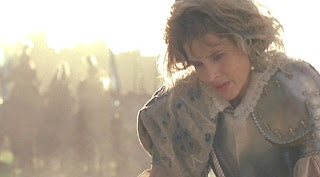
Who is mentioned is her regent, the Queen Mother of Scotland Marie d'Guise, played by the captivating Fanny Ardant. The part was, to me, one of the most interesting of the film and Ardant gives a spectacular performance of an intriguing character. Yet, fond as I am of devious, warrior-queens, there is no truth in any of this. Queen Marie d'Guise was no scheming zealout, never a threat to England (though Protestant England was certainly a threat to her) and it is a total fabrication that she was poisoned by Sir Francis Walsingham after a night of passion. Marie d'Guise died of natural causes while trying to reconcile the feuding Scots. At the time of her death, she bore no resemblance to the character on film. Instead of Fanny Ardant's attractive, mature woman look, imagine an older, heavier woman with swollen extremities and a case of dropsy. I'm a fan of Marie d'Guise, but as much as I would rather picture her as seen in the movie, it is simply not accurate. Not at all.
However, the film as a whole, as good as the look of it was, that look was totally inaccurate. Most of the sets look like they should be in a movie about the Middle Ages rather than Renaissance, Tudor England. The palaces all seem dark, dank, dreary (insert dungeon-like metaphor here). That may do for scenes in the Tower of London, but the court of Queen Elizabeth lived in much more splendid and cheerful mansions and palaces. The dingy, Gothic sets have about as much to do with Elizabethan England as the assassination attempt on the river barge (yet another fabrication).
Believe it or not, I could go on, but I think you get the picture. Still, I cannot overstate how much talent was shown in this movie, and how entertaining it was. Yet, as excellent as it was in the art of cinema it was absolutely horrific in the history department and paints a distorted view of the Tudor era and Queen Elizabeth. It opened with a lie and, fittingly enough, ended with one as well: although it is a powerful scene, Elizabeth did not start wearing white makeup and portraying herself as the statue-like "Virgin Queen" until well into the latter part of her reign. Oh, the humanity...
The story is certainly an attractive one. It follows the young Elizabeth, starting in the final days of the reign of her sister Queen Mary I (who, as usual, is ugly and villainous less modern Brits fail to recognize her), following her through her own reign as she faces constant harassment from Scotland, France, Spain and even the dastardly Pope while dealing with a stressful romance with the Earl of Leicester. The problem is certainly not in the acting, which is superb. The cast contains some of the best in the business, masters of their craft and even a living legend or two. The characters are interesting, deep and well done in every way aside from the occasional cartoonish villain but these are pretty much restricted to Catholic clergy so everyone else, hero or villain, is in pretty good shape.
Catte Blanchett is Queen Elizabeth I, the young innocent who must overcome and find her inner strength; Geoffrey Rush is Sir Francis Walsingham, the unscrupulous, loyal, bisexual spymaster and secret police chief; Christopher Eccleston is the imperious, duplicitous and finally traitorous Duke of Norfolk; Joseph Fiennes is the tempestuous, lusty and frustrated Earl of Leicester, Sir John Gielgud appears as the murderous Pope (Pius V, I presume) and Lord Richard Attenborough is the faithful, fatherly and stressed Sir William Cecil. So, again, it is a superb cast and they have a truly epic period of history to work with, tailor-made for great filmmaking. As a film, it is lavish, dramatic, gripping, visually stunning and immensely entertaining. As anything even pretending to be history it is absolutely insulting to the name.
I knew I was in trouble as soon as I saw the opening scene: the wicked Catholic Bishop Gardiner having some saintly Protestants burned alive for heresy on order from "Bloody Mary", who is herself depicted as a vile, raving tyrant. In fact, the records show Mary I was the least of all her dynasty in having people executed. Moreover, Bishop Gardiner had no one in his own diocese executed, had opposed the Queen marrying Philip II of Spain and was generally considered a moderate. However, the historical lies in this movie are far too many to record every one. The Earl of Leicester is shown frolicking with Elizabeth at the start when he should have still been in the Tower for treason. The Duke of Norfolk is shown as one of Elizabeth's earliest enemies in a Catholic conspiracy, which he was not. His anti-Elizabeth actions came much later in the plot surrounding Queen Mary Stuart, and he was always vague about his religion but never declared himself to be anything other than an Anglican. In fact, he is shown urging Queen Mary to have her sister killed to keep her off the throne when, in truth, Mary was not thrilled with the thought of this herself and was persuaded to allow Elizabeth's succession only by her husband, King Philip II of Spain (who, again, is portrayed as a horrible villain so as not to confuse the Brits).
Keep up, there’s more. William Cecil is portrayed as an elderly and ready to retire statesman when in fact he was a robust, young man when Elizabeth came to the throne. Sir Francis Walsingham is depicted as a scheming, murderous homosexual whereas, while certainly scheming, he never killed anyone himself and was a happily married family man and a devout Protestant - certainly not a homosexual. The Duc d'Anjou is shown as a bizarre, cross-dressing pervert whom Elizabeth finds abhorrent, yet another fabrication. In fact, the Duc d'Anjou never came to England and the Queen was quite taken with him and considered him very seriously to be her husband or at least pretended so to annoy the Spanish. There is also at least a possibility that the romance with Lord Robert, Earl of Leicester was never sexual, and Elizabeth may well have been a 'real' "Virgin Queen". I tend to doubt it and in these day and age it seems positively unbelievable but, in fairness, I have to say that a case can be made for the Queen being as good as her title.
Leicester was also certainly not involved with any kind of plot against the Queen, nor was there a great falling out between the two, and contrary to the film, his marriage was a well known fact at court and Elizabeth met with him many, many times before her death. (let me catch my breath) It is also untrue that Leicester ever had affairs with the Queen's ladies-in-waiting, whom she kept a close eye on and no one ever sent the Queen a poisoned dress. The plot at the center of this film also never happened in anything like the way it was portrayed. It seems the filmmakers simply took all of the schemes against Elizabeth, invented some intrigue of their own, and put them all together, stuffed them in a blender and hit “mix”. Much of it seems to be connected to the historical trap set for Queen Mary Stuart, yet, she is never seen or mentioned in the film.
Who is mentioned is her regent, the Queen Mother of Scotland Marie d'Guise, played by the captivating Fanny Ardant. The part was, to me, one of the most interesting of the film and Ardant gives a spectacular performance of an intriguing character. Yet, fond as I am of devious, warrior-queens, there is no truth in any of this. Queen Marie d'Guise was no scheming zealout, never a threat to England (though Protestant England was certainly a threat to her) and it is a total fabrication that she was poisoned by Sir Francis Walsingham after a night of passion. Marie d'Guise died of natural causes while trying to reconcile the feuding Scots. At the time of her death, she bore no resemblance to the character on film. Instead of Fanny Ardant's attractive, mature woman look, imagine an older, heavier woman with swollen extremities and a case of dropsy. I'm a fan of Marie d'Guise, but as much as I would rather picture her as seen in the movie, it is simply not accurate. Not at all.
However, the film as a whole, as good as the look of it was, that look was totally inaccurate. Most of the sets look like they should be in a movie about the Middle Ages rather than Renaissance, Tudor England. The palaces all seem dark, dank, dreary (insert dungeon-like metaphor here). That may do for scenes in the Tower of London, but the court of Queen Elizabeth lived in much more splendid and cheerful mansions and palaces. The dingy, Gothic sets have about as much to do with Elizabethan England as the assassination attempt on the river barge (yet another fabrication).
Believe it or not, I could go on, but I think you get the picture. Still, I cannot overstate how much talent was shown in this movie, and how entertaining it was. Yet, as excellent as it was in the art of cinema it was absolutely horrific in the history department and paints a distorted view of the Tudor era and Queen Elizabeth. It opened with a lie and, fittingly enough, ended with one as well: although it is a powerful scene, Elizabeth did not start wearing white makeup and portraying herself as the statue-like "Virgin Queen" until well into the latter part of her reign. Oh, the humanity...
Tuesday, May 3, 2011
Monarch Profile: Shidebala Khan
Shidebala, Gegeen Khan, Emperor Yingzong of the Great Yuan, was the son and heir of Ayurbarwada Khan and his accession is the sole example of the throne of the Yuan passing peacefully from father to son throughout their reign. Ever since the Mongol conquest of China the throne had passed back and forth between those who favored adopting aspects of the Chinese civilization to solidify and maintain their empire and those who felt that success would only come by holding fast to their Mongol traditions which had brought them to power in the first place. As we have seen, Temur Khan was (slightly) more inclined to Chinese methods, Khaishan Khan ruled in nomadic Mongol style and Ayurbarwada had swung back the other way to heavily favor Chinese administrative policies. The reign of Shidebala was to see this division continue and tensions ran very high between the two factions, each convinced that their way was the only way that the Yuan Empire could be maintained. For Shidebala it would result in tragedy.
Shidebala was born on February 22, 1303 to Ayurbarwada Khan (Emperor Renzong to the Chinese) and his wife Radnashiri of the Khunggirad clan. His early life was dominated by his grandmother the empress-dowager Targi and her favorite minister Temudur, a rather villainous fellow who was appointed tutor to the young prince and his grandmother worked to assure his eventual accession to the Mongol throne. His father, however, had taken care that he be educated in Chinese style as well so as to continue his policies of reliance on Confucian doctrines and traditions, suitably Chinese, to rule China. In 1316 he was declared crown prince and heir to the throne and on April 19, 1320 he succeeded his father Great Khan of the Mongols and Emperor of the Yuan Dynasty. For the empress-dowager it seemed that all had gone according to plan and she could become the effective ruler of China and the vast Mongol dominions.
Convinced that they could dominate the young emperor, Empress Targi and in particular Temudur, were quick to enact their own policies and Temudur began exacting revenge against his own political enemies. Also targeted by him were the pro-Chinese supporters of the more Sino-oriented policy set down by Ayurbarwada. However, Shidebala was not the helpless babe many took him for. He was Chinese educated and tended to favor Confucian policies of administration (the Chinese did have a pretty long and successful record when it came to administering a large empire) but he was, like all of the Yuan emperors, still a Mongol. He was not weak, not pliant and would not allow others to flout his authority or work against the vision that he had for the Mongol Empire. Confucian scholars came to him for protection, which he extended, and he stood up against the persecution Temudur was bringing down on them.
Shidebala Khan showed great promise. He had strength of character, was very well educated (he could recite Tang dynasty poems from memory and was an accomplished calligrapher) and a devout Buddhist. When he stood up against Temudur and showed that he was his own man and would not be dominated by others, his exasperated grandmother, the Empress dowager Targi, lamented that, “We should never have reared this boy!” He replaced Temudur with a new chief minister named Baiju and though Temudur later tried to return to court and humble himself, the Great Khan would not have him back and he died embittered around 1322, in roughly the same period as his patron the dowager empress.
As emperor, Shidebala began enacting many reforms to try to bring under control the political and economic chaos that had been growing for a very long time, much of it due to the lack of a consistent policy on the part of the dynasty. He showed favor to the Confucian scholars and to the Buddhist lamas but took a rather dim view of Islam and there was some persecution of Muslims. This antagonism, however, should not be too surprising considering that there are probably no two religions that stand in starker contrast than Buddhism and Islam. The renewed emphasis on Confucianism also led to a somewhat more restrictive role for women than was traditionally the case in Mongol society.
However, what was most important was the efforts by Shidebala to bring about economic reform and stamp out corruption. Patronage had run rampant in the empire and efforts to stop this in particular had the effect of making Shidebala very unpopular with many Mongol princes. His dismissal of Temudur and his appointment of Chinese officials also caused bitter feelings among many who felt the new Khan was taking their empire in a non-Mongolian direction. Five princes colluded with the supporters of the late Temudur to launch the “Nanpo Coup” on September 4, 1323. The Emperor and Baiju had stopped at Nanpo on their way from Xanadu to Peking and it was there that the conspirators struck and assassinated them both. The next Khan would take a much more Mongol purist style as ruler though even he (Yesun Temur) was outraged by the murder.
Shidebala had shown great promise and one cannot help but speculate about what would have happened had he lived out his reign. Might the Yuan Empire have been put or a more solid setting that might have allowed it to endure longer? In any event, as it happened, the “tradition” continued as the pendulum swung back in the opposite direction. As a result of this, Shidebala has the unique position of being one of the few non-Chinese rulers of China that Chinese history tends to speak favorably of. Considering how they were treated by him and his father compared to their predecessor and successor it is no wonder that Shidebala Khan, or Emperor Yingzong as they would have called him, in one of the most highly regarded of the Mongol emperors by the Chinese even today.
Shidebala was born on February 22, 1303 to Ayurbarwada Khan (Emperor Renzong to the Chinese) and his wife Radnashiri of the Khunggirad clan. His early life was dominated by his grandmother the empress-dowager Targi and her favorite minister Temudur, a rather villainous fellow who was appointed tutor to the young prince and his grandmother worked to assure his eventual accession to the Mongol throne. His father, however, had taken care that he be educated in Chinese style as well so as to continue his policies of reliance on Confucian doctrines and traditions, suitably Chinese, to rule China. In 1316 he was declared crown prince and heir to the throne and on April 19, 1320 he succeeded his father Great Khan of the Mongols and Emperor of the Yuan Dynasty. For the empress-dowager it seemed that all had gone according to plan and she could become the effective ruler of China and the vast Mongol dominions.
Convinced that they could dominate the young emperor, Empress Targi and in particular Temudur, were quick to enact their own policies and Temudur began exacting revenge against his own political enemies. Also targeted by him were the pro-Chinese supporters of the more Sino-oriented policy set down by Ayurbarwada. However, Shidebala was not the helpless babe many took him for. He was Chinese educated and tended to favor Confucian policies of administration (the Chinese did have a pretty long and successful record when it came to administering a large empire) but he was, like all of the Yuan emperors, still a Mongol. He was not weak, not pliant and would not allow others to flout his authority or work against the vision that he had for the Mongol Empire. Confucian scholars came to him for protection, which he extended, and he stood up against the persecution Temudur was bringing down on them.
Shidebala Khan showed great promise. He had strength of character, was very well educated (he could recite Tang dynasty poems from memory and was an accomplished calligrapher) and a devout Buddhist. When he stood up against Temudur and showed that he was his own man and would not be dominated by others, his exasperated grandmother, the Empress dowager Targi, lamented that, “We should never have reared this boy!” He replaced Temudur with a new chief minister named Baiju and though Temudur later tried to return to court and humble himself, the Great Khan would not have him back and he died embittered around 1322, in roughly the same period as his patron the dowager empress.
As emperor, Shidebala began enacting many reforms to try to bring under control the political and economic chaos that had been growing for a very long time, much of it due to the lack of a consistent policy on the part of the dynasty. He showed favor to the Confucian scholars and to the Buddhist lamas but took a rather dim view of Islam and there was some persecution of Muslims. This antagonism, however, should not be too surprising considering that there are probably no two religions that stand in starker contrast than Buddhism and Islam. The renewed emphasis on Confucianism also led to a somewhat more restrictive role for women than was traditionally the case in Mongol society.
However, what was most important was the efforts by Shidebala to bring about economic reform and stamp out corruption. Patronage had run rampant in the empire and efforts to stop this in particular had the effect of making Shidebala very unpopular with many Mongol princes. His dismissal of Temudur and his appointment of Chinese officials also caused bitter feelings among many who felt the new Khan was taking their empire in a non-Mongolian direction. Five princes colluded with the supporters of the late Temudur to launch the “Nanpo Coup” on September 4, 1323. The Emperor and Baiju had stopped at Nanpo on their way from Xanadu to Peking and it was there that the conspirators struck and assassinated them both. The next Khan would take a much more Mongol purist style as ruler though even he (Yesun Temur) was outraged by the murder.
Shidebala had shown great promise and one cannot help but speculate about what would have happened had he lived out his reign. Might the Yuan Empire have been put or a more solid setting that might have allowed it to endure longer? In any event, as it happened, the “tradition” continued as the pendulum swung back in the opposite direction. As a result of this, Shidebala has the unique position of being one of the few non-Chinese rulers of China that Chinese history tends to speak favorably of. Considering how they were treated by him and his father compared to their predecessor and successor it is no wonder that Shidebala Khan, or Emperor Yingzong as they would have called him, in one of the most highly regarded of the Mongol emperors by the Chinese even today.
Monday, May 2, 2011
Consort Profile: Empress Mathilde, Lady of the English
Most people remember Mary Tudor as the first Queen regnant of England, and officially this is so. However, long before there was a Tudor dynasty there was another woman who tried to be or who should have been the reigning Queen of England. Her story begins with that of her father King Henry I of the Norman line. Henry was not an oppressive king but he was certainly less than successful at the royal duty of securing the succession. He had eight or more mistresses by whom he fathered around twenty five illegitimate children but of legitimate offspring who could succeed him he only managed to produce one boy and one girl: Prince William and Princess Matilda. This left little room for tragedy and in 1120 tragedy occurred when Prince William drowned in the Channel. This left King Henry with only his daughter Matilda to succeed him.
Matilda, who had been married to the Holy Roman Emperor Henry V of Germany, was made heiress and the King ordered the powerful barons of England to swear before God their allegiance to her as his successor on four different occasions hoping to ensure a peaceful succession. However, the nobility of England did not take an oath before God, even four of them, as seriously as Henry hoped and once he died, in 1135, there was to be trouble indeed. The barons were also rather hypocritical. They claimed that a woman was not capable of ruling a country but the fact of the matter was that Matilda was only too capable of ruling her country and the barons as well and they knew she would have been more than a match for them.
Empress Matilda (or Maud as she was often called in England) was now Queen though she only ever styled herself Lady of the English. She was a strong woman, bright, well educated, very independent and perfectly familiar with the politics of her day. She had in fact ruled as regent in Germany during the absence of her husband the Emperor. The nobles knew that, like her father, she could never be dominated by them and so they decided to back as king someone they thought they could dominate: her cousin Stephen de Blois. Stephen, though, was no fool and he was not about to pass up the chance to be King of England. Going along with the crowd that disregarded the wishes of the late king and the oaths of allegiance, he set out for England at once and began securing the loyalty of the nobles, government officials and churchmen he needed to seize the throne. After only three weeks he had enough support, aided a great deal by his seizure of the Treasury, to crown himself King of England on December 22, 1135.
Matilda suffered the disadvantage of being in France as the battle for control of England was already breaking out but she spent her time wisely, gathering her military forces and the support of those barons in England who were loyal to the wishes of her father and accepted her as the legitimate Queen of England. In 1139 she left Normandy with her army to land in England and confront her cousin who had usurped her throne. When it came to blows both sides were about evenly matched. One castle would fall to one side and another castle to the other. Eventually a bloody stalemate ensued with neither side able to gain a clear advantage.
This situation was intolerable for both Stephen and Matilda as neither of them had the resources to prevail in what had become a war of attrition. The Church was deluged by refugees and some unscrupulous barons took advantage of the lack of a single government to pillage the countryside for their own benefit. Famine spread and disease, hunger and raids took a horrible toll on the public. Things began turn in the direction of the Lady of the English though in 1141. Her forces defeated Stephen in April and took the would be king prisoner. For a short time she was in control of the country and held power unopposed, but it was not to last given how much the state of the country had already deteriorated. The situation became so bad that when Matilda decided to have her own coronation in June the funds could scarcely be found. Stephen escaped from his captivity and a rebellious mob stormed her pre-coronation banquet at Westminster, forcing Matilda to flee London. By the end of the following year it was Matilda who was stuck; besieged at OxfordCastle by the forces of King Stephen. She had to escape with four of her knights draped in white robes to blend in with the surrounding snow. Such a harrowing event was not uncommon for the Empress as she had earlier escaped the clutches of her enemy disguised as a corpse!
Everything seemed to be going wrong for the Queen Empress and in 1148 she was finally forced to leave England and return to Normandy. The fight had begun to seem completely hopeless and she was devastated by the loss of Robert of Gloucester, her half brother and most ardent supporter. It seemed that Stephen had won, which he had, but Matilda would continue to be a force in English politics for some time to come. When Henry Plantagenet, the son of Matilda and her second husband Geoffrey V of Anjou, grew up he became quite a thorn in the side to King Stephen. Tragedy then struck the King of England when his wife died in 1152 and his son and heir died a year later. The grief stricken Stephen made a deal with Matilda that her son would succeed him on the English throne. Less than a year later Stephen died and the young Plantagenet became King Henry II of England, destined to rule over the greatest extent of English power in Western Europe. And, through it all, Matilda was there acting as Queen Mother and trying to keep the peace between her sons and later Henry II and St Thomas a Becket. She died in 1167, never recognized as Queen of England, but the first woman nonetheless to hold power over the country and prove that, popular or not, she had what it takes to rule a country.
Matilda, who had been married to the Holy Roman Emperor Henry V of Germany, was made heiress and the King ordered the powerful barons of England to swear before God their allegiance to her as his successor on four different occasions hoping to ensure a peaceful succession. However, the nobility of England did not take an oath before God, even four of them, as seriously as Henry hoped and once he died, in 1135, there was to be trouble indeed. The barons were also rather hypocritical. They claimed that a woman was not capable of ruling a country but the fact of the matter was that Matilda was only too capable of ruling her country and the barons as well and they knew she would have been more than a match for them.
Empress Matilda (or Maud as she was often called in England) was now Queen though she only ever styled herself Lady of the English. She was a strong woman, bright, well educated, very independent and perfectly familiar with the politics of her day. She had in fact ruled as regent in Germany during the absence of her husband the Emperor. The nobles knew that, like her father, she could never be dominated by them and so they decided to back as king someone they thought they could dominate: her cousin Stephen de Blois. Stephen, though, was no fool and he was not about to pass up the chance to be King of England. Going along with the crowd that disregarded the wishes of the late king and the oaths of allegiance, he set out for England at once and began securing the loyalty of the nobles, government officials and churchmen he needed to seize the throne. After only three weeks he had enough support, aided a great deal by his seizure of the Treasury, to crown himself King of England on December 22, 1135.
Matilda suffered the disadvantage of being in France as the battle for control of England was already breaking out but she spent her time wisely, gathering her military forces and the support of those barons in England who were loyal to the wishes of her father and accepted her as the legitimate Queen of England. In 1139 she left Normandy with her army to land in England and confront her cousin who had usurped her throne. When it came to blows both sides were about evenly matched. One castle would fall to one side and another castle to the other. Eventually a bloody stalemate ensued with neither side able to gain a clear advantage.
This situation was intolerable for both Stephen and Matilda as neither of them had the resources to prevail in what had become a war of attrition. The Church was deluged by refugees and some unscrupulous barons took advantage of the lack of a single government to pillage the countryside for their own benefit. Famine spread and disease, hunger and raids took a horrible toll on the public. Things began turn in the direction of the Lady of the English though in 1141. Her forces defeated Stephen in April and took the would be king prisoner. For a short time she was in control of the country and held power unopposed, but it was not to last given how much the state of the country had already deteriorated. The situation became so bad that when Matilda decided to have her own coronation in June the funds could scarcely be found. Stephen escaped from his captivity and a rebellious mob stormed her pre-coronation banquet at Westminster, forcing Matilda to flee London. By the end of the following year it was Matilda who was stuck; besieged at OxfordCastle by the forces of King Stephen. She had to escape with four of her knights draped in white robes to blend in with the surrounding snow. Such a harrowing event was not uncommon for the Empress as she had earlier escaped the clutches of her enemy disguised as a corpse!
Everything seemed to be going wrong for the Queen Empress and in 1148 she was finally forced to leave England and return to Normandy. The fight had begun to seem completely hopeless and she was devastated by the loss of Robert of Gloucester, her half brother and most ardent supporter. It seemed that Stephen had won, which he had, but Matilda would continue to be a force in English politics for some time to come. When Henry Plantagenet, the son of Matilda and her second husband Geoffrey V of Anjou, grew up he became quite a thorn in the side to King Stephen. Tragedy then struck the King of England when his wife died in 1152 and his son and heir died a year later. The grief stricken Stephen made a deal with Matilda that her son would succeed him on the English throne. Less than a year later Stephen died and the young Plantagenet became King Henry II of England, destined to rule over the greatest extent of English power in Western Europe. And, through it all, Matilda was there acting as Queen Mother and trying to keep the peace between her sons and later Henry II and St Thomas a Becket. She died in 1167, never recognized as Queen of England, but the first woman nonetheless to hold power over the country and prove that, popular or not, she had what it takes to rule a country.
Sunday, May 1, 2011
We Are Revenged!
I’m sure everyone has heard the news by now. The arch-terrorist and most wanted criminal on earth, Osama bin Laden, is finally and certainly dead. On orders from President Obama U.S. Navy SEALS (I would like to think my cousin among them but who knows) stormed his compound in Pakistan and put a bullet in his head about a week ago. His remains were brought back to the U.S. where DNA testing confirmed beyond doubt that it was Osama himself. As everyone probably knows, I am not a fan of much of U.S. foreign policy nor am I a fan of the current administration, however, this was absolutely good news. The impact of it will be debated for some time but the psychological satisfaction is immense. This man had the blood of thousands of innocents on his hands, innocents from all over the world, from the United States of America to the United Kingdom to the Kingdom of Spain, to the Republic of India, the Republic of Indonesia and in Afghanistan and Pakistan as well as many other places around the world. The current situation around the world is very complex (I think by design) but at the end of the day a very, very bad man has been removed from mankind and sent to face divine judgment. As he descends to the depths of Hell I do hope he has to pass through a gauntlet of all the souls he butchered on 9-11, in London, in Madrid and all the other places around the world. Congratulations to all the heroes of the armed forces who played a part in his downfall and good riddance to this villain who now, thankfully, no longer curses this earth with his foul presence.
Blog News
As regular readers may know, I am running behind due to the recent 3-part series, the royal wedding in Britain and my own absent-mindedness. Planned posts for last week will be posted this week in their turn. They will deal with royal figures from England, Mongolia, Spanish South America, Austria and a well known film from the 90's. Since things do pop up (news, anniversaries or the urge to rant) I will be a bit more guarded about promises as to exactly when things will be posted. However, on my list for the not-too-distant future will be the last King of Italy (I've been trying to cover more Italian topics in this year of the anniversary of the Kingdom of Italy), a swashbuckling Spanish-Austrian adventurer, a "great" Roman Pontiff, the controversial Queen Christina of Sweden and a more detailed look at the 'mascot' of The Mad Monarchist blog, the notorious Baron Ungern von Sternberg. There will be other items as well, still have some thinking to do on other topics but I hope everyone will find something to interest them. My thanks to you all for reading, stay strong, keep up the fight and keep spreading the 'madness'!
Subscribe to:
Posts (Atom)


