Showing posts with label France. Show all posts

Friday, March 16, 2018

France, Jews and the Monarchy

In the recent history of monarchism in France, one of the major problems was the persistent accusation of anti-Semitism. Once upon a time, such an accusation did not mean much as no one expected anyone in France to be pro-Semitic, only pro-French and so the accusation of being anti-Semitic would have been met with as much of a yawn as that of being anti-Anglo or anti-Teutonic. However, as anti-Semitism came to be seen as uniquely despicable, the accusation became much more problematic and it has been consistently applied against the Catholic right in France, most of which was, increasingly so the farther back one looks, royalist. The current narrative tends to stem from the infamous “Dreyfus Affair” in which a Jewish artillery officer was convicted of treason and sent to Devil’s Island in French Guiana for passing military secrets to Imperial Germany. Subsequent evidence came forward that another man had been the spy but, in a retrial, Dreyfus was again found guilty but given a pardon and released. In 1906 Dreyfus was exonerated and reinstated as a major in the French army.

Charles Maurras
This case was the center of the great political divide in France with the left-wing, secularist republicans supporting Dreyfus and claiming that he had been the victim of anti-Semitic bigotry by the right-wing, Catholic and royalist officer corps of the French military. So, the leftist republicans claimed that Dreyfus was innocent, the rightist royalists claimed he was guilty and the eventual exoneration of Dreyfus is widely pointed to as the decisive factor in bringing the radical left to power in France. The division remained and one of the most effective rhetorical weapons used against the growing power of Action française, the royalist movement led by Charles Maurras, was the charge of anti-Semitism. Maurras himself had been prominent during the Dreyfus affair, referring to the French government as the “Jewish republic”. It was an accusation that fell equally on both of the feuding royalist factions in France (Maurras being a supporter of the Duke of Orleans) and, particularly in light of subsequent events in World War II, helped to marginalize the royalist movement.

Maurras had plenty of criticism for the Jews, no doubt about it, however, while this is sufficient for the mainstream to condemn him today, any thoughtful person can easily see that there is more to the story. He had just as much negative things to say about French Protestants, the Germans or Freemasons, yet no one seems to mind any of that so much. He also condemned the racist policies of Adolf Hitler which serves to illustrate where his opposition to the Jews came from. The goal of Maurras was a restored Catholic Kingdom of France, though he himself appreciated the Church more than he believed in it, and the Jews, like the Protestants or any non-French people, were not what he wanted for his Kingdom of France as they would always be a source of division and internal discord. In 1926 the Catholic Church condemned Action française and its periodical even gained the distinction of being the first newspaper placed on the Index of Forbidden Works. Later, Pope Pius XII lifted the condemnation but this did little good as it allowed the members to claim that the previous prohibition had been politically motivated, simply opposition to a nationalist movement, while also allowing critics of Pius XII another bit of propaganda to portray him as being soft on anti-Semites (the ridiculous “Hitler’s Pope” canard).

French Action
The efforts of Maurras were really the last time, to date, that a French royalist movement was a major force in politics and had the potential to achieve victory and bring about a restoration of the monarchy. It is a terrible thing that they were undercut and were not successful, however, the anti-Semitic label is still used against them to this day and while, again, it was not so significant in the past, today it is front and center in vilifying and marginalizing this French royalist movement. To the extent to which it is talked about at all today, the main points hammered home are Maurras and the French royalists are anti-Semitic, they are untouchable, move along. That being so, it is worth taking a deeper look into the history behind all of this, because the position of Maurras and the French royalists of the early Twentieth Century was not out of step with the cause their ancestors had upheld and fought for over the many centuries previous. The Kingdom of France was and had always been an officially and explicitly Catholic monarchy and thus, inherently, the Jews were never going to be seen, indeed could not be seen, as no different from everyone else.

Some number of Jews had been present in France since the time of the Roman Empire. When the Roman Empire became Christian, Emperor Valentinian III put restrictions on them from holding any positions of influence but, it is often omitted, these restrictions applied to pagans as well. It was not a specifically anti-Jewish ordinance but rather part of a recognition that Rome was a Christian empire and non-Christians would not be allowed to rule over Christian people within it. This was the earliest example of the sort of problem that the Kingdom of France would have in dealing with the Jews. The barbarian tribes who conquered the Western Roman Empire took little notice of them but later they gained a sort of a special status under Charlemagne, elevated to the rank of emperor by the Pope in 800. They had some restrictions placed on them in so far as their interaction with Christians went, but Charlemagne protected them and they became quite prosperous as merchants and traders with the near east. Charlemagne, as well as his son Emperor Louis the Pious, believed that, in time, they would convert to Christianity though we know from the accounts of bishops at the time that there were concerns about their presence being at odds with the nature of a Catholic empire.

The baptism of Clovis
Undoubtedly some will be wondering why the mere presence of Jews should be a cause of concern or disunity in the Kingdom of France (since 987 under the House of Capet) but this is to fail to grasp the entire concept of what France was. It was a specifically Catholic kingdom and to be French was to be Catholic and to be Catholic was to be in communion with the body of Christ, the Church, and all other Catholics everywhere. This was the foundation of the kingdom and the highest purpose of the Catholic monarchs was to safeguard the souls of their subjects by ensuring that they were all good Catholics. Obviously, with such a foundation, it is going to be a problem to have a majority of the population which is French and who believe Jesus Christ is God, alongside a minority of people who are not French and who believe Jesus Christ was a criminal deserving of death. That is a pretty stark contrast, not a lot of room for compromise between those two viewpoints. It would inevitably cause tension and problems when a French peasant would be subject to severe punishments for denying the divinity of Christ, whereas Jews were primarily differentiated solely for this same denial.

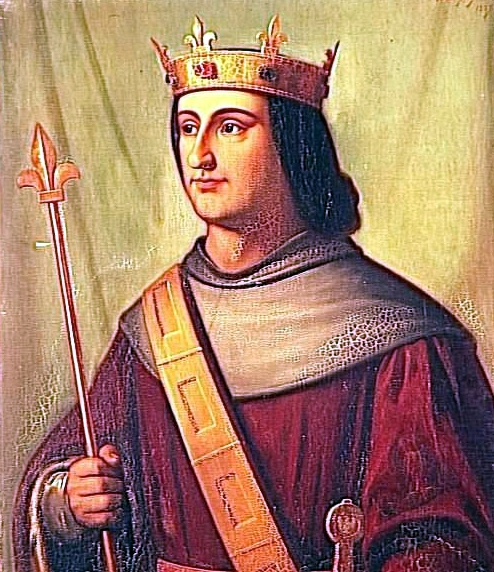
King Robert II of France tried to solve this problem by trying to basically intimidate the Jews into conversion. He was also just as hard on heretical Christians if it matters as his goal was to have his kingdom united in one faith. The situation became worse over a correspondence between the Jews in the west with the Jews in the east concerning an upcoming Islamic offensive which resulted in the destruction of the Church of the Holy Sepulcher. This produced such a backlash against the Jewish population that Pope Alexander II wrote to the local Church authorities condemning any acts of violence and any efforts to convert the Jews by force. These were, however, localized events and Jews in the unaffected parts of France continued to thrive and prosper. An upsurge did come about with the launching of the Crusades and it is not difficult to understand some of the reasons why. It made little sense to a considerable number of people to be fighting so hard against a religion that considered Christ a prophet while tolerating at home another religion which considered Christ a criminal. In 1182 King Philip Augustus of France ordered the expulsion of all Jews from royal lands, allowing a grace period for them to sell the goods they could not take with them and make arrangements to move, though this did not remove them from the whole of France, simply from lands belonging to the Crown. However, in 1198, the same king allowed them to return.

King St Louis IX
This would not be the last time this sort of thing would happen. Another growing concern was financial, a topic which invariably comes up in dealing with this subject. Jewish law prohibited Jews from charging interest on loans to other Jews whereas it was permissible to charge interest, even exorbitant interest, on loans to non-Jews (like French Catholics for example). At the same time, the Catholic Church tended to frown on money lending in general which all created the perfect conditions for Jews to loan money to Christians at very high interest rates and, let us be honest, even under the best of circumstances, no one who lends money is ever popular when the loan comes due. This not only caused tension between the two communities, it also highlighted the ‘different laws for different people’ nature of the situation as well as upsetting the stability of the French economy with so many in debt to so few. King St Louis IX of France determined to do something about this situation and, as a man devoted to having a truly Catholic kingdom, was compelled to address the Jews in France on a number of fronts.

First of all, on the economic front, he tried to persuade the nobility of France to stop allowing Jews to loan money in their lands and he forbid the nobility and the Crown of France itself from borrowing money from Jews. Given the system of government that existed at the time, in which every lord was practically an autonomous ruler of his own lands, this was about all the king could do as, despite what many people think about the Middle Ages, the king could not tell a noble lord what he could or could not do on his own lands arbitrarily. He forgave the debts of about 1/3 of Christians who owed to Jews and decreed that no Christian could be imprisoned for failing to pay back a loan from a Jew. Finally, he ordered all Jews engaged in usury to be expelled from France though, it seems, this order was not entirely carried out, probably due, again, to the decentralized nature of countries at that time. Most controversially today, he also ordered the mass burning of all copies of the Talmud and Jewish holy books in Paris in 1243.

Burning offensive books
This, of course, is a very prickly subject today because of “optics”. Because everything touching on this issue has been tainted by World War II, whenever people hear about Jews and Jewish books being burned they immediately start thinking of men in brown shirts with strains of the Horst Wessel Lied drifting through the air. So be it, that cannot be helped. The fact of the matter is that works such as the Talmud were contradictory, on their face, to the Christian foundations of the Kingdom of France. When your entire society is based on Christianity, on a sacred line of Christian monarchs ruling over a country known as the “Eldest Daughter” of the Catholic Church, there will be no getting around the problem of having a religious minority whose holy book describes Jesus Christ being boiled in excrement in Hell. There really is not a great deal of room for compromise or ‘agreeing to disagree’ on something like that. King St Louis IX considered having all the Jews arrested but ultimately decided against it, instead following the instructions of the Fourth Lateran Council of 1215 to have Jews wear badges on the front and back of their clothing to clearly mark them as a people apart. This also, today, has negative connotations but it was simply illustrating a fact which the Jews themselves clung to. They saw themselves as a people apart, not the same as everyone else and were adamant about remaining so.

King St Louis IX was also a supporter of the efforts by the Church to maintain Catholic orthodoxy throughout Christendom. France was, in fact, to become “ground zero” for what would be formalized as the Holy Office of the Inquisition after the outbreak of the Albigensian heresy in the south of France and the formation of the Dominican Order to combat it. Jews were often brought before the French Inquisition though, as the Inquisition only had authority over Catholics, it was only in cases of Jews who had converted and were either insincere (false converts) or who apostatized and returned to Judaism. This comes to the nub of the issue which is one of identity. The Jews could have, at any time, converted to Catholicism and would have been treated the same as every other Catholic in France, however, if they refused to do so, choosing to remain separate, they had little room to complain about being treated differently. The problem that the Inquisition had to deal with (as it later would more famously in Spain) was that many Jews converted, not because they believed in the teachings of the Catholic Church, but in order to improve their standard of living. Today the Church might applaud them for that but, at the time, the faith was taken more seriously and basically lying about the most important question of all was seen as a heinous crime and so a false convert or someone who converted and relapsed into Judaism was treated no differently than any other heretic. If the case was proven, they would be given the chance to repent and be forgiven but, if they persisted, they would be turned over to the secular authorities for execution.

King Philip the Fair
The actions taken by King St Louis IX were those of a monarch the Church upheld as a model Christian sovereign and an example for all others to follow. He was easily one of the greatest western monarchs of all time. However, not every monarch was a saint and while the problems caused by Jews for monarchs like St Louis cannot be denied, neither can it be denied that there were monarchs who caused problems for the Jews, not out of any desire for protecting the Christian foundations of his state but simply to enrich himself. This was the case with King Philip IV, better known as King Philip the Fair. He found himself destitute of funds and saw how well the Jews were doing and decided he could get rich quick by expelling them and seizing all their assets, which he did in 1306. However, he quickly found out that much of this “wealth” was loaned out and when his own agents tried to collect on these loans, his royal agents became just as unpopular as the Jews had been and an uproar ensued. His true motives are further revealed by the fact that, after the expulsion of the Jews failed to solve his money problems, he went after the Knights Templar in the same way, accusing them of all sorts of fantastic misdeeds as a justification for suppressing them and seizing their wealth. King Philip the Fair (meaning “handsome”) might more appropriately be known as Philip the unfair.

In 1315 King Louis X allowed the Jews to return to France with certain restrictions in place. In their absence, there had been essentially no money lending at all and so the King finally decided to have them back again but with the restriction that the interest they charged could not be excessive, that they had to wear the identification badges, could not discuss religion with French people and so on. He also stated that they were under his special protection and could not be attacked or have their property taken from them. However, the restrictions put in place were fairly quickly flouted and all of the old problems soon resurfaced. There was the people being shackled in debt, bribery, influence peddling and the civil disturbances that erupted, inevitably, from having society divided in this way. Once again, it was determined that something had to be done and so King Charles VI (perhaps best known for coming to believe he was made of glass) investigated the situation and found the Jews to be guilty of numerous and widespread outrages against their Christian neighbors and so, in 1394, ordered them expelled from France. The Jews were removed from the country and all debts owed to them forgiven.

King Louis XIV
In the following centuries, some did begin to come back to France, keeping as a low a profile as possible, however, by this point, the monarchy was well fed up with the subject and to associate with or give shelter to Jews was made a capital crime. King Louis XIV did tolerate their presence in the newly acquired provinces of Alsace-Lorraine but not elsewhere, just as he famously revoked the Edict of Nantes which had granted toleration to Protestants. The “Sun King” was very firm, despite being fairly consistently opposed by the popes throughout his reign, that France was a Catholic kingdom for French Catholics, end of story. Some still came in, some always managed to remain and as the era of the “Enlightenment” came to France, the Jews began to emerge in greater numbers and to be more vocal, usually in opposition to the existing state of affairs. King Louis XVI took a more tolerant attitude toward them than his predecessors had done, yet this was not enough to prevent the Jews from being ardent supporters of the emerging French Revolution.

In 1789 the first call for Jewish emancipation came up, with the full-throated support of the arch-criminal Robespierre, but the issue was postponed. In 1790 some Jews were emancipated and in 1791, to great applause by the revolutionary assembly, Jews were granted full citizenship as with “Muslims and men of all sects”, setting the stage for the free for all France has become now. Many were persecuted during the Reign of Terror but such was the case with many others as the Revolution began to devour its own. On the whole, they remained staunchly supportive of the Revolution and the military efforts to spread the Revolution abroad, raising large sums of money to support the war effort. Later, under Napoleon, Judaism was given recognition by the state along with Catholics and Protestants, though their clerics did not receive government support. As had been the case in England, when King Louis XVIII was restored to the throne, things had come to such a point that these changes were not undone. It was a touchy subject given that, as the Jews had been so supportive of the Revolution, they had naturally attracted the ire of the royalist counter-revolutionaries.

Revolutionary "Brotherhood"
This, then, should explain why Jews fall where they do in the context of French politics. The division carried on through episodes such as the Dreyfus Affair and the controversy surrounding the royalists of Charles Maurras. Under the best of circumstances, the Jews never fit in with the concept of a Catholic Kingdom of France and under the worst of circumstances were injurious to it. At the moment of greatest crisis, the most significant turning point in French history, the Revolution, they firmly cast their lot with the republicans and thus could not but incur the opposition of the French royalists. Today there has been some evidence that at least some have come to regret this history but, so far as I can tell, it has resulted in no dramatic political shift on the part of the Jewish community. As such, it should be no surprise, nor any great outrage, that many French royalists still oppose them. In fact, the only thing that is surprising is those who advocate for the restoration of a Catholic Kingdom of France should have no qualms about voicing their opposition to Protestants or Muslims but who often remain silent on the subject of the Jews who would, presumably, be regarded as just as unacceptable. I leave it to the readers to ponder why that may be.

Wednesday, March 14, 2018

The Buonaparte Famiglia

Even among monarchists, as well as polite society as a whole, there are two figures for whom I have more positive things to say than is generally considered acceptable; Benito Mussolini and Napoleon Bonaparte. Today, obviously, the topic of discussion is Napoleon. Given that he was the great bogey man of post-revolutionary Europe, I must make some disclaimers at the outset before any readers have to reach for the smelling salts. I fully agree that Napoleon was a usurper, if not technically so in the first instance of his seizure of power, certainly so after his escape from the island of Elba. I fully agree that he upset the peace of Europe and caused many and far-reaching problems for the “Old Order” that existed in the western world. I would say it is at least debatable whether he or the French Revolution itself was responsible for destroying the last vestiges of Christendom but he certainly swept up the pieces and tried to put it all back together according to his own designs and taking little to no consideration for legitimacy and hereditary, vested rights. I hope we are all clear on all of that.

All of those facts not being in dispute, I think it can also be regarded as beyond dispute that he was an extremely talented man. Certainly, in terms of his role as a military commander, he was a genius on such a level as has rarely been seen in the history of the world. One could argue over his talents as a statesman but he was certainly not inept in that regard. He did, I maintain, also do some good things, if not for Europe, at least for France. It was Napoleon who ended the horror that was the French Revolution, he did restore law, order and a functioning society to the country and it was Napoleon who finally restored Church-state relations in France with his concordat of 1801 with Pope Pius VII. It did not put everything back to the way it had been before the Revolution, but it did bring normalcy to Church-state relations, did away with the worst excesses of the revolutionaries and restored the Church to an official, recognized status in France. These were, to my mind, all very good things.

Napoleon, the former revolutionary, also became, with power, increasingly conservative and the new order he envisioned for Europe was not that of the First French Republic. Whereas the revolutionary armies had marched into neighboring lands erecting republics and planting those absurd “liberty” trees, Napoleon turned these into client-monarchies with monarchs chosen from among his top generals or, more often, the ranks of his own family. The sort of European system Napoleon endeavored to create, while not ideal, is not, at least to my mind, devoid of some promise. The ideal, for most traditional monarchists, would probably be the Europe of Christendom. Unfortunately, that high-minded ideal had never really been capable of producing the unity and concerted action that it might have done. This only seemed to come close to fruition during the Crusades and, even then, was certainly not devoid of division and trouble. The European order that Napoleon planned can be seen in how he tried to make the unity of Europe a largely family affair.

Napoleon was the second son of Carlo Maria di Buonaparte and Maria Letizia Ramolino of Corsica. The family had its roots in the nobility of Tuscany and carried on the traditional importance attached to the family common in that part of the world. Napoleon’s siblings were; Giuseppe, Luciano, Maria Anna Elisa (Elisa), Luigi, Maria Paula (Pauline), Maria Annunziata Carolina (Caroline) and Girolamo. Those were the names they were born with, like Napoleon, they would adopt the French versions of their names and later other versions based on what countries they were ‘farmed out’ to. The idea of Napoleon seemed to be to have a core of support in and around the French Empire based on blood ties with other allied countries brought into line by either being given a ruler of Napoleon’s choice or to be bound to the Bonaparte clan by marriage with those untouched being too few or too weak to oppose the rest.

Joseph Bonaparte
Giuseppe Buonaparte (later Joseph Bonaparte) was first made King of Naples and Sicily (though he did not actually control Sicily), which country he liked and where he was fairly popular. After only about two years, and much to his regret, Napoleon relieved him of the Neapolitan crown and transferred him to Spain where he ruled as King Jose I, though he was never accepted by the Spanish as a whole and never managed to be master of the entire country. To take his place in Naples, Napoleon made Marshal Joachim Murat the king instead. Aside from being a Marshal of France and one of Napoleon’s top subordinates, Murat was also married to Napoleon’s sister Caroline Bonaparte. Aside from Naples and the French Empire, the rest of the Italian peninsula consisted of the Kingdom of Italy which crown Napoleon held himself and second only in precedence to that of Imperial France. However, to act on his behalf in the Kingdom of Italy, operating out of Milan, Napoleon appointed his step-son Eugene de Beauharnais viceroy. Luciano or, later, Lucien Bonaparte, was the most difficult brother by virtue of being the most revolutionary of the bunch. Although given important government posts, he opposed his brother making himself Emperor of the French and refused any title or monarchical status.

Elisa Bonaparte
Napoleon’s sister Elisa Bonaparte was, after some other duties and political maneuverings, made Grand Duchess of Tuscany. The idea was to have at least France, Italy and Spain all under Bonaparte monarchs with others in countries close at hand. Brother Luigi Buonaparte (later Louis Bonaparte) was chosen in 1806 to be the monarch of the conquered Netherlands as King Lodewijk I of Holland. This replaced the Batavian Republic which the French revolutionaries had originally concocted and, to the surprise of some, Louis became a fairly popular monarch. In fact, Louis took his duties as King of Holland so seriously that he ultimately became more popular with the Dutch than with his own brother. When Dutch and French interests conflicted, Louis took the side of the Dutch whereas Napoleon expected him to bow to France. This, as one can imagine, was a state of affairs that could not endure and in 1810 Napoleon removed his brother from the throne and simply annexed Holland to the French Empire. Louis would ultimately spend most of the rest of his life in exile in the Austrian Empire but, in a way, he would have the last laugh over his ambitious brother as it was his family line which would carry on the name of Napoleon into the future with his third son ultimately becoming Emperor Napoleon III of the Second French Empire.

Maria Paola Buonaparte, better known as Pauline, had a very colorful life to say the least of it. In 1797, in Milan which had just been occupied by his French troops, Napoleon married Pauline to General Charles Leclerc who was later put in command of the expedition to restore French rule over Saint-Dominque (Haiti) which had been in rebellion since 1791. Despite frequent bouts with yellow fever, Pauline engaged in numerous affairs but refused all efforts by her husband to send her home. She much preferred being the mistress of Saint-Dominque than being a subordinate in Paris, famously saying that, “Here, I reign like Josephine”. In 1802 her husband died of fever and Pauline had to return to Europe and, with the papal envoy playing match-maker, was married to Prince Camillo Borghese of Sulmona. Napoleon later made her sovereign Princess and Duchess of Guastalla but she sold it for six million francs to the Duchy of Parma. After Napoleon’s downfall, she lived in a villa in Rome as the guest of Pope Pius VII.

Jerome Bonaparte
Caroline Bonaparte, as mentioned previously, was Queen of Naples after the appointment of her husband, Marshal Joachim Murat, and frequently held power there herself as regent during his absences. The youngest boy of the family, Girolamo Buonaparte, better known as Jerome, was also somewhat problematic. After service in the navy, Jerome ran off to the United States and married an American girl in 1803, much to the outrage of his brother. Napoleon annulled the marriage when the Pope would not and eventually had the couple divorced. From 1807 to 1813 Jerome served as monarch of the Kingdom of Westphalia, a new German state Napoleon had put together which essentially served as a buffer between the French Empire and the Kingdom of Prussia (or what was left of it anyway). In an effort to remake the country, revolutionary policies were implemented. Serfdom was abolished and a market economy was established, the guilds were out and the Jews were in. The country was soon depleted and officially bankrupt by 1812, hardly a ringing success by any measure.

On the continent, all of this meant that, for a longer period than most realize, Napoleon had a family network that brought about a sort of European unity. Brother Joseph was in Spain, brother Louis in Holland, step-son Eugene in northern Italy, sister Caroline and Marshal Murat in Naples, brother Jerome in Westphalia and Napoleon himself entered into a marriage alliance with the Austrian Empire by marrying Archduchess Marie Louise, daughter of Kaiser Franz II. Prussia was reduced and surrounded by Westphalia to the west, the French-allied kingdom of Bavaria to the south, the French-established Duchy of Warsaw to the east, ruled by Napoleon’s ally King Frederick Augustus I of Saxony, while to the north was the French-allied Kingdom of Denmark and Sweden where a Marshal of France was the new king. From 1807 to 1810 Czar Alexander I of Russia was an ally so that, for a time, the whole of Europe was more firmly united than it has probably ever been with the only major power holding aloof being Great Britain. Every continental power was either ruled by Napoleon himself, by one of his family, one of his allies or was so isolated as to be unable to do anything but go along other than the Ottoman Empire of Turkey which had a Serbian rebellion to deal with and which proved incapable of defeating the uprising by the fundamentalist Wahabi sect, making them no threat to the new Napoleonic order.

Napoleon I
Needless to say, with their origins being in the French Revolution, bad ideas spread throughout Europe with the French legions. However, there is nonetheless something to be said for it. By sheer brute force, Napoleon had done what no one else had done before; united the continent of Europe. He did end the Revolution, which was an obvious good, and was certainly preferable to the First Republic which had gone before him. I doubt any would call him pious, indeed, he seemed rather cynical about religion, but it was he who restored Church-state relations in France, had his coronation presided over by the Pope and, although it sounds odd given his character, it is nonetheless technically true that under Napoleon, the whole of European Christendom was united behind a Catholic emperor. Of course, he did it after making war on the Pope and basically taking him prisoner and, if you wanted to be really controversial, you might point out that this was pretty much how the coronation of Emperor Charles V came about but you really should not as that would be quite unfair to compare the two.

Ultimately, this episode of enforced European unity did not last, and perhaps could not have done so given the very ideas of the French Revolution that it enabled to spread. However, whether one takes it as good or bad, it was certainly remarkable and quite unprecedented. Had Napoleon not overreached, had this new order endured, can we imagine how history might have evolved? It is hard to imagine someone with such restless ambition as Napoleon retiring to a quiet life and with all of Europe, with the possible exception of Great Britain, pulling in the same direction, that seemingly impossible things might have been accomplished. It would be easy to picture Napoleon resuming his conquests with the a massive pan-European army that would liberate the Balkans, Constantinople and the Holy Land, which might then press on into Persia and India. Who knows how far they might have gone?

In closing, just to reassure all of my good, traditional, monarchist readers, yes, Napoleon was a usurper, yes, he upset the peace of Europe and yes he spread some pretty terrible ideas wherever he went. What is, I think, nonetheless important to point out was his drive and his audacity. Look at what he accomplished, think what more might have been accomplished and all because someone had the nerve to try. One, little, Corsican upstart did all of this and only because the impossible did not exist for him; he just did it. Great and seemingly impossible things can, actually, be accomplished but only by those who try. Napoleon dreamed of a Gallic-Roman empire with himself as the new Charlemagne, uniting Europe with his own family to lead in one common direction. For a time, and longer than I suspect most people realize, he did exactly that and in so doing, left behind a wealth of lessons on what to do, what not to do, and what can be possible. It is, I think, a subject worth pondering.

Saturday, February 24, 2018

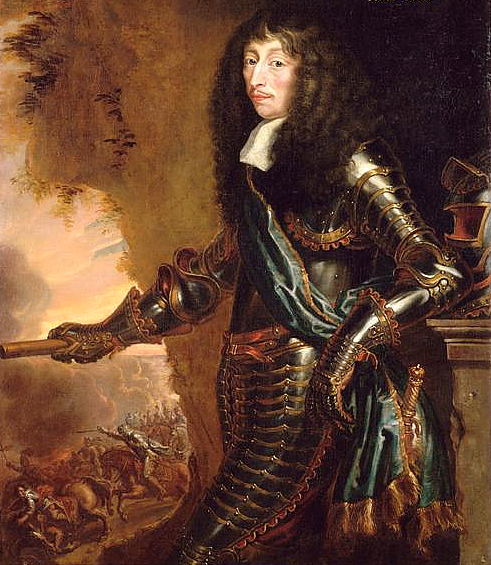
Battlefield Royal: Louis II de Bourbon, Prince de Condé

The way French military prowess is routinely denigrated, it is no wonder that the ignorant often say scoffingly that, in terms of great military leaders, the French would have nothing without Napoleon. And Napoleon wasn’t even really French. This attitude, however, derives almost entirely from World War II and is an exaggeration even if only looking at that unfortunate conflict. Rest assured, that even without Napoleon, France boasts a number of military giants, not only in French history but in the history of the world at large and one of those was most certainly Louis II de Bourbon, Prince de Condé. He was a colorful character to be sure, alternately regarded as a war hero, a traitor and the savior of his country. His achievements warrant his inclusion, not just on any list of great French military commanders but amongst the most remarkable and influential captains in world history (and he would not be the sole Frenchman on such a list).

The young prince
A “prince of the blood”, Louis was born the Duke of Enghien on September 8, 1621. As such, his was a childhood of wealth and privilege. Despite their august and semi-sacred status, many Bourbon royals could still be shy, withdrawn or even possessing of a degree of humility. Condé, however, was not one of them. He was proud, arrogant and could be extremely condescending. Yet, he was one of those rare personalities who, to the frustration of some, had as much talent as he had vanity. Entrusted, because of his birth, with a military command at the age of only nineteen, Condé nonetheless quickly proved that he more than merited such a position. He was no listless lord, no idle aristocrat, not at all one of those puffed up princes of popular fiction who is all glamour and no substance, the sort in any story we all wait to receive his comeuppance. On the contrary, Condé was driven to excel, possessed immense determination and real bravery. He also learned the art of war very quickly and very well. He became a master at evaluating the enemy and exploiting the slightest weakness.

The Prince at the Battle of Rocroi
He displayed so much talent that within three years he was given command of the French army and posted to the frontier to defend against an invasion from the Spanish Netherlands. However, standing still on the defensive was not his style. Condé went on the offensive himself and intercepted the Spanish army at Rocroi on May 19, 1643. This was no small affair. The Spanish infantry formations of pikemen and musketeers were rightly regarded as the best in the world in those days, a powerful combination of powder and steel that seemed unstoppable. The vaunted tercios, however, had met their match in the Prince de Condé. He concentrated his artillery to blast the Spanish lines, outflanked their cavalry with his own and then crushed the Spanish from both sides as his own infantry charged from the front and his cavalry from the rear. It was one of the most spectacular victories in French history. While losing only 2,000 men, Condé had wiped out 20,000 Spaniards, destroyed their army and in so doing also destroyed 150 years of Spanish military dominance in Europe. He had correctly evaluated his enemy and brilliantly exploited their weaknesses. It was his specialty and he won a victory that would never be forgotten.

The Battle of Rocroi, however, was only the beginning for the Prince de Condé. He next shifted to Alsace to meet the Bavarians. Although he did not destroy their army totally as he had the Spanish, in three sharp battles he forced the Bavarians to quit French soil and retreat back across the Rhine. When they returned the following year, Condé, along with another giant of French military history, Turenne, again defeated the Bavarians and forced them to withdraw. Time and again, over the next decade, Condé was called upon to chastise the enemies of France but with each victory he also gained enemies at court where jealously about the young man who so dominated the battlefields was not uncommon. The greater his popularity, the greater the envy many felt towards him. He did have his setbacks as well. In 1647 he was dispatched to Spain and met with a bitter loss at Lerida, a failure of logistics rather than battlefield tactics. Nonetheless, it was an aberration and he still succeeded in carrying out the occupation of Catalonia.

The Prince at the Battle of Lens
1648 saw the Prince de Condé rushed to command the French army in Flanders, the target of the Spanish forces of Archduke Leopold Wilhelm. Condé concocted a cunning trap for the Archduke, feigning a retreat to draw the Spanish out of their defenses at Lens on August 20. The enemy took the bait and as they came out Condé again used his cavalry to outflank them and rolled them up like a blanket. This additional success was welcome but it came at a time of great turmoil in France. “The God-given” Louis XIV was officially King of France but it was his mother, Queen Anne of Austria, who ruled as regent. She, however, had handed actual power over to Cardinal Mazarin and rumors about the two were rampant. Soon, leading aristocrats in France were preparing to rise up in revolt against the Queen-regent and Cardinal Mazarin. To lead this rebellion, the “Fronde”, the elites recruited the Prince de Condé. More controversial still, he made common cause with his former Spanish enemies to bring down the Queen Mother.

The Prince received at Versailles
In 1658, at the head of a largely Spanish army, the Prince de Condé met the loyalist forces of his old comrade-in-arms, the great Turenne. The resulting battle was short but decisive and it was Turenne who emerged victorious. Condé retreated, having already been sentenced to death in absentia for treason in 1654. The situation in France stabilized after 1659 when the war ended with the Treaty of the Pyrenees and the Prince began to use his connections to lobby for his pardon and return home. Many, obviously, were not enthusiastic about this but the enemies of France persisted and it proved impossible to leave so talented a captain in exile. In 1668 Condé finally succeeded in being brought home and given command of another French army. Some distrusted him and always would but his immense talents had not abandoned him and after a smashing victory over the Dutch at Arnhem in 1672 and later another triumph over the Prince of Orange at Seneffe in 1674, his loyalty seemed well proven and his critics were largely silenced.

The success at Seneffe, however, would prove to be his last victory. Although only in his mid-fifties, that was a more advanced age for the time than it is today and Condé was suffering from a variety of ailments ranging from gout, the common affliction of the upper class, to the simple effects of old age and so many years campaigning. He was simply no longer physically capable of taking to the battlefield and so, after more than thirty years of leadership, retired to his palatial home, devoting his remaining years to his family, study and of course, living as lavishly as he could. The great Condé died at Fontainebleau on December 11, 1686 at the age of sixty-five.

The Prince de Condé was one of the most remarkable figures France has ever produced and one of the most brilliant tacticians the world has ever seen. Coming from the very elite of the elite, Condé was nonetheless a “hands on” commander, a general who led from the front and who had the scars to show for it. During his many years of battles he had numerous horses shot out from under him and was wounded in action on multiple occasions. His courage was beyond question and his skill was obvious for all to see. He had a very quick mind, remarkable powers of observation and almost always found some fault in his enemy that he could exploit, in the heat of battle, to win the day. In his own time, Turenne was probably the only commander more influential than he and of course it helped that Turenne was never branded a traitor. Yet, even in that, Condé proved himself capable of snatching victory from the jaws of defeat in his own life. Widely regarded as the greatest war hero in France, he was condemned as a traitor, sentenced to death and yet, in a time of crisis, came back and smashed the Dutch to be celebrated as the savior of his country. In any listing of the great captains of history, from all around the world, one will surely find the name of Louis II de Bourbon, Prince de Condé.

Sunday, January 21, 2018

The Repercussions of Regicide

Today, once again, we mark the anniversary of the regicide of His Most Christian Majesty King Louis XVI of France. It is not, at this point, necessary to go through all the details of this monstrous crime, as that has been done before (relevant links will be below). However, I thought it might be worthwhile to make brief mention of what the repercussions of this event have been, which are present even to the present day. Obviously, there were immediate consequences in that most of the crowned heads of Europe immediately went to war with the First French Republic simply on principle. Even the British, and King George III felt that King Louis was suffering for having supported the American rebels in their war against him, immediately went to war with the French even though the Kingdom of France had been England's most long-standing enemy. France suffered immediate and terrible consequences for this. Even the United States immediately changed their point of view of the French Revolution when King Louis XVI was killed. Practically every major monarchy in Europe immediately became an enemy and even the Americans were no longer willing to be friends with a regime that would murder an innocent and powerless man.

Everyone knows about the Reign of Terror, the massacres, the repression and the long succession of wars that followed this event. However, there were broader and more far-reaching consequences that no one could possibly have foreseen at the time. For one thing, the permanence and sacrosanct nature of the monarchy was destroyed and that is something that is seemingly impossible to recover. This is why, I think, the British monarchy consistently decreased in power since the regicide of King Charles I, even though the monarchy was willingly restored. The French monarchy was restored, more than once, since the regicide of King Louis XVI but, as we know, none of these restorations lasted. The radical elements of French society knew that they had taken down one king and that set a precedent that they could take down others and so they did. It set up a very long-term destabilization of France as a country. The way modern France has become so famous for its strikes and a populace, particularly in Paris, being known for their temper tantrums all goes back to the regicide of King Louis XVI.

We also see today the huge explosion of the non-French population in France so that today about 20% of the population of France is not French. In terms of religion, France has the largest amount of Muslims as a percentage of the population of any country in Europe. It is also worth keeping in mind that the immigrant population has about twice the rate of natural growth as the native French population. For myself, I do not think this state of affairs is unrelated to the regicide and the French Revolution. In the first place, as I have said before, it is a logical next step for people who claim that the bloodline of their rulers does not matter, getting rid of monarchy, to then believe that the bloodline of the population being ruled does not matter either, which is the attitude held by those in power today. Similarly, by the overthrow and regicide of King Louis, the precedent was sent for the people changing their ruler to one more to their liking (or at least so they thought), it then also stands to reason that the rulers of republican France today can decide to change the population of France and replace it with another more to their liking.

Bertolt Brecht supposedly said, of the Communist regime in East Germany, that they might dismiss the current electorate and appoint a new one. He was being sarcastic to make a point but that seems to be something the modern liberal elite of western countries thinks is not only possible but a positively brilliant idea. In the aftermath of the regicide of King Louis XVI, I cannot see it any other way as being directly responsible for the current state of affairs. The downfall of monarchy, in France as elsewhere, set the standard for national authorities being changeable with no direct, personal ties of blood and history with the country and it is simply taking this to its logical conclusion for the rulers of today to believe that their peoples are also just as changeable. The crisis that France finds itself in today is, I firmly believe, a direct result of the regicide of King Louis XVI and the twisted "values" of the French Revolution. The country and the people are still suffering from this horrendous crime.

The Root of the Current French Crisis

The Greatness of King Louis XVI

A Tragic Anniversary

Inspiration in a Tragic Anniversary

Thursday, November 30, 2017

Sacrifice at Fort Carillon

Today is St Andrew's Day, the "national day" of Scotland as the feast day of Scotland's patron saint, Andrew. As such, it is a day to celebrate all things Scottish and, for me at least, nothing symbolizes the best of Scotland like the highland regiments of the British army. Today they have been sadly reduced but best not to dwell on that now. One of, if not the, most famous of these regiments was the 42nd Royal Highland Regiment of Foot, better known as the "Black Watch". It was formed in the aftermath of the 1745 Jacobite Uprising and, naturally, consisted of highlanders who had supported the government which meant they tended to be Protestants in their religion and Whig in their politics. The Black Watch would have a long history of many great victories and ample military glory, however, one of her most famous engagements was not a victory at all but a very heroic, tragic and bloody defeat. It would go down in history as one of the worst British defeats but for the men of the Black Watch it would be remembered for the tremendous sacrifice their soldiers made. It was during the French and Indian War (which regular readers will know all about) and happened at a French fort called, at the time, Fort Carillon, later re-named Fort Ticonderoga on the east border of what is today the state of New York, south of Lake Champlain.

The French and the Indians
The French, and their Indian allies, had been winning stunning victories over the British despite the fact that they were outmatched and the governments in both Paris and London had focused mostly on the European front of the war. The Marquis de Montcalm, commander of the French forces in North America, had won a string of victories in 1756 and 1757 despite having the odds against him. Although he did not enjoy it, the lack of French support for the war in the American colonies meant that he had to augment his forces with American Indian tribes who were difficult to integrate into European-style warfare. However, for a change, in what was to prove his greatest victory, the French would be fighting on their own. The British government, after a number of embarrassing setbacks, decided to made North America the main focus of their war effort, seeing it as of greater long-term value which did not exactly best please King George II who was very concerned about his native Hanover in Germany falling into the hands of King Louis XV of France. However, his fears were set aside in favor of a new, major, offensive in North America.

The British planned for a huge, crushing blow that would strike northward, via Lake Champlain, retaking lost outposts and ending in a massive attack on Quebec City, the capital of New France (Canada) which would win them the war. Doing that, however, would mean that they would have to take Fort Carillon which the French had just built to guard the southern approach to Lake Champlain (the lakes and rivers being the most efficient ways to travel in North America at the time). On paper, this seemed to be no great challenge. General James Abercrombie would have nearly 30,000 British troops at his disposal, a huge army by the standards of the time and place, with many excellent units such as the Black Watch. The Marquis de Montcalm, on the other hand, would have only 3,600 soldiers to defend the fort and many of these would be Canadian militia rather than French regulars. However, perhaps overconfident because of all of this, Abercrombie would fight this battle with all of the strategic calculations of a bulldozer. The Marquis, on the other hand, had his men in well fortified positions, with men in trenches out in front with other men on the walls to give them covering fire and obstructions in front of all of them. Although his defenses could have been more solid still, they would prove more than up to the task given that Abercrombie's plan was simply to charge right in.

Abercrombie's force approached on July 8, 1758 with local militia units and the famous "Roger's Rangers" out front having no problem forcing the French skirmishers back. However, Montcalm had good troops under his command in the center with good protection for them and artillery in redoubts to cover his flanks. One of these was unfinished but, it would not matter, because Abercrombie would be charging straight in, confident that his regulars could smash the French without undue difficulty. He was, of course, to be proven completely wrong. In fact, from the outset, everything seemed to go wrong for the British. Units were drawn into battle early and not as planned which led to disorganized attacks that failed and were very costly. The Black Watch was supposed to have been kept in reserve but, seeing their comrades engaged, demanded to join the fight and so were sent in as well. The result was that the British troops charged into a killing zone of withering French fire. Montcalm, who had thrown off his coat and was dashing among his men in his shirtsleeves, kept up French discipline and morale while the British commander was far away from the action (which had broken out before he had planned). Nonetheless, Abercrombie ordered more attacks, thinking each one would break the French lines and carry the day. Instead, he simply sent more men to certain death.

To make matters worse, the British had no artillery to provide fire support for their attacks. The barges carrying the guns had gone the wrong way and ended up floating down within range of the French in Fort Carillon who quickly spotted them and sank several of the barges in quick order. Abercrombie then sent in his reserves, mostly local militia, but they too were ruined and finally he decided to admit defeat and call off the attack. However, heroically but tragically, just because he had had enough, did not mean the hard fighting highlanders of the Black Watch had. They refused to retreat and continued trying to push on, finally charging forward, they alone managed to reach the foot of the outer walls of Fort Carillon but those who tried to continue ran into French bayonets. When there were finally none left to carry on, the battle came to an end.

Montcalm triumphant
Ultimately, the Battle of Fort Carillon would prove to be the most vicious and bloodiest battle of the French & Indian War. The British lost nearly 3,000 men dead, wounded or missing. The heroic highlanders of the Black Watch lost more than half of their entire number. The French, on the other hand, lost only a little over 600 men, the vast majority of them wounded rather than killed. It was the greatest victory in the military career of the Marquis de Montcalm and would never be surpassed. Abercrombie, by contrast, would never command an army in the field again. The British offensive had been stopped cold and with bloody losses, bringing about a change in command, however, the overall situation did not change at all. The British continued to make North America the main focus of the war, the French would provide precious little support to their own forces in the region and Montcalm would go on fighting against the odds until his life and French rule over Canada both came to an end. Because of a lack of resources and defeats elsewhere, the French would later abandon Fort Carillon, leaving it to be occupied by the British who renamed it Fort Ticonderoga. It would remain in British hands until the outbreak of the American War for Independence.

Monday, September 18, 2017

Clash of Monarchies: The Second War of Italian Independence

The Italian peninsula, after so many centuries of division and foreign rule since the fall of the Western Roman Empire, would ultimately fight three wars for independence but of these three, none would be so consequential as the second. The first had seen the hope of the existing Italian princely states, Papal, Bourbon and even Habsburg, come together under the leadership of the House of Savoy against the Austrians with the possibility of confederation or federal unity for Italy only to be defeated by the Austrian army of the unflappable Graf von Radestky. King Carlo Alberto of Piedmont-Sardinia, after his defeat, abdicated in favor of his son King Vittorio Emanuele II a monarch who was originally interested only in the unification of northern Italy and that mostly so as to prevent it from occurring under the leadership of the radical republicans. However, with cooperation from the other Italian states now out of the question, he knew he would have to look for an ally against the Austrian Empire. Such an ally was to be found in the person of Emperor Napoleon III of the French.

Vittorio Emanuele II, Napoleon III & Franz Joseph
One benefit the Savoy monarchy had was that the radical republicans had been, in 1848 and after, thoroughly discredited among Italian nationalists. They had failed and in Austria, the Papal States and Naples, reactionary forces had revived in a harsh way. This meant that the Savoy, careful to keep on the side of the nationalist spirit, was looked to for leadership while the republican crowd of Mazzini was discredited. Aside from the King, the most important player on the Savoyard side was his prime minister Count Camillo di Cavour. For Cavour, nationalism was a means to an end rather than an end in itself. His goals were for the financial independence of Turin from British banks, the furthering of industrialization and economic expansion. Ties with British banks were cut, new ties with French banks were established, railroad construction exploded and trade increased. The army was improved as well and in 1855 the Piedmontese participated in the Crimean War as a way of gaining British and French support against Austria. The result was a Savoyard army that was better organized, more easily mobilized, with a better staff system and with greater combat experience.

Obtaining an alliance with France, however, proved rather difficult. The French were willing but Napoleon III extracted a heavy price for his support which included the Savoy ceding their own heartland, the Duchy of Savoy as well as the County of Nice to France. The King also had to give his daughter, the petite Princess Clothilde, to the hulking Prince Jerome Bonaparte, the French Emperor’s cousin. In exchange, France would support the end of Austrian rule over Lombardy and Venice and the creation of an independent Kingdom of Italy on the northern half of the peninsula. This was, however, a defensive alliance and would only take effect if Austria attacked Piedmont. In Naples, the Kingdom of the Two-Sicilies did not figure into the issue. While still possessing a powerful army, it was geared entirely toward suppressing the local population, which had proven very prone to rebellion, and not to defending against foreign invasion. An alliance was proposed between Turin and Naples but King Francesco II of the Two-Sicilies had rejected it out of hand. They would play no part in the ensuing conflict.

Austrian Imperial Army, 1859
The French, more so than the Piedmontese, also took care to ensure that there would be no unwelcome intervention on the part of the Russians. This was not a problem as the Russians were feeling in no way sympathetic to the Austrians. Perhaps even more than the powers that fought against them, the Russians blamed Austria for their defeat in the Crimean War and were particularly bitter given that they had aided the Habsburgs during their time of greatest peril in the Revolutions of 1848. They also did not tend to view Austrian rule over northern Italy as legitimate anyway, going all the way back to the French Revolutionary Wars, Russia’s Czar Paul had been very disappointed by the British and Austrians keeping territory they took from the French rather than restoring it to its previous rulers, be it Malta or Venice. The British could also be counted on to remain on the sidelines given that they had good relations with France (for a change) and had been quite offended by the harshness of Austrian rule in Lombardy-Venetia. Paris and Turin were convinced that they could handle Austria between them and all that was necessary was for Austria to fire the first shot.

The Austrian Empire had come very near to total collapse in the Revolutions of 1848 but, thanks to the leadership of their new, young Emperor Franz Joseph and the victories of Graf Radetzky, they had weathered the storm and the Austrian Imperial Army seemed all the more robust and formidable. Austria did become a constitutional monarchy but it was a constitution that the Emperor accepted on his own terms and he pursued a policy since labeled “neo-absolutism”. There were problems though due to rivalries in the military leadership and a financial crisis which greatly effected military readiness. The politicians in Vienna always seemed prepared to sacrifice spending on the army before anything else and this meant that Austria could not maintain so large an army, or armies, on the Italian peninsula and, in the event of major trouble there, would have to divert forces from elsewhere in the empire if they were to maintain an overwhelming superiority. The Austrian Empire had also simply become overstretched. Aside from their own frontiers to the south and east, garrisons to keep troublesome populations in line within the empire, the Austrians had also been called upon to safeguard the Papal States and the Spanish Bourbons in Naples as well as their own Italian possessions. It was simply too much, particularly with a less than robust economy. The desire of Emperor Franz Joseph to reassert Austrian leadership in Germany also meant that neither Berlin or Moscow were, at the time, looking too favorable toward Vienna.

Officers of the Savoyard army
The French and Piedmontese, on the other hand, were well prepared with a joint-plan for military cooperation in the event of war and the Piedmontese economy was booming. It was the perfect time for a war but it could only happen if Austria made the first aggressive move. Count Cavour, therefore, entered into a number of schemes to encourage trouble in the central duchies such as Tuscany and Modena, nominally independent but ruled by junior members of the House of Habsburg. The famous nationalist revolutionary Giuseppe Garibaldi was also recruited to lead volunteers in the cause of Italian independence under the Savoy banner. This caused nearly 20,000 Italians to rush to Turin to volunteer, fired by nationalist zeal, so many that Cavour had to suspend his plan before things went off prematurely. The point was for the trouble in the duchies to draw Austrian strength away from Lombardy-Venetia and the government in Turin knew perfectly well that the government in Vienna would blame them for any Italian nationalist unrest and thus the Austrians would be encouraged to attack Piedmont-Sardinia.

King Vittorio Emanuele II also ordered the mobilization of his army, at least gradually, which was sure to attract Austrian attention. The Austrians were certainly alarmed but also unsure how to respond. The Piedmontese had not actually made any aggressive move and a full mobilization of the Austrian Imperial Army was a costly exercise Vienna would wish to avoid if not strictly necessary. The Italians also had to be fully prepared before the war started given that, as per the agreement, they would be responsible for both paying for the French intervention on their behalf and keeping both armies supplied during the war, which would be no small task. The French also began moving their forces into position which alarmed the Austrians all the more. In April, 1859, however, everything almost came to ruin when the British government proposed an international congress to deal with the Italian situation. Thankfully, France and Italy were rescued by their Austrian adversary. Emperor Franz Joseph had sought out the retired elder statesman, Prince Klemens von Metternich, who immediately understood that the French and Italians were trying to provoke Austria into a war and he advised the Emperor that, whatever he did, do NOT send an ultimatum to Turin. The young Kaiser sheepishly had to admit that he had already sent one out.

Kaiser Franz Joseph of Austria
The ultimatum ordered the King to demobilize his forces or face war and this message was immediately forwarded to Paris. The French and Italians had their threat and could take action in a war of self-defense against Austrian aggression. Lest anyone think that Emperor Francis Joseph was being purely hot-headed in this blunder, he had expected such a conflict to rally the German states in support of Austria. Unfortunately for him, they did not. The Prussians were not sympathetic, seeing the Austrians as rivals with a bizarre obsession with non-Germans and the other states often did not see Austria as a “team player”, partly also because they were necessarily focused on their rebellious non-German territories. They also saw no reason for Austria not to accept the proposal for a congress rather than giving the Italians exactly what they wanted, which was a war. Emperor Francis Joseph, however, feared that any such congress just might say what many Italian nationalists had been saying for ages; leave Italy to the Italians and everyone mind their own business. Austria simply had no real friends at this point and so would have to stand alone. Emperor Francis Joseph, for good or ill, was prepared to and after the Italians did not respond to his ultimatum, issued the declaration of war on April 29, 1859.

Feldzeugmeister Franz Graf Gyulai, commander of the Austrian Second Army in Lombardy, believed that his forces would have at least two weeks to crush the Italians before the French could intervene. He had on hand some 110,235 soldiers as well as another 59,000 deployed throughout Lombardy-Venetia to suppress any popular uprisings. The Italians could field only 77,348 men to meet them, however, they were very efficient and led by men who had learned from the mistakes of 1848. The Franco-Italian leadership had also carefully worked out the train schedules and necessary stockpiles of supplies to move the French into northern Italy as quickly as possible. The Austrians had previously assumed the French were not prepared to move because they had not been stockpiling supplies. However, this was because it had been left to the Italians to handle the logistics and, in the end, the French army was transported quickly with ample stores by the very efficient Piedmontese rail network.

General Alfonso La Marmora
Unfortunately for the Austrians, Gyulai was no Graf Radetzky and no one knew this better than Gyulai himself who was more of a desk general. He had asked to be reassigned but this was refused. With the outbreak of war, his plan was to crush the Italians with his superior numbers and by then be able to take up a good position from which to deal with the French. He would march directly on the Piedmontese capital at Turin. Of course, this is exactly what the Italians expected him to do and the Piedmontese army was deployed to block any such advance and hold up the Austrians until the French arrived at which point they would work together to drive the enemy from Italian soil. The Italian commander, General Alfonso La Marmora was under no apprehension that this would be easy but he was aided by the extensive spy network set up by Lt. Colonel Giuseppe Govone, his chief of military intelligence, who had a constant flow of information on the movements of the Austrian army. La Marmora deployed his five infantry and one cavalry divisions to be in a position to block the advance on Turin and to be able to link up with the five French Corps at their places of deployment which, when they arrived, would be set up to pin down the Austrians at the Dora Baltea line and then, with three of the French Corps coming from Genoa to Alessandria, to threaten the Austrian flank.

Austrian naval strength was negligible, being about as large as the Piedmontese navy, far outmatched by the French fleet which was the second-largest in the world. In any event, the commander of the Austrian navy, Archduke Ferdinand Maximilian, had prepared only for the defense of the Adriatic and had no plans for offensive operations (and keeping in mind most of the sailors in the Austrian navy were Italians). As such, by rail and by sea the French were able to move their forces into Italy rapidly and freely. The Austrian army, likewise, inexplicably remained in place for days while their enemies massed against them. Gyulai claimed that Vienna had ordered him to wait while in Vienna they blamed Gyulai for not seizing the initiative. It is difficult to know who was in the right but it does seem that, having blundered into giving the Italians the war they wanted, Emperor Franz Joseph hoped, at the last minute, to be able to negotiate a solution or for the German states to rally in support of Austria. Of course, neither would be the case nor were such hopes frankly realistic. By May 1, with French deployments proceeding as scheduled, General La Marmora remarked to the commander of the Third Division at Novi, General Giovanni Durando (commander of the Papal Army in the First War) that the Austrian advance was “molto lentamente” (very slow).

Feldzeugmeister Gyulai
The Austrians had their spies too and they reported to Gyulai on the movements of the French army which seems to have intimidated him as they tended to exaggerate French strength. He was unsure of how to deploy his own forces for fear of where they would be when the French reached their own destinations. As it turned out, it was ten days from the time of the ultimatum until Gyulai moved, very slowly, toward Vercelli. King Vittorio Emanuele II, who was in his element on such occasions, wanted to stick to the original plan but the French convinced him to redeploy Franco-Italian forces away from Turin. He did so and, as it happened, a determined Austrian advance would have found little more than one Piedmontese cavalry division blocking their way if they had driven on for the capital but the Austrians were convinced that the French were planning to flank them from the south and so began to pull back. The danger to Turin dissolved faster than it had appeared.

By May 12 the Emperor Napoleon III had arrived in Genoa. Armed with some thoughtful advice from retired General Baron Antoine-Henri Jomini (a veteran of his famous uncle’s army), Napoleon met with King Vittorio Emanuele II at Alessandria to work out their offensive against the Austrians. It would be too much to say the Franco-Italian forces took the initiative from the Austrians as the Austrians never seemed to have held it in the first place but Napoleon III and Vittorio Emanuele II were certainly willing to seize it where it lay. They did, however, pass up an opportunity to strike the Austrians while Gyulai was redeploying his forces but an overall strategy was still being well executed. The famous Giuseppe Garibaldi, given rank as a Lt. General in the Piedmontese army after pledging allegiance to “Vittorio Emanuele and Italy”, was to harass the Austrian right, brushing the Alps. He had originally intended to lead the effort to foment unrest in the central duchies but this job was instead given to Prince Jerome Bonaparte and his French troops, which was deemed preferable to the authorities in Turin as Garibaldi, a lifelong republican and former Mazzinian, was still not regarded as being sufficiently loyal to the Savoy monarchy to be absolutely trusted. Garibaldi in the north and Prince Jerome in the south would threaten the Austrian position from the left and right, they would be intimidating but not part of the major action.

French line infantry
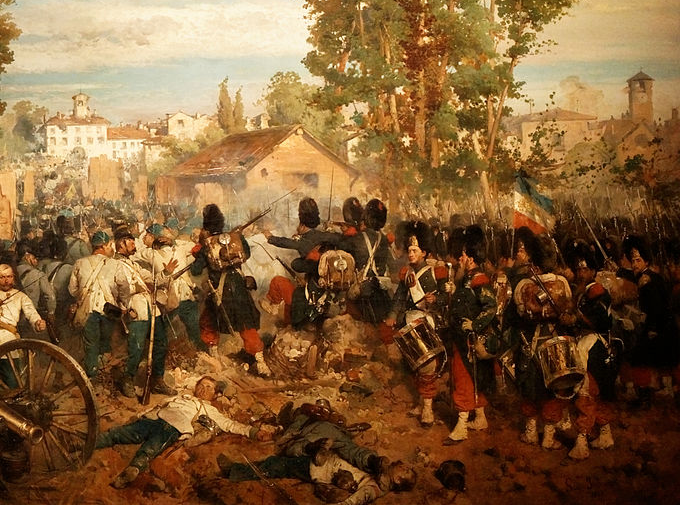
As the French First Corps moved on Voghera, the Austrians thought this the first move in an effort to get around behind them and the Austrian IX Corps under Field Marshal Lieutenant Karl Urban was deployed to stop them. The result was the first engagement of the war that was more than a skirmish, the Battle of Montebello on May 20 between the lead French division of General Elie Frédéric Forey and elements of the Austrian V Corps under General Philipp Graf von Stadion which had been sent in to support Urban. Three Italian cavalry regiments, the Aosta, Novara and Montferrato, also participated. Despite being considerably outnumbered (3 to 1), Forey fought an aggressive action that made Graf Stadion believe that the French had more support behind them, prompting him to retreat and give the victory to the Franco-Italian forces under Forey. This sharp rebuke made Gyulai all the more reluctant to take risks but as he had initiated the action, it also made Napoleon III nervous that the Austrians might be trying to take back the initiative. As it was, Gyulai had been concerned about a move south and his forces had met the enemy so he continued to believe he was on the right track and all forces were shifted toward the south.

When an armed reconnaissance by General Enrico Cialdini, commander of the Piedmontese fourth division, found minimal Austrian resistance at Vercelli the following day, the French Emperor and Italian King could see that Gyulai was shifting away from the north, giving them an opportunity to come at the Austrians from that direction. Garibaldi was also proving effective at keeping the Austrians off-balance. On May 26 at the Battle of Varese, his Cacciatori delle Alpi routed the Austrians, forcing them to keep more troops deployed in the north as the aggression of the Italians again caused the Austrians to overestimate their strength. The next day Garibaldi and his men defeated another Austrian contingent at the Battle of San Fermo, forcing the Austrians to withdraw from Como.

King Vittorio Emanuele rallies the Zouaves at Palestro
At the same time, while the largely French force was engaged at Montebello, King Vittorio Emanuele II led Cialdini’s division with the addition of some French Zouaves against a smaller contingent of Austrians under General Friedrich Zobel at the Battle of Palestro. The Austrians rushed in reinforcements so that, in the aftermath, they held the numerical advantage yet the threat of French troops on the Sesia caused him to retreat for fear of being cut off. By May 30 the Franco-Italian forces had secured a bridgehead across the Sesia. With efforts to retake Palestro having failed and with Garibaldi keeping control of the northern front in spite of being outnumbered nearly 4 to 1, Gyulai decided that the threat to Milan was too great and he ordered a retreat across the Ticino to concentrate his forces at Mortara. However, the rapid movements of the Franco-Italian armies forced him to abandon that plan. He was correct that they were moving against Milan, the capital of Lombardy, but he did not know what approach they would take. He was coming under intense pressure and no small amount of criticism, particularly after the arrival of Field Marshal Heinrich von Hess with stern orders from the Emperor (who had reached Verona) to defend the frontier and not retreat to the Quadrilateral fortress complex.

The Battle of Magenta
More Austrian reinforcements arrived and Gyulai was finally convinced that the enemy was not trying to maneuver around behind him after all. There was also confusion as Hess outranked Gyulai, yet seemed to be leaving things to him. All of this caused a degree of stagnation on the Austrian side as one commander would fail to do something because he assumed the other commander would do it. Nonetheless, the Austrians did hold a strong defensive position around Magenta after destroying the bridges over the Ticino. Gyulai had about 68,000 men in the area when the Battle of Magenta commenced on June 4. With a little over 50,000 French troops plus 12,000 Italians under General Manfredo Fanti, Napoleon III planned an assault on the front and flank of the Austrian army. The two sides were thus evenly matched as long as the Austrians concentrated on the points of attack and did not remain spread out. Both sides made mistakes and many units blundered into each other, nonetheless, the Austrians took far heavier losses and finally retreated, giving the victory to the French. Napoleon III congratulated Marshal MacMahon with a peerage as Duke of Magenta for this success.

This latest defeat was the last straw for Emperor Franz Joseph who had seen his forces do nothing but retreat, be outmaneuvered and defeated often by forces inferior to their own. He dismissed Gyulai and took command of the Austrian Imperial Army himself. With the Quadrilateral fortress cities secure but the enemy in command of the surrounding countryside, his position was similar to that of Graf Radetzky in 1848. However, “Papa Radetzky” was a veteran, unflappable commander and Emperor Franz Joseph was not. Determined to take the offensive and crush the enemy, he abandoned his strong position and moved out on June 23 to take on the Franco-Italian armies. The result was the bloody Battle of Solferino the following day. Once again both sides were about evenly matched with roughly 130,000 soldiers each.

Emperor Napoleon III at the Battle of Solferino
Each army was basically trying to attack the other and so units ran headlong into combat, often not as they intended. It was a huge brawl that involved a number of separate actions and coordination was difficult. The Austrian position was also undermined on distant fronts by uprisings breaking out in conjunction with Prince Jerome’s arrival in central Italy. Earlier, toward the end of May, his forces entered Florence and soon dispatched units to Parma and Modena. At Solferino, most of the fighting centered around two engagements, one around Solferino itself where the French under Forey pushed the Austrians back into the town itself at which point house-to-house fighting ensued. Despite Austrian reinforcements arriving, French attacks soon succeeded in nearly surrounding the town. Fighting south of town was disconnected from the main engagement and involved a number of cavalry units. There, the French attacks were repulsed by the Austrians but this had no effect on the imperiled Austrian position in town. The fighting was fierce and casualties were heavy, particularly for the Austrians.

Battle of San Martino
The other major action was the battles at San Martino and Madonna della Scoperta which largely involved the Italian forces. The Austrians had a fairly good defensive position and the Italians attacked immediately, hoping to dislodge them before they could strengthen their lines. However, this meant that the Italians attacked piecemeal as they came up rather than being able to throw their entire force at the Austrian position. Field Marshal Lieutenant Ludwig Benedek, considered the best Austrian corps commander by many, had been ordered to attack the French flank and had not been expecting to run into the Italians. However, he was a veteran of this region and kept his cool, responding rapidly to the changing situation. Repeatedly, Italian discipline and determination carried them forward to the cusp of success only to have Benedek adeptly move his men and guns to the imperiled area and throw the Italians back with devastating barrages. However, when word came that the main Austrian army had been beaten at Solferino, he had no choice but to conduct a fighting withdrawal as the Italian attacks continued. With the French having taken Solferino, the Italian seizure of San Martino marked the end of the massive and bloody battle.

French & Austrian Emperors meet at Villafranca
Stunned by the ferocity and chaos of the engagement, Emperor Franz Joseph ordered his forces to fall back to the security of the Quadrilateral fortresses. Losses had been heavy for both sides. The Italians had lost about 5,000 men, the French more than 10,000 and the Austrians about 22,000 in the vicious struggle. Both the French and Austrian emperors were shaken by the extreme loss of life. The carnage would later lead one Swiss observer of the engagement to found the International Red Cross in 1863. Operations continued for a time but Napoleon III and Franz Joseph both agreed that the war should come to an end. Franz Joseph feared that a continuation of the so far disastrous conflict could pose an existential threat to the Austrian Empire itself if other areas rose in rebellion. Napoleon also feared that if Austria seemed near to collapse the other German states might get involved and threaten France itself. Disregarding his earlier promises to the Italians, Napoleon III agreed to make peace with Emperor Franz Joseph at Villafranca on July 8.

The result of this was that Austria gave up Lombardy to the House of Savoy but retained control of Venetia. It was not the total victory that Italian nationalists had wanted and many were bitter about the result. The French had gained Savoy and Nice but had backed out before the total liberation of northern Italy had been achieved. Many, given how close Austria had come to collapse in 1848, thought they would not put up so strong a fight. However, despite being weakened by budget cuts, the Austrian military was much more effective than Austrian diplomacy had been. Things would have gone very differently if the Austrians had not managed to offend the Russians, Prussians, the minor German states and the French all at the same time. Not only did this isolate Austria but it also gave the Prussians room to further gain prestige among the German states, standing as the defenders of German rights while Austria was focused on keeping control of Italians, Slavs and Magyars.

King Friedrich Wilhelm IV of Prussia
A particular example of this was in 1857 when royalists in the Principality of Neuchâtel had risen in revolt. They favored the King of Prussia for their prince rather than being a part of Switzerland and the German states saw this as an opportunity to strengthen the German Confederation. Emperor Franz Joseph, president of the Confederation as the Head of the House of Habsburg, had, however, refused to give their cause imperial support. Prussia was ultimately forced to back down and many in the German Confederation wondered why they should take any risk to support the Austrian rule over unwilling Italians two years later when the Austrians had been unwilling to support pro-German royalists who wanted to be ruled by a German monarch. It was illustrative of how Austrian interests diverged from those of the rest of the German-speaking people. There were also those in Berlin who realized the implications that Italian independence would have better than the French did. Napoleon expected to gain a subservient northern Italian buffer state but, as Modena, Tuscany, Parma and after Garibaldi’s shockingly successful invasion of the south, all came to be part of the Kingdom of Italy, France instead helped create a rival in the Mediterranean.

The result of all of this was that Austria lost Lombardy, which joined with Piedmont-Sardinia, Tuscany, Parma and Modena to form the Kingdom of Italy, soon joined by the south and the Papal States outside of Rome. Austria remained friendless and increasingly overshadowed by Prussia and the French were not seen by the Italians as stalwart allies but as rather fair-weather friends who likewise kept troops in Rome. The French had gained battlefield laurels but would also find themselves without friends going forward just as the Austrians had because of their determination to maintain some level of control over Italy, continuing a cycle which had been going on for many, many centuries and which would continue until the fall of Napoleon himself in 1870. Italy had gained much from the Second War for Independence but not so much as to not require a third war. The Austrian loss did not seem too significant but it actually was. In trying to maintain control of Italy, Austria would ultimately lose their place in Italy and their place at the had of Germany to the Kingdom of Prussia. It would be no coincidence then that the Third War of Italian Independence would see Italy and Prussia on the same side.
Related Posts Plugin for WordPress, Blogger...