Showing posts with label Spain. Show all posts

Monday, October 2, 2017

Catalonia, Separatism & Small States

The day of the great independence referendum in the Catalonian region of the Kingdom of Spain has now come and gone and the result is that, true to their word, the Spanish government did not allow it to happen. Spanish police and the Civil Guard were deployed prior to the day votes were to be cast to raid polling stations, seize ballot papers, prevent people from voting and arrest ringleaders. Catalan separatists responded with cries of fascism and militarism, as well as producing ballots Catalans could print out at home. That, of course, only reaffirms the comment made by the Spanish prime minister that the referendum was a mere mockery of democracy. It is hard to say how he is wrong. Separatist leaders gave no guidelines by which success could be judged, no level at which voter turnout would be deemed sufficient to declare it legitimate, the voting process would be in the hands of the separatists themselves as would the process of counting the votes. It sounds rather like the referendum which gave birth to the Italian Republic in that regard.

Certainly, the entire affair contained a great deal of what the political class calls “bad optics” for the Spanish government with scenes of police smashing into polling stations and roughing up Catalan voters. However, what else could have been expected? The Spanish courts had already ruled that such a vote would be illegal and would have no validity, the organizers were openly flouting the law and the only recourse left was the use of force by the state. However, “optics” do matter these days and have for a long time actually which is why President Lincoln in the United States ordered the re-supply of the sacrificial garrison at Fort Sumter in South Carolina. He knew the outpost was doomed but he wanted the “optics” of the southerners firing on the American flag in order to boost northern support for a war of conquest against the breakaway southern states. The Catalan separatists were also clever enough to keep the issue simple, far more simple than it actually is, by giving the people the choice of only two options; the status quo or a Catalan republic. Thus, all we know about what sort of state they were proposing was that it would not be a monarchy.

These are certainly troubled times for the once proud and powerful Kingdom of Spain and there seems no hope of anything getting better in the immediate future. Separatist leaders have already, in spite of no vote really being held, declared themselves the winners with Carles Puigdemont saying that Catalonia has, “won the right to an independent state in the form of a republic” and that the way is now open for a unilateral declaration of independence. Again, it is noteworthy that the only thing the separatist leader can say to describe his ideal, independent, Catalonia is that it will be some sort of republic. What would actually resist remains to be seen as the separatists have portrayed independence as all things to all people, presenting differing visions cut to the customer’s satisfaction. To the socialists, it will be more socialist than ever, to the liberals it will be more capitalist than ever, to the Muslims, well, they were promised a ‘mega-mosque’ to be built when independence is achieved. They have no doubt about what sort of state they want and their views cannot be ignored considering that Catalonia has the highest percentage of Muslims among the Spanish regions. In fact, if Catalonia became independent, it would have the third most Muslim population in the neighborhood with a greater percentage than either Britain or Germany.

What has been odd is the number of people on the slightly right-of-center side of the political spectrum taking up the cause of Catalan independence. For the most part, these have been people and news outlets far removed from Spain who are mostly responding to the aforementioned “optics” of the situation. An independent Catalan republic would certainly be no bastion of conservatism or traditional European values (as the size and growth of the Muslim population rather clearly demonstrates). It would not even be all that “independent” given that they are even now looking to the EU to intervene on their behalf. So far, EU authorities have been rather lukewarm on the subject of Catalan independence, certainly showing none of the enthusiasm they failed to hide on the issue of Scottish independence. This, I contend, is simply because of money. Spain owes the EU a great deal of it and Catalonia accounts for about a fifth of the Spanish economy. If Catalonia were able to leave Spain, it would mean Spain would be even less likely to pay back its debts. Further, regions of Spain would likely then begin abandoning the sinking ship so that they are not the last one left holding the bill.

Due to a couple of comments, I think it also worth addressing the broader point of the ever-dividing states of Europe. I do not think I made it clear enough before why I think these ever smaller states are helpful. In the first place, whether one is speaking of Catalonia or Flanders or even Scotland, the immediate or ultimate end of these movements are to create more republics which is repugnant to my monarchist loyalties. However, even were they not, they would hardly be in a position to be truly independent. Some, more often the libertarian-minded rather than reactionary, also put forth the notion of micro-states. The problem with these is that they are too small and too incapable of the practical necessities of actual independence to withstand the stresses they would inevitably face. Those who point to the benefits of free market economics, and they have a case certainly, point to examples such as the British Crown Colony of Hong Kong which, while self-governing, was a colony and not independent. The Principality of Liechtenstein, while legally sovereign, is not capable of total independence and for most of its history has not been, previously being part of the First German Empire, currently part of a customs union with Switzerland.

The point can be made quite clear, I think, by pointing out the obvious which is that any small state which, unlike an independent Scotland or Catalonia or Flanders, truly wishes to go against the prevailing world order, will find itself isolated and vulnerable. Consider, for example, the fate of Rhodesia or South Africa prior to Black rule. These were not micro-states, in the case of South Africa it is a quite large state. However, even with their considerable resources, they were ultimately unable to stand against a hostile globe that treated them as pariahs. Even in the case of a Liechtenstein or a Monaco, these countries have had to bend to the international elites to one degree or another in order to retain their sovereign status. However, if you are not prepared to do business the way the masters of the current world order demand, such a state would be slapped with every sort of sanction imaginable. You have to have enough resources to be self-sufficient or otherwise have a patron to whom you are answerable like China is to North Korea. This is why there really is no substitute for winning the battle, winning the argument, because withdrawing is not possible when dealing with control-freaks.

Sunday, September 24, 2017

Why the Catalonia Crisis Matters

As most readers are probably aware, the Kingdom of Spain is in the midst of a crisis. The Catalans are threatening to break away and issue a unilateral declaration of independence in spite of legal rulings from Spanish courts that such a thing would be illegal and threats from the central government in Madrid to have Catalan leaders arrested if they go ahead with their promised referendum on independence. As most are also probably aware, this is not a new problem, Catalonia has been threatening to break away for some time now nor are they the only ones. This also comes at a time when the Kingdom of Spain is still dealing with an economic crisis, the migrant crisis and at a time when it seems that the Spanish have less holding them together than in ages past.

Even this, as most students of history know, is not a recent problem but one that has become, sadly, the rule rather than the exception. When the Spanish have been united and all pulling in the same direction, they have accomplished astounding things. Spain reached unprecedented levels of wealth and prosperity, social cohesion, blazed new trails in exploration, conquered empires and subdued continents under such conditions. Spain was once the backbone of western Christendom, the power which ensured the Catholics rather than the Protestants retained Belgium and France and which played no small part in the retention of Catholicism in much of central Europe during the Thirty Years War. All of that, unfortunately, seems like a very distant memory that few today feel any connection with. Since the French Revolutionary Wars, roughly, Spain has been in a period of recurrent internal unrest. The country which triumphed over enemies as diverse as the British Empire, the French Empire and the Ottoman Empire found itself unable to triumph over the enemy within which has been internal divisions.

It was the internal divisions fostered by the invasion and occupation by the Napoleonic French which first caused the Spanish empire to crack and begin breaking apart. Efforts to deal with this were, at first, successful but, alas, internal squabbling in Spain itself prevented such victories being followed up. The struggle between constitutional and absolute monarchists seemed to have been done when King Fernando VII, backed by his Bourbon cousin King Louis XVIII of France, restored himself to power but his death then set off a series of conflicts over the succession; the Carlist Wars. There were a number of these and, though the Carlists were never victorious, their persistence meant that the Spanish were mostly focused on fighting each other rather than external enemies. That, unfortunately, was only the beginning as the divisions became only worse with time.

During the reign of Queen Isabella II, despite the Carlist trouble, the Kingdom of Spain did seem to be on the cusp of a rebound. Efforts to reclaim lost territories or forge new relationships to Spain’s benefit were going well, Spain had the fourth largest navy in the world, rebels in Cuba and the Philippines were successfully subdued and one former colony, the Dominican Republic, even returned willingly to submission to the Spanish Crown. Spain seemed on course to recover its lost glory and former place of prominence as one of the great powers. However, not only did the Carlist opposition persist but their enemies, the ruling government, began to fragment and begin fighting amongst themselves. Queen Isabella II, unacceptable to the Carlists, proved too conservative to be acceptable to the liberals who had previously supported her. She was forced out and the ruling elite decided to give monarchy one more chance.

As the division over the Bourbon succession seemed hopelessly permanent, the Spanish government decided to start over from blank paper with a new dynasty, importing the Italian Duke of Aosta to be King Amadeo I of Spain. This solved nothing, another Carlist uprising flared up and the party which had brought in the new king also began fighting among themselves so that, after less than three years in Spain, King Amadeo I declared the country ungovernable, abdicated and went home to Italy, sorry that he had ever attempted such an enterprise. This resulted in the, thankfully short-lived, First Spanish Republic as the revolutionary party, which had always opposed the monarchy, was bolstered by the fact that the monarchists seemed unable to maintain a functioning monarchy anyway. The republic did not last long but it set a dangerous precedent and should have been a warning to all that if the monarchy was to only be a source of division, a republic would be given a chance.

As it was, King Alfonso XII, son of Isabella II, was put on the throne. He defeated the latest Carlist rebellion, suppressed another in Cuba and was able to get some degree of calm in the political sphere at home by allowing both liberals and conservatives to take it in turns governing the country. They were still divided of course, but seemed willing to accept the rule of the other while they waited for their turn to come again. Prosperity began to return once the Spanish stopped fighting each other and got back to the business of doing business. Unfortunately, the reign of King Alfonso XII was a short one. He died in 1885, just before his twenty-eighth birthday. The throne passed to his son, King Alfonso XIII, and soon the old divisions began to reappear. A relatively new part of this division was the emergence of the Catalan nationalist movement. Although somewhat present in the past, it began to emerge in a new way with the First Spanish Republic and received a large boost after 1898 and the defeat of Spain by the United States. The leading industrial region of Spain, Catalonia lost the markets for her manufactured goods in Cuba, Puerto Rico and The Philippines after that war.

Flag of the Kingdom of Aragon
In the old days, Catalan nationalism had been tied to maintaining or regaining their privileges from the time of the Kingdom of Aragon. The unity of Spain had always been a fragile thing. Even when most of the country was under Moorish rule, the Christian kingdoms still fought among themselves and when unity was finally achieved it was only by marriage, only a personal union and the relationship between the people and the king was a contractual one. The people submitted to the Crown but only conditionally. Later, Catalan nationalist became more liberal. General Juan Prim, leader of the Revolution of 1868, which brought down Isabella II and ultimately replaced her with Amadeo I, was a Catalan. The First Republic was their great hope but, after its failure, they focused mostly on pushing for as much autonomy as possible and were not necessarily opposed to the monarchy. However, the increased divisions and unrest in Spain during the era of King Alfonso XIII, led to the dictatorship of Miguel Primo de Rivera who cracked down on any hints of separatism. Catalan nationalists then began to go solidly republican.

Catalan separatist flag
When King Alfonso XIII was overthrown and the Second Spanish Republic was declared, the Catalan nationalists went along in the hope of establishing Catalonia as a subsidiary republic. Needless to say, when the Spanish Civil War ended in victory for Generalissimo Francisco Franco, all of that was suppressed. Franco wanted an end to all of the bickering, infighting, regional unrest and political divisions that had been plaguing Spain for so long. Immediately before the victory of Franco and his Spanish nationalists, the leader of the Catalan nationalists declared the independence of the Republic of Catalonia before leaving the country and claiming to lead a government-in-exile. All hints of Catalan separatism were firmly suppressed by Franco and, though Franco was a monarchist, it is likely that his reluctance to not bring back an actual monarch until after his death was due to how divisive rather than unifying the Spanish monarchy had become.

Once Franco was dead and gone, however, the Catalan separatists came back in a big way. In 1979 Catalonia gained a degree of autonomy from the Spanish government and, after another vote in 2006, this autonomy was expanded. However, there has been no shortage of problems in Spain and there have been no shortage of Catalan separatists, on both the left and the right (or “right” as we are basically talking about socialists and liberals here) who are quick to offer Catalan independence as the answer. This is an old problem and one that has been building in its current form for decades at least. Why should any of this matter, particularly to anyone who is not Spanish? It matters because the Kingdom of Spain matters. Spain is never going to rise above its current lower-tier status if these internal divisions persist and if the Catalan nationalists are successful, the results could have far-reaching consequences well become the present day boundaries of the Kingdom of Spain.

The most unthinkable possibility would be if the vote results in a declaration of independence which the Catalans inflexibly stand by and which Madrid inflexibly opposes which would result in another Spanish Civil War. If, however, it goes forward and the government does not use force to suppress it, we are then presented with the very real possibility that other regions start to abandon the sinking ship that is Spain, no one wishing to be the last one left holding the bill for Spain’s massive debt. What happens when the Basques or the Galicians decide to follow the example of the Catalans? Then you have the cascade effect this could cause across Europe, starting with areas already known for their separatist tendencies such as Scotland in the UK, Flanders in Belgium, Venice or Sardinia in Italy, similar Basque and Catalan separatists in France, their example to be followed by the Corsican, Breton, Savoyard and other separatists. Will the Frisians of the Netherlands or the Bavarians of Germany be far behind? Where does it all end?

Many of these, most of them in all probability, have also stated their desire to carry on within the European Union, which means not so much true independence but more a desire to have the benefits of autonomy with none of the responsibilities. We would be left with a collection of tiny, powerless statelets which are, far from independent, all the more dependent on larger powers for their defense and access to profitable markets. Secessionists in places such as the American states of California or Texas could be (and in the case of Texas have) successful independent entities if their adopt the correct policies. Both have large markets, considerable farm land, their own energy sources and access to the oceans, the ‘highway of the nations’. The same could not be said for these tiny regions of Europe. In many of these places, the separatists do have some legitimate points on their lists of grievances in my view. However, the breakup of once major powers into powerless micro-states will not solve them or, at best, simply replace them with other, usually larger, problems.

I deplore the state that the Kingdom of Spain is in presently. However, I do not want to see Spain disappear from the map. With real unity and the correct policies, Spain could rise again to be a major power in Europe. I would like to see that. Further, I think it would be to the benefit of everyone if a revived Kingdom of Spain then went on to strengthen ties and form a stronger coalition of all the Spanish-speaking countries. If that could be accomplished, if all of the Hispanic lands could be united and all pull in the same direction, you are not just talking about a major power but a potential super-power. That is something I would like to see and I would love to see the cascade effect from that possibility, with other European countries doing the same.

Wednesday, September 20, 2017

MM Movie Review: 1898, Los Ășltimos de Filipinas

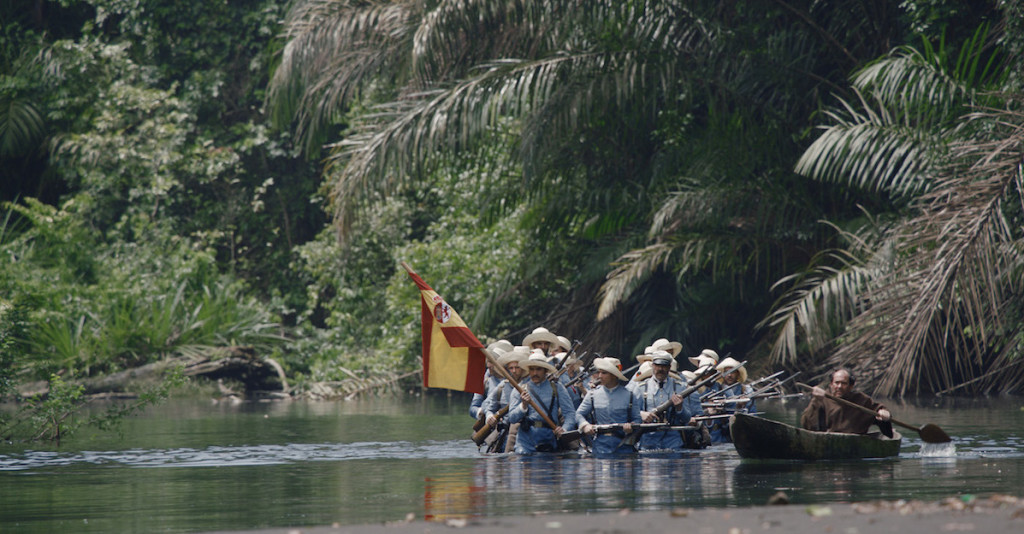
Given recent events, it is clear that the Kingdom of Spain, like most every other West European country, is suffering from a severe lack of confidence and self-esteem. If this film, titled in English as “1898, Our Last Men in the Philippines”, is any indication of the popular culture it is certainly no surprise. It is the story of the last die-hard holdouts of the Spanish empire who, barricaded in a small church in the village of Baler, held out against a far larger force of besieging Filipino rebels from July 1, 1898 to June 2, 1899. I cannot say how the film did with its intended audience but of the Spanish reviews I read, most were positive though, thankfully, almost as many were quite negative. What we have with “1898, Los Ășltimos de Filipinas” is a gorgeous film that throws historical accuracy out the window in an effort to tow the politically correct line and make the Spanish soldiers look as horrible and nasty as all “evil, European imperialists” are supposed to look today. Yet, do not think that the Filipinos escape unscathed either.

The Spanish return
In many ways, perhaps because the siege of Baler has sometimes been referred to as ‘the Spanish Alamo’ (which is a bit ironic considering the actual Alamo is a Spanish mission) it reminded me of the most recent film version of Texas’ most famous siege in that, in an effort to be liberal and avoid taking your own side in a dispute, the filmmakers went out of their way to portray the defenders in a negative light, yet, in so doing, could not help but portray the besieging force in a negative light as well, in fact making them look worse than the supposedly more patriotic pieces of decades past. Despite portraying the Spanish as the villains of this story, I would think it completely justifiable if The Philippines were to ban this movie as an insult to their people. They still, for most of the movie going masses, come across better than the Spanish but that is only because the public has been taught to accept what is spoon-fed to them and it is clear that the Spanish are the “bad guys”, carrying on the ‘evil European imperialist’ stereotype. However, if you actually think about it for a minute, you will see how the Filipinos should actually find this film even more insulting than a proud, God-fearing Spaniard would.

Teresa, a local 'working girl'
The film begins with a crowd of Filipino rebels making a surprise, nighttime attack on a small Spanish detachment at Baler, massacring all but one of the soldiers. We then take up with the unit that is coming to retake Baler and hold it for the King of Spain. I have heard some talk about the uniforms of the Spanish soldiers being wrong for a start. I am no expert on the subject, but I did think they were slightly off. In the end, it was more noticeable to me how the Spanish soldiers all had disappearing hats. By the end of the film, the two remaining officers still have their caps, but the straw hats of every one of the soldiers have totally vanished. I am sure this was done for the sake of the ‘look’ of the film, but as someone very familiar with exceedingly hot climates, a hat is essential. Anyway, the Spanish soldiers arrive, raise the flag and make contact with the sole survivor of the previous garrison, a bloodthirsty and brutish sergeant named Jimeno (played by Javier Gutierrez) as well as the local Filipino whore named Teresa (played by the very fetching Alexandra Masangkay). She is the only Filipina with a speaking part in the film and she is a whore which, sadly, sets the stage for how the Filipinos will be portrayed in this movie.

The Brother, Captain Morenas & Lt. Cerezo
The Spanish soldiers are led by Captain Enrique de las Morenas (played by Eduard Fernandez) who, in what I have heard is actually a rare bit of accuracy, brought his little dog along with him. Other than that, I doubt there is any similarity at all to the actual historical figure as this character is portrayed as fairly competent but still a rather out-of-his-depth fop. The primary leadership role, however, is that of his second-in-command Lieutenant Martin Cerezo (played by Luis Tosar). He is portrayed as an upright man with something of a death wish. His wife died in Spain, he has nothing to live for and, over the course of the film, seemed to me to be cast in a very fanatical light as someone willing to needlessly sacrifice the lives of his men simply because he feels he has no home to go back to and would prefer to die for his country. The main character, however, is an artistic soldier named Carlos (played by Alvaro Cervantes) who has ‘main character’ magical powers, by which I mean he somehow always manages to just happen to be nearby when important things happen, is talked to by everyone, picked for every important mission and so on. Frankly, it becomes annoying very fast.

I should also add that that the only other officer besides the captain and the lieutenant is the doctor, which is not historically accurate at all and should have been obvious given that the Spanish army was rather notoriously top-heavy with an overabundance of officers compared to the number of enlisted men. In any event, the Spanish take possession of Baler and in quick order are attacked by a large force of Filipino rebels, forcing them back into the church which they had prepared to endure a long siege. Here, again, the historical inaccuracies return as they imply many more Spaniards being killed in battle than was reality. Only a handful of Spanish soldiers (literally 3-5) were killed by the Filipino rebels, the vast majority of casualties coming from disease over the many months in a confined, sweltering space with an insufficiently balanced food supply. The Captain soon falls ill and upon his death is succeeded by Lt. Cerezo who refuses to surrender. They endure the occasional attack as well as one foray outside the church to eliminate a rebel artillery piece but for the most part it is a standoff.

Defending the church
No one comes away from this film looking very good. The Spanish soldiers are shown to be suspicious, discontented and disdainful of their government. They highlight, for example, the stupidity of putting untested, inexperienced troops who have never even fired a weapon into such a position and that the government was incapable of even providing them with shoes that fit. The first is another outright fabrication. Most of the soldiers at Baler were experienced veterans of colonial service and the second is simply silly. Shoes and uniforms that do not fit is a common complaint of armies all over the world. As to the attitude of the soldiers, it is impossible to believe that discipline and a determined defense over such a long period under such grueling conditions could have been maintained if the soldiers were so lacking in patriotic devotion as they are portrayed here. Given their behavior, one constantly expects them to simply shoot the lieutenant, surrender and go home. In fact, the Spanish soldiers were remarkably disciplined and only two men deserted (one of these being portrayed in the film, fairly accurately from what I can recall). However, overall, the portrayal is one of sullen, bickering soldiers who care nothing for the cause they are defending and who have only contempt for their country.

The Roman Catholic Church fares no better. The only religious figure shown (there were actually several) is the missionary Brother Carmelo (played by Karra Elejalde). Here is a man who has devoted his life to the service of God in the most distant and alien lands from his own home. However, in this film he is portrayed as a drug addict who retreats to the cellar to smoke opium from his hidden stash and lament that the Christian Heaven is, I will clean it up a bit and say “crap”, and far inferior to the Muslim Heaven. His only real praise for the Christian religion is that it is preferable to the Buddhist belief in reincarnation since you only have to suffer through one life. He also, before succumbing to disease, allows Carlos to share in his hidden store of opium and so turns him into a drug addict as well which eventually leads to a great deal of agony for Carlos when the supply runs out. The whole sub-plot is insulting and ridiculous as well, as if someone thought that an historical epic about heroism and determination needed to take time out to rip off the plot from “Trainspotting”.

Literally every Filipina in this movie is portrayed as a whore
The Filipinos are also horribly insulted, though safe to say it is rather by accident. The filmmakers obviously intended to show the Filipinos as everything the Spaniards (i.e. “evil European imperialists”) are not. They are free, in touch with nature, simple and sexually liberated. Their commander lounges around with his shirt open and Teresa sings in the rain with one breast exposed. They mock the Spaniards for fighting a war they know is already over, laugh at their sacrifice for a government that has “sold them out” to the villainous United States and they take all of this way too far. In what has to be the most insulting scene of all for Filipinos, the rebels shout to the Spanish in the church that they have local women available for them to enjoy and demonstrate this by having a rebel soldier and a local woman start fornicating in broad daylight right in front of the church so the Spanish inside can watch. The point was, again, to show the Filipinos as liberated natives living in a ‘state of nature’. The effect was to make all the Filipino men and women look like pimps and whores. Again, I am not the absolute expert on the subject but I am pretty damn sure that the Filipinos never used the tactic of, “surrender and you can have sex with our women”. It is hard to imagine anything more degrading than that.

If you look close, they did actually get the flag right.
I should also add that the United States does take a few hits in this movie too, being viewed as the enemy for both sides (the Spanish-America War was fought and ended during the course of the siege). This, however, is something the filmmaker clearly threw in to be politically correct as sticking to the actual facts would have been detrimental to the narrative he was trying to sell. The Americans actually tried to rescue the Spanish soldiers besieged at Baler but did not have much luck. A scouting party they sent in was attacked an massacred by the Filipinos who were, keep in mind, supposed to be allied with the Americans at this time. If, as the film claims, the Filipinos did not hate the Spanish at all (as they constantly claim) but simply wanted them to surrender and go home because the war was over, surely allowing the U.S. military forces to make contact with them would have been an easy way to do it. But, no, though the film does show Carlos, in an effort to go to Manila and report back on the situation, seeing a bunch of dead American soldiers in the jungle. Contrary to popular belief, many Americans wanted nothing to do with The Philippines and the decision to keep the islands and suppress the pro-independence forces happened when Filipino rebels attacked American soldiers before the government had decided what to do. I think I can safely say that no American wishes The Philippines had remained an American Territory. If that had happened, they could be a state by now and the expense of that would be outrageous.

Marching out after finally giving up
Eventually, and in fairness it must be said that the reason shown was historically accurate, the Spanish lieutenant does decide to surrender his post. The Filipino rebels, showing great chivalry and a total lack of animosity, allows the soldiers to depart with their colors and their arms to return to Spain. The problem is, what should be a moment to stir the pride of any patriotic Spaniards, actually amounts to nothing of the sort given the way the film has portrayed everyone. If one accepts the narrative of this movie, one would probably feel nothing but pity at best and contempt at worst for the Spanish soldiers who, led by an unreasonable fanatic, fought, suffered and died for a government that had abandoned them and against people who had no ill-will toward them at all. And imperialism/colonialism, at least when done by western countries, is always bad anyway so defending it is nothing to be proud of. The actors all did their jobs well enough and the movie looks absolutely spectacular, shot on the island of Gran Canaria in the Canary Islands off the coast of Africa and Equatorial Guinea, the scenery is truly breathtaking. Other than that, the whole thing was downright insulting to the memory of everyone involved, certainly for the tremendously heroic Spanish who endured so much to defend that last patch of ground over which their flag flew, to the Filipinos as well, albeit inadvertently.

Wasted potential
In the end, the audience is also made to think that Lt. Cerezo will be in for big trouble when he gets home for his actions at Baler. Once again, even this final note is a totally false one. The Spanish defenders will all hailed as heroes when they returned to Spain and Lt. Cerezo was decorated with the Cross of St Ferdinand by King Alfonso XIII and died in 1945 having achieved the rank of general. Ultimately, the only positive thing I can say about the message of this film is that it did make me see the parallels between the defenders of Baler and modern-day monarchists. Anything and everything will be said to try to convince you to abandon support for your monarch. You will be told it is a bad cause you are supporting, then that it is a futile cause, that the republic is inevitable, finally you will also be told that your monarch is not worthy of your loyalty, that a “real” monarchist would not support such a monarch anyway, whatever it takes so long as the end result is you abandoning your loyalty and accepting the end of the monarchy. Don’t do it. Be the hold out that never surrenders. This film is disgraceful, I am told there was one made in the 1940’s that may be better but I have not seen it. Instead, stick to the actual history and you will find a story of courage and determination that will inspire you rather than a film like this that can only demoralize.

Monday, June 5, 2017

Final Efforts at Restoration in Latin America

As discussed previously on several occasions, the American Civil War represented the last realistic chance to date of ending the monopoly on power of the republican form of government in the Americas. The United States has long before issued the Monroe Doctrine which declared the Americas “off limits” to any European power attempting to reestablish their former New World empires. This was backed up by the British and the Royal Navy made what would otherwise been nothing but bluster something that could be enforced. However, with the outbreak of war between the United States and Confederate States of America in 1861 two very important things changed. First, the U.S.A. was no longer in a position to actually do anything to stop a European monarchy from trying to restore their fallen away territories in the Americas and second, the British and the United States were no longer on very friendly terms. Many in Britain, particularly among the aristocracy, favored the Confederacy. So, from 1861 to 1865 the monarchies of the Old World had a chance to do as they pleased without having to worry about the politicians in Washington DC. Had the Confederacy succeeded in maintaining its independence, this bank holiday might have turned into a new era for monarchy in the Americas.

Queen Isabella II of Spain
The largest, and most discussed, effort along these lines was the restoration of monarchy in Mexico. The British, French and Spanish all landed troops on the Mexican coast in December of 1861, the French stayed, pushed inland and captured Mexico City. The Austrian Archduke Ferdinand Maximilian was imported in 1864 to begin his reign as Emperor Maximilian of Mexico. The French Emperor Napoleon III was also looking to build a canal across Central America and the eventual expansion of the Mexican Empire into that region sometime in the future seemed to be a foregone conclusion. Louis Napoleon also corresponded with President Gabriel Garcia Moreno on the idea of creating a French-backed “Kingdom of the Andes” centered around Ecuador under a suitable Spanish prince. This was not altogether new as the first President of Ecuador had conspired with Queen Marie Christina of the Two-Sicilies (former regent of Spain) to put her son on the throne of a Latin American monarchy that would encompass Ecuador and several surrounding countries. The Empire of Brazil was, at the time, also a major power and Emperor Maximilian of Mexico expected it to become the dominant power in South America had his own regime survived and the years of the American Civil War also saw the Dominican Republic return to the arms of Spain when they recognized Queen Isabella II as their sovereign. When the United States defeated the Confederacy in 1865, the Spanish gave up their half of Hispaniola, knowing they could never hold it in defiance of a hostile United States just across the water.

Another effort by the Old World to regain influence in the New during this period, not yet discussed on these pages, was the Chincha Islands War fought by the Kingdom of Spain under Queen Isabella II against the South American republics of Peru and Chile from 1864 to 1866. It was not a major event and is generally overlooked in the catalogue of historic events of the Americas and, for once, I will concede that this is not unjustified. The war was not a massive conflict, consisting of a few rather minor naval skirmishes, and while it could have been extremely significant, it was not because of two reasons. It ultimately amounted to nothing because the South American republics showed that while they may have a hard time getting along with each other, they would unite to prevent the reestablishment of Spanish rule or even Spanish influence in their continent and because the defeat of the Confederacy the year after the war started meant that even if the Spanish had been successful, the United States would likely have ultimately forced them out anyway. Finally, it is also true that the Chincha Islands War was from start to finish, at the very most, simply a quite modest first step in the direction of rebuilding the Spanish empire at some distant, unforeseen date.

Spanish forces on the Chichan Islands, 1864
The primary antagonists were Spain and Peru and it is worth remembering a few things about both countries. The Kingdom of Spain was a power to take seriously in 1864. The military had been greatly enlarged, mostly due to the ongoing civil wars at home, Spain had the fourth largest navy in the world and Queen Isabella II was anxious to reassert Spain as one of the major European powers. Had not Spanish strength been squandered by the fratricidal Carlist Wars, one can imagine Spain succeeding far beyond the establishment of a foothold in North Africa. Peru, on the other hand, was still a new country, having effectively achieved independence only 43 years earlier. It had been the Spanish royalist stronghold of South America during the Latin American revolutions and was only torn from Spain when revolutionary armies from neighboring countries invaded and forced the Spanish out. One of the things that made Peru and other South American republics somewhat nervous about the Chincha Islands War was that, by 1864, Spain had still not recognized the independence of Peru. The facts on the ground were the facts on the ground but those who thought Spain had more in mind than the ostensible reasons for the conflict could point to the fact that, technically, Queen Isabella II still regarded Peru as a Spanish possession in rebellion rather than a legitimate country.

Conflict erupted following a mob attack on a couple of Spanish subjects in Peru, followed by Peru refusing the Spanish demand for an apology and reparations. Spain was also insisting that Peru pay debts from the colonial period and for Spanish property seized during the war for independence. Peru refused and on April 14, 1864 a Spanish naval flotilla seized the not very well defended Chincha Islands. This was somewhat important as these islands were a primary source of guano for Peru. If the idea of a war over bird feces sounds ridiculous, keep in mind that this bird crap produced more than half of the Peruvian government’s annual income and then you might also want to go and refresh your memory on what oil actually is. Spanish marines occupied the islands, raised the flag and shouted vivas to Queen Isabella II but holding the islands was simply a means to force Peru to the negotiating table. Spanish ships also began blockading the major Peruvian ports but Spain never had sufficient forces anywhere near Peru for a major operation such as an invasion of the mainland to reestablish Spanish authority by force.

Vice Admiral Pareja
This opening move was taken by the local Spanish commander, Admiral Luis Hernandez Pinzon, on his own authority and, at first, the Spanish government tried to undo the action and replaced the admiral with another, Peruvian born, officer but in the face of continued Peruvian defiance decided to carry on for the sake of Spanish honor. Nonetheless, the new man on the ground (or ‘on the water’ as it were), Admiral Juan Manuel Pareja, began negotiations with the Peruvian government and the two sides agreed to a treaty that would end the conflict. However, the Peruvian public considered the agreement an outrage and the Peruvian Congress refused to ratify it and as this was followed by an anti-Spanish rebellion against the sitting government, all doubt vanished that the conflict would go on. A wave of anti-Spanish hysteria swept the region and when Chile closed its ports to the Spanish sanctions were placed on them and ships were dispatched to show the flag in Chilean waters. The Chilean government shortly thereafter joined the conflict, declaring war on Spain.

Ecuador and Bolivia later joined in declaring war on Spain as well. They would take no active part in the conflict but this meant that all ports on the Pacific would be closed to Spanish ships, making it extremely difficult to maintain operations against Peru and Chile. Argentina and the Empire of Brazil were invited to add their names to the list of allies at war with Spain but they were both occupied with a war against Paraguay and decided against it. The Spanish wanted to engage the Peruvian and Chilean navies in a decisive action at sea that would wipe them out and give Spain uncontested naval control of the Pacific coast, however the Battle of Abtao, fought on February 7, 1866 between two Spanish ships and four allied ships (3 Peruvian & 1 Chilean) was tactically indecisive but a strategic failure as the allied fleet survived. On March 31, 1866 the Spanish fleet bombarded the port of Valparaiso, Chile and destroyed 33 Chilean merchant ships, effectively wiping out the merchant marine of Chile. This was followed up by the Battle of Callao on May 2, 1866 in which the Spanish attacked a heavily defended port. They did some damage, inflicted far heavier losses on the Peruvians than they suffered but did no major, lasting damage to the port and ultimately withdrew. Peru, therefore, claimed to have successfully repelled the Spanish while the Spanish also declared victory, saying that their goal had simply been to punish the Peruvians and that goal had been accomplished.

The Battle of Callao
In truth, Spain had basically won the battle. They had destroyed the shore defenses and then sailed away because, effectively, there was nothing more they could do. They had no invasion force to land and so, left when the battle was over. The Peruvians had survived rather than triumphed, there had been considerable loss of life and their claims of driving the Spanish away were rather erroneous. The Spanish had never intended to invade and seize the port, they had no army to do it with and so had left after destroying what shore batteries there were to destroy. Still, the Spanish fleet had sailed away and so it was easy for the Peruvian media to portray the battle as a victory over their former masters. With no base of support and no friendly ports in the region, this engagement effectively ended the war as the Spanish fleet was forced by dwindling supplies to return to Spain via The Philippines. In the aftermath, Peru was so buoyed by their “victory” that they considered revamping their navy and conquering The Philippines which, considering the local opposition to Spanish rule, is not as far-fetched as it sounds. Nonetheless, domestic difficulties quickly nixed the idea.

By 1866, of course, the American Civil War had ended and the United States was once again free to assert itself south of the Rio Grande and all European involvement in the Americas began to draw to a close. In the years that followed the war was officially concluded though it would take well into the next decade before the Kingdom of Spain officially recognized Peruvian independence. This has, needless to say, helped fuel speculation and controversy as to how far Spain intended to go with the conflict. Personally, I doubt there is any precise answer. The Chichan Islands War had not been premeditated, so to speak, but I think it safe to assume that Spain would have logically pushed any advantage as far as it could go. They may have meant simply greater Spanish influence in the region or, had things gone considerably differently, I doubt they would have objected to a reestablishment of the Spanish empire in South America.

Ever since the breakup of the Spanish empire on the American mainland, the Spanish had always believed that they had considerable popular support that was being suppressed and if only they could land in some force, win a respectable victory and appear strong then the great mass of the locals would rush to the Spanish colors and welcome them back as liberators from the succession of military dictators who held power in virtually every Latin American country. Looking back, events would seem to indicate that this was largely wishful thinking. It was certainly the motivation behind the 1829 invasion of Mexico at the port of Tampico by General Isidro Barradas which ended in disaster. Yet, given that Peru had been the center of the most royalist sentiment in Spanish America during the colonial period, this may well have been something the Spanish were counting on to regain their former empire, or at least much of it, ‘on the cheap’ by use of predominately local volunteers. Given the public response in Peru during the Chichan Islands War, if there was any sizeable loyalist element it remained well hidden. Yet, that is not to say it should be dismissed. It may well have been that a significant Spanish victory on the mainland would have convinced the locals that they were the winning side and that always helps to win people over.

As it was, as stated at the outset, the Chichan Islands War was a minor affair. Spain did not back up its forces for a major campaign and, as the American Civil War had ended in 1865, the United States would not have allowed such a thing if it had. As with the Mexican adventure by Napoleon, his dreams of a Kingdom of the Andes, the readmission of the Dominican Republic to the Kingdom of Spain and any thoughts of expansion into South America, all was doomed by the Confederate defeat and the victory of the Union forces in America who stated at the start of European involvement in Mexico that it would never recognize or accept the establishment or reestablishment of any monarchy in the Americas. The only way any of this could have happened would have been if the Confederate States of America had succeeded in securing their independence and thus provided a buffer state between the remaining United States and Latin America. When General Robert E. Lee surrendered at Appomattox Court House in southern Virginia, the impact was felt far away from simply the American southern states.

Tuesday, May 9, 2017

The Military Might of the Kingdom of Spain

Although it may not seem so today, the Spanish have been a fighting nation and a country of great martial glory for the vast majority of their history. Perhaps because the Spanish had the good sense to stay out of the two World Wars, many people tend to forget this, particularly in the present when most of the countries of Europe have ceased to take the issue of national defense seriously. However, Spain is a country that was, in a sense, created on the field of battle, born out of the longest war in the history of the world. This produced a proud nation forged from the most intense flames of holy war. In the aftermath, innovation, a politically advantageous royal marriage or two and intense zeal surged the Kingdom of Spain rapidly forward as the most militarily powerful country in the western world, on land or sea, even though it had only recently freed itself from the shackles of foreign rule. The King of Spain had no equal in Europe and so looked to the west, from the “Land of the Setting Sun” to distant shores where the Spanish conquered the first empire upon which “the sun never sets”. This period of dominance was not able to be maintained but in the centuries that followed, the Spanish proved that they were perfectly capable of rising to the top again. Unfortunately, as with most great empires, the decline in Spanish fortunes only became disastrous when the Spanish started fighting each other rather than a foreign foe.

Don Pelayo de Asturias
It would be quite impossible to detail all of the military glories of Spain in a single article, so this will simply be a broad overview, looking at the major points and the major figures which too Spain from a conquered land of subject peoples to a unified nation that dominated entire continents. After the fall of the Roman Empire, the barbarian invasions of the Vandals and Goths, the Visigothic Kingdom of Spain emerged. However, in 711 AD Visigothic Spain was invaded by Muslim forces from North Africa (with the help of non-Christian turncoats in Spain itself) and most of the Iberian Peninsula was swiftly conquered. However, the re-conquest of Spain (la Reconquista) began almost immediately with the critical victory of Don Pelayo at the Battle of Covadonga which established the Kingdom of Asturias as the one corner of the Iberian Peninsula that the Muslims never controlled. This was the beginning of the longest war in history, an often brutal conflict that would last for 800 years until the last Muslim stronghold was destroyed in 1492. Those centuries saw the emergence of several Spanish Christian kingdoms, all of them almost constantly at war with the Muslims and also, sadly, sometimes at war with each other.

This period of the Reconquista produced the great Christian warrior-culture of the Kingdom of Spain. It also produced a number of legendary military heroes such as “El Cid” and King St Fernando III of Castile as well as the great Spanish religious-military orders of knighthood; the Order of Calatrava, the Order of Santiago, the Order of Alcantara and the Order of Montesa. As it was a religious war, it also imbued the Spanish with a special regard for the ‘fighting faith’ with particular devotions such as to St James the Moor Slayer and Our Lady of Los Remedios. It was also this long era of struggle which produced the component parts of the Kingdom of Spain as we know it today. Eventually, the Christian states came to be dominated by two factions; the Kingdom of Castile (or Leon-Castile) and the Kingdom of Aragon. The driving force behind the final victory over the Muslims was Queen Isabella I of Castile, a formidable, pious and shrewd woman, and by her marriage to King Fernando of Aragon, Spain became united for the first time.

El Gran Capitan
Even before this was accomplished, however, mostly due to the Kingdom of Aragon, the Spanish had also taken control of southern Italy and when the French moved against them, the Spanish became embroiled in the series of conflicts known as the Italian Wars. It was there that arose one of the greatest soldiers in Spanish history and one of the most influential military commanders in the world; Gonzalo Fernandez de Cordoba, known to the Spanish as “the Great Captain”. After an initial defeat, he was able to totally upset the French position without fighting a single major engagement and, once he was able, won a brilliant victory against them which was the first significant battlefield victory won by the use of firearms. This has impacted practically every war since up to the present day. It was Cordoba who set the standard, he was the example that the later Spanish conquistadores sought to emulate and he changed the way wars would be fought forever. To overstate the significance Cordoba has had on the art of war would be almost impossible and it was his lessons that influenced the men who would lead Spain to a position of military dominance in the western world.

Conquistadores
The year that King Fernando and Queen Isabella defeated the last of the Muslim forces in Spain, 1492, was also the year that a certain Italian navigator named Christopher Columbus set out on his voyage of discovery which ultimately opened the Americas to European colonization. The Kingdom of Spain would ultimately come to dominate the whole of South America, other than Brazil, all of Central America and much of North America though this last point is sometimes forgotten. Spanish control encircled the Gulf of Mexico, reached the Great Plains and farther north in California than is generally known. However, in all of this conquest, two incredible victories stand out as the most dramatic and these were the conquest of the Aztecs of Mexico by Hernan Cortez and the Incas of Peru by Francisco Pizzaro. Today these men, particularly Pizzaro, tend to be vilified but what they accomplished was unparalleled in the history of the world. With only a few thousand men they were able to conquer entire empires and the victory of Cortez over the Aztecs, won by a combination of superior weaponry and tactics as well as diplomatic skill in winning over native allies, represents what is quite possibly the greatest single military campaign in world history. With less than 2,000 Spanish soldiers, Cortez was able to prevail over hundreds of thousands of Aztec warriors. That is a feat unparalleled in military history. This was, of course, a long affair with military campaigns ranging from what is now the United States to Chile and Argentina, with some defeats along the way of course, but ultimately the Spanish were successful in conquering a vast, bi-continental American empire.

Meanwhile, closer to home, the Spanish combination of pikemen and musketeers quickly rose to dominate the battlefields of Europe. Habsburg Spain possessed the most powerful navy in the world and, contrary to some assertions, this did not end with the defeat of the mis-named “Invincible Armada” in 1588, though that was certainly a blow. One of the most important naval victories was, of course, the Battle of Lepanto which was fought by a largely Italian fleet against the Ottoman Turks, however, there was a sizeable Spanish contingent and it was a Spaniard, Don Juan of Austria, who was in command. On land, the Spanish were also heavily engaged in the Dutch Revolt and The Netherlands really became, for a time at least, the epicenter of the Catholic-Protestant war that was raging across Europe. The Dutch proved to be extremely formidable foes, yet they seemed to have met their match in the person of the Italian soldier Alessandro Farnese, Duke of Parma, who commanded the Spanish army (and was the son of a natural daughter of the King of Spain).

Alessandro Farnese, Duke of Parma
The Duke of Parma is widely considered the most brilliant soldier of his day and he led the Spanish forces to victory after victory. Under his command, the Spanish army recaptured all of Belgium, securing it for the Catholic side and continued to push on into The Netherlands itself until the Dutch were cornered and facing certain doom. It was only the timely intervention of the English fleet which saved them. However, across the border in France, the Wars of Religion were still raging and when the Protestants began to gain the upper hand it was the Spanish army of the Duke of Parma which defeated the Protestant forces besieging Paris and then another Protestant army that was besieging Rouen. However, soon after a minor wound ultimately brought about Parma’s untimely death in 1592. As the Catholic-Protestant conflict continued, Spanish soldiers also saw extensive service in the Thirty Years War across Germany and central Europe aiding in significant Catholic victories such as the Battle of White Mountain in 1620, the Battle of Stadtlohn in 1623 and the Battle of Nordlingen in 1634. After the intervention of the French, the Spanish forces won a number of victories and came close to capturing Paris itself in 1636. The French backed a Portuguese revolt against Spain which, combined with the emergence of the great French commander the Prince de Conde, forced the Spanish on to the defensive.

The era that followed saw a decline in Spanish fortunes which coincided with the rising power of France and during this period, any Spanish loss was usually France’s gain. Spain was also badly hit by the War of Spanish Succession (Queen Anne’s War for Americans) in which Spanish forces were engaged on both sides. Spain lost numerous territories in Italy, the Mediterranean and had to hand Belgium over to Austria but the loss of Gibraltar would prove the point that has hurt the most, obsessing Spanish governments ever since. However, this overall period of decline did not go on indefinitely and during the reign of King Carlos III, the Kingdom of Spain was able to regain that glorious reputation from the past. During the American War for Independence, Spanish forces were almost everywhere successful, taking back total control of the coast of the Gulf of Mexico, repelling a British invasion of Central America, retaking Minorca and capturing Pensacola, Florida. Spanish forces in North America raided British outposts to a greater extent than most are aware, even capturing a British fort in southern Michigan. The only Spanish operation which failed was the effort to re-take Gibraltar. Other than that, though, the Spanish forces had achieved every goal on their agenda.

El marques de la Romana
Unfortunately, this great victory was not capitalized upon but was followed by a period of decline which saw the Spanish military, particularly the army, reduced to a disastrous condition by the time of the outbreak of the French Revolution and Napoleonic Wars. The top Spanish general of the period, Don Gregorio de la Cuesta, was not the best and certainly not a “team player” in working with the British in the campaign to free the Iberian Peninsula from French rule. There were some heroic defensive battles in certain cities but, overall, the regular Spanish army performed quite poorly. However, there were still bright spots and signs that, with the proper care, Spain could have accomplished much more. It is generally agreed that the best Spanish commander of the period was General Pedro Caro, Marquis of La Romana. When King Carlos IV had been forced into an uneasy alliance with the French, La Romana led the Spanish contingent which served in northern Germany and Denmark. However, when Spain joined the Allies, La Romana used his considerable espionage talents to successfully withdraw most of his men to British ships where they were sent to join the fight for their homeland. La Romana faced a no-win scenario when he got home but still fought with great tenacity and secured numerous small-scale victories against the French before his untimely death in 1811. However, even at this time, the martial spirit of Spain survived among the people and while the regular army may have been lacking, the Spanish guerillas behind the lines waged an unrelenting campaign against the French which drained Napoleon’s forces considerably and played an absolutely crucial part in the ultimate Allied victory.

There were also a number of notable Spanish victories in the colonies during this period. In 1806-07, when Spain was allied to France, Spanish colonial forces successfully repelled a British invasion of what is now Argentina/Uruguay and in 1813 another Spanish colonial army defeated an army of Mexican revolutionaries and American land pirates at the Battle of Medina in Texas. In 1812 rebel forces in Venezuela were defeated by General Juan Domingo de Monteverde at the Battle of San Mateo, stopping the first republican effort at independence in that area. A year previously, the Count of Calderon, after a brilliantly fought campaign, led Spanish forces to victory at the Battle of Calderon bridge, defeating 100,000 Mexican rebels with only 6,000 royalists which put off Mexican independence for another decade. 1809 had similarly seen Jose Manuel de Goyeneche defeat rebel forces in Bolivia and blocked the expansion of the revolutionary movement out of Argentina until he was outflanked by General Belgrano and forced to retreat. Throughout all of this period, the Spanish forces were obviously capable of success and achieved incredible victories, however, the overall war effort was crippled by the internal divisions that would plague Spain for most of the rest of the century.

Tomas de Zumalacarregui
The original division, and one which was responsible for the success of numerous independence movements in the Spanish empire, was the conflict between those who favored a constitutional monarchy and those who backed King Fernando VII in restoring the absolute power. This lasted until the death of the King in 1833, by which time most of the empire had been lost and then followed a series of succession wars from 1833 to 1876 with brief respites in between the three major clashes. Spain stagnated while the country was locked in this bitter cycle of civil conflict. The Carlists (those who favored the succession of the King’s brother Don Carlos rather than his daughter Isabella II) came close to success on occasion but never quite achieved it. One problem was their lack of expert military leadership. There was, however, one man who emerged from the Carlist ranks who stood above the rest in talent and martial valor and that was General Tomas de Zumalacarregui who was devout, fearless and extremely skilled, winning one victory after another. However, Zumalacarregui was an asset that the Carlist leadership did not make best use of and following his death in 1835 there was really never another Carlist general that could measure up to his matchless talent.

The Carlist Wars also meant that focus tended to shift away from the remnants of the Spanish empire and major insurrections broke out in The Philippines and Cuba. The long, bitter struggle in Cuba eventually prompted intervention from the United States and the result was the Spanish-American War of 1898. Spain was outmatched and easily defeated at sea, however, if one looks at the battles fought in Cuba, one could still see the gallantry and determination of the glory days of Spain. The Spanish forces were defeated but they showed immense courage and inflicted considerably more losses on the enemy than they sustained themselves. Their valor and gallantry in the midst of a hopeless struggle was so impressive that they earned the admiration of their American foes. However, as the situation in Spain became, at least temporarily, more stable, military victories were still possible. In the First Melillan campaign (aka First Rif War) in Morocco, Spanish colonial forces won a decisive victory. The Second Melillan campaign (or Second Rif War) of 1909-1910 was a bit more intense and Spain took some heavy blows at the outset but, in the end, the Spanish army was once more victorious and the Spanish foothold in North Africa was expanded.

Spanish troops landing in Morocco
The Kingdom of Spain stayed out of World War I, showing better judgment than most European powers, but was soon forced back into another colonial conflict with the outbreak of the Third Rif War which lasted from 1920 to 1926. Once again, the Spanish were caught off guard and took the worst of it in the early stages of the conflict but, as before, in the end it was the Spanish forces that won the day, though this time they also had the support of the French who had a similar interest to seeing this problem dealt with for good. Not long after, the Spanish monarchy was overthrown and the horrific Second Spanish Republic was declared but the establishment, because of the last Rif War, of the Army of Africa and a Spanish Foreign Legion would prove important in the ultimate demise of the monstrous regime. The Army of Africa ultimately came under the command of General Francisco Franco and when a coup was launched in 1936 these forces were airlifted to the mainland and the Spanish Civil War ensued with the republican forces being aided by Mexico, the Soviet Union and communists and leftists from around the world (as well as subtle aid from France) while the nationalist forces, led by Franco received assistance from Germany and the Kingdom of Italy.

The civil war was a brutal and nasty business but there still stands out numerous examples of the finest martial tradition of the heroes of Spain. One such illustration was the heroic stand of General Jose Moscardo Ituarte at the siege of the Alcazar in Toledo where a thousand nationalists held out against a republican force eight times larger and with the general’s own son as a hostage. Franco took his army to relieve the siege and the result was a decisive nationalist victory. In 1937 Spanish nationalists with Italian support won a decisive victory at the Battle of Malaga which opened the way for a major string of successes for the nationalist side. In fact, the 1937 Battle of Guadalajara would largely be the only major republican victory of the entire war. Even in battles in which they held superior forces on land and in the air, the republicans proved unable to match the nationalists whose ranks included most of the professional soldiers of the Spanish army. In March of 1939 the last major nationalist offensive was launched and by April 1 Generalissimo Francisco Franco was able to announce the end of the war and his ultimate victory.

Agustin Munoz Grandes
The Spanish Civil War was extremely significant, not just for Spanish history but for the history of Europe in general as a republican victory may well have enabled the forces of international communism to dominate the continent. It was also the conflict that has been called the “dress rehearsal” for World War II, where many men and tactics were first tried that later rose to prominence in the largest war in history. Again, the Spanish had the good sense to stay out of World War II but some Spanish soldiers were involved. Franco allowed the formation of a volunteer unit, the “Blue Division” along with air support in the form of the “Blue Squadron” to aid the Axis war effort on the condition that they only be used on the eastern front to fight the Soviets and never against the western allies. Eventually, Allied pressure forced Franco to withdraw the Blue Division but they performed extremely well on what was arguably the harshest front of the war. Led by General Agustin Munoz Grandes, the division served with Army Group North in the siege of Leningrad and surrounding engagements. Hitler himself said that the Spanish Blue Division was, “equal to the best German ones”. While critical of their habits, Hitler nevertheless said that, when confronted by the Russians, “…the Spaniards have never yielded an inch of ground. One can’t imagine more fearless fellows. They scarcely take cover. They flout death. I know, in any case, that our men are always glad to have Spaniards as neighbors in their sector.”

After World War II, Spanish military activities have grown increasingly limited but still achieved success in the modest operations undertaken. There was the “Forgotten War” in Spanish West Africa fought in late 1957 to early 1958, assisted by the French, which ended in a Spanish victory. However, the Western Sahara War which lasted officially from 1975 to 1991 saw Spain abandon the area which remains disputed by several native groups all claiming ownership of the region. In the decades since, Spain has undertaken no major military operations but has participated modestly in numerous NATO military campaigns. The Kingdom of Spain sent a medical team to the Vietnam conflict, a team of engineers to the First Gulf War, engaged several aircraft in the NATO interventions in Bosnia, Kosovo and Libya. In the (ongoing) war in Afghanistan, Spain contributed a rapid response force, logistical support personnel and military instructors but operated under orders not to engage the enemy, not to leave their area of operations and to fight only when directly attacked. Leadership of this international force is on a rotational basis and the Spanish contingent has declined to take charge each time their turn has come. To date, 102 Spanish military personnel have been killed in Afghanistan from all causes.

Spanish troops parade in Afghanistan
From 2003 to 2004 the Kingdom of Spain was officially a participant in the Iraq War (Second Persian Gulf War etc, names vary) or at least the aftermath with 1,300 military personnel serving, mostly in policing duties with 11 being killed during their time in the field. Prime Minister Jose Luis Rodriguez Zapatero, once elected to power, kept his promise to withdraw Spanish military forces from Iraq though, by that time, only 260 remained in the country. None of this is much out of the ordinary for European countries which, in the last fifty years or so, have drastically increased spending on social welfare programs while just as drastically downsizing their military forces, confident in their NATO membership that the United States military will handle any significant defense crisis that should arise. In short, Spain, like most European countries, have largely stopped taking national defense seriously, preferring to focus inwardly and on the European project rather than making their own way in the world at large.

In conclusion, we can see that the proper will, ambition and unity is all that is holding Spain back from being as powerful as it once was. Like many others, the people today have become comfortable with being a less than top-tier power. Throughout its history, the Kingdom of Spain has accomplished some of the greatest military feats of all time and those heroes of the past like Cordoba or Cortez possessed no magic, their blood was the same as that which flows through Spanish veins today. No one now would consider Spain a significant military power and they would have a number of explanations for this and excuses for why it cannot be otherwise. However, consider that, in economic terms, Spain is about equal to Russia. Yet, Russia is much more militarily significant because they devote more of their economy to national defense and developed their own nuclear deterrent. In other words, even with an economy little if any more productive than that of Spain, they have made different choices, they have made their military and an independent foreign policy their top priorities. Spain, as these pages have shown, can be and has been an extremely strong nation, a top-tier power and there is no reason that Spain cannot be again with the right decisions, a united people and something more than the material to believe in. ¡Viva el Rey! ¡Arriba España!
Related Posts Plugin for WordPress, Blogger...