Showing posts with label knighthood. Show all posts

Tuesday, April 25, 2017

The Order of Calatrava

The Order of Calatrava is the most senior military-religious order of knighthood in the Kingdom of Spain, in fact, the most senior on the Iberian Peninsula, though it was second in terms of being given official sanction by the Roman Pontiff. It was founded in January of 1158 by St Raymond of Fitero (San Raimundo de Fitero) during the reign of King Sancho III of Castile. The fortress of Calatrava la Vieja had been retaken from the Muslims a few years earlier by Sancho III’s father, King Alfonso VII of Castile, and holding it was proving problematic. In those days of private, feudal armies, there was no permanent military force that could be counted on. St Raymond took up the challenge, knowing that there were a number of knights and the sons of knights associated with the recently formed Cistercian Order (a Catholic religious order also known as the “White Monks”) and so began establishing a permanent militia force associated with the order. This was the birth of the Order of Calatrava (sometimes also called the Order of Calatrava la Vieja and later, after moving, the Order of Calatrava la Nueva) which was to play a significant part in the on-going, centuries long struggle to retake the Iberian Peninsula from its Islamic conquerors.

San Raimundo de Fitero
Under their first Grand Master, known only as Don Garcia, the knights of the Order of Calatrava saw their first battles against the Moors. They received their confirmation from Pope Alexander III on September 26, 1164 with their final rule being approved in 1187 by Pope Gregory VIII. And, that rule was a rigorous one intended to instill great religious piety as well as martial discipline on all members of the order. There the basic vows of the Cistercians, a vow of silence in the refectory, dormitory and oratory, a certain number of prayers that had to be said every day, a certain number of fasts to be observed throughout the year, abstinence three days a week,  as well as additional disciplines such as the knights being required to sleep in their armor and so on. The purpose was to give them a secure grounding in the faith they were fighting to defend, the morals they were expected to uphold and to be ready for battle at any time in case of any emergency. Originally situated on the front lines, an area filled with danger which had been easy to take but difficult to hold, they were an elite force that was always prepared to act when and where they were needed.

This made for a magnificent fighting force indeed and in their first battles against the Arab and North African invaders, they proved themselves well worth their keep, winning decisive victories in engagement after engagement. In fact, they were so successful that the neighboring King of Aragon called on them for help in defending his own lands. Yet, this was a long and arduous war that was to know many setbacks as well as victories. The lands that were given as a reward for their many battles won soon became imperiled and divided due to a family dispute between the Castile and Leon branches of the Royal House of Ivrea. Then came the greatest disaster which was a renewed, fierce Muslim invasion by the Almohads of Morocco. The Almohad Caliphate overthrew and supplanted the previous Almoravid dynasty and by 1172 came to rule all of the Islamic areas of the Iberian Peninsula with fundamentalist zeal. At the Battle of Alarcos in 1195 the fortress of Calatrava fell to the Almohads and the order was almost wiped out completely. Those living in the Kingdom of Aragon tried to take charge and set up their own Grand Master but this was objected to by the remnant in Castile so that, while the Castilian knights of Calatrava sheltered and reformed in the Cistercian monasteries where they took refuge, the leader of the knights in Aragon, while not permitted to be Grand Master, was elevated to the status of Grand Commander for Aragon.

Knight of the Order of Calatrava
In Castile, the knights finally began to replenish themselves somewhat and took up residence in Salvatierra Castle, thus being known for a time as the Knights of Salvatierra, but this fortress too fell to the Almohads in 1209. The seriousness of the situation prompted Pope Innocent III to call on the whole of Christendom to rush to the aid of their fellow Christians in Spain and in 1212 the castle of Calatrava itself was (again) retaken and restored to the Grand Master of the order.  After the victorious Battle of Las Navas de Tolosa, the tide began to turn and the Muslim forces were pushed back farther and farther. Within a span of three years the order moved their headquarters to Calatrava la Nueva and took into their ranks the members of the Order of Monfrague (founded in 1196 by the Order of Mountjoy knights who had refused to merge with the Knights Templar). This was the start of a period of success and triumph for the Christian forces and the Order of Calatrava oversaw the establishment of new orders of knighthood which would later be famous in their own right such as the Order of Alcantara in Leon and the Order of Avis in Portugal. It was the high point of chivalric Spanish knighthood and culminated with the capture of Cordova in 1235 by King St Ferdinand, Cordova having previously been the capital of the Islamic caliphate.

When other important cities, including Seville, were retaken, King Alfonso X of Castile was feeling so triumphant that he began to plan for a campaign eastward to restore the Latin Kingdom of Jerusalem with his Spanish knights. The Order of Calatrava was respected, militarily powerful, largely independent of the local government and quite wealthy with extensive lands of its own. However, these strengths also made them a prize to be fought over and in 1296 an internal dispute broke out with two rival Grand Masters fighting for leadership of the order. By the early years of the Fourteenth Century it became noticeable that the zeal and piety of the early knights had been dissipated by greed and ambition. Plots and intrigues started to be commonplace with rival leaders or factions allying with the secular powers in various power plays. This ultimately resulted in the Kings of Castile becoming ever more involved with the leadership of the order, ultimately forcing the election of the candidate of their choosing to be Grand Master. One was even set to marry Queen Isabella I of Castile until his death prevented it.

Rodrigo Telles Giron
Things had clearly reached a low point when Pope Pius II allowed the Grand Master, Rodrigo Telles Giron, to make his bastard son his heir which left the order under the nominal leadership of an 8-year old child. He was, of course, acted for by guardians but while the order had become a rather extensive empire unto itself, it was also increasingly divided. When Portugal and Aragon fought over the succession to the throne of Castile, different factions within the Order of Calatrava took opposing sides. It was only in their twilight that their honor was fully restored and we saw a glimpse of what the knights used to be under the leadership of Lopez de Padilla who was a respected warrior who led the knights in the last campaign of the war against Granada. He did not live to see the final victory and he would be the last of the independent Grand Masters, but he had provided a last glimmer of light in an otherwise dark decline.

With the expulsion of the last Islamic stronghold in Spain, King Ferdinand of Aragon took control of the Order of Calatrava himself and this was approved by Pope Innocent VIII. By 1540 Pope Paul III removed the vow of celibacy for the knights, replacing it with a vow of conjugal fidelity which greatly changed the nature of the order which began to become increasingly less military-religious and more of an honorary and secular. With the 800-year “Reconquista” having ended in triumph, the knights had lost their original reason for existing. The vow of poverty was later removed by Pope Julius III and though King Philip IV, in 1652, charged with Spanish orders with defending the doctrine of the Immaculate Conception, it was clear that the military character of the order was a thing of the past. They became restricted to the aristocracy and upper class with the last thing close to military action being undertaken by them was a call for assistance in suppressing the 1640-50 Catalan rebellion during which time the Order of Calatrava did not participate directly, consisting mostly of wealthy, older men and not young warriors, the order funded the arming and outfitting of an army regiment, along with the other Spanish orders of knighthood, which thus became known as the “Regimen of the Orders”.

King Alfonso XIII
By the time the Spanish Habsburgs were replaced by the Spanish Bourbons, the Order of Calatrava had already largely become a money-making institution rather than a religious or military one. As such, the Bourbons made use of it for that purpose and when King Carlos III founded his own order of knighthood, he required the existing Spanish orders to cough up the money to pay for it. This loss of funds forced the Order of Calatrava to sell off many of its assets which ultimately meant that it was not even fit for service simply as a profitable enterprise anymore. What it did have left was confiscated by King Jose (Bonaparte) in 1808 but later restored by King Ferdinand VII. However, it was finally secularized officially in 1838 though, effectively, this had long been the case. Still, the Order of Calatrava does survive, usually grouped together with the Orders of Santiago, Alcantara and Montesa as “the Spanish orders” with all of their insignia often being seen grouped together. As with all of them, the Order of Calatrava is now a hereditary order with the King of Spain as Grand Master.

Monday, April 3, 2017

The Livonian Brethren of the Sword

Outside of Europe in particular, it is often not realized the extent to which the crusades and the military religious orders that fought in them were largely national affairs. This may be partly because many people ignore the crusades that were not aimed at retaking the Holy Land as those were probably the most ‘inter-national’ of the crusades, yet, still more than I think most people realize, largely French. The Knights Templar, which is most famous for fighting in the crusades in the Holy Land, had a multinational membership but were, likewise, predominately French. The crusade to retake the Iberian Peninsula from the Muslims was, on the other hand, an almost entirely Spanish and Portuguese affair. The military religious orders that sprang up to fight in that crusade, the longest war in history, were likewise Spanish. Perhaps the least talked about is the largely German-driven crusade against the pagans of northeastern Europe on the shores of the Baltic Sea. Those who do know about this arduous and bitterly fought struggle will likely recall the Order of the Teutonic Knights (ancestor of the later Kingdom of Prussia and originator of the oldest families of the Prussian nobility, more about them here) but less well known was another German military religious order known the Livonian Brethren of the Sword. They should not be forgotten.

Unlike their fellow Germans of the Teutonic Knights, the Livonian Brethren of the Sword were not founded in the Holy Land but right on the spot in Livonia, specifically in Riga, the capital city of what is now Latvia. The order was founded by the Bishop of Riga, also known as the Prince-Bishop of Livonia, in 1202 and gained official recognition from Pope Innocent III in 1204. Their initial aim was to convert and or conquer the pagan tribes of the region and defend the Christian community from their attacks. The groups most often engaged by the Brethren of the Sword were the Latgalians, Selonians and Livonians in the area around Riga and more broadly the coastal region of what is today Estonia, Latvia and Lithuania, a region referred to at the time as Courland. As such, the order was known by several different variants of their official name. Their official name in Latin was Fratres Militiae Christi Livoniae but they were also known the Sword Brethren, The Militia of Christ of Livonia, the Livonian Brothers of the Sword, the Courland Brethren of the Sword, Christ Knights or the Order of the Porte-Glaive Knights (“Glaive” in this case likely referring back to the French for gladius or sword). Their symbol was a cross pattée over a sword, pointing down.

The knights were based at Fellin, which is today Viljandi in Estonia and they established other castles in the surrounding area with the commanders of these castles acting as the entourage of the Grand Master of the Sword Brethren. Officially, they were subject to the Catholic bishops, beginning with their founder Bishop Albert of Riga, however the Sword Brethren were an extremely hard fighting and strong-willed group of warriors so it soon became the case that their submission to the bishops was rather nominal as they often acted on their own. In the course of the Livonian Crusade, they quickly gained quite a reputation for ferocity and reckless courage as well as being rather unruly and difficult to control. They would also, at times, make agreements with neighboring monarchies as the situation dictated such as in 1218 when Bishop Albert called on King Valdemar II of Denmark for assistance, though in the end this amounted to little more than the Danes conquering northern Estonia for themselves. In 1232 Pope Gregory IX called on the Sword Brethren to aid in the defense of Finland from attacks by the Republic of Novgorod though no accounts of their activities on this front have survived. Ultimately this would result in a Swedish-led crusade that would see Finland united with the Kingdom of Sweden for the first time.

Over time, the many hard fought battles of the Sword Brethren saw threats from the east decreased and their focus moved toward the south and the Lithuanians and Semigallians (aka the Samogitians). This resulted in what was, in many ways, the Waterloo of the Sword Brethren with the Battle of Saule on September 22, 1236. Grand Master Volkwin led between 50 to 60 knights along with other troops amounting to 3,000 men against 5,000 pagan Samogitians led by their Duke Vykintas. The Christian forces were defeated and lost almost their entire army, some estimates putting losses at 2,700. Grand Master Volkwin died in battle and the Sword Brethren were wiped out as an effective, independent fighting force. Likewise, in the aftermath, other groups, previously conquered by the Brethren, saw their chance and rose up in rebellion. Latvia and Lithuania still mark the anniversary of this battle as a national holiday, not long ago jointly declaring it the ‘Day of Baltic Unity’.

This was, practically speaking, the end of the Livonian Brethren of the Sword. They would never be an independent military religious order again. However, those who survived the ordeal carried on, faithful to their vows, and were absorbed into the Teutonic Knights, retaining their traditions and leaders. As a branch of the Teutonic Knights they were known as the Livonian Order and still had their own Master though he was subject to the Teutonic Grand Master. Thirty years of fighting by the Sword Brethren had been brought to ruin by their defeat at Saule, however, as the autonomous Livonian Order within the Teutonic Knights, they reconquered Courland, Livonia and Semigallia, eventually buying the Duchy of Estonia from King Valdemar IV of Denmark after a devastating loss north of Riga at the hands of the Lithuanians, including, again, the death of their Master Bruno in 1298. As a result, two groups emerged and, due to their autonomy, they survived the secularization of the Teutonic Knights by Albert of Brandenburg fallowing his adoption of Lutheranism in 1525.

The Livonian Order was pushed farther back towards Estonia, where their comrades were based, and in 1453 joined together in the Livonian Confederation. This gave the Catholic remnant in the region some measure of unity and hope for self-defense but their enemies were many and increasing. The pagans may have been gone but Lutherans to the south and the Russian Orthodox to the east were constant threats. In 1560 they were again almost wiped out by a massive attack by Muscovite Russia, yet some still remained and, determined as ever, they still tried to carry on, seeking out and ultimately obtaining the patronage of Sigismund II Augustus, King of Poland and Grand Duke of Lithuania. However, not long after, the Livonian Order went the way of the Teutonic Knights when their Master, Gotthard Kettler, converted to Lutheranism and thereafter secularized the order. That proved the final end of the last remnants of what had once been the Brethren of the Sword. The lands they retained were quickly taken over by neighboring states and the order ceased to exist.

Friday, January 13, 2017

King Philippe & Friday the 13th

Long before Jason Vorhees starting cutting down teenagers at Camp Crystal Lake on screens across America, Friday the 13th has been considered a day of bad luck. Why this is so we may never know for certain. Speculation goes back to the "last supper" with Jesus and his twelve apostles (13) and even further. Most of this does, however, more often involve why 13 is considered an unlucky number rather than why Friday the 13th would be considered a cursed day. In modern times, however, the most common explanation involves a rather unsavory King of France and a certain order of knighthood that has been at the center of many wild stories, tall tales and conspiracy theories. The monarch was King Philippe IV of France, often known as "Philip the Fair" though we should note that would more accurately be translated these days as "Philip the Handsome" because, by most accounts, he was actually quite unfair.

He made a good many enemies in his own time and today about the only people who speak up for him are those who hate the people he targeted. Scots or Anglophobes sometimes defend him for being an enemy of King Edward I of England, Protestants or anti-Catholics sometimes defend him for being an enemy of Pope Boniface VIII and anti-Semites find at least one thing to praise him for, which was his expulsion of the Jews from France in 1306. This last act, however, came back to bite him quite quickly and he invited the Jews to return. However, his association with the most unlucky day on the calendar came as a result of something that happened a year after his action against the Jews. That was his suppression of the Knights Templar, with many hundreds being arrested in a coordinated, 'surprise attack' as it were on Friday the 13th, 1307.

King Philippe IV had fought with the King of England for the usual reasons of Anglo-French rivalry and he fought with the Pope basically because of an argument over who had the higher authority. The Jews were targeted largely in an effort to seize their wealth and to take control of their extensive money-lending operation. That, however, as mentioned, did not work out well. The agents he put in charge soon proved even more unpopular than the Jews had been when it came to collecting debts that were owed and he soon faced such a clamor that he asked the Jews to return to France. That still left him in need of money. So, he targeted another group that was known to control a great deal of wealth and that was the Knights Templar who, aside from their fame as crusaders, became known as rather successful bankers. However, the Templars only came to be in that position because of their reputation for honesty, piety and bravery. It was necessary then to first smear their reputation.

King Philippe IV started spreading the word that the Templars were living a double life, that they were getting up to all sorts of unspeakable things in private ranging from blasphemy and sodomy to worshiping Satan. When it came to smearing someone, "Philippe the Fair" believed in "go big or go home". As stated above, he planned his campaign well and had most of the knights arrested on Friday the 13th, 1307 in a mass, simultaneous 'attack' that would prevent them from helping each other and to get it all over with quickly. Hundreds were arrested and after a good deal of good old fashioned torture (more of the hot pokers and less of the water-boarding style) there were naturally confessions. In the end, Philippe had his way and the knights were burned alive for their many supposed crimes. As a Christian monarch, he had a great deal of authority over the religious in his country, and the Templers were of course a military religious order, but it was also not all that difficult to put sufficient pressure on Pope Clement V to have the knighthood suppressed entirely on orders from the Pope.

Given what happened in the aftermath of this infamous event, it is not difficult to see why Friday the 13th should come to be considered a cursed day. The Templars did have a very good reputation and the accusations made against them really were outrageous and too fantastic for most people to believe. More than that though, the King had enriched himself at their expense which did not look good and fairly soon after both King Philippe IV and Pope Clement V suddenly dropped dead which, especially in those days, was taken as a sure sign of divine anger. The Pope reportedly died weeping with regret over what was done to his knights and King Philippe dropped dead from a stroke while hunting which many took as God's justice being done and a fulfillment of a warning made by the last Grand Master of the order just before he was burned that both the King and the Pope would seen meet him standing before the Almighty. It wasn't all that soon after doing in the Templars but time moved more slowly then we presume and people tended to take such omens much more seriously in those day than nowadays when we are so much more scientific and rational and are only afraid of things like cow farts making weather that will kill us all. Anyway, that is the most accepted explanation as to why Friday the 13th became the most unlucky day on the calendar.

Wednesday, September 28, 2016

The Knights of St Stephen of Tuscany

In the old days of Christendom, there were religious military orders subject to the Roman Pontiff, such as the Templars, as well as religious military orders subject to a particular dynastic house. One of these was the Order of St Stephen of the Italian Grand Duchy of Tuscany. Officially, the “Holy Military Order of St Stephen Pope and Martyr”, it was founded on October 1, 1561 by the first Grand Duke of Tuscany, Cosimo I de’ Medici with the permission of Pope Pius IV. This could be seen as part of the normalization of the transition in Tuscany to monarchy, away from the city-state Republic of Florence, taking on more of the trappings associated with monarchy as Florence became the seat of power of a hereditary Grand Duke rather than a republican leadership. The order was named for Pope St Stephen the Martyr because his feast day (August 2) corresponded with the victories that Grand Duke Cosimo had won at the Battle of Montemurlo (August 2, 1537) against republican insurgents who wanted to restore the Florentine republic and the Battle of Marciano (August 2, 1554) in which the Medici grand duke had conquered the city-state Republic of Siena.

Cosimo I
Grand Duke Cosimo had actually been trying to establish such an order for some time and more than one attempt was thwarted by Church opposition, largely for political reasons which was typical of the period in which Italy was divided among feuding states. That, however, finally changed with the reign of Pope Pius IV who was a Medici. The primary purpose of the order was to combat the Islamic pirates who were raiding the Mediterranean at will and who had increasingly threatened the Tyrrhenian Sea where Grand Duke Cosimo had built a new, modern port at Livorno. He also wished to demonstrate his support for the cause of Christendom and to unite his people, including the more recently conquered regions such as Siena and Pisa, against a common, non-Italian and non-Christian enemy. The Grand Duke also hoped it would add prestige to his newly established grand duchy, standing alongside other dynastic orders and adding fame to the name of Tuscany and the House of Medici for fighting on the front-lines against the forces harassing Christendom.

Based on the religious rule of St Benedict, the order took as its symbol a red eight-point cross on a white background, incorporating the red and white colors of Florence, with a heraldic lily flower in between the arms of the cross, again using a symbol associated with Florence as well as that of the House of Medici due to their ties with the Royal House of France. Grand Duke Cosimo served as the first Grand Master of the order and, as it was a dynastic order, this would be passed on to every subsequent Grand Duke of Tuscany. The headquarters of the order were originally in Portoferraio but later moved permanently to the city of Pisa where one can still find the magnificent Palazzo dei Cavalieri and the church of Santo Stefano dei Cavalieri. The knights focused primarily on coastal defense but also took the fight to the enemy in cooperation with larger allies. The first of three, broad “campaigns” that the Knights of St Stephen fought was done in cooperation with the Spanish in their fight against the Ottoman Turks in the Mediterranean.

One of the order's war galleys
The Knights of St Stephen, with their own war galleys, fought alongside the Spanish (and other allied Italian states) at the siege of Malta in 1565 and the Battle of Lepanto in 1571. They also participated in the attack and capture of Annaba in Algeria in 1607 under Admiral Jacopo Inghirami in which the city was devastated. This phase in their campaigning was, such as at Malta and Lepanto, defensive and focused on stopping major Turkish offensives against southern Italy. However, once that was done, low level harassment on the part of Turkish and, more often, Barbary pirates remained a problem and the Order of St Stephen focused its second campaign on dealing with this problem. They also concentrated on areas closer to home with raids on the Turkish-held islands of the Aegean as well as launching attacks on Islamic forces in Dalmatia, Negroponte and the island of Corfu. These were successful enough that offensive military operations by the Knights of St Stephen decreased, their last major campaign, coming around the year 1640, during the reign of Grand Duke Ferdinand II, focused on coastal defense and aiding the Republic of Venice in their on-going struggle against the Ottoman Empire.

Ferdinand III
The year 1719 saw the last time that the Order of St Stephen was used in combat by Grand Duke Cosimo III. Later, in 1737, a major change came when the House of Medici was supplanted by the Austrian dynasty of Hapsburg-Lorraine. The second Hapsburg grand duke, Peter Leopold I, formally ended the military aspect of the order and reorganized it as an order that would focus on education for the elites of Tuscany. It became more a feature of social status and no longer an order focused on war and military defense. The Order of St Stephen lost its fighting capacity under the Hapsburgs but things soon became even worse. In 1791 Emperor Leopold II abdicated the throne of Tuscany in favor of his son Ferdinand III who has the dubious distinction of being the first monarch to recognize the revolutionary First French Republic. However, that was not enough to save him. French expansion continued and the Austrians eventually agreed to hand over control of northern Italy to the French Republic in exchange for half of the territory of neutral Venice. The Grand Duchy of Tuscany was occupied by the French, the Grand Duke was forced to abdicate and the Order of St Stephen was suppressed.

Leopold II
Thankfully, that situation did not endure. In due time Napoleon was defeated and the Grand Duke of Tuscany was put back in his place in 1814 and, the following year, the Order of St Stephen was restored. It was, however, restored in its reformed form, not a military order but became more of a sign of favor with the grand ducal family. The French experience also seemed to have an affect on the Italian populace as so many years of division, feuding and foreign rule or foreign occupation prompted the growth and spread of a new Italian nationalism. It was an unfortunate period for the Grand Dukes of Tuscany, who were good men of good motives and intentions but their natural inclination to support their Austrian relatives was not matched by their subjects and many deserted the forces of Tuscany to join the Piedmontese and the Italian national movement in fighting to expel the Austrians from Italian soil. Grand Duke Leopold II, a noble and tragic figure, made the mistake of so many of his contemporaries in granting constitutional government, only to later revoke it and he was forced to abdicate. Grand Duke Ferdinando IV, his successor, ruled for only about a year before he too was forced out in 1859 by the Italian nationalists. In 1860 Tuscany was formally annexed to the Kingdom of Italy.

Neither the Kingdom of Italy nor the current Italian republic officially recognize the Order of St Stephen, though it does still exist but as a purely private organization under the leadership of the Hapsburg-Lorraine heirs of the former grand duchy. Prince Sigismund, Archduke of Austria, is the current Grand Master and the order is considered, by the Catholic Church, as a “public association of the faithful” with historic papal foundations. The Knights of Malta still recognize it but membership is extremely limited, mostly to close friends and family. One must have extensive documented proof of aristocratic ancestry to even be considered for membership and the costs required, as with most such orders today, ensure that only quite wealthy people could ever hope to be invited. Nonetheless, what exists today is a valuable reminder of what a glorious and formidable military-religious order the Knights of St Stephen once were and one can still see their educational facility and naval war college in Pisa, a testament to their past as one of the major forces on the front lines of defending Christendom in the Mediterranean area.

Friday, August 16, 2013

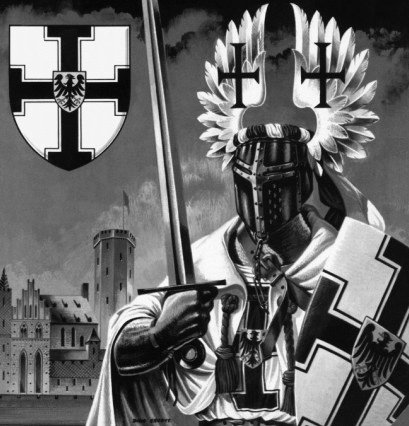
The Teutonic Knights

When one thinks of the old-fashioned image of a knight, one probably first thinks of the Knights Templar or other Crusaders fighting in the bleak lands of the Middle East, most of them being southern Europeans and, early on, even more specifically, predominately French. However, one of the three most famous crusading orders of knighthood had a very pronounced German flavor to it and that was the Teutonic Knights. Rather than fighting bandits and Muslim warriors in the burning sands of the Levant, the Teutonic Knights fought pagan barbarian tribes in the snow, ice and dark forests of the Baltic coast. Still, like the Knights Templar and the Knights of Malta, the origins of the Teutonic Knights can be traced back to the Holy Land as well. The Order of the Teutonic Knights of St Mary’s Hospital in Jerusalem was first formed to protect pilgrims and care for the sick and rose to prominence in Acre protecting the ports there in that last bastion of Christendom in the Middle East. It was recognized by Pope Celestine III in 1192 as an order of hospice monks using the Augustinian Rule and in 1198 it became a military order under the authority of a Grand Master.

Under the Grand Master Hermann von Salza the Teutonic Knights became more prominent as the Holy Roman Emperor (and sometime excommunicate) Frederick II, the “Wonder of the World” made the Grand Master a Prince of the Empire and when Emperor Frederick II came to the Church of the Holy Sepulchre to be crowned King of Jerusalem it was the Teutonic Knights that served as his escort. However, as the Middle East was completely conquered by Muslim forces the Teutonic Knights were forced to relocate, which they did to what might seem an unlikely place; Transylvania. In 1211 King Andrew II of Hungary employed the Teutonic Knights to defend Burzenland from the Cumens, a powerful warrior nation of nomads from the steppes of what is now southern Russia. This they did, bringing numerous German colonists with them, and they stayed until 1225 when their growing power combined with an effort to place themselves under the direct authority of Pope Honorius III caused the King of Hungary to expel them.

The Teutonic Knights wore a white garment with a black cross as their uniform and the black and white colors of the knights and their style of cross would become a long-established symbol in the history of the German and particularly the north German people and it all goes back to the Teutonic Knights. The black and white colors of Prussia, the decoration of the Iron Cross and even the symbol of the Federal German military today can all be traced back to the Teutonic Knights. In 1226 Duke Konrad I of Masovia, in what is now Poland, called upon the knights to defend his land from the pagan Prussians in the Baltic. So, for the next fifty years the Teutonic Knights fought fiercely but successfully in what became known as the conquest of Prussia. It was a long, bitter war that is not very well remembered today but one which was marked by extreme heroism on the part of the Teutonic Knights who fought usually against immense odds, facing the most horrific consequences if they were taken alive. History records knights captured by the pagans being roasted alive in their armor and offered as sacrifices to their pagan gods. They fought in bitter cold and in dark, dense forests and like most knights they built strong castles on this frontier of Christendom that were often islands of safety in a sea of pagan hostility.

Over time, however, the pagan tribes were defeated and the local nobles began to be converted to Christianity. This became the core of what would become the Prussian nobility. The Holy Roman Empire, in agreement with the Pope, eventually bestowed upon the Teutonic Knights political control over the area as a sovereign monastic state under the nominal authority of the Pope. Slowly but steadily these pagans who had practiced everything from polygamy to cannibalism were converted and civilized. Clinging to the Teutonic Knights for protection it was only natural that they grew to become something of a warrior race yet again but from then on of a Christian variety. More than defeating the pagan tribes outright in a climactic clash, these people were gradually assimilated into Christendom under the leadership of the Teutonic Knights. This was also aided by the colonization of the lands of the order by German, Belgian, Dutch and Scandinavian Christians.

Livonia (Estonia) and Lithuania were absorbed into the Teutonic Order as well as were parts of Poland that had not yet become Christian. The expansion into Lithuania, however, came only after a significant setback. Previously, the plan had been to convert/conquer the Russians. However, the Teutonic Knights suffered what was probably their most famous defeat at the “Battle of the Ice” in 1242 at the hands of Prince Alexander Nevsky of Novgorod (today recognized as a saint himself in the Russian Orthodox Church). So, after having their fingers burned by the Russians, the Teutonic Knights turned to Lithuania in a bitter war that lasted for most of two hundred years. Resentment can still be seen today, yet the sizeable minority of Baltic Germans in these countries can be traced back to these original campaigns of the Teutonic Knights. When their focus fell on Poland the Teutonic Knights captured Danzig, driving out the invading Brandenburgers in the process. There were plenty of sad events of great cruelty but few people consider these events in the context of a group of hardened warriors who had spent their lives fighting the most ferocious enemies Christendom had ever faced, peoples far more savage and barbaric than the worst of the Muslim enemies other knights had battled in the Holy Land.

In about the Fourteenth Century the Teutonic Knights reached their peak of power and influence with vast lands stretching across what is today northern Germany and Poland, Lithuania, Estonia and even parts of Sweden. However, the reason for their existence as a religious military order was rather undercut by the first union between Poland and Lithuania at the start of the rise to prominence of the Polish Jagiello dynasty. With that Lithuania became as firmly Christian as Poland and the Teutonic Knights were left with little to do. When the Poles and Lithuanians joined in attacking the order the Teutonic Knights suffered a terrible reverse (the battle of Tannenburg). Their capitol of Marienburg was besieged but successfully defended, nonetheless, the war was a devastating blow to the power and prestige of the order. Later, after the Protestant revolt, the Grand Master Albert of Brandenburg converted to Lutheranism in 1525 and he secularized the Order at which time his uncle, King Sigismund I of Poland, gave him control of the territory of the Teutonic Knights as the Duke of Prussia. This, of course, later became the Kingdom of Prussia which never lost the warrior tradition it had inherited from the Teutonic Order.

The Order of Teutonic Knights continued, of course, but it was never quite the same again. Over time, more and more lands were taken by other local rulers until the order was somewhat reorganized in 1531 under the Holy Roman Emperor Charles V after which a new headquarters was established in Wurttemberg. Protestants gained control of more and more of the lands of the Teutonic Order to the point that it existed almost in name only until it was finally abolished in 1809 by Napoleon Bonaparte who confiscated whatever was left. Some Teutonic Knights remained of course, mostly in Austria and the House of Hapsburg took control of the nominal leadership of the order and it continues to this day but only as a purely religious order with nothing other than the faith of the Catholic Church to connect it to those original warrior-monks who had fought off the pagan tribes of northern Europe on the frontier of Christendom. Nonetheless, they left a lasting legacy of which traces remain to this day in both the Christian presence that remains in the region of the old lands of the Order and in the symbols, colors and warrior traditions of many of the German people, growing out of the Kingdom of Prussia, prior to which was the Duchy of Prussia, prior to which had been the Order of the Teutonic Knights.

Wednesday, May 15, 2013

The Knights of Malta


Next to the Knights Templar, probably the most well known group of Crusader knights is the Knights of Malta, also known as the Hospitallers and the Knights of St John. Alongside the Templars they were one of the preeminent defenders of the Christian presence in the Holy Land, mostly the Latin Kingdom of Jerusalem. Their names come from the fact that St John the Baptist was their patron saint (hence, Knights of St John) and because they originally ran a hospital for Christian pilgrims in Jerusalem they became known as the Hospitallers. Later, after the fall of the Latin Kingdom of Jerusalem they took the name of whatever their base of operations was, particularly Rhodes and finally Malta. The Knights of St John were one of the earliest military orders, founded around 1099 in the aftermath of the First Crusade and the capture of Jerusalem by the Christian forces. As their name suggests, they got their start simply running a hospital, founded by Blessed Gerard Thom, a native of southern Italy (exactly where is disputed) who became guardian of a hospital built in Jerusalem. Eventually, the need for military protection became more evident as his organization grew until it was granted official sanction by Pope Paschall II in 1113. This was because pilgrims became more and more in need of armed escorts to ensure their safety throughout the region but, it is important to note, even when they became a specifically military religious order, the Knights Hospitaller never lost their commitment to their humanitarian medical role.

Like other religious military orders, the Knights Hospitaller had religious as well as military discipline to keep but they always maintained both a fighting arm and a medical arm to look after the sick and injured pilgrims. Even the most illustrious and high born knights were still expected to spend time caring for the most poor and destitute of the hospital. In fact, the earliest records of the Knights Hospitaller deal exclusively with their medical role and it is not until much later that we can find documents dealing with the rules and regulations for their soldierly role. The “uniform” was a black robe with a white 8-pointed cross; another symbol being a white cross on a red field to distinguish them from the Templars who displayed a red cross on a white field. There were three types of Knights Hospitaller; the military brothers, the medical brothers and the religious brothers or chaplains who were the clergymen attached to the order and loyal to the grand master of the order. On the battlefield, the Knights Hospitaller were quick to distinguish themselves as one of the most elite groups of soldiers of the Christian powers and their reputation spread throughout both the territories of Christendom as well as the Islamic lands. As they grew with their success the Knights Hospitaller established hospitals and fortified bases throughout the Holy Land with seven major castles and over a hundred smaller outposts throughout the region.

Eventually, however, the Muslim forces were able to come together and drive out the Christian presence from the Holy Land, conquering (or re-conquering) Jerusalem in 1187. The Knights Hospitaller relocated their main base to the County of Tripoli until the last Christian foothold in the Holy Land, Acre, was captured by the Muslims in 1291. It was at that point that the Knights Hospitaller withdrew to the island of Rhodes, after a brief stay on the Kingdom of Cyprus where they found the political atmosphere not to their liking. So, at that point, many began to refer to the order as the Knights of St John of Jerusalem of Rhodes. This took time though as Rhodes was then held by the Byzantine Empire (sometime ally and sometime enemy of the Latin Crusaders) and it took more than two years to conquer Rhodes and the surrounding islands which the Knights then held for some time thereafter. Once secure in their new base, the Knights won more battles and earned greater fame. They also got a considerable boost with the unfortunate dissolution of the Knights Templar, many of whom chose to continue their vocation by joining the Knights of St John.
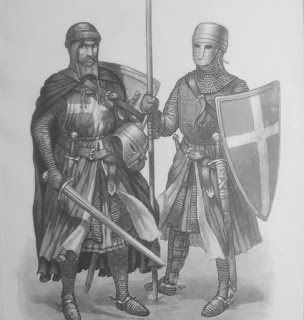
The Hospitallers became such a large and significant military order that they reflected almost the entirety of European Christendom in their ranks. Because of that the order was divided into “tongues” which were Aragon, Castile, Italy, France, Auvergne, Provence, England and Germany based on language. Obviously, as with much of the Crusades in general, the French presence was usually the largest but the ranks included knights from all across Christendom. They also attracted an increasingly illustrious membership with many members of the most old and noble families joining the order. One example of this was a member of the House of Savoy, which eventually became the Royal Family of Italy, and the motto of the Savoy comes from the ancestor who defended Rhodes with the Knights of St John and the Savoy arms of a white cross on a red shield are obviously those of the Knights of St John (or at the time, the Knights of Rhodes). During this time the military duties of the knights became increasingly dominant as a matter of necessity. Besides harassment from Barbary pirates, the Knights had to defend Rhodes from a number of Muslim invasions, defeating forces vastly greater than their own. Because this was rather embarrassing, the Ottoman Sultan made the eradication of the Knights of Rhodes a top priority and after conquering Constantinople in 1453 the Turks came after the knights with a vengeance.

In 1522 Sultan Suleiman the Magnificent sent an invasion force of 400 ships and more than 100,000 troops to conquer Rhodes which was defended by a scant 7,000 knights and their auxiliaries. Obviously, the odds were hopeless for the knights, but they fought with immense tenacity and held out for some six months before finally accepting the Turkish terms for surrender which allowed the survivors to evacuate to Sicily. The Knights were then homeless for a time until the King of Spain and Holy Roman Emperor Charles V granted the Knights the island of Malta in return for a rather unique annual rent payment which was a Maltese falcon to be paid to the Viceroy of Sicily every year on All Souls Day. Today, at least among film noir fans, “The Maltese Falcon” is quite famous even if few know exactly where it comes from. In any event, the move to Malta was of great benefit to the Knights, thereafter known as the Knights of Malta, who settled in and began to grow and strengthen again while still standing guard on the southern frontier of Europe to ward off the ever present Barbary pirates and the occasional Turkish offensive. The Ottoman Sultan was still determined to see the Knights of Malta eliminated and once they reappeared on Rhodes, Suleiman sent another invasion force against them.

This was the spearhead of what was planned as a major invasion of southern Europe. The idea was to conquer Malta, then Sicily and then to advance up the “boot” of Italy to capture Rome itself. Suleiman the Magnificent sent about 180 ships and 31,000 men against the Knights of Malta who numbered only 641 knights backed up by 8,000 auxiliaries. They were led by Grand Master Jean Parisot de la Valette who had himself spent a year as a slave in a Turkish galley. He had a religious process, led by the Blessed Sacrament, in La Valette (at least as it is now known) to invoke the help of God as the Turkish fleet approached. The attack began on May 18, 1565 and the Turks attacked with determined ferocity, at one point launching six attacks on the Christian walls in one day. However, despite taking terrible losses, the Knights and their companions just managed to hang on and repel each attack. They knew, again, the odds against them were hopeless, but they fought on while waiting for a Spanish fleet sent by King Philip II to come to their rescue. The battle was long, hard and desperate. Maltese civilians pelted the Turkish attackers with stones, taken from the rubble of the holes blasted in the walls by Turkish artillery. Women fought on the walls and children carried food and water to the fighting forces. Everything was in ruins, ammunition supplies were so exhausted that the Knights had to fire back the canon balls the Turks shot at them and eventually there were only 600 Christian defenders left alive. But, just as the Turks were preparing what would likely have been the final attack, the Spanish fleet arrived and the Turks, who had taken heavy losses themselves plus being weakened by sickness and the climate, withdrew.

This was undoubtedly the most famous battle and “finest hour” for the Knights of Malta but they carried on for quite a while afterwards. Because of their island location they became as much a naval power as they had been a cavalry force in the Holy Land. They sent ships to fight with the Christian fleet at the battle of Lepanto and their war galleys escorted Christian vessels in the Mediterranean to protect them from pirates and hostile powers. When money became scarce they began to hire out their ships to the navies of France and Spain. Money became an ever bigger problem, especially after the spread of Protestantism meant that many who had previously supported the Knights would no longer do so and many Catholics had other priorities closer to home to deal with and could no longer make their usual donations. So, the Knights of Malta adapted and despite being a Catholic order did their best to make friends with Protestant powers as well. The increase in mercenary work, usually for France, also meant that at times the Knights of Malta would be allied with their old enemies the Turks while fighting against the Catholic Spanish who had once been their saviors. Still, they did the best they could to survive and carry on. They remained secure on their island fortress of Malta until 1798 when the French forces of Napoleon Bonaparte conquered the island on their way to Egypt.

The Knights would never rule Malta again as, after the French occupation ended, the island would become part of the British Empire. Some of the Knights joined other orders, most simply waited for a new home to be provided for them as had happened in the past. One monarch who wanted to come to their rescue was Tsar Paul I of Russia who welcomed a large number of Knights to St Petersburg. He admired their traditions and sympathized with their plight. Catholic authorities were rather shocked when the knights in Russia elected the Tsar as their Grand Master and he founded a Russian establishment for the Knights of Malta that was open to all Christians rather than only Catholics (which was necessary for his new “job” as he, of course, was a devout Russian Orthodox). The Catholic Church did not and does not recognize the Grand Mastership of Tsar Paul as legitimate but the Russian establishment carried on for the rest of the life of the Russian Empire and even afterwards in the exile community. In Western Europe, the order was homeless and fatherless until 1879 when Pope Leo XIII appointed a new Grand Master and in 1834 it was more formally revised as the Sovereign Military Order of Malta, a purely humanitarian organization with nothing military about it aside from their traditional attire. This order was given a home in Rome and still exists today, including among its ranks a great many nobles, royals (mostly non-reigning royals unfortunately) and some of the most successful people in the world. However, they are really not the same as the knights of old and are purely a charitably organization which carries out and funds medical and social work.

Protestant countries founded several different orders inspired by the Knights of Malta and there are numerous groups which make use of the name, or some variant of it, with no real connection at all to the original order (much like the Knights Templar). The Sovereign Military Order of Malta is the only valid continuation but, again, it is for all intents and purposes something new. Among those royals who have been granted ranks in the Knights of Malta are King Juan Carlos I of Spain, Prince Albert II of Monaco, King Albert II of the Belgians, Grand Duke Henri of Luxembourg and Vittorio Emanuele Prince of Naples (former Crown Prince of Italy). There are over 10,000 members of the order around the world, membership is by invitation only and until recently was exclusive to the aristocracy. Today, however, the lower ranks are open to commoners while the higher still require an extensive pedigree.

Thursday, April 4, 2013

The Knights Templar


When it comes to knighthood, probably none are so iconic as the Knights Templar. Officially the Poor Fellow-Soldiers of Christ and of the Temple of Solomon, the Knights Templar were formed around 1119 in the Holy Land after the First Crusade to protect Christian pilgrims. The founder and first Grand Master was Hugues de Payens who received approval from King Baldwin II of the Latin Kingdom of Jerusalem to organize a specifically religious order of knights. Because the king gave them a wing of the royal palace for their headquarters that was situated above the former Temple of Solomon (over which had been built the Al-Aqsa Mosque) they took the name of the Poor Knights of Christ and the Temple of Solomon or Knights Templar for short. Their colors were a red cross on a white field and their symbol was two knights on one horse, illustrative of their poverty by sharing one mount. They were from the start an elite force, one of the first permanent military corps dedicated to the defense of the Latin Kingdom of Jerusalem and Christian pilgrims. They took monastic vows but were soldiers rather than monks. Sworn to a life of poverty, chastity and obedience, they were governed by religious discipline but devoted themselves to a military calling rather than a life of prayer.

St Bernard of Clairvaux praised the knights, and those like them that came later, as a new breed of warrior dedicated to the protection of the weak and innocent and the defense of the Holy Land. A Cistercian abbot, St Bernard had been an inspiration to the knights himself and Hugues de Payens and his chief lieutenants such as Godfrey de Saint-Omer (a relative of de Payens) and Andre de Montbard adopted the religious discipline of the rule of St Benedict. In 1129 the Catholic Church officially endorsed the Knights Templar at the Council of Troyes and in 1139 HH Pope Innocent II issued a papal bull which granted special favors to the knights such as being able to pass through all borders, exempted them from taxation and placed them solely under the authority of the Roman Pontiff. It is to be expected that some would paint this grant in a negative light but all of these were necessary favors. The Knights Templar were made of soldiers from various countries in Christendom and had to have freedom of movement, if they had not been exempted from taxation they would have been forced to abandon their vow of poverty to at least some degree to raise the money to pay the taxes and as far as being under the authority of the Pope alone, one need look no farther than the later sacking of Constantinople to see what crusaders were capable of when they went their own way rather than following the orders of the Roman Pontiff.

These men, whom St Bernard referred to as “Christ’s militia” quickly gained a very noble reputation for their austerity, discipline, care for the defenseless and unmatched tenacity in battle. Their service was also very much in need. Even after the First Crusade had restored the Holy Land to Christian rule (following the Muslim conquest of the region from the East Roman Empire) the Kingdom of Jerusalem was under almost constant threat and pilgrims were frequently harassed and murdered by marauding bandits (who were not solely Muslims). A permanent religious military corps to defend these pilgrims and to defend the wild frontiers of Christendom was very necessary and soon came to be seen as the special elite guard of Christendom. Among the Knights Templar were several ranks. First were the ordinary knights, effectively heavy cavalry, wearing chain mail and armor, armed with swords and lances; then there were the sergeants who were armed and equipped as light cavalry and served as what we would today call the enlisted men as opposed to the knights who held the position similar to what would be commissioned officers today. They were to assist the knights, often in “mopping up” operations after the heavily armed knights made their charge which invariably smashed enemy armies. Then there were non-combatant members such as the ‘serving brothers’ who often did things such as taking care of the paper work of the order, looked after their properties and so on. These men were often under the direction of a retired knight or sergeant who was no longer fit for combat and, finally, there were the chaplains who attended to the spiritual needs of the knights.

This administrative aspect grew rapidly in importance as the prestige of the Knights Templar rose. Because the Holy Land was constantly under threat and pilgrims constantly needed protection, military operations were almost always ongoing and funds were needed to maintain them. So, as lands were donated to the knights and as bases were set up for recruitment and logistical support across Christendom, in time the knights had extensive properties that had to be looked after. Also, because of their reputation for honesty and nobility, their strength and their vow of poverty, wealthy individuals increasingly handed over their money to the knights to keep safe for them. In time, the Knights Templar became, inadvertently, one of the largest banking networks Europe had ever known. Part of this was also encouraged by the knights to protect pilgrims. It took money, then as now, to go on pilgrimage and a pilgrim carrying large numbers of sacks of very heavy coins was a very tempting target for bandits. Therefore, to prevent this, pilgrims could take their money to a Templar office in their home country, hand over a certain amount of money and be given a note to take with them which would then be redeemed for the same amount once the pilgrim reached the Holy Land.

First and foremost, of course, the Knights Templar were a small, elite military force. So small and so elite that at their height there were only four hundred in Jerusalem, though they, of course, also had auxiliary forces that fought with them. However, they were still subject to the divisiveness and infighting that was problematic for the Latin Kingdom of Jerusalem as it was at various times for every power, Christian and Muslim alike. They suffered a terrible blow at the disastrous battle at the Horns of Hattin at the hands of the Sultan Saladin, one of the most gifted and successful Muslim leaders of the period. In the aftermath, Jerusalem fell, which the Christians later retook but it fell again not long after and remained in Muslim hands until the First World War. The Knights Templar were forced to relocate to the city of Acre but, after a heroically fought siege, it was taken by the Muslims in 1291 at which time the knights relocated again to Syria. This too was, in due course, conquered by Islam and the Knights Templar were forced to leave the Holy Land for the island of Cyprus. However, the larger Islamic counter-offensive continued over the years but, it is important to note, the reputation of the Knights Templar always remained pristine.

Illustrative of the fact that the Knights Templar were very much an elite force was the fact that their most rigid rule was that they could never surrender unless the Templar banner went down and even then they were required to regroup and fight on with another of the military orders such as the Knights Hospitaller (later better known as the Knights of Malta). They could only leave the field of battle after all military banners had fallen. The Knights Templar were invariably the best equipped and most heavily armed of all the Christian knights. They were so effective that there was no group of Christian knights more feared amongst their enemies than the Knights Templar who were invariably massacred if any were ever taken alive. However, their prowess on the battlefield and great reputation for honesty and integrity helped, in a way, to bring about their ultimate downfall. It was because of these very excellent qualities that the Knights Templar became more and more trusted and so became more and more wealthy as the elites of Christendom entrusted their financial security to the knights. As tends to happen (and we can certainly see it now) this brought about a growing jealousy against the Knights Templar on the part of those who were less successful and had, perhaps, mismanaged their own finances.

The situation became worse when they fell to the mercy of local rulers after being forced out of the Holy Land after losing their last foothold after 1300 when they had tried to make a comeback in alliance with the Mongol Empire that was crushing Muslim forces from the east. Forced to relocate across Europe, the Knights Templar continued in isolated groups, becoming ever more prosperous and incurring more and more envy from people like King Philip IV of France (aka “Philip the Fair” or handsome) the same monarch who famously clashed with Pope Boniface VIII, after whom a Frenchman was elected to the See of Rome and the papacy removed to Avignon in France. It did not help that King Philip IV had borrowed a great deal of money from the Knights Templar during his war with England and was not looking forward to paying it back. Getting rid of the Knights Templar would, therefore, erase his considerable debt and enrich him immensely from the seizure of their properties. Sadly, this is exactly what he set out to do. However, to suppress so powerful and prestigious a group as the Knights Templar, it was first necessary to smear them and sully their reputation by inventing and spreading all sorts of lies about the knights. This is where the fantastic stories about bizarre sexual rituals and even satanic practices came from.

Most of it was simply made up out of thin air but others were exaggerations (gross exaggerations) of a small kernel of truth. An example of this was the accusation of idolatry which, far from being sinister, may have been an exaggerated perversion of the deep veneration the Knights Templar had for the holy Shroud of Turin, which they had recovered and carefully preserved. In any event, just as he had previously done to the Jews in another cash-grab, Philip IV ordered the mass arrests of the Knights Templar on Friday the thirteenth of October 1307. Under horrific torture many of these men confessed to every horrible crime their captors dreamed up, recanting all of it later. However, that made no difference as Philip was more than willing to spread the stories of the horrible “confessions” of the Knights Templar and to begin pressing the Pope to dissolve the order. He also had as many as possible burned alive, including the last Grand Master of the order, the elderly Jacques de Molay. The Pope did finally dissolve the Knights Templar, their reputation having been falsely and maliciously but irretrievably ruined, but it is important to note that he found them “not guilty” of heresy and the many crimes they had been unjustly accused of prior to doing so.

That is something that is almost never talked about but Pope Clement V, seen by many as a creature of the French monarch, totally exonerated the Knights Templar. Some certainly had done wrong, just as with the membership of any organization, and some made mistakes at time, however, on the whole, there should be no doubt about the Knights Templar being honest, upright and fantastically effective soldiers for Christendom. Their downfall came about solely because of jealously on the part of those who always envy the successful and seek to tear down those who have achieved something. It is also often forgotten that in other countries where the Knights Templar had been put on trial (again by envious little men) they were found completely innocent. Most wanted to continue their work and after the suppression joined other military orders of knighthood. Their downfall was one of the great betrayals of history, and their name has been sullied in all the years since with disreputable groups appropriating their names and symbols or by simply being the stars in every sort of bizarre fiction and conspiracy theories. However, none of that should sully the reputation of the Knights Templar who were the elite shock troops of Christendom, models of chivalry and who exemplified the spiritual and military virtues of the true Christian soldier.

Monday, March 18, 2013

Knights and Knighthood Today


It may surprise some people who do not know very much about the subject just how extensive knighthood is today. While monarchy and aristocracy (or at least an aristocracy that is open and honest about itself) is increasingly rare, orders of knighthood still about around the world with even republics getting in on the game. However, gratifying as it might be to just leave it at that, we must face the facts about the current situation. Anyone looking at the situation today should accept the truth that practically none of the orders of knighthood that exist today have anything in common with the knighthoods of old, even if they are still some of the same orders. Their ideals and trappings may seem just as noble as they did in years past but, effectively, most are little more than clubs for the elite today with membership based on who you know rather than what you are or have done or on the size of your bank account rather than your courage or character. That certainly does not mean that every member of an order of knighthood today is unworthy, I would certainly never suggest such a thing, but simply being a “knight” today does not mean the same thing that it did in the time of the Crusades or the High Middle Ages even. As someone once said on one of my favorite television shows, “Elton John is a knight, it’s not what it used to be”.

Thankfully, people like pop stars, comedians and media personalities are generally restricted to the lowest orders of knighthood, though even that is rather ridiculous considering that someone like a movie star will receive a knighthood while someone serving in combat in the military is not. However, even the highest ranks, such as in the United Kingdom for example (being the most prominent monarchy in the world) are often given to retired politicians regardless of whether or not they accomplished anything significant or not. Giving it to one compels that it be given to all the others, I suppose, is the thinking behind this so that the monarch cannot be accused of having any favorites. The situation is even worse when it comes to non-reigning royals and the orders of knighthood associated with their particular house, as such heirs are often targeted and taken advantage of by dishonest and vain individuals who are simply out to swindle as many such appointments as possible, presumably to massage their ego. Personally, I cannot understand that mentality. After all, one could hardly take much pride in such an award and if one just likes to have lots of gongs and ribbons hanging off of them, you can dress up in whatever decorations you like and no one can stop you.

Originally, of course, knighthood was exclusively associated with combat and military service. A knight was a warrior who protected the weak and innocent against those who would molest them. Some, which required great sacrifices and which carried great risks in its service, were open to anyone. If you wanted to become a knight, you simply ‘signed up’ as it were and began working your way up the ranks. Usually, though, if the order survived for long it tended to be restricted to only men from the most elite families and an appropriately prestigious genealogical pedigree would be required for membership. Today, most orders not under the rule of a national government, have membership which is by invitation only. Again, this effectively means, it is not what you do but rather who you know that is the determining factor. Because of this, it is simply not possible for me to see modern orders of knighthood in the same light as those of long ago. This applies, unfortunately, as much to purely religious orders of knighthood such as the papal orders. For example, Rupert Murdoch (republican sleaze-peddler) was made a knight of the Order of St Gregory the Great in 1998, even though he is not Catholic but he did donate over $10 million to the Catholic Church in Los Angeles, California (disgraced Cardinal Roger Mahony recommended him for it, if that matters to anyone). Similarly, John Wilkins, editor of “The Tablet” which voiced support for contraception, women priests, homosexual acceptance and so on, was made a knight of the Order of St Sylvester I.

This is all something which has to be seen in context of course. Orders such as the Knights of St John, the Knights of Malta, the Knights of the Holy Sepulcher and so on do a tremendous amount of good around the world. To do that, obviously, requires a great deal of money and so it is, perhaps, not so surprising that some extremely wealthy people who perhaps have not exhibited the most upstanding moral behavior throughout their lives, are awarded membership. This includes some royals, whose names I will not mention, but who certainly do not seem to be very religious people who are nonetheless awarded lofty ranks in these orders of knighthood, all of them religiously based, presumably to gain some public attention and some hefty donations; which is not necessarily bad as these orders do a great deal of good work around the world as has been said. They are, however, very clearly not what they used to be and could be seen in the same way as modern monarchies with established churches. England, for example, is legally a Christian monarchy yet this is actually more like a technicality these days. It can in no way compare to the Christian monarchies of the past, yet the technicality is worth clinging to as both a reminder of what was and as a foundation for any hope of restoration.

In the future, we will be looking at some of the more famous orders of knighthood from history as knighthood is something inexorably bound up with monarchy in the popular imagination. Those we will be reviewing were very much the genuine articles and a far cry from the often merely political institutions of today. The facts should be looked at clearly though, both to discourage those (and they do exist) whose attachment to monarchy is dependent on their fascination with baubles and to show what these orders have been capable of and, were they to embrace the zeal and discipline of their origins, could be again.
Related Posts Plugin for WordPress, Blogger...