Showing posts with label story. Show all posts

Saturday, November 4, 2017

Story of Monarchy: The Byzantine Empire

Although it is a subject of great interest to me, I have been put off from talking about the Byzantine Empire because, in the past, it has invariably aroused bitter partisan vitriol that is completely unhelpful at best and detrimental at worst. Nonetheless, I can refrain no longer because this is an extremely important subject that people really need to know more about. Obviously, this post will only be a very general overview of the Byzantine Empire but I think it is necessary and anyone can look up particular items in greater detail on your own. Western civilization would likely not exist at all were it not for the Byzantine Empire and an important point to make at the outset is to emphasize that the Byzantine Empire is simply another word for the continuation of the East Roman Empire and the Roman Empire is absolutely essential and foundational for the entirety of western civilization. Certainly, Eastern Europe owes the most to the Byzantine Empire but Western Europe likewise owes an immense debt to the Eastern Roman Empire and neither would be what they are today without it.

Byzantine throne room
The Byzantine Empire, formally the East Roman Empire, was also known as the Later Roman Empire and, occasionally, the Greek Empire but it is important to note that the Byzantines themselves did not refer to themselves as “Byzantines” but as “Romans”. The name comes from the city of Byzantium on the Bosporus which dates to the 500’s BC. Originally Greek, when it was conquered by the Romans in the 100’s BC it became a relatively prosperous trading center until it was leveled and partially rebuilt by Emperor Septimius Severus. One could date the birth of the Byzantine Empire as far back as 293 AD when Emperor Diocletian first divided the Roman Empire into eastern and western halves, making his capital in the east at Nicomedia in Asia Minor (modern Turkey). However, the “Founding Father” of the Byzantine Empire is not usually considered to be Diocletian but Emperor Constantine the Great, the first Christian Roman emperor, who moved the imperial capital to Byzantium, renaming it Constantinople. Although the city of Rome would remain important for some time to come, from this point on Rome was eclipsed by Constantinople as the center of Roman wealth and power.

Tim Curry as Emperor Theodosius II
Emperor Constantine I ruled the entire Roman Empire and was succeeded by his three sons but the division between east and west returned. However, Emperor Theodosius I again ruled the whole empire himself, the last monarch to do so. It was also Emperor Theodosius who made Christianity the sole and official religion of the empire. After his death, Emperor Honorius ruled the west and Emperor Arcadius ruled the east. During this period, the West Roman Empire was repeatedly attacked by barbarian tribes, Alaric the Goth sacking Rome itself in 410 but the East Roman Empire carried on secure and prosperous by comparison. Emperor Arcadius was not the best monarch one could hope for but he was succeeded by a more able man, his son Emperor Theodosius II. From 408 to 450 Emperor Theodosius II ruled and ruled quite well, all things considered. He had wars in the east and rampaging Huns to deal with but he built immensely strong fortifications around Constantinople that proved invaluable, built a university there and established the Theodosian Code by reforming the existing laws. In his reign the East Roman Empire began to look like the united Roman Empire of old and seemed the more worthy successor to it than the battered west. Not long after his time, in 476, the West Roman Empire ceased to exist altogether, leaving the Byzantine Empire as the last Roman Empire standing.

This is important to remember, particularly for people in the west, because so many of the east-west, Catholic-Orthodox problems really date back to this point in history. People in the west need to understand, setting aside the religious disputes, that it was at this point that the Pope in Rome became much more significant and eventually a political as well as religious figure. However, all too often religion was used as cover for what were basically political disputes and the fact is that the Byzantine Emperors understandably considered themselves the legitimate rulers of the entire Roman world once the last Western Roman Emperor was forced from power. The religious differences between the Catholic and Orthodox Churches are what they are but people in the west really should understand that it was not an illegitimate or unreasonable position for the Eastern Roman Emperor to consider himself the rightful monarch of the west as well once the west no longer had an emperor at all (in fact the Byzantines regarded Julius Nepos as the last Western Emperor as they had never recognized Romulus Augustulus). Many of the east-west tensions really come down to this basic, political and non-religious point; that there were people in the west with newly conquered lands and subjects who did not want the Emperor in Constantinople telling them what to do.

Emperor Justinian
The final, east-west religious break would not happen for some time, which is well enough as the religious situation was, by all accounts, frankly, a confusing mess with both sides having plenty of fashionable heresies to deal with. However, what is generally recognized as the “Golden Age” of the Byzantine Empire came with the ambitious reign of Emperor Justinian I, starting in 527. He was an able man and determined to see the Roman Empire restored to its former glory even if that mean reconquering the west entirely. It helped that he was an able military leader and it helped even more that he had one of the greatest military geniuses of the time to call upon in the person of his general Belisarius. Ever present threats remained to the east such as the Persians and the Arabs but Emperor Justinian fought battles to re-take the western empire, winning against the Vandals in Africa, the Ostrogoths in Italy and the Visigoths in Spain. Emperor Justinian had just about made the Mediterranean a ‘Roman lake’ once again while at the same time driving back the Persians on the eastern frontier.

Justinian & Theodora
Emperor Justinian had his problems with the Church of course but, in all fairness, the Church was having plenty of problems with itself at this time, the empire was wealthy and prosperous and the Emperor published a new, more complete, edition of the Roman law code which has since been known as the Justinian Code. The Emperor also oversaw the construction of the magnificent Church of Saint Sophia or Hagia Sophia in Constantinople which was one of the architectural wonders of Christendom. It may not seem quite so impressive from the outside but the interior, particularly in its former glory days, was astonishingly magnificent. There had never been a church like it before. Unfortunately, such building projects and unending military campaigns also left the Byzantine treasury basically empty by the end of the reign of Justinian. His passing was, in a way, the end of an era as he was the last Byzantine emperor to speak Latin and this, as well as his preservation of many old, Roman traditions, has caused some in the east to take a rather negative view of him as their hatred for anything western, Latin and/or Roman dominates their entire thinking. Justinian was not perfect as no mere mortal can be but he undoubtedly came closer than any other Eastern Emperor to restoring the entirety of the Western Roman Empire to Byzantine rule. Nonetheless, by the time he died, the government was bankrupt and the public rather put off, particularly regarding the many schemes of his ambitious wife Empress Theodora.

Emperor Maurice
The period which followed was one of seemingly constant crisis for the Empire. From 565 to 578 Emperor Justin II had to deal with barbarian invasions from practically every direction. The Germans were invading in the west, the Lombards were charging into Italy, the Avars, Slavs and Bulgars were attacking into the Balkans while in the east the Persians were back on the offensive as well. However, internal power struggles would remain a problem and this is why the very word “Byzantine” has become synonymous with devious plots and palace intrigue. Emperor Maurice, for example, had great success in fighting back against the Persians and against the Avars in the Balkans, pushing beyond the Danube for the first time in centuries and took steps to maintain footholds in Italy and Africa. However, he was assassinated in 602 along with all six of his sons by an ambitious general after which disastrous war with Persia broke out anew. They made repeated advances until finally being stopped by Emperor Heraclius who reigned from 610 to 641. However, a new threat arose which changed everything when Islam sprang up among the Arabs and a wave of Muslim conquests assailed the Byzantine Empire. Palestine and Syria fell in 636, Egypt in 640 and Armenia in 654. Muslim forces besieged Constantinople itself from 673 to 678 and from 717 to 718 but were held off thanks to the immense fortifications ringing the city which previous emperors had wisely invested in. Around Constantinople, however, Muslim conquests continued with Crete and Sicily falling in the 820’s.

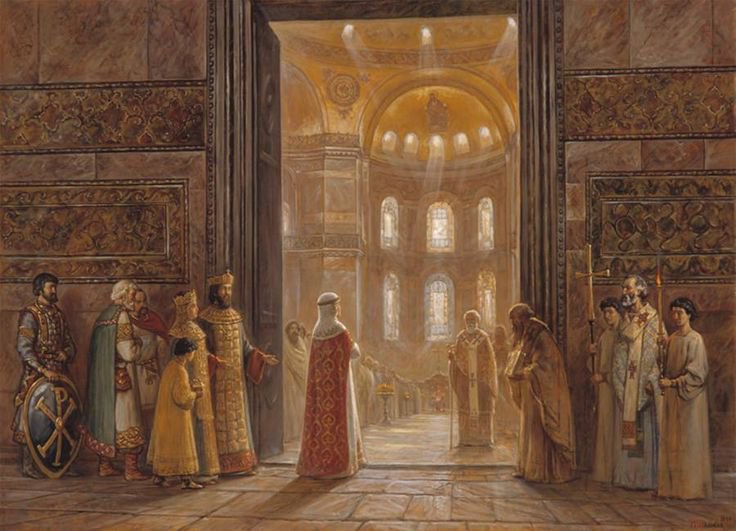
St Olga enters the Church of Holy Wisdom
Constantinople remained the center of classical culture but these setbacks have also given rise to some confusion with many of the medical, scientific and other advances often attributed to the Arabs actually being the product of classical Greek and Roman scholars preserved by the Byzantines but seized by the Muslims during their conquests of East Roman centers of learning such as Alexandria, Egypt. Even in these troubled times, the Byzantine Empire also still had a civilizing, cultural influence in the east, just as the West Roman Empire had done on barbarians in their neighborhood. Christianity as today practiced in the Eastern Orthodox Churches was the most visible part of the East Roman culture spread by the Byzantine Empire throughout Eastern Europe. The South Slavs and Bulgarians were converted but the most significant was the conversion of Russia in the 800’s. St Olga, Princess and Regent of the Kievan-Rus converted to Christianity and was received into the church in Constantinople during the reign of Emperor Constantine VII. She took the faith back to her home and her grandson, Vladimir the Great, would make Christianity the official religion of the Russians which it remained up until the downfall of the Romanov dynasty in 1917.

The Byzantine Empire stands as rather persuasive proof that the fall of the Western Roman Empire was not inevitable as the Eastern Roman Empire carried on, seemed more than once on the brink of collapse but revived again. This occurred in the 800’s as the Byzantine Empire started to recover its old prosperity, fighting spirit and began to take back her conquered territories. The Muslim invaders were driven back, the Balkans was brought back under imperial rule and Constantinople was once again the center of great wealth and opportunity. Trade boomed and Italian merchants began making alliances with the Byzantine Empire because friendship and trade with them was so much more profitable than in the west. The peak was probably reached under Emperor Basil II, known as “the Bulgar-Slayer” who made a marriage alliance with the Russians, conquered Bulgaria, recovered Armenia and halted Muslim incursions. Art, religion, learning all seemed to have their best flowerings in Constantinople during this time. It was a sad occasion when Basil II passed away in 1025. Leadership problems followed, fights over the throne and this, of course, gave an opportunity for the enemies of the empire to advance. Some measure of stability was recovered with the rise of the Komnenos Dynasty but they had huge problems to deal with.

Godfrey de Bouillon pledges allegiance to Emp. Alexius
A major new problem, that ultimately would never go away, was the appearance of the Seljuk Turks riding in from central Asia. They quickly surpassed the Arabs as the primary Islamic threat to the Byzantine Empire. In 1071 at the pivotal Battle of Manzikert the Byzantine army was smashed by the Turks and Asia Minor completely laid open to them. Faced with overwhelming enemy forces, Emperor Alexius decided to look to the west and call on the Latin Christians for help. Pope Urban II answered by calling the First Crusade for the knights of western Europe to rush to the defense of Christendom against the Muslim invaders. The primary leader of the First Crusade was Godfrey de Bouillon and, while passing through Constantinople, Emperor Alexius had Godfrey and the leaders of the other crusader armies as they came, pledge allegiance to him and to reiterate than all lands they took back from the Muslims would belong to the Byzantine Empire. Not all of the Crusaders took kindly to this, which is understandable as they did the fighting and so expected to receive something in return for their efforts. The result was the establishment of Crusader states, primarily the Latin Kingdom of Jerusalem, who might nominally do obeisance to the Byzantine Emperor and who tended to adopt Byzantine style for their court life but who basically operated according to the western, feudal system as masters of their own lands with plenty of acrimony and accusations between the Latin Crusaders and their nominal Byzantine overseers.

Emp. John II & Irene of Hungary
The truth is that neither side was perfect in keeping their agreements but this period did see the most east-west cooperation in years. Emperor Alexius was succeeded, in 1118, by his son Emperor John II who married Princess Irene of Hungary. His reign was dominated with trying to repair the damage inflicted on the empire since the disaster at Manzikert. He dealt with the Serbs and Hungarians to the north, part of the settlement of which was his marriage to Irene who converted to the Orthodox Church and has since been recognized as a saint. He was known for his patronage of the church and for taking to the field himself to deal with the Turkish threat from the east, fighting and winning many battles and establishing fortified towns and outposts along the way to prevent future incursions. He succeeded in taking back the initiative in this war, reaching as far as Tarsus. The empire prospered during his reign and the population grew remarkably. However, when he determined to march into the Islamic occupied area of Syria he met only frustration as cooperation with the western Crusader forces failed to materialize. He also had problems with the Italians of Venice and all of these problems were to reemerge as far larger problems in the future.

Emperor Manuel I
For the time being, however, things seemed to be going much better. John II was succeeded by his youngest son Emperor Manuel I in 1143. He made an alliance with the Pope, oversaw the passage of the Second Crusade, joined them in an invasion of Egypt, managed to keep control of the Balkans and made Hungary and the Crusader states Byzantine protectorates. In that regard, he had succeeded where his father had failed, was referred to as “Manuel the Great” by the Greek population and even earned considerable praise from the Latin west as the “most blessed emperor of Constantinople”. This is, again, important to keep in mind because it shows that the Byzantine Empire was not just hanging by a thread or stumbling toward its inevitable doom after the western collapse. It had its periods of crisis but, under able leadership, was shown repeatedly to be capable of coming back and rising again to prominence. The reign of Emperor Manuel also shows that the introduction of the Crusaders into the equation was not something that was completely unmanageable and that the Latins and the Byzantines were capable of putting aside their differences and making common cause for the greater good of Christendom. Emperor Manuel took advantage of the rebellions against the Normans in Sicily to launch an invasion of southern Italy which initially had great success despite being too late to take part in a joint venture with German Emperor Frederick Barbarossa as he had planned. He made an alliance with Pope Adrian IV against the Normans and for a time saw hope of restoring the old Roman Empire, reuniting east and west. Unfortunately, this did not happen as the Emperor would not agree to accept papal supremacy over the eastern Christians nor would the Pope accept imperial political control over the west.

Divine Liturgy in Hagia Sophia
By the time of his death, the Byzantine Empire was prosperous, larger than before, more respected than before and one of the major world powers of the time. However, factions and conspiracies at court remained, enemies on the frontier looked for their chance and relations with Venice, the most important Byzantine ally in the west, had again broken down. It would take a strong monarch to carry on and, unfortunately, his son was a minor when raised to the throne, the regency was unpopular and soon court intrigue brought about the downfall of the boy and another period of political instability followed. The next seven emperors all met unhappy ends, six being murdered and one dying in captivity. Everything came to ruin with the Fourth Crusade of 1203, called by Pope Innocent III who wanted to invade Egypt, seeing it as the ‘soft underbelly’ of the Islamic domains. However, the Crusaders were diverted to retake a city on the Adriatic by the Republic of Venice as payment for ferrying them to Africa. Unfortunately, they never made it to Africa as they met with the deposed Byzantine Emperor Alexius IV Angelus who promised to pay for their ships, religiously reunite east and west and contribute large forces to the Crusade if they would restore him to his throne. They agreed and instead of going to Egypt attacked Constantinople.

This turned out to be a very brutal affair, partly because of the earlier “Massacre of the Latins”, longstanding east-west disputes and the discovery that none of the money or men the Crusaders had been promised existed. In 1204 Constantinople was ransacked on a large scale and quite devastated. Baldwin of Flanders was chosen to be Latin Emperor of the East by his fellow Crusaders, the east-west schism was declared over and the lands of Asia Minor were divided among various Greek rulers with the Crusaders becoming feudal lords of the more choice remnants of the Byzantine Empire. This was a very traumatic event and something that many if not most Eastern Orthodox Christians have yet to get over. The Latin Empire of Constantinople did not last too long with the Greeks, Turks and Bulgars all rising up against it on various fronts. It is, frankly, rather remarkable that it lasted for 57 years under such circumstances. The ideal of the Byzantine Empire as it had been was also not forgotten and in 1261 the last Imperial Dynasty came to power when Michael Palaeologus, a general and imperial relative in the employ of the Greek ruler at Nicaea, overthrew the Latin Empire and reclaimed Constantinople, banning all Latin and restoring the previous Byzantine traditions and ceremonies. Efforts by the Crusaders to restore their domains failed and the Byzantine Empire was once again a force to be reckoned with.

Emperor Constantine XI
Unfortunately, though Emperor Michael VIII, began to rebuild and repopulate Constantinople, the Byzantine Empire, having been broken up, was hard to put back together and would never be as strong as it had been before. Likewise, once the western enemy was gone, the eastern Christians soon began warring against each other again as well, all of which served the interests of the Turks quite nicely. In Asia Minor the Turks were on the advance while in the Balkans the Serbians were attacking and taking ground. The fact that the Christians did not stick together allowed the Turks to gain their own foothold in the Balkans and soon the city of Constantinople was an island in a Turkish sea. It was only thanks to the impressive, monumental, double fortifications around the city and her ingenious naval defenses that kept Constantinople out of enemy hands even though, eventually, the Byzantine Empire included very little beyond the walls of the city itself. There was also a sense of apathy that seemed to take hold of the populace as when the city was again besieged by massive Islamic armies led by Sultan Mehmed II, nicknamed “the Blood Drinker” which doesn’t make him sound like the nicest fellow, only 5,000 men, about 5% of the population could bestir themselves to take up arms in their own defense. This meant that nearly half of the defenders, about 3,000 of them, were western mercenaries, predominately Italian and Spanish with Giovanni Giustiniani (an Italian obviously) named top military commander by Emperor Constantine XI.

Emperor Constantine XI did the best he could under the most hopeless of circumstances. When the Turkish artillery finally breached the walls on May 29, 1453 and the end was eminent, he hurled himself into the enemy ranks and was never seen again, giving rise to a popular legend that he was rescued by an angel, turned to stone and hidden away to be brought back to life later and retake the city for Christendom. It is a story reminiscent of those of King Arthur in England or Frederick Barbarossa in Germany and shows just how much of an impact his heroic sacrifice had on his people. Despite repeated calls for a crusade to retake the city by a number of popes, this proved to be the end of the Byzantine Empire. The Turks turned the Hagia Sophia into a mosque and, initially, made the city the capital of their Ottoman Empire. Eventually, the Ottoman Empire would fall as well but the Turks still maintain control of Asia Minor, the “Golden Horn” and the city of Constantine. Today this is so taken for granted that few even think about it.

14th Century Byzantine flag
The Eastern Roman Empire, however, is something everyone should think about, in the west as well as the east. It certainly had many problems and was notorious for its conspiracies and palace intrigues, however, while the Western Roman Empire fell in 476, the Eastern Roman Empire survived until 1453 and that is something that cannot be shrugged off or dismissed out of hand. For Eastern Europe, the Byzantine Empire was the source of faith, culture and, originally at least, royal legitimacy. For the west, it was the bulwark on the frontier of Christendom that kept very powerful and highly organized enemies from ravaging the continent. Does anyone think that the Persians would not have continued on into Greece as their ancient forefathers had done if the Byzantine Empire had not stopped them? The initial Arab Islamic conquests that swept across north Africa could have easily reached Germany, even Britain or Scandinavia if the Byzantines had not stood in the way. The Turks ultimately gained control of much of the Balkans in their conquests but consider how much more they could have gained without Constantinople blocking their path.

Constantinople as an imperial capital
Western Civilization would likely not exist without the Byzantine Empire and not only because it stood as a barrier against invasion. The Christian religion of the empire, the Roman laws, the Greek culture that came together there served as a gateway from the classical world to the modern world. The Eastern Orthodox Churches and those of the Byzantine-rite of the Catholic Church come down to us from the empire, its learning and the learning it preserved was rediscovered during the Renaissance leading to many advances and its famous artistic style was copied early on and into the Italian Renaissance with numerous churches in Ravenna, Italy and St Mark’s Cathedral in Venice as obvious examples. Byzantine art and architecture also had a tremendous impact on Russia which can still be seen today. The Byzantine Empire was one half and the longer lived half of the Roman Empire which was the foundation of European civilization as we know it. As the kingdoms of France, Spain or Germany looked to Rome, so too did those of Serbia, Greece, Bulgaria and Russia look to Constantinople. We cannot allow it to be forgotten.

Thursday, February 16, 2017

Story of Monarchy: The Kingdom of Denmark

In all the monarchies of the western world, none can match the longevity of the Danes. The venerable Danish monarchy can boast of having the longest unbroken hereditary succession in the world other than Japan. As such, the history of Denmark stretches back to traceless antiquity. Scientists have found evidence of human habitation in Denmark going back 11,000 years though very little is known about the people that lived there at that time other than that they survived by hunting and fishing. With the fall of the Western Roman Empire and the onset of the “Dark Ages” things began to become more exciting for the people of Denmark who, under their various chieftains, struck out on Viking raids into neighboring countries. In the 800’s Danish Vikings conquered most of southern England while others conquered and settled on the northern coast of France. Referred to as the “Northmen” or Normans, this area has since been known as Normandy. These Danes were Vikings but eventually adopted French culture, mixed with the local population and converted to Christianity.

Sweyn Forkbeard
About the year 950 AD the Danes were finally united into one country by a chieftain known as Harald Bluetooth. It was his son, Sweyn Forkbeard (and you have to love those Viking names) who led the Danish conquest of England which was completed by 1013. King Sweyn Forkbeard was, in turn, succeeded by his son King Canute the Great who conquered Norway in 1028. This represented a high point in Danish history but it was to be rather short-lived. After the death of King Canute the Great things began to come apart, aided in so small part by the fact that various chieftains battled over the throne. While civil war prevailed at home, Denmark lost control of England and Norway as well as other territorial holdings outside Denmark itself. However, when your history is as long as that of the Kingdom of Denmark, there is time for more than one high point and, in a way that seems rather foreign to people today, the Danes were not deterred by these setbacks and as soon as the domestic problems were settled, began to expand again to build another era of power and glory for their country.

A new Danish empire stretching across the shores of the Baltic Sea was established by two particularly powerful monarchs with the same name; King Valdemar the Great (1131-1182) and King Valdemar the Victorious (1170-1241). Thanks to their successful campaigns, the lands of the Kingdom of Denmark stretched across much of northern Germany, the island of Gotland and east to what is now Estonia. It was also King Valdemar the Victorious who gave Denmark its first legal system known as the “Jutland Code”. This law code was to remain in effect in Denmark until 1683 and influenced subsequent Danish law codes far beyond that. However, the Danish empire built by the two Valdemars eventually met its match with the rise of the German merchant city-states that banded together in the Hanseatic League. Denmark lost most of its continental possessions to the League as well as absorbing an amount of German customs due to proximity and close interaction. But, you can’t keep a good Dane down and as the 1200’s gave way to the 1300’s the Kingdom of Denmark began to rise again.

Queen Margaret I
The island of Iceland became a Danish possession in 1380 and would remain such until the middle of the last century. The late 1300’s also saw the emergence of one of the most famous and formidable characters in Danish royal history; Queen Margaret (1353-1412). During her time on the Danish throne, Queen Margaret was able to unite under her rule all of Denmark, Norway and Sweden by 1397. These countries did not become Danish possessions but retained their own national governments. They were, however, united in personal union with Queen Margaret of Denmark. This union of the Scandinavian countries survived Queen Margaret but not by much. It began to come apart when the Swedish nobility rebelled against King Christian II of Denmark (1481-1559) and the Swedes succeeded in winning their independence from the Danish crown in 1523.

Baptism of Bluetooth
On the religious front, the beginning of Christianity in Denmark dates back to our old friend King Harald Bluetooth. There are conflicting accounts as to how exactly it happened but all agree that King Harald Bluetooth was the first to convert to Christianity and was the first Catholic monarch of Denmark. He even had his father, Gorm the Old, (honored as the originator of the Danish monarchy) removed from the old pagan burial mound and reburied in a church. King Harald Bluetooth helped to spread Christianity though it would take some time before the faith was accepted in Norway and Sweden. However, eventually it was and Denmark was a Catholic country as were Norway and Sweden. So firmly were these lands a part of the wider Christendom that Christian knights from the most distant northern land of Norway even participated in the Crusades to retake the Holy Land from the Muslims. However, by the sixteenth century, religious changes arrived in Denmark and were to change the course of Danish history.

King Christian III
In 1536 King Christian III of Denmark (1503-1559) became a Protestant, adopting Lutheranism and making the Lutheran church the official state religion of the Kingdom of Denmark. Prior to this, as elsewhere, the Catholic Church held extensive properties and assets in Denmark. When King Christian III embraced the Protestant cause, he seized all of these assets for the Crown of Denmark and in so doing greatly increased the wealth and power of the Danish monarchy. This also, of course, separated Denmark from the countries of Catholic Christendom but it did not mean peace and tranquility with the Protestant powers either as this was followed by a long period of conflict with the Kingdom of Sweden which had also become officially Lutheran as well. For most of the next two hundred years Denmark and Sweden were often at war. The Danes were trying to force Sweden back into the personal union with Denmark while the Swedes were growing more powerful and ambitious and wished to secure control of the Baltic shores and to obtain an outlet to the North Sea and Atlantic Ocean. Denmark and Norway stood in the way of this goal and frequent warfare ensued. The fighting was fierce but between 1649 and 1660 the Swedes succeeded in gaining access to the ocean and expelling the last Danish footholds from the Swedish mainland. Over the next two centuries the Danes would fight to regain the territory lost to Sweden with the situation not really calming down until the Napoleonic Wars.

The defeats at the hands of Sweden were certainly demoralizing but they did prove rather beneficial for the Danish monarchy. The nobility of Denmark had been devastated by the wars with Sweden and this gave rise to the middle classes increasing their power and eliminated the nobility as a major rival for power with the King. The middle classes wanted stability and the opportunity to advance themselves and so joined with the King in opposition to the aristocracy and so it was that in 1660 King Frederick III (1609-1670) made the Kingdom of Denmark an absolute monarchy and, officially, a hereditary monarchy. In the old days, the monarchy was elective but effectively hereditary as the eldest son of the previous monarch was invariably chosen to be the next king but Frederick III made this official. Even modern historians have had to admit that royal absolutism benefited Denmark.

King Frederick VI
Absolute monarchy brought greater stability to Denmark which in turn brought about a flourishing of commerce and, with the increased wealth, also a flourishing of the arts as monarchs sponsored great artists. In 1721 the Danes settled Greenland and in 1788 serfdom was abolished in Denmark by King Christian VII (1749-1808), though as most regarded him as quite insane, it was actually his doctor and later brother and regent who produced these changes. The end of serfdom meant the end of the huge estates which hurt the economy in the short term but eventually led to improvements in farming that benefited the country as a whole. It was under the regent, later King Frederick VI (1768-1839), that the Napoleonic Wars first came to Denmark when the British launched two attacks on Copenhagen, in 1801 and 1807, to stop Denmark from trading with France and frightening Sweden, Prussia and Russia away from the same. A period of hostility between Britain and Denmark ensued with the British taking the view that Denmark was essentially taking the side of France and, as such, when Napoleon was ultimately defeated, Denmark would have to pay a price as well to the victorious allies. In 1814 the Kingdom of Denmark was forced to hand over Norway to the Kingdom of Sweden as their compensation for the Swedes giving Finland to Russia.

Like the country as a whole, King Frederick VI was embittered by this loss and a gloomy mood seemed to hang over Denmark in the aftermath. The King abandoned the tentative liberalism of his youth and turned hard reactionary though he did allow for consultative assemblies on the local level. This, however, produced two problems in the decades that followed; disputes between the Danes and Germans in the Schleswig-Holstein region and increasing demands for even more democracy and representative government in Denmark. The absolute monarchy came to an end in Denmark with King Frederick VII (1808-1863) who signed a new constitution that allowed for the creation of a Danish parliament and made Denmark a constitutional monarchy in 1849. There was also the growing crisis over Schleswig-Holstein to deal with. Did the new constitution apply to these areas? To make matters worse, these lands were becoming of greater interest to the Germans at a time when the Prussians were starting to move to displace the Austrians as the dominant power in the German-speaking community.

Victorious Danish troops
Schleswig was a Danish dependency while Holstein was a German dependency but both were ruled by the Crown of Denmark. The Germans in Holstein wanted not only their own territory but Schleswig as well to be part of the German Confederation (the presidency of which was held by the Austrian House of Habsburg). In 1848 Holstein and southern Schleswig finally rose up in open revolt against Denmark. The Prussians and later the Austrians gave aid to the rebels in their fight against the Danes. The result was the First War of Schleswig of 1848-1851 and later the Second Schleswig War of 1864. In the first war, despite the rebels being aided by the German Confederation (primarily Prussia), the Kingdom of Denmark was victorious. Some people in Norway and Sweden volunteered to fight for Denmark because of their fear of the growing power and expansion of the Germans at the expense of a Nordic neighbor.

Danish attack in the Second Schleswig War
The second war, in 1864, was generally a hopeless fight as both the Kingdom of Prussia and the Austrian Empire aligned against the Kingdom of Denmark. Not only were the Danes hopelessly outmatched by the relatively new Danish politicians interfered with the army in how to conduct the war, leading to the Danish forces being poorly deployed to repel the German invaders. The Austrian and Prussian invading columns pushed the Danes back where forced to retreat or risk being surrounded. Fighting and retreating February, often in blinding snow, was a bitter and grueling experience. The Danes fought hard and were able to win some engagements but most were delaying actions, stalling the inevitable Austro-Prussian advance. Bismarck also pushed the Austrians to go along with invading Denmark itself, not stopping with the conquest of Schleswig-Holstein. At Heligoland the Danish navy won at least a tactical victory though it would not effect the outcome of the war. Ultimately, King Christian IX of Denmark (1818-1906) was forced to accept an unfavorable peace being totally outmatched by Prussia and Austria while being unsupported by his Scandinavian neighbors. Schleswig, Holstein and Lauenburg were handed over to the victorious Germans and King Christian IX immediately became a very unpopular monarch for, evidently, not being able to work miracles.

Nonetheless, in the ensuing years, Denmark become more and more prosperous. Industry and trade expanded, new farming methods were devised and cooperative enterprises were developed. The Kingdom remained neutral during World War I and in 1918 granted independence to Iceland though it remained in union with the Crown of Denmark. In 1920 a political shift occur when King Christian X (1870-1947) dismissed his elected cabinet and this brought about a left-wing backlash that further subordinated the Crown to the elected government. Though, that same year, following the collapse of the German Empire, northern Schleswig voted to rejoin the Kingdom of Denmark. However, the era of peace was not to continue indefinitely. With the outbreak of World War II, Denmark and her neighbors thought they could remain neutral but this proved impossible, mostly due to efforts to infiltrate Norway. On April 9, 1940 the Germans invaded Denmark. The government had largely neglected the armed forces and put all of their faith in other countries respecting their neutrality. As a result, Denmark was taken by surprise and was practically helpless in the face of the German attack.

King Christian X
The Danes were thus unable to resist and so, effectively, they didn’t resist and the German occupation of Denmark was completed in a matter of hours. It was a strangely peaceful and swift end to over a thousand years of independence. It is often forgotten that until April of 1940 the Kingdom of Denmark had never been conquered in all of its very long history. Fortunately, the Germans were initially on their best behavior, the Nazi government portraying Denmark as the ‘model protectorate’. In time, however, that relationship began to break down with the Danish underground carrying out acts of sabotage and Danish workers going on strike which resulted in greater German repression of the population. In the summer of 1943 King Christian X was placed under German guard, the Danish army was disbanded and the parliament ceased to function. The Danish navy sank their ships to prevent them being confiscated by the Germans. A “Freedom Council” was organized to coordinate resistance against the Germans and when Jews began to be arrested for deportation the Danes worked to smuggle more than 5,000 into neutral Sweden. In 1944 the Germans even disarmed the Danish police but, as we know, by the following year the war ended and Denmark was liberated from German control.

King Frederick IX (1899-1972) came to the throne in 1947 and presided over Denmark joining the United Nations and abandoning neutrality, which had not proven an effective defense, in favor of joining NATO in 1949. During the war the Allies had occupied Iceland and during that time Iceland severed ties with the Crown of Denmark and became a republic. Themselves under German occupation at the time, Denmark was unable to respond to this. In 1953 a new constitution was adopted which saw Greenland upgraded from a Danish colony to an independent country but still within the Danish Commonwealth in union with the Crown of Denmark. In 1953, following a referendum, the Danish monarchy changed to allow women to succeed to the throne for the first time in the modern history of Denmark and upon the death of King Frederick IX he was succeeded by his eldest daughter Queen Margaret II, the first female Danish monarch since the fourteenth century.

Queen Margaret II
An accomplished artist and sometime translator, Queen Margaret II has presided over a tumultuous period of Danish history with the rise of the European Union, the end of the Soviet Union, NATO participation in the “War on Terror” and an unprecedented rise in immigration to Denmark. The Queen spoke out in 2005 about the rising population of Muslims in Denmark and raised some eyebrows on the left when she said that Danes had to stand more firmly for their principles and culture and be more clear about what immigrants are expected to do when coming to Denmark, regardless of what unkind names Danes may be called for doing so. This was said in the context of a contentious debate in which any who oppose total open borders and unlimited immigration have frequently been labeled “racists”. Quality of life in Denmark has remained consistently high and society remarkably united. Recently, however, parliament did voice objections when it was learned that Danes are now a minority in a number of Danish cities. The Queen is highly respected in the country and her heir, Crown Prince Frederick and his Australian bride Crown Princess Mary, are likewise popular. As it stands now, the oldest monarchy in Europe faces challenges but seems secure for the foreseeable future to carry on their remarkable longevity.

Tuesday, June 28, 2016

Story of Monarchy: The Kingdom of Portugal

The history of the Kingdom of Portugal dates back to the ‘Reconquista’ of the Iberian Peninsula by the Christians against the Moorish invaders from North Africa. Earlier, the Phoenicians and Carthaginians had visited the country, finding people already there who they named Iberians. The Greeks founded colonies there, one where Lisbon stands today. In the 100’s BC the area was conquered by the Romans and remained part of the Roman Empire until the final days of the Western Roman Empire when the whole peninsula was conquered by the Visigoths. They remained in control until Arab and Moorish forces invaded and subjugated almost the whole of the Iberian Peninsula in the 700’s. In the 1000’s the Christians began to fight back and the longest war in history ensued as the Muslim invaders were slowly driven out. The first area to be liberated was known as Pôrto, formerly Portus, and it is from that that the name of Portugal was derived. In 1094 a French knight, Henri of Burgundy, was rewarded for his service by King Alfonso VI of Castile with the counties of Pôrto and Coimbra, with the title “Count of Portugal”.

Afonso I Henriques
That was the first seed of what would become independent Portugal. The son of Henri of Burgundy, Afonso Henriques, was a champion of the Christian forces and won many hard fought battles against the Moors. His strength and prestige grew and in 1143 he upgraded his title to King of Portugal, claiming independent sovereignty. Within four years he had liberated the city of Lisbon and made it his seat of power. The war dragged on but by the mid-1200’s all of what is now Portugal was finally freed of the invaders and totally under Christian control. In 1383 the reign of the House of Burgundy came to an end when King Ferdinand I died without an heir. There was an interregnum but ultimately the throne was claimed by the illegitimate brother of Ferdinand I, John, the Grand Master of the Order of Aviz, a Portuguese order of knights. In 1385 he succeeded in taking control of the country as King John I, his dynasty being known as the House of Aviz because of its knightly origins. Aviz kings would rule Portugal for the next two hundred years and bring it to great fame and fortune.

King John I was a very successful monarch, maintaining Portuguese independence from Castile, expanding Portuguese territory into north Africa and making an alliance with England that remains in effect to this day, making it the oldest alliance in the world. It was also under the reign of King John that Prince Henry the Navigator explored the African coast. The island groups of the Azores and Madeira were claimed by Portugal and the country became the preeminent power in the western world in the areas of exploration, sailing and cartography. All of this set a trend that was to continue and kept Portugal at the forefront of exploration and discovery of new lands and trade routes. It can be compared to American astronauts landing on the moon in the 1960’s as the Portuguese explorers were truly going “where no man had gone before” and discovered new lands and peoples, originally in Africa, who had never been contacted before. Under King Afonso V, Portuguese forces won further victories in North Africa and later, under King Manuel I, Portugal became a country with truly global influence.

Manuel I
In 1488, under the reign of John II, Bartolomeu Dias discovered the Cape of Good Hope at the bottom of Africa, allowing for further explorations into the Indian Ocean and the original sea route to East Asia. King Manuel I came to the Portuguese throne in 1495 and two years later another intrepid Portuguese navigator named Vasco de Gama rounded the Cape of Good Hope and sailed to India, establishing the first Portuguese presence on the subcontinent. Portugal would maintain holdings in India from that time until 1961. Under King Manuel, the Portuguese established trade routes, gained ports and made commercial agreements with the Persians, numerous Indian princes and even the Emperor of China. Portugal was on the cutting edge of new technologies, new discoveries and international trade. A relatively small country with a small population and few natural resources, the Kingdom of Portugal rapidly became a world power and the wealthiest country in Europe. Other powers could scarcely find any part of the world where the Portuguese had not preceded them. The Kingdom of Portugal was the trailblazer in opening up contact between Europe and all the previously unreached lands of Africa and Asia. In 1500, Pedro Àlvares Cabral discovered Brazil, giving Portugal a foothold in the Americas as well which would eventually grow into the largest and most important Portuguese colony.

Unfortunately, this was the peak period for Portugal and a decline was soon coming. One of the first causes involved the Jews who had previously been tolerated under King Manuel I but, when he married the Infanta Isabella of Aragon (daughter of Ferdinand and Isabella of Aragon and Castile), part of the marriage contract stipulated that the Jews be removed from Portugal as they had been from Spain. After that time, Jews were forced to convert to Catholicism or leave the country and as they had a very large presence in the banking and commercial sectors, the Portuguese economy took a heavy blow with this new policy. There was also a complacency that set in regarding the wealth Portugal was gaining from overseas, whether by the spice trade with Asia or the slave trade in Africa, and many took for granted that this prosperity would last forever while other countries were making serious inroads into all of these areas. There was also about to be a major problem with the Kingdom of Spain. However, mention should also be made of the great faith of Portugal. King Manuel I was a very devout Catholic and the first person to receive the honor of a Golden Rose from the Pope twice in his lifetime. The Portuguese took missionaries, often Jesuits, with them on all their overseas adventures and spread Christianity to vast new lands in Africa, Asia and South America. They were the first westerners to visit Japan and planted Christian seeds in that country that endured fierce persecution and centuries of isolation.

John IV
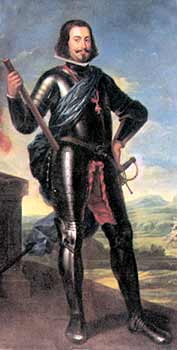
After the death of King Manuel, King John III abandoned North Africa but expanded Portuguese influence in India and East Asia. His grandson and successor, King Sebastian, died in battle in Morocco and was succeeded by King Henry, a cardinal of the Catholic Church who, of course, had no heirs. When he died King Philip II of Spain claimed the Portuguese throne and sent his troops in. From 1581 to 1640 Portugal would be ruled by the Spanish Hapsburgs. The reign of King Philip II was a high point in the history of Spain but Portugal was drained in the furtherance of Spanish causes that were quite ambitious. The period of Spanish rule also involved Portugal in conflicts with other European powers and the English, French and Dutch all made colonial gains at the expense of the Portuguese empire around the world. This finally came to an end when John II, Duke of Braganza, claimed to be the heir of the Aviz dynasty and led an uprising against the Spanish. The English and French were quick to seize the opportunity to hinder their Spanish rival and backed the cause of Portugal. In 1668 the Spanish finally agreed to recognize Portuguese independence under what became known as the House of Braganza.

King John IV, the original Braganza monarch, was succeeded by the weak and chronically ill King Afonso VI under whom Portuguese fortunes continued to decline and he was ultimately deposed and exiled. The next monarch was King Peter II who allied with Britain and Austria in the War of Spanish Succession and whose forces even captured Madrid in the course of the conflict though the overall campaign was not a success. However, Peter was succeeded by King John V and under his leadership, the fortunes of the Kingdom of Portugal finally turned around. An ambitious man with a grandiose style, he expanded the Portuguese empire and brought wealth and prosperity back to the country through his victories and policies. An extremely pious man, he was also given the title of “Most Faithful Majesty” by the Pope, a title passed on to all subsequent Portuguese monarchs. He chose good ministers for the administration of the country, showed good judgment himself and presided over a flowering of art, architecture and other cultural achievements for Portugal.

John V
Further victories followed the reign of King John V but the country also saw the rise in the political class and religious tensions over the expulsion of the Jesuits. Conflicts and later a major earthquake also put a severe strain on the country’s finances. Corrupt and incompetent officials also caused serious damage and it did not help that Queen Maria I went insane. She was ultimately succeeded by King John VI but the whole situation made it extremely difficult to deal with the rot that had set in within the government and there were a succession of huge foreign catastrophes to handle, all stemming from the French Revolution. Portugal was pushed into an alliance with Spain, against the French and then when the country refused to accede to French demands, was invaded by the forces of Napoleonic France. King John VI and the royal court relocated to Brazil while the British landed troops under the Duke of Wellington who assigned a commander to take in hand the reform of the Portuguese army.

The Anglo-Portuguese forces drove the French out of the country and along with the Spanish proved to be a major irritant to Napoleon. Eventually, the French were driven from the Iberian Peninsula but the region was far from free of conflict. In 1821 King John VI returned to Portugal and found a discontented country. From the beginning there had been those who sympathized with the French and their presence had only increased demands for constitutional government and an end to the absolute monarchy. A liberal constitution was produced in 1822 which greatly restricted royal powers, however, it did not include the colonies and Brazil, its status raised by the recent relocation of the seat of power there, rose up to demand independence. The son of King John VI, Peter, took the lead in this movement and became Emperor Peter (Pedro) I of Brazil. King John VI tried to dispense with the liberal constitution but the stage had already been set for a clash between those who favored constitutional monarchy and the supporters of absolutism.

Peter V
After the death of King John VI, Emperor Peter I of Brazil returned to Portugal to claim the throne as King Peter IV, however, he soon passed the Portuguese throne to his daughter Queen Maria II. She was backed by the constitutional monarchists but she had a rival in the person of her uncle who claimed the throne as King Miguel I, backed by the absolutists. There were also problems from the radical revolutionaries who, first appearing during the French occupation, were to never completely go away. In 1834 King Miguel I was defeated and forced to abdicate, going into exile in Italy, Britain and finally Germany. Queen Maria II and her husband King Ferdinand II ruled until her death in 1853 though the king remained a couple more years as regent for their son King Peter V. The country had come through a difficult period of occupation, war, civil war, dynastic dispute and overall chaos but under King Peter V there finally seemed hope for peace, stability and a period of renewal.

Such hopes were well founded as the young King Peter V, who came to the throne in 1853, was a very intelligent and hard-working monarch. The infrastructure of the country was modernized and improved dramatically. However, there proved to be little time as the handsome young king died in 1861 during a cholera outbreak. Ironically, one of the areas that had most improved during his reign was the public health system. Still, his loss prompted further beneficial changes in that regard, most notably the passage of the Sanitary reforms. In 1878 slavery was abolished throughout the Portuguese colonial empire under King Luis I. He put Portugal at the forefront of oceanographic research but overall the country did not live up to the potential many saw in the time of Peter V. Political instability was a major problem as the liberal reforms had created a class of politicians, often corrupt, always eager to struggle for power and influence. Portugal fell behind other countries and was blocked from further colonial expansion in Africa as more countries became involved in the game.

Manuel II
In 1889 Luis was succeeded by his son King Carlos I but the political situation only grew worse due to bad policies enacted by corrupt officials. Portugal, which had once been the wealthiest country in Europe, fell into poverty and was forced to declare bankruptcy twice. Radical revolutionaries, usually socialists, were also increasing in strength and advocating the overthrow of the monarchy in favor of a republic even though it was their sort of state intervention which had helped wreck the Portuguese economy, something they were only too willing to use to their advantage. Tensions and unrest grew worse and in 1908 King Carlos I was assassinated, an act which was shocking even in an era where such assassinations were not uncommon, due to the fact that the Portuguese royals had generally been well liked and had not known great animosity even in periods of internal dispute. He was succeeded by the 19-year old King Manuel II, a very bright and cultured young man but who could hardly be expected to undue such a long period of government extravagance and foolish policies at such a late date.

Only a couple of years later a military coup sparked a revolution that saw the downfall of the monarchy and the establishment of a republic in 1910. There was little popular support for the upheaval but the King was forced to go into exile in Great Britain. There was one major effort to restore the monarchy but this was ultimately unsuccessful and the fortunes of Portugal likewise continued to sink under republican rule. Chaos and power struggles ensued and the country declined ever farther. Order was only restored after the establishment of the Corporatist State in 1933 after which time the economy slowly began to improve. However, that progress was thwarted by the outbreak of communist-backed anti-colonial wars in Africa. Portugal was essentially forced to fight three wars simultaneously and the strain ultimately led to the so-called “Carnation Revolution” in 1974 after which the Portuguese colonies were abandoned.

Socialists seized power and mostly held it, giving way to more moderate liberals from time to time but still pursuing policies that stymied economic growth to the point that Portugal became one of the poorest countries in Europe, a far cry from the fabulous wealth that had existed in centuries past under the monarchy. This made Portugal all too willing to join in with the “European project” but that only made it easier for the republican government to borrow more and more money, putting the country deeper and deeper into debt and all the more dependent on the ruling elite of the European Union. No lasting solution has yet been found and still today the situation in Portugal remains precarious. However, the history of the Kingdom of Portugal contains all the necessary lessons to turn this situation around. The contrast could not be more stark between the current status of the Portuguese republic as a debtor nation and that of the Kingdom of Portugal which was on the cutting edge of innovation, in business and technology, making it a prosperous country with influence all over the world. That is what Portugal needs to return to.

Saturday, June 13, 2015

Story of Monarchy: The Kingdom of Württemberg

The story of Wurttemberg has its roots in the Dark Ages when the Hohenstaufen counts of Swabia were succeeded by the family of Conrad von Beutelsbach who was the count of Wurttemberg and his family later adopted that name, the name of Conrad’s ancestral castle. Eberhard I became the first Duke of Wurttemberg and was quite an accomplished figure in German history. He became a Knight of the Holy Sepulcher in Jerusalem and was the one who moved the capitol of Wurttemberg to Stuttgart where it has remained ever since. He received the Golden Rose from Pope Sixtus IV and the Order of the Golden Fleece from Emperor Maximilian before his death in 1496. It was the Emperor Maximilian who, in the Reichstag of Worms, elevated his title to duke in 1495. However, his next two successors were deposed in turn by the nobility. Duke Ulrich, deposed mostly because of his spending and taxation, saw Wurttemberg annexed by Austria though he was later restored when French troops defeated the few forces Emperor Charles V could dispatch and the Duke was restored to his throne. He had regained popularity by adopting Protestantism and taking up the cause of the ‘common man’ in the Peasants’ War.

Duke Friedrich I
There was the seizure of Catholic Church property at that time, as was common in such circumstances, and Duke Ulrich participated in a Protestant-led war against Emperor Charles V. However, they were defeated and Wurttemberg was conquered by imperial forces. Still, Charles V allowed the Duke to retain his position, though his future successor Ferdinand had wished to remove him. Ulrich’s son and successor would have to make considerable payments to the by-then Emperor Ferdinand to avoid being convicted of treason. Later, Duke Friedrich I would be made a Knight of the Garter by Queen Elizabeth I of England and was referred to several times by Shakespeare in “The Merry Wives of Windsor”. In the Thirty Years War Duke Johann Friedrich fought briefly on the Protestant side but was defeated by the imperial troops of Marshal Tilly. Wurttemberg was later plundered and much of the territory parceled out by the Emperor to Catholic nobles. However, most of it was ultimately restored with the Peace of Westphalia that ended the conflict. Duke Eberhard Ludwig fought as a Field Marshal in the War of Spanish Succession and being inspired by a visit to the court of King Louis XIV tried to make the Duchy of Wurttemberg into an absolute monarchy. Shortage of funds hampered him and his lack of a legitimate heir aroused concern that the ducal throne would pass into Catholic hands.

In 1733 Karl Alexander succeeded Eberhard Ludwig as Duke of Wurttemberg and he had quite an eventful life. A very successful soldier who fought for the Emperor under the great Prince Eugene of Savoy in the War of Spanish Succession. He converted to Catholicism in 1712 and fought the Ottoman Turks with great success. In 1720 he was appointed by Emperor Charles VI (Kaiser Karl VI) governor of the Kingdom of Serbia. So it was that for a little over a decade a Wurttemberg prince was the regent and more or less absolute ruler of the Kingdom of Serbia. It was also Duke Karl Alexander who married into the prestigious princely House of Thurn und Taxis. He died in 1737. His son and successor, Duke Karl Eugen, learned his trade at the Prussian court of King Frederick the Great and fought for him in Saxony. He was a patron of the famous German writer Friedrich Schiller and behind such notable building projects as the New Palace and the grandly named Castle Solitude. He loved farming, books, the opera as well as a number of women and spent his little state into bankruptcy though he left it a more grand place than he found it.

Despite three marriages and ten or more illegitimate offspring by his mistresses, Duke Karl Eugen produced no legitimate heir and so upon his passing in 1793 the ducal throne went to his brothers, first Ludwig Eugen, who died within two years, and then Friedrich Eugen. Duke Friedrich Eugen had also served with King Frederick the Great and even married the niece of the famous Prussian monarch. By her he had twelve children and these were raised Protestant so that when his son succeeded him the religion of the ducal family and their subjects were once again the same. By this time the French Revolution had broken out and Duke Friedrich Eugen had been forced to break his ties with the Austrian Emperor due to a French invasion. His son, the towering Friedrich II, who succeeded him in 1797, went to war against France, was swiftly defeated and Wurttemberg was left in ruins by the French revolutionary forces. Duke Friedrich II was left with the unenviable choice of total destruction or an alliance with France. He chose France.

In 1802 Friedrich II signed a private treaty with Napoleon Bonaparte, giving up his territory on the left bank of the Rhine in exchange for some conquered imperial territory and Napoleon elevated him to the rank of Elector. After forming a military alliance with France in 1805 he was rewarded with more Austrian territory in the Treaty of Pressburg. The following year, on New Year’s Day, he assumed the title of King Friedrich I of Wurttemberg with the backing of the French Emperor. He also joined Napoleon’s Confederation of the Rhine, a grouping of all the German states aligned with France, intended to be a French dominated successor to the Austrian dominated Holy Roman Empire of the German Nation. Wurttemberg gained more and more territory as French victories increased but also paid a heavy price for French favor in the form of the many soldiers from Wurttemberg attached to Napoleon’s armies. The greatest sacrifice would come with the invasion of Russia in 1812. King Friedrich I contributed 14,000 men to the invasion, serving in the III Corps under Marshal Ney. They acquitted themselves well but were virtually annihilated before the campaign was over.

King Friedrich I
The following year, King Friedrich I switched sides and signed a treaty with the Austrian Empire, joining forces with the Allies in exchange for the confirmation of his expanded territory and more exalted title. All was agreed to, the Kingdom of Wurttemberg officially joined the Allies to see the downfall of Napoleon and Friedrich I emerged from the conflict with his new lands and his status as King intact. It was the side he had started on and he had plenty of connections to the Allied side as well. When his sister married into the Romanov dynasty he had made a favorable impression on Empress Catherine the Great and for a time was Governor-General of Eastern Finland. However, he was later forced to leave the country on charges of being abusive toward his wife which rather ruined his reputation. Still, his second marriage was to the British Princess Royal Charlotte, daughter of King George III so he maintained contacts on both sides of the line. He married the daughter of the King of England and gave his own daughter to be married to one of Napoleon’s brothers. In the end, it all worked out for him and the Congress of Vienna did not take back any of the lands or the title Napoleon had given him. However, he did not live long to enjoy it as the massive monarch died in 1816.

At the time there was a great deal of squabbling going on over the constitution. The government rejected his proposal and his son and successor, King Wilhelm I, had to negotiate a new one which was passed in 1819. King Wilhelm I had big ideas about forming a coalition of the minor German states of Wurttemberg, Bavaria, Hanover and Saxony to act as a counterweight to the increasingly antagonistic Austria and Prussia. As most know, such a thing never came about but King Wilhelm I never stopped trying. Because of his constitution, he had a somewhat liberal reputation when the Revolutions of 1848 hit and probably because of that, though there was some turmoil, the Kingdom of Wurttemberg weathered the storm with no outbreaks of violence. He did, however, have the distinction of being the only German monarch to sign on to the Frankfurt Constitution but he spent the rest of his reign as an ardent reactionary, trying to undo all the damage that had been done.

King Karl
In time, King Wilhelm became quite a respected figure among the crowned heads of Europe and fairly influential in German affairs. During the Crimean War he backed the cause of German neutrality, benefiting Russia more than most realized as this also helped keep Austria from joining in the anti-Russian coalition. He restored good relations with France and also helped France and Russia to begin patching up their relationship after that ugly business in the Crimea. Many monarchs and important people came to him for advice on various matters. However, his private life was less than ideal, though most never knew it. His marriage was little more than a charade and he did not get along with his son, Karl, who succeeded him in 1864. His second daughter, Sophie, would become Queen of the Netherlands by her marriage to King Willem III and his only son, King Karl I of Wurttemberg, married the daughter of Czar Nicholas I of Russia in 1846. It was probably unfortunate for her as King Karl I was likely a homosexual. The two never had any children and King Karl was plagued by scandal over his antics regarding his “companion” Charles Woodcock of New York. It is at this point in the story of Wurttemberg that you realize again that truth is stranger than fiction as absolutely no writer would think to get away with inventing the character of a gay lover named Woodcock.

However, it was fortunate for Wurttemberg that he married as Queen Olga was the far more impressive of the two, both in how she carried herself and her tireless charitable work on behalf of her adopted people. Unlike his father, King Karl was not to remain neutral in the rivalry between Prussia and Austria. Whether out of conviction or because he could simply see which way the wind was blowing, he began to distance the Kingdom of Wurttemberg from the Austrian Empire and draw ever closer to the Kingdom of Prussia. He joined his country to the North German Confederation and took the side of the Prussians in the 1870 war with France. Afterwards, his nephew August von Wurttemberg represented him when the King of Prussia was proclaimed German Kaiser Wilhelm I at the Hall of Mirrors in Versailles. The Kingdom of Wurttemberg became part of the Second German Empire but retained considerable autonomy. For King Karl, it was all for the better. This, as well as his liberal style of leadership, coincided well with his own lack of interest in the affairs of government which he was pleased to leave with others. He died in 1891 and was succeeded by his nephew, King Wilhelm II.

King Wilhelm II
King Wilhelm II would preside over the end of the Kingdom of Wurttemberg, unfortunately, but he was quite an interesting figure. He had a love for sailing and refused to let being the King of a landlocked country get in the way of that. He founded a yacht club on Lake Constance. He first married Princess Marie von Waldeck und Pyrmont in 1877 but he became very depressed with the death of their second child and only son, Prince Ulrich, in 1880. Two years later his wife died giving birth to a stillborn daughter, furthering his sadness. In 1886 he married Princess Charlotte von Schaumburg-Lippe but the two never had any children. His eldest daughter, Princess Pauline, married Prince Wilhelm Friedrich von Wied, elder brother of the thwarted Prince of Albania. After World War II she got into some trouble with the American authorities for giving shelter to a Nazi couple. She was indicted but released on bail and maintained that she knew nothing of their politics but simply helped two of her countrymen who were in need. Her father would have likely done the same.

Duke Albrecht
King Wilhelm II was well liked by his subjects for his informality and his regard for persons rather than politics. He introduced the first income tax to pay for a health insurance program for servants and farm workers, invited ordinary men to the palace for regular gatherings and was known for his solitary walks through the streets of Stuttgart without guards or any sort of escort. Unlike the Wilhelm II who was King of Prussia, he had no great love for military life though he was made a Field Marshal in World War I it was a basically honorary rank with no active field command. However, when the Great War did come, the Kingdom of Wurttemberg was certainly well represented. XIII Corps was based at Stuttgart and in the initial invasion force of August 1914 some 4% were soldiers from Wurttemberg. Duke Albrecht of Wurttemberg, a distant cousin set to succeed Wilhelm II, commanded the German Fourth Army and proved a very capable battlefield commander. He led his troops to victory at the Battle of the Ardennes, saw action at the first Battle of the Marne and later was moved to Flanders where he commanded German forces in the Battle of the Yser and the Second Battle of Ypres. In 1916 he was promoted to Field Marshal and the following year was made an army group commander, “Army Group Albrecht”, on the southern end of the Western Front.

The Prussian Crown Prince & King Wilhelm II in France
Married to an Austrian Archduchess, Duke Albrecht had seven children so the succession was well secured. However, the throne of Wurttemberg did not survive the war. When revolution swept Germany in 1918 demonstrations began in Wurttemberg in October. When there were calls for the abolition of the monarchy no one could give a clear reason why. King Wilhelm II had been a very popular monarch, had always acted in accordance with the constitution and had even allowed the International Socialist Congress to meet in Stuttgart in 1907. He saw things in personal rather than political terms yet the revolutionary ideologues would not desist in demanding his downfall even though they could cite absolutely nothing he had ever done that was objectionable. King Wilhelm II, needless to say, was extremely embittered by how he was abandoned in spite of all he had done to be as down-to-earth and scrupulous in his duties as he had always been. He loved his people, even shedding tears when his first troops marched off to war in 1914, now, in his hour of need, no one was prepared to return that affection by standing up for their king. He abdicated on November 30, 1918 though, perhaps feeling guilty for what they had done, the provisional government quickly granted him a pension and pledged to respect his private property.

That was the end of the Kingdom of Wurttemberg but I cannot resist adding a bit more as to the military legacy of the little south German kingdom (we cannot have Prussia get all the glory). In World War I the top figure of Wurttemberg (though he was born in Austria) was the aforementioned Army Group Commander Duke Albrecht who became head of the family in 1921 upon the death of King Wilhelm II. Behind the scenes, though, the most important official was General of the Infantry Friedrich (“Fritz”) von Graevenitz who was the Wurttemberg military representative at the German General Head Quarters. One of the leading logistical experts of the war was Wurttemberg General Wilhelm Groener who succeeded General Erich Ludendorff as First Quartermaster General toward the end of the war. At the end, he urged Kaiser Wilhelm II to abdicate (privately he thought the Kaiser’s death at the front would be more glorious) for which the Kaiser never forgave him but which he did in an effort to save the monarchy by sacrificing the man the Allies had so vilified. He later went into politics but his career there came to an end over his opposition to the Nazis.

Field Marshal Rommel
Also during World War I, one of the most famous German units of the war was a particular group of specialist soldiers from Wurttemberg, the Wurttemberg Mountain Battalion. It had a special status and proved itself to be one of the best regiments of the war. One junior officer who distinguished himself remarkably in the Wurttemberg Mountain Battalion would go on to become one of the greatest military commanders in history during World War II as commander of the German forces in North Africa. That officer from Wurttemberg was, of course, Field Marshal Erwin Rommel, famously known as “the Desert Fox”. Another native of Wurttemberg who achieved immense fame in the conflict was Major (and later Colonel) Erich Hartmann of the Luftwaffe who remains the most successful fighter pilot in the history of aviation, with 352 victories to his credit. Never the biggest, Wurttemberg nonetheless made a significant contribution to German history, rising from obscurity to become one of only four kingdoms in the German Empire. Although easily overshadowed, Wurttemberg has somehow always managed to be in the center of things as the history of the German peoples has played out.
Related Posts Plugin for WordPress, Blogger...