Showing posts with label Catholic Church. Show all posts

Tuesday, August 15, 2017

The Imperial Roots of Ferragosto

Today is Ferragosto, a holiday unique to Italy (and the Republic of San Marino) today identified with the mid-August vacation period. It is made to coincide with the Feast of the Assumption of the Blessed Virgin Mary, however, it has a much wider significance which includes but is not limited to this particular feast day which is so important to Catholics. The roots of Ferragosto go back to at least the year 18BC though, even then, it built upon an already long established custom of a holiday period in mid August after the local harvest period. However, it became an officially period of celebration to mark the occasion on which Octavian (Julius Caesar's heir and nephew) was given the title of Augustus by the Roman Senate, "Augustus" meaning 'exalted' and used as the official imperial title. In other words, it was on this occasion that Augustus Caesar officially became the first Emperor of Rome. Thus, the already existing post-harvest holiday period was expanded and upgraded to be an official, practically month-long, celebration of the exaltation of the first Roman Emperor. This was known as the Feriae Augusti or the 'festivals of the Emperor Augustus'.

Later, in the Christian period, this came to coincide with the Feast of the Assumption and rather beautifully illustrates the way in which the peoples of Europe did not abandon their own culture and customs with their conversion to Christianity. Rather than ban everything that had pagan roots (which would have meant eradicating practically everything, including democracy which liberals claim to be so fond of), pagan customs were folded into the Christian experience. Obviously, these customs would vary from nation to nation as the Germans or Celts had extremely different customs from those of the Greeks and Romans. It is for this reason that Ferragosto is a uniquely Italian holiday. In time it came to be the start of the vacation period in Italy and this was reinforced by the Kingdom of Italy during the Fascist Era. In an effort to encourage Italians to get out of their small towns and see more of the country, the trains would offer discounts on tickets to enable working class people to take a vacation to famous cities or resort towns. The desire of the regime was to foster greater nationalism and social unity in this way by having the people see more of their own country and to allow people other than the upper class to take vacations too.

It says something about the success of this policy of embracing the whole of European culture and not setting Christianity against it that for quite some time the celebration of Ferragosto was legally mandatory in the Papal States.

Thursday, July 13, 2017

Royal Saints and the Catholic Church

I recently had an exchange online (not the usual unpleasant sort) which I thought worth bringing to these pages as others may find it interesting. The question put to me was why, in the long history of the Roman Catholic Church, have relatively so few royals been raised to the status of recognized sainthood by the Church. Is it harder for monarchs to achieve sainthood? Is something blocking their way? My short answer was that it comes down to a little of column “A” and a little of column “B”. For one thing, the Catholic Church hierarchy today holds a vastly different broad view of politics than in the past. Whereas the historic Catholic Church held that, as Pope Pius VI said, monarchy is the best form of government, the Catholic Church of today is all about liberal, representative democracy, or at least so they claim. It would certainly be difficult to imagine His Holiness Pope Francis being very praiseworthy of any monarch as an ideal Christian ruler. Loyalty and obedience are not so popular as diversity and human rights nowadays. Yet, this was not always the case.

St Louis IX w/Crown of Thorns
Most Catholics, and indeed most western Christians of any sort know of some saintly monarchs as these tend to date from before the Protestants came to be. Most will have at least heard of one king-saint from most countries that have been around a long time. There is King St Louis IX of France, King St Ferdinand III of Castile, King St Edmund the Martyr of East Anglia, King St Stephen of Hungary, King St Olaf II of Norway and so on. However, given the huge number of kings over thousands of years of Christian history, most of that history being dominated by monarchies and practically nothing else, their ranks can seem rather thin. Why is this? As stated at the outset, my immediate response is both that of royal worthiness as well as political machinations that would block the causes for the canonization of royals. In each case, human frailty plays the dominant part I would say. In the first place, monarchs are usually figures of wealth, power and prestige and, as such, they doubtless face a greater degree of temptation than an ordinary person would. In this way, yes, it is probably harder for a monarch to be worthy of canonization than a lesser person would be.

It would, however, be absurd to think that politics does not play a part in this either and not simply today when monarchy is the exception rather than the rule and traditional monarchies are frowned upon as being ‘backward’ and ‘authoritarian’. Christian monarchs, unfortunately, have a long history of fighting with other Christian monarchs and this applies to Catholics just as much if not more so than to Protestants. When one considers the monarchs who have been recognized as saints, such as those mentioned above, I direct your attention to who their enemies were. In most cases, their enemies were non-Christians; pagans or Muslims and the opinion of pagans and Muslims tended to hold little weight in the Catholic Church in those days. If, however, the Catholic Church had moved to canonize someone like King Henry VI, a monarch who was once considered saintly by a great many people in England, one could expect the French to protest against this vociferously as Henry VI had not only claimed the French Crown (as many English monarchs did) but was the only one to actually be crowned King of France in Paris. Likewise, being of the House of Lancaster, the notables of the House of York might have opposed it too. For a time, it seemed that the Tudors might have pushed for his canonization but then the break with Rome over the marriage of King Henry VIII brought all of that to a total halt.

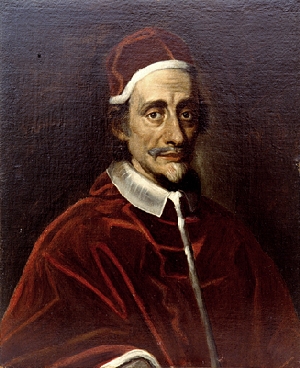
Blessed Innocent XI
So, you can see how this would play out. Try to canonize a French monarch, you upset the Germans. Try to canonize a German monarch, you upset the French. This also applied to the Roman Pontiffs themselves. Pope Innocent XI, for example, was beatified centuries after his death but his cause never progressed beyond that point and the reason for this is well known to those familiar with his case. At the time of his pontificate, the most powerful Catholic monarch was King Louis XIV of France and, as we have discussed before, the Popes tended to oppose whichever Catholic monarch was the strongest in their time and Pope Innocent XI was very much opposed to King Louis XIV of France. As such, when his cause for canonization came up, French clergymen blocked it from going forward and it was not until the 1950’s that he was beatified and his cause has not progressed since for, while there is no longer a French monarchy to oppose it, there are few who feel strongly about pressing it either. Doubtless there have been other, similar cases. Now, as I have also mentioned before, contrast this with the sudden flurry of papal canonizations. Since the Second Vatican Council, every deceased pope has either been canonized or is at some point along in the process of being canonized (John XXIII, Paul VI, John Paul I & John Paul II). A few have pointed out, particularly given how poorly the Catholic Church has fared in this era, that this looks like an effort to ‘canonize the council’.

The person who raised this issue also pointed out that out of 46 (or 47 depending on how you count them) Holy Roman (German) Emperors, only one, Emperor Heinrich II, is recognized as a saint. Once again, it would be foolish to think that the long history of rivalry and antagonism between the popes and the German emperors played no part in this being the case. All of the most famous German emperors could expect heavy opposition to any consideration of their piety. Even someone as widely admired as Emperor Otto the Great would likely be opposed given that he was quite strict about the Church in his lands being answerable to him. Emperor Frederick Barbarossa is possibly the most famous of the Medieval German monarchs yet, as far as the Catholic Church is concerned, he was a villain and, to be fair, from the standpoint of the Church, it is just as legitimate that they view him as such as it is for the Germans to view him as a hero for his victories. Even an emperor most Catholic monarchists admire perhaps more than any other, Emperor Charles V, would be an almost impossible case. It would be hard to imagine the Catholic Church canonizing a monarch who waged war against the Pope, regardless of the circumstances.

Empress Maria Theresa
There are also those monarchs who might have been more easily canonized in the past than today. Queen Isabella I of Castile, for example, has a small but fervent following who wish for her to be canonized, yet such a cause could expect to attract immense criticism upon the Church from Jewish, Muslim and Native American groups and advocates. Such criticism is basically groundless and shouldn’t have any impact but realistically it should be expected and not surprising that the Church would wish to avoid the whole subject and everything it would bring up from the establishment of the Spanish Inquisition to the voyage of Columbus. The Austrian Empress Maria Theresa, Queen of Hungary, would also, I think, be worth consideration for canonization, yet she too would attract a great deal of opposition due to her attitude toward the Jews and such a cause might also generate political opposition from Poland. Again, such cases would bring up issues that the Church would rather not deal with.

Of course, canonizations are much more common among the ranks of the clergy. Not only are they less susceptible to political objections but, even among the hierarchy where the temptations associated with power and prestige are more common, they are also the ones who determine whether a cause goes forward or not which makes things much easier of course. This is not to imply that the system is out or order of course, only that any system consists of human beings and human frailty applies to the clergy as well as the laity. It also cannot be denied that even among the clergy, political opposition can still cause complications. The cause of Saint Josemaria Escriva, for example, was the source of considerable controversy because of his association with the regime of Generalissimo Franco in Spain or the cause of Blessed Aloysius Stepinac who was imprisoned by the communists and martyred after World War II for complicity with the Axis regime of the Independent State of Croatia. This sparked immense opposition and it remains to be seen if his cause will progress further. The cause to canonize Pope Pius XII himself is also very well known for the political opposition it has aroused due to accusations that he was insufficiently zealous in opposing the Nazi and Fascist government all the way to accusations of sympathy and collaboration with them, all of which has aroused considerable debate and acrimony. To date he has reached the status of “venerable”.

King Baudouin of the Belgians
Unfortunately, the enemies of traditional authority are also not always the only source of opposition to royal saints. For example, I would think that the Belgian monarchs King Albert I and King Baudouin worthy of examination but of course the mainstream types will not push for causes for them, because they were monarchs and held traditional moral views, yet there are likewise intransigent types on the right who will neither take up their cause because of their opposition to a Belgian monarchy existing in the first place (though this is absurd given that Belgian independence came at the expense of a Protestant monarch and their previous, failed, bid for independence was against a Catholic, Habsburg monarch who far-right Catholics heartily despise). King Baudouin has been talked about more than others, particularly by the Pro-Life, anti-abortion community given his public stand on that issue. However, that would also then invite opposition from leftists everywhere and no doubt they would also take issue with his words of praise for King Leopold II at the granting of independence to the Congo. The (now retired) Cardinal Godfried Daneels, while praising King Baudouin, said some years ago that a cause for canonization was “not going to happen”.

There is also the fact that, sadly, for a great many people Catholic monarchies in particular are seen as a source of division rather than unity, nothing but an open door to trouble that is best avoided. In Spain, France and the former Italian states (basically an all Bourbon problem) there continues to be intense internal dynastic disputes which are unrelenting and which the Church, as with most others, would certainly wish to avoid getting in the middle of. The left is content to let the feuding monarchists focus on fighting each other and the right would prefer not to get caught in the crossfire and look for other, non-royal alternatives. Even if there was a worthy candidate, the Church would have to show considerable courage to canonize someone in such a position, given the intense opposition it would immediately attract from the opposing faction of the various Bourbon family branches.

Blessed Maria Cristina di Savoia
However, while all of this must seem grim to Catholic monarchists, and it is certainly far from ideal, if one is prepared to not be partisan on the subject, there is still room for hope. Royal canonizations are rare but they are certainly not unheard of, even today. The most prominent example, of course, is the beatification of Emperor Charles of Austria and a French bishop did, in 2009, open a cause for his wife Empress Zita of Bourbon-Parma which it would be hard to imagine anyone objecting to and, while extremely rare certainly, saintly royals who are husbands and wives are not without precedent. There are also currently a number of potential royal saints under consideration within the historic ranks of the Italian royal House of Savoy. Maria Cristina of Savoy, Queen of the Two-Sicilies, was beatified in 2014 (being a Savoy means taking neither side in the feuding branches of the Bourbon-Two Sicilies dispute), Princess Maria Clotilde of Savoy has a cause open, making her a “Servant of God” and Queen Elena of Italy (wife of King Victor Emmanuel III) is, last I heard, under consideration for a cause of her own. All of this is good to see, though I would caution that the Italian Royal Family has a history of royals being beatified but not going on to sainthood. Still, there are royal causes being pressed which I fully support and am grateful for.

Blessed Charles of Austria
Certainly, there are many others that I would think certainly at least worthy of consideration and some I think should have been canonized long ago. Speaking of the House of Savoy, almost every recent royal consort would be worthy of consideration, Maria Pia of Savoy, Queen of Portugal, King Charles Emmanuel IV and his Bourbon bride would both be worth looking into I think. On the subject of the Bourbons, I think it odd that King Louis XVI and his Habsburg bride Queen Marie Antoinette have not been canonized already. The Dauphin, Louis XVII, would seem to be a child martyr to me and his sister Marie-Therese would seem more than worthy of consideration I think. There are others of course but, much beyond that, in France or Spain or Italy, with the Bourbons you start running into the dynastic disputes that make them all untouchable without kicking off a firestorm of acrimony. King Baudouin of the Belgians is, I think, deserving and I have been told that there has at least been talk of a potential cause for Queen Astrid. There are also others among the ranks of the Habsburgs who I would think would be possibilities given that the current family leadership has, since the days of Archduke Otto, become ‘acceptable’ to the powers-that-be and considering that, thankfully, the followers of the Habsburgs have shown more loyalty and adaptability than those of the Bourbons so that it remains one of the few Catholic dynasties that is not at the center of any serious inheritance disputes.

Clearly, there are obstacles and plenty of difficulties but hope remains and there are plenty of causes worth pursuing. Certainly, nothing will happen if no one at least tries.

Tuesday, June 13, 2017

Catholic Saints, Korea and Japan

In 2014 I wrote an article titled, “Assassins, Sainthood and Joan of Arc” in which I commented on the cause for canonization currently underway in the Republic of Korea for Ahn Jung Geun, a Korean Catholic most famous for being the man who assassinated the first Prime Minister of the Empire of Japan, Prince Ito Hirobumi. Not surprisingly, this move raised some eyebrows given that Ahn Jung Geun not only seemed to be rather deranged and perhaps not in full possession of his faculties but particularly because the one act in his life which made him famous was not caring for the unfortunate, giving his life for his faith or converting people to Christianity but was, rather, the murder of an unarmed man and gunning down several others. He has, since his death, been lavished with praise and honor by the governments of South Korea and Communist China while, not surprisingly, being regarded as a terrorist and murderer in Japan. Obviously, there are a great many political implications for the Catholic bishops in South Korea promoting the canonization of this individual.

Mass in Japan
The Japanese have every reason to object to this and it would certainly be an unusual thing for the Catholic Church to do. The Church did not, as I pointed out in 2014, give in to the public call for the canonization of Balthazar Gerard in the 1580’s who had assassinated the Dutch leader Prince Willem “the Silent” of Orange. However, the Roman Catholic Church of today is quite different from that of the Sixteenth Century and in recent years the requirements for canonization have been “streamlined” considerably so that it is much easier to have someone canonized today than in the past when it might take several centuries for someone to be verified as a saint worthy of veneration. In other words, as much as I would oppose the canonization of such an individual, I do not think it beyond the realm of possibility that the Catholic Church today might go along with it, that the Holy See might simply go along with the recommendations of the Korean bishops who are pushing for this assassin to be recognized as a saint. I made my objections clear enough, I think, in that 2014 article but today I want to propose a positive action that the Japanese could take in response to this.

Konishi Yukinaga
The Catholic Church in Japan should, I think, propose a more worthy figure from their own history for canonization. I think the Japanese bishops should start a cause for the canonization of Konishi Yukinaga. For those unfamiliar with his exploits, you can read the story of the conflict he is most famous for in my recent article, “Clash of Monarchies: The Imjin War”. Konishi Yukinaga was a great Japanese warrior, a daimyo and a Catholic. He was also the leader of the vanguard force of the samurai armies of Toyotomi Hideyoshi which invaded Korea in 1592. He led the conquest of Busan, was instrumental in the conquest of the Korean royal capital of Seoul and gained further fame for his defense of the captured city of Pyongyang against the armies of Ming China. After a peaceful interlude he arranged, Yukinaga, who was also known by his baptismal name of Augustine (in Portuguese) Konishi, still played a prominent part in the second invasion of Korea, even fighting alongside a bitter rival of his, the daimyo Kato Kiyomasa who had a vicious hatred of Christians. In the final period of the war, Konishi was most distinguished by his heroic defense of Suncheon Castle against much larger Chinese and Korean forces.

All of that makes, I think, Konishi Yukinaga worthy of being considered one of the best Japanese warriors of his time but, of course, it does not make someone worthy of canonization. That being said, neither does the murder of a foreign dignitary which is what Anh Jung Geun is most known for. Is there anything else that would make Konishi Yukinaga more worthy of being “Saint Augustine Konishi”? I would say, yes. In the first place, his faith was obviously important to him and this is significant as other Japanese Christians of the period are often accused of being insincere in their conversions. It is not uncommon to find Japanese daimyos in particular, Otomo Sorin comes to mind, who are accused of converting simply to gain greater favor and cooperation from the Portuguese and who did not genuinely accept Christianity. Personally, I find such accusations to often be unfair but in any event this would not apply to Konishi Yukinaga. After the war in Korea, following the death of Lord Hideyoshi, the Japanese fought another civil war over who would take charge of the country. Konishi backed Ishida Mitsunari, unfortunately for him, rather than Tokugawa Ieyasu and was defeated at the Battle of Sekigahara. In the aftermath, in keeping with custom, the defeated daimyos committed ritual suicide. Konishi, who was captured by Takenaka Shigekado at Mount Ibuki, refused to kill himself because, as a Christian, this would be a sin and so he was beheaded by his captors.

Konishi Yukinaga
This, I think, is proof enough that Konishi was a sincere Christian. However, more than that, he was also something of a peacemaker and got himself into some trouble over his desire to make peace. The Koreans would no doubt object to the canonization of the conqueror of their capital just as the Japanese object to the idea of canonizing the assassin of their first prime minister but Konishi Yukinaga was no anti-Korean bigot. Before he landed his invasion force, he sent a last message to again urge the Koreans to join with his forces in friendship to fight against their Chinese overlords only to be rebuffed. Then, after China intervened in the war, he and a Chinese envoy arranged a period of peace for several years. This was controversial because it was a peace based on a deception. Konishi and the Chinese envoy both, basically, agreed to tell their masters what they wanted to hear. So, Konishi Yukinaga told Lord Hideyoshi that the Chinese had agreed to surrender and the Chinese envoy told the Ming Emperor that the Japanese had agreed to surrender. For a fear years, the war ended and peace prevailed until Lord Hideyoshi received a message from the Ming Emperor granting him the tributary status of “King of Japan” which caused no small amount of outrage and a great deal of anger directed at Konishi Yukinaga.

Obviously, this was not a successful or very sound effort at peace but it was an effort to make peace nonetheless. “Blessed are the peacemakers” is what Christ said and Konishi Yukinaga had tried, even if not by the best means, to be such a peacemaker. We can also see that Konishi was not an anti-Korean bigot as well as how serious he was about his faith by the fact that he married a Korean woman during the war and she was baptized as a Christian, taking the name of “Julia”. Historians still debate the issue but it is quite possible that the Catholic Japanese samurai were the first Christians to ever come to Korea and if so, Julia would have converted at the time of her marriage which shows that Konishi Yukinaga had no prejudice against Koreans and also that his Christian faith was important enough to him that he insist his wife become Catholic as well so that they would have a proper Catholic family.

Having said all of this, I have no doubt, given the level of knee-jerk anti-Japanese sentiment in Korea, that the Koreans would find a cause for the canonization of Konishi Yukinaga objectionable. Yet, I fail to see how anyone could legitimately say that it is more objectionable that their effort to canonize an assassin. Konishi Yukinaga, though I will grant he is far from the traditional sort of candidate, seems to me to be a far more worthy individual and I think a legitimate case could be made for his consideration for sainthood. Perhaps, if the Japanese hierarchy began to seriously take up this suggestion and begin looking into a cause for the canonization of Konishi Yukinaga, it might make some think twice about the obviously politically motivated effort to canonize Anh Jung Geun. The process is different these days and the more thought I have given this, the more I think it is an idea worth pursuing. Japanese Catholics might try praying for the intercession of Konishi Yukinaga. Perhaps a miracle will be forthcoming. If a formal investigation of his merits were to result in the Korean episcopacy re-thinking their own motivations, that would be something of a miracle itself.

Saturday, February 18, 2017

Royal Regalia: Recent Papal Tiaras

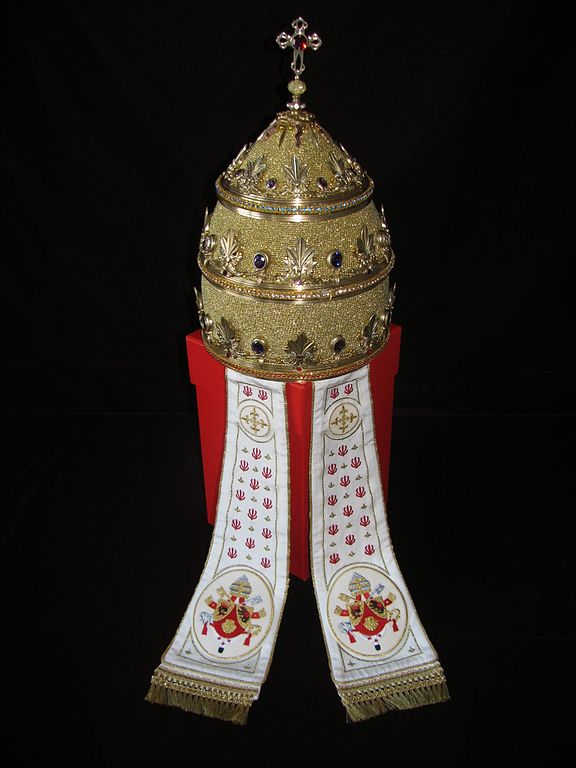
The Roman Pontiffs, because their spiritual position is of greater importance than their political position (though sometimes it hasn’t seemed that way) have never had the sort of accoutrements than secular royals have had, these typically being a sword, a scepter and a crown, at least in western, Christian countries. However, there have still been some items of personal adornment that have distinguished the Bishops of Rome such as the “Fisherman’s Ring” (which is unique to each Pontiff), the red shoes and, most strikingly, the three-tiered crown or Papal Tiara. The oldest sort of unique papal ceremonial headgear dates back to the Dark Ages but there soon developed a sort of crown, originally a bullet or beehive-shaped object with a crown at the base. Later, a second crown was added and, in time, a third which became the traditional norm for hundreds of years. Popes would wear their crown at their coronation, of course, and certain other formal events but, it should be noted, were never liturgical wear other than on one occasion when Pope St. John XXIII wore his tiara at a special joint Catholic-Orthodox service.

The Palatine Tiara
The three crowns on the Papal Tiara can symbolize a number of things, from the triple Christian roles of prophet, priest and king to the Church militant, Church suffering and Church triumphant to the supreme authoritative position of the Pontiff as, “the ruler of the rulers of the world”, a phrase which was formerly used at the papal coronations. Most of the Papal Tiaras were destroyed when the French Revolution came to Italy but a new collection was begun as popes were often donated a Tiara from their home diocese. When Pope Bl. Pius IX lost his political position as ruler of central Italy, Catholic countries seemed to try to compensate for failing to go to war to defend his property by showing how much they still respected his spiritual authority by gifting him a Papal Tiara. He ultimately collected six Papal Tiaras, the most of any Pontiff. For a time, it became tradition to use the 1877 “Palatine Tiara” of Pope Bl. Pius IX at papal coronations. All of his successors were crowned with this Papal Tiara until the coronation of Pope Bl. Paul VI.

Tiara of Bl. Paul VI
Pope Bl. Paul VI was crowned with a very distinctive tiara made for him by his former archdiocese of Milan. However, his would be the last papal coronation to date as, at the end of the Second Vatican Council, Bl. Paul VI gave up his Papal Tiara as a gesture of humility, selling it to benefit the poor. It was bought by the Catholic Church in America and is currently on display in Washington DC at the Basilica of the National Shrine of the Immaculate Conception. This was the last Papal Tiara to ever be worn or, at least, the last to ever be worn publicly (who knows what the Popes try on for size behind the walls of the Vatican). However, old traditions do not ordinarily stop so suddenly and, other than the short-lived Pope John Paul I, every one of the Pontiffs since Pope Bl. Paul VI have still been given a Papal Tiara of their own from some group or another. Obviously, though it remains only as a symbol on the Vatican City coat-of-arms, the Papal Tiara is still the one symbol most associated with the papacy.

Tiara of St John Paul II
When elected to the throne of St Peter, Pope St John Paul II remarked on his immediate predecessor not having a coronation. He lamented that the Papal Tiara had come to be viewed in an incorrect way, yet, he made no effort to correct this other than pointing it out on this one occasion. In the same remarks he said that he too would not be having a coronation to mark his installation as Supreme Pontiff. While Pope Paul VI had done away with much of the traditional pomp and ceremony of the papal court, the reign of St. John Paul II saw occasional use of traditional finery but an explosion of extremely novel modes of dress for a Pope. It seemed to be the era of tie-dye vestments. However, though it remained unknown until long after his passing, Pope St. John Paul II did have a Papal Tiara of his own. It was made by unknown persons behind the “Iron Curtain” in Hungary and was smuggled out of the land of the Magyars to Rome. Although simple in style, it is still quite striking. The lack of lappets (representing the Old and New Testaments and traditionally featured on all bishops miters and Papal Tiaras) suggest it may have been made solely as an artistic work and was not intended to be worn at all. Who was responsible for its construction remains a mystery (as far as I know) and photos of it only emerged after the collapse of the Communist regimes in Eastern Europe. Whatever faithful Hungarians were responsible, I say God bless them for helping to carry on the tradition of every pope having a crown of his own.

Tiara of Pope Benedict XVI
With the death of St. John Paul II and the election of Pope Benedict XVI the era of the tie-dye papacy had certainly come to an end. Benedict XVI took a noticeably more traditional style in his dress and habits, however, unfortunately, that did not extend to the Papal Tiara. Benedict XVI reportedly inquired about having a coronation but was told that it would take too long to organize and come up with a proper ceremony on such short notice so that, effectively, it could not be done. I have no way of verifying that story, just relating what I heard but it seems like a lame excuse. Pope Benedict instead opted for a larger, more old-fashioned style of pallium (the wool band worn about the shoulders by popes and metropolitan archbishops) to be invested with at his inauguration, though it was later replaced with one more like those others wear but still slightly distinctive. However, the Papal Tiara was not only used but even removed from the papal coat-of-arms, replaced with an odd looking miter sporting three, connected, gold bands around it. This was designed by Deacon (now Cardinal) Andrea Cordero Lanza di Montezemolo. Pope Benedict XVI was not to end his reign without a tiara of his own though. In 2011, after a General Audience, Pope Benedict XVI was presented with a Papal Tiara by a group of German Catholics with a businessman named Dieter Philippi being behind the project, having employed a Bulgarian firm that makes liturgical headgear for the East Orthodox which makes it more likely than not that this Papal Tiara can actually be worn. Unfortunately, it was not, despite Benedict XVI being known for trying on all sorts of hats and reviving other forms of papal headgear, specifically the camauro, not seen since the days of Pope St John XXIII (though he did only wear it once).

Tiara of Pope Francis
The election of Pope Francis brought about a drastic change from the more traditional style of his predecessor. From the first day of his election, Pope Francis dispensed with traditional papal fashions along with other displays to highlight his humility in contrast to his predecessors such as refusing to live in the papal apartments at the Apostolic Palace and wearing black or brown shoes rather than the traditional red shoes meant to symbolize martyrdom. With the new standard for humility and simplicity set by Pope Francis, papal coronations seem firmly consigned to the history books and, needless to say, the Papal Tiara has remained absent from the papal coat of arms as well. Whether it was his decision to live in the equivalent of the Vatican ‘guest house’ to his preference for a compact car over the dreadfully named “Popemobile” much less the stately Sedia Gestatoria, Pope Francis has been known for his public displays of humility and renunciation of traditional finery. One would think that he would be the last Roman Pontiff who would wish to receive a Papal Tiara of his own, yet, he too has one. In 2016 Pope Francis was presented with a Papal Tiara by the President of the Assembly of the Republic of Macedonia. It was handmade for him by the nuns of the monastery of Rajcica of Ohrid pearls from a nearby lake. It is quite an exquisite Papal Tiara, obviously made with great care. Pope Francis has never worn it nor would any expect him too. In fact, it was stated at the time that those giving the gift are well aware that Papal Tiaras have become a thing of the past and obviously did not expect their gift to ever be used.

Pope Francis being presented with his tiara
The papacy has, in a very short time, outpaced even the progressive constitutional monarchies of liberal Europe in not only ceasing to have coronations but going so far as to remove their crowns from even symbolic use. Any pope could at any time choose to revive the old traditions, as the pope can generally do as he pleases and is not bound by the actions or words of his predecessors, but the way in which it was done makes this highly unlikely and unfortunately so in my opinion. Pope St John Paul II lamented that the Papal Tiara was, “…an object considered, wrongly, to be a symbol of the temporal power of the Popes” but nonetheless refrained from the use of one and, in that same remark at least seemed to imply that a clash with the virtue of humility was the reason. The portrayal of the abandonment of the Papal Tiara by Pope Paul VI as a symbol of the ‘renunciation of earthly glory’ thus set a standard that it would be very hard for a future Roman Pontiff to undo. By abandoning the Papal Tiara as a gesture of humility, how can any future Pope return to it without appearing vainglorious? It may be hard enough simply to move back in to the Apostolic Palace after the reign of Pope Francis without appearing to show vanity. And that, I think, underscores a more fundamental point about why the renunciation of the Papal Tiara was a mistake. In attempting to show that such “appearances” do not matter, they have, on the contrary, shown the extent to which “appearance” is all that matters.

Thursday, February 9, 2017

Papal Profile: Pope Paul III

Few Roman Pontiffs ever inherited so unfavorable a position as Pope Paul III. Rome had been sacked, much of Italy was in ruins, Protestantism was taking root and the papacy itself was firmly in the grip of the German Emperor and King of Spain Charles V. However, Pope Paul III would not be deterred by any of that. A Renaissance prince, rather typical of the period, he had his negative as well as positive qualities yet his pontificate would be remembered as one of pushing back wherever possible and accepting the ills of the day when not. A man from an illustrious family whose name appears often in papal history, he was born Alessandro Farnese on February 29, 1468 in Canino, in what was then Latium, part of the Papal States. His family were well known in the ranks of the condottiere and his sister, the famously lovely Giulia Farnese, had been the beloved mistress of the notorious Pope Alexander VI. As a son of the Italian Renaissance, Alessandro Farnese would be known for his great culture, his love of art as well as for his political machinations and nepotism. However, as with the Renaissance Popes as a group, he was a more pious man than he is usually given credit for.

Young Cardinal Farnese
It is true that Alessandro Farnese lived a rather colorful and worldly life as a young man. He fathered four illegitimate children but this was all before joining the priesthood. By the time he was ordained in 1519 he had abandoned his worldly ways and dissolute life and devoted himself to the service of God. It is interesting how often this fact, which is not uncommon among the Renaissance Popes, is often left out of the popular histories. In spite of the recent obsession with mercy and forgiveness, the Renaissance Popes often seem to be denied either and are forever tainted by their misdeeds prior to becoming men of the cloth. In fact, many of those people absent-mindedly regard as notorious, were, like Alessandro, faithful to their vows once they had taken them. His career in the Church was undoubtedly aided by his family connections but he was by no means unfit for the stations he held. In time he was made a cardinal bishop and was dean of the Sacred College prior to being elected at the age of 66 on October 13, 1534 after the death of the long suffering Medici Pope Clement VII. He took the name Paul III and quickly set to work trying to restore a sense of normalcy about the Church and begin pushing forward again.

His election had taken only two days, a sign of the respect his fellow cardinals had for him as well as being seen as no friend of the King of France but also not beholden to the German Emperor though he was careful not to cross him. As someone who owed his red hat to his sister being the mistress of Pope Alexander VI, it should not be too surprising that, while his own life had changed considerably upon entering the Church, Pope Paul III was not above laughing at a bawdy comedy, turning a blind eye to the indiscretions of the Roman court and elevating his teenage grandsons to the Sacred College. Nonetheless, when it came to matters of the Church, the spiritual life of the Church and the revival secular historians have dubbed (erroneously) the, “Counter-Reformation”, Pope Paul III provided invaluable leadership to Catholic Christendom.

In political matters, Pope Paul III was not too timid to clash with the secular authorities. He famously excommunicated King Henry VIII of England for his divorce of Queen Catherine of Aragon, appropriation of Church property and various other desecrations of the sacred which Henry termed as a ‘campaign against idolatry’. Paul III was though careful not to find himself opposed to Emperor Charles V and he backed the Habsburg war against the Schmalkaldic League, an alliance of Lutheran princes in Germany which was happily in his own interests as well. However, Paul III knew there was only one thing that would fully satisfy Emperor Charles V and it was the one thing all of his predecessors since the first outbreak of Lutheranism had been reluctant to do; call a general council of the Church.

Pope Paul III with two of his grandsons
Emperor Charles V had been pushing for a council for years. Although he would make peace and grant toleration to Protestants when it served his interests, he most wanted the Church leadership to address the problems that Luther and his fellows made issue of so that some sort of reconciliation could be made that would restore the tranquility of Christendom and stop his German subordinates making war on him and each other. However, history had taught the popes that this was a dangerous thing to do. Such councils, particularly those pushed for by German emperors, frequently ended with an effort to depose the Pontiff and replace him with someone more amenable to the imperial position. This resulted in a cycle of antagonism between popes and emperors which could be extremely disastrous as such a thing had only recently resulted in the near death of Pope Clement VII and the Sack of Rome which was absolutely unprecedented in its horror and bestial cruelty. Pope Paul III finally put a stop to this cycle by calling the Council of Trent which first met in December of 1545 and would carry on for quite some time addressing the many problems and corruptions that had permeated the Church.

This actually had a huge impact and was probably the single most significant thing that Pope Paul III did during his reign. Nothing happened overnight, but the Council of Trent did provide the framework and the starting point for what would be a Catholic revival which would ensure that the Church of Rome not only survived the Protestant storm but would push back against it, ultimately regaining at least a good deal if not all of what had been lost. As part of this overall campaign, Pope Paul III also continued the work of his predecessor Clement VII in pushing for reform in the religious orders. The Theatines, Capuchins, Somaschians and Barnabites were rejuvenated, the Ursulines (a teaching order of nuns) was established in 1535 who would prove quite effective and in 1540 Pope Paul III officially recognized the Society of Jesus. In 1550 he would confirm their constitution and he showed great favor to the Jesuits, viewing them as the spiritual ‘shock troops’ of Catholicism in combating the spread of Protestant sects. He also established and gave extensive powers to the Holy Office of the Roman Inquisition. Despite his worldly reputation, Paul III was obviously someone who took his faith seriously.

Pope Paul III
So, there were two sides to the coin of Paul III. On the one hand he was the pope who made his teenage grandsons cardinals, pushed the power of the Farnese family wherever possible, who made his son Pier Luigi the Duke of Parma and lavished wealth on his grandson Ottavio so that Margherita of Austria would marry him and yet, on the other hand, he was the pope who began reforming the Church, authorized zealous new religious orders, urged respect for the persons and property of the Native Americans and condemned their enslavement. He was also a great patron of the arts and paid heavily for the rebuilding and refurbishment of Rome itself. Probably his most noteworthy project was commissioning the great Michelangelo to finish his painting, “Last Judgment” in the Sistine Chapel. He had a relatively long pontificate for a man who was 66 when he first was elevated to the Throne of St Peter. Pope Paul III died of fever on November 10, 1549 after reigning 15 years and 29 days. He had his good points as well as bad ones but the good was far more significant whereas the bad can generally be reduced to being partial to his own family. That should be considered easily forgivable, especially considering the very valuable work he accomplished as well as setting the stage for greater successes to come. On the whole, Pope Paul III is another example which should prove that the supposedly notorious ‘Renaissance Popes’ were not nearly so awful as most imagine.

Saturday, October 1, 2016

A Word on "Bloody" Mary

It was on this day in 1553 that Queen Mary I of England, eldest child of King Henry VIII, had her coronation as "Queen of England, Ireland and France". She came to the throne in a rather jubilant atmosphere as the vast majority never regarded the Lady Jane Grey as legitimate in any way and her brief bid for power only lasted a little more than a week. However, since her death, Queen Mary I has been vilified to the extent that even all these centuries later she is still known as "Bloody Mary". This is really unfortunate as, despite her reputation, Queen Mary I was not a cruel or heartless woman. She was, rather, a perhaps overly zealous woman, more concerned with principle than politics and an early case of what happens when your enemies write your popular biography.

It is also unfortunate that the case of Queen Mary I is often, to this day, seen through a partisan, religious, glass. The truth is that the Tudor period was a time of intense religious zeal in Christendom and neither Catholics nor Protestants were particularly tolerant of each other. Queen Mary herself had been persecuted, not tortured by any means but certainly persecuted, for her adherence to Catholicism and her refusal to change and embrace Protestantism. Yet, her villainous reputation stems entirely from the fact that she had several hundred Protestants burned alive during her rather short reign for heresy. That is true and by modern standards it is horrific but there are a few facts people should keep in mind before being too harsh towards Queen Mary (and that includes many Catholics who blame her for the failure of their cause in England).

Queen Mary I actually began her reign with a very tolerant attitude toward those who had tried to prevent her from taking the throne, those who had persecuted her mother and the most adamant Protestants of the Church of England. It was only after this attitude of reconciliation was not returned that she likewise became more intolerant. Though often blamed, her husband King Philip II of Spain, actually urged against taking repressive measures, for political reasons of his own. It is also true that Queen Mary had fewer Protestants put to death for their religion than either her father before her or her younger sister after her would have Catholics put to death for their faith, the caveat being that Queen Mary I reigned for only a few years while Henry VIII and Elizabeth I reigned for a much longer period of time. All the same, most of those who were put to death would have or could have justly been put to death anyway for treason but the Queen decided to put them to death for heresy, by burning, rather than for treason which called for a slower and more gruesome means of execution.

Despite her reputation, Queen Mary I was not cruel or heartless. She had a very soft spot for her younger brother and predecessor King Edward VI, though he was raised a radical Protestant and, despite some frustrations, could never bring herself to be too harsh toward her younger sister Elizabeth. She was very fond of children, likely all the more so since she was never able to have any of her own, and would visit the homes of humble common people and always give money to the mothers of small children, who she invariably fussed over. Her ladies-in-waiting and all those who knew her best and spent the most time with invariably described her as kind, considerate and compassionate. It was only that, on the subject of religion, she would not bend to what was expedient. She was a firm believer that the Catholic Church was the only true church and, as such, the humane thing to do was to stamp out heresy ruthlessly so that more souls would not be lured away from the path of righteousness. She inflicted nothing on any Protestant that she would not have been willing to endure herself if the roles were reversed.

Most today would certainly regard what she did as unspeakably cruel and this is not the place to argue over that but the point is that the Queen herself certainly did not see it so. The last evidence of that is in the manner of her death. Her final hours show a woman with a clear conscience who did not dread the judgement of the Almighty. In stark contrast to her more beloved sister, Queen Elizabeth I, who died in agony, tormented by terrifying visions, Queen Mary I died calmly, peacefully, with visions of angelic children playing around her. She was a zealous woman but she was not an evil woman or a heartless woman and should not be portrayed as such.

Wednesday, September 28, 2016

The Knights of St Stephen of Tuscany

In the old days of Christendom, there were religious military orders subject to the Roman Pontiff, such as the Templars, as well as religious military orders subject to a particular dynastic house. One of these was the Order of St Stephen of the Italian Grand Duchy of Tuscany. Officially, the “Holy Military Order of St Stephen Pope and Martyr”, it was founded on October 1, 1561 by the first Grand Duke of Tuscany, Cosimo I de’ Medici with the permission of Pope Pius IV. This could be seen as part of the normalization of the transition in Tuscany to monarchy, away from the city-state Republic of Florence, taking on more of the trappings associated with monarchy as Florence became the seat of power of a hereditary Grand Duke rather than a republican leadership. The order was named for Pope St Stephen the Martyr because his feast day (August 2) corresponded with the victories that Grand Duke Cosimo had won at the Battle of Montemurlo (August 2, 1537) against republican insurgents who wanted to restore the Florentine republic and the Battle of Marciano (August 2, 1554) in which the Medici grand duke had conquered the city-state Republic of Siena.

Cosimo I
Grand Duke Cosimo had actually been trying to establish such an order for some time and more than one attempt was thwarted by Church opposition, largely for political reasons which was typical of the period in which Italy was divided among feuding states. That, however, finally changed with the reign of Pope Pius IV who was a Medici. The primary purpose of the order was to combat the Islamic pirates who were raiding the Mediterranean at will and who had increasingly threatened the Tyrrhenian Sea where Grand Duke Cosimo had built a new, modern port at Livorno. He also wished to demonstrate his support for the cause of Christendom and to unite his people, including the more recently conquered regions such as Siena and Pisa, against a common, non-Italian and non-Christian enemy. The Grand Duke also hoped it would add prestige to his newly established grand duchy, standing alongside other dynastic orders and adding fame to the name of Tuscany and the House of Medici for fighting on the front-lines against the forces harassing Christendom.

Based on the religious rule of St Benedict, the order took as its symbol a red eight-point cross on a white background, incorporating the red and white colors of Florence, with a heraldic lily flower in between the arms of the cross, again using a symbol associated with Florence as well as that of the House of Medici due to their ties with the Royal House of France. Grand Duke Cosimo served as the first Grand Master of the order and, as it was a dynastic order, this would be passed on to every subsequent Grand Duke of Tuscany. The headquarters of the order were originally in Portoferraio but later moved permanently to the city of Pisa where one can still find the magnificent Palazzo dei Cavalieri and the church of Santo Stefano dei Cavalieri. The knights focused primarily on coastal defense but also took the fight to the enemy in cooperation with larger allies. The first of three, broad “campaigns” that the Knights of St Stephen fought was done in cooperation with the Spanish in their fight against the Ottoman Turks in the Mediterranean.

One of the order's war galleys
The Knights of St Stephen, with their own war galleys, fought alongside the Spanish (and other allied Italian states) at the siege of Malta in 1565 and the Battle of Lepanto in 1571. They also participated in the attack and capture of Annaba in Algeria in 1607 under Admiral Jacopo Inghirami in which the city was devastated. This phase in their campaigning was, such as at Malta and Lepanto, defensive and focused on stopping major Turkish offensives against southern Italy. However, once that was done, low level harassment on the part of Turkish and, more often, Barbary pirates remained a problem and the Order of St Stephen focused its second campaign on dealing with this problem. They also concentrated on areas closer to home with raids on the Turkish-held islands of the Aegean as well as launching attacks on Islamic forces in Dalmatia, Negroponte and the island of Corfu. These were successful enough that offensive military operations by the Knights of St Stephen decreased, their last major campaign, coming around the year 1640, during the reign of Grand Duke Ferdinand II, focused on coastal defense and aiding the Republic of Venice in their on-going struggle against the Ottoman Empire.

Ferdinand III
The year 1719 saw the last time that the Order of St Stephen was used in combat by Grand Duke Cosimo III. Later, in 1737, a major change came when the House of Medici was supplanted by the Austrian dynasty of Hapsburg-Lorraine. The second Hapsburg grand duke, Peter Leopold I, formally ended the military aspect of the order and reorganized it as an order that would focus on education for the elites of Tuscany. It became more a feature of social status and no longer an order focused on war and military defense. The Order of St Stephen lost its fighting capacity under the Hapsburgs but things soon became even worse. In 1791 Emperor Leopold II abdicated the throne of Tuscany in favor of his son Ferdinand III who has the dubious distinction of being the first monarch to recognize the revolutionary First French Republic. However, that was not enough to save him. French expansion continued and the Austrians eventually agreed to hand over control of northern Italy to the French Republic in exchange for half of the territory of neutral Venice. The Grand Duchy of Tuscany was occupied by the French, the Grand Duke was forced to abdicate and the Order of St Stephen was suppressed.

Leopold II
Thankfully, that situation did not endure. In due time Napoleon was defeated and the Grand Duke of Tuscany was put back in his place in 1814 and, the following year, the Order of St Stephen was restored. It was, however, restored in its reformed form, not a military order but became more of a sign of favor with the grand ducal family. The French experience also seemed to have an affect on the Italian populace as so many years of division, feuding and foreign rule or foreign occupation prompted the growth and spread of a new Italian nationalism. It was an unfortunate period for the Grand Dukes of Tuscany, who were good men of good motives and intentions but their natural inclination to support their Austrian relatives was not matched by their subjects and many deserted the forces of Tuscany to join the Piedmontese and the Italian national movement in fighting to expel the Austrians from Italian soil. Grand Duke Leopold II, a noble and tragic figure, made the mistake of so many of his contemporaries in granting constitutional government, only to later revoke it and he was forced to abdicate. Grand Duke Ferdinando IV, his successor, ruled for only about a year before he too was forced out in 1859 by the Italian nationalists. In 1860 Tuscany was formally annexed to the Kingdom of Italy.

Neither the Kingdom of Italy nor the current Italian republic officially recognize the Order of St Stephen, though it does still exist but as a purely private organization under the leadership of the Hapsburg-Lorraine heirs of the former grand duchy. Prince Sigismund, Archduke of Austria, is the current Grand Master and the order is considered, by the Catholic Church, as a “public association of the faithful” with historic papal foundations. The Knights of Malta still recognize it but membership is extremely limited, mostly to close friends and family. One must have extensive documented proof of aristocratic ancestry to even be considered for membership and the costs required, as with most such orders today, ensure that only quite wealthy people could ever hope to be invited. Nonetheless, what exists today is a valuable reminder of what a glorious and formidable military-religious order the Knights of St Stephen once were and one can still see their educational facility and naval war college in Pisa, a testament to their past as one of the major forces on the front lines of defending Christendom in the Mediterranean area.

Thursday, March 10, 2016

Anti-Papal Profile: Anti-Pope Felix V (Duke Amadeus VIII of Savoy)

Once upon a time in Europe there was a major Catholic embarrassment known as “the Great Schism”. It came as a result of what is known as “the Babylonian Captivity” or the “Avignon Papacy” when the papal court moved from Rome to Avignon in France which produced a succession of French pontiffs who were seen as little more than the tools of the French Crown. That ended with Pope Gregory XI and when he died the people of Rome were determined to have a Roman pontiff rather than a French one. They were quite forceful about it and so the cardinals elected a rather unpleasant fellow (not exactly a Roman but a southern Italian deemed ‘close enough’) who took the name Pope Urban VI. The French, however, did not like that and so declared his election invalid, the cardinals electing another pope, a warrior-cardinal (Robert of Geneva), who took the name Pope Clement VII. He is what is known as an “Anti-Pope” or an invalid pope. This was the beginning of the “Great Schism” which saw Catholic Europe split into feuding factions, at one point with three different men all claiming to be the “true” Pope at the same time. It was a major embarrassment and it is not surprising that anti-Popes tend to be viewed as ‘bad guys’ in Catholic history.

Popes, popes, everywhere a pope!
However, that is not necessarily true. Pope Urban VI, for example, while undoubtedly the valid, legitimate pontiff, was a rather unsavory character and most who had to deal with him found him a rather vindictive, bullying jerk. Pope Clement VII, on the other hand, though nicknamed “the butcher” in his earlier, military career just because of a trifling incident involving the massacre of a few thousand people, was widely considered the much better man, a very nice fellow who treated people well, was forgiving toward his enemies and genuinely considered himself the valid pontiff. Practically any Catholic history will, in fact, relate that while Urban VI was the correct pope, Clement VII would have made a better one. Not every anti-Pope was an ambitious usurper, thirsty for power but rather were sometimes men of sincere piety who, in a confusing and tumultuous time, were prevailed upon to accept the papal crown as a duty to the Church and Christendom. The “Great Schism” was, thankfully, mostly ended with the election of Pope Martin V in 1417, however one rival remained and there would be a couple more before it was all over. The man regarded by history as the last of the anti-Popes is an illustration of a good, devout man being caught up in a situation not of his making which left him on the wrong side of Church history but still with a good reputation.

That man was Amadeus VIII, Count and later Duke of Savoy. He was born on September 4, 1383 to Count Amadeus VII of Savoy and Bonne of Berry (granddaughter of King Jean II of France). His father died in 1391 leaving him Count of Savoy at an early age but his mother acted as his regent until he was old enough to rule in his own right. As the Count of Savoy he was quite a successful ruler. He enlarged his domains, oversaw economic prosperity, earned a reputation for being mild-mannered and just as well as being quite religious. With the Hundred Years War still raging between England and France, he tried several times to arrange a negotiated end to the conflict though to no avail. When the “Great Schism” broke out, he was very troubled by it, more so than most because of his pious nature. He had been such a success and had such a great reputation that, in 1416, Sigismund of Luxembourg, the Holy Roman (German) Emperor gave him an aristocratic promotion, raising him to the status of Duke of Savoy. Later, he also conferred on him the title of Count of Geneva. Earlier he had married Mary of Burgundy and had a happy home life, fathering nine children. However, his world fell apart when his beloved wife died in 1422 and Duke Amadeus VIII turned his back on the world.

Amadeus VIII retired, though he retained his title, handing power over to his son Louis, to live a contemplative life as a hermit in Ripaille on the shores of Lake Geneva. He took five knights with him to live by a monastic code he devised as the Order of St Maurice, which, combined with another, is still one of the senior chivalric orders of the Italian Royal Family today. He was thus mostly out of touch from that time on though he had kept up with the events of the Council of Basel-Ferrara-Florence. It was this council, in opposition to Pope Eugene IV, which elected him (Anti-)Pope on October 30, 1439. It was not a position he had sought for himself and it took a period of negotiations before he could be prevailed upon to accept the papal crown. The primary motivation of the electors seems to have been the wealth and prestige they thought Amadeus would bring with him to their cause. He finally accepted and was duly installed as Pope Felix V on November 5, 1439.

"Pope" Felix V
Anti-Pope Felix V renounced his secular titles and was crowned by Cardinal d’Allamand in 1440. For the first few years of his pontificate his secretary was Aeneas Sylvinus Piccolomini, later Pope Pius II. The actual pope, Eugene IV, excommunicated him of course and he found no widespread popular support for his position beyond his own lands in Savoy and across Switzerland. Those who did acknowledge him as the rightful pope included the Dukes of Austria, Tyrol, Bavaria-Munich, the Count-Palatine of Simmern, the Teutonic Order and a handful of religious orders and universities in Germany. Most of those who appointed cardinals refused to take their places and as Pope Eugene IV gave way to Pope Nicholas V support for Felix V fell away further. He was also frequently at odds with the Council of Basel over financial matters which is the one area that tends to taint his reputation. Still, no one could find that he had acted in bad faith or could show any evidence of serious defects in his character. His position continued to deteriorate though through 1442 and 1443 after which he increasingly became isolated and ignored. Efforts to establish a papal court and control over the Church bureaucracy ended in frustration and finally the pretense came to an end in 1449 when he submitted to the authority of Pope Nicholas V on April 7.

Nonetheless, it was not all that bad an end for anti-Pope Felix V. Because of his good name and recognition that he had been misled rather than acting purposely malicious, Pope Nicholas V was inclined to be forgiving. He appointed Amadeus of Savoy Cardinal of St Sabina and made him his permanent Apostolic vicar-general for the lands of the House of Savoy as well as the dioceses of Basel, Strasbourg, Chur and others. The papal schism had ended and there seemed to be few hard feelings about it, so a happy ending all in all. Amadeus VIII carried on in ecclesiastical office, under the legitimate pontiffs, until his death on January 7, 1451 at the age of 67.

Thursday, April 16, 2015

Santo Niño de Cebú

The monarchist legacy in the Philippines can be a tricky subject. However, one area in which the Spanish colonial legacy is not controversial is in the area of religion with the Philippines standing out as the most devoutly Catholic country in all of Asia. Within that spectrum, one of the most beloved local focuses for religious devotion is the 'Holy Child of Cebu'. It is the oldest Christian icon in the Philippines and its origins in the islands have monarchist origins. It was brought by the Portuguese explorer (in the employ of Spain) Ferdinand Magellan and given as a gift to the Raja of Cebu, Humabon, as a gift to mark his baptism into the Catholic faith. Incidentally, the gift was presented along with another icon, a statue of Our Lady of the Remedies which later became a very specifically royalist icon in Mexico. Over the centuries, the Holy Child icon was embellished with fine cloth and the regalia of a Christian emperor.

Eventually, as this particular devotion grew and grew in popularity, it achieved the farthest heights of official recognition. Pope Innocent XIII approved of special liturgical texts for the celebration of the 'Holy Child of the Philippines'. Centuries later, both Pope Paul VI and Pope St John Paul II gave the devotion special recognition. In 1965 Pope Paul VI empowered his legate to hold a pontifical high mass and a canonical coronation for the image, which is a rare honor indeed. The only other Christ images to be so crowned have been the Holy Infant of Prague in what is now the Czech Republic and the Holy Child of Aracoeli in Italy (which was stolen in 1994).

During the colonial era, the Holy Child of Cebu was named Captain-General of the Spanish forces of the Philippines, which was marked by the addition of military garb in the form of boots and a red sash. In 2011 the modern Filipino navy named the Holy Child the "Lord Admiral of the Seas" on the anniversary of the rediscovery of the image (it had been lost for some time following its original presentation to the raja until the establishment of Spanish rule). Probably the most beloved and widely revered icon in the Philippines, it is the focus of a special liturgical feast every third Sunday of January.

Monday, January 19, 2015

Papal Profile: Pope Paul II

As has been mentioned previously, the popes of the Renaissance period have, undoubtedly, a bad reputation in the popular culture. They are, collectively, portrayed as being flagrantly corrupt, vicious and immoral. However, as I have said before, this is an exaggeration which has built up over time as lurid gossip has been repeated so often as to be accepted as “fact” to many people, it makes for a more entertaining story and because it is simpler to use such generalizations than to take each Renaissance Pontiff individually and accept that each had their faults as well as their virtues, some admittedly more of one than the other. Pope Paul II is one of these. One of the earlier Renaissance Popes, he was born Pietro Barbo in Venice on February 23, 1417. As a native son of the Republic of Venice, it was expected that he would have a career as a merchant and was trained to be a businessman. However, the course of his life changed when his maternal uncle was elected Pope Eugenius IV, which was so common that, of course, the word “nepotism” itself comes from the Italian word for “nephew” as it became the accepted practice for popes to promote their nephews to high office in the Church. Young Pietro Barbo thus entered an ecclesiastical career and was rapidly promoted through the Church hierarchy, receiving the red hat of a cardinal in 1440.

While still a layman (and one did not have to be ordained to be a cardinal in those days), Barbo also helped ease his way through the hierarchy by being known for his generosity. This, of course, was easy for critics to dismiss as bribery, which would be unfair to Barbo though “greasing the wheels” was certainly a far from unknown practice. In 1445 he became archpriest of the Vatican Basilica and he twice served as camerlengo of the Sacred College. He was known for being generous, rather reclusive (perhaps a bit on the paranoid side) and extremely emotional. Later on, critics would read into certain things to exaggerate habits to paint a picture designed to blacken the reputation of Barbo, such as pointing to the fact that he cried easily and tended to dress very flamboyantly to portray him as a homosexual. However, at the time, he was simply regarded as being vain and rather too proud of his good looks (in the prime of his life) which few considered very unusual. With the death of Pope Pius II, Pietro Cardinal Barbo was elected to the See of Peter on July 26, 1471 on the first ballot and took the name of Pope Paul II. It did not take long after his election for it to become obvious why so many would have an interest in trying to ruin his reputation and portray him as negatively as possible.

Pope Pius II had been an ardent believer in papal supremacy, was rather authoritarian as pontiff and wanted nothing more than another crusade against the Turks. He did not deal very patiently with those who preferred a comfortable life to going off to fight a Holy War and so he ruffled a great many feathers amongst the upper echelons of Christendom as well as the Church. Pope Paul II was chosen by the electors on the understanding that he would undo all of that. He was expected to share more power and be more “collegial” as we might say today. However, to the frustration of many princes of the Church, after he was elected Pope Paul II made it clear that he would do no such thing. The supremacy of the Pontiff was a matter of sacred tradition and something he could not undo. This upset many powerful people in the Church. However, it was also illustrative of something not uncommon with the Renaissance popes; that men often changed once assuming the Throne of St Peter and the immense responsibilities that went with it. Paul II also attracted disfavor from another direction, which was the humanist community which, in the spirit of the Renaissance, had been embracing all things classical which had come to include a sort of neo-paganism. Pope Paul II put a stop to that and so was denounced as being illiberal and tyrannical. It is unlikely to have bothered him.

Libertine intellectuals and career-cardinals may have despised Paul II, but the ordinary Romans certainly did not. His public works and increase in the number of holy years as well as his more artistic projects brought gainful employment to many. Religious festivals were also coming more often and the Romans, with their traditional love of pomp and ceremony, be it imperial or papal, welcomed the change. Pope Paul II also, contrary to the popular image of Renaissance Popes, opposed the way that indulgences had been abused. To the regular people, he was a handsome, generous Pontiff who made all the right moves and it probably would have been to his benefit to let the people see more of him but he tended to be somewhat reclusive. His reputation for vanity evidently did not extend to any wish to be seen and lauded publicly as Paul II tended to keep to himself and do his work privately. A great deal of that work included the long-sought after dream of Christian unity and triumph over the Ottoman Turks. He carried on the call for a crusade just as his predecessor had done but, knowing he would be ignored as well, tried to use diplomatic maneuvering to advance the cause of Christendom in the struggle against the expanding Islamic empire. One such effort was his forming an alliance with an Iranian prince who opposed the Turks.

In furthering the cause of Christian unity, and trying to bring about the strategic encirclement of the Ottoman Empire, Pope Paul II used the tactic of dynastic alliance through marriage. He managed to find a Byzantine princess, Sophia (a niece of Emperor Constantine XI), from those who had become Catholic, and brokered her marriage to Czar Ivan III of Russia. This seemed a brilliant maneuver as Russia had declared itself the inheritor of the legacy of Constantinople and the Byzantine (East Roman) Empire, a marriage to a member of the old Byzantine Imperial Family would have looked quite attractive to a Russian ruler eager to cement his claims. There had also been increased interaction between the two as Czar Ivan III had imported Italian architects to add to the grandeur of Moscow. However, while Ivan III took the title of Czar and Autocrat for himself, added the Byzantine eagle to his flag and so on, the marriage which occurred in 1472 did not result in the reunion of east and west that the Pope had hoped for. Ivan III remained staunchly Russian Orthodox and refused to take part in an alliance with the Latin west against the Turks. For his many achievements, he would be remembered in Russian history as “Ivan the Great” but for Pope Paul II, his reign was a disappointment, representing opportunity lost.

In the final days of his reign, Paul II had to deal with some trouble with the King of Bohemia who took a religious position contrary to the Pope. The King was excommunicated and ordered deposed (local rebels were trying to bring that about) but, contrary to their popular image, Renaissance popes did not tend to be exceptionally vindictive and when the King of Bohemia changed his attitude the Pope was prepared to lift the spiritual sanctions against him and welcome him back into the fold. However, before he could see to the matter himself Pope Paul II died on July 26, 1471 at the age of 54. Accounts of his death varied, usually due to his enemies trying to one-up each other in coming up with a story more scandalous than whatever was being put about at the moment. In truth, the Pope simply mentioned feeling ill, went to bed, was later found foaming at the mouth and by the time help arrived he was dead, most likely from a stroke.

On the whole, the reign of Pope Paul II had been a succession of disappointments yet none could fault him for not trying. He was vain, having an almost obsessive fascination with glamorous attire, jewels and lavish decorations but he had also been something of a reformer and zealous in his monarchical role of trying to secure and advance Christendom. His dealings with the King of Bohemia had begun in an effort to get him to lead a war against the Turks who were pushing into Albania and Hungary. His call for a crusade, after the last Venetian foothold in Greece was lost, was simply ignored and his efforts to get Russia and Iran on side for a united war effort against the Ottomans were only half successful at best and came to nothing. He was not on the best of terms with the German Emperor but that practically become a papal tradition. He is in no danger of being regarded as saintly but he was nowhere near as bad as his many detractors have made people think.
Related Posts Plugin for WordPress, Blogger...