Showing posts with label Pope. Show all posts

Saturday, February 18, 2017

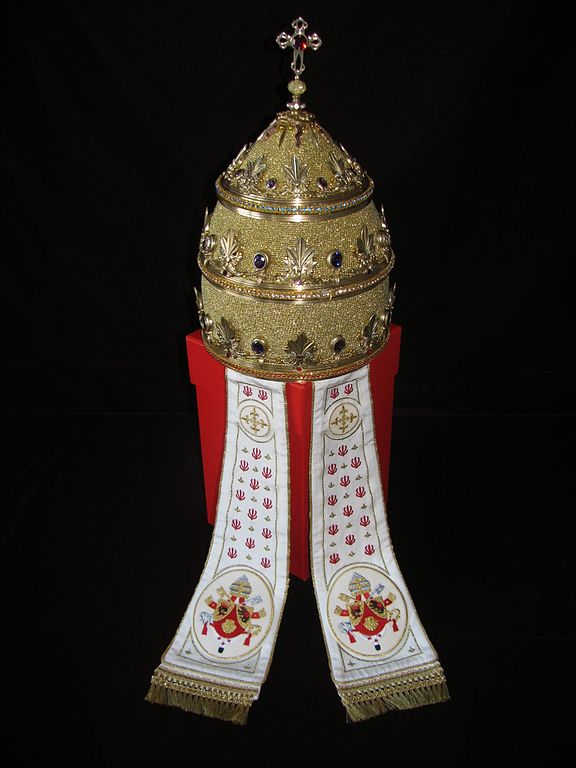
Royal Regalia: Recent Papal Tiaras

The Roman Pontiffs, because their spiritual position is of greater importance than their political position (though sometimes it hasn’t seemed that way) have never had the sort of accoutrements than secular royals have had, these typically being a sword, a scepter and a crown, at least in western, Christian countries. However, there have still been some items of personal adornment that have distinguished the Bishops of Rome such as the “Fisherman’s Ring” (which is unique to each Pontiff), the red shoes and, most strikingly, the three-tiered crown or Papal Tiara. The oldest sort of unique papal ceremonial headgear dates back to the Dark Ages but there soon developed a sort of crown, originally a bullet or beehive-shaped object with a crown at the base. Later, a second crown was added and, in time, a third which became the traditional norm for hundreds of years. Popes would wear their crown at their coronation, of course, and certain other formal events but, it should be noted, were never liturgical wear other than on one occasion when Pope St. John XXIII wore his tiara at a special joint Catholic-Orthodox service.

The Palatine Tiara
The three crowns on the Papal Tiara can symbolize a number of things, from the triple Christian roles of prophet, priest and king to the Church militant, Church suffering and Church triumphant to the supreme authoritative position of the Pontiff as, “the ruler of the rulers of the world”, a phrase which was formerly used at the papal coronations. Most of the Papal Tiaras were destroyed when the French Revolution came to Italy but a new collection was begun as popes were often donated a Tiara from their home diocese. When Pope Bl. Pius IX lost his political position as ruler of central Italy, Catholic countries seemed to try to compensate for failing to go to war to defend his property by showing how much they still respected his spiritual authority by gifting him a Papal Tiara. He ultimately collected six Papal Tiaras, the most of any Pontiff. For a time, it became tradition to use the 1877 “Palatine Tiara” of Pope Bl. Pius IX at papal coronations. All of his successors were crowned with this Papal Tiara until the coronation of Pope Bl. Paul VI.

Tiara of Bl. Paul VI
Pope Bl. Paul VI was crowned with a very distinctive tiara made for him by his former archdiocese of Milan. However, his would be the last papal coronation to date as, at the end of the Second Vatican Council, Bl. Paul VI gave up his Papal Tiara as a gesture of humility, selling it to benefit the poor. It was bought by the Catholic Church in America and is currently on display in Washington DC at the Basilica of the National Shrine of the Immaculate Conception. This was the last Papal Tiara to ever be worn or, at least, the last to ever be worn publicly (who knows what the Popes try on for size behind the walls of the Vatican). However, old traditions do not ordinarily stop so suddenly and, other than the short-lived Pope John Paul I, every one of the Pontiffs since Pope Bl. Paul VI have still been given a Papal Tiara of their own from some group or another. Obviously, though it remains only as a symbol on the Vatican City coat-of-arms, the Papal Tiara is still the one symbol most associated with the papacy.

Tiara of St John Paul II
When elected to the throne of St Peter, Pope St John Paul II remarked on his immediate predecessor not having a coronation. He lamented that the Papal Tiara had come to be viewed in an incorrect way, yet, he made no effort to correct this other than pointing it out on this one occasion. In the same remarks he said that he too would not be having a coronation to mark his installation as Supreme Pontiff. While Pope Paul VI had done away with much of the traditional pomp and ceremony of the papal court, the reign of St. John Paul II saw occasional use of traditional finery but an explosion of extremely novel modes of dress for a Pope. It seemed to be the era of tie-dye vestments. However, though it remained unknown until long after his passing, Pope St. John Paul II did have a Papal Tiara of his own. It was made by unknown persons behind the “Iron Curtain” in Hungary and was smuggled out of the land of the Magyars to Rome. Although simple in style, it is still quite striking. The lack of lappets (representing the Old and New Testaments and traditionally featured on all bishops miters and Papal Tiaras) suggest it may have been made solely as an artistic work and was not intended to be worn at all. Who was responsible for its construction remains a mystery (as far as I know) and photos of it only emerged after the collapse of the Communist regimes in Eastern Europe. Whatever faithful Hungarians were responsible, I say God bless them for helping to carry on the tradition of every pope having a crown of his own.

Tiara of Pope Benedict XVI
With the death of St. John Paul II and the election of Pope Benedict XVI the era of the tie-dye papacy had certainly come to an end. Benedict XVI took a noticeably more traditional style in his dress and habits, however, unfortunately, that did not extend to the Papal Tiara. Benedict XVI reportedly inquired about having a coronation but was told that it would take too long to organize and come up with a proper ceremony on such short notice so that, effectively, it could not be done. I have no way of verifying that story, just relating what I heard but it seems like a lame excuse. Pope Benedict instead opted for a larger, more old-fashioned style of pallium (the wool band worn about the shoulders by popes and metropolitan archbishops) to be invested with at his inauguration, though it was later replaced with one more like those others wear but still slightly distinctive. However, the Papal Tiara was not only used but even removed from the papal coat-of-arms, replaced with an odd looking miter sporting three, connected, gold bands around it. This was designed by Deacon (now Cardinal) Andrea Cordero Lanza di Montezemolo. Pope Benedict XVI was not to end his reign without a tiara of his own though. In 2011, after a General Audience, Pope Benedict XVI was presented with a Papal Tiara by a group of German Catholics with a businessman named Dieter Philippi being behind the project, having employed a Bulgarian firm that makes liturgical headgear for the East Orthodox which makes it more likely than not that this Papal Tiara can actually be worn. Unfortunately, it was not, despite Benedict XVI being known for trying on all sorts of hats and reviving other forms of papal headgear, specifically the camauro, not seen since the days of Pope St John XXIII (though he did only wear it once).

Tiara of Pope Francis
The election of Pope Francis brought about a drastic change from the more traditional style of his predecessor. From the first day of his election, Pope Francis dispensed with traditional papal fashions along with other displays to highlight his humility in contrast to his predecessors such as refusing to live in the papal apartments at the Apostolic Palace and wearing black or brown shoes rather than the traditional red shoes meant to symbolize martyrdom. With the new standard for humility and simplicity set by Pope Francis, papal coronations seem firmly consigned to the history books and, needless to say, the Papal Tiara has remained absent from the papal coat of arms as well. Whether it was his decision to live in the equivalent of the Vatican ‘guest house’ to his preference for a compact car over the dreadfully named “Popemobile” much less the stately Sedia Gestatoria, Pope Francis has been known for his public displays of humility and renunciation of traditional finery. One would think that he would be the last Roman Pontiff who would wish to receive a Papal Tiara of his own, yet, he too has one. In 2016 Pope Francis was presented with a Papal Tiara by the President of the Assembly of the Republic of Macedonia. It was handmade for him by the nuns of the monastery of Rajcica of Ohrid pearls from a nearby lake. It is quite an exquisite Papal Tiara, obviously made with great care. Pope Francis has never worn it nor would any expect him too. In fact, it was stated at the time that those giving the gift are well aware that Papal Tiaras have become a thing of the past and obviously did not expect their gift to ever be used.

Pope Francis being presented with his tiara
The papacy has, in a very short time, outpaced even the progressive constitutional monarchies of liberal Europe in not only ceasing to have coronations but going so far as to remove their crowns from even symbolic use. Any pope could at any time choose to revive the old traditions, as the pope can generally do as he pleases and is not bound by the actions or words of his predecessors, but the way in which it was done makes this highly unlikely and unfortunately so in my opinion. Pope St John Paul II lamented that the Papal Tiara was, “…an object considered, wrongly, to be a symbol of the temporal power of the Popes” but nonetheless refrained from the use of one and, in that same remark at least seemed to imply that a clash with the virtue of humility was the reason. The portrayal of the abandonment of the Papal Tiara by Pope Paul VI as a symbol of the ‘renunciation of earthly glory’ thus set a standard that it would be very hard for a future Roman Pontiff to undo. By abandoning the Papal Tiara as a gesture of humility, how can any future Pope return to it without appearing vainglorious? It may be hard enough simply to move back in to the Apostolic Palace after the reign of Pope Francis without appearing to show vanity. And that, I think, underscores a more fundamental point about why the renunciation of the Papal Tiara was a mistake. In attempting to show that such “appearances” do not matter, they have, on the contrary, shown the extent to which “appearance” is all that matters.

Sunday, October 19, 2014

Papal Beatification in Rome

Today at the Vatican the Bishop of Rome (as he now prefers to be called) beatified his predecessor, now Blessed Pope Paul VI, best known for presiding over the close of the Second Vatican Council. For those keeping score, despite the immense problems the Catholic Church has had in recent times, it has apparently been blessed with an unprecedented abundance of saintly leadership. Of the past five Pontiffs who have gone to their eternal reward, Pius XII has been declared "venerable", John XXIII has been declared a saint, Paul VI has been declared "blessed", John Paul I has been declared a "Servant of God" and John Paul II has been declared a saint. In other words, every deceased Pope since 1939 either has or is set to become a recognized saint. Rather hard to imagine that the canonization of popes was once a rare thing.

Blessed Pope Paul VI


Tuesday, May 20, 2014

Pope Francis and Socialism

On Friday, May 9, 2014 in Vatican City, during a meeting with UN Secretary-General Ban Ki-moon and other UN leaders Pope Francis called for a worldwide effort by government to redistribute wealth to help the poor in a new spirit of “generosity”. This should not be too difficult for governments to do as it is always easy to be generous with the wealth of others and that is all governments have to work with. They generate no wealth on their own and so can only sustain themselves by confiscating the wealth created by others, which is what we call taxation. It is rather perplexing in that regard since very few people feel “generous” on tax day. Generosity, in my obviously out-dated mode of thinking, is the voluntary giving out of a spirit of charity which is rather the exact opposite of governments using the coercion of force to take wealth from one group to give it to another group which is deemed more worthy. This, of course, has led to the word “socialism” being tossed around and it is not the first time Pope Francis has been accused of promoting Marxist/socialistic values in the name, as always, of helping the poor. It immediately called to my mind something else a famous figure once said.

This man spoke of those who “proclaim the absolute equality of all men in rights and duties” and that these are also invariably enemies of the family, of the bond of husband and wife and who are themselves full of greed. He said, “they assail the right of property sanctioned by natural law; and by a scheme of horrible wickedness, while they seem desirous of caring for the needs and satisfying the desires of all men, they strive to seize and hold in common whatever has been acquired either by title of lawful inheritance, or by labor of brain and hands, or by thrift in one’s mode of life”. They spread these ideas vigorously in various ways this man said and he even added, “Wherefore, the revered majesty and power of kings has won such fierce hatred from their seditious people that disloyal traitors, impatient of all restraint, have more than once within a short period raised their arms in impious attempt against the lives of their own sovereigns.” This came from a man Pope Francis will no doubt be aware of. These words were from none other than Pope Leo XIII in his encyclical “Quod Apostolici Muneris” of December 28, 1878.

I would recommend any to read this encyclical, not excluding Pope Francis himself, as it may prove enlightening. It is known as the encyclical against socialism and rightly points out that these advocates of egalitarianism (which Pope Leo at least did not consider a beneficial thing) cloak their maliciousness behind the guise of a charitable impulse to help the poor and he could also see, even in 1878, that these were the enemies of the traditional family unit as well as the obvious truth, then as now, that they were also the enemy of the legitimate monarchs of the world. Pope Leo XIII also listed the past Roman Pontiffs who had condemned these same miscreants, or their ideological forefathers, and their reprehensible ideology which is so ruinous to mankind. Nor would he be the last. Faced with appalling examples of socialism in action in places from Mexico to Spain to Russia, Pope Pius XI similarly condemned it on numerous occasions such as in his 1937 encyclical “Divini Redemptoris” “On Atheistic Communism” in which he denounced the entire collectivist mentality that would make of the individual no more than a cog in the wheel of the great, collectivist machine devoted solely to materialism. He also stated famously in “Quadragesimo Anno” that, “No one can be at the same time a sincere Catholic and a true socialist”.

However, in a sincere desire to assist Pope Francis, I would recommend sticking close to the example of the aforementioned Pope Leo XIII. Today, Pope Leo XIII is most famous as being the ‘Pope of the worker’ for his encyclical “Rerum Novarum” in which he sanctioned the formation of Catholic trade unions. Even then, however, he warned against the collectivism of the socialists and said, “The first and most fundamental principle, therefore, if one would undertake to alleviate the condition of the masses, must be the inviolability of private property.” He went on to lay out guidelines for a way of bringing ownership and labor together in something along the lines of the corporatism of medieval Italy. Pope Leo XIII has gone down in history as a pontiff who was a champion of the working man, the poor and the marginalized. And yet, his personal style could not be more dissimilar to Pope Francis. Pope Leo XIII was an Italian aristocrat and was quite famous for his strict adherence to traditional court protocol and papal ceremony. He showed that it was not necessary to sacrifice the smallest detail of the majesty of the papal position in order to be a defender of the poor and an advocate for the marginalized. Pope Leo XIII championed the cause of the downtrodden in imperial Roman splendor. I might also add that he openly identified himself as a monarchist. Alas, many today would not consider that a good thing but, on the other hand, he certainly never gave anyone cause to speculate that he might be a Marxist. No one would have ever made that mistake.

Part of the trouble with the enforced redistribution of wealth to help the poor, is that it destroys positive feelings on the part of both parties involved. This is totally different from charity which gives the party making the donation a sense of happiness for being benevolent and makes the receiver grateful that someone would freely choose to help them. It is a gift and is appreciated as such. Wealth redistribution by the state, on the other hand, generates no feeling of happiness because it is done by force. Being forced to do something, even to do good, is not charitable and one can take no satisfaction in it. In fact, it builds resentment among the providers that what they earned was forced from them to be given to someone who did not earn it. Likewise, the one receiving is also poisoned by it. Rather than feeling gratitude at receiving a gift, they expect it as something they are entitled to and when it is ever lessened or stopped altogether they feel themselves “robbed” of something which they never earned in the first place because they were taught to feel themselves entitled to the fruits of another’s labor. The only ones who benefit are the state bureaucrats who handle the transaction, always keeping a tidy sum for themselves in the process, a sort of ‘handling fee’ for the government.

This is something past pontiffs seemed to understand, that socialism was not wrong simply because socialists tend to be anti-clerical and thus ‘bad for business’ but because they are wrong in principle, their motivations are false and their methods do more harm than good. Of course, in the past, pontiffs also openly attested that monarchy was ‘the best of all governments’ (Pius VI) and considered that they themselves held a rather monarchial position all of which was according to the divine commands. As a result, they viewed the socialist championing of egalitarianism as something dangerous and immoral. Today, unfortunately, that does not seem to be the case. I would also recommend paying particular attention to Pope Leo XIII, so many years ago, pointing out the link between the socialists and attacks on the family. Today we see the same thing. It is the socialists of the left who are at the forefront of destroying the traditional family and they use the arguments of ‘helping the poor’ and promoting equality to do it, whether it is by encouraging single-parent homes, divorce or redefining marriage altogether. If Pope Leo XIII could see the world, and the Church, now, I wonder what he would say?

*Additional note: Some authors, devout Catholics among them, have warned that this new attitude by Pope Francis could open the Catholic Church up to accusations of hypocrisy since they do not pay taxes, at least in the United States where there is probably the most to be gained if the Church did start having to pay taxes. I would have to say, asking the Pope to practice what he preaches would not be an unreasonable position and would add, just for some context, that when Pope Leo XIII made his remarks, he was the first Pontiff in a very long time who did not have subjects to tax in order to sustain himself. He was living entirely off of charity and still never found the need to give up any of the pomp and ceremony of the papal office (of course, he wasn’t constantly traveling all over the world either, somehow the Church survived quite a few decades without the Pope ever leaving Vatican City). I would not be surprised to hear someone suggest that, because of his support for wealth redistribution by the state, Pope Francis might want to stop accepting the subsidy he receives from Italian taxpayers (which is rather ridiculous considering that the Church in Italy is now taxed, ever since the financial crisis) and let that portion designated for the Church to go to the Italian Republic instead to redistribute to the poor. Of course, I would try to be more helpful and suggest that the Church go back to the much smaller bureaucracy it had before the massive expansion of Vatican II or perhaps stop using the ridiculously named “Pope-mobile” and return to the sedan chair that used no fossil fuels and produced no harmful emissions (since we’re all so environmentally conscience these days). That should help save some money for the poor.

Oh, and another piece of advice: go back to the Apostolic Palace. Not many seem to understand that by taking over the Domus Sanctae Marthae “guesthouse” nothing is actually being saved. The Pope has more space than he had on one floor of the Apostolic Palace and he still uses the Palace, it still has to be heated and cleaned and maintained and all the rest so, despite being portrayed as some sort of humble act of frugality, it just means the Pope is taking up two buildings instead of one. Going back to the old way would save something, even if just a little. But then again, this is rather illustrative in and of itself when it comes to government wealth redistribution programs. The appearance is often quite different from the facts of the matter. It looks like governments are being terribly generous and “charitable” when it fact the poor are worse off as a result and, in the same way, the Pope may have been a much more grand and majestic looking figure in the days of Leo XIII but he actually received less money and spent far less money than the so much more outwardly humble Pope Francis does. It is worth thinking about. -MM

Monday, April 28, 2014

Popes, To Canonize or Not to Canonize?

Sunday, there was a dual canonization held at the Vatican with Pope Francis recognizing his predecessors Pope John Paul II and Pope John XXIII as saints. This was fairly groundbreaking in a number of ways though, perhaps, it is easy to miss it considering that breaking with the established rules and long-held traditions has become rather commonplace in the reign of Pope Francis. For one thing, at no other time in Christian history have there been two popes present for the canonization of two other popes; speaking of course of Pope Francis and “Pope Emeritus” Benedict XVI. That Pope Benedict XVI stepped down (abdicated, resigned or whatever one chooses to call it) was, in itself, something that had not been done in centuries and even then, was nothing like previous papal abdications had been because, it was almost as though it was only a partial-abdication or some sort of half-way measure. He is still known as Benedict XVI and not Joseph Cardinal Ratzinger, he still wears white, is still addressed as “Holiness” and still uses the keys of St Peter on his coat of arms. He is not exactly “the” Pope anymore but he certainly didn’t go back to being a cardinal. Furthermore, his replacement, Pope Francis, doesn’t seem terribly attached to the idea of being Pope himself. He prefers to call himself Bishop of Rome rather than Supreme Pontiff (does not add “PP” after his name, which he writes in Italian rather than the customary Latin), has been reticent to don the traditional garb of the Pope and while under Benedict XVI the Papal Tiara disappeared from the coat of arms (replacing it with a modified miter), but added a pallium at the bottom to signify his special position, Pope Francis has deleted both the tiara and the pallium. So, he was elected pope, accepted the office of pope but doesn’t want to call himself pope, doesn’t like dressing like a pope and doesn’t want to live in the palace of the popes. I suppose it makes sense to somebody.

Pope John XXIII
The canonizations themselves are also rather unusual, given how speedily they were carried out. Traditionally, it takes a very long time for someone to be canonized in the Catholic Church with some candidates not being recognized as saints for centuries; even martyrs. Yet, Pope John XXIII is declared a saint 51 years after his death and John Paul II a mere 9 years. What is also rather interesting is the fact that Pope John XXIII was beatified (declared ‘Blessed John XXIII’) alongside Pope Pius IX, yet he is being canonized alongside Pope John Paul II. So what happened to Pope Pius IX? A good question. Pope John XXIII was “fast-tracked” for canonization by Pope Francis because he opened the Second Vatican Council. In fact, his feast day is to be celebrated, not on the anniversary of his death as is traditional, but on the anniversary of the start of Vatican II. Aside from the streamlining for all canonizations enacted by Pope Paul VI and Pope John Paul II (and John Paul II streamlined things considerably) this “fast-tracking” means that Pope John XXIII is being recognized as a saint with only one miracle attributed to his intercession rather than two as the rules of the day require. Some might ask exactly how opening a council is grounds for accelerated sainthood (and I would regard that as a valid question) but it still does not explain why John XXIII is given this favor and not Pius IX. After all, Pius IX opened the First Vatican Council and under considerably more stressful circumstances than the opening of the Second Vatican Council. If opening Vatican II was grounds for “fast-tracking” John XXIII, why is opening Vatican I not grounds for “fast-tracking” Pius IX? This gives the appearance that the council is more important than the pope/potential saint under discussion.

This stands out all the more when one considers the causes for canonization for former popes related to Vatican II. During and after Vatican II the Catholic Church has had four Pontiffs who have gone to their reward; John XXIII, Paul VI, John Paul I and John Paul II. Now consider that two of those have already been declared saints, Paul VI has been declared a “Servant of God” and last year had a miracle attributed to him, clearing the way for him to be beatified and John Paul I also has a cause underway, has also been named a “Servant of God” and has a miracle under examination by the Congregation for the Causes of Saints. In other words, every single deceased Pope since Vatican II has been or is in the process of being declared a saint. This sudden flood of saintly pontiffs seems, rightly or wrongly, all the more out of the ordinary given that, during this period of history, the Catholic Church has diminished greatly, both in influence and in the number of clerics and adherents. Skillful leadership is not a requirement for saintliness but, again, it does seem rather odd that such a succession of saintly leaders would preside over such a decline in a religious organization. What qualities exactly have these men demonstrated that their pre-Vatican II predecessors did not that would warrant this? Were Pius XII, Pius XI or Benedict XV any less saintly?

Pope Pius IX
In any event, I do not want to stray too far from Pope Pius IX here because it does seem, to me at least, to be the most obvious question. John XXIII and Pius IX were beatified at the same time, why are they not being canonized at the same time? Why did Pope Francis choose to “fast-track” the one but not the other? Some might speculate that political considerations played a part and that is a perfectly valid argument. John XXIII is remembered as the “good” Pope while Pius IX is remembered as the Pope who said “no”. John XXIII is seen as the Pope who stopped using the plural “we” to refer to himself, who visited the sick and the imprisoned, who was friendly and jovial. Pius IX is seen as the Pope who maintained his rule over Rome by a French army, the last Pope to have people executed, the Pope who said “no” to modernity and whose funeral procession was attacked by an angry mob. That is the perception, and all of it is true but it does not give a complete picture of either man. Perceptions change after all and the perception of Pope Pius IX, perhaps most famous for his (masterful) “Syllabus of Errors” is perceived in a negative light mostly because all the errors he enumerated in that document have been embraced by the modern world and accepted as good things, even by many, if not most, in the Church itself. Oddly enough, one is more apt to find Catholics who will defend the (often contradictory) political maneuverings of Pius IX than any who will defend, without equivocation, his “Syllabus of Errors”. And, it should be pointed out, that syllabus contained nothing but a restatement of what the Catholic Church had always condemned anyway.

Certainly, one can make the argument that the canonization of Pius IX should be delayed because it might give people the wrong impression; the idea that such a step implies a ringing endorsement of his every action. Pius IX is, and certainly was even in his own time, a rather divisive figure. To some degree, he had only himself to blame for that, presenting himself as a reformer and an Italian patriot only to later (come to his senses and) become a reactionary and force Italians to choose between their country and their Church. That is a painful thing and most people do not want to have to make such a choice, which is invariably bad for the Church since history shows, from England to Germany, if forced to decide, the majority tend to choose their country. However, and this is my own opinion I must emphasize, it does not seem to me that his politics is really the issue. Yes, he was the last Pope to wage war, he was the last Pope to send people to the guillotine and today we know that the Popes are against all wars and oppose the death penalty. But it is not uncommon, in my experience, to find Catholics who will defend those actions, who will point out the context of the situation and the principles that motivated Pope Pius IX in his rule as the last “Pope-King”. What is far from common is to find anyone defending the “Syllabus of Errors” and I cannot help but think that, rather than his political decisions, it is the syllabus that causes Pius IX to be pushed aside by those in the Vatican today. Anyone who would defend the “Syllabus of Errors” is probably a hopelessly outdated reactionary, probably a monarchist and quite possibly mad (and probably has a portrait of Pius IX on his wall simply for being so ardently opposed to “progress” -not that we’re talking about anyone specific here).

Pope John Paul II
After all, even more “fast-tracked” that John XXIII is Pope John Paul II and the Vatican authorities have been quite clear that his canonization is in regard to his personal piety and is not to be taken as a statement on his pontificate as a whole. After all, there was the whole problem of the sexual-abuse scandal during the reign of John Paul II and the, frankly disgraceful, sheltering of clerics of questionable morality such as Bernard Cardinal Law who was found to have covered up reports of sexual abuse only to be reassigned to Rome beyond the reach of the American justice system. Why wasn’t something done to punish those responsible for these crimes in the Church? Why was nothing done to the deplorable Mexican priest Father Marcial Maciel (who was removed from active ministry but only after the election of Benedict XVI)? What about the case of the reprehensible Roger Cardinal Mahony of Los Angeles? Famous for his homosexual outreach, a priest praised Cardinal Mahony for never “rebuking those gays and lesbians who are not celibate”. He himself even said a special mass for homosexual Catholics during “Gay Pride Week” in Los Angeles. Doesn’t that run counter to the official teaching of the Catholic Church? How is it that someone like Archbishop Lefebvre was excommunicated for disobedience but Cardinal Mahony was not (and today lives happily in retirement devoting his time to campaigning on behalf of illegal immigrants)? I bring these examples up not to disparage the late John Paul II in any way. I think he was a good man and a sincere Christian, he was an inspirational public figure but just not a very good administrator. However, if his reign can be set aside in preference to his personal piety, why can the same not be done for Pius IX? And given the fact that those questions have not been answered, it would seem at least prudent, for the sake of the good name of the Church if nothing else, to have delayed the canonization of John Paul II until they could be answered.

Pope Pius IX
Again, there is plenty of negative things that could be said about Pope Pius IX and his administration of the Catholic Church and his political decisions as ruler of the Papal States, but why is that grounds for delaying his canonization while all of the above does not stop the “fast-tracking” of Pope John Paul II? This is my opinion alone, as I have mentioned before, but I cannot help but think this involves the “Spirit of Vatican II” and that the primary impediment to the canonization of Pius IX is not his administration of the Church, his political decisions, the ghettos or the papal military but is rather best summarized by the Syllabus of Errors which so unequivocally condemned things like socialism, the separation of Church and state, communism, and perhaps most importantly these days, the idea that “The Roman Pontiff can, and ought to, reconcile himself, and come to terms with, progress, liberalism and modern civilization.” I don’t think they have a problem with his personal behavior, I don’t even think they have a problem with his willingness to fight to defend his rule over central Italy but I am beginning to have a hard time coming to any other conclusion than that they have a very big problem with his refusal to change or to even accept the mentality that the Church or the Pope should ever change. I could, of course, be wrong and I would be glad to hear explanations from any who care to comment on exactly why John XXIII and Pius IX were beatified together but have not been canonized together. Has there been an upswing in the personal piety of pontiffs since Vatican II or is there a prejudice against the more princely pontiffs of old? You tell me.

Tuesday, December 10, 2013

What the Pope Said

These days, whenever a Pope says anything not concerning God, Jesus or the Virgin Mary, I habitually begin to worry. In his recent papal ‘mission statement’ entitled “The Joy of the Gospel” Pope Francis has caused a number of people around the world to worry and opened a great deal of argument over what he was “really” saying. American right-wing commentator Rush Limbaugh said the Pope was sounding like a Marxist, left-wing pundits have hailed him as the “OccuPope”. Some have worried that the Pope is calling for a world government by saying, “If we really want to achieve a healthy world economy, what is needed at this juncture of history is a more efficient way of interacting which, with due regard for the sovereignty of each nation, ensures the economic well-being of all countries, not just a few.” Others are positively ecstatic that major changes are on the way with the Pope saying, “Pastoral ministry in a missionary style is not obsessed with the disjointed transmission of a multitude of doctrines to be insistently imposed.” Along the same lines he wrote, “I do not want a church concerned with being at the center and then ends up by being caught up in a web of obsessions and procedures.” On the left, many still frowned at his insistence that abortion is wrong and that women cannot be priests, though some did still see some hope in his calling for a greater role for women which, given what changes have already taken place, would be hard to define as anything but ordination since that is really all that is still denied them. Calls for a greater decentralization of the church was met with a more positive reaction all around (even the Protestants and Orthodox liked that part) as well as the Pope saying that the papacy itself might need to be reevaluated.

This is not the first time I have addressed this document, short and limited though that might have been, but I do have a problem with it and it is a problem that is quite common in papal documents of recent decades. First, however, I feel that I must defend, to some extent, some of the backlash over this which has upset some people. Mostly this has involved Catholics becoming upset with people on the political “right” for calling the Pope a Marxist or a socialist. I will defend them only in as much as anytime any Pope decides to address economics and economic policies it should be expected that there will be some controversy. A simple perusal of the internet will show left-wing outlets generally cheering the Pope for this document while right-wing outlets are critical of it or arguing that the Pope didn’t mean what everyone on the left thinks he meant. That gets to the root of my most basic problem with the document and much of what has come out of the Vatican in modern times. That is that, even while Pope Francis is often quite precise in his criticisms, on the whole it is so frustratingly vague as to be open to a wide variety of “interpretation”. For example, in decrying “inequality in society” the Pope writes, “This is not the case simply because inequality provokes a violent reaction from those excluded from the system, but because the socioeconomic system is unjust at its root.” Well, pray tell Holy Father, what exactly do you mean by “socioeconomic system”? He speaks of “unjust social structures” without specifying what these social structures are or what should replace them. What is the “more efficient way” of the world interacting that is needed or being called for here?

He calls for the rich to help the poor but more than just calling for generosity he insists that governments must be involved in this. For myself, I found this rather at odds with his views on the Catholic Church itself. He seemed to be calling for a decentralization of the church but for greater centralization in government. In general, decentralization came about in governments because of a distrust of politicians whereas, in the Catholic Church, greater centralization was deemed only natural since the Pope was the Successor of St Peter and the one granted the gift of infallibility. This has been a bit difficult for your humble correspondent to wrap his damaged mind around. For example, in the United States, certainly since the Johnson administration, the government has taxed the rich and “given to the poor” in social programs more than ever before and yet poverty levels have only gone up. The Pope also calls on governments to provide all people with education and healthcare. Well, the U.S. is working on the healthcare bit right now (and being sued by the Catholic bishops over it) and as for education, again, the U.S. is spending more on education than ever before but with no improvement.

It is at times like these that I really miss the Papal States. After all, if the Pope still had an actual country to rule, with subjects to tax and an economy to regulate, we could see papal pronouncements put into effect. The Pope could actually lead by example. As it is now, with only Vatican City under his personal rule, I am told that comparisons to other (“real”) countries do not count. I was most vociferously told this when I pointed out that while Catholic bishops across Europe and North America decry border enforcement and efforts to control immigration, slipping into the Vatican without a ticket will lead to an altercation with a very large Swiss fellow holding a boarding pike. One cannot compare Vatican City to a “real” country. For example, the Pope condemns “unbridled consumerism”. Many news reports have translated that as “unbridled capitalism” and that could (or should) cause some confusion since I know of no place on earth where “unbridled capitalism” exists just as I have never known of a country on earth that ever practiced pure, total communism (though Pol Pot gave it a darn good try). However, again, that raises some questions which are left unanswered. How is consumerism to be bridled? How is a government to control what or how much people consume without infringing on their individual freedom which, lately anyway, the Catholic Church has upheld as something to be defended? We are given no explanation, no alternative model.

Historically, the Catholic Church has been a bit more specific as to the ideal “socioeconomic” system (if I can use that word even though I’m not sure what it means exactly and am unsure anyone else does either) but there is no consensus as to what exactly that was or if it was ever even really put into effect anywhere to be tried. Most agree that it involved some sort of revival of something like the guild system of the Middle Ages but, call it what you will, it became rather unpopular in the second half of the last century because so many who adopted it (or claimed to because, again, there is no consensus) were what most people today would label as “fascists” (Dollfuss, Mussolini, Franco, Salazar etc). Right or wrong that is the perception and so, especially since perception is reality more and more these days, it is mostly not talked about. You can put out statistics about what actually happened in those countries (unemployment levels dropping and trains running on time) but it won’t do much good because once the “f-word” is mentioned, all rational discussion grinds to an immediate halt. It seems quite a dilemma. If a pope is going to roll up his sleeves and get involved in critiquing economic policies, surely he should have a clearly defined alternative to offer or at least more specifics as to what exactly is good and what exactly is bad so that people are not just left arguing over what he “really” meant? After all, it would not be the first time that a papal foray into politics ended up not turning out so well. For example, when Pope Leo XIII called on French Catholics to embrace the republic, he did so while claiming to be a monarchist and insisting that French royalists could restore the monarchy democratically by playing ball with the republic. In hindsight, however, most took it as a papal blessing on republicanism and the effective end of the royalists as a political force in France.

Of course, gone are the days when popes defended Christian monarchy. The last time the Church actually defended an officially Catholic monarchy was in the final days of the Kingdom of Italy and that was a case of ‘too little, too late’ after decades of demonizing it at worst and ignoring it at best up until 1929. A republic took over and the Lateran Treaty started to be amended very quickly. Popes stopped having coronations, democracy is what Pope Francis speaks for (as did his immediate predecessors) and along with it multiculturalism and inter-religious dialogue are the new watchwords. In the few officially Catholic monarchies that remain, one would be led to believe that the Pope would not find much to admire about them. The Prince of Liechtenstein is rather well known around the world for his advocacy of less government and fewer regulations and the Prince of Monaco rules over a country with the greatest concentration of those terrible rich people in the whole world. Something else I noticed was the number of people rushing to point out, because of all the coverage of this in the American media, that this was not directed at the United States and Americans should stop thinking it is ‘all about them’. Which is true, though as best as I can recall, the United States was the only country mentioned by name in the document. So, there’s that.

I also could not help but noticing, in my perusal of the internet and what people were saying about this in the major publications and news sources in preparation for this was that everyone on the political left seemed overjoyed by it with just a few negative types mentioning that the Pope should practice what he preaches and have the Church start paying taxes and selling off the contents of the Vatican Museum (which I rather hate to mention for fear that he just might do it) while those on the political right were either opposed to what the Pope said, confused by it or were trying to defend it by basically saying he didn’t mean what everything thinks he meant. As I have said before, that alone should cause reasonable people to think a little harder. I have never known any religious leader who has had to have so many people rush out to interpret for everyone else what he “really” meant every time a statement or quote comes out. It is, however, quite difficult these days, especially when dealing with modern Christianity, to determine what is a “moral issue” and what is not, because, so many on both sides claim that every issue is related to every other issue and, in the end, it is all about morality any way you look at it. Border enforcement is a moral issue, healthcare is a moral issue, the debt is a moral issue, national security is a moral issue, foreign aid is a moral issue and so on. I will not try to categorize what the Pope said (I’ve made enough enemies already) but I will point out just a few statistics. In this papal mission statement the word “inequality” is mentioned ten times. The word “Heaven” is also mentioned ten times though eight of those were in quoting someone else. The Pope used the word “economy” twelve times and the word “economic” nineteen times. He used the word consumer or consumerism a total of eleven times while mentioning “marriage” three times and “abortion” only once.

Of course, I have not read every papal document from every pope in history and I know of no one who has, however, this struck me overall as being a very worldly document from a man who in this same document said, “God save us from a worldly Church with superficial spiritual and pastoral trappings!” And it is not as though this was a document intended to address some specific worldly problem (such as those of Pope Leo XIII on trade unions) but was released as a mission statement for the papacy of Francis yet it dwells (not entirely by any means) so much with the affairs of this world and not simply with spiritual matters but with economic ones. People who do not give to the poor are stealing from the poor, wealthy countries of the northern hemisphere are not doing enough to help the poorer countries of the southern hemisphere and so on. Which seems odd, to me at least, coming from the Pope but which, no matter how laudable, is rendered rather useless, again, by the total lack of specifics on what exactly to do about it. Is this really what the modern papacy has been reduced to, telling countries how to spend their money?

True, he mentioned a “more efficient way of interacting” for the countries of the world, but gave no clue as to what this way was or what vehicle could bring it about. Is it the United Nations? Is it some new international organization or global forum? We are not told. If I am seen as dwelling too excessively on this point it is only because of what I have witnessed firsthand. In the United States of America, for example, it is the Democrats, currently President Obama, who speak the most about inequality and social injustice and the need for the rich to “pay their fair share” and for the need for government to provide healthcare to all people. It is the Republicans who would say that less government regulation is the answer to these problems, that social welfare is being taken advantage of by fraudsters and that over taxing and regulating businesses (and the rich) only create more unemployment and thus more poor people for the Pope to embrace. In the last election, President Obama campaigned on providing “universal healthcare” and the U.S. Catholic bishops came out also in favor of “universal healthcare”. If you were to read the fine print you would see that the bishops did not officially endorse the plan of the President but they did call for universal healthcare and he was the only candidate promising to deliver it. Related or not, most American Catholics voted for Obama and the healthcare plan that was then passed directly attacked the religious beliefs of the Catholic Church such as in funding for abortion-inducing drugs and artificial birth control. So, vague calls for nice sounding things can have disastrous consequences when one ignores the details.

The specifically spiritual aspects of this document are ones that I cannot imagine anyone having a problem with, the political and economic aspects some people do have a problem with and they have not been bashful in voicing them or at least expressing confusion. My main point here is that this is to be expected. What stands out though is the reaction to this and I have been rather amazed at how hyper-sensitive many people have been to any disagreement with or even questions concerning Pope Francis. These people are told they are putting self interest before God (or as the Pope says, making an idol of money), that they have to choose between obedience to God (as represented by the Pope) or their own judgment on political or economic matters. It seems rather odd when it all springs from a document in which the Pope calls for, “Social dialogue as a contribution to peace, Dialogue between faith, reason and science, Ecumenical dialogue, Relations with Judaism, Interreligious dialogue and Social dialogue in a context of religious freedom”. That is an awful lot of “dialogue” going on in a document people react to challenges or questions over with ‘you worship your money, have turned your back on God and you’re going to Hell’ -or more subtle words to that effect. It seems a stretch to hold personal obedience to the Pope who talks about doing away with outdated customs, going out into the world and interacting and “dialoguing” with everyone to then react so harshly to those who disagree with the Pope on certain points. The Pope himself wrote, “Since I am called to put into practice what I ask of others, I too must think about a conversion of the papacy.” and that, “The papacy and the central structures of the universal Church also need to hear the call to pastoral conversion.” He goes on to speak about Episcopal gatherings and the like but what exactly the papal conversion entails I cannot say as it is not expressed.

Given all of that, I am not the least bit surprised by the reaction this document has produced. It is critical of a great deal, inside the Catholic Church and outside of it yet rather vague when it comes to details, solutions or specific changes and that, it seems to me, is a sound recipe for controversy and confusion. This is something to be taken seriously because, for anyone who is a Catholic certainly, obedience to the Pope is not supposed to be an optional extra (assuming that is not included in the aspects of the papacy that need “conversion”). Traditionally, the teaching of the Catholic Church has been that obedience to the Pope is a necessary requirement for salvation and whether what he says falls under the (again, at this point rather vague) guidelines of what constitutes an infallible statement or not, what he says is supposed to carry immense weight and be taken very seriously. Given that, and given that what constitutes a “moral issue” is expanding into areas such as international relations and income inequality, the Church needs to take care to be just as specific about its pronouncements on those issues as it is on things like the sacraments, sin and salvation. Critics should calm down and read the document and ponder it before leaping to conclusions (the Pope also criticizes debt and dependency -which is usually left out) and at the same time, supporters of the Pope should not immediately jump on those who disagree with or question it. The Pope said he wanted a church that was “bruised, hurting and dirty”. Don’t be afraid of the “dirt” that comes from a little bit of debate.

Additional Note: One of the “danger” signs Catholics should have been alerted to about the Second Vatican Council was how it was so highly praised in the liberal, leftist, secularist elite media. Ever since then, people have been trying to explain away the guitars, altar girls and “clown masses” as being the result of “misinterpretation”. In all the research I did before writing this, I could not help but notice that the more leftist and the more traditionally anti-Catholic and anti-Christian in general the news source was, the more in love they were with Pope Francis. If Church documents and papal statements being misinterpreted is a problem, let me give this warning that what I heard, over and over again, based on this as well as the papal record so far is that politicians shouldn’t be denied communion for voting for abortion, that homosexuality is okay, free markets are terrible things and socialism is the answer because the rich are doomed to hell anyway because Jesus said so. That has been much of the take away from this and anytime there is a papal document that someone like former Obama White House Senior Advisor David Plouffe, Democrat Representative Keith Ellison (a Muslim) or Catholics like Ed Schultz and Michael Moore praise with such gusto -you might want to rethink your position.

Thursday, October 24, 2013

Question for Catholics: Why Not the Pope?

Two weeks ago was my second attempt at a “theme week” focusing on royal topics from a particular region. The first was Scandinavia, then two weeks ago was Southeast Asia. Here at The Mad Monarchist your humble correspondent makes an effort to cover the royal heritage of every part of the world, not just the popular monarchies or former monarchies most in this audience are probably most familiar with. However, who you are will always have some effect on what you do and so, in spite of my efforts to leave no continent or region neglected, I am sure I have naturally tended to talk more about the monarchies of those places I am most familiar with; Europe and East Asia. Not surprisingly for someone like me, I have long been fascinated by both the similarities and the vast differences between these two sides of the world. Recently, while thinking about the ways of the major monarchies of East Asia, a question occurred to me regarding the oldest succession in the western world; the Roman Pontiff. I pose this question to Catholic readers, not to exclude anyone, but because others would have no reason to even have the vaguest clue of an answer. The question is; why was the Pope never made Emperor? There must be some really smart Catholic readers out there who could take a crack at this one. Here is how I arrived at such a thought:

In the Far East the usual translation for what westerners have called the emperor is some variation of the term “celestial sovereign”. It is a position that holds supreme political as well as religious authority with some variations in one or the other from time to time. In Japan, for example, His Majesty the Emperor was considered the highest political authority (even when he did not exercise such authority) as well as being the chief priest of the ancient Shinto faith of Japan. Similarly, in China (and Sino-influenced countries), the Emperor was the “Son of Heaven” who, at the top of the Confucian hierarchy, said prayers and made sacrifices to Heaven on behalf of humanity. He was the national pontiff, so to speak, linking the upper and middle kingdoms. A similar situation exists or existed in those monarchies more influenced by India than China such as in Thailand where the King is regarded as an avatar of the Hindu god Vishnu and (reflecting Hinduism being supplanted by Buddhism) as an enlightened one. He too performs religious rituals on behalf of his country, in a way acting as their pontiff, in traditional beliefs being the center of all things. This is all, of course, very different from the way things are or were done in the west. Kings at times claimed to be the viceroys of God on earth, particularly in Protestant countries during the height of Protestant fervor, but they always had to be careful not to be too overt about it for fear of resembling their primary enemy; the Pope in Rome.

Leo III crowns Charlemagne
However, if we go back far enough (but not too far) the monarch and the pontiff were one and the same. The title of the Pope, Supreme Pontiff, of course goes back to the pre-Christian religious leaders of pagan Rome and from the beginning of the Roman Empire under Caesar Augustus, the Emperor of Rome was also the Supreme Pontiff. This tradition actually carried on even into the early days of Christian Rome until the Emperor Gratian decided it was rather odd that he still be titled as the Supreme Pontiff when the Bishop of Rome was basically doing that job in the new Christian religion of the empire. So, from that time on there was an Emperor and a Pontiff but they were never again one and the same. And, as we know, there was not always an emperor (just as there is not today) but there has always been a Pope. We also know that, when there was again a Pope and an Emperor (after 800 AD) they did not enjoy a peaceful relationship terribly often. The feuds between the two most powerful figures in western Christendom were quite unfortunate for everyone but it is not surprising considering the rather complicated nature of their relationship. The Pope needed the Emperor politically but did not want to be subject to him while the Emperor did not exactly need the Pope politically, the Pope could certainly help or hurt your cause and then, for the true believers amongst them, there was the whole burning in Hell for eternity thing if you did not fall in line with him. So, trouble.

It would seem at least plausible that all of this might have been avoided if the Pope had simply made himself emperor rather than constantly having to crown an emperor only to then excommunicate or attempt to depose him when he did something wrong. Likewise, the emperors went to a great deal of trouble dealing with popes who opposed them like calling councils to depose them, setting up anti-popes and waging war against them. Even Emperor Charles V, one of the great champions of the Catholic cause, made war on the Pope and his troops came very close to killing the Pontiff. This relationship remained somewhat complicated even long after the days when wars were fought over religion in Europe. The Emperor of Austria, for example, (successor of the Holy Roman Emperors) retained the right to veto papal candidates they thought would be a threat to their national interests until 1904 when Pope Pius X forbid any outside interference in papal elections. There was, in any event, only one other papal election before there was no more Austrian emperor and, indeed, no more emperors in Europe at all (unless one counts the Tsar of Bulgaria but he was Orthodox in any event). So, almost up until the very end, there was still this possible cause of contention between the Pope and emperor.

Gregory VII absolves Henry IV
Now, just to be clear, I am not suggesting that the Pope should have become the emperor or that everything would have worked out for the better if he had. I have no idea, I am just wondering what reasons others might have for why this was never done. Obviously, the recreation of the imperial office by the Pope was done for practical reasons; the Pope needed protection and the King of the Franks had the muscle to do it. However, most of the time, the Catholic Church does not seem to rely on solely practical explanations for things but usually points to some higher reason for why or how the Church does things. There are also reports, though I am not sure if they are believable or simply examples of the many accusations made about the Popes by their religious or political enemies that certain pontiffs fancied themselves as emperors. There are stories of one or two even dressing in imperial robes and some claim that, Boniface VIII perhaps, exclaimed, “I am Caesar! I am the Emperor!” before a crowd of pilgrims. That may not be true but the thought has occurred to me; why not? What would be the problem with it? After all, it is not as though the popes were ever deemed to be too lofty to deal with politics and government. For much of history between the fall of Rome in the west and 1870 the Pope was a temporal ruler who maintained ships and soldiers, levied taxes, enacted laws, arrested criminals and maintained diplomatic alliances and trade.

The relationship never seems to have been very well defined or thought out before Pope Leo III restored the Western Empire by crowning Charlemagne the Emperor of the Romans. At least one source says that, after he did so, Pope Leo bowed his head to the ground before Charlemagne in the manner that was done to the past Roman Emperors, portraying himself as the Emperor’s subject. After that, Emperor Charlemagne not only essentially ruled over those lands his father Pepin had entrusted to the Pope but even ruled in religious matters. As any Catholic with a catechism can attest, however, it is only supposed to be the Pope who has absolute authority and protection from error when it comes to matters of faith. Later on, the appointment of bishops became a major bone of contention but there almost never ceased to be at least some unfortunate infighting or at least tension over the simple political jurisdiction of the two. The Emperor was, after all, supposed to be the “Emperor of the Romans” and so he was, at least at first, but very early on the Pope, while still recognizing the German monarch as Roman Emperor, fiercely guarded his own political authority over Rome and the surrounding territory. So the Emperor of Rome was titled the Emperor of Rome by the Pope but the Pope would not allow him to actually exercise that office as it was really the Pope who ruled the Romans. It can get more than a little confusing.

Pope Caesar Boniface VIII
Eventually, the Pope being the absolute monarch of his own central Italian kingdom was deemed as essential so that the Pope could exercise his spiritual office without being dependent and thus partial to influence by any secular monarch. A very good argument. Yet, it did not start out that way as, obviously when the Roman Empire first became Christian the Bishop of Rome was an imperial subject and had no secular authority at all and later on when the restored Western Empire or what eventually became the German “Holy Roman Empire” came into being, Rome was clearly a part of the Empire over which the German monarch reigned as Holy Roman Emperor. It is also true that in all the time that the Pope was master of his own country, it was never a country that was strong enough to stand completely on its own and thus he was often at the mercy of foreign powers; if not controlled by them at least forced to shift in alliances between the French and the Germans to keep either one from dominating his territory. Upon reflection, it seems slightly amazing to me that no Pope ever decided to just simplify things by saying that since the spiritual authority is greater than the secular authority and since I claim the right to crown and depose the emperor, I will just be emperor myself and make it a part of the whole papal package. It could not have been a hereditary monarchy but the Holy Roman Empire, at least on paper, was not hereditary either. Papal elections might have been extremely troublesome affairs, but they were in any event and eventually calmed down to be carried out peacefully and without controversy.

It was not until 1177 with the Treaty of Venice (after the Italians had defeated a German invasion led by Emperor Frederick I) that it was ever really spelled out that the Papal States, over which the Pontiff ruled, were to be considered an independent sovereign state apart from the Holy Roman Empire. At that point it could have been truthfully stated that Frederick I was no more “Emperor of the Romans” than he was the “Emperor of the Muscovites” and that he should be satisfied with the title of “King of Germany” while the Pope took the title of Roman Emperor for himself. There was, unfortunately, the minor fact that even then the Romans were not prepared to submit to the Pope (he was driven out of the city a couple of years later) but the fact that many if not most would have been reluctant to submit to the Pope as their temporal monarch does not move me much as a reason for this never having been done. After all, even when all of western Europe was Catholic, not everyone submitted to the Pope even in spiritual matters and despite the outbreak of numerous heresies, the long-term silent treatment with the Orthodox half of Christendom and the rise of Protestantism, the Pope never ceased to maintain his pontifical title and position in spite of all those who denied it.

Again, I am not trying to make a case here, at all, for the Pope being the Emperor. I am not trying to argue that everything would have been better if he had, though nor am I saying things would have been worse. I am simply asking the question and throwing it out to any who may wish to answer it. There is no “right” answer I am looking for, nor can there be a “wrong” answer, this is purely speculative. Are there some concrete religious or political reasons why this was an absolute impossibility that I am ignorant of? Did anyone ever suggest such a thing in the past? Let me know what you think.

Tuesday, October 1, 2013

A Brief Suggestion Concerning the Pontiff

Recently, His Holiness Pope Francis caused a bit of a stir by a few of the things he said, especially in conjunction with some other things he has said. From my perspective, I have never known any religious leader who has had so many people rush to "explain" his every utterance. The language never seemed particularly obscure to me and yet, it seems everything Pope Francis says requires a horde of 'talking heads' and e-people to relate to everyone 'what he really meant' by this or that. The latest stir came about because of an interview in which the Pope said, "We cannot insist only on issues related to abortion, gay marriage and the use of contraceptive methods. This is not possible. The teaching of the church, for that matter, is clear and I am a son of the church, but it is not necessary to talk about these issues all the time." This, combined with words about finding a "new balance" between the pastoral ministry and enforcing doctrine caused some people to jump to the conclusion that the Catholics were throwing out the rule book and others, on the other end of the political spectrum usually, to think that the Pope means to purposely de-emphasize these issues in favor of his obviously favorite position and cause of being humble and helping the poor.

My brief suggestion, to the Pope or anyone upset that others are upset by this new "tone" is simple. The reason why Catholics (and other Christians) seem to go on so much about abortion, gay marriage and birth control is because modern society at large is telling people that these are all not wrong but are all, in fact, very good things; rights that are beneficial. No one is going around saying that we should not be taking care of the poor. In fact, in modern times, there seems to be no shortage of supporters for that cause (yet the poor remain -isn't that strange, it's almost like hand-outs don't help or something, but I know that can't be correct). In the old days, the Church was the only source of charity for widows, orphans, the sick and the disabled. Today the government funded welfare state takes care of all of that or at least purports to and, frankly, the Catholic Church has been a pretty big supporter of the government taking that job. It does not surprise me in the least that some people might slack off on helping the poor when everyone has been taught to believe that such is the duty of the government and all you have to do is vote for social justice and pay your taxes. And that's all I'm going to say on the matter. If it seems some Christians focus too much on abortion and gay marriage rather than helping the poor, I would suggest it is because it often seems the whole world is trying to say abortion and gay marriage are okay. No one is saying helping the poor is bad. That's all.

Thursday, July 11, 2013

Monarchist Quote

"When they have spread this darkness abroad and torn religion out of men’s hearts, these accursed philosophers proceed to destroy the bonds of union among men, both those which unite them to their rulers, and those which urge them to their duty. They keep proclaiming that man is born free and subject to no one, that society accordingly is a crowd of foolish men who stupidly yield to priests who deceive them and to kings who oppress them, so that the harmony of priest and ruler is only a monstrous conspiracy against the innate liberty of man.

Everyone must understand that such ravings and others like them, concealed in many deceitful disguises, cause greater ruin to public calm the longer their impious originators are unrestrained. They cause a serious loss of souls redeemed by Christ’s blood wherever their teaching spreads, like a cancer, it forces its way into public academies, into the houses of the great, into the palaces of kings, and even enters the sanctuary, shocking as it is to say so."

-Pope Pius VI, “Inscrutabile” (On The Problems Of The Pontificate)

Wise words from the Pontiff and I really miss the days when the Pope would actually call a group of people "accursed" who deserve it. Can't imagine that happening these days.
-MM

Thursday, March 14, 2013

Pope Francis I, What to Expect


The main word that has most been used to describe the new Pontiff, even within the first few minutes of his reign, is certainly “humility”. From all I have tried to rapidly learn about Pope Francis I since his election, it seems to me that his reign will be one that will make reformers applaud and supporters of the status quo groan. That can only be a good thing as, from all I have read, there is evidently some very firmly encrusted corruption that has built up in the curia and most expect the pope from Argentina to be just the man to clean it out. If Pope Francis proves to be as upright and intolerant of corruption and wrongdoing as is his reputation, I can only applaud him for his morals and strength of conviction. Where his humility may be less than pleasing to some is in the externals of his position. It will surprise no one I’m sure that I am myself less than thrilled about this but when a pope takes the name of “Francis” and even in his first appearance on the balcony refuses to wear the traditional red mozzetta (if my dictionary is correct, I mean the red shoulder cape of course) and only temporarily donned the elaborate stole to give his blessing before promptly taking it off, I think it is safe to say that the high fashion in traditional style of Benedict XVI has passed into retirement with him.

The humble, simple nature of the new Bishop of Rome, formerly known as Cardinal Bergoglio, is certainly laudable. Everyone has probably heard by now how he declined to live in the Episcopal Palace in Buenos Aires, opting instead for a small, modest apartment; how he cooked his own food, carried his own luggage and took the train to work rather than be driven in his own car. The standards for papal simplicity have now been kicked up a notch since Paul VI and John Paul I and I think it is safe to say that papal coronations are gone for good. Perhaps he might make good on the musings of Paul VI to disband the Swiss Guard? Castel Gandolfo Palace might be donated as an orphanage but with Pope Emeritus Benedict XVI still on the premises I think the Apostolic Palace will be safe enough -he has to live somewhere and there are not that many options in a “country” the size of Vatican City. I heard one commentator remark that if Francis wishes to continue his humble means of transportation by making use of the Roman trains instead of the (horrendously named) “Popemobile” he better get used to arriving late everywhere. As I have said before with the abandonment of the Papal Tiara by Paul VI and the coronation by John Paul I, it is not that these were bad acts but that such gestures of humility are problematic because they are impossible to go back on and force future pontiffs to go to greater lengths to show their own humility. What will a future pope have to do to ‘out-humble’ Francis I?

Monarchists who long for the ceremony of the coronation, it seems, will have to be content with the British (providing that ceremony survives the Prince of Wales of course) but, to try to be optimistic, perhaps this will help win over … someone. That is my problem with this sort of stuff, I must confess; I don’t know who this is supposed to impress. Humility is something in our character, it is not something dependent on our surroundings or material possessions. I have seen plenty of people who lived in a shack on nothing but a government welfare check and had the most arrogant and haughty attitude imaginable. On the opposite side, one of the most gracious, humble and compassionate ladies I have ever known in my life is married to one of the richest men in the state and lives in a huge house with a private pool and golf course in the back yard. I am sure popes in the past were perfectly humble even with all of the splendor and ceremony as it used to be. And, I doubt anyone who sees the Pope or the papacy as arrogant and vainglorious will be won over by any giving up of external trappings. I always thought the external things were supposed to be important to Catholics.

All that being said, I am not trying to criticize the Sovereign Pontiff on his first day. I thought his asking the public to bless him before blessing them was touching and if he can clean out the corruption in the curia, I think most would agree it to be a feat worth a mozzetta. These areas of dress and ceremony are relatively minor details (the major stuff being done away with long before now) and Pope Francis may yet impress many a great deal if he is, as many have described him, as upright and intolerant of wrongdoing so as to put the Vatican to rights. When it comes to more strictly moral issues such as the most often under attack these days; abortion, contraception, gay “marriage”, a male-only clergy and so on, Pope Francis I looks to be as intransigent in his defense of doctrine as the most ardent could wish. That, at least, is what I have been hearing and I have no reason to doubt it. At this point, having had two papal elections so close together, it is rather funny to see the media babbling on and on about whether the next pope will change the Church’s position on any of these subjects -as if any Roman Pontiff ever could. One may also just as well laugh as to cry when Catholics are interviewed on the street and say they would like to see a more “tolerant” man elected pope. Tolerant? Tolerant of what? Some sympathy for the Devil next too?

Finally, we have the nationality of the new pope. I did think his remark about the cardinals going to the “end of the earth” to find a new pope rather funny. It seems safe to say, at this point, having had a Pole, a German and an Argentine in succession that Italians can say “ciao” to the papacy. As the pope is Bishop of Rome and Primate of Italy it never seemed unreasonable to me that 80% of popes throughout history have been Italian but, evidently, that is another tradition that is no more. I would look for more national competitions in the coming years as everyone demands to have “their” first pope. However, the times are certainly changing, and Pope Francis may be the ideal man to ease Catholics through the transition, being the first South American pope but also being a man whose parents were native-born Italians. I have had my worries that, if this came to be, it might be bad for the already dwindling Church in Europe as people with already scant interest in the Church might come to see it as a “foreign” institution, however, it may be just as well to rip the bandage off quickly and let Christianity brush the dust off its sandals as it bids Europe farewell.

I know I caused some a bit of anxiety when, some months ago, I mentioned the fact that the European peoples are doomed to extinction in the not-too-distant future and that, at this point, nothing could be done to change that fact. Well, it seems, noted Catholic monarchist and author Charles Coulombe might agree with me. He said he would welcome a South American or African pope as the Church in Europe is just about dead and the future of Catholicism will be as a Latin American and African Church. It is only fitting then that the papacy begin to reflect the cultures and nationalities that will be the future of the Catholic Church. When asked about the nationality of Pope Francis, I heard Donald Cardinal Wuerl, Archbishop of Washington DC, among others, make the statement that “it was time” there was a Latino pope (Eva Longoria said it weeks ago, hmm…) and that says to me that there will be more non-Europeans in the future, probably fewer European electors. In that regard, Pope Francis may be blazing the trail for a Church that will probably always have to be based in Rome but which will have a noticeably non-European flock. It seems to me he will be a figure of transition, cleaning up the decay of the past to make way for gains in the future, bringing a new, simpler style to the papacy and easing Catholics into a less European future.
Related Posts Plugin for WordPress, Blogger...