Showing posts with label Napoleon III. Show all posts

Monday, September 18, 2017

Clash of Monarchies: The Second War of Italian Independence

The Italian peninsula, after so many centuries of division and foreign rule since the fall of the Western Roman Empire, would ultimately fight three wars for independence but of these three, none would be so consequential as the second. The first had seen the hope of the existing Italian princely states, Papal, Bourbon and even Habsburg, come together under the leadership of the House of Savoy against the Austrians with the possibility of confederation or federal unity for Italy only to be defeated by the Austrian army of the unflappable Graf von Radestky. King Carlo Alberto of Piedmont-Sardinia, after his defeat, abdicated in favor of his son King Vittorio Emanuele II a monarch who was originally interested only in the unification of northern Italy and that mostly so as to prevent it from occurring under the leadership of the radical republicans. However, with cooperation from the other Italian states now out of the question, he knew he would have to look for an ally against the Austrian Empire. Such an ally was to be found in the person of Emperor Napoleon III of the French.

Vittorio Emanuele II, Napoleon III & Franz Joseph
One benefit the Savoy monarchy had was that the radical republicans had been, in 1848 and after, thoroughly discredited among Italian nationalists. They had failed and in Austria, the Papal States and Naples, reactionary forces had revived in a harsh way. This meant that the Savoy, careful to keep on the side of the nationalist spirit, was looked to for leadership while the republican crowd of Mazzini was discredited. Aside from the King, the most important player on the Savoyard side was his prime minister Count Camillo di Cavour. For Cavour, nationalism was a means to an end rather than an end in itself. His goals were for the financial independence of Turin from British banks, the furthering of industrialization and economic expansion. Ties with British banks were cut, new ties with French banks were established, railroad construction exploded and trade increased. The army was improved as well and in 1855 the Piedmontese participated in the Crimean War as a way of gaining British and French support against Austria. The result was a Savoyard army that was better organized, more easily mobilized, with a better staff system and with greater combat experience.

Obtaining an alliance with France, however, proved rather difficult. The French were willing but Napoleon III extracted a heavy price for his support which included the Savoy ceding their own heartland, the Duchy of Savoy as well as the County of Nice to France. The King also had to give his daughter, the petite Princess Clothilde, to the hulking Prince Jerome Bonaparte, the French Emperor’s cousin. In exchange, France would support the end of Austrian rule over Lombardy and Venice and the creation of an independent Kingdom of Italy on the northern half of the peninsula. This was, however, a defensive alliance and would only take effect if Austria attacked Piedmont. In Naples, the Kingdom of the Two-Sicilies did not figure into the issue. While still possessing a powerful army, it was geared entirely toward suppressing the local population, which had proven very prone to rebellion, and not to defending against foreign invasion. An alliance was proposed between Turin and Naples but King Francesco II of the Two-Sicilies had rejected it out of hand. They would play no part in the ensuing conflict.

Austrian Imperial Army, 1859
The French, more so than the Piedmontese, also took care to ensure that there would be no unwelcome intervention on the part of the Russians. This was not a problem as the Russians were feeling in no way sympathetic to the Austrians. Perhaps even more than the powers that fought against them, the Russians blamed Austria for their defeat in the Crimean War and were particularly bitter given that they had aided the Habsburgs during their time of greatest peril in the Revolutions of 1848. They also did not tend to view Austrian rule over northern Italy as legitimate anyway, going all the way back to the French Revolutionary Wars, Russia’s Czar Paul had been very disappointed by the British and Austrians keeping territory they took from the French rather than restoring it to its previous rulers, be it Malta or Venice. The British could also be counted on to remain on the sidelines given that they had good relations with France (for a change) and had been quite offended by the harshness of Austrian rule in Lombardy-Venetia. Paris and Turin were convinced that they could handle Austria between them and all that was necessary was for Austria to fire the first shot.

The Austrian Empire had come very near to total collapse in the Revolutions of 1848 but, thanks to the leadership of their new, young Emperor Franz Joseph and the victories of Graf Radetzky, they had weathered the storm and the Austrian Imperial Army seemed all the more robust and formidable. Austria did become a constitutional monarchy but it was a constitution that the Emperor accepted on his own terms and he pursued a policy since labeled “neo-absolutism”. There were problems though due to rivalries in the military leadership and a financial crisis which greatly effected military readiness. The politicians in Vienna always seemed prepared to sacrifice spending on the army before anything else and this meant that Austria could not maintain so large an army, or armies, on the Italian peninsula and, in the event of major trouble there, would have to divert forces from elsewhere in the empire if they were to maintain an overwhelming superiority. The Austrian Empire had also simply become overstretched. Aside from their own frontiers to the south and east, garrisons to keep troublesome populations in line within the empire, the Austrians had also been called upon to safeguard the Papal States and the Spanish Bourbons in Naples as well as their own Italian possessions. It was simply too much, particularly with a less than robust economy. The desire of Emperor Franz Joseph to reassert Austrian leadership in Germany also meant that neither Berlin or Moscow were, at the time, looking too favorable toward Vienna.

Officers of the Savoyard army
The French and Piedmontese, on the other hand, were well prepared with a joint-plan for military cooperation in the event of war and the Piedmontese economy was booming. It was the perfect time for a war but it could only happen if Austria made the first aggressive move. Count Cavour, therefore, entered into a number of schemes to encourage trouble in the central duchies such as Tuscany and Modena, nominally independent but ruled by junior members of the House of Habsburg. The famous nationalist revolutionary Giuseppe Garibaldi was also recruited to lead volunteers in the cause of Italian independence under the Savoy banner. This caused nearly 20,000 Italians to rush to Turin to volunteer, fired by nationalist zeal, so many that Cavour had to suspend his plan before things went off prematurely. The point was for the trouble in the duchies to draw Austrian strength away from Lombardy-Venetia and the government in Turin knew perfectly well that the government in Vienna would blame them for any Italian nationalist unrest and thus the Austrians would be encouraged to attack Piedmont-Sardinia.

King Vittorio Emanuele II also ordered the mobilization of his army, at least gradually, which was sure to attract Austrian attention. The Austrians were certainly alarmed but also unsure how to respond. The Piedmontese had not actually made any aggressive move and a full mobilization of the Austrian Imperial Army was a costly exercise Vienna would wish to avoid if not strictly necessary. The Italians also had to be fully prepared before the war started given that, as per the agreement, they would be responsible for both paying for the French intervention on their behalf and keeping both armies supplied during the war, which would be no small task. The French also began moving their forces into position which alarmed the Austrians all the more. In April, 1859, however, everything almost came to ruin when the British government proposed an international congress to deal with the Italian situation. Thankfully, France and Italy were rescued by their Austrian adversary. Emperor Franz Joseph had sought out the retired elder statesman, Prince Klemens von Metternich, who immediately understood that the French and Italians were trying to provoke Austria into a war and he advised the Emperor that, whatever he did, do NOT send an ultimatum to Turin. The young Kaiser sheepishly had to admit that he had already sent one out.

Kaiser Franz Joseph of Austria
The ultimatum ordered the King to demobilize his forces or face war and this message was immediately forwarded to Paris. The French and Italians had their threat and could take action in a war of self-defense against Austrian aggression. Lest anyone think that Emperor Francis Joseph was being purely hot-headed in this blunder, he had expected such a conflict to rally the German states in support of Austria. Unfortunately for him, they did not. The Prussians were not sympathetic, seeing the Austrians as rivals with a bizarre obsession with non-Germans and the other states often did not see Austria as a “team player”, partly also because they were necessarily focused on their rebellious non-German territories. They also saw no reason for Austria not to accept the proposal for a congress rather than giving the Italians exactly what they wanted, which was a war. Emperor Francis Joseph, however, feared that any such congress just might say what many Italian nationalists had been saying for ages; leave Italy to the Italians and everyone mind their own business. Austria simply had no real friends at this point and so would have to stand alone. Emperor Francis Joseph, for good or ill, was prepared to and after the Italians did not respond to his ultimatum, issued the declaration of war on April 29, 1859.

Feldzeugmeister Franz Graf Gyulai, commander of the Austrian Second Army in Lombardy, believed that his forces would have at least two weeks to crush the Italians before the French could intervene. He had on hand some 110,235 soldiers as well as another 59,000 deployed throughout Lombardy-Venetia to suppress any popular uprisings. The Italians could field only 77,348 men to meet them, however, they were very efficient and led by men who had learned from the mistakes of 1848. The Franco-Italian leadership had also carefully worked out the train schedules and necessary stockpiles of supplies to move the French into northern Italy as quickly as possible. The Austrians had previously assumed the French were not prepared to move because they had not been stockpiling supplies. However, this was because it had been left to the Italians to handle the logistics and, in the end, the French army was transported quickly with ample stores by the very efficient Piedmontese rail network.

General Alfonso La Marmora
Unfortunately for the Austrians, Gyulai was no Graf Radetzky and no one knew this better than Gyulai himself who was more of a desk general. He had asked to be reassigned but this was refused. With the outbreak of war, his plan was to crush the Italians with his superior numbers and by then be able to take up a good position from which to deal with the French. He would march directly on the Piedmontese capital at Turin. Of course, this is exactly what the Italians expected him to do and the Piedmontese army was deployed to block any such advance and hold up the Austrians until the French arrived at which point they would work together to drive the enemy from Italian soil. The Italian commander, General Alfonso La Marmora was under no apprehension that this would be easy but he was aided by the extensive spy network set up by Lt. Colonel Giuseppe Govone, his chief of military intelligence, who had a constant flow of information on the movements of the Austrian army. La Marmora deployed his five infantry and one cavalry divisions to be in a position to block the advance on Turin and to be able to link up with the five French Corps at their places of deployment which, when they arrived, would be set up to pin down the Austrians at the Dora Baltea line and then, with three of the French Corps coming from Genoa to Alessandria, to threaten the Austrian flank.

Austrian naval strength was negligible, being about as large as the Piedmontese navy, far outmatched by the French fleet which was the second-largest in the world. In any event, the commander of the Austrian navy, Archduke Ferdinand Maximilian, had prepared only for the defense of the Adriatic and had no plans for offensive operations (and keeping in mind most of the sailors in the Austrian navy were Italians). As such, by rail and by sea the French were able to move their forces into Italy rapidly and freely. The Austrian army, likewise, inexplicably remained in place for days while their enemies massed against them. Gyulai claimed that Vienna had ordered him to wait while in Vienna they blamed Gyulai for not seizing the initiative. It is difficult to know who was in the right but it does seem that, having blundered into giving the Italians the war they wanted, Emperor Franz Joseph hoped, at the last minute, to be able to negotiate a solution or for the German states to rally in support of Austria. Of course, neither would be the case nor were such hopes frankly realistic. By May 1, with French deployments proceeding as scheduled, General La Marmora remarked to the commander of the Third Division at Novi, General Giovanni Durando (commander of the Papal Army in the First War) that the Austrian advance was “molto lentamente” (very slow).

Feldzeugmeister Gyulai
The Austrians had their spies too and they reported to Gyulai on the movements of the French army which seems to have intimidated him as they tended to exaggerate French strength. He was unsure of how to deploy his own forces for fear of where they would be when the French reached their own destinations. As it turned out, it was ten days from the time of the ultimatum until Gyulai moved, very slowly, toward Vercelli. King Vittorio Emanuele II, who was in his element on such occasions, wanted to stick to the original plan but the French convinced him to redeploy Franco-Italian forces away from Turin. He did so and, as it happened, a determined Austrian advance would have found little more than one Piedmontese cavalry division blocking their way if they had driven on for the capital but the Austrians were convinced that the French were planning to flank them from the south and so began to pull back. The danger to Turin dissolved faster than it had appeared.

By May 12 the Emperor Napoleon III had arrived in Genoa. Armed with some thoughtful advice from retired General Baron Antoine-Henri Jomini (a veteran of his famous uncle’s army), Napoleon met with King Vittorio Emanuele II at Alessandria to work out their offensive against the Austrians. It would be too much to say the Franco-Italian forces took the initiative from the Austrians as the Austrians never seemed to have held it in the first place but Napoleon III and Vittorio Emanuele II were certainly willing to seize it where it lay. They did, however, pass up an opportunity to strike the Austrians while Gyulai was redeploying his forces but an overall strategy was still being well executed. The famous Giuseppe Garibaldi, given rank as a Lt. General in the Piedmontese army after pledging allegiance to “Vittorio Emanuele and Italy”, was to harass the Austrian right, brushing the Alps. He had originally intended to lead the effort to foment unrest in the central duchies but this job was instead given to Prince Jerome Bonaparte and his French troops, which was deemed preferable to the authorities in Turin as Garibaldi, a lifelong republican and former Mazzinian, was still not regarded as being sufficiently loyal to the Savoy monarchy to be absolutely trusted. Garibaldi in the north and Prince Jerome in the south would threaten the Austrian position from the left and right, they would be intimidating but not part of the major action.

French line infantry
As the French First Corps moved on Voghera, the Austrians thought this the first move in an effort to get around behind them and the Austrian IX Corps under Field Marshal Lieutenant Karl Urban was deployed to stop them. The result was the first engagement of the war that was more than a skirmish, the Battle of Montebello on May 20 between the lead French division of General Elie Frédéric Forey and elements of the Austrian V Corps under General Philipp Graf von Stadion which had been sent in to support Urban. Three Italian cavalry regiments, the Aosta, Novara and Montferrato, also participated. Despite being considerably outnumbered (3 to 1), Forey fought an aggressive action that made Graf Stadion believe that the French had more support behind them, prompting him to retreat and give the victory to the Franco-Italian forces under Forey. This sharp rebuke made Gyulai all the more reluctant to take risks but as he had initiated the action, it also made Napoleon III nervous that the Austrians might be trying to take back the initiative. As it was, Gyulai had been concerned about a move south and his forces had met the enemy so he continued to believe he was on the right track and all forces were shifted toward the south.

When an armed reconnaissance by General Enrico Cialdini, commander of the Piedmontese fourth division, found minimal Austrian resistance at Vercelli the following day, the French Emperor and Italian King could see that Gyulai was shifting away from the north, giving them an opportunity to come at the Austrians from that direction. Garibaldi was also proving effective at keeping the Austrians off-balance. On May 26 at the Battle of Varese, his Cacciatori delle Alpi routed the Austrians, forcing them to keep more troops deployed in the north as the aggression of the Italians again caused the Austrians to overestimate their strength. The next day Garibaldi and his men defeated another Austrian contingent at the Battle of San Fermo, forcing the Austrians to withdraw from Como.

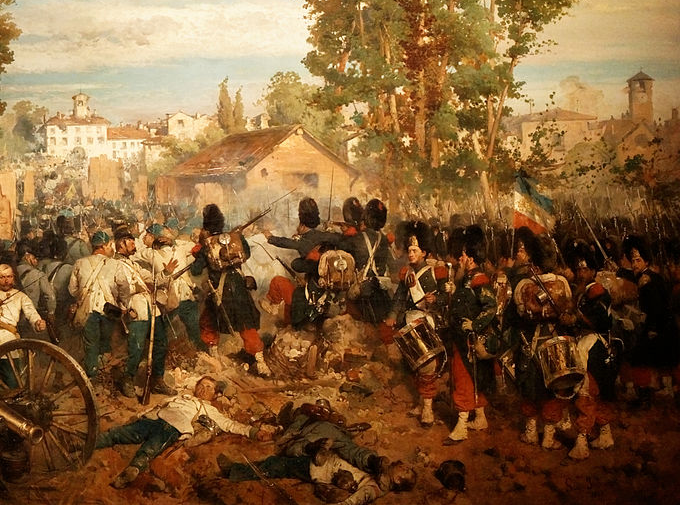
King Vittorio Emanuele rallies the Zouaves at Palestro
At the same time, while the largely French force was engaged at Montebello, King Vittorio Emanuele II led Cialdini’s division with the addition of some French Zouaves against a smaller contingent of Austrians under General Friedrich Zobel at the Battle of Palestro. The Austrians rushed in reinforcements so that, in the aftermath, they held the numerical advantage yet the threat of French troops on the Sesia caused him to retreat for fear of being cut off. By May 30 the Franco-Italian forces had secured a bridgehead across the Sesia. With efforts to retake Palestro having failed and with Garibaldi keeping control of the northern front in spite of being outnumbered nearly 4 to 1, Gyulai decided that the threat to Milan was too great and he ordered a retreat across the Ticino to concentrate his forces at Mortara. However, the rapid movements of the Franco-Italian armies forced him to abandon that plan. He was correct that they were moving against Milan, the capital of Lombardy, but he did not know what approach they would take. He was coming under intense pressure and no small amount of criticism, particularly after the arrival of Field Marshal Heinrich von Hess with stern orders from the Emperor (who had reached Verona) to defend the frontier and not retreat to the Quadrilateral fortress complex.

The Battle of Magenta
More Austrian reinforcements arrived and Gyulai was finally convinced that the enemy was not trying to maneuver around behind him after all. There was also confusion as Hess outranked Gyulai, yet seemed to be leaving things to him. All of this caused a degree of stagnation on the Austrian side as one commander would fail to do something because he assumed the other commander would do it. Nonetheless, the Austrians did hold a strong defensive position around Magenta after destroying the bridges over the Ticino. Gyulai had about 68,000 men in the area when the Battle of Magenta commenced on June 4. With a little over 50,000 French troops plus 12,000 Italians under General Manfredo Fanti, Napoleon III planned an assault on the front and flank of the Austrian army. The two sides were thus evenly matched as long as the Austrians concentrated on the points of attack and did not remain spread out. Both sides made mistakes and many units blundered into each other, nonetheless, the Austrians took far heavier losses and finally retreated, giving the victory to the French. Napoleon III congratulated Marshal MacMahon with a peerage as Duke of Magenta for this success.

This latest defeat was the last straw for Emperor Franz Joseph who had seen his forces do nothing but retreat, be outmaneuvered and defeated often by forces inferior to their own. He dismissed Gyulai and took command of the Austrian Imperial Army himself. With the Quadrilateral fortress cities secure but the enemy in command of the surrounding countryside, his position was similar to that of Graf Radetzky in 1848. However, “Papa Radetzky” was a veteran, unflappable commander and Emperor Franz Joseph was not. Determined to take the offensive and crush the enemy, he abandoned his strong position and moved out on June 23 to take on the Franco-Italian armies. The result was the bloody Battle of Solferino the following day. Once again both sides were about evenly matched with roughly 130,000 soldiers each.

Emperor Napoleon III at the Battle of Solferino
Each army was basically trying to attack the other and so units ran headlong into combat, often not as they intended. It was a huge brawl that involved a number of separate actions and coordination was difficult. The Austrian position was also undermined on distant fronts by uprisings breaking out in conjunction with Prince Jerome’s arrival in central Italy. Earlier, toward the end of May, his forces entered Florence and soon dispatched units to Parma and Modena. At Solferino, most of the fighting centered around two engagements, one around Solferino itself where the French under Forey pushed the Austrians back into the town itself at which point house-to-house fighting ensued. Despite Austrian reinforcements arriving, French attacks soon succeeded in nearly surrounding the town. Fighting south of town was disconnected from the main engagement and involved a number of cavalry units. There, the French attacks were repulsed by the Austrians but this had no effect on the imperiled Austrian position in town. The fighting was fierce and casualties were heavy, particularly for the Austrians.

Battle of San Martino
The other major action was the battles at San Martino and Madonna della Scoperta which largely involved the Italian forces. The Austrians had a fairly good defensive position and the Italians attacked immediately, hoping to dislodge them before they could strengthen their lines. However, this meant that the Italians attacked piecemeal as they came up rather than being able to throw their entire force at the Austrian position. Field Marshal Lieutenant Ludwig Benedek, considered the best Austrian corps commander by many, had been ordered to attack the French flank and had not been expecting to run into the Italians. However, he was a veteran of this region and kept his cool, responding rapidly to the changing situation. Repeatedly, Italian discipline and determination carried them forward to the cusp of success only to have Benedek adeptly move his men and guns to the imperiled area and throw the Italians back with devastating barrages. However, when word came that the main Austrian army had been beaten at Solferino, he had no choice but to conduct a fighting withdrawal as the Italian attacks continued. With the French having taken Solferino, the Italian seizure of San Martino marked the end of the massive and bloody battle.

French & Austrian Emperors meet at Villafranca
Stunned by the ferocity and chaos of the engagement, Emperor Franz Joseph ordered his forces to fall back to the security of the Quadrilateral fortresses. Losses had been heavy for both sides. The Italians had lost about 5,000 men, the French more than 10,000 and the Austrians about 22,000 in the vicious struggle. Both the French and Austrian emperors were shaken by the extreme loss of life. The carnage would later lead one Swiss observer of the engagement to found the International Red Cross in 1863. Operations continued for a time but Napoleon III and Franz Joseph both agreed that the war should come to an end. Franz Joseph feared that a continuation of the so far disastrous conflict could pose an existential threat to the Austrian Empire itself if other areas rose in rebellion. Napoleon also feared that if Austria seemed near to collapse the other German states might get involved and threaten France itself. Disregarding his earlier promises to the Italians, Napoleon III agreed to make peace with Emperor Franz Joseph at Villafranca on July 8.

The result of this was that Austria gave up Lombardy to the House of Savoy but retained control of Venetia. It was not the total victory that Italian nationalists had wanted and many were bitter about the result. The French had gained Savoy and Nice but had backed out before the total liberation of northern Italy had been achieved. Many, given how close Austria had come to collapse in 1848, thought they would not put up so strong a fight. However, despite being weakened by budget cuts, the Austrian military was much more effective than Austrian diplomacy had been. Things would have gone very differently if the Austrians had not managed to offend the Russians, Prussians, the minor German states and the French all at the same time. Not only did this isolate Austria but it also gave the Prussians room to further gain prestige among the German states, standing as the defenders of German rights while Austria was focused on keeping control of Italians, Slavs and Magyars.

King Friedrich Wilhelm IV of Prussia
A particular example of this was in 1857 when royalists in the Principality of Neuchâtel had risen in revolt. They favored the King of Prussia for their prince rather than being a part of Switzerland and the German states saw this as an opportunity to strengthen the German Confederation. Emperor Franz Joseph, president of the Confederation as the Head of the House of Habsburg, had, however, refused to give their cause imperial support. Prussia was ultimately forced to back down and many in the German Confederation wondered why they should take any risk to support the Austrian rule over unwilling Italians two years later when the Austrians had been unwilling to support pro-German royalists who wanted to be ruled by a German monarch. It was illustrative of how Austrian interests diverged from those of the rest of the German-speaking people. There were also those in Berlin who realized the implications that Italian independence would have better than the French did. Napoleon expected to gain a subservient northern Italian buffer state but, as Modena, Tuscany, Parma and after Garibaldi’s shockingly successful invasion of the south, all came to be part of the Kingdom of Italy, France instead helped create a rival in the Mediterranean.

The result of all of this was that Austria lost Lombardy, which joined with Piedmont-Sardinia, Tuscany, Parma and Modena to form the Kingdom of Italy, soon joined by the south and the Papal States outside of Rome. Austria remained friendless and increasingly overshadowed by Prussia and the French were not seen by the Italians as stalwart allies but as rather fair-weather friends who likewise kept troops in Rome. The French had gained battlefield laurels but would also find themselves without friends going forward just as the Austrians had because of their determination to maintain some level of control over Italy, continuing a cycle which had been going on for many, many centuries and which would continue until the fall of Napoleon himself in 1870. Italy had gained much from the Second War for Independence but not so much as to not require a third war. The Austrian loss did not seem too significant but it actually was. In trying to maintain control of Italy, Austria would ultimately lose their place in Italy and their place at the had of Germany to the Kingdom of Prussia. It would be no coincidence then that the Third War of Italian Independence would see Italy and Prussia on the same side.

Saturday, September 2, 2017

The Eclipse of Empires at Sedan

It was on this day in 1870 that the Battle of Sedan, between the forces of the French Emperor Napoleon III and the German forces led by the King of Prussia, ended in a decisive defeat for France. It was a day in history which saw one empire come to an end and another marching on to be born. For France, the battle would mark the end of their Second Empire while for Prussia and her allies it would mark the beginning of the Second German Reich. The French would not forget this humiliation and it would drive them to plunging headlong into the First World War in August of 1914, vowing to avenge Sedan and to recover Alsace-Lorraine, the provinces they would lose in the final peace agreement. For the Prussians, particularly Bismarck, it was the final step in his methodical plan to demonstrate that the Kingdom of Prussia had mastered her traditional rivals; Austria and France, showing the other German states that their fates would be bound to that of Prussia, making German unity a reality. Yes, quite a lot was determined by this two-day battle in the Ardennes.

Bismarck, Roon and Moltke
For quite some time, the Kingdom of Prussia had been a power that could not be ignored but one which was considered no more than a regional power. The stunning victories of Frederick the Great were far in the past and while the battles against the first Napoleon were a proud memory and ones that had revived German nationalism, it was lost on no one that they had been won in cooperation with several other, stronger, allied nations. Furthermore, many discounted the military expertise of the Prussians, rightly judging their most famous commander, Bluecher, as a great leader but certainly no great strategist. They failed to take notice of the more brilliant but less inspiring staff officers of the Prussian army at that time. King Wilhelm I may not have been another Frederick but his most eminent subjects; Bismarck, Graf von Roon and Graf von Moltke made up for the difference. Although he does not always receive the recognition he deserves, Graf von Moltke was undoubtedly one of the greatest military geniuses the German people would ever produce. Their victory over the Austrians in 1866 had been so swift and so overwhelming that many attributed the outcome more to the deficiency of Austria than the strength of Prussia.

Nonetheless, the Prussians, with recent victories over Denmark and Austria behind them, definitely had the momentum going forward into 1870. The French Second Empire was, contrarily, certainly not at its best but still was subject to higher expectations. Not that long before, Napoleon III had seemed to have done the impossible. Not only had he brought about the restoration of the Bonaparte house to power and revived the Napoleonic French Empire but he had also managed to make a Bonaparte emperor acceptable to the crowned heads of Europe. He had ended the traditional antagonism between France and Britain, his armies won laurels for their hard fought victories against mighty Russia, secured control of southern Vietnam and made Cambodia a French protectorate. They won battles in China, Africa and, though it was a hard fought and bloody affair, had seen the Austrians removed from Lombardy. Armies around the world copied French fashions and while the royalists refused to accept him, he still managed to make even the Pope in Rome his dependent. It was a high point for French influence around the world.

Napoleon III at Sedan
However, the war against Austria in Italy had not been the total victory that was hoped for and both parties were left rather unsatisfied. The age old rivalry over the Italian peninsula would ultimately prevent either from the cooperation both could have benefited from in the face of the rising power of Prussia. A new effort at Franco-Austrian cooperation came when French armies succeeded in placing a Habsburg on the throne of Mexico, the first step in what Napoleon III envisioned as a new era of monarchical expansion in the Americas. However, while French troops dominated the battlefields, Mexico became a drain on resources, money and manpower with the republicans resorting to low-level banditry. When the American Civil War ended with the defeat of the Confederacy, the United States was able to send all necessary support to her republican lackeys south of the border and order the French to clear out. French prestige was lowered by this withdrawal at the command of another power and, particularly in light of the noble, tragic death of the Habsburg Emperor of Mexico, Napoleon III himself came out looking like a man who lacked commitment and whose word could not be relied upon.

Because of this downturn in French fortunes, it was all the easier for Bismarck, cunning character that he was, to provoke Louis Napoleon into instigating a war with Prussia. The French were not prepared, taking far too much for granted, while the Prussians were not. To use a not-so-technical term, France was basically curb-stomped by the Germans and the defeat at Sedan was the climax, though certainly not the end as France still had the ignominious end of the Paris Commune to look forward to. Neither army matched their traditional stereotype in this conflict. The French were slow, stuck rigidly to their plans and showed little initiative. The Germans, on the other hand, kept flexible, took risks and, as the old saying  goes, ‘marched toward the sound of the guns’. Napoleon III himself, rather like his famous uncle at Waterloo, was not at his best on this occasion. Whether the King of Prussia was or not hardly mattered, Graf von Moltke was and that is all that ultimately mattered.

Wilhelm I takes Napoleon's sword
At Sedan, by the second day, the French had been totally outmaneuvered and were trapped. The French Emperor, practically surrounded and outnumbered, ordered a succession of desperate attacks in an attempt to break out. None were successful and his army, which had hoped to relieve the siege of Metz, was itself finally forced to surrender. Napoleon handed over his army and his sword to King Wilhelm of Prussia and within only a couple of days the French Empire collapsed. Napoleon III would live out the rest of his life in exile while the Prussians went on to deal with the Paris Commune and then, at the Hall of Mirrors in Versailles, to have the assembled German princes proclaim the King of Prussia, “German Emperor”. All of this was a little too innovative for the very conservative Hohenzollern monarch, having an Austrian Kaiser and a German Kaiser seemed rather excessive and he refused to have “Sedan Day” made a national holiday in the new German Reich, though it was widely celebrated nonetheless, every year until the end of the First World War which was also the end of the Second Reich. All the same, Sedan had secured the unity of the German nation.

Monarchists played a major part in all of the events surrounding this momentous moment of European history. The war between France and Prussia was set off by the search for a new King of Spain after the overthrow in 1868 of Queen Isabella II who, having been unacceptable to the Carlists from birth, became unacceptable to the constitutional monarchists as well for being too conservative. Napoleon’s effort to find an ally to aid him against the Germans was also thwarted by monarchist opposition on two fronts, both regarding Italy as well as an at least perceived threat to the monarchy in Austria. The most important ally France could have had against Prussia was the Austrians. However, the Austrians were engaged in placating the Hungarians by implementing the “dualism” that would result in the Austrian Empire becoming Austria-Hungary which rather kept them busy. Austria also feared that if they became engaged in a war with Prussia, alongside France, the Italians might take advantage of the situation and go to war against them, so if Austria was to come on side, they wanted the Italians on side as well (where they could keep their eye on them).

Proclaiming the King of Prussia "German Kaiser"
However, this proved impossible for the same reason that Napoleon was unable to secure the new Kingdom of Italy as an ally against the Prussians. That reason, of course, was the presence of a French army in Rome propping up the rule of Pope Pius IX. While King Victor Emmanuel II was sympathetic to France, the Italians would have none of it so long as French troops remained on Italian soil and Napoleon dared not risk the wrath of the French royalists by withdrawing his army which was the only thing keeping the Pope in power in Rome. The result was that the French Empire was isolated with no other European power willing to take their side while Prussia, having already dealt with the Austrians, had the south German states ready to realign themselves to Berlin rather than Vienna.

Finally, there was also the issue of the royalists in France itself. Napoleon III had, throughout his reign, repeatedly taken action in the utterly futile cause of winning over the French royalists but, while many would fight for France, none would fight for him. Patrice de MacMahon, the commander of his army at Sedan, would fill the void left by Napoleon III with royalist support after suppressing the Paris Commune. The resulting national assembly had a monarchist majority, MacMahon was open to a restoration and the feuding French royalists had even managed to work out an acceptable compromise over who should take the throne. However, the designated heir, the Comte de Chambord, famously refused as he was told that the French tricolor would not be replaced with the Bourbon white as the national flag. That rather ended the discussion and while royalists thought that they could wait until the passing of Chambord for the next-in-line to the throne to bring about a restoration, Chambord lived longer than anyone expected and by the time he did go, the Third French Republic had taken root. The matter decided by the Battle of Sedan thus, ultimately, affected the House of Bourbon as well as the Houses of Bonaparte and Hohenzollern.

Thursday, June 26, 2014

The Bonaparte Crusader

Few people, even, or perhaps especially, monarchists would think of a Bonaparte as a religious crusader. Napoleon Bonaparte supported the violently anti-clerical French Revolution and though he ultimately made his peace with the Church, none could forget that he had looted Rome, annexed the Papal States and even took the Pope prisoner at one point. Devout Catholic monarchists were always among his most bitter of enemies. Yet, his nephew and eventual successor, Louis Napoleon Bonaparte, eventually Emperor Napoleon III, had a reign which, on the face of it, would suggest to the casual viewer of history the character of a champion of Catholicism. Is this a case of appearances being deceiving? On the other hand, the Catholic Church has a history of strange relationships with those regarded as her most ardent defenders. Two men widely regarded as Catholic champions were Holy Roman Emperor Charles V and his son King Philip II of Spain. Both actually waged war against the Pope, the Emperor inadvertently unleashing the most savage and vicious brutalization of the city of Rome that ancient city has ever experienced. Emperor Napoleon III never did such a thing, in fact causing himself considerable trouble by his commitment to defending the Pope. Yet, Napoleon III remains less than highly regarded in virtually any of the wide variety of Catholic circles.

The reasons for this odd relationship owe something to the man himself, the Bonaparte president who made himself “Emperor of the French” as well as to the times in which he lived, his family name, which was both a blessing and a curse, and the changes in the nature of Catholic sentiment from what it had been in centuries past. What is undeniable is that Napoleon III did many things in the name of defending Catholicism and it is just as evident that it did him little good personally. Certainly, his past plays a part in his public image. Early on, no one would have taken Louis Napoleon Bonaparte to be a future protector of the Catholic Church. He joined a revolutionary secret society in Italy that made him a wanted criminal by both the Papal government and that of the Austrian Empire. His life-long goal, of course, was a return to political power in France for the Bonaparte name and in that he did manage to put himself alongside many Catholics. They may not have been in favor of the same thing but they were opposed to the same thing; the popular monarchy of King Louis-Philippe. Eventually, after numerous failures and exiles, Louis was successful in rising to power in the wake of the downfall of the last King to reign over France and he became President of the Second French Republic.

Almost immediately, the “Prince-President” as he was known, came charging to the rescue of the temporal power of the Catholic Church. In the Revolutions of 1848 radicals led by Giuseppe Mazzini had driven Pope Pius IX from the Eternal City and declared the birth of the Roman Republic. The French government sent troops to wipe out this new regime and, of course, increase French influence in Italy as well. However, as they marched on Rome they were defeated by the veteran Italian guerilla fighter Giuseppe Garibaldi. Louis Napoleon sent reinforcements and the Roman Republic was crushed in a second attack. From that time until the end of his rule, French troops would remain in Rome to suppress dissent and uphold the political power of Pope Pius IX. This earned Louis-Napoleon some popularity with French Catholics. However, while approving of his actions, not all approved of him and particularly worrying was the large presence of Catholic French monarchists in the international volunteer army Pope Pius IX assembled to defend the political power of the papacy. For those men, who were obviously ardent Catholics and just as ardent legitimist French monarchists, Napoleon III was a usurper who they would never respect or support regardless of what his policies happened to be.

Napoleon III & Eugenie
However, after managing to become President-for-life and finally Emperor as Napoleon III, Louis took a step that added greatly to the Catholic character of his empire. He married the very devout, conservative and lovely Spanish countess Eugenie de Montijo. For the rest of his reign, Empress Eugenie could be counted on to always argue in favor of Catholic causes and rushing to the rescue whenever the Church was imperiled. Napoleon III was usually persuaded to oblige but, it seems safe to suppose, perhaps not always with the purest of motives. As early as 1853 the Emperor took France into a major and costly war ostensibly on the grounds of defending the rights of Catholics in the Holy Land, which was ruled by the Ottoman Empire, in response to demands from Czar Nicholas I of Russia for greater rights for Orthodox Christians. In truth, of course, the war was more about Britain and France trying to prevent Russian expansion into the Balkans as well as holding off the possible collapse of the Ottoman Empire for fear of the destabilizing effects that would have (surely an unrealistic concern…) but, officially, it was portrayed in the French press as Napoleon III defending the Catholics of the Holy Land against Eastern Orthodox efforts to dominate them. The war was hard and the war was bloody but, fortunately for Napoleon III, it ended in an Allied victory and the Russian Empire being forced to sue for peace.

French attack on DaNang
Not long after, Napoleon III initiated the first of what would be several interventions in East Asia when, in 1858, he joined the British in an expedition into China. Here, the initial pretext was the murder of a French priest and a general unpleasantness for Christians in China. However, again, there was also the ulterior motive of opening up Chinese markets to French trade. French influence in China would also, ultimately, be tied to French involvement in Indochina, starting with Vietnam. Here again, the first involvement came about in response to the persecution of Catholic missionaries. Of course, there was much more to it than that. France had originally made an alliance with the Nguyen Dynasty in the reign of King Louis XVI. However, due to domestic unrest at home, France never supplied the assistance the King had promised but still tried to collect payment (in privileges and territory) from the “Great South”. However, subsequent Vietnamese monarchs tried to keep their distance from the French and draw closer to China. Emperors Minh Mang, Thieu Tri and Tu Duc tried to discourage missionary activity by expelling French priests and threatening to execute Catholics. Some were but the most dramatic threats were never followed through on and were issued mostly in an effort to frighten foreigners into staying away. That tactic did not work, nor did the effort to carry out anti-foreign policies at times when France seemed to be distracted by events elsewhere.

French attack on Saigon
Empress Eugenie was always quick to urge her husband to take action whenever Catholics were in danger around the world. It is also true that the French navy had a high proportion of very conservative, Catholic officers and they were able to take action on their own authority being so far removed from the government in Paris. They, like Napoleon III, were also concerned about France falling behind Britain in the race to gain control of Asian territories. Ultimately, again, the persecution of Catholics prompted French naval forces to take action and in 1858 they bombarded and captured the coastal city of Danang. Napoleon III sent in reinforcements and an undeclared war was underway. French forces suffered heavily from heat and tropical diseases as well as fierce Vietnamese resistance. Despite their technological superiority, the Vietnamese forces may have been able to prevail with the aid of their inhospitable climate were it not for the outbreak of a revolt in the north that forced Emperor Tu Duc to come to terms with France in order to prevent the possible overthrow of the dynasty. In 1859 French forces occupied Saigon and Cochinchina, the extreme south of Vietnam, became a French colony. In time, all of Indochina would come under French control.

French land in Beyrouth, Lebanon
New opportunities for Napoleon to act as the champion of the Catholic Church came quickly. In what is now Lebanon, then part of the vaguely defined region of Syria within the Ottoman Empire, Maronite Christians came under vicious attack by radical Islamic elements. The Middle East had a special place in the historical memory of France and for the Bonapartes in particular due to the victories there by the first Napoleon. The song “Departing for Syria” had been written by the Emperor’s mother and had become a sort of unofficial national anthem for the Second French Empire. To the applause of French Catholics, Napoleon III sent about 7,000 soldiers to Lebanon in 1860 and 1861, putting a stop to the violence against the Maronites and obtaining from the Ottoman Sultan the right to appoint a Christian governor for the region (who was subject to the approval of the Sultan of course). In less than a year the French troops were withdrawn and Napoleon III could congratulate himself on a rather neat and successful intervention which had increased French influence in the near east and won him praise (if not lasting, heartfelt support) from Catholics in France. His next foreign adventure would not end so well.

French officers in Mexico
For some time there had been growing concern over events in Mexico. A bitter civil war ended with the radical, anti-clerical Benito Juarez becoming President and defaulting on all foreign debts. The Catholic Church lost all special privileges, Church property was seized and the Mexican government attempted to take total control of the Catholic Church in Mexico. Empress Eugenie took a special interest in this case and urged her husband to do something. Many powerful bankers also wanted some action that would see them paid the money owed them. Ordinarily, the United States would have prevented anyone from intervening in Mexico (other than themselves of course) but as a civil war was raging north of the Rio Grande there was nothing that the Lincoln administration could do but issue threats and condemnations. In 1862 Napoleon III joined with the British and Spanish in a joint expedition to enforce the payment of debts from Mexico. After some rushed promises, Britain and Spain withdrew but France did not and after an early setback at the Battle of Puebla, Napoleon III sent in more troops and the French were everywhere victorious. Mexico City was taken, a Catholic conservative junta was established and in 1864 the Archduke Maximilian of Austria was crowned Emperor of Mexico. More victories followed and soon the government-on-the-run of Juarez was on the verge of total defeat and collapse.

The Prince-Regent of Korea
Everything seemed to be going well but then, in the spring of 1865, Confederate General Robert E. Lee was forced to surrender and the American Civil War soon came to an end. The United States sent a curt ultimatum to France: pull out or we will force you out. War weariness had been growing at home and a dejected Emperor ordered French forces to withdraw from Mexico. At about the same time, there was another episode, again on behalf of the Catholic Church, that caused Napoleon III some serious embarrassment. In 1866 the Prince-Regent and father of the King of Korea launched a surprise campaign to eliminate western elements in his country and had about 10,000 Catholics massacred, Korean converts and French missionaries. This was combined in the minds of the French naval officers in the region with further persecutions in China. As the Chinese had dominated Korea off and on for about a thousand years, the French thought that retribution against one would also send a message to the other. Admiral Pierre Gustave Roze led a naval force and about 600 French marines to punish Korea for this and threatened to conquer the whole kingdom for the French Empire. This was mostly an empty threat as, without considerable reinforcements from France, Roze could obviously not conquer anything with his one squadron and a few hundred marines. As it happened, they were overwhelmed by about 10,000 Korean troops and were forced to retreat after doing relatively little damage.

Empress Eugenie as 'Queen of Asia'
Some demanded a more serious expedition to bring serious retaliation against Korea but with the deteriorating situation in Mexico, Napoleon III considered further action to be out of the question. By the following year the Mexican Empire had collapsed and Napoleon III faced more criticism, being blamed for abandoning the ill-fated Emperor Maximilian to a republican firing squad. In the years that followed, France also came under increasing threat from the rising power of the Kingdom of Prussia which was rallying all the German states north of Austria behind its leadership. Napoleon III hoped that the Catholic German states of the south would take the side of France or at least remain neutral rather than ally with the Protestant Kingdom of Prussia but that hope was a vain one. The French Emperor still had one heavy price to pay for his policy of acting as the defender of the Pope and the Catholic Church. With France under threat and Austria having just been humbled in a short war with Prussia, there was a plan to form an alliance to contain Prussian expansion. However, the Austrian Empire was worried about the newly formed Kingdom of Italy taking advantage of any conflict to reclaim Italian territory still under Austrian control. The Austrians would not agree to any alliance with France unless the Italians joined in as well to ensure that they would not act independently or take the other side.

French light infantry in Rome
At first, this seemed to be no problem. King Victor Emmanuel II of Italy had been an ally of Napoleon before and was fully prepared to take part in such an alliance. There was just one problem and that was the continued presence of French troops on Italian soil, the garrison that remained in Rome to maintain papal rule of the city. The nationalist Italians wanted all foreign troops out of Italy and wanted no part of an alliance with France until those forces were gone. Napoleon III knew that he would face an immediate outcry from French Catholics if he withdrew his army, especially after having maintained them there for so long. He simply could not do it and so the hoped for alliance never came to be. Without Italy, Austria would not move and so France stood along against Prussia and her German allies. The result was the Franco-Prussian War of 1870 which saw the Second French Empire crushed and Napoleon III forced to abdicate and go into exile. So, we return to our original question; was Emperor Napoleon III a champion of Catholicism and should he be remembered as such?

"Apotheosis of Napoleon"
To some adherents of the Bonaparte legacy he may well be and, as we have seen, they have a considerable number of facts to support such a claim. If one is to look at who took action, who took risks and who plain and simply ‘did something’ to protect the Catholic Church and Catholics around the world, Napoleon III certainly deserves some credit for that because he did. However, it can also be said with justification that he might have done the right thing for the wrong reasons. In every case there was invariably some ulterior motive to the imperial foreign policy besides an altruistic effort to protect Catholicism. Yet, has that not almost always been the case anyway? Very rarely does any government do something for one reason and one reason only. What makes it perhaps even more interesting that, whatever his other reasons for doing so, Napoleon III so frequently took action to defend the Catholic Church is the conclusion that it ultimately did him little to no good at least as far as his own career and his objective of firmly establishing the Bonaparte dynasty in France was concerned. A cynical look at the basic facts and political realities would cause not a few to conclude that Napoleon was wrong to have risked anything or gone to any pains to help the Church at all. The fact that he did may, perhaps, have been the result of a fundamental misunderstanding of the nature of French Catholics.

Napoleon III at Sedan
Most really devout French Catholics who were serious about religion and about defending the Church and particularly the power of the Pope were, as mentioned earlier, staunch monarchists and the most zealous were the legitimist monarchists in particular. They might still fight for France in spite of Napoleon (and some did) but they were never going to accept him. Napoleon III was never going to win these people over no matter what his policies did. Even if he had stepped in front of an assassins bullet and gave his life for the Pope it would not change the fact that he was a Bonaparte and would never have any legitimacy to rule over France in the eyes of the legitimists. Certainly there were some Catholics who did support Napoleon III and many more that were prepared to accept him and at least not oppose him but his policies in regard to the Church probably won him more enemies on the left than they did friends on the Catholic right. Most monarchists never regarded him as anything more than a usurper and were it not for the bitter feud between French royalists it is possible he would have never come to power in the first place.

The legacy that was not
Was Napoleon III a Catholic champion? He certainly did a great deal on behalf of the Church and Catholics around the world that the leader of no other major power did. He did it with ulterior motives in most every case but that was nothing really new. It was also always hard to regard his actions as totally sincere given his radical, revolutionary youth, particularly when seen in combination with his ulterior motives. There was also the tendency to view any effort undertaken on behalf of the Church to be credited to Empress Eugenie rather than Napoleon III. Whether his actions won him favor in the eyes of God is something known only in eternity. For the world in which he lived, Napoleon III was faced with the fact that, at the end of the day, his greatest strength was his greatest weakness. He had risen to power on his name and his connection to his famous uncle. If he had not been a Bonaparte he would have likely died in obscurity. However, that very name alone probably meant that he would never be seen as a great hero to most devout Catholics. He may have done a great deal for the Church around the world, but for French royalists, as much as they might have approved of what he did, he was still not the man that should have been doing it and nothing could change that. In purely political terms, for his empire and the future of his dynasty, what Napoleon III did for the Church ended up gaining him nothing and in some ways costing him a great deal.

Friday, November 9, 2012

French Imperial Army in Mexico, Part II

Continued from Part I

Marechal de France Bazaine
Bazaine had started out as a private and worked his way up through the ranks, becoming a lieutenant while serving with the legion in Algeria. He had distinguished himself in Crimea, Italy and at the battles of San Lorenzo and the siege of Puebla. He was popular and well respected by his men but over time problems did develop between him and Emperor Maximilian. Even some on the French side feared that he was going too native and might have had aspirations toward local power after he married an obscenely young girl from the Mexican aristocracy. Bazaine was quickly promoted to Marshal of France and set out on a campaign to crush the remaining resistance under Juarez who was driven from San Luis Potosi to Saltillo, four hundred miles farther north. With every French victory more Mexicans defected to what seemed to be the winning side and soon Juarez was reduced to little more than a fugitive on the run in the barren deserts of northern Mexico. By the spring of 1864 the French controlled most of Mexico and had a force of 38,000 men plus 1,800 Mexican auxiliaries.

However, the situation was not as good as it seemed on paper or as sunny as the reports Marshal Bazaine was sending home to his Emperor in Paris. The French could not effectively garrison every area and the Juaristas were quick to flee before them only to return as soon as the French marched away. After suffering so many defeats Juarez adopted a guerilla warfare policy and Mexican republicans were reduced to behaving more like bandits than regular soldiers, avoiding confrontations with the French unless the odds seemed extremely stacked in their favor. The French also suffered from having small arms that were quite behind the times. At first this was not of very great consequence as the Mexican liberals were even more poorly armed. However, after 1865 the United States was able to send large numbers of the latest weapons to their republican allies in Mexico including repeating rifles and rifled artillery. French artillery was very good but none was left behind for the benefit of the Mexican Imperial Army once the French pulled out of Mexico.

By the fall of 1864 the French army reached the northern border with Texas and was able to benefit from the lucrative trade with the embattled Confederate States of America in the Civil War north of the Rio Grande. Also, in the far south, Bazaine defeated and forced the surrender of 8,000 republican troops in Oaxaca in early 1865. Juarez was, by that time, living constantly on the run in the northern reaches of Chihuahua just south of the Arizona border. Still, bandits were running rampant throughout the country acting in the name of the republicans to give legitimacy to their age old occupation. Bazaine also had to juggle a bad relationship with Emperor Maximilian and with disgruntled subordinates like General Felix Douay. The Mexican Emperor resented the power the French held in the country as well as what he saw as the effort to strengthen their own position at his expense. As an example, one dust up involved the case of Colonel Charles Dupin, commander of the fearsome contra-guerillas. Maximilian objected to the colonel and his brutal tactics and obtained his transfer back to France. However, once there Dupin was able to convince Napoleon that with a few troops and a free hand he could clean out the bandits in northeast Mexico. Napoleon was convinced and sent him back which Maximilian (mistakenly) believed to be the work of Bazaine and an affront to his authority. It did not help that Dupin considered Maximilian a vacillating weakling and was not hesitant to say so. General Douay also argued that Bazaine did not understand the country and was not doing enough to reduce republican harassment.
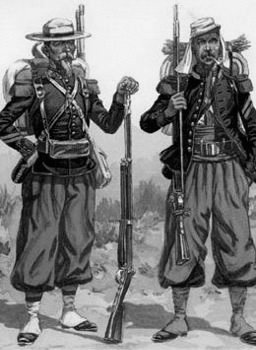
Time was also against him as, ever since mid-1864 when things seemed pretty much under control the French public had begun to call for the troops to come home. There was also the typical problems of an overseas force dealing with guerilla warfare. There were fewer smashing victories to proclaim in the newspapers yet a small but steady stream of casualties from raids and ambushes as well as disease and desertion. As time went on morale also dropped as the French forces were marched back and forth across the country through often inhospitable terrain with seemingly no end in sight. All of that being said, it is often overlooked just how much the French military accomplished and especially how much good they did while deployed in Mexico. Even people who opposed the whole enterprise had to admit that even the most backward villages deep in the wilds of Mexico received hitherto unknown gifts of law, order and government efficiency thanks to the French forces. They erected telegraph lines between Queretaro and Veracruz (and, more miraculously, kept them running), built a railroad along the gulf coast and established a reliable postal service.

Emperor Napoleon III
It is sadly true that many of these advances receded as Emperor Maximilian took firmer control of the government and was eager to place more responsibility in the hands of native Mexicans. He had the best intentions in doing so, but the corruption and selfishness of the Mexican governing class was a major reason for the country being in so dilapidated a condition in the first place and few, if any, saw fit to change their ways. The tensions between the French army and Mexico City were also exacerbated by the arrival of the foreign volunteers from Austria and Belgium. Maximilian wanted them under his own control, Bazaine wanted them under his and the Austrians wanted an independent command of their own. The French troops were also torn as the threat of war with Prussia grew and most were more eager to defend France from the Prussians than to defend Mexico from liberal republicans. Morale began to drop and even the famed Foreign Legion, which suffered a higher casualty rate than any other unit, began to be plagued with desertions. On one march along the Texas border the Legion lost 93 men in one day to desertion.

Despite his earlier assertions of victory Bazaine had been forced to restrict himself to defensive operations as French forces simply held their fortified outposts in strategic areas. In the end though, it was no decisive defeat that evicted the French from Mexico but rather the diplomatic pressure and threat of military forces from the United States after 1865. A huge American army, fresh from victory in the Civil War, was dispatched to the border and the U.S. all but ordered Napoleon III to withdraw from Mexico or face the consequences. The Emperor bowed to the inevitable and ordered his forces to begin their evacuation. Despite the popular perception, this was not always popular with the Mexican public. In some small villages, the people begged the French to stay, even the presence of just one man in uniform would save them from the ravages of marauding (but cowardly) bandits and their common practice of extortion. But, this was not possible and the French army contracted its position further and further and began pulling out and marching to the coast. It is also noteworthy that the Mexican republicans were content to let them leave in peace. They shadowed the French army but never made any effort to actually do battle with them. Emperor Maximilian was offered safe conduct out of the country but, of course, refused and once the French had gone he bravely marched out with his loyal Mexican brigades to make his last stand at Queretaro.

Thursday, November 8, 2012

French Imperial Army in Mexico, Part I


The French intervention in Mexico began in January of 1862 just after the arrival of Spanish and British troops in Veracruz. This initial commitment consisted of 2,000 French marines and 600 zouaves from the French Army of Africa. With the perpetual chaos in Mexico about the only revenues the government could count on were the import tariffs collected at the coast such as the principal port of Veracruz. However, the low lying coastal areas of Mexico are notorious hotbeds for disease and it is no wonder that Mexican President Benito Juarez took no action against the foreign presence and allowed sickness to decimate their ranks for him. By the middle of the following month the Spanish and British had had enough and after receiving new promises from Juarez pulled their troops out. The French, however, remained and had more far reaching goals in mind.

The Legion in Mexico
The French Imperial Army was strengthened by some 3,000 men under the command of the Brigadier General Ferdinand Latrille, Comte de Lorencez. On the same day that the other powers pulled out the French Empire effectively declared war on the liberal republican regime in Mexico City. After advancing to Cordoba General Lorencez issued a pronouncement which stated that France would pacify the country, restore order and he actively called for the recently defeated conservative faction to launch a counterrevolution. The French army was, at that time, fresh from victories in Africa, Italy and the Crimea and was considered possibly the best in the world. Throughout the length of the French intervention in Mexico the troops involved by the French Imperial Army included elements from 6 line infantry regiments, 3 zouave regiments, 4 light infantry battalions, squadrons from 3 cavalry regiments, 6 artillery batteries, 5 companies of engineers, 1 supply train squadron, colonial troops from Martinique, Algeria and the Foreign Legion, 1 marine regiment, 1 battalion of sailors and 1 battery of naval (marine) artillery. According to the treaty signed with then Archduke Maximilian of Austria the French Foreign Legion was supposed to remain in Mexico for 6 years even after all other French forces had withdrawn to form a corps around which the new Imperial Mexican Army could be built.

General Forey
To be sure, the French Imperial Army was a grand spectacle and carried an illustrious reputation with them as they began the march inland to Mexico City. However, this may have worked against them by causing a severe case of overconfidence. This was realized on the famous battle of the fifth of May when General Lorencez launched a frontal assault on the liberal stronghold at Puebla defended by Mexican troops under General Ignacio Zaragoza. The French were soundly repulsed in a bloody battle celebrated as a national holiday ever since and General Lorencez was forced to withdraw back to Orizaba to lick his wounds and wait for reinforcements. Emperor Louis Napoleon of France responded by increasing the size of the French forces in Mexico to 28,000 and gave the top command to General Elie Frederic Forey. As the French prepared to renew their advance Forey was most concerned with his long supply lines from Veracruz. To keep these lines open he entrusted their defense to the Foreign Legion and a battalion of Sudanese troops provided by the Khedive of Egypt. It was thought these African soldiers would be better able to resist the disease-ridden climate on the coast. Whether that was true is debatable but they earned a reputation for discipline, good order and for considerable cruelty toward the local populace.

After the debacle at Puebla it seemed that the French army began to take the whole enterprise more seriously. Many officers even adopted a more native appearance, in typical French style, wearing their coats open with wide sashes and large sombreros on their heads to shield them from the tropical sun. They also made use of allied Mexican forces such as the conservative troops under the fearsome General Leonardo Marquez who won a smashing victory at the battle of San Lorenzo in March as the French moved up to take Puebla again, this time by siege. This time, however, it was the Mexican republicans who made a stupendous mistake. Puebla was the only really half-way defensible place on the road to Mexico City and Juarez decided to gamble everything on holding Puebla despite the fact that the French were better trained, better disciplined, better armed and more experienced that his own forces and, despite the earlier Mexican victory there, in any face-to-face fight between the French and Mexicans the smart money would be on the French army. Nowhere was this more evident than in a little battle along the French line of supply that may not be as widely celebrated as Cinco de Mayo but is actually an even more remarkable battle and is still celebrated today as the official holiday of the French Foreign Legion.

The battle revolved around a French wagon train that was taking a payroll of three million in gold from Veracruz to the French forces at Puebla. The liberals quickly sent a force of republican cavalry and militia to grab the gold and a company of the Foreign Legion was dispatched to intercept them. The two sides met at the hacienda of Camaron on April 30, 1863 where Captain Jean Danjou and 62 legionnaires confronted 2,000 Juaristas. The legionnaires repulsed several cavalry charges after being caught in the open before barricading themselves in the nearby hacienda where they repelled attack after attack inflicting heavy losses on the Mexican republicans. After almost literally fighting to the death the legionnaires were overwhelmed and forced to surrender with only five of the original 62 still alive. This was a stunning example of the tenacity and effectiveness of the French Imperial forces and demonstrated why it was a good idea for the Mexican republicans to avoid formal battles with them considering the trouble they had defeating 62 men with 2,000 at their disposal.

Given that, it was not surprising that after two months under siege the Mexican republicans at Puebla surrendered on April 17, effectively clearing the way to Mexico City. Juarez, for his part, did not even try to defend the city and evacuated his government to San Luis Potosi and a week later General Forey and the French army marched into Mexico City and began establishing the conservative junta that would direct national affairs until a new government could be formed. It was this junta that eventually gave way to the triumvirate that invited Archduke Maximilian of Austria to become Emperor of Mexico. However, Napoleon III was bothered by the fact that his top commander, General Forey, seemed to have lost faith in the expedition and was extremely critical of the situation on the ground and the long term prospects for success. However, as he could hardly punish such a successful commander the Emperor decided to kick him upstairs by promoting him to the rank of Marshal of France, recalling him and replacing him with one of his divisional commanders General Francois Achille de Bazaine.

To be concluded in Part II...

Related Posts Plugin for WordPress, Blogger...