Showing posts with label Austria. Show all posts

Wednesday, February 21, 2018

Clash of Monarchies: The Third War of Italian Independence

The last of the three wars to secure the unity and independence of the Kingdom of Italy requires more than the usual background information. The preliminaries took longer than the war itself. The Second War of Italian Independence had seen the Austrian Empire beaten by the French and Italians at the bloody Battle of Solferino in 1859. Austria was forced to cede Lombardy to the King of Piedmont-Sardinia as well as the conquest of Modena, Parma, Tuscany and most of the Papal States in 1860 which were united with the rest of the northern half of the peninsula under the House of Savoy of the Kingdom of Piedmont-Sardinia. However, the French ultimately won few friends and, by the time the smoke had cleared, came to be seen as duplicitous by both the Austrians and many Italians. Moreover, the Prussians had mobilized during the conflict but had not taken part. They too were pursuing a nationalist goal of reunifying all of the German states into one empire (Reich). Austria, rather than lead, stood opposed to this and the war in Italy was used by the Prussians as proof of both Austrian weakness and a greater concern for maintaining their rule over non-Germans than for resuming leadership of the German nation on the part of Austria.

Franz Joseph, Wilhelm I, Vittorio Emanuele II
All of that was simmering and would ultimately come to a boil when Bismarck was to provoke Austrian Emperor Franz Joseph into a war (just as Napoleon III had done in 1859 and others would do yet again). In the meantime, however, the unification of the Italian peninsula continued apace and in a shocking way. The famed Italian nationalist, Giuseppe Garibaldi, renowned for his exploits in South America and his defeat of the French in front of Rome in 1849, was as eager as ever to go on the attack. In 1849, Garibaldi, a lifelong republican and Freemason, had fought for the radical republicans of Giuseppe Mazzini. However, he had seen them prove totally incapable of governing and witnessed how easily they were defeated. Since then, he had seen King Vittorio Emanuele II and his royalists, deliver actual victories for the nationalist cause and Garibaldi was that rare case of a nationalist who did not put his own ideology before all else. If the republicans, who he favored, could not get the job done, he would fight his battles on behalf of a monarch if that meant the furtherance of the nationalist cause. However, given his background, his politics and his aggressiveness, the government of King Vittorio Emanuele II, led by Count Camillo Cavour, had to be careful in how it dealt with Garibaldi, to make use of him while not being seen too blatantly to make use of him in case his far-fetched scheme might fail.

The scheme he had in mind was nothing short of the conquest of the Kingdom of the Two-Sicilies, ruled, at that time, by the cadet branch of the Spanish Royal Family. In May of 1860, with only a thousand volunteers, Garibaldi sailed out to take on the Bourbon monarchy which possessed a large army and a bigger navy than Piedmont-Sardinia. He and his little force of men, garishly dressed in red shirts, landed in Sicily, the garrison of which had been reinforced from 21,000 to 40,000 men when word of Garibaldi’s plan reached Naples. Garibaldi should have had no chance at all, however, he was a master at misdirection and the Kingdom of the Two-Sicilies proved far less formidable in fact than it appeared on paper. Particularly in Sicily, the repeated rebellions of the previous decades had taken their toll and the King, Francesco II, had wiped out his Swiss mercenaries, his best troops, when they went on strike over better pay and conditions.

Battle of Calatafimi
Garibaldi could never have conquered Sicily with only a thousand men but many Sicilian peasants rushed to join his cause and more reinforcements would be arriving by ship later on. The first decisive action was the Battle of Calatafimi on May 15, 1860. If the Neapolitans had beaten Garibaldi there, he would have been ruined and his local support would have melted away. Yet, though outnumbered 3-to-1, Garibaldi managed to win, or at least not lose which was good enough for his purposes. Emboldened by this, and attracting a little over a thousand more local volunteers in the aftermath, Garibaldi launched a direct assault on the coastal fortress city of Palermo. He let prisoners out of jail which enlarged his forces and had little trouble rousing the city to rebellion (Palermo had a history of this) but the Neapolitan general, the elderly Ferdinando Lanza, managed to drive them back after which he and his offshore naval support shelled the city for three days, killing hundreds of civilians. This, obviously, did nothing to help the Bourbon cause in the long-run. Many have since accused Lanza of having been paid off by the British but I would be hesitant to believe such a thing without hard evidence. He did surrender the city to a force smaller than his own and which was practically out of ammunition but he did so only after his own counter-attack had failed. The enemy were in the city and it seemed impossible to dislodge them. He also had permission from his King to withdraw and on July 7 the Neapolitan army did just that.

Garibaldi & the King meet at Teano
Earlier that month King Francesco II had granted a(nother) constitution but it did him no good. Those who wanted one no longer believed the Bourbon monarchy trustworthy on this subject while the more reactionary supporters of the monarchy were put off by it. After Garibaldi’s forces won another victory at Milazzo, the Neapolitan commander surrendered the key fortress city of Messina less than a week later. The remaining Neapolitan garrisons on the island surrendered soon after. Garibaldi was master of Sicily and controlled access to the mainland. The next month he and his forces crossed over to Calabria, against the direct wishes of Cavour who had conspired with Garibaldi to make the invasion of Sicily possible. In Calabria there was little effective resistance as the large Bourbon armies simply melted away, many simply deserting and not a few even crossing over to join Garibaldi. In the meantime, the Piedmontese had invaded the remaining Papal States on the pretext of suppressing disorder. Pope Pius IX deployed his own army but held them back, certain that France or Austria would come to his aid. Neither did. Further south, the gallant, young, King Francesco II barricaded himself inside the coastal fortress of Gaeta with his few remaining loyal troops. The Piedmontese army and the army of Garibaldi linked up with Garibaldi handing all of his conquests over to King Vittorio Emanuele II of Italy. The siege of Gaeta dragged on to its inevitable conclusion, showing at least what an inspiring leader King Francesco II was and what he might have accomplished if he had taken to the field to defend his kingdom personally.

After 100 days of resistance, Francesco II surrendered and went into exile, the south was reunited with the north for the first time since the fall of the Roman Empire and Vittorio Emanuele II was proclaimed King of Italy. Of the major Italian territories, only Rome and Venice remained out of reach. Rome was occupied by the French and Venice by the Austrians. Peaceful efforts to gain these came to nothing. The new King of Italy offered to purchase Venice from Emperor Franz Joseph, but was refused. Likewise, Pope Pius IX refused to hear of the offer of Cavour for absolute sovereign immunity for the pope and total power for him in all Church matters. The status quo, however, could not endure as the nationalist movement which had taken hold in Italy would never abide separation from Venice and Rome. Not long after, Count Cavour suddenly died and though the King had never liked him much, the two had learned how to work together and a period of some political instability ensued. Garibaldi, seeing his work still unfinished, recruited some more volunteers and made to attack Rome. The French and Austrians both threatened war if he was not stopped and so the Italian army did the job, halting the nationalist volunteers at the Battle of Aspromonte in August of 1862, even wounding Garibaldi himself in the process.

King Wilhelm I & Bismarck
This was what we would call today a public relations nightmare for the Italian government and to an extent broke the nationalist-monarchist coalition. The royalists accused the nationalists of being rash and foolhardy while the nationalists accused the King of caring more for the Pope than for Italy, taking the side of the French occupiers over the Italian people. All of this added pressure on the new Kingdom of Italy to take any chance that presented itself to regain its nationalist credentials. The government saw hope for regaining Venice when, also in 1861, Otto von Bismarck became chancellor of the Kingdom of Prussia. Bismarck was well known as a man who was determined to have a united Germany and if Austria would not lead, he would push them out of the way and Prussia would assume leadership. However, when Napoleon III proved not so positive toward Prussia and negative toward Austria as Bismarck had hoped, Prussia and Austria renewed ties under the German Confederation (just in time for a war with Denmark). Italian hopes for an alliance were dashed, but the reunion did not last long.

Conflict began to bubble up over disagreements between Austria and Prussia over the administration of the lands taken in the war with Denmark. Among German nationalists, there had also been a long standing division over whether or not the united Germany would include Austria due to the fact that Austria also ruled over so many non-German peoples that German nationalists cared nothing about. With the Austro-Prussian dispute, that matter was settled; Austria would be excluded and, as far as Bismarck was concerned, could go on having fun in her ‘majority minority’ empire. If Prussia were to take on Austria, there would be no better time as Habsburg foreign policy had managed to alienate just about everyone by this stage. Austria was sore at the French for allowing the incorporation of the central Italian states into the Kingdom of Italy and so, naturally, the French were sore at Austria in return. The Italians, naturally, wanted Venice back and so were certainly not going to take the side of Austria and, most importantly, the Russians were still furious at Emperor Franz Joseph for threatening to side against them in the Crimean War, effectively forcing them to concede defeat. The Prussians had also stood by the Russians in a recent rebellion in Poland, whereas the Austrians had not. The British, for their part, had no great love for either side and had no reason to care who won.

Bismarck, von Roon & von Moltke
Bismarck had only to prod Austria with the right words for Emperor Franz Joseph to demand a resolution of the Holstein issue by the German Imperial Diet which violated a treaty between Austria and Prussia, which was all Bismarck needed to go to war. Many have since pondered why the Austrian Emperor did such a thing after having been previously baited into a failed war with France and Piedmont-Sardinia not so long before. The most common explanation is that Austria was still not really looking toward the German states so much as the other ethnicities within the Austrian Empire, which were rather restive. The Hungarians, who had come under much more strict control since the Revolution of 1848, were looking particularly troublesome. The Emperor may have been hoping that a war with Prussia and Italy would unite the ethnic groups behind Austrian leadership and strengthen the empire.

In any event, on June 14, 1866 the war began with Prussian troops marching into Saxony and Bohemia. The Prussian army had mobilized rapidly thanks to the adept leadership of war minister Graf von Roon and the army commander Graf von Moltke. The Italian Royal Army was less well prepared, with elements of the north and south still not having coalesced very well. Some of this was due to personality issues, some due to organizational differences and sometimes simply the differences between the dialects of Turin and Naples. The Italian war plan was for the army of General Alfonso La Marmora to strike while the army of General Enrico Cialdini remained on the defensive. They would have superior numbers but the Austrians, with their powerful fortress cities of the Quadrilateral, would be able to concentrate their troops against any threat. The Italians, in typical fashion, came straight on with a bold offensive by the troops of La Marmora, accompanied by King Vittorio Emanuele II himself, who loved nothing better than being on campaign.

Archduke Albrecht
The Austrians were led by Archduke Albrecht, Duke of Teschen, the Emperor’s cousin and a veteran of Radetzky’s victorious army from the First War of Italian Independence. He was not content to remain on the defensive but moved his army around to the north in an effort to get behind the Italians, cut them off from their base of operations and assault them from the rear. As it happened, the Italian army turned at just the right moment and the two sides collided at the Battle of Custoza on June 24. It was a very confused fight. The Austrian cavalry charged in, were mostly wiped out but spread confusion that stymied a sizeable number of Italian units. The Austrians drove the Italians out of Oliosi and seemed to be winning the day, yet were then met by an Italian division that exploited the gaps in their lines and refused to be dislodged, repelling fierce and repeated Austrian attacks at Monte Croce. The Austrians thought they were beaten, yet the Italians did not immediately reinforce Monte Croce and finally the forces there began to fall back. When reinforcements were sent and the Austrians moved to match them, the Austrians left another gap in their lines but the Italians failed to exploit it.

The Battle of Custozza
Each army believed they had been beaten, though neither actually had been. However, it was La Marmora who was the first to take action on this mistaken assumption and he ordered a retreat. As his forces moved back to secure the bridges over the Mincio, gaps in the Italian lines opened up which the Austrians were quick to exploit and Italian losses were heavy. By the end of the day, the Italians had retreated across the river after losing 8,147 men compared to losses of 5,650 for the Austrians. However, Archduke Albrecht did not follow up to destroy the Italian army, viewing his army as too bloodied and too exhausted to continue. As it was, most of the Italian losses had been men who were captured, as far as the number of dead and wounded alone went, Austrian losses were considerably higher. The Archduke retired to Verona, fearful of exposing his forces in case the French decided to get involved. Emperor Franz Joseph had advised him to ignore any political consideration and focus on annihilating the Italians, however, Archduke Albrecht seemed more concerned in not repeating the disaster that had befallen Franz Joseph himself at Solferino. As it was, Austria had won a solid victory and removed itself from immediate danger on the Italian front.

Battle of Bezzecca
In fact, the Austrian Empire seemed to be doing exceedingly well in the opening weeks of the conflict. They had defeated the Italians at Custoza and soon after halted the Prussians at Trautenau and the Austrian-allied forces of the Kingdom of Hanover also defeated the Prussians at Langensalza. However, at that point, everything began to go wrong. Only two days later the Hanoverians surrendered and the Prussians bested the Austrians at Gitschin on June 29. Most devastating of all for Austria was the decisive Prussian victory at the Battle of Koeniggraetz (Sadowa) on July 3. Subsequent defeats followed and in Italy, a small force under Giuseppe Garibaldi, who was still full of fight, was on the attack in the Trentino while the Italian high command planned their own counter-offensive. On July 21, Garibaldi and his “Hunters of the Alps” were attacked by two Austrian columns led by Major General Franz Baron von Kuhn at the town of Bezzecca. The Italians immediately counter-attacked and though they took heavier losses, managed to drive the Austrians out, providing a much needed morale boost for the Italian forces.

Battle of Lissa
The Italian war effort seemed to be on the rebound. General Cialdini was on the advance, this time with La Marmora holding back to cover the Austrian fortresses, Garibaldi had won a hard fought victory at Bezzecca and the Italian navy, widely regarded as the vastly superior force, was preparing to land troops on the Adriatic island of Lissa off the Dalmatian coast. However, it was then that everything was spoiled by the greatest disaster of the war for Italy. To the surprise of all, the much smaller Austrian fleet of Admiral Wilhelm von Tegetthoff, attacked the Italian fleet while they were preparing to land their forces. The Italian commander, Admiral Count Carlo di Persano, was caught off guard and seemed totally bewildered. Two Italian ironclad warships were sunk while the Austrians lost none of their own, though one unarmored steamer was badly damaged. The Italians retreated and the Austrian sailors cheered. Ironically, most of the “Austrian” sailors were actually Italians, from Venice. It was a humiliating blow for Italy which was not helped by the fact that Persano first reported that he had won a great victory. This made it very awkward, needless to say, and all the worse when the truth came out.

The outcome of the war had, for all intents and purposes, mostly been decided at the Battle of Sadowa with the Prussians crushing the Austrian army there. However, the Austrian reinforcements on their way to Italy, combined with the stunning loss at Lissa, prompted Italy to come to the peace table too, in spite of the advances of Garibaldi and Cialdini and the hopes riding on them to make good on the loss at Custoza. It was not the glorious victory that had been hoped for, nor would the resulting peace treaty be easy for anyone. Italy was on the winning side but Prussia had been the ones to force Austria to the negotiating table. Even then, it was only thanks to the intransigence of Bismarck as most of the Prussian officers wanted to carry on and capture Vienna and perhaps more. Bismarck would not hear of it. All he wanted was a war to shove Austria out of the way so that Prussia could create a united Germany. He had no desire to see Austria humiliated or destroyed.

King Vittorio Emanuele II enters Venice
However, the Austrians were still Austrian and while they could grudgingly accept being beaten by Prussia, they would still insist on being condescending to the hated Italians. They refused to concede anything to Italy, yet Prussia was bound by their alliance not to make peace unless Venice was restored to Italy. However, the Austrian Empire refused to budge on this and so Prussia and Italy had to turn to Emperor Napoleon III of the French, who had been on side but taken no part in the conflict. The result was rather ridiculous. Austria finally agreed to make peace but by ceding Venice to the French Empire at which point the French then handed Venice over to the Kingdom of Italy. In a way, however, it was rather fitting given that Austria had first acquired Venice by originally dividing the Venetian territories with the first French Republic. So it was that Prussia proved to the minor German states that Austria would not be looked to for leadership and, after the appropriate referendum, Venice was annexed to the Kingdom of Italy.

An unfortunate result of the Austrian intransigence during the peace process was to perpetuate the false impression that Italy had accomplished nothing during the war. The Italians had won battles and the naval engagement of Lissa was the only truly embarrassing loss. The battle of Custoza was two armies that basically fought each other to exhaustion, both thought they had lost and the Italians were simply the first to do anything about it and as they began to pull back the Austrians pounced. Garibaldi had won a hard fought victory in the north, the Italians had not been destroyed and were in the process of counter-attacking, were advancing back into Venetia, when the crushing victory of the Prussians brought the war to a close. The Austrians had not ‘run away with it’ so to speak. In any event, Italy had at least regained Venice, leaving only Rome still under foreign occupation. Prussia was clearly established as the leading German state, only one further step away from unification whereas the Austrian Empire had been humbled and was soon thereafter forced to make vast concessions to the Hungarians, leading to the compromise which turned the Austrian Empire into the “Dual Monarchy” of Austria-Hungary.

Wednesday, October 4, 2017

The House of Habsburg and the Jews

Particularly after World War II, many have looked back and heavily scrutinized any comments concerning the Jews from German Kaiser Wilhelm II in a very obvious effort to portray him, and thus justify his overthrow, as the precursor to Adolf Hitler. That, however, is a ridiculous exercise. The Kaiser did make accusations against the Jews, no doubt because of their overrepresentation in the ranks of his enemies on the far left, but he also expressed genuine horror at the first anti-Semitic crackdowns in Germany under the Nazi regime. The entire narrative, however, is a canard. Hitler, after all, was a native of Austria rather than Germany and none of these people ever look to the relationship between the last two Austrian Kaisers and the Jewish population, doubtless because there is little, if anything, which can be used against the final Habsburg monarchs in that regard. What was the relationship like between the Jews and the Habsburg emperors? The answer is that it was one subject to change.

The First Reich, the “Holy Roman Empire of the German Nation”, had a large and very old Jewish population. Because the First Reich was usually a very decentralized body, more like a collection of small countries than one, large, empire other than in the periods when a particularly strong German Kaiser came to the throne and united the German people behind him. The Jewish population predated the rise of the House of Habsburg to the imperial throne, the Hohenstaufen Kaiser Friedrich II being notable for encouraging Jews to enter the financial sector and, indeed, they soon became known as the ‘servants of the treasury’. They were recognized as a separate group within the empire, allowed to live by their own laws and were not subject to the same laws as the Christian population. However, because of the decentralized nature of the empire, their status varied from locality to locality with some local rulers being more tolerant of them than others. There were occasions of mob violence against them but, overall, they were generally far better off than the Jews in other countries.

Albert II of Germany
Just prior to the Habsburgs attaining the imperial throne the status of the Jews initially remained the same as it had been previously. However, that changed under Archduke Albert V of Austria, aka Albert II of Germany. During the Hussite Wars the Jews were accused of complicity with the enemy and after a notorious incident of Eucharistic desecration at a church in Krems in 1420, Albert V ordered that the Jews be arrested, forced to convert and forfeit their property. Some were deported, some fled and a few were burned. Albert V banned Jews from Austria, destroyed the synagogue in Vienna and declared that they would never be allowed back. The successor of Albert V as Archduke of Austria would be the first Habsburg to be elected to the imperial throne; Emperor Frederick III. The “eternal ban” of Albert V turned out to be nothing of the sort as Emperor Frederick III canceled it, welcomed the Jews back and was extremely popular with the Jewish community who hailed him as the “King of the Jews”. The Jewish population revived quickly and prospered quickly, finding no shortage of customers for their businesses, particularly those looking for loans. Yet, this period of tolerance was not eternal either as Friedrich III was succeeded by Emperor Maximilian I.

Emperor Maximilian I, a very astute statesman and a figure who looms large in European history, found the Jewish presence rather at odds with the foundational principles of what was supposed to be a Catholic Christian empire. He did not go as far as he could have or as far as other monarchs had done in countries such as England, France or Spain but in 1496 he ordered the expulsion of all Jews from Styria and, later in 1509, confiscated Jewish property and burned all Jewish books. Yet, this situation did not persist nor was it widespread. After greatly expanding the reach of his dynasty, Maximilian was succeeded by Emperor Charles V who, despite being one of the most significant emperors, did not command unquestioning obedience. Faced with enemies such as the French, the Turks, the first Protestants and even the Pope, he had to take care to respect local authorities. He tolerated Jews in his German lands but in Spain, of which he was king as Carlos I, where Jews had been expelled, they remained expelled. Indeed, compared to Martin Luther, many Jews viewed Emperor Charles V as their guardian from fundamentalist mobs. In this period the Habsburg emperors were known to defend the Jews from the repressive measures of the Estates-General.

Ferdinand I
However, the outbreak and spread of Protestantism, and with it an increase in Christian fundamentalism, was bound to cause trouble for the Jews who stood out as the most noticeable non-Christian population within the borders of Christendom. When Emperor Charles V abdicated and divided his lands, the German half went to Emperor Ferdinand I who remained tolerant of them but did order them to wear a symbol marking their status as Jews. Today, this tends to cause an uproar due to memories of Hitler making the Jews wear a Star of David on their clothes but for Emperor Ferdinand it went no further than that. He did not molest them, he simply wanted them to be easily identified as a people apart which, it must be said, the Jews themselves considered themselves to be. However, restrictions on them did increase throughout the reigns of Emperors Maximilian II, Rudolf II and Matthias. This is often attributed to the Society of Jesus and an increasingly “fanatical” Catholicism in the empire, in reaction to the Protestants, yet, most ardent Catholics have a generally less than extremely favorable view of any of these Habsburg monarchs with many doubting the Catholic zeal of Maximilian II and Rudolf II and with Emperor Matthias also often viewed as too tolerant of non-Catholics.

It should also be pointed out that Emperor Ferdinand II, who is generally regarded as a Catholic champion like Emperor Charles V, was also like Charles V in being more tolerant of the Jews. He opposed their persecution and even allowed them to build a new synagogue. Obviously, it is ridiculous to attribute anti-Semitism to Catholic zealotry when the monarchs who are most celebrated by traditional Catholics, Charles V and Ferdinand II who led the Catholic side of the Thirty Years War, were more tolerant of Jews than Maximilian II or Rudolf II who are generally disliked by these same staunch Catholics. Indeed, during the Thirty Years War, Emperor Ferdinand II found the Jewish population to be a very valuable tax base to support his war effort against the Protestant coalition. In many ways, the Catholic emperors who wanted reconciliation with the Protestants tended to be more anti-Jewish while the Catholic emperors who wanted to defeat the Protestants were more tolerant of the Jews, at least during this period.

Emperor Leopold I
Things changed again with the reign of Emperor Leopold I. He was a staunch Catholic and had a very different attitude toward the Jews than his predecessors. Leopold I expelled the Jews from many of his lands, including banning them from Vienna in 1640. However, while he deported a great many Jews, he ultimately did not prevent them from returning which, in spite of accusations of persecution, they inevitably did. It is also worth noting that Emperor Leopold I had a Jewish economic advisor, one Samson Wertheimer. Clearly, whatever his attitude toward Jews collectively, he was willing to make exceptions. Although not extremely significant, it is also true that not all the Jews did come back after being expelled from the Habsburg lands with some moving all the way back to the Holy Land, following a rabbi who purported to be the messiah but who later converted to Islam (!). In general, however, over the ensuing years and throughout the reigns of a number of monarchs, the situation of the Jews was peaceful and the attitude of the Imperial Crown generally tolerant.

This trend generally remained in place though with one slight exception. Maria Theresa, Archduchess of Austria and Queen of Hungary, inherited the Habsburg lands, prompting the War of the Austrian Succession (King George’s War to Americans) and she married the Duke of Lorraine, bringing to the Habsburgs one of the claims to the Latin Kingdom of Jerusalem. She was a devout Catholic, not a fan of the “Enlightenment” and not a big fan of the Jews. She wrote that, “Henceforth no Jew, no matter under what name, will be allowed to remain here without my written permission. I know of no other troublesome pest within the state than this race, which impoverished the people by their fraud, usury and money-lending and commits all deeds which an honorable man despises. Subsequently they have to be removed and excluded from here as much as possible.” However, it should also be remembered, she had a similar opinion of Protestants and wished to deport them as well which ultimately prompted a threat from her eldest son to abdicate. She also, like Leopold I, had Jews in her court and her ministers did convince her to moderate somewhat.

Emperor Joseph II
Her son, Emperor Joseph II, is generally regarded as much more tolerant than his mother, however, as is often the case with Joseph II, the truth is more complicated with him. He did not, like his mother, wish to expel all Jews or deport them to wild, frontier areas, but he did basically want them to stop being so Jewish. Emperor Joseph II was perfectly willing to restore the old tolerance toward the Jews but, at the same time, he also wanted them to stop being ‘a nation within a nation’ and integrate or assimilate as we would say today. He would give them the same rights as his Christian subjects but also expected them to submit to the same obligations with no special privileges. Joseph II, for example, was happy to let Jews worship as they please and do business as they pleased but he also wanted them to speak German rather than Yiddish, be subject to service in the Imperial Army, submit to the same laws as everyone else and so on. The Jews accepted their restored rights but generally refused to assimilate. It was, for Joseph II, one more project of his that failed to reach completion. As with most of the innovations of Joseph II, his successors, Leopold II and Francis II/I moderated the most extreme but largely kept the rest in place.

The status of the Jews remained largely unchanged until the reign of Emperor Franz Joseph who also oversaw the transition of the Austrian Empire to the “Dual-Monarchy” of Austria-Hungary. Rather than being a primarily German power, as the First Reich had been, Austria-Hungary reflected the shift toward multi-nationalism. Emperor Franz Joseph lifted remaining restrictions on the Jews and even championed their cause, repeatedly condemning anti-Semitism. As a result, he was widely popular with the Jews who called him the King of Jerusalem. They also recognized that nationalism by the member peoples of Austria-Hungary was a threat to them and so regarded themselves and the monarchy as having a common enemy. Rabbi Joseph Samuel Bloch, a native of Polish Galicia, was highly involved in this, promoting a Jewish form of Austrian patriotism. The restoration of full citizenship for Jews by Emperor Franz Joseph caused many to flock to Vienna. One of the most notable was Theodor Herzl, father of the Zionist movement, who believed that anti-Semitism could never be eliminated and the only solution was for the Jews to have a state of their own outside of Europe.

Badge of Jewish support for the K.u.K. war effort
Emperor Franz Joseph elevated many Jews to the nobility and gave them special considerations in the army. In the last conflict of the Habsburg drama, the Imperial and Royal Army included Protestants, Jews and Muslims which would likely have shocked previous generations. Rabbis and Imams served alongside priests in the chaplaincy. These policies were continued by Emperor Charles (Kaiser Karl) though he had little time to establish the same sort of relationship with his various peoples that his uncle had over so many years. According to Scottish author Gerald Warner, in Austria at least (likely not Hungary) the Jews were very supportive of the restoration of Emperor Charles and his son and would-be successor Archduke Otto is credited with helping a great many Jews escape Austria after its annexation by National Socialist Germany. This is rather remarkable given that all three of the founders of the Austrian Communist Party were Jews as was the leader of the short-lived communist takeover of Hungary Bela Kun. However, neither Emperor Charles or Archduke Otto in his long life ever relented in their friendly attitude toward the Jews or showed any regret over the policies of the last Habsburg monarchs in this regard (or any other really).

Rabbi praying over Emperor Charles & Empress Zita
No doubt this attitude contributed to the visceral hatred Adolf Hitler had toward the House of Habsburg whom he regarded as altogether too pandering towards Jews, Slavs and others rather than the German-Austrians. The problem that usually arises with this issue is that so many who focus on it tend to have a very simplistic attitude and firmly set preconceived notions one way or the other, pro- or anti-Semitic. History, as is usually the case, is more complicated than that. Some Habsburg monarchs were very indulgent with the Jews, some very clearly found them objectionable. However, on the whole, Jews fared better under the Habsburgs than in most other parts of Europe, the decentralized nature of the empire being very beneficial for them. When the King of England or King of France expelled the Jews, they were expelled from the country entirely. Under the Habsburgs, however, even when an emperor did expel them, they could only be expelled from lands directly belonging to the Habsburg dynasty and not from the whole empire over which the emperor had no control. Some did try to change this but none were successful. So, after starting out quite hostile to each other, the Jews and the Habsburgs ended on quite friendly ground with even the end of the empire not changing the attitude of the Habsburg dynasts in that regard.

Monday, September 18, 2017

Clash of Monarchies: The Second War of Italian Independence

The Italian peninsula, after so many centuries of division and foreign rule since the fall of the Western Roman Empire, would ultimately fight three wars for independence but of these three, none would be so consequential as the second. The first had seen the hope of the existing Italian princely states, Papal, Bourbon and even Habsburg, come together under the leadership of the House of Savoy against the Austrians with the possibility of confederation or federal unity for Italy only to be defeated by the Austrian army of the unflappable Graf von Radestky. King Carlo Alberto of Piedmont-Sardinia, after his defeat, abdicated in favor of his son King Vittorio Emanuele II a monarch who was originally interested only in the unification of northern Italy and that mostly so as to prevent it from occurring under the leadership of the radical republicans. However, with cooperation from the other Italian states now out of the question, he knew he would have to look for an ally against the Austrian Empire. Such an ally was to be found in the person of Emperor Napoleon III of the French.

Vittorio Emanuele II, Napoleon III & Franz Joseph
One benefit the Savoy monarchy had was that the radical republicans had been, in 1848 and after, thoroughly discredited among Italian nationalists. They had failed and in Austria, the Papal States and Naples, reactionary forces had revived in a harsh way. This meant that the Savoy, careful to keep on the side of the nationalist spirit, was looked to for leadership while the republican crowd of Mazzini was discredited. Aside from the King, the most important player on the Savoyard side was his prime minister Count Camillo di Cavour. For Cavour, nationalism was a means to an end rather than an end in itself. His goals were for the financial independence of Turin from British banks, the furthering of industrialization and economic expansion. Ties with British banks were cut, new ties with French banks were established, railroad construction exploded and trade increased. The army was improved as well and in 1855 the Piedmontese participated in the Crimean War as a way of gaining British and French support against Austria. The result was a Savoyard army that was better organized, more easily mobilized, with a better staff system and with greater combat experience.

Obtaining an alliance with France, however, proved rather difficult. The French were willing but Napoleon III extracted a heavy price for his support which included the Savoy ceding their own heartland, the Duchy of Savoy as well as the County of Nice to France. The King also had to give his daughter, the petite Princess Clothilde, to the hulking Prince Jerome Bonaparte, the French Emperor’s cousin. In exchange, France would support the end of Austrian rule over Lombardy and Venice and the creation of an independent Kingdom of Italy on the northern half of the peninsula. This was, however, a defensive alliance and would only take effect if Austria attacked Piedmont. In Naples, the Kingdom of the Two-Sicilies did not figure into the issue. While still possessing a powerful army, it was geared entirely toward suppressing the local population, which had proven very prone to rebellion, and not to defending against foreign invasion. An alliance was proposed between Turin and Naples but King Francesco II of the Two-Sicilies had rejected it out of hand. They would play no part in the ensuing conflict.

Austrian Imperial Army, 1859
The French, more so than the Piedmontese, also took care to ensure that there would be no unwelcome intervention on the part of the Russians. This was not a problem as the Russians were feeling in no way sympathetic to the Austrians. Perhaps even more than the powers that fought against them, the Russians blamed Austria for their defeat in the Crimean War and were particularly bitter given that they had aided the Habsburgs during their time of greatest peril in the Revolutions of 1848. They also did not tend to view Austrian rule over northern Italy as legitimate anyway, going all the way back to the French Revolutionary Wars, Russia’s Czar Paul had been very disappointed by the British and Austrians keeping territory they took from the French rather than restoring it to its previous rulers, be it Malta or Venice. The British could also be counted on to remain on the sidelines given that they had good relations with France (for a change) and had been quite offended by the harshness of Austrian rule in Lombardy-Venetia. Paris and Turin were convinced that they could handle Austria between them and all that was necessary was for Austria to fire the first shot.

The Austrian Empire had come very near to total collapse in the Revolutions of 1848 but, thanks to the leadership of their new, young Emperor Franz Joseph and the victories of Graf Radetzky, they had weathered the storm and the Austrian Imperial Army seemed all the more robust and formidable. Austria did become a constitutional monarchy but it was a constitution that the Emperor accepted on his own terms and he pursued a policy since labeled “neo-absolutism”. There were problems though due to rivalries in the military leadership and a financial crisis which greatly effected military readiness. The politicians in Vienna always seemed prepared to sacrifice spending on the army before anything else and this meant that Austria could not maintain so large an army, or armies, on the Italian peninsula and, in the event of major trouble there, would have to divert forces from elsewhere in the empire if they were to maintain an overwhelming superiority. The Austrian Empire had also simply become overstretched. Aside from their own frontiers to the south and east, garrisons to keep troublesome populations in line within the empire, the Austrians had also been called upon to safeguard the Papal States and the Spanish Bourbons in Naples as well as their own Italian possessions. It was simply too much, particularly with a less than robust economy. The desire of Emperor Franz Joseph to reassert Austrian leadership in Germany also meant that neither Berlin or Moscow were, at the time, looking too favorable toward Vienna.

Officers of the Savoyard army
The French and Piedmontese, on the other hand, were well prepared with a joint-plan for military cooperation in the event of war and the Piedmontese economy was booming. It was the perfect time for a war but it could only happen if Austria made the first aggressive move. Count Cavour, therefore, entered into a number of schemes to encourage trouble in the central duchies such as Tuscany and Modena, nominally independent but ruled by junior members of the House of Habsburg. The famous nationalist revolutionary Giuseppe Garibaldi was also recruited to lead volunteers in the cause of Italian independence under the Savoy banner. This caused nearly 20,000 Italians to rush to Turin to volunteer, fired by nationalist zeal, so many that Cavour had to suspend his plan before things went off prematurely. The point was for the trouble in the duchies to draw Austrian strength away from Lombardy-Venetia and the government in Turin knew perfectly well that the government in Vienna would blame them for any Italian nationalist unrest and thus the Austrians would be encouraged to attack Piedmont-Sardinia.

King Vittorio Emanuele II also ordered the mobilization of his army, at least gradually, which was sure to attract Austrian attention. The Austrians were certainly alarmed but also unsure how to respond. The Piedmontese had not actually made any aggressive move and a full mobilization of the Austrian Imperial Army was a costly exercise Vienna would wish to avoid if not strictly necessary. The Italians also had to be fully prepared before the war started given that, as per the agreement, they would be responsible for both paying for the French intervention on their behalf and keeping both armies supplied during the war, which would be no small task. The French also began moving their forces into position which alarmed the Austrians all the more. In April, 1859, however, everything almost came to ruin when the British government proposed an international congress to deal with the Italian situation. Thankfully, France and Italy were rescued by their Austrian adversary. Emperor Franz Joseph had sought out the retired elder statesman, Prince Klemens von Metternich, who immediately understood that the French and Italians were trying to provoke Austria into a war and he advised the Emperor that, whatever he did, do NOT send an ultimatum to Turin. The young Kaiser sheepishly had to admit that he had already sent one out.

Kaiser Franz Joseph of Austria
The ultimatum ordered the King to demobilize his forces or face war and this message was immediately forwarded to Paris. The French and Italians had their threat and could take action in a war of self-defense against Austrian aggression. Lest anyone think that Emperor Francis Joseph was being purely hot-headed in this blunder, he had expected such a conflict to rally the German states in support of Austria. Unfortunately for him, they did not. The Prussians were not sympathetic, seeing the Austrians as rivals with a bizarre obsession with non-Germans and the other states often did not see Austria as a “team player”, partly also because they were necessarily focused on their rebellious non-German territories. They also saw no reason for Austria not to accept the proposal for a congress rather than giving the Italians exactly what they wanted, which was a war. Emperor Francis Joseph, however, feared that any such congress just might say what many Italian nationalists had been saying for ages; leave Italy to the Italians and everyone mind their own business. Austria simply had no real friends at this point and so would have to stand alone. Emperor Francis Joseph, for good or ill, was prepared to and after the Italians did not respond to his ultimatum, issued the declaration of war on April 29, 1859.

Feldzeugmeister Franz Graf Gyulai, commander of the Austrian Second Army in Lombardy, believed that his forces would have at least two weeks to crush the Italians before the French could intervene. He had on hand some 110,235 soldiers as well as another 59,000 deployed throughout Lombardy-Venetia to suppress any popular uprisings. The Italians could field only 77,348 men to meet them, however, they were very efficient and led by men who had learned from the mistakes of 1848. The Franco-Italian leadership had also carefully worked out the train schedules and necessary stockpiles of supplies to move the French into northern Italy as quickly as possible. The Austrians had previously assumed the French were not prepared to move because they had not been stockpiling supplies. However, this was because it had been left to the Italians to handle the logistics and, in the end, the French army was transported quickly with ample stores by the very efficient Piedmontese rail network.

General Alfonso La Marmora
Unfortunately for the Austrians, Gyulai was no Graf Radetzky and no one knew this better than Gyulai himself who was more of a desk general. He had asked to be reassigned but this was refused. With the outbreak of war, his plan was to crush the Italians with his superior numbers and by then be able to take up a good position from which to deal with the French. He would march directly on the Piedmontese capital at Turin. Of course, this is exactly what the Italians expected him to do and the Piedmontese army was deployed to block any such advance and hold up the Austrians until the French arrived at which point they would work together to drive the enemy from Italian soil. The Italian commander, General Alfonso La Marmora was under no apprehension that this would be easy but he was aided by the extensive spy network set up by Lt. Colonel Giuseppe Govone, his chief of military intelligence, who had a constant flow of information on the movements of the Austrian army. La Marmora deployed his five infantry and one cavalry divisions to be in a position to block the advance on Turin and to be able to link up with the five French Corps at their places of deployment which, when they arrived, would be set up to pin down the Austrians at the Dora Baltea line and then, with three of the French Corps coming from Genoa to Alessandria, to threaten the Austrian flank.

Austrian naval strength was negligible, being about as large as the Piedmontese navy, far outmatched by the French fleet which was the second-largest in the world. In any event, the commander of the Austrian navy, Archduke Ferdinand Maximilian, had prepared only for the defense of the Adriatic and had no plans for offensive operations (and keeping in mind most of the sailors in the Austrian navy were Italians). As such, by rail and by sea the French were able to move their forces into Italy rapidly and freely. The Austrian army, likewise, inexplicably remained in place for days while their enemies massed against them. Gyulai claimed that Vienna had ordered him to wait while in Vienna they blamed Gyulai for not seizing the initiative. It is difficult to know who was in the right but it does seem that, having blundered into giving the Italians the war they wanted, Emperor Franz Joseph hoped, at the last minute, to be able to negotiate a solution or for the German states to rally in support of Austria. Of course, neither would be the case nor were such hopes frankly realistic. By May 1, with French deployments proceeding as scheduled, General La Marmora remarked to the commander of the Third Division at Novi, General Giovanni Durando (commander of the Papal Army in the First War) that the Austrian advance was “molto lentamente” (very slow).

Feldzeugmeister Gyulai
The Austrians had their spies too and they reported to Gyulai on the movements of the French army which seems to have intimidated him as they tended to exaggerate French strength. He was unsure of how to deploy his own forces for fear of where they would be when the French reached their own destinations. As it turned out, it was ten days from the time of the ultimatum until Gyulai moved, very slowly, toward Vercelli. King Vittorio Emanuele II, who was in his element on such occasions, wanted to stick to the original plan but the French convinced him to redeploy Franco-Italian forces away from Turin. He did so and, as it happened, a determined Austrian advance would have found little more than one Piedmontese cavalry division blocking their way if they had driven on for the capital but the Austrians were convinced that the French were planning to flank them from the south and so began to pull back. The danger to Turin dissolved faster than it had appeared.

By May 12 the Emperor Napoleon III had arrived in Genoa. Armed with some thoughtful advice from retired General Baron Antoine-Henri Jomini (a veteran of his famous uncle’s army), Napoleon met with King Vittorio Emanuele II at Alessandria to work out their offensive against the Austrians. It would be too much to say the Franco-Italian forces took the initiative from the Austrians as the Austrians never seemed to have held it in the first place but Napoleon III and Vittorio Emanuele II were certainly willing to seize it where it lay. They did, however, pass up an opportunity to strike the Austrians while Gyulai was redeploying his forces but an overall strategy was still being well executed. The famous Giuseppe Garibaldi, given rank as a Lt. General in the Piedmontese army after pledging allegiance to “Vittorio Emanuele and Italy”, was to harass the Austrian right, brushing the Alps. He had originally intended to lead the effort to foment unrest in the central duchies but this job was instead given to Prince Jerome Bonaparte and his French troops, which was deemed preferable to the authorities in Turin as Garibaldi, a lifelong republican and former Mazzinian, was still not regarded as being sufficiently loyal to the Savoy monarchy to be absolutely trusted. Garibaldi in the north and Prince Jerome in the south would threaten the Austrian position from the left and right, they would be intimidating but not part of the major action.

French line infantry
As the French First Corps moved on Voghera, the Austrians thought this the first move in an effort to get around behind them and the Austrian IX Corps under Field Marshal Lieutenant Karl Urban was deployed to stop them. The result was the first engagement of the war that was more than a skirmish, the Battle of Montebello on May 20 between the lead French division of General Elie Frédéric Forey and elements of the Austrian V Corps under General Philipp Graf von Stadion which had been sent in to support Urban. Three Italian cavalry regiments, the Aosta, Novara and Montferrato, also participated. Despite being considerably outnumbered (3 to 1), Forey fought an aggressive action that made Graf Stadion believe that the French had more support behind them, prompting him to retreat and give the victory to the Franco-Italian forces under Forey. This sharp rebuke made Gyulai all the more reluctant to take risks but as he had initiated the action, it also made Napoleon III nervous that the Austrians might be trying to take back the initiative. As it was, Gyulai had been concerned about a move south and his forces had met the enemy so he continued to believe he was on the right track and all forces were shifted toward the south.

When an armed reconnaissance by General Enrico Cialdini, commander of the Piedmontese fourth division, found minimal Austrian resistance at Vercelli the following day, the French Emperor and Italian King could see that Gyulai was shifting away from the north, giving them an opportunity to come at the Austrians from that direction. Garibaldi was also proving effective at keeping the Austrians off-balance. On May 26 at the Battle of Varese, his Cacciatori delle Alpi routed the Austrians, forcing them to keep more troops deployed in the north as the aggression of the Italians again caused the Austrians to overestimate their strength. The next day Garibaldi and his men defeated another Austrian contingent at the Battle of San Fermo, forcing the Austrians to withdraw from Como.

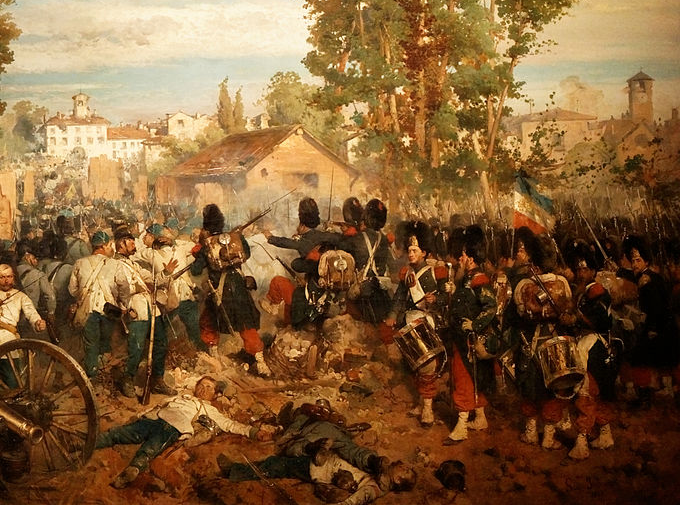
King Vittorio Emanuele rallies the Zouaves at Palestro
At the same time, while the largely French force was engaged at Montebello, King Vittorio Emanuele II led Cialdini’s division with the addition of some French Zouaves against a smaller contingent of Austrians under General Friedrich Zobel at the Battle of Palestro. The Austrians rushed in reinforcements so that, in the aftermath, they held the numerical advantage yet the threat of French troops on the Sesia caused him to retreat for fear of being cut off. By May 30 the Franco-Italian forces had secured a bridgehead across the Sesia. With efforts to retake Palestro having failed and with Garibaldi keeping control of the northern front in spite of being outnumbered nearly 4 to 1, Gyulai decided that the threat to Milan was too great and he ordered a retreat across the Ticino to concentrate his forces at Mortara. However, the rapid movements of the Franco-Italian armies forced him to abandon that plan. He was correct that they were moving against Milan, the capital of Lombardy, but he did not know what approach they would take. He was coming under intense pressure and no small amount of criticism, particularly after the arrival of Field Marshal Heinrich von Hess with stern orders from the Emperor (who had reached Verona) to defend the frontier and not retreat to the Quadrilateral fortress complex.

The Battle of Magenta
More Austrian reinforcements arrived and Gyulai was finally convinced that the enemy was not trying to maneuver around behind him after all. There was also confusion as Hess outranked Gyulai, yet seemed to be leaving things to him. All of this caused a degree of stagnation on the Austrian side as one commander would fail to do something because he assumed the other commander would do it. Nonetheless, the Austrians did hold a strong defensive position around Magenta after destroying the bridges over the Ticino. Gyulai had about 68,000 men in the area when the Battle of Magenta commenced on June 4. With a little over 50,000 French troops plus 12,000 Italians under General Manfredo Fanti, Napoleon III planned an assault on the front and flank of the Austrian army. The two sides were thus evenly matched as long as the Austrians concentrated on the points of attack and did not remain spread out. Both sides made mistakes and many units blundered into each other, nonetheless, the Austrians took far heavier losses and finally retreated, giving the victory to the French. Napoleon III congratulated Marshal MacMahon with a peerage as Duke of Magenta for this success.

This latest defeat was the last straw for Emperor Franz Joseph who had seen his forces do nothing but retreat, be outmaneuvered and defeated often by forces inferior to their own. He dismissed Gyulai and took command of the Austrian Imperial Army himself. With the Quadrilateral fortress cities secure but the enemy in command of the surrounding countryside, his position was similar to that of Graf Radetzky in 1848. However, “Papa Radetzky” was a veteran, unflappable commander and Emperor Franz Joseph was not. Determined to take the offensive and crush the enemy, he abandoned his strong position and moved out on June 23 to take on the Franco-Italian armies. The result was the bloody Battle of Solferino the following day. Once again both sides were about evenly matched with roughly 130,000 soldiers each.

Emperor Napoleon III at the Battle of Solferino
Each army was basically trying to attack the other and so units ran headlong into combat, often not as they intended. It was a huge brawl that involved a number of separate actions and coordination was difficult. The Austrian position was also undermined on distant fronts by uprisings breaking out in conjunction with Prince Jerome’s arrival in central Italy. Earlier, toward the end of May, his forces entered Florence and soon dispatched units to Parma and Modena. At Solferino, most of the fighting centered around two engagements, one around Solferino itself where the French under Forey pushed the Austrians back into the town itself at which point house-to-house fighting ensued. Despite Austrian reinforcements arriving, French attacks soon succeeded in nearly surrounding the town. Fighting south of town was disconnected from the main engagement and involved a number of cavalry units. There, the French attacks were repulsed by the Austrians but this had no effect on the imperiled Austrian position in town. The fighting was fierce and casualties were heavy, particularly for the Austrians.

Battle of San Martino
The other major action was the battles at San Martino and Madonna della Scoperta which largely involved the Italian forces. The Austrians had a fairly good defensive position and the Italians attacked immediately, hoping to dislodge them before they could strengthen their lines. However, this meant that the Italians attacked piecemeal as they came up rather than being able to throw their entire force at the Austrian position. Field Marshal Lieutenant Ludwig Benedek, considered the best Austrian corps commander by many, had been ordered to attack the French flank and had not been expecting to run into the Italians. However, he was a veteran of this region and kept his cool, responding rapidly to the changing situation. Repeatedly, Italian discipline and determination carried them forward to the cusp of success only to have Benedek adeptly move his men and guns to the imperiled area and throw the Italians back with devastating barrages. However, when word came that the main Austrian army had been beaten at Solferino, he had no choice but to conduct a fighting withdrawal as the Italian attacks continued. With the French having taken Solferino, the Italian seizure of San Martino marked the end of the massive and bloody battle.

French & Austrian Emperors meet at Villafranca
Stunned by the ferocity and chaos of the engagement, Emperor Franz Joseph ordered his forces to fall back to the security of the Quadrilateral fortresses. Losses had been heavy for both sides. The Italians had lost about 5,000 men, the French more than 10,000 and the Austrians about 22,000 in the vicious struggle. Both the French and Austrian emperors were shaken by the extreme loss of life. The carnage would later lead one Swiss observer of the engagement to found the International Red Cross in 1863. Operations continued for a time but Napoleon III and Franz Joseph both agreed that the war should come to an end. Franz Joseph feared that a continuation of the so far disastrous conflict could pose an existential threat to the Austrian Empire itself if other areas rose in rebellion. Napoleon also feared that if Austria seemed near to collapse the other German states might get involved and threaten France itself. Disregarding his earlier promises to the Italians, Napoleon III agreed to make peace with Emperor Franz Joseph at Villafranca on July 8.

The result of this was that Austria gave up Lombardy to the House of Savoy but retained control of Venetia. It was not the total victory that Italian nationalists had wanted and many were bitter about the result. The French had gained Savoy and Nice but had backed out before the total liberation of northern Italy had been achieved. Many, given how close Austria had come to collapse in 1848, thought they would not put up so strong a fight. However, despite being weakened by budget cuts, the Austrian military was much more effective than Austrian diplomacy had been. Things would have gone very differently if the Austrians had not managed to offend the Russians, Prussians, the minor German states and the French all at the same time. Not only did this isolate Austria but it also gave the Prussians room to further gain prestige among the German states, standing as the defenders of German rights while Austria was focused on keeping control of Italians, Slavs and Magyars.

King Friedrich Wilhelm IV of Prussia
A particular example of this was in 1857 when royalists in the Principality of Neuchâtel had risen in revolt. They favored the King of Prussia for their prince rather than being a part of Switzerland and the German states saw this as an opportunity to strengthen the German Confederation. Emperor Franz Joseph, president of the Confederation as the Head of the House of Habsburg, had, however, refused to give their cause imperial support. Prussia was ultimately forced to back down and many in the German Confederation wondered why they should take any risk to support the Austrian rule over unwilling Italians two years later when the Austrians had been unwilling to support pro-German royalists who wanted to be ruled by a German monarch. It was illustrative of how Austrian interests diverged from those of the rest of the German-speaking people. There were also those in Berlin who realized the implications that Italian independence would have better than the French did. Napoleon expected to gain a subservient northern Italian buffer state but, as Modena, Tuscany, Parma and after Garibaldi’s shockingly successful invasion of the south, all came to be part of the Kingdom of Italy, France instead helped create a rival in the Mediterranean.

The result of all of this was that Austria lost Lombardy, which joined with Piedmont-Sardinia, Tuscany, Parma and Modena to form the Kingdom of Italy, soon joined by the south and the Papal States outside of Rome. Austria remained friendless and increasingly overshadowed by Prussia and the French were not seen by the Italians as stalwart allies but as rather fair-weather friends who likewise kept troops in Rome. The French had gained battlefield laurels but would also find themselves without friends going forward just as the Austrians had because of their determination to maintain some level of control over Italy, continuing a cycle which had been going on for many, many centuries and which would continue until the fall of Napoleon himself in 1870. Italy had gained much from the Second War for Independence but not so much as to not require a third war. The Austrian loss did not seem too significant but it actually was. In trying to maintain control of Italy, Austria would ultimately lose their place in Italy and their place at the had of Germany to the Kingdom of Prussia. It would be no coincidence then that the Third War of Italian Independence would see Italy and Prussia on the same side.

Friday, August 18, 2017

The Austrian Empire and the Confederacy

The American Civil War was the bloodiest conflict ever fought in the western hemisphere of the world and, as such, attracted a great deal of attention from other powers. Previously, I have discussed on these pages how a war between two factions of republicans actually had a tremendous impact on the monarchist cause in the Americas. Most of the ‘Great Powers’ of Europe had an interest in the War Between the States. The British Empire had an economic interest with southern cotton feeding the textile mills of England while the industrial centers of the northern states were major competitors. Indeed, only a few decades after the war ended with the north victorious, the United States of America surpassed Great Britain as the world’s largest economy and has remained so ever since. The tentative steps of the Kingdom of Spain to rebuild the Spanish Empire in Latin America, the French-backed restoration of the Mexican Empire and the French plans for a “Kingdom of the Andes” in South America all depended on the Confederacy being victorious due to opposition to all such endeavors by the Union government in Washington DC.

Emperor Francis Joseph
The northern states were also home to large numbers of European immigrants who had fled their countries after failed revolutionary movements, so there were many Irish republicans in the north who detested the British Empire and many liberal Germans who had fled in the aftermath of the Revolutions of 1848. The only ‘Great Power’ to be seen at least as supportive of the U.S. government was the Russian Empire and this was mostly due to the fact that Britain and France were seen as friendlier to the Confederacy and the Russians hoped to counter this such as when Russia sold Alaska to the United States in order to prevent it being added to Canada by the British in a potential future conflict. The Austrian Empire was not extremely concerned about events in America, having many pressing problems of their own to deal with at the time, but that is not to say that they were not interested at all. Although the Emperor of Austria, Francis Joseph, had opposed the whole adventure, his younger brother was Emperor of Mexico and thus his fate, and that of the Austrian volunteer corps sent to aid him in Mexico, also depended almost entirely on the Confederates winning their independence.

Captain Ross at Gettysburg
As also pointed out previously, the Confederacy was also greatly influenced by the style of the Austrian Empire. The uniforms of the Confederate army were inspired by those of the Austrian light infantry and the first Confederate national flag was inspired by the ensign of the Austrian Empire, both being designed by the Prussian artist Nicola Marschall. The Emperor of Austria also had his own “eyes on the ground” so to speak, in the person of Captain FitzGerald Ross, a British-born officer of the Sixth Austrian Hussar Regiment. He made quite a stir in the southern states with his waxed moustache and braided Hussar uniform, in fact he was almost mobbed by admirers after being persuaded by some Confederate officers to wear his full dress uniform, fur busby, dolman and all, for a ride with them. He witness the Battle of Gettysburg, then went to Richmond, Charleston and then Chattanooga, Tennessee where he observed the fight from the lines of the Confederate General Braxton Bragg. He also visited the Gulf coast, Mobile, Alabama and so on. Like many, he was very impressed by the Confederate military and, like many more, was also impressed by the southern ladies. He became an ardent Confederate sympathizer, even to the point of picking up a rifle and taking part in a battle during his long stay in the south. When Ross finally returned to Europe, no matter what bad news reached him, he remained confident that the south would ultimately win.

Such a thing would have, inadvertently, greatly expanded Austrian influence in the New World given that the establishment of a Habsburg monarchy in Mexico (or rather the ‘reestablishment’) would have given Austria a sort of foothold in the region. Confederate President Jefferson Davis was certainly aware of this and tried to enlist the Prussian observer, Captain Justus Scheibert, as an envoy to Emperor Napoleon III of France. He proposed a sort of Franco-Confederate alliance, pointing out that in the Mexican War (of which Davis was a noted veteran) the U.S. had defeated Mexico with only 12,000 men and that if Napoleon would lift the Union blockade of the southern coast, which Davis believed could be done with ‘the stroke of a pen’ and would ensure a Confederate victory, he would supply 20,000 Confederate troops to aid the Emperor Maximilian of Mexico, explaining that southern troops were adjusted to the climate and familiar with the fighting style of the Mexicans.

Austrian officers in Mexico
However, this, as we know, did not come to pass. Although tempted, none of the European powers ultimately were bold enough to risk war with the United States by recognizing the Confederacy (though Pope Pius IX did address a letter to Jefferson Davis as President of the C.S.A.). When the Confederacy fell, the effort to spread monarchy in the Americas quickly fell apart. The U.S. government dispatched an army to the south Texas border and warned the French to withdraw or face war. Napoleon, not wishing to see the enterprise be for nothing, hoped that the Austrian Empire would take up the French cause of supporting the Mexican imperialists. A further 2,000 Austrian volunteers (roughly) were assembled at the port of Trieste, ready to embark for Mexico and fight for Emperor Maximilian. It was, though, at that point that the Union government stepped in by way of U.S. Minister to Vienna John Lothrop Motley who went to the Hofburg and informed the Austrian Emperor quite bluntly that the U.S. recognized only Benito Juarez as the leader of the legitimate Mexican government and that if the Austrian troops were allowed to leave, the U.S. would consider the Austrian Empire to be at war with the Mexican Republic and the U.S. Navy would take retaliatory action on behalf of Mexico.

The expedition was thus canceled, the Austrian soldiers disbanded and the Austrian Volunteer Corps already fighting in Mexico was promptly recalled. Many had already been slaughtered at the Battle of Santa Gertrudis where, seeing which way the winds were blowing, their comrades of the Mexican Imperial Army had deserted in the middle of the battle to join the republicans. The surrender of General Lee at Appomattox Court House in 1865 had set the dominos to falling, the Austrians pulled out and shortly thereafter the Habsburg Emperor of Mexico was captured and shot, the Austrian Emperor then even having a difficult time retrieving the body of his slain younger brother. The Imperial House of Habsburg had had a presence in the Americas ever since Philip the Handsome and Charles V had held their Spanish crowns until the succession was taken up by the Bourbons of France. In 1864, however, another Habsburg returned to, he hoped, usher in a new era of monarchy in the Americas but with the fall of the Confederacy, it was inevitable that the Habsburgs would once again lose their place in the New World.
Related Posts Plugin for WordPress, Blogger...