Showing posts with label the Netherlands. Show all posts

Wednesday, November 15, 2017

Dutch Nazis, Nationalism and the Monarchy

Regular readers may recall a past article on the Netherlands involvement in World War II in which mention was made of the Dutch equivalent of the Nazi Party, the NSB or Nationaal-Socialistische Beweging in Nederland (National Socialist Movement in the Netherlands) which was founded in 1931 and led by Anton Mussert, today the most notorious Dutch collaborator of World War II. There is much that can, I think, be learned from the relationship between Anton Mussert and Adolf Hitler, the Dutch NSB and the German NSDAP which should serve as a warning for people today who might have the right intentions but who should be on guard against any threats to separate them from their own unique identity and historic institutions. The NSB started out with the simple goal of wishing to stop the decay in Dutch society and restore the Netherlands to her former status as a major world power but ended up, by their increasing adherence to the German Nazi Party, fighting for the exact opposite of that.

As with many such similar movements, the NSB was originally most inspired by the fantastic success of Benito Mussolini and his Fascist Party in Italy. They had swept to power a decade earlier while Hitler and his Brown shirts were still struggling. Because of this, the NSB, founded by Anton Mussert and Cornelis van Geelkerken, had more in common with the Italian Black shirts than with Hitler and the Nazis. The most noticeable difference was that they were pro-Dutch and not anti-Jewish, indeed, like the Fascists, originally had Jewish members. They were opposed to direct democracy, advocating corporatism rather than capitalism or socialism but were not revolutionary, planning to work within the existing constitutional framework to achieve power and enact their changes to the Netherlands legally. They pushed for national unity and favored the corporatist model specifically to end the labor-versus-ownership divide which caused strikes and to put occupational concerns over ideological divisions.

Their goal of pushing for a return to national greatness also meant calling to mind the glory days of Dutch history when the Netherlands had been a major power. This meant that they were not opposed to the Dutch monarchy, indeed they drew inspiration from many past members of the House of Orange and, most significantly for our purposes here, they wanted to see the strengthening and expansion of Dutch power around the world. This meant that they wanted to strengthen their position in the Dutch East Indies (modern day Indonesia) and to annex Flanders and French Flanders to create a “Greater Netherlands”. This would, of course, necessitate the break up of the Kingdom of Belgium and the NSB intended for the vast Belgian Congo to become a Dutch colony and, if possible, for the Netherlands to regain control of South Africa by restoring the Afrikaner republics as Dutch colonies united with their ancestral homeland. They expected to be a close ally of Germany but nothing more, pursuing their own national interests on the world stage. However, their friendship with the Nazi Party proved a double-edged sword.

Early on the NSB gained some surprising electoral success for a country which, then as now, was seen as a place where such a party would not be expected to do well. The NSB gained enough of a following for the socialists, trade unionists and major religious institutions to come out against them. The government forbid state employees from joining the party and the socialists formed groups to disrupt their events and prevent the NSB from getting its message out (the Antifa of the day). They reached their peak in 1935, saw support drop somewhat after that but they were still a force to be reckoned with when World War II in Europe broke out with the German invasion of Poland in 1939.

The decline in support for the NSB came at around the same time, roughly 1936 and afterwards, that the Nazis began to eclipse the Italian Fascists as their primary source of inspiration. Racial rhetoric and anti-Semitism began to appear and became increasingly common though never on the same level as these subjects dominated political discourse in Germany. One area of concern in this regard was the Dutch East Indies where the NSB had some sizeable support before the war. This is not surprising given that one of the primary concerns of the NSB was to strengthen and enlarge the Dutch colonial empire and so, naturally, they were not without support in the largest and most important Dutch colony. However, the Dutch East Indies was also home to a sizeable minority of mixed-race people who, like the Anglo-Indians for the British, were quite important to the smooth operation of the colony which constituted the vast majority of the Dutch empire. There was considerable concern that the racial rhetoric would damage the support for the NSB in the East Indies. As it turned out, that would prove the least of their problems.

Future Dutch Queen Juliana with exiled Kaiser Wilhelm II
Yet, it was partly the racial rhetoric of the Nazis that kept the Dutch complacent. When Hitler invaded Poland and Britain and France declared war on Germany, most people in the Netherlands expected to sit out the war just as they had done from 1914-1918. The German Nazis, after all, viewed them as their Germanic cousins of superior racial stock and this, along with the fact that the Germans had pledged to respect Dutch neutrality and the detail that the Dutch had not and would not be so foolish as to attack the Germans, caused many to think the war would pass them by. Their queen was even married to a German prince and the former German Kaiser was living in the Netherlands and had been protected by the Dutch monarchy from efforts by the Allies to have him extradited and hanged as a “war criminal”. It therefore came as a great shock when the Germans started bombing them, dropping airborne troops on them and had panzers racing across the border. The Dutch were caught completely unprepared and despite their surprisingly fierce resistance were only able to hold on for four days before being obliged to surrender with the government and Queen Wilhelmina going into exile in England (quite against her wishes as she was preparing to hand out rifles to her maids and butlers and defend her palace herself -she was quite a formidable old lady).

The Nazis occupied the Netherlands and, naturally, turned to their biggest local fans in the NSB for support in running the country and dealing with the local population. This brought about a dramatic change in how the NSB was viewed and by what the role of the NSB was to be in the destiny of the Netherlands. Formed in reaction to the Great Depression, the NSB had garnered much of its support from presenting an alternative to communism and Mussert had addressed record crowds to talk about an alternative to the alien ideology of communism and the recently discredited model of capitalism. However, as soon as the war touched the Netherlands, a war no one expected, least of all the NSB which thought the Nazis would never attack, bomb and invade their Germanic racial brethren which was also neutral, until they did, Mussert immediately got in touch with the Nazis and offered his country up for annexation by Hitler’s Third Reich and even proposed leading a secret mission to kidnap Queen Wilhelmina and present her to the Germans.

Anton Mussert, doing his best to look the part
Mussert had rather ‘jumped the gun’ in throwing himself at the feet of Hitler before Hitler’s forces had actually conquered the Netherlands with the result that the Dutch government found out about these messages and several NSB leaders were arrested though Mussert himself escaped and remained in hiding until after the German conquest was complete. When the dust settled, however, he was not immediately given control of the Netherlands as he had expected, Hitler appointing the Austrian Arthur Seyss-Inquart as Reichskommissar of the Occupied Dutch Territories. When Mussert approached him about being named head of state in place of the Queen, Seyss-Inquart referred him to Hitler and to Hitler the ambitious Mussert proposed a ‘Nordic Federation’ of Germanic countries under Hitler’s direction and with himself in charge of the Netherlands. Hitler brushed him off but Mussert went on, holding rallies urging for cooperation with the Germans but with talk of the “Greater Netherlands” being sidelined in favor of talk about the Netherlands simply having “a place” in the “new Europe” run by Germany and Italy. Later on, Mussert would propose that he himself should be Hitler’s ‘number two’ man in this new order but, again, Hitler brushed him off.

Nonetheless, Mussert remained devoted to Hitler, even publicly swearing personal allegiance to him and urged his people to do the same. In June of 1940, at a mass gathering, he called on the Dutch people to rally behind him in supporting Hitler and the German war effort and to renounce their allegiance to the House of Orange, the Dutch monarchy and the government-in-exile in Britain. The Dutch were thus given a choice and it was made very stark for them; Mussert or Queen Wilhelmina. Mussert had been the nationalist leader pledging to strengthen and expand the Dutch empire but now was more about having a favored position in German-dominated Europe so long as they behaved themselves. Hitler, it must be said, did little to encourage such expectations and never allowed Mussert any position of real importance. He was not the head of state, he was not the prime minister and was only allowed the sort of honorary title of “Leader” but with no official position or power to go along with it. On the contrary, the Germans would eventually show more favor to other NSB members who were more pro-German and anti-Dutch, one even proposing to replace the Dutch language with German.

Dutch recruiting poster for the SS
A new chance arose, however, to rally the Dutch to the Axis cause when the war was expanded to what Germany and Italy had always claimed was their real enemy; the Soviet Union. The Dutch had no desire to fight against the British but they volunteered in large numbers to fight the communist threat which had openly called for the subjugation of the world. The Netherlands supplied more volunteers for the Axis war effort than any other occupied country and the Germans were quick to make use of them on the brutal eastern front. Putting politics aside, the Dutch proved themselves in dramatic fashion, fighting with immense courage, many being highly decorated and taking dramatic losses in the process. Against the Bolshevik hordes, the Dutch fighting man had proven his worth and made incredible sacrifices in the process. However, just as the first year of the ‘Crusade against Bolshevism’ came to an end, Dutch nationalists would find themselves betrayed yet again when the Empire of Japan decided to get in on the global war. However, rather than joining Germany and Italy in war against the Soviet Union, it would be against the United States of America and, subsequently, against the Netherlands as well in order to seize the extensive oilfields of the Dutch East Indies.

Japan invades the Dutch East Indies
Once again, the Dutch were caught unprepared and had only minimal Allied assistance to call upon when the Japanese invaded, a massive operation that none of the western powers had previously thought Japan capable of. The Dutch set fire to their oilfields and their small colonial army offered gallant resistance but it was to no avail. Needless to say, the previously considerable support the NSB had in the Dutch East Indies immediately evaporated. It also caused considerable dismay at home. Imagine yourself being a proud, patriotic Nederlander; the NSB says they will lead you to a “Greater Netherlands” which will revive and enlarge the Dutch empire, making it bigger and better than it had ever been before. Then you are told that, instead, the Netherlands will be a subsidiary part of a greater Germanic federation but you can at least keep what you have and will be protected from communist subjugation. Finally, while your men are fighting and freezing to death on the eastern front alongside the Germans, you find out that Germany’s ally has seized your largest and most important colony, killed large numbers of your people and put everyone else in concentration camps. That sort of thing would tend to sap morale.

Queen Wilhelmina during the war
Now, still keeping in mind that you are a proud Dutch nationalist, possibly freezing to death on the Russian front, that while the side you are fighting for says your empire must be given up and your relatives in Southeast Asia are at the mercy of the Japanese, that Queen Wilhelmina, who you are told is now your enemy, is calling for the liberation of the Netherlands from German rule and the liberation of the Dutch East Indies from Japanese rule, fighting for the full restoration of the Dutch empire. You will also notice that all talk about South Africa is out of the question whereas Queen Wilhelmina had been the most sympathetic leader in the world toward your Boer brethren back in the days of their fight against the British, even sending a Dutch warship, HNLMS Gelderland, to evacuate the Boer President Paul Krueger from Africa and bring him to Europe. You might have even heard that the German Kaiser would not receive Krueger but in the Netherlands, Queen Wilhelmina and the Dutch Royal Family gave him the warmest welcome in The Hague. Which side, that represented by the Queen, or that represented by Mussert, must have seemed the proper cause for any proud Nederlander?

Mussert had enough sense to see this and when the Dutch East Indies was invaded he appealed to Hitler to use his influence to get the Japanese to back off, to call off his “Honorary Aryans” in favor of actual Aryans as the Nazis might put it. Again, Mussert was ignored and Hitler and Mussolini quickly declared war on the United States in solidarity with their Japanese ally. Did this have an impact on the Dutch who were fighting alongside the Germans? Obviously, it could not have helped. Friction over Dutch officers being replaced with German ones in the Dutch SS volunteer legion had caused many to resign and the Dutch suffered heavy losses around Leningrad after being reformed in the spring of 1942. Later, their nominal commander, a former high ranking officer of the Dutch military, Lt. General Hendrik Seyffardt was assassinated at home. After their enlistments expired in the spring of 1943, by which time the Japanese had seized the Dutch East Indies, most refused to reenlist to fight with the Germans. Due to the lack of recruits, the legion was disbanded in May of 1943. When Mussert tried to protest against the reprisals taken by the SS after the murder of Seyffardt, Hitler would not even see him.

As Axis forces were being pushed back in Russia, North Africa and the Pacific, the Germans ordered the conscription of all former Dutch soldiers into their own army and SS legions. In response, the Dutch went on strike and nearly a hundred were shot in retaliation but there was little the Germans could really do, a dead man being rather less likely to work or fight for your war effort than one on strike. The NSB was decimated, most of its members dead on the Russian front or assassinated by the Dutch underground. When Hitler finally gave Mussert a last audience he informed the Dutch “Leader” plainly that he would never be given any political power. Still, he carried on even as June 1944 saw the Allied invasion of France, including over a thousand Dutch soldiers who had escaped the continent, fighting for their Queen and country. On September 5, fearing the approach of Allied soldiers, the remaining NSB members fled to Germany though Mussert notably did not, was taken prisoner and executed for high treason after the war.

The Dutch spent the last winter of the war starving and freezing as the Allied Operation Market Garden failed and the Germans cut off all supplies to punish their racial cousins. The only relief came from 11,000 tons of food dropped by American and British aircraft. Not long after, the German forces remaining surrendered and soon the Queen returned, met by a rapturous welcome. Interestingly enough, after Mussert was convicted and sentenced to death, he appealed to Queen Wilhelmina to spare him. The Queen he had renounced his allegiance to, the Queen he encouraged his people to abandon, the last hope Mussert had was for her to use her royal powers to spare his life. However, Queen Wilhelmina was not that sort and Mussert was executed by firing squad. He died for his persistent allegiance to a German ruler who never trusted him nor made any objection to the stripping away of Dutch territory. Queen Wilhelmina, on the other hand, would spend the end of her reign fighting to maintain the Dutch colonial empire in Southeast Asia, even while her own allies betrayed her and the business elites of the country criticized her for not conceding.

Dutch colonial troops march against Japan
There is a great lesson to be learned from the sad life of Anton Mussert and his NSB. His desire for the Netherlands to be stronger was certainly valid as subsequent events proved that neutrality only works if your neighbors are good enough to respect it. He was not a revolutionary, was not anti-religion nor was he anti-other races, simply pro-Dutch. His political views about disliking democracy and preferring a system based around occupational representation were, in my view, perfectly reasonable. However, his captivation with Hitler proved disastrous for himself as well as his movement. It certainly did his country no good but Hitler would have done with the Netherlands as he pleased regardless of whether Mussert was in the picture or not. He became so enamored with the idealized image of Hitler that he turned against the traditions and traditional institutions of his own nation so that, in the end, it was the Queen he betrayed and was fighting against who represented the cause of Dutch greatness while the side he was on was allied to a power which themselves claim to have been fighting a race war against his people and those like them. That is something everyone with a proper pride and self-respect for their own people and culture would do well to take notice of.

Saturday, July 15, 2017

The Netherlands in the Napoleonic Wars

At the time of the outbreak of the French Revolution, The Netherlands was still a republic, albeit a very business-minded republic with a prince, usually, holding the place of honor in government. This was the United Provinces, as they were often called, though some still referred to the area as the Spanish Netherlands to differentiate the lands from Belgium which was known as the Austrian Netherlands. Both areas were to see rebellions and upheavals and their destinies would prove to be intertwined. In the Austrian Netherlands, Catholics and leftist republicans joined forced in opposition to Emperor Joseph II to proclaim the independence of the “United States of Belgium” which was eventually suppressed by Emperor Leopold II. The trouble brewing in Belgium, where Catholic opposition to the Emperor brought about a common cause with the dissident, revolutionary sect, was the primary reason why Joseph II was probably the most anti-American and pro-British monarch on the continent during the American War for Independence as he feared the precedent this would set for his Belgian subjects.

Prince Willem V of Oranje
In the United Provinces, there had long been a tension, periodically breaking out into violence, between the republican faction and the royalist faction (or ‘Orange party’) of Dutch politics with the republicans wanting to keep the country a republic and, indeed, make it even more republican while the Orange party wanted to empower the Prince of Orange and make him king. The American War for Independence also highlighted this division as the Prince of Orange, Willem V, favored the British while the republican government favored the American patriots and ultimately succeeded in bringing the Dutch republic into the war against Britain alongside the American rebels (though the Dutch did not benefit by it). As in Belgium, the Dutch republicans seem to have been inspired by the American example as illustrated by how they began calling themselves the Patriot party in opposition to the Orange party. They became even bolder until finally clashes broke out between the Patriots and the Dutch army which tended to be loyal to the Prince of Orange. The situation became so serious that it took an armed intervention by King Friedrich Wilhelm II of Prussia to see the Dutch patriots cleared out.

Prince Willem V was thus in control but only by the grace of Prussian bayonets when the French Revolution began to come to a boil and, given recent events, he was well aware of the danger of such ideology spreading. In 1792 the French declared war on Austria and prepared to invade Belgium where they expected popular support. The Prince of Orange, not being in the strongest position, held back. However, 1793 saw the regicide of King Louis XVI of France and every royal in Europe was instantly made aware of how serious this situation was. On February 1, the United Provinces, led by Prince Willem V, declared war on the French Republic, joining the “War of the First Coalition”. There was, originally, some success when an Austrian-Dutch army led by the Prince of Coburg defeated the French under General Charles Dummouriez at the Battle of Neerwinden on March 18 in Belgium, however the Prince of Orange and his Dutch troops were defeated at Menin on September 3 and another Austro-Dutch army was defeated by the French at the Battle of Wattignies in October. The Austrians on their own, as well as the British and their German comrades did no better in the face of the mass conscript armies of France.

Willem VI, later Willem I
1794 saw the last of the coalition forces driven from Belgium and the country was annexed to the French Republic and would remain so for quite some time. That same year, French forces under General Charles Pichegru invaded the Netherlands along with a contingent of anti-Orange Dutch patriots led by General Herman Willem Daendels in a surprise attack during the harsh winter. Local republican revolutionaries rose up in support of the invaders, making things even more difficult. Whereas, in the past, the French had been traditional enemies of the Dutch, the French had made themselves the most acceptable allies for Dutch, Protestant, republicans by embracing republicanism and tearing down the Catholic Church as well the monarchy. The French republicans declared that they had come to “liberate” the Netherlands and in 1795 declared the country the Batavian Republic. Defeated from without and betrayed from within, Prince Willem V was forced to go into exile in England. The new French-backed Batavian Republic was declared a “sister republic” of France, one of many such puppet-republics the French established in the wake of their armies.

However, not everyone felt “liberated” by this turn of events. The behavior of the French republicans won them few friends outside the already ideologically committed and the French also annexed Flanders, Maastricht, Venlo and part of Walcheren with Flushing to France. The British, however, still had a good intelligence service operating in the area and took notice of the growing Dutch discontent with their so-called liberators and in 1799, as part of the War of the Second Coalition, launched a joint invasion of the Batavian Republic along with an Imperial Russian Army force. The British were led by the “Grand Old” Duke of York and the Russians by General Johann H. von Fersen. They were met by a Franco-Batavian (Dutch) force of about equal size but, after initial success, in battles lasting from August to November, the Anglo-Russian army was ultimately forced to retreat, leaving the Netherlands once again to the First French Republic and their local collaborators. The House of Orange had not been mere spectators to these events as the Hereditary Prince of Orange, later Willem VI, participated in the campaign alongside the British and Russians. In fact, he was instrumental in the seizure of a naval squadron known as the “Vlieter Incident” with the ships ultimately being sold to the Royal Navy.

Gen. Janssens at the Battle of Cape Town
The Prince of Orange also wrote a series of letters in 1795 known as the “Kew Letters” while in exile, instructing the governors of the Dutch colonies overseas to resist the French and cooperate with the British, in his capacity as Captain-General of the Dutch armed forces, in the hope of keeping these territories from being controlled by the Batavian Republic. Malacca, Amboina and West Sumatra (in the Dutch East Indies) did so and surrendered to the British without opposition. Cochin, or Dutch Malabar in India, on the other hand, required some “persuasion” from the Royal Artillery but, in the end, the Dutch holdings in India and Ceylon were captured by the British. Also in 1795 the British sent an expedition to seize control of the Dutch Cape Colony at the bottom of Africa. The local Dutch forces offered determined resistance but were finally compelled to surrender on September 15. Later, the British would hand the cape over to the Batavian Republic as part of a peace agreement and so another expedition would have to take it back again. When the Napoleonic Wars finally ended, the British would give back the Dutch colonies they seized, but not all of them, keeping some, such as the Cape colony, for themselves as it was a highly prized strategic chokepoint, controlling access to and from the Indian Ocean and south Atlantic.

Meanwhile, in 1803, Jan Rudiger Schimmelpenninck was elected President of the Batavian Republic but things began to change thanks to the grander aspirations of one Napoleon Bonaparte. After succeeding in making himself “Emperor of the French”, the client republics that France had set in neighboring countries suddenly received an upgrade to become client monarchies. In 1806 the Batavian Republic, at the behest of its French masters, became the Kingdom of Holland and the Emperor Napoleon awarded the new Dutch kingdom to his brother Louis (originally Luigi) who became King Ludwig I of Holland (or to be more precise, Lodewijk I). This led to a rather unusual situation as the new King Ludwig proved to be quite popular with his new Dutch subjects. Unlike, for instance, Napoleon’s older brother who became King of Spain, many Dutch people embraced their new monarch or, at least, did not dislike or oppose him. To his credit, Ludwig I took his new position seriously and tried to be a good king. That, however, ultimately led to trouble with his brother. King Ludwig I was supposed to be little more than a puppet but he was a puppet who tried to pull his own strings and when Dutch and French interests conflicted, Napoleon expected French interests to prevail. However, his brother actually stood up for Dutch interests which caused Napoleon no small amount of frustration (and at a time when he had much to be frustrated about).

King Ludwig I of Holland
This tension between the two Bonaparte brothers was exacerbated by the effort of the Emperor Napoleon to defeat Britain by means of economic strangulation. He instituted the Continental System which forbid France and all countries controlled by or allied with France from trading with the British which, as it turned out, proved more ruinous for the continent than it did for Britain and particularly for The Netherlands which had a heavily trade-based economy. Needless to say, smuggling soon reached epidemic proportions because of this and Napoleon was so desperate to stamp it out that in 1810 he simply annexed the Kingdom of Holland and it was absorbed into the French Empire. The former King Ludwig I, by then none too popular with his brother, fled into exile in the Austrian Empire and remained there for the rest of his life. So it was that, until 1813, the Dutch, willingly or not, mostly fought alongside the French under Napoleon. For some, this did not seem all that unnatural given the long history of Anglo-Dutch rivalry and warfare.

Because of this situation, there were prominent Dutch military men on both sides of the conflict. General Jan Willem Janssens had fought against the British at the Cape Colony and Java, was made Secretary-General for War for the Kingdom of Holland by Louis Bonaparte and then, after annexation, fought for Napoleon under Ney in the War of the Sixth Coalition. He would later serve as War Minister for the Kingdom of the United Netherlands in the last campaign against Napoleon. General David Hendrik Chasse, regarded by many as the best Dutch soldier of the period, was from the Patriot party and commanded the Dutch brigade that fought for Napoleon in Spain for which exploits he was elevated to baron. He carried on in French service after the annexation but remained bitter about it though he won decorations and promotions for outstanding service, even being credited with saving the French army at the Battle of Maya. For his offensive spirit and fierce attacks, Napoleon nicknamed him, “General Bayonet”. He too though would later fight against Napoleon as commander of the Third Netherlands Division during the Waterloo campaign. Later still, he would defend Antwerp during the Belgian Revolution.

Constant Rebecque
One soldier of the Dutch army who fought against the French revolutionaries as well as Napoleon the whole way was not actually Dutch but a Swiss professional soldier; Jean Victor de Constant Rebecque. He first came to France as part of the Swiss Guard protecting the King. He survived the massacre of his regiment during the Revolution and from there was employed by the Dutch, serving in the regiment of Prince Frederick. When the French conquered the United Provinces, he served with the British and later the Prussians before returning to the British along with the Prince of Orange during the Peninsular War under the Duke of Wellington. After the downfall of Napoleon, according to a previous agreement by the major allied powers, the former United Provinces as well as Belgium were to be united into one country with the Prince of Orange as its monarch. This would be the Kingdom of the United Netherlands which would officially come into being in 1815, combining the Seven Provinces, Belgium and Nassau, though Nassau would later be traded for Luxembourg. This was because the allies wanted a strong monarchy as a buffer between the French and the Germans. Rebecque was instrumental in organizing the Dutch-Belgian army and would serve as Quartermaster-General and chief aid to the Prince of Orange (commander of the Allied I Corps) in the Waterloo campaign.

Prince Willem V of Orange was long since gone by then, having died in exile in Germany in 1806 (in fact, his body was only reburied in The Netherlands in the 1950’s). He was succeeded by his son Prince Willem VI of Orange, however, in 1813 he had, with the downturn of fortune for Napoleon, returned to the Netherlands and received quite a warm welcome, almost everyone by that time having turned against the French. In 1815, with the support of the allies, he proclaimed himself King Willem I of the United Netherlands, also becoming, in due course, Grand Duke of Luxembourg. His son and heir was the Prince of Orange who would fight on more than one battlefield as chief deputy to the Duke of Wellington with his old military tutor Rebecque as his ‘right hand man’. Unfortunately, the military reputation of the Dutch, particularly as it concerns the Waterloo campaign, has suffered considerably and quite unjustly at the hands of their British allies, both in accounts from participants, post-war historians and even television filmmakers.

The Prince of Orange at Quatre Bras
Probably because so many had fought with the French, the British may not have been inclined to trust the Dutch too much and, in addition, there was the already mentioned long history of Anglo-Dutch rivalry in trade, colonial expansion and naval supremacy. Whatever the cause, the British quite unfairly ridiculed and derided the Dutch participation in the Waterloo campaign. More recently, historians have done serious research, not simply repeating what others wrote before them and have found that the standard British version of events was not true, indeed, in some cases was shown to be impossible. The truth is that the Dutch-Belgian army played a critical part in the final campaign against Napoleon. Indeed, if Rebecque had not countermanded an order from Wellington so that the Dutch-Belgian troops stayed and fought at the crossroads of Quatre Bras, the British would not have been able to occupy the choice position that Wellington had picked out to do battle at Waterloo. The Prince of Orange himself, has often been portrayed in a grossly exaggerated way as being totally incompetent. This is also not true. Though the Prince of Orange certainly made some mistakes, they were not due to incompetence but simply to his lack of experience.

King Willem I of the Netherlands
As it happened, the troops with the orange cockades acquitted themselves well and, again, if the Dutch forces had not held off the French for as long as they did at Quatre Bras, the subsequent defeat of Napoleon at Waterloo might never have happened. However, it did and so King Willem I was secure on his throne, achieving what almost all the Princes of Orange before him had dreamed of since the winning of Dutch independence. As things were established, he was also pretty much an absolute monarch, though that situation would not survive him. The French Revolution and Napoleonic Wars could be seen as the fire in which the modern Kingdom of the Netherlands was forged. At the beginning of the era, they were a republic, the Seven Provinces which was often called the United Provinces but which were far from united. Crippled by the feuds between the orange and patriot parties, the country was an easy victim of the revolutionary French. However, they endured and finally fought their way back, emerging as a strong and, mostly, united kingdom. Belgium and Luxembourg was part from them in time but for the Netherlands itself, the Napoleonic Wars were a pivotal moment in history. The Dutch had gone in as a republic but emerged as a monarchy.

Monday, January 9, 2017

Revolution in the Dutch East Indies

Not everyone may know it now, but the Kingdom of the Netherlands was once a major power. After winning independence from Spain (the dominant military power of the day) in a very long war, the Dutch fought off the French, won wars against England and established themselves as a major player in Europe. Long a powerhouse in business and world trade, the Dutch built an empire that stretched from the Americas to South Africa to India and East Asia. It was, however, in Southeast Asia that the crown jewel of the Dutch empire rested, their largest colony by far and the one which was the most productive, contributing a huge percentage of the overall economy of the Netherlands. That colony was, of course, the Dutch East Indies, known today as the Republic of Indonesia, a vast archipelago of thousands of islands that is about as far from one end to the other as the continental United States. For more than three hundred years the Dutch East Indies belonged to the Netherlands, a princely republic and later a very business-minded, Protestant monarchy reigning over a huge territory of disparate Islamic principalities and some of the most abundant natural resources to be found anywhere in the world.

KNIL troops in Java, World War II
There were conflicts, of course, in the establishment of this colony and the occasional unrest but none of it was very serious, certainly nothing that the small but very professional Royal Netherlands East Indies Army (KNIL) could not handle. An anti-Dutch nationalist movement had been on the rise, but it seemed to be dealt with easily enough and its leader, Sukarno, was captured and incarcerated. Even when World War II erupted in Europe, not much changed in the Dutch East Indies. After an heroic but futile four-day fight the Netherlands was conquered by Germany and the Dutch Royal Family was forced to flee to England. However, the stout-hearted and determined Queen Wilhelmina continued to preside over her government-in-exile and the Dutch East Indies contributed as much as possible to the Allied war effort against Nazi Germany. When the United States of America placed sanctions on the Empire of Japan, including an oil embargo when America had been the primary provider of oil to the Japanese, the British Empire did the same. The Dutch government, likewise informed the Japanese that they could expect no oil from the Dutch East Indies. Their homeland was under occupation by Japan’s Nazi ally and the Dutch stressed that all of their resources were needed for their own struggle to liberate the Kingdom of the Netherlands.

Japanese troops in the Dutch East Indies
Not long after, in a major offensive kicked off by the bombing of Pearl Harbor, Hawaii, the Japanese launched an ingenious, multi-stage offensive across Southeast Asia. Despite more heroic but futile resistance, the Dutch naval forces and the Dutch colonial army was defeated and the Dutch East Indies came under Japanese occupation. All White people were immediately placed in concentration camps, as were most of the sizeable minority of mixed-race people and any natives who opposed or were expected to oppose Japanese rule were either killed or confined. The anti-Dutch dissident Sukarno was released from his prison and became a willing collaborator of the Japanese. There was talk of absorbing other surrounding territories, particularly British Malaysia, to create a “Greater Indonesia” but the Japanese had no intention of allowing the Dutch East Indies to become independent. The whole point of the invasion was to secure control for Japan of a source of resources and raw materials that no foreign power could withhold from them. It was then, only after Japan had clearly lost the war and the atomic bomb had already been dropped on Hiroshima, that Japan authorized Sukarno to declare independence. It was a final, parting shot at the hated Europeans to make a restoration of Dutch rule as difficult as possible. In that regard, it more or less worked as planned.

Sukarno
The Dutch had previously always been on friendly terms with Japan. In fact, during the long years of Japanese isolation, the Dutch were the only western power to have any contact with Japan at all. When the war was over, the Dutch asked the Japanese military to remain in place to keep order in the colony until they could return. The Japanese did stay until Allied forces arrived but they gave many of their weapons to the anti-Dutch Indonesian dissidents and thousands of Japanese stayed behind rather than return home to carry on their war against the Whites in Asia. Sukarno had also been busy, trying to set up a government of his own, growing out of a committee the Japanese had allowed him to form during the war. It was this body which declared that the Indonesian Republic would include not only the Dutch East Indies but British North Borneo, the Malay Peninsula and Portuguese Timor as well. It would have a dictatorial president and, although Sukarno wanted a secular and unitary state, he later conceded to the powerful Islamic clerics of the country to state that the new country would be based on submission to Allah and would require all Muslims to obey Shariah law (or syariah law in the local tongue).

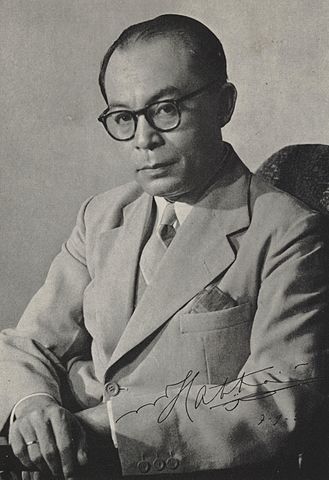
Mohammad Hatta
There were divisions, Sukarno wanted a unitary state while his deputy, Mohammad Hatta, favored a federal system. Nonetheless, they were united in what they were against and Sukarno simplified his position and his proposed republic by basing it on five principles; Islam, humanitarianism, national unity, democracy and social justice (as he defined them of course). This, of course, will sound all too familiar to people today. You have a Marxist-socialist revolutionary, making concessions to Islam, talking about democracy which he has no intention of actually enacting, national unity but only for those of his own nationality, humanitarianism while carrying out horrific atrocities and the catch phrase so popular with today’s progressives, “social justice” which, then as now, came down to a war against anything White, western, Christian or traditional. No doubt the “social justice warriors” of today would look on the Indonesian revolutionaries with their coalition of socialists and Islamists as their beloved ideological forefathers. This was though, it must be said, also the start of a struggle within Indonesia between the more secular nationalists and the Islamic fundamentalists which is still going on today.

Queen Wilhelmina
So it was that by the time the Dutch were ready to return to their colony, Indonesia had already declared independence, already had a political platform, a flag and national anthem and even aspirations for territorial conquest. HM Queen Wilhelmina of the Netherlands, certainly had no intention of giving an inch of this. She was extremely determined that any concession would be a betrayal of all they had fought and suffered for during the war. She wanted to fight for the full restoration of the Dutch empire and regarded Sukarno and his regime as traitors who had collaborated with foreign invaders and perpetrators of a race war. However, having just emerged from the ruin of World War II, the Kingdom of the Netherlands was hardly in a condition to make an immediate and robust response to this outbreak of revolution in the colonies. Worse, her Allies were far from united or in agreement as to what their reaction would be. The United States had, under President Roosevelt, taken a very hostile attitude to all colonial empires during the war and while it was certainly in the interests of the British who wished to maintain their own empire, also recently decimated by the Japanese in East Asia, to support the Dutch, they were in hardly better condition to offer much support. The Dutch, with a depleted, bombed-out country of their own and “friends” who were either opposed or indifferent to their reclaiming their lost empire faced a huge territory with a large population full of revolutionary fervor ready to fight them using any tactics necessary.

The Dutch were pressured then, both by the situation and their own allies, to come to some sort of a negotiated peace with the Indonesian republicans. This was not the first choice of the Queen, but it seemed the only option available. While Allied, mostly British Imperial, forces landed to disarm the Japanese and liberated the Europeans being held in concentration camps, the Indonesian revolutionaries prepared to resist them, wrongly fearing that they were determined to restore Dutch rule. In the meantime, republican officials were parceled out among the islands to enact the dictates of the revolutionary government. The local Indonesian princes mostly came under extreme pressure if not outright attack either for having collaborated with the Dutch previously or for collaborating with the Japanese more recently. Young people ran rampant, fired by the revolutionary rhetoric of the republicans, led by Sukarno who blasted the native princes for stunting their country with “feudalism” and thus allowing the Dutch to gain control and rule the islands for the last three centuries. Law and order quickly broke down and chaos ensued as different factions and different ethnic groups pursued different goals.

Flag of the Japanese sponsored PETA
There were Marxist radicals, separatists, Islamic fundamentalists and more moderate leftists all jockeying for position. The revolutionaries were, however, aided by the fact that since the Japanese had first broken Dutch rule, most did not want to see it return. Not everyone was opposed to maintaining some sort of connection with the Netherlands but a reactionary return to the former colonial regime as it was seemed completely beyond the realm of possibility. That this would be a vicious fight was made clear early on when violence broke out in Surabaya in East Java, between Indonesian republicans (along with remnants of the Islamic militia force formed by Japan, PETA) and occupying British forces on October 28, 1945. From November 10-24 this escalated to an all out battle and what would be the bloodiest single fight of the entire revolutionary war. The British won the battle but, in what would become an all too familiar pattern, were horrified by the cost and determined that the Dutch cause was hopeless. Thereafter, rather than stand by their Dutch ally, the British would likewise support the republicans in the United Nations.

The republicans began forming a more formal government, though none tended to last very long and Sukarno remained the real power and driving force of the revolutionary movement. The Dutch were convinced that they would have to come to some sort of agreement and the British brokered the Linggajati Agreement between them and the Indonesians. The agreement went into effect on November 12, 1946 and stipulated that the Dutch government would recognize republican rule over Java and Sumatra while the eastern archipelago would be retained and all would remain under the Dutch Crown. There would be a federal system for the islands with the Republic of the United States of Indonesia (RUSI) including Java and Sumatra of course as well as southern Kalimantan and the “Great East” of Sulawesi, Maluku, the Lesser Sunda Islands and West New Guinea. The revolutionaries did not ratify this agreement until March of 1947 and neither they nor the Dutch were satisfied with it when it was signed on May 25, which of course the British took as proof that it was actually perfectly fair and reasonable. It was, however, destined to fall apart very quickly.

Dutch royal troops of the first police action
Revolutionaries had been fired by radical zeal and a compromise solution was not what they had been prepared for. Within hardly a month the republicans committed numerous violations of the agreement and the Royal Dutch government, frustrated with the whole affair, decided that it would take a taste of battle to set things in order. On July 21, 1947 the Dutch launched a “police action” (“Politionele Acties” as the Dutch called it) named Operation Product. The Royal Netherlands military had to rebuild their colonial forces from scratch since they had been completely dismantled by the Japanese but, nonetheless, they fought with skill and determination. Royal Dutch troops drove the republicans out of Sumatra, then East and West Java, finally confining them to the central Yogyakarta region of the island of Java. The action had been quite successful but rather than congratulations on their victory, the Dutch were denounced by the new international community represented by the United Nations. More negotiations were organized, this time held aboard an American warship, and these resulted in the Renville Agreement, agreed to on January 17, 1948. This agreement recognized Dutch control over the territory taken by their forces but only until a vote could be held to determine whether the populace wished to remain under the jurisdiction of the Netherlands or the Indonesian republic.

Dutch military column, first police action
This time, certainly, the Dutch had more cause for discontent with the agreement than the republicans. They had fought a hard campaign and been immensely successful, only to be told their gains would likely be taken away as soon as it could be organized. Meanwhile, the revolutionaries had been knocked down hard by this defeat and seemed to be coming apart at the seams. In 1948 part of western Java broke away under the leadership of Islamic radicals, declaring itself the Indonesian Islamic State (doesn’t that sound familiar too?) or as it was more commonly known, Darul Islam. This separatist Islamic theocracy would continue to bedevil the Indonesian authorities until its founder was finally captured and promptly executed by the republicans in 1962. There were other divisions too such as one faction led by the throwback anti-colonial dissident of a bygone era Musso of the PKI and a Trotskyite faction led by Tan Malaka. In what was called the Madiun Affair, for its location in East Java, a communist insurgency broke out that called for the people to overthrow the republican government as well as the Dutch. None of these ultimately succeeded, Musso being killed and Tan Malaka later being executed by republican forces in February of 1949. However, it made the United States very nervous about the communists gaining a foothold in Indonesia and increasingly put pressure on the Dutch to make an accommodation with Sukarno who, the Americans were convinced, could be kept on the side of the non-communist western camp.

General Simon Spoor
The Royal Dutch military forces, however, were not about to give up while the work of centuries was falling into chaos. The Queen of the Netherlands was fortunate to have a very tough and talented commander of her forces in the East Indies in the person of General Simon Hendrik Spoor, a World War II veteran who had worked closely with General Douglas MacArthur and rather took the “American Caesar” as his example. Originally a colonel, Spoor was given the temporary rank of lieutenant general when he was given command of the Royal Dutch Army in the East Indies. He was a man of seemingly boundless optimism, for whom no task was too great and his first ‘police action’ against the republicans had been very successful. Many did not know, because of the immense confidence he displayed and the great care he took of his soldiers, just how much stress was heaped on the workaholic general. The only real criticism of General Spoor was his efforts to suppress news of atrocities committed by Dutch forces under his command. Such things did happen, though none were officially sanctioned of course, but these were widely used for propaganda purposes by the revolutionaries and were taken up by communist forces in the international community. They never told, of course, that these were prompted by acts of torture and mutilation carried out by the republicans against the Dutch and Dutch-allied native forces. General Spoor was simply concerned with not providing the enemy with such ammunition and protecting the integrity of the Royal Netherlands Armed Forces.

KNIL forces on parade ground
General Spoor, and the other Dutch authorities, could see the international elites aligning against them, they knew they were in an extremely difficult position but they also knew that success on their ground would counteract more of this pressure than anything else could. As such, the Dutch launched a second ‘police action’ in December of 1948 codenamed “Operation Kraai”. General Spoor had excellent intelligence on the enemy thanks to the breaking of the republicans’ secret code which revealed both their military and diplomatic plans. Once again, the focus was on Java and Sumatra, where the “head” of the revolutionary movement was located. The object was to force the republicans to accept the compromise proposed by the Kingdom of the Netherlands which would preserve the federal system and keep the East Indies under the overall reign of the Dutch Crown. The operation began with a formal announcement by the local Dutch civil authorities that, as the republicans had violated the Renville Agreement, the Netherlands forces were no longer bound by it. General Spoor launched a complex, integrated attack on the leadership centers of the revolutionary movement using land, air and airborne forces.

KNIL troops in the jungle
The republican leadership based at Yogyakarta was the primary target and General Spoor thought that the revolutionaries would throw everything they had into the fight. However, he was surprised by how little resistance they ultimately offered, quickly retreating in the face of the determined Dutch offensive. They would resort to guerilla warfare, something Spoor never wanted to consider. However, once again, the Royal Dutch military operation was well-planned and hugely successful. Yogyakarta was captured on December 19, 1948 and very soon both Sukarno and his deputy Hatta were captured and exiled to northern Sumatra or the island of Bangka. It was the second time Sukarno had been apprehended by Dutch authorities (the first being prior to the Japanese attack in World War II) and the revolutionary republic was effectively decapitated by this victorious operation. The republicans quickly cobbled together an emergency government in western Sumatra but their entire operation was in disarray, their forces were defeated and smashed and the Netherlands forces seemed to have accomplished all of their goals of the operation.

Unfortunately, and to the great frustration of Queen Wilhelmina and the Dutch authorities, at this moment of triumph, the Kingdom of the Netherlands was effectively undermined by the international community, including their own allies. The British had already turned against them, recently independent Asian countries such as India aligned against them and finally the United States also condemned the Dutch military action. Needless to say the Soviet Union and Communist countries were always opposed to the Dutch and the continuation of any colonial regime. In January of 1949 the UN Security Council passed a resolution demanding that the Dutch give up the gains of their victory and allow the reinstatement of the republican government. Pressure was also put on the Dutch to renounce any and all sovereignty over the Indonesian archipelago by July 1, 1950 including the threat of losing Marshall Aid for the Netherlands if they did not. In effect, the UN was coming out against the compromise proposed by the Netherlands and endorsing the Dutch simply handing the Indonesian republicans everything they wanted in spite of having beaten them in the field.

Flag of the Indonesian Republic
The Dutch had little choice, in the face of the opposition of the international community, but to give in. From August 23 to November 2, 1949 talks, known as the “Round Table Conference” were held in The Hague to hammer out the details for the transfer of power between the Indonesian Republic, the Kingdom of the Netherlands and the Indonesian federal states established by the Dutch in the aftermath of their successful police actions. The Dutch authorities agreed to recognize the independence of the “Republic of the United States of Indonesia”, to withdraw all Dutch military forces and to the holding of elections for an Indonesian Constituent Assembly. West New Guinea, or Netherlands New Guinea, remained under Dutch control although the republicans never relented in claiming it as part of their “Greater Indonesia”. The republicans agreed to pay 4.3 billion guilders of the sizeable debt owed to The Netherlands though this was far from the total amount. On December 27, 1949 the Kingdom of the Netherlands officially transferred sovereignty to the Indonesian republic.

Queen Juliana at her inauguration
This would not, however, be presided over by Queen Wilhelmina who, despite wishing to reign until 1950, had grown increasingly ill and increasingly frustrated at the loss of the Dutch East Indies. The Queen abdicated on September 4, 1948 to be succeeded by her daughter Queen Juliana. It was left to her to formally acknowledge Indonesian independence though the Dutch still hoped to maintain a close relationship with at least the more loyal portions of their former colony. The RUSI, under its constitution at the time of independence, consisted of the Republic of Indonesia plus the fifteen “united states” established by the Dutch and which they were closest with. The Dutch government had ensured that these states would, according to the constitution, have a more equal standing with the much more heavily populated republican territories and thus could influence the new regime in a more friendly direction for the Netherlands or at least for those fifteen states. However, this was not to be as Sukarno quickly made use of his “emergency powers” to dissolve the federal system bit by bit and take control of all of these areas, incorporating them into the Republic of Indonesia as the unitary state he had wanted all along. By May of 1950 the last of these states were gone and the Republic of Indonesia stood alone as one, united, top-down government ruled from Jakarta.

One of the most famous events which led to Sukarno taking emergency authoritarian measures was an attempted coup by Captain Raymond Paul Pierre “The Turk” Westerling, a former Dutch colonial army officer and expert in anti-guerilla warfare in January of 1950. He was backed not only by Dutch loyalists but also by certain powerful Indonesians who wanted to preserve the federal system to maintain greater autonomy for the local authorities, the most notable being Sultan Hamid II of Pontianak, himself also a former officer of the Royal Netherlands Indies Army (KNIL). One of the last areas of resistance was Ambon where, in April of 1950, the Republic of South Maluku was declared. The Ambonese were a rather unique ethnic group in Indonesia with many Christians and a history of friendship with the Dutch. The Ambonese had formed a large part of the mostly native KNIL. By November the authorities had succeeded in suppressing them after which 12,000 Ambonese soldiers, along with their families, were forced to flee to the Netherlands where they established a relatively short-lived government-in-exile.

Flag of Netherlands New Guinea
The only holdout then was Netherlands New Guinea which remained a Dutch colony and was intended to provide a safe haven for the Christian, pro-Dutch population, particularly the large number of mixed-race Eurasians who faced persecution at the hands of the Islamic nationalist revolutionary republicans, for either their race or, if they were Christians, for their religion. This ‘last stand’ of the Dutch in Indonesia lasted until 1962 when Indonesian military forces began to move in following the announcement that a local government would be established. Once again, although the Dutch and especially the locals in West New Guinea were prepared to defend themselves, the international community closed ranks against the Kingdom of the Netherlands. In the United States, John F. Kennedy was President, a long-time admirer of the socialist Sukarno, and he sent his brother to basically threaten the Dutch with economic catastrophe if they did not immediately surrender and abandon Netherlands New Guinea to Indonesia. The territory was handed over to the UN which duly transferred it to Indonesia. There was a plebiscite, much later, after the authorities had time to consolidate, intimidate and indoctrinate which, of course, showed a result in favor of the Republic of Indonesia. This “Act of Free Choice” was known as the “Act of No Choice” by the locals and was so flagrantly unfair that even the international community had to protest but, of course, nothing was done about it.

British troops at the Battle of Surabaya
What is most remarkable about what is now known as the Indonesian Revolution is just how successful the Dutch were yet they ultimately lost everything because of the pressure of the international community, in particular the United Nations. The whole affair revealed just how disunited the western powers were compared to the communist bloc which, while they often agreed on little between themselves, were certainly in agreement when it came to who they opposed and any western, Christian or colonial power was always to be opposed. The Dutch were sold out by their own allies. The British jumped first, believing after the Battle of Surabaya that the whole affair was hopeless, plus they shifted radically to the left immediately after the end of World War II and were determined to surrender their own empire while the United States displayed a very inconsistent and naïve policy in regard to the Dutch East Indies. They effectively backed a regime led by a man who had collaborated with Japan and the Axis powers in World War II simply because colonialism had become very unfashionable and they thought they could win over Sukarno to the side of the anti-communist countries if they backed him in supporting Indonesian independence. Not for the first time, the American government was proven completely wrong. Once done with the Netherlands, Sukarno immediately turned on his naïve sympathizers, aligned himself with the Soviet Union and became virulently anti-American.

This conflict is also much closer to us today than most realize. A leftist revolutionary and insurgent becomes a world celebrity promising “social justice” while stamping out freedom, radical Islamism makes common cause with secularists against a Christian power, what amounts to ethnic cleansing is carried out but is shrugged off by the world community because the targets are people of European or partial European ancestry. A military campaign is fought and won only to have globalist politicians say they are not allowed to win and must withdraw and allow the defeated enemy to reclaim all they had lost. Western powers back fundamentally anti-western forces because they think these can be won over with kindness only to have them turn on them in the end. Does any of this sound familiar? A better question would be; does any of this NOT sound familiar? The aftershocks are still going on today.

Osama bin Laden, he remembered, others forgot
In 1975 East Timor declared independence from Portugal and the place was immediately invaded by Indonesia. Decades of warfare ensued between the Islamic Indonesians and the mostly Christian population of East Timor. The independence of Catholic East Timor from Muslim Indonesia was cited by Osama bin Laden in his 2001 statement justifying the 9-11 terrorist attack. Often upheld as the “model” Islamic country (and Indonesia is the largest Islamic country by population in the world) the divisions that existed at the time of independence still exist today between the more secular Muslims and the more fundamentalist Muslims. As of 2011, almost half of Indonesian Muslims supported Islamic law being the law of the land in their country and abroad, about 70% believed Muslims were not responsible for the 9-11 attacks. From 2007 to 2013 attacks on religious minorities in Indonesia shot up from 91 to 220. In Aceh, where the Dutch fought a particularly fierce colonial war in the 1870’s, the province adopted total shariah law in 2001. There have been an increasing number of incidents, leaving aside the terrorist bombings in Bali in 2002 and 2005 that killed hundreds of people, showing how Islamic fundamentalism is on the rise, lashing out at Christian converts (such as in West Papua or West New Guinea), insufficiently radical Muslims and those who have been rediscovering the Hindu roots of the country.

What is certain is that life has not been a pleasant succession of improvements for Indonesia since the success of the revolutionary republicans and the end of Dutch rule. Despite being a treasure house of natural resources, most Indonesians live in or near poverty while only the top government officials enrich themselves. The government has been tyrannical more often than not, frequently violent and unstable with numerous rebellions and now a growing trend toward Islamic terrorism. The Kingdom of the Netherlands, on the other hand, with virtually no natural resources, a bombed out ruin of a country in the aftermath of World War II, managed to quickly work its way back to prosperity, despite having a lower GDP than Indonesia, having a much higher standard of living. True, Marshall Aid from the United States helped in the recovery, but Indonesia has also received a huge amount of foreign aid including a huge amount of war reparations from the Japanese which is frankly ridiculous given that the man then ruling Indonesia, Sukarno, had collaborated with the Japanese so any harm they did during their occupation was harmed he helped them to accomplish! In any event, far from the socialist paradise that was promised. The overall event does, however, provide numerous lessons which we should all be able to learn from.

Monday, September 26, 2016

Monarch Profile: King Willem I of the Netherlands

It is no exaggeration to say that the reign of King Willem I of the Kingdom of the United Netherlands was the culmination of centuries of struggle, climaxed by the most critical conflict since the Dutch won their independence from Spain and which would remain the most critical until World War II was thrust upon them with the German blitzkrieg in May of 1940. From the start of the Dutch fight for freedom, that fight had been led by the Princes of Orange and, as founded, the independent Netherlands had been a republic but a republic which reserved a special place of leadership for the Princes of Orange. However, a more strident republican faction had emerged that sought to exclude the House of Orange from any position of influence. In response, a royalist faction rose up to counter them, often called the Orange party for the Orange sashes they often wore to show their support for their prince. As the republican faction strove to make the Netherlands more puritanically republican, so too did the Orange party move to do away with republican concessions and make the Prince of Orange their king.

Princes Willem & Frederik
Willem Frederick, Hereditary Prince of Orange-Nassau, was born in The Hague on August 24, 1772 to Prince Willem V of Orange and Princess Wilhelmina of Prussia. The internal struggle that had long troubled the Netherlands was still going strong at the time of his birth, not long before the forces of revolution began to sweep across the western world. In America, British colonists rose in revolt and declared the independence of the United States. Prince Willem V favored the British but the Dutch government allied with the Americans and declared war on Britain. That conflict was eventually settled but a more serious problem arose with the growth of a much more radical revolutionary movement in France. The Dutch republicans saw the French revolutionaries as their natural allies and rose up in a rebellion known as the “Patriot revolt” which was suppressed with help from the Prussians in 1787. Prince Willem and his brother Frederick were both given an education that stressed military matters, both eventually attending a military academy in Brunswick.

While on a visit to Berlin he met Princess Friederike Luise Wilhelmine of Prussia, his cousin, and the two were married in 1791. After finishing his education, the Hereditary Prince was made a general in the Dutch army by his father and given a seat on the Council of State of the Dutch republic. Not long after, the Dutch republicans were to learn that the kinship they felt with the French revolutionaries was not returned when the French National Convention declared war on the Dutch republic in 1793. Prince Willem was given command of the Dutch ‘mobile army’ to meet the attacking French and he was soon leading his troops alongside the armies of other powers in the Flanders campaign. It was hard fighting and the Prince tasted both victory and defeat such as when he captured Landrecies and was later smashed along with his allies at the Battle of Fleurus in 1794. Still, he made enough of a favorable impression that the Emperor Francis II gave him command of the Austrian forces in the region, to be grouped with his own though, in the end, the huge advantage in numbers possessed by the French revolutionaries with their campaign of mass conscription, proved impossible to overcome.

Willem, Prince of Orange
In 1795 Prince Willem V was forced to leave the Netherlands and go into exile in Britain, taking his sons with him as the French and their Dutch republican collaborators proclaimed the birth of the Batavian Republic, effectively a French puppet state. Prince Willem wanted to strike back immediately but his Prussian relatives vetoed the idea but he returned nonetheless in 1799 in an effort to spark a loyalist counter-revolution in cooperation with a joint Anglo-Russian invasion. The whole affair was a fiasco, though much of the navy and some Dutch soldiers did defect to join their prince. These men were formed into the King’s Dutch Brigade which later saw action in Ireland. When the British made peace with the French “First Consul”, Napoleon Bonaparte, in 1802 the cause of the Dutch loyalists seemed lost. Prince Willem felt betrayed by the British, who also went on to conquer a number of far flung Dutch colonies such as the Cape colony in South Africa and Ceylon in the Indian Ocean. Embittered, the Prince left England for Germany.

However, in 1806 Napoleon invaded the German states, the same year that Willem V died and his son officially became Prince Willem VI of Orange, and the Prince fought alongside his Prussian relatives against the French as a divisional commander of the Prussian army at the Battle of Jena. However, the Prussians were defeated and the Prince was forced to surrender the next day. He was given his parole, forced to promise not to fight against the French any more and was granted a pension from France as his country was a vassal of the government in Paris. However, he had no intention of keeping his word to the French and when the Austrian Empire went to war with France, he quickly joined their ranks and was wounded at the Battle of Wagram while serving on the staff of the Austrian commander Archduke Charles. Later, he received a great boost from Czar Alexander I of Russia who promised to help restore Dutch independence and make the Prince of Orange king. Prussia and Britain were both expected to agree. After the defeat of Napoleon at Leipzig, an Orange restoration seemed imminent.

By 1813, republicanism had been hugely reduced in the Netherlands, mostly thanks to the French. After promoting himself to Emperor, Napoleon had abolished the Batavian Republic and recreated the country as a satellite state called the Kingdom of Holland with his brother Louis as monarch. As it happened, King Louis proved rather popular and seemed to take his position seriously and clashed with his brother when French and Dutch interests collided. Napoleon would have none of that and so he sacked his brother and simply annexed the Netherlands to the French Empire. This turned the Dutch completely against the French and Napoleon’s constant wars and increasing demands for more money, more men, more resources brought about a very anti-French attitude amongst practically the entire Dutch population. The period of French rule made everyone long for the return of the Prince of Orange and the idea of a Dutch monarchy was more popular than it had ever been before.

The return of the Prince of Orange
On November 30, 1813 a British warship landed the Prince of Orange at Scheveningen, almost exactly the spot where he had left the country eighteen years before and the local provisional government immediately offered him the title of king. Humbly, the Prince of Orange refused, at least for the time being, calling himself “Sovereign Prince of the Netherlands” and, knowing well enough that the years of French prattle about the “Rights of Man” had to be taken into account, called for “a wise constitution”. He knew what he was doing and would end up in a far stronger position than any of his ancestors could have dreamed of. A new constitution was drawn up but it was a constitution that made Willem an all but absolute monarch. With the agreement of the Emperor in Vienna, he was made Governor-General of the Austrian Netherlands (Belgium) and in exchange for the Duchy of Nassau, who he gave to Prussia, he was made Grand Duke of Luxembourg. The allies had all agreed that it was best to have all the Low Countries united under one reliable monarch as a bulwark against any future French offensive into central Europe.

King Willem I inspects the army in the 100 Days Campaign
With the allies gathered at the Council of Vienna, and Napoleon escaping his exile to return to power in France, it was unanimously decided to regularize the situation in the Low Countries by making the “Sovereign Prince” King Willem I of the United Kingdom of the Netherlands, covering all of the Dutch and Belgian lands as well as Luxembourg. He was proclaimed king on March 16, 1815 and with French troops marching into Belgium, King Willem I’s son and heir, the Prince of Orange, was made a corps commander in the allies army that definitively defeated Napoleon at the Battle of Waterloo. It was the hour of triumph for the new King Willem I who had achieved more for his house and country than any would have thought possible. He was practically an absolute monarch over all of the Low Countries with the support of all the major powers, his greatest enemy was defeated and tributes poured in from abroad. The King of Spain awarded him the Order of the Golden Fleece, the King of Great Britain sent him the Order of the Garter, it was as though all of the wildest dreams of the old Orange party had come true at last.

However, there were problems. The Belgians had hoped to gain their own independence from the wars with France and many were not happy about being subject to a Dutch king. Though his son was popular there, King Willem I was not. The Belgians complained of being underrepresented in the new Dutch government. They resented the King pushing everyone to adopt the Dutch language as, in those days, not only did the Walloon population of Belgium speak only French but the elite, the educated and the businessmen of Flanders spoke French as well. The Belgians were also solidly Catholic and they also resented the special favor shown by their Protestant monarch to the Dutch Reformed Church. This is all, of course, completely understandable just as it is understandable that King Willem I wished to have all parts of his kingdom united, wanting one people, one language, one religion under one monarch. It might not have been so bad if Belgian expectations had not been raised previously. It also did not help that the policies which benefited the Dutch population of traders, bankers and businessmen were often less than helpful to the farmers and laborers of Belgium.

King Willem I
In the summer of 1830 the Belgians rose up in revolt, soon declaring the independence of the Kingdom of Belgium and looking around for a monarch of their own. King Willem I responded by sending his sons with the Dutch army to put down the rebellion. The Prince of Orange was quite popular in Belgium, particularly Flanders where the Orange party existed in a new form but whereas the Prince was open to reconciliation, his father was not. King Willem I wanted all rebellion suppressed by force, the ringleaders made example of and that to be an end to it. In a short campaign the Royal Dutch Army was quite successful at scattering the rag-tag Belgian civilian-soldiers. However, when the French King Louis Philippe threatened to intervene, the Dutch were forced to pull back. Pressure was applied by the French, British and Germans to get King Willem I to agree and, failing that, they simply recognized the Kingdom of Belgium anyway. The Dutch army held on for a time in the fortress-port of Antwerp but they were besieged by the French Royal Army and in time were forced to concede and recognize Belgian independence.

This was a particularly bitter pill for King Willem I to swallow as he had been so very proud of his “United Kingdom of the Netherlands” which, after the separation of Belgium, became instead the Kingdom of the Netherlands as it is today though still with the personal union with the Grand Duchy of Luxembourg. Dutch liberals also took advantage of the opportunity that came with amending the constitution to take into account the loss of Belgium to diminish the King’s powers. It was not an immense change but it did mean that the King could no longer do as he pleased entirely and King Willem I was outraged by this. He was also facing mounting anger over his private life as, since the death of his wife in 1837 (after giving him two sons and two daughters) he had taken up with a countess who, to the outrage of the Dutch public, was a Catholic and a Belgian. He wished to marry her but it was clear the Dutch people would not stand for such a thing. So, with King Willem I refusing to accept the constitutional changes, his people refusing to accept his choice of wife and lingering resentment over the loss of Belgium, King Willem I started the tradition of Dutch monarchs abdicating when he gave up his throne on October 7, 1840.

The former king, to make room for his more popular son, left the country for the Kingdom of Prussia, using the title Count of Nassau. He married his beloved Belgian countess and she took good care of him for the rest of his life, which was not long. He died in Berlin in 1843 at the age of 71. The care his wife, Countess Henrietta d’Oultremont, showed to him even softened the hearts of the Dutch government sufficiently for them to grant her a pension and a castle near Aachen, though not enough to have her buried along with her husband and other Dutch royals when she passed away in 1864. So, in the end, King Willem I of the Netherlands had left his country on a less than happy note. He had fought the French for years to regain his country and his triumph in becoming the first King of the Netherlands was the culmination of many, many years of struggle for the House of Orange and their supporters. Yet, the subsequent losses he had to face were more than he could accept. Nonetheless, his reign had still been the most successful of any of his dynasty and his victory gave us the Kingdom of the Netherlands that still exists today.

Looking back at King Willem I, everyone would agree that he was a pivotal figure in Dutch history. Born into the Dutch republic, he presided over the creation of the Dutch kingdom. Today he tends to be viewed though, rather unfairly, in a critical light as a rigid man with a noticeably authoritarian streak. That is not, in itself, that unfair but it should be seen in context. Had he been a little less rigid the Kingdom of the Netherlands might not exist today. He was a man of great tenacity, who was unrelenting in his fight to restore his house and the independence of his country, making common cause with anyone who would help make that dream a reality. It is certainly understandable why the Belgians would have been unhappy with him but subsequent history can also be seen as something of a vindication of his policy given how bitterly divided Belgium has become as a bi-lingual country. In his opposition to the constitutional modifications, it is true that his loss of power was not a great one (real changes in that regard would come under his son) but one must remember the background of King Willem I. He had seen much of and learned even more about all the strife in his country when, as a republic, power was shared with the princes of Orange and he did not want to simply go from being a republic with a prince to a kingdom with a president. He had fought long and hard to finally make good on his family’s dynastic dream to become king and as king, he intended to rule. Willem I may be criticized for that today, but for him to have done otherwise would, for someone like him, seemed a complete betrayal of everything he had spent his life fighting to achieve and all the struggles of generations of his ancestors as well. History should be more kind to him.
Related Posts Plugin for WordPress, Blogger...