It is, sadly, nothing new for people to attack royals no longer on this earth to defend themselves but this one has to be one of the most disgusting and outrageous such attacks I have ever seen and, evidently, it is not completely new. That is the accusation that Queen Marie Jose of Italy had an affair with none other than "Il Duce" himself, Benito Mussolini. I admit, this shocks me to the core that anyone could be stupid enough to believe such an obvious lie. It would be unthinkable enough for the "May Queen" to have indulged in such behavior with anyone, as she was a very upright and principled person (praised by St Padre Pio for her good soul), but the idea that she could have ever had anything to do with Mussolini of all people frankly staggers the imagination. Of the entire Royal Family none more despised Mussolini than Marie Jose. Not only did she not find him in any way appealing, she was disgusted by him and actively worked, secretly of course, to thwart him. That is a well established fact, confirmed by her contacts with the Allies, via the Holy See, by which she tried to encourage the abandonment of the Rome-Berlin Axis and peace with the Allies. She had no respect or regard at all for Mussolini or his government.
It should also be added that the feeling was mutual. Mussolini was likewise never fond of the Royal Family and he particularly disliked Marie Jose (he even said he found her 'repulsive') and her husband, the future King Umberto II. Read anything about the war from pro-Fascist sources and you will see that they all regarded the Royal Family as troublesome at best or a threat at worst. They were constantly complaining that the palace was thwarting their efforts toward this or that end or that the royals and the aristocracy were too pro-British. Marie-Jose was often singled out and, in fact, she had got on the bad side of the dictator from the very start when she refused to have her name changed to the Italian version. OVRA (the Organizzazione per la Vigilanza e la Repressione dell'Antifascismo -the fascist secret police) kept a close watch on her and finally became sufficiently alarmed that Mussolini sent her out of Rome. Are these the actions of two people carryong on an affair? It is the most ridiculously absurd accusation one could imagine. Not only did the two come from different worlds in direct opposition to each other but of those from the 'world' of Queen Marie Jose, none were as adamantly opposed to Mussolini as she was, and this was known in Rome, London and Washington DC.
And what is the source? One mention from one of Mussolini's sons -that's it. Rumors and gossip, as always -rumors and gossip, the sort that can never be pinned down because they give no specifics and so can never be disproven to those who choose to believe them. The whole thing is so outrageous and ridiculous that I was hesitant to mention it, however, in this day and age lies spread like wild fire. I had a quick look over at that bastion of misinformation "Wikipedia" and, sure enough, it is already there, without a single source to back up even the accusation -to say nothing of any actual proof of what the Queen is being accused of. It is positively disgusting. And, evidently, this is not a new story, though I had never heard of it before. A salute to Monarchici in Rete for bringing this to my attention as this is just the sort of malicious lie that monarchists should work hard to refute.
Wednesday, September 7, 2011
Tuesday, September 6, 2011
Favorite Royal Images: A Romanian Princess
Sunday, September 4, 2011
A Personal Request
This morning I got a call from my old Dad asking, in a very matter of fact way, to come meet him over at our place just southeast of here. No more than that. Once I got there I found he had tangled with an old bull and, not surprisingly, the bull won. Tossed him in the air like a rag doll and broke his hip. I rushed him to the nearest half-way professional hospital (50 miles away) and spent most of the day there until my mother arrived. He's now in the big city waiting for surgery which should be sometime tonight, in a great deal of pain as you can imagine. When he was thrown up in the air his cell phone landed about 15 feet away from him and with his hip blown out he had to crawl over to get it, amongst about 40 cattle he had been feeding, then back again to get under the neck of the trailer in case the bull wanted to make another pass. I would appreciate any prayers or good thoughts sent his way for a safe and speedy recovery. Thanks.
Saturday, September 3, 2011
Royal News Roundup
This week we have a theme most are familiar with but which many still take for granted or shrug off: royals doing good. For a change, let’s start in the heart of the British Commonwealth. The BBC ran a documentary on HRH Prince Harry and his trek to the North Pole with four fellow veterans of the war in Afghanistan, all of them men who had been wounded and two of whom had lost limbs in the fighting there. The show was called “Harry’s Arctic Heroes” and the expedition was held to support wounded British veterans of the Afghan conflict, a cause obviously close to Prince Harry’s heart. Prince Harry was also front and center at the awards for Wellchild, a charity of which he is patron, in which children are recognized for helping others or enduring hardship with a smile. It happened that the ceremony fell on the anniversary of the death of Prince Harry’s mother Diana. Prince Harry handed out the prizes and met with the winners which included a 6-year old girl who has cared for her older sister, age 8, who suffered a brain hemorrhage which left her mute and paralyzed. Another was a little boy who lost his hands and feet to meningitis and a 5-year old who managed to find a way to communicate despite being silenced by cerebral palsy.
On the Scandinavian front, HRH Crown Princess Mary of Denmark has been spreading smiles amidst the suffering in East Africa and providing a great deal of real assistance along the way. Dropping plans at home she traveled to Kenya to visit a refugee camp set up for victims of the famine in Somalia to bring world attention to their plight. TRH Prince Alwaleed bin Talal and Princess Ameerah of Saudi Arabia also visited Somalia and promised that help would be forthcoming from their country. But, back to the Crown Princess of Denmark, continuing on her way, she met many locals in the (former) Empire of Ethiopia and through her charity, “The Mary Foundation” donated 200,000 Danish Kroner to help the people there. Meanwhile, on Thursday, HRH Crown Prince Frederick seemed pleased as punch to be opening a new Wastewater (SSI) Sludge Incinerator Plant in Copenhagen. Perhaps not the most glamorous royal occasion but the Prince did not take in lightly, pointing out the benefits of the planet which, as he said, is energy efficient and environmentally friendly.
In Norway the Royal Family was out in force to welcome the President and First Lady of the Republic of South Africa on Wednesday who made a formal state visit to the Nordic kingdom. In Sweden, Prince Carl-Phillip attended the premier of a new film highlighting a group of Holocaust survivors who were rescued by the Red Cross and brought to Sweden. On Tuesday evening the Swedish King, Queen, Crown Princess Victoria and Prince Daniel were on hand for the presentation of the Polar Music Prize. Showing their usual range, Patti Smith and the classical group Kronos Quartet were honored and took home about a million kroner worth of prize money before performing for the audience. King Carl XVI Gustaf presented the prizes himself which are called by some the ‘Nobel Prize of Music’.
In the Low Countries, on Tuesday HRH Crown Princess Maxima of the Netherlands opened “Orange House” for women and children who are victims of domestic abuse. Princess Laurentien has been going around the world to promote the Netherlands and a cause very dear to her; literacy. This week she has been attending the International Book Fair in Peking, the largest in the world, where the Netherlands was singled out for special recognition. In neighboring Belgium, Crown Prince Philippe and Crown Princess Mathilde took their children to their first day of school for this year on Thursday. All were included this time around from Princess Elisabeth who is entering the 5th grade to little Princess Eleonore who is starting her first year of kindergarten.
And in southern Europe, HM King Juan Carlos I of Spain is set to have surgery on his left foot next week for some minor repairs to his Achilles tendon. His Majesty previously had knee surgery in June, which caused a little minor alarm over the health of the Spanish king. Whether this will happen again remains to be seen. The procedure is described as minor but will entail a period of recovery and therapy during which time the King will not be able to get around very well. Queen Sofia firmly dismissed any talk, passed around after surgery last year to remove a lung tumor, about abdication but lately the King has been cutting down on his official duties, leaving more for the Prince of the Asturias to do on his behalf. And also in the Mediterranean area, and keeping with the theme of royals helping ohers, the Monaco-Matin newspaper ran a story on the new Princess Charlene of Monaco, highlighting her work for The Giving Trust Organization in South Africa, the Special Olympics and mentioning a new foundation all her own that will be going public soon.
And we’ve had some birthdays this week. On Tuesday HM Queen Anne-Marie of Greece celebrated her 65th birthday in London with the King and her family and, if I may add, she still looks great at 65. And on Wednesday HM Queen Rania of Jordan, who of course looks great too, turned 41 years old. Hard to believe isn’t it? And harder still to tell just by looking. Also, in Denmark, Prince Nikolai, eldest son of Prince Joachim by his first wife, the Countess of Frederiksborg, celebrated his 12th birthday on Sunday with most of the Danish Royal Family. The Mad Monarchist wishes them all a happy birthday and many more to come. And in a similar vein, this weekend there will also be a number of celebrations in the (former) Kingdom of Hawaii to mark the birthday of their last Queen, Liliuokalani, who was born on September 2, 1838.
On the Scandinavian front, HRH Crown Princess Mary of Denmark has been spreading smiles amidst the suffering in East Africa and providing a great deal of real assistance along the way. Dropping plans at home she traveled to Kenya to visit a refugee camp set up for victims of the famine in Somalia to bring world attention to their plight. TRH Prince Alwaleed bin Talal and Princess Ameerah of Saudi Arabia also visited Somalia and promised that help would be forthcoming from their country. But, back to the Crown Princess of Denmark, continuing on her way, she met many locals in the (former) Empire of Ethiopia and through her charity, “The Mary Foundation” donated 200,000 Danish Kroner to help the people there. Meanwhile, on Thursday, HRH Crown Prince Frederick seemed pleased as punch to be opening a new Wastewater (SSI) Sludge Incinerator Plant in Copenhagen. Perhaps not the most glamorous royal occasion but the Prince did not take in lightly, pointing out the benefits of the planet which, as he said, is energy efficient and environmentally friendly.
In Norway the Royal Family was out in force to welcome the President and First Lady of the Republic of South Africa on Wednesday who made a formal state visit to the Nordic kingdom. In Sweden, Prince Carl-Phillip attended the premier of a new film highlighting a group of Holocaust survivors who were rescued by the Red Cross and brought to Sweden. On Tuesday evening the Swedish King, Queen, Crown Princess Victoria and Prince Daniel were on hand for the presentation of the Polar Music Prize. Showing their usual range, Patti Smith and the classical group Kronos Quartet were honored and took home about a million kroner worth of prize money before performing for the audience. King Carl XVI Gustaf presented the prizes himself which are called by some the ‘Nobel Prize of Music’.
In the Low Countries, on Tuesday HRH Crown Princess Maxima of the Netherlands opened “Orange House” for women and children who are victims of domestic abuse. Princess Laurentien has been going around the world to promote the Netherlands and a cause very dear to her; literacy. This week she has been attending the International Book Fair in Peking, the largest in the world, where the Netherlands was singled out for special recognition. In neighboring Belgium, Crown Prince Philippe and Crown Princess Mathilde took their children to their first day of school for this year on Thursday. All were included this time around from Princess Elisabeth who is entering the 5th grade to little Princess Eleonore who is starting her first year of kindergarten.
And in southern Europe, HM King Juan Carlos I of Spain is set to have surgery on his left foot next week for some minor repairs to his Achilles tendon. His Majesty previously had knee surgery in June, which caused a little minor alarm over the health of the Spanish king. Whether this will happen again remains to be seen. The procedure is described as minor but will entail a period of recovery and therapy during which time the King will not be able to get around very well. Queen Sofia firmly dismissed any talk, passed around after surgery last year to remove a lung tumor, about abdication but lately the King has been cutting down on his official duties, leaving more for the Prince of the Asturias to do on his behalf. And also in the Mediterranean area, and keeping with the theme of royals helping ohers, the Monaco-Matin newspaper ran a story on the new Princess Charlene of Monaco, highlighting her work for The Giving Trust Organization in South Africa, the Special Olympics and mentioning a new foundation all her own that will be going public soon.
And we’ve had some birthdays this week. On Tuesday HM Queen Anne-Marie of Greece celebrated her 65th birthday in London with the King and her family and, if I may add, she still looks great at 65. And on Wednesday HM Queen Rania of Jordan, who of course looks great too, turned 41 years old. Hard to believe isn’t it? And harder still to tell just by looking. Also, in Denmark, Prince Nikolai, eldest son of Prince Joachim by his first wife, the Countess of Frederiksborg, celebrated his 12th birthday on Sunday with most of the Danish Royal Family. The Mad Monarchist wishes them all a happy birthday and many more to come. And in a similar vein, this weekend there will also be a number of celebrations in the (former) Kingdom of Hawaii to mark the birthday of their last Queen, Liliuokalani, who was born on September 2, 1838.
Friday, September 2, 2011
Monarchist Profile: Konstantin Pobedonostsev
In Eastern Europe, prior to the arrival of the Bolsheviks, monarchism was so accepted, so bound up with the Orthodox faith and simply seen as so self-evident in its status as the best basis for government, that relatively fewer, compared to the west, saw it necessary to defend or explain in a comprehensive way. However, one man who did just that was the great Russian monarchist Konstantin Pobedonostsev. He was born on May 21, 1827 into an educated family and when still barely a teenager his literary professor father sent him to a school in St Petersburg to prepare him for the civil service. He quickly proved himself to have a brilliant legal mind and he earned rapid promotion. This gave him an intricate working knowledge of both the Imperial Russian legal system and the rather complex Russian bureaucracy. He soon became so renowned for his firm grasp of the law and the workings of government that he was being asked to lecture at Moscow State University.
A renowned lecturer while still working for the civil service, in 1860 he was formally made a law professor at the university. However, he was unable to hold that position for too long as his reputation had become so great that Tsar Alexander II appointed him tutor to his son and heir on the subjects of law and statecraft. Even after the death of the heir-to-the-throne, Pobedonostsev was retained by the Tsar to instruct his second son, the future Tsar Alexander III, in these same subjects. Pobedonostsev moved to St Petersburg because of this work and became a very familiar face among the Russian Imperial Family and had a very close relationship with his pupil and future Tsar who held his teacher in high esteem and great respect. His guidance was undoubtedly an influence on Tsar Alexander III and his strong, paternal leadership of Russia during his reign. Pobedonostsev continued to rise in important positions, in 1868 he was appointed to the Russian Senate (mostly a judicial body) and in 1874 was given a place on the Council of the Empire which served to advise the Tsar on important legal or legislative matters and included representatives from across Russian society. In 1880 he was given his highest position, that of Chief Procurator of the Holy Synod of the Russian Orthodox Church.
It is hard to imagine anyone being more prefect for the job of Chief Procurator than Konstantin Pobedonostsev. He was a devout Orthodox Christian and had a clear understanding of the essential cooperation between the Church and the monarchy and the vital, central place of the Church in the Russian Empire, on every level of society. His contribution to the Russian legal system was extensive but he is best remembered for his views on the monarchy and, most importantly, the emphasis on Russia as an Orthodox monarchy. This is partly due, it must be said, because his thoughts and writings on political matters drew much more attention and condemnation from leftists and revolutionaries than did his extensive work on legal matters. For anyone fond of the idea of faith-based, Christian absolute monarchy, the works of Pobedonostsev are hard to beat. In fact, he was probably the most brilliant theoretician to defend absolute monarchy to have lived into the Twentieth Century. Many in the west may not be aware of him or his work, but he is a find and well worth reading given how few other people there were, at the time, standing up and making the case that he did.
As a word of warning to western readers I will say that Pobedonostsev did not have a very favorable view of the west and was not bashful about saying so. However, before anyone gets too upset, just consider things from the Russian point of view. Think about the things that even many western monarchists cringe at such as the “Enlightenment” (so-called), the French Revolution, the spread of liberal democracy, constitutional government, the separation of Church and State and so on and so forth. All of these things did originate in the west and all of them had or led to things that had disastrous results for Russia (and, many would argue, the west as well). Pobedonostsev was an authentic statesman, not a blindly Slavophile nationalist, but a man who put the interests of his country, that being his Tsar and his people, first; which is as it should be. He also recognized, and famously impressed on Alexander III, that Russia was not a “European” country, certainly not a western one, and even things that might work in the west would not work in Russia. Surely in this most can agree that subsequent history has proven Pobedonostsev absolutely correct.
Faith was the foundation of the political views and the general world view of Pobedonostsev. He despised any sort of democracy, not out of any contempt for ‘the common man’ but because of the nature of man. He reasoned that, due to original sin, man is inherently sinful and inclined to do wrong. Therefore, it would be absurd to vest political power in every individual based on the whims of popularity. He viewed, quite correctly, the liberal political innovations of the west as being man-focused instead of God-focused. True authority came from God, preserved by the Orthodox Church and enacted by the Tsar. Therefore, as he once told Alexander III, it would be unthinkable for the Tsar to give up power or share that power with others in a system of representative government as this would be shirking the duty God entrusted to him. It was also because of his deep Orthodox convictions that he opposed anything other than religious education. A Christian state would recognize that Christ is “the Truth” and would, therefore, necessarily want to make “the Truth” the heart and center of the educational system. Anything less would be to deny the truth of Christianity or, at the very least, betray a fundamental loss of faith.
It was also for this reason that Pobedonostsev was very much in accord with what had been the motto, so to speak, of Tsar Nicholas I: Orthodoxy, Autocracy and Nationality. This is nothing that should be seen as radical, even though few contemporaries were making the same argument elsewhere. Russia was an absolute, Orthodox monarchy and it seemed not at all unreasonable but perfectly natural for Pobedonostsev to emphasis Russia being Russian, being strongly Orthodox and maintaining the autocracy. This has, however, been used, and was at the time, as tool with which to criticize Pobedonostsev for encouraging religious intolerance. However, religious tolerance was simply not what he was about. His views were firm and strongly held. The Orthodox faith was true and therefore anything else was necessarily in error, therefore harmful and therefore, frankly, something which should not be tolerated or at least certainly not encouraged.
Pobedonostsev, by his ardent support for the Church and the autocracy and opposition to a constitution or any sort of democracy or representative government managed to make himself fairly unpopular toward the end of his life but, in this, he was at least in good company. The socialists and revolutionaries rightly saw him as their arch-enemy and tried on at least one occasion to assassinate him. His influence also declined with the accession of Tsar Nicholas II who, despite what many think of him, was much less willing to take as great a ‘hard-line’ approach as Pobedonostsev. The great statesman retired after the disastrous war with Japan and died on March 23, 1907. Had he lived longer he would have seen Russia enact many of the changes he had warned against and then finally fall prey to exactly the fate he had predicted in such an event. Few men of so relatively recent a time managed to make themselves more despised by all the right sort of people a loyal monarchist should wished to be despised by than Pobedonostsev. However, despite how unpopular his positions may be today, he was proven correct too often to simply ignore and his writings, particularly his “Reflections of a Russian Statesman” should be required reading for all monarchists and Orthodox monarchists particularly. He was, from first to last, a most gifted and eloquent defender of “unshakable autocracy”.
A renowned lecturer while still working for the civil service, in 1860 he was formally made a law professor at the university. However, he was unable to hold that position for too long as his reputation had become so great that Tsar Alexander II appointed him tutor to his son and heir on the subjects of law and statecraft. Even after the death of the heir-to-the-throne, Pobedonostsev was retained by the Tsar to instruct his second son, the future Tsar Alexander III, in these same subjects. Pobedonostsev moved to St Petersburg because of this work and became a very familiar face among the Russian Imperial Family and had a very close relationship with his pupil and future Tsar who held his teacher in high esteem and great respect. His guidance was undoubtedly an influence on Tsar Alexander III and his strong, paternal leadership of Russia during his reign. Pobedonostsev continued to rise in important positions, in 1868 he was appointed to the Russian Senate (mostly a judicial body) and in 1874 was given a place on the Council of the Empire which served to advise the Tsar on important legal or legislative matters and included representatives from across Russian society. In 1880 he was given his highest position, that of Chief Procurator of the Holy Synod of the Russian Orthodox Church.
It is hard to imagine anyone being more prefect for the job of Chief Procurator than Konstantin Pobedonostsev. He was a devout Orthodox Christian and had a clear understanding of the essential cooperation between the Church and the monarchy and the vital, central place of the Church in the Russian Empire, on every level of society. His contribution to the Russian legal system was extensive but he is best remembered for his views on the monarchy and, most importantly, the emphasis on Russia as an Orthodox monarchy. This is partly due, it must be said, because his thoughts and writings on political matters drew much more attention and condemnation from leftists and revolutionaries than did his extensive work on legal matters. For anyone fond of the idea of faith-based, Christian absolute monarchy, the works of Pobedonostsev are hard to beat. In fact, he was probably the most brilliant theoretician to defend absolute monarchy to have lived into the Twentieth Century. Many in the west may not be aware of him or his work, but he is a find and well worth reading given how few other people there were, at the time, standing up and making the case that he did.
As a word of warning to western readers I will say that Pobedonostsev did not have a very favorable view of the west and was not bashful about saying so. However, before anyone gets too upset, just consider things from the Russian point of view. Think about the things that even many western monarchists cringe at such as the “Enlightenment” (so-called), the French Revolution, the spread of liberal democracy, constitutional government, the separation of Church and State and so on and so forth. All of these things did originate in the west and all of them had or led to things that had disastrous results for Russia (and, many would argue, the west as well). Pobedonostsev was an authentic statesman, not a blindly Slavophile nationalist, but a man who put the interests of his country, that being his Tsar and his people, first; which is as it should be. He also recognized, and famously impressed on Alexander III, that Russia was not a “European” country, certainly not a western one, and even things that might work in the west would not work in Russia. Surely in this most can agree that subsequent history has proven Pobedonostsev absolutely correct.
Faith was the foundation of the political views and the general world view of Pobedonostsev. He despised any sort of democracy, not out of any contempt for ‘the common man’ but because of the nature of man. He reasoned that, due to original sin, man is inherently sinful and inclined to do wrong. Therefore, it would be absurd to vest political power in every individual based on the whims of popularity. He viewed, quite correctly, the liberal political innovations of the west as being man-focused instead of God-focused. True authority came from God, preserved by the Orthodox Church and enacted by the Tsar. Therefore, as he once told Alexander III, it would be unthinkable for the Tsar to give up power or share that power with others in a system of representative government as this would be shirking the duty God entrusted to him. It was also because of his deep Orthodox convictions that he opposed anything other than religious education. A Christian state would recognize that Christ is “the Truth” and would, therefore, necessarily want to make “the Truth” the heart and center of the educational system. Anything less would be to deny the truth of Christianity or, at the very least, betray a fundamental loss of faith.
It was also for this reason that Pobedonostsev was very much in accord with what had been the motto, so to speak, of Tsar Nicholas I: Orthodoxy, Autocracy and Nationality. This is nothing that should be seen as radical, even though few contemporaries were making the same argument elsewhere. Russia was an absolute, Orthodox monarchy and it seemed not at all unreasonable but perfectly natural for Pobedonostsev to emphasis Russia being Russian, being strongly Orthodox and maintaining the autocracy. This has, however, been used, and was at the time, as tool with which to criticize Pobedonostsev for encouraging religious intolerance. However, religious tolerance was simply not what he was about. His views were firm and strongly held. The Orthodox faith was true and therefore anything else was necessarily in error, therefore harmful and therefore, frankly, something which should not be tolerated or at least certainly not encouraged.
Pobedonostsev, by his ardent support for the Church and the autocracy and opposition to a constitution or any sort of democracy or representative government managed to make himself fairly unpopular toward the end of his life but, in this, he was at least in good company. The socialists and revolutionaries rightly saw him as their arch-enemy and tried on at least one occasion to assassinate him. His influence also declined with the accession of Tsar Nicholas II who, despite what many think of him, was much less willing to take as great a ‘hard-line’ approach as Pobedonostsev. The great statesman retired after the disastrous war with Japan and died on March 23, 1907. Had he lived longer he would have seen Russia enact many of the changes he had warned against and then finally fall prey to exactly the fate he had predicted in such an event. Few men of so relatively recent a time managed to make themselves more despised by all the right sort of people a loyal monarchist should wished to be despised by than Pobedonostsev. However, despite how unpopular his positions may be today, he was proven correct too often to simply ignore and his writings, particularly his “Reflections of a Russian Statesman” should be required reading for all monarchists and Orthodox monarchists particularly. He was, from first to last, a most gifted and eloquent defender of “unshakable autocracy”.
Thursday, September 1, 2011
Hurrah for Prince Alois!
In something of a turnaround HSH Prince Alois of Liechtenstein, currently acting as regent for his father Prince Hans-Adam II, now says that the decriminalization of abortion in the little principality will not be happening. The government recently voted down a bill to legalize abortion in Liechtenstein but this was met with outrage by the pro-abortion crowd which claims that the majority of the public supports it, pointing to the numbers of women from Liechtenstein who leave the tiny country to have abortions done. They have called for a referendum to be held on the issue but they may decide not to bother as Prince Alois now says that he will use his veto power to overrule such a referendum if it is held and produces a favorable result for making abortion legal. Perhaps the rather public disapproval of the Bishop of Vaduz this last national day was effective in reminding everyone in the Liechtenstein government of their duty to God? The Principality of Liechtenstein is one of the few officially Catholic monarchies left in the world. The population is roughly 85% Christian (almost all of them Catholic) with the next largest religious group made up of Muslim immigrants. I salute Prince Alois for taking this stand and I hope he will stick to his guns and not back down on the issue. However, it is still a shame that anyone would Liechtenstein would favor such a thing to say nothing that enough would to have brought the issue this far.
Wednesday, August 31, 2011
Royal Profile: Archduchess Sophie of Bavaria
Princess Sophie of Bavaria, later Archduchess of Austria, is another one of those royal women who have been burdened with a very distorted popular image. Despite the fact that she was the mother of two emperors on two continents, thanks to Hollywood and certain pop history portrayals her image these days has been reduced solely to that of an over-bearing mother-in-law; all too often the “villain” in stories about the more beloved Empress Sissi of Austria-Hungary. I think this is quite unfair and, while she was imperfect as all mortals are bound to be, my view is that she was a much more admirable figure than she is often given credit for. Her son, Emperor Francis Joseph of Austria-Hungary, is often remembered for his devotion to duty. Much of that, perhaps most of that, should be credited to his mother, Princess Sophie, who was nothing if not totally committed to her duty; her duty to her family, the monarchy and the Hapsburg empire she married into.
HRH Princess Sophie Friederike Dorothee Wilhelmine of Bavaria was born on January 27, 1805 along with her twin sister Princess Maria Anna (future Queen of Saxony) to King Maximilian I Joseph of Bavaria and Queen Karoline of Baden. Contrary to the popular image of her as a cold and scheming woman, those who knew her throughout her youth attested to the very opposite. She was always known as a strong woman, even when very young, determined, intelligent and passionate. When she learned that her parents had arranged for her to marry the Austrian Archduke Francis Charles she was originally furious and referred to him as an “imbecile”. However, she was a princess who knew that royals lived lives of duty and as Austria was the strongest neighbor of Bavaria, marriage ties and good relations were essential so she put her best foot forward. On November 4, 1824 she married the Archduke, tolerating his odd habits and giving him six children.
It is rather humorous, in a way, that a woman so often accused of being cold and calculating is, usually in other accounts, also accused of having an affair with the un-crowned “Emperor of the French” Napoleon II. There is, of course, no evidence that there was ever an affair, but the two were close friends and were known to laugh and joke for hours -an image not often associated with Sophie. She was the only one with whom the young man could openly talk about his father and Sophie even encouraged him to look up to the “Little Corporal” from Corsica. She reassured the frustrated young man that he would rule France one day, though of course that was not to be. Sophie was most concerned with the Austrian throne of course, particularly after the birth of her first child, Francis Joseph, in 1830. With her husband unassuming and un-ambitious and Emperor Ferdinand I rather handicapped it was clear to Sophie right away that her son would sooner or later be Emperor of Austria, and that could not be soon enough for her.
This is often cited as evidence of Sophie having a scheming mind, anxious for power, but that is simply putting a very negative spin on the existing facts. Emperor Ferdinand I was handicapped and her husband really didn’t have any desire to rule and with radical forces growing ever stronger the Austrian Empire needed a strong, vigorous monarch. For Sophie, this was not self-serving ambition, this was simply common sense. Someone in the House of Hapsburg had to be on guard, with an eye to the future, and Sophie was perhaps the only one up to the task. One thing most do remember her for was being known as “the only man at court”. Even the formidable Prince Metternich recognized her as his only intellectual equal at the palace. In another example of her strength, and putting reality ahead of emotion, Sophie actually despised Prince Metternich but still enlisted him to tutor her son in statecraft, recognizing that, despite her personal feelings, he was the best man for the job. However, Sophie could hardly have had much time for conspiracies as she was kept pretty busy with pregnancy. In 1832 she gave birth to another son, Archduke Ferdinand Maximilian, and the next year another son, Archduke Charles Louis. Her next child, a daughter, died before she was five years old in 1840 and later that year tragedy struck again when she delivered a stillborn baby boy.
There was little time for mourning though as events were building rapidly toward the calamitous Revolutions of 1848. It was then that the strength and determination of Sophie proved invaluable for the House of Hapsburg. She persuaded (with little difficulty) her husband to abdicate his rights to the throne and so Emperor Ferdinand I passed the throne to her son and retired. The young and determined Emperor Francis Joseph was then able to save the situation, suppressing rebellions in Italy, Austria and (with help from Russia) in Hungary. It was taken for granted that Sophie had arranged it all and she remained a force to be reckoned with in Vienna. Because of this, it is not surprising that Sophie wanted to hold fast to a working formula and she fully approved of the idea of her eldest marrying a Bavarian princess as his father had. She did not, however, approve of that choice falling on the beautiful young Princess Elisabeth, “Sissi”. Sophie warned that she was too young, too liberal and too immature but Francis Joseph would have no other and the two married.
To be sure, Sophie and Sissi were polar opposites. It seems clear that Sissi did suffer from some degree of depression and she was willful and headstrong. Sophie could not begin to understand her daughter-in-law. For her, duty always came before personal happiness. She also could not understand the way Sissi seemed always downcast for no apparent reason. When Sophie had determined that it was her duty to marry Archduke Francis Charles she said, “I have decided to be happy, and I will” and for her, with her level of self-discipline, it was as simple as that. She also could not abide the liberal affiliations of her daughter-in-law as Sophie was ever on the alert for any potential threats to the Hapsburg empire and, remembering 1848 all too clearly, saw Sissi’s fascination with Hungary, particularly dissident elements within Hungary, as not only foolish but possibly dangerous to the dynasty. It also did not help their relationship that, concerning issues over which the two clashed, Sophie was usually proven correct.
This relationship, should also been seen in context. Sophie was extremely optimistic about the marriage of her second son, Ferdinand Max, to Princess Charlotte of Belgium and was greatly impressed by the charm and intelligence of the young lady. When Mexican monarchists enlisted the Archduke to become Emperor of Mexico, Francis Joseph was adamantly opposed and Sophie had to work to keep the two from an open break and when the Emperor demanded that his brother renounce all rights to the Austrian throne in order to accept, Princess Charlotte enlisted Sophie’s help in trying to dissuade her son from such a drastic measure. She wished her son well on his new enterprise, he had always been something of a favorite, and Sophie was positively devastated when word came in 1867 that her son, Emperor Maximilian of Mexico, had been shot by a republican firing squad. He had written her regularly and though news of the slow deterioration was widespread, Maximilian had always been hopeful and optimistic. Sophie was heartbroken and retired from public life, never really recovering from the loss of her beloved boy.
Princess Sophie of Bavaria, Archduchess of Austria, died at the age of 67 on May 28, 1872 from what was determined to be a brain tumor.
HRH Princess Sophie Friederike Dorothee Wilhelmine of Bavaria was born on January 27, 1805 along with her twin sister Princess Maria Anna (future Queen of Saxony) to King Maximilian I Joseph of Bavaria and Queen Karoline of Baden. Contrary to the popular image of her as a cold and scheming woman, those who knew her throughout her youth attested to the very opposite. She was always known as a strong woman, even when very young, determined, intelligent and passionate. When she learned that her parents had arranged for her to marry the Austrian Archduke Francis Charles she was originally furious and referred to him as an “imbecile”. However, she was a princess who knew that royals lived lives of duty and as Austria was the strongest neighbor of Bavaria, marriage ties and good relations were essential so she put her best foot forward. On November 4, 1824 she married the Archduke, tolerating his odd habits and giving him six children.
It is rather humorous, in a way, that a woman so often accused of being cold and calculating is, usually in other accounts, also accused of having an affair with the un-crowned “Emperor of the French” Napoleon II. There is, of course, no evidence that there was ever an affair, but the two were close friends and were known to laugh and joke for hours -an image not often associated with Sophie. She was the only one with whom the young man could openly talk about his father and Sophie even encouraged him to look up to the “Little Corporal” from Corsica. She reassured the frustrated young man that he would rule France one day, though of course that was not to be. Sophie was most concerned with the Austrian throne of course, particularly after the birth of her first child, Francis Joseph, in 1830. With her husband unassuming and un-ambitious and Emperor Ferdinand I rather handicapped it was clear to Sophie right away that her son would sooner or later be Emperor of Austria, and that could not be soon enough for her.
This is often cited as evidence of Sophie having a scheming mind, anxious for power, but that is simply putting a very negative spin on the existing facts. Emperor Ferdinand I was handicapped and her husband really didn’t have any desire to rule and with radical forces growing ever stronger the Austrian Empire needed a strong, vigorous monarch. For Sophie, this was not self-serving ambition, this was simply common sense. Someone in the House of Hapsburg had to be on guard, with an eye to the future, and Sophie was perhaps the only one up to the task. One thing most do remember her for was being known as “the only man at court”. Even the formidable Prince Metternich recognized her as his only intellectual equal at the palace. In another example of her strength, and putting reality ahead of emotion, Sophie actually despised Prince Metternich but still enlisted him to tutor her son in statecraft, recognizing that, despite her personal feelings, he was the best man for the job. However, Sophie could hardly have had much time for conspiracies as she was kept pretty busy with pregnancy. In 1832 she gave birth to another son, Archduke Ferdinand Maximilian, and the next year another son, Archduke Charles Louis. Her next child, a daughter, died before she was five years old in 1840 and later that year tragedy struck again when she delivered a stillborn baby boy.
There was little time for mourning though as events were building rapidly toward the calamitous Revolutions of 1848. It was then that the strength and determination of Sophie proved invaluable for the House of Hapsburg. She persuaded (with little difficulty) her husband to abdicate his rights to the throne and so Emperor Ferdinand I passed the throne to her son and retired. The young and determined Emperor Francis Joseph was then able to save the situation, suppressing rebellions in Italy, Austria and (with help from Russia) in Hungary. It was taken for granted that Sophie had arranged it all and she remained a force to be reckoned with in Vienna. Because of this, it is not surprising that Sophie wanted to hold fast to a working formula and she fully approved of the idea of her eldest marrying a Bavarian princess as his father had. She did not, however, approve of that choice falling on the beautiful young Princess Elisabeth, “Sissi”. Sophie warned that she was too young, too liberal and too immature but Francis Joseph would have no other and the two married.
To be sure, Sophie and Sissi were polar opposites. It seems clear that Sissi did suffer from some degree of depression and she was willful and headstrong. Sophie could not begin to understand her daughter-in-law. For her, duty always came before personal happiness. She also could not understand the way Sissi seemed always downcast for no apparent reason. When Sophie had determined that it was her duty to marry Archduke Francis Charles she said, “I have decided to be happy, and I will” and for her, with her level of self-discipline, it was as simple as that. She also could not abide the liberal affiliations of her daughter-in-law as Sophie was ever on the alert for any potential threats to the Hapsburg empire and, remembering 1848 all too clearly, saw Sissi’s fascination with Hungary, particularly dissident elements within Hungary, as not only foolish but possibly dangerous to the dynasty. It also did not help their relationship that, concerning issues over which the two clashed, Sophie was usually proven correct.
This relationship, should also been seen in context. Sophie was extremely optimistic about the marriage of her second son, Ferdinand Max, to Princess Charlotte of Belgium and was greatly impressed by the charm and intelligence of the young lady. When Mexican monarchists enlisted the Archduke to become Emperor of Mexico, Francis Joseph was adamantly opposed and Sophie had to work to keep the two from an open break and when the Emperor demanded that his brother renounce all rights to the Austrian throne in order to accept, Princess Charlotte enlisted Sophie’s help in trying to dissuade her son from such a drastic measure. She wished her son well on his new enterprise, he had always been something of a favorite, and Sophie was positively devastated when word came in 1867 that her son, Emperor Maximilian of Mexico, had been shot by a republican firing squad. He had written her regularly and though news of the slow deterioration was widespread, Maximilian had always been hopeful and optimistic. Sophie was heartbroken and retired from public life, never really recovering from the loss of her beloved boy.
Princess Sophie of Bavaria, Archduchess of Austria, died at the age of 67 on May 28, 1872 from what was determined to be a brain tumor.
Tuesday, August 30, 2011
Favorite Royal Images: Imperial Family
HIM Emperor Showa, the then Crown Prince Akihito and Crown Princess Michiko and HIM Empress Kojun in 1959 on the occation of the Crown Prince's wedding.
Monday, August 29, 2011
Papal Profile: Pope Paul VI
It has very often been said by many Catholic clerics and learned men and women that it is absurd to apply terms like “liberal” and “conservative” to the Supreme Pontiffs. Nothing is said about the laity, however, and it says something, I think, that if you ask a liberal Catholic to name the most controversial pope of the twentieth century they will most likely say Pope Pius XII and if you ask a conservative Catholic the same question they will most likely say Pope Paul VI. Vehemently opposed by many staunch traditionalists, Pope Paul VI is likewise often just as despised by the liberal extremists, usually a sign of being right on target. However, the shared opposition to Pope Paul VI comes from very different sources. Generally, conservatives dislike him for what he changed and liberals dislike him for what he did not. Many things changed during the reign of Paul VI, and being very much reluctant to see changes of any kind, to this day I still fail to see the sense in most of it. Yet, when it came to the things that mattered most, particularly the very issue of life and death, Pope Paul VI was always on the right side and did his best to lead the Church in such a way that would be both steadfast in doctrine and friendly toward progress. It was a tightrope act that, in the end, even the Pope himself seemed to recognize as realistically impossible.
Paul was born Giovanni Battista Montini in Concesio, Italy on September 26, 1897. After becoming a priest he served as Archbishop of Milan and Cardinal Secretary of State of the Vatican. After his election to the Throne of Peter on June 21, 1963 it was left to the new Pope, Paul VI, to conclude the Second Vatican Council and begin dealing with the changes and problems which were a sure result. Controversy was already to be found in ample supply. Paul VI had always been known for his opposition to certain Papal traditions, at one time he even suggested that the Pope be removed from the Vatican -a drastic idea to say the least that was quickly discarded. Numerous acts, from almost the very beginning, had traditionalists in an uproar. He gave up the Papal Tiara, ancient symbol of papal authority and did away with numerous other things he viewed as out of step with modern times, from the Papal court to the military corps. Princely Roman families who had given up their place in secular society to stand with the papacy were suddenly told their services were no longer needed. The Noble Guard was disbanded, as was the Palatine Guard and Paul VI even thought to discharge the Swiss Guards but was dissuaded from this given the centuries of tradition they represented.
Naturally, changing so much so fast caused some painful divisions, most famously the schism of Archbishop Marcel Lefebvre who opposed any changes to the old “Tridentine Mass” (aka the Latin mass). Even those not intricately familiar with the minutia of Church ceremony could see some confusion in the more diverse countries where masses had to be scheduled in various different languages, depending on the congregation, whereas before it had been Latin for all. The traditionalists were outraged further by the fact that liberals seemed to think that the changes of the Council, put into effect by Paul VI, gave them free reign to pretty much do as they pleased with the apostolic blessing of the Pope himself. This was when guitars and hand-holding started showing up in Church and those were among the tamer innovations in some areas. However, Paul VI was to prove almost as good at attracting progressive condemnation as he was the traditionalist sort. He began to travel around the world calling for Christian unity and worked feverishly on paper after paper explaining the documents Vatican II had produced.
One of these was the great encyclical Humanae vitae, issued in 1968 which in no uncertain terms, firmly and strongly condemned any methods of artificial birth control or human interference in the process of life. Contraception, Paul VI wrote, far from being part of women's liberation, removed all responsibility from the man and reduced women to being simply objects of pleasure for men. Needless to say, the "free love" crowd of the 60's was not very happy with this stern warning from a Pope they thought was going to let them do whatever they wished. Pope Paul further defended the tradition of priestly celibacy, which many of the Vatican II spin doctors had predicted would be dropped. This caused further uproar among the liberal community. Such an uproar in fact that Humanae vitae would be the last encyclical the disheartened pontiff would ever write.
Pope Paul VI broke plenty of new ground during his reign. He was the first pope to travel to the United States, where he met President Kennedy and held mass in Yankee Stadium. He was the first pontiff to travel by way of planes and helicopters, the first pope of modern times to go to Israel, the first to ever visit India and the first to address the United Nations, which the Vatican joined as a permanent observer. However, this was a time of great hardships and instability, for both the world and the Church. The Cold War was raging, Southeast Asia was covered by war, international terrorism was on the rise and the Church was torn by divisions. In 1970 the Pope himself had been the subject of an assassination attempt in Manila. The Pontiff was, contrary to what some think, greatly distressed by the reaction to Vatican II, both by those who opposed it and even more so by those who seemed to willingly misinterpret it. When he defended traditional Church teachings, in some cases, the Church leadership across whole countries simply refused to obey. Paul VI lamented that, "the smoke of Satan" had entered the Church.
Paul VI was certainly not traditional, but neither could he be called a total modernist as he upheld consistently fundamental Church teachings. The worst thing he could be accused of is seeing the hold modernists had gained in the Church and failing to take any direct action to stop them as his predecessor St Pius X had done. He was very aware of this, but feared that making use of his disciplinary authority would only drive more people away. Instead, he reacted in the pastoral way he was most comfortable with, writing encyclicals upholding Catholic doctrines. For defending human life at any stage, the special role of the family, which he called "the domestic Church" and condemning contraception he was just as often attacked for being old fashioned and autocratic as he was for failing to remove all modernists from authority. He was the favorite whipping boy of many for all the problems of his time.
Because of all this, it is safe to say that his final days were not happy ones. Perhaps he had been a bit too idealistic upon coming to the papal throne but, whatever the case, he was certainly distressed by the state of the Church and the world during his reign. Things had definitely taken a turn for the worse in terms of vocations and even the public image of the Church which did not change despite all of the efforts to more or less 'make nice' with the modern world. The liberals may have welcomed such changes but so long as fundamental truths were upheld, their opposition to the Catholic Church, or indeed any organized religion, was not about to change and Paul VI seemed rather dismayed by it all. It would be left to his successors to try to put the changes into the proper perspective and to come out with the "correct interpretation" of the Second Vatican Council, the consequences of which so dominated the reign of the "pilgrim pontiff".Pope Paul VI died on August 6, 1978 after suffering a heart attack while hearing mass at Castel Gandolfo. Most of the positive feelings attached to his memory revolve around his defense of Church teachings on life and although not given much attention a cause for his beatification has been initiated.
Paul was born Giovanni Battista Montini in Concesio, Italy on September 26, 1897. After becoming a priest he served as Archbishop of Milan and Cardinal Secretary of State of the Vatican. After his election to the Throne of Peter on June 21, 1963 it was left to the new Pope, Paul VI, to conclude the Second Vatican Council and begin dealing with the changes and problems which were a sure result. Controversy was already to be found in ample supply. Paul VI had always been known for his opposition to certain Papal traditions, at one time he even suggested that the Pope be removed from the Vatican -a drastic idea to say the least that was quickly discarded. Numerous acts, from almost the very beginning, had traditionalists in an uproar. He gave up the Papal Tiara, ancient symbol of papal authority and did away with numerous other things he viewed as out of step with modern times, from the Papal court to the military corps. Princely Roman families who had given up their place in secular society to stand with the papacy were suddenly told their services were no longer needed. The Noble Guard was disbanded, as was the Palatine Guard and Paul VI even thought to discharge the Swiss Guards but was dissuaded from this given the centuries of tradition they represented.
Naturally, changing so much so fast caused some painful divisions, most famously the schism of Archbishop Marcel Lefebvre who opposed any changes to the old “Tridentine Mass” (aka the Latin mass). Even those not intricately familiar with the minutia of Church ceremony could see some confusion in the more diverse countries where masses had to be scheduled in various different languages, depending on the congregation, whereas before it had been Latin for all. The traditionalists were outraged further by the fact that liberals seemed to think that the changes of the Council, put into effect by Paul VI, gave them free reign to pretty much do as they pleased with the apostolic blessing of the Pope himself. This was when guitars and hand-holding started showing up in Church and those were among the tamer innovations in some areas. However, Paul VI was to prove almost as good at attracting progressive condemnation as he was the traditionalist sort. He began to travel around the world calling for Christian unity and worked feverishly on paper after paper explaining the documents Vatican II had produced.
One of these was the great encyclical Humanae vitae, issued in 1968 which in no uncertain terms, firmly and strongly condemned any methods of artificial birth control or human interference in the process of life. Contraception, Paul VI wrote, far from being part of women's liberation, removed all responsibility from the man and reduced women to being simply objects of pleasure for men. Needless to say, the "free love" crowd of the 60's was not very happy with this stern warning from a Pope they thought was going to let them do whatever they wished. Pope Paul further defended the tradition of priestly celibacy, which many of the Vatican II spin doctors had predicted would be dropped. This caused further uproar among the liberal community. Such an uproar in fact that Humanae vitae would be the last encyclical the disheartened pontiff would ever write.
Pope Paul VI broke plenty of new ground during his reign. He was the first pope to travel to the United States, where he met President Kennedy and held mass in Yankee Stadium. He was the first pontiff to travel by way of planes and helicopters, the first pope of modern times to go to Israel, the first to ever visit India and the first to address the United Nations, which the Vatican joined as a permanent observer. However, this was a time of great hardships and instability, for both the world and the Church. The Cold War was raging, Southeast Asia was covered by war, international terrorism was on the rise and the Church was torn by divisions. In 1970 the Pope himself had been the subject of an assassination attempt in Manila. The Pontiff was, contrary to what some think, greatly distressed by the reaction to Vatican II, both by those who opposed it and even more so by those who seemed to willingly misinterpret it. When he defended traditional Church teachings, in some cases, the Church leadership across whole countries simply refused to obey. Paul VI lamented that, "the smoke of Satan" had entered the Church.
Paul VI was certainly not traditional, but neither could he be called a total modernist as he upheld consistently fundamental Church teachings. The worst thing he could be accused of is seeing the hold modernists had gained in the Church and failing to take any direct action to stop them as his predecessor St Pius X had done. He was very aware of this, but feared that making use of his disciplinary authority would only drive more people away. Instead, he reacted in the pastoral way he was most comfortable with, writing encyclicals upholding Catholic doctrines. For defending human life at any stage, the special role of the family, which he called "the domestic Church" and condemning contraception he was just as often attacked for being old fashioned and autocratic as he was for failing to remove all modernists from authority. He was the favorite whipping boy of many for all the problems of his time.
Because of all this, it is safe to say that his final days were not happy ones. Perhaps he had been a bit too idealistic upon coming to the papal throne but, whatever the case, he was certainly distressed by the state of the Church and the world during his reign. Things had definitely taken a turn for the worse in terms of vocations and even the public image of the Church which did not change despite all of the efforts to more or less 'make nice' with the modern world. The liberals may have welcomed such changes but so long as fundamental truths were upheld, their opposition to the Catholic Church, or indeed any organized religion, was not about to change and Paul VI seemed rather dismayed by it all. It would be left to his successors to try to put the changes into the proper perspective and to come out with the "correct interpretation" of the Second Vatican Council, the consequences of which so dominated the reign of the "pilgrim pontiff".Pope Paul VI died on August 6, 1978 after suffering a heart attack while hearing mass at Castel Gandolfo. Most of the positive feelings attached to his memory revolve around his defense of Church teachings on life and although not given much attention a cause for his beatification has been initiated.
Sunday, August 28, 2011
Saturday, August 27, 2011
Royal News Roundup
The big news this weekend is, of course, the royal wedding in Potsdam. On Thursday HIRH Prince Georg Friedrich of Prussia and HSH Princess Sophie von Isenberg ‘tied the knot’ in their civil wedding ceremony, conducted by the Lord Mayor of Potsdam, Jann Jakobs at the Potsdamer Registry. On Friday the happy couple attended a special charity concert in Berlin to benefit the Princess Kira of Prussia Foundation and today is the big day for the religious wedding, which has been causing quite a stir in Germany much to the annoyance of the socialist politicians. There has been some squabbling over broadcasting the wedding, but it seems the monarchists have won out due to the outpouring of public interest, the event even attracting some headlines in the United States, which is fairly unusual for any royals not named “Windsor” or “Grimaldi”. It will be an ecumenical wedding, Protestant for the groom, Catholic for the bride, and while it may not include the most well-known royals of today, almost every royal house is sure to be represented. However, due to lingering bad feelings over the succession of Prince Georg Friedrich to the leadership of the Prussian Royal Family, his still resentful uncles will not be attending. Unfortunate, but their problem and not his. Of course The Mad Monarchist wishes the happy couple all the best, with sincere congratulations and hopes that one day the prince may be properly called German Kaiser Friedrich IV.
To the north, the recently expanded Royal Family of Denmark has been keeping busy. Crown Prince Frederick and Crown Princess Mary, along with their new twins, went on a tour around the Jutland Peninsula aboard the Danish royal yacht, visiting a number of fishing villages along the way. The biggest news out of Denmark though is that Prince Joachim and Princess Marie recently announced that the Princess is expecting their second child. The Prince has two children, both boys, from his previous marriage and one son with Princess Marie. In a radio interview Prince Joachim said it would be nice to have a girl this time, but of course, as long as the baby is healthy that is all that matters. Congratulations to the Prince and Princess and the Danish Royal Family!
Even father north, Thursday marked the tenth wedding anniversary of TRH Crown Prince Haakon and Crown Princess Mette-Marit of Norway. Their match came not without some raised eyebrows, even for a country so libertine as Norway. An unwed mother, mixed up with the drug crowd, and the two living together before their marriage, yes, you could say there was some controversy. However, it has all worked out for ten years now and the couple seem devoted, happy and popular with the Norwegian people. A special service was held at the Oslo Cathedral in honor of their anniversary and rightly so as Norway deserves to celebrate any happy occasion given all that has happened there recently. We hope the future King and Queen of Norway continue to have many, many years of happiness together.
To the north, the recently expanded Royal Family of Denmark has been keeping busy. Crown Prince Frederick and Crown Princess Mary, along with their new twins, went on a tour around the Jutland Peninsula aboard the Danish royal yacht, visiting a number of fishing villages along the way. The biggest news out of Denmark though is that Prince Joachim and Princess Marie recently announced that the Princess is expecting their second child. The Prince has two children, both boys, from his previous marriage and one son with Princess Marie. In a radio interview Prince Joachim said it would be nice to have a girl this time, but of course, as long as the baby is healthy that is all that matters. Congratulations to the Prince and Princess and the Danish Royal Family!
Even father north, Thursday marked the tenth wedding anniversary of TRH Crown Prince Haakon and Crown Princess Mette-Marit of Norway. Their match came not without some raised eyebrows, even for a country so libertine as Norway. An unwed mother, mixed up with the drug crowd, and the two living together before their marriage, yes, you could say there was some controversy. However, it has all worked out for ten years now and the couple seem devoted, happy and popular with the Norwegian people. A special service was held at the Oslo Cathedral in honor of their anniversary and rightly so as Norway deserves to celebrate any happy occasion given all that has happened there recently. We hope the future King and Queen of Norway continue to have many, many years of happiness together.
My Flags
Having discussed this with some others, I thought I would list here some of my flags, in case some might find it of interest. I have long had an interest in what the educated folks call vexillology. Flags have a way of inspiring strong emotions in people that has never ceased to amaze me. Since I have a great many I will list here only those I have large enough for display outdoors (though at least a couple of them were not made durable enough for that) and with a few exceptions are 3’x5’.
The Grand Union Flag: This is the only American flag that I own and I fly it on those occasions in which I feel compelled to. There are a few misconceptions about this one. It was never an official flag of the United States as it was only used prior to the declaration of independence. However, it was the first flag to represent the thirteen colonies as a whole or the ‘American nation’ when they were still fighting simply for a redress of grievances while remaining within the British Empire. It was also the first American flag to ever fly over foreign soil in the brief capture of Nassau, Bahamas.
The Republic of Texas: This is the one that sees the most service and is the one that can usually be seen flying over my home. It is the flag of my country as I am one of those stubborn few who still adheres to the old idea of state sovereignty. So long as Texas adheres to the Union, I adhere but that is as far as it goes. It has been the official flag of Texas since December 10, 1836 though the basic symbol of the “Lone Star” is much older. Obviously not a monarchist flag, but nonetheless the symbol of my home and native land. As we say, “I’m Texas born, Texas bred and when I die; I’ll be Texas dead!” I’m also one of the few, even among Texans, who can sing the first two verses of the Texas national anthem, “Texas, Our Texas”.
The De Zavala Flag: Reading about this one always makes me laugh because someone will inevitably declare that this flag is a "myth"! Does that mean the one I own does not really exist? Silly. Of course it is no myth, it exists -I can hold it in my boney, nicotine-stained fingers. Whether or not it is an accurate depiction of the design suggested by Vice President Lorenzo De Zavala in 1836 I don't know, but it certainly exists and did at the time as well as the basic design, a blue field with a lone star, was quite common as were various words or mottos displayed on flags, the most common being "Texas" or "Independence". In any event, the historical facts regarding it are of little importance to me, I just think it is a nice design and it does quite well to convey my feelings to those passing by concerning the subject of Texas and our relationship with the Union.
The Confederate States of America: Here is one always sure to cause controversy. Some love it, some hate it and some hate anyone who would even display it. Well, for those, you’ll have to take a number and get in line, there will be quite a long wait. I also have the more familiar ensign but I prefer to fly this one, the third and last national flag of the Confederacy. I own it out of principle, my country voluntarily adhered to the Confederacy and was involuntarily forced back into the Union, which rather annoys me. It is not, I assure you, intended to show any support for racism or slavery. In fact, the nearest county to mine that existed at the time of the war voted unanimously in favor of secession and it had not a single ‘White’ resident at the time. I usually fly it on occasions when I am especially annoyed with the federal government in Washington. Tax day immediately comes to mind.
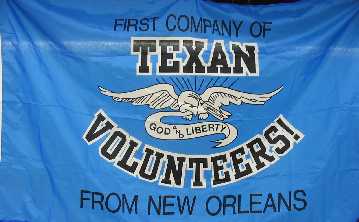
The New Orleans Greys: This one takes me back to my “Living History” period many years ago. The New Orleans Greys were two companies of volunteer militia from the United States (though it included members from Europe as well) which came to Texas in 1835 to aid in the War for Independence. They were ultimately wiped out almost to a man at the Alamo and the Goliad Massacre. This flag was presented to the first company by the ladies of Nacogdoches, Texas and flew at the Alamo where it was captured by Santa Anna and sent back to Mexico as a war trophy. Back when “W” was governor he tried to get it back, offering to exchange it for one of the Mexican flags captured at the battle of San Jacinto but Mexico said “no”. This has led some to think that the Mexicans either lost it or allowed it to deteriorate completely.
The Spanish Empire: This was the ensign of the Kingdom of Spain from 1785 to 1931 but, around here at any rate, is known as the Spanish imperial flag and can be seen in the more accurate displays of the Six Flags of Texas to cover the centuries during which Texas was part of the colonial empire of Spain. I bought it because of that, the Kingdom of Spain being the one monarchy Texas was longest associated with and though it does not see the light of day very often I do fly it occasionally on days significant to the Kingdom of Spain or just to cause annoyance on the sixteenth of September. What can I say? I’m a pain.
The Cross of Burgundy: I own this flag for much the same reason as that above. It was widely flown in the Spanish colonial period, though the only place I have ever seen one still flying today was at Mission San Jose near San Antonio. It is pretty rare and I was surprised to find one at my usual flag store and had to grab it immediately. I have never actually flow it though because it is significantly smaller than the rest and would not fit my flag pole. However, I like the flag, I like what it represented and it was also commonly used by the Carlists and the (historic) Carlist cause is one I have great sympathy for. Let us not, however, get into the debate again over those still using the name today.
The Cross of St George: This one I did not buy but was given to me as a gift by an Englishman. In fact, the first time I met this friend of mine ‘in the flesh’ he had this flag wrapped around him so he was certainly hard to miss. I like the English flag, I do not like the rather negative reputation many have attached to it today. It is also a part (one of many) of my ancestry and having had ancestors who fought for the King in the English Civil War it seems only appropriate to have an English flag. Alas, if it has ever been flown it was only briefly (I can’t really remember) as it was one of those not made for outdoor use but more for hanging on a wall inside.
The Dominion of Canada: As I have said before, I do prefer the old Canadian Red Ensign but I have nothing against the current design. I purchased this flag during my first visit to Canada (indeed the first time I had ever visited an existing monarchy) which was close to Dominion Day (aka Canada Day) and so a lot of Canadian paraphernalia was to be found in the stores. I also flew it the first time the friends I was there to visit came down to Texas. However, I don’t think it was made for extended outdoor use and in any event, given the odd shape of the Canadian flag compared to most, was not a perfect fit for my pole. It could be done but was bubbled a little in the center so was not exactly at its best. I do have some family in Canada as well, I’ve never met them and they live on an Indian reservation but -there’s that anyway.
The German Empire: I don’t recall what prompted me to buy this flag but it was a disappointment in any event. We will blame it on the German percentage of my ancestry and if I am going to have a German flag it was going to be the German Empire and not the republic and if it is going to be an Imperial German flag it was going to be the ensign as I just think it is much more attractive than the civilian flag. Anyway, when it actually arrived it was, again, a great disappointment. It was one of those printed versions and something must have been askew in the printing process as the colored portions in the central arms were almost all missing, so there is a cross but no orb, a tongue but no beak and so on. It just looks terrible. I did fly it once but it was not made for outdoor use. It also has some blood stains on it as I had it in my truck when I was in a bad accident and nearly broke my neck.
The Kingdom of Italy: This is my latest addition, which I bought this year to mark the anniversary of Italian unification. If I am going to fly the flag of Italy it is going to be the flag of the Kingdom of Italy and not the current dysfunctional republic, whose blank tricolor is just boring anyway. It was not made for extended outdoor display, which is probably just as well as down here it would probably just confuse people who would think it was some sort of version of the Mexican flag. Also, as with just about every Italian flag made outside of Italy the shade of green used is not quite correct. But, it serves its purpose and I like a flag with a crown on it in any event.
The Holy See: I do not remember the exact occasion I first bought this flag for but I do remember I had a hard time finding it at the flag store. I looked under “V” for “Vatican City”, then I looked under “P” for “Papal flag” and finally even looked under “C” for “Catholic Church” only to still find nothing. Finally I asked the clerk and it was quickly located, of course, under “H” for “Holy See”. Anyway, as the symbol of the tiny State of Vatican City it is the flag of the last Christian absolute monarchy in the world so significant for that at the very least. I do not often display it but it has been flown on Vatican “independence day” (the day the Lateran Treaty became official) and possibly some other days of papal significance.
The Principality of Monaco: Ever since buying my first Monegasque flag (whenever that was) I have always wondered if they didn’t lie to me and sell me an Indonesian flag instead. I may never know. The red and white come from the coat of arms of the House of Grimaldi which dates back nearly to time immemorial but the national flag was officially adopted by HSH Prince Charles III on April 4, 1881. Since I was knee-high to a duck the Monegasque monarchy was always most prominent in our home, no doubt because of the influence of the late, beloved Princess Grace, who caused a craze for monarchy and Monaco in particular across the United States. Ever since then, in our house at least, the Princely Family, being half-American, was seen as partly our own and it is from that, I suppose, that my fascination with the very long history of Monaco and the Grimaldi dynasty grew. I fly it on every significant Monaco-related occasion, be it National Day or any date significant to the Princely Family.
The Kingdom of France: Finally we come to the French. This flag I have had for quite a while and is probably the most common French flag one will see in my part of the world. I bought this flag both for my admiration for the ancien regime and because it is one of the Six Flags of Texas, during that brief period when we were claimed by King Louis XIV. That claim was made by La Salle with whom there is some local connection and while the blue flag with the three lilies is also often seen, it is the white flag that I have always preferred. I make it a point to fly this flag at least once a year, naturally on Bastille Day.
There are a few others on my 'list' to get that I just havn't gotten around to picking up yet, but I'm sure I've gone on long enough now on a subject of interest to very few if any. Moving on then...
The Grand Union Flag: This is the only American flag that I own and I fly it on those occasions in which I feel compelled to. There are a few misconceptions about this one. It was never an official flag of the United States as it was only used prior to the declaration of independence. However, it was the first flag to represent the thirteen colonies as a whole or the ‘American nation’ when they were still fighting simply for a redress of grievances while remaining within the British Empire. It was also the first American flag to ever fly over foreign soil in the brief capture of Nassau, Bahamas.
The Republic of Texas: This is the one that sees the most service and is the one that can usually be seen flying over my home. It is the flag of my country as I am one of those stubborn few who still adheres to the old idea of state sovereignty. So long as Texas adheres to the Union, I adhere but that is as far as it goes. It has been the official flag of Texas since December 10, 1836 though the basic symbol of the “Lone Star” is much older. Obviously not a monarchist flag, but nonetheless the symbol of my home and native land. As we say, “I’m Texas born, Texas bred and when I die; I’ll be Texas dead!” I’m also one of the few, even among Texans, who can sing the first two verses of the Texas national anthem, “Texas, Our Texas”.
The De Zavala Flag: Reading about this one always makes me laugh because someone will inevitably declare that this flag is a "myth"! Does that mean the one I own does not really exist? Silly. Of course it is no myth, it exists -I can hold it in my boney, nicotine-stained fingers. Whether or not it is an accurate depiction of the design suggested by Vice President Lorenzo De Zavala in 1836 I don't know, but it certainly exists and did at the time as well as the basic design, a blue field with a lone star, was quite common as were various words or mottos displayed on flags, the most common being "Texas" or "Independence". In any event, the historical facts regarding it are of little importance to me, I just think it is a nice design and it does quite well to convey my feelings to those passing by concerning the subject of Texas and our relationship with the Union.
The Confederate States of America: Here is one always sure to cause controversy. Some love it, some hate it and some hate anyone who would even display it. Well, for those, you’ll have to take a number and get in line, there will be quite a long wait. I also have the more familiar ensign but I prefer to fly this one, the third and last national flag of the Confederacy. I own it out of principle, my country voluntarily adhered to the Confederacy and was involuntarily forced back into the Union, which rather annoys me. It is not, I assure you, intended to show any support for racism or slavery. In fact, the nearest county to mine that existed at the time of the war voted unanimously in favor of secession and it had not a single ‘White’ resident at the time. I usually fly it on occasions when I am especially annoyed with the federal government in Washington. Tax day immediately comes to mind.
The New Orleans Greys: This one takes me back to my “Living History” period many years ago. The New Orleans Greys were two companies of volunteer militia from the United States (though it included members from Europe as well) which came to Texas in 1835 to aid in the War for Independence. They were ultimately wiped out almost to a man at the Alamo and the Goliad Massacre. This flag was presented to the first company by the ladies of Nacogdoches, Texas and flew at the Alamo where it was captured by Santa Anna and sent back to Mexico as a war trophy. Back when “W” was governor he tried to get it back, offering to exchange it for one of the Mexican flags captured at the battle of San Jacinto but Mexico said “no”. This has led some to think that the Mexicans either lost it or allowed it to deteriorate completely.
The Spanish Empire: This was the ensign of the Kingdom of Spain from 1785 to 1931 but, around here at any rate, is known as the Spanish imperial flag and can be seen in the more accurate displays of the Six Flags of Texas to cover the centuries during which Texas was part of the colonial empire of Spain. I bought it because of that, the Kingdom of Spain being the one monarchy Texas was longest associated with and though it does not see the light of day very often I do fly it occasionally on days significant to the Kingdom of Spain or just to cause annoyance on the sixteenth of September. What can I say? I’m a pain.
The Cross of Burgundy: I own this flag for much the same reason as that above. It was widely flown in the Spanish colonial period, though the only place I have ever seen one still flying today was at Mission San Jose near San Antonio. It is pretty rare and I was surprised to find one at my usual flag store and had to grab it immediately. I have never actually flow it though because it is significantly smaller than the rest and would not fit my flag pole. However, I like the flag, I like what it represented and it was also commonly used by the Carlists and the (historic) Carlist cause is one I have great sympathy for. Let us not, however, get into the debate again over those still using the name today.
The Cross of St George: This one I did not buy but was given to me as a gift by an Englishman. In fact, the first time I met this friend of mine ‘in the flesh’ he had this flag wrapped around him so he was certainly hard to miss. I like the English flag, I do not like the rather negative reputation many have attached to it today. It is also a part (one of many) of my ancestry and having had ancestors who fought for the King in the English Civil War it seems only appropriate to have an English flag. Alas, if it has ever been flown it was only briefly (I can’t really remember) as it was one of those not made for outdoor use but more for hanging on a wall inside.
The Dominion of Canada: As I have said before, I do prefer the old Canadian Red Ensign but I have nothing against the current design. I purchased this flag during my first visit to Canada (indeed the first time I had ever visited an existing monarchy) which was close to Dominion Day (aka Canada Day) and so a lot of Canadian paraphernalia was to be found in the stores. I also flew it the first time the friends I was there to visit came down to Texas. However, I don’t think it was made for extended outdoor use and in any event, given the odd shape of the Canadian flag compared to most, was not a perfect fit for my pole. It could be done but was bubbled a little in the center so was not exactly at its best. I do have some family in Canada as well, I’ve never met them and they live on an Indian reservation but -there’s that anyway.
The German Empire: I don’t recall what prompted me to buy this flag but it was a disappointment in any event. We will blame it on the German percentage of my ancestry and if I am going to have a German flag it was going to be the German Empire and not the republic and if it is going to be an Imperial German flag it was going to be the ensign as I just think it is much more attractive than the civilian flag. Anyway, when it actually arrived it was, again, a great disappointment. It was one of those printed versions and something must have been askew in the printing process as the colored portions in the central arms were almost all missing, so there is a cross but no orb, a tongue but no beak and so on. It just looks terrible. I did fly it once but it was not made for outdoor use. It also has some blood stains on it as I had it in my truck when I was in a bad accident and nearly broke my neck.
The Kingdom of Italy: This is my latest addition, which I bought this year to mark the anniversary of Italian unification. If I am going to fly the flag of Italy it is going to be the flag of the Kingdom of Italy and not the current dysfunctional republic, whose blank tricolor is just boring anyway. It was not made for extended outdoor display, which is probably just as well as down here it would probably just confuse people who would think it was some sort of version of the Mexican flag. Also, as with just about every Italian flag made outside of Italy the shade of green used is not quite correct. But, it serves its purpose and I like a flag with a crown on it in any event.
The Holy See: I do not remember the exact occasion I first bought this flag for but I do remember I had a hard time finding it at the flag store. I looked under “V” for “Vatican City”, then I looked under “P” for “Papal flag” and finally even looked under “C” for “Catholic Church” only to still find nothing. Finally I asked the clerk and it was quickly located, of course, under “H” for “Holy See”. Anyway, as the symbol of the tiny State of Vatican City it is the flag of the last Christian absolute monarchy in the world so significant for that at the very least. I do not often display it but it has been flown on Vatican “independence day” (the day the Lateran Treaty became official) and possibly some other days of papal significance.
The Principality of Monaco: Ever since buying my first Monegasque flag (whenever that was) I have always wondered if they didn’t lie to me and sell me an Indonesian flag instead. I may never know. The red and white come from the coat of arms of the House of Grimaldi which dates back nearly to time immemorial but the national flag was officially adopted by HSH Prince Charles III on April 4, 1881. Since I was knee-high to a duck the Monegasque monarchy was always most prominent in our home, no doubt because of the influence of the late, beloved Princess Grace, who caused a craze for monarchy and Monaco in particular across the United States. Ever since then, in our house at least, the Princely Family, being half-American, was seen as partly our own and it is from that, I suppose, that my fascination with the very long history of Monaco and the Grimaldi dynasty grew. I fly it on every significant Monaco-related occasion, be it National Day or any date significant to the Princely Family.
The Kingdom of France: Finally we come to the French. This flag I have had for quite a while and is probably the most common French flag one will see in my part of the world. I bought this flag both for my admiration for the ancien regime and because it is one of the Six Flags of Texas, during that brief period when we were claimed by King Louis XIV. That claim was made by La Salle with whom there is some local connection and while the blue flag with the three lilies is also often seen, it is the white flag that I have always preferred. I make it a point to fly this flag at least once a year, naturally on Bastille Day.
There are a few others on my 'list' to get that I just havn't gotten around to picking up yet, but I'm sure I've gone on long enough now on a subject of interest to very few if any. Moving on then...
Friday, August 26, 2011
Monarch Profile: King Ludwig III of Bavaria
The last King of Bavaria was born Ludwig Luitpold Josef Maria Aloys Alfried on January 7, 1845 in Munich the firstborn son of the long-serving Prince Regent Luitpold and Archduchess Augusta of Austria. He came from pretty solid roots as the regency of his father was known for being conservative, traditional and opposed to the “culture war” that Bismarck waged against the Catholic Church but all of that was still to come. His mother was the daughter of Grand Duke Leopold II of Tuscany (link to profile), came from Florence and always spoke to her children in Italian. As a boy Ludwig loved the outdoors and in 1861, when he was sixteen, he was commissioned a lieutenant in the 6th Jägerbattalion by his uncle King Maximilian II, the start of what would be a long military career. The following year he started attending classes at Ludwig Maximilians University in Munich to study law and economics, fine fields for a future monarch, but he would have preferred agriculture. That same year, upon turning eighteen, he was appointed to the Senate in the Bavarian Legislature as was custom for all princes to gain some practical experience in government.
In 1866 Prince Leopold served in the Seven Weeks War between Prussia and her allies and Austria and her allies, which included Bavaria. By then a First Lieutenant he was shot in the thigh at the battle of Helmstedt and for his service in the conflict was awarded the Knight’s Cross 1st Class of the Bavarian Military Merit Order. However, Austria was defeated and by the conflict was displaced by Prussia as the dominant German-speaking country. The following year, while in Vienna for the funeral of one of his cousins Ludwig met Archduchess Maria Theresia of Austria-Este, a step-cousin of his and a beauty at eighteen years old. On February 20 the following year the two were married in Vienna. It was a real coup for Ludwig who obtained a good wife and vast estates in Bohemia and Hungary. This allowed him to further his interest in farming and agriculture and brought in sufficient funds for him to purchase and build his model estate in Bavaria which was very successful. His wife also had quite an illustrious lineage of her own and in time was recognized as heiress to the British throne by the handful of Jacobites still lingering around (the Jacobite succession having passed from the House of Stuart, to the House of Savoy and then to the House of Modena and Austria-Este). She would also give Ludwig thirteen children, doing more than her duty to secure the succession.
Ludwig and Maria Theresa were a happy couple, very devoted to each other and their children and Ludwig would have liked nothing better than to have spent all of his time with his family and dabbling in his favorite pastimes such as farming, livestock and harnessing water power for energy production. However, royal duty came first and often interfered with his pastoral interests. In 1870 the Franco-Prussian War broke out and the Prince-Regent led the Bavarian forces in alliance with the Prussians and afterwards joined in the formation of the German Empire under Prussian leadership in 1871. In 1912 his father died and Ludwig succeeded him as Prince-Regent still ruling on behalf of the nominal King Otto who had been supposedly suffering from insanity and kept locked away since 1875. Because the regency has been a fact of life for so long there were soon calls to made Ludwig the King of Bavaria. This made sense to everyone and when the legislature reconvened in 1913 a new law was passed which made the regent King Ludwig III of Bavaria, though Otto continued to be titled King and treated as such for his few remaining years as well, meaning that from 1913-1916 there were actually two Kings of Bavaria.
King Ludwig III was very close to his people, quite concerned with their welfare and always looking for ways to improve his kingdom. However, he was not without his critics. The Prussians tended to view the Bavarians as difficult and somewhat pretentious for so minor a power, no matter how cooperative they were, but there were also some in Bavaria who criticized King Ludwig, as they had his father before him, for being too subservient to the Prussians. This was, however, quite unfair. Just as the Prince-Regent Luitpold has clashed with Bismarck over his anti-Catholic policies, so too did King Ludwig III take great care to preserve the unique culture of Bavaria, especially her Catholic character, and to limit Prussian influence. He saw Bavaria as the southern counter-weight to Prussia and was always concerned with Prussia becoming too powerful at the expense of his own kingdom within the German Empire. This was seen particularly after the outbreak of World War I only a year after Ludwig III became King.
Some accounts like to portray Ludwig III and to an extent Bavaria as a whole as unwilling participants in what was a Prussian conflict. This, however, is not entirely true. As with most countries the German public as a whole was very enthusiastic about the war and anxious for a final showdown with the nations which had, they felt, denied them their “place in the sun”. Where King Ludwig III was concerned was in preventing Prussia from becoming inordinately powerful as a result of the conflict. Again, as he viewed Bavaria as the only major counter-weight to Prussian dominance within the German Empire, Ludwig III felt it essential that Bavaria have her own share of the spoils. These included, most famously, a plan for the Bavarian annexation of Alsace (Alsace-Lorraine having previously been imperial lands not associated with any particular member state) and the Belgian city of Antwerp to provide Bavaria with an outlet on the North Sea as the King had long been interested in maritime developments.
Yet, despite these actions, as the war situation worsened for Germany, the King was again accused by many opposed to the monarchy of being a puppet for the Prussians, which was certainly untrue. However, the losses Bavaria incurred were major given her status as the second most powerful state within the German Empire. At the outset of the war Bavaria contributed three Army Corps, the largest contingent after Prussia among the German states and Munich was headquarters to a separate Bavarian General Staff, War Ministry and her Army Corps were almost totally autonomous with their own commanders, their own uniforms and military establishment. In 1917 Georg von Hertling of the Catholic Center Party (the dominant power in Bavaria) left his post of Prime Minister in Munich which he had held since 1912 when appointed by the King’s father to become Imperial Chancellor in Berlin. However, the government remained dominated by Field Marshal Hindenburg and General Ludendorff and the course Germany was on remained unchanged.
Separatist attitudes increased along with opposition to the war and Bavaria was especially hard hit by the infiltration of Marxist and other left-wing revolutionaries. At the very end in 1918 there was even an effort by Bavaria to come to a separate peace with the Allies but this failed. Revolution broke out in the streets and King Ludwig III was forced to leave Munich with his family in fear of their lives. The revolutionaries declared the King deposed (the first German monarch to suffer such an indignity) and seeing no other option Ludwig III released all soldiers and government officials from their oath of loyalty. He did not, however, abdicate even though the republican leaders announced as much to the crowds. However, legal formalities aside, the monarchy had fallen and Ludwig III was forced to leave the country, moving from Hungary to Liechtenstein to Switzerland. However, in time, after more conservative forces put down the Marxists and restored order, the Royal Family was able to return in 1920 and they continued to enjoy a sizeable minority of monarchist support. There remained for quite some time a cautious optimism that a restoration would be possible but only the following year, while visiting Hungary, King Ludwig III died on October 18, 1921. Because there continued to be such a strong monarchist presence in Bavaria the republican government gave him a state funeral. He never abdicated and his son, Crown Prince Rupprecht, who succeeded to his rights likewise refused to accept the republic until the people of Bavaria were given the choice in a free referendum to decide between a republic or a monarchy. To date, such a vote has never been held.
In 1866 Prince Leopold served in the Seven Weeks War between Prussia and her allies and Austria and her allies, which included Bavaria. By then a First Lieutenant he was shot in the thigh at the battle of Helmstedt and for his service in the conflict was awarded the Knight’s Cross 1st Class of the Bavarian Military Merit Order. However, Austria was defeated and by the conflict was displaced by Prussia as the dominant German-speaking country. The following year, while in Vienna for the funeral of one of his cousins Ludwig met Archduchess Maria Theresia of Austria-Este, a step-cousin of his and a beauty at eighteen years old. On February 20 the following year the two were married in Vienna. It was a real coup for Ludwig who obtained a good wife and vast estates in Bohemia and Hungary. This allowed him to further his interest in farming and agriculture and brought in sufficient funds for him to purchase and build his model estate in Bavaria which was very successful. His wife also had quite an illustrious lineage of her own and in time was recognized as heiress to the British throne by the handful of Jacobites still lingering around (the Jacobite succession having passed from the House of Stuart, to the House of Savoy and then to the House of Modena and Austria-Este). She would also give Ludwig thirteen children, doing more than her duty to secure the succession.
Ludwig and Maria Theresa were a happy couple, very devoted to each other and their children and Ludwig would have liked nothing better than to have spent all of his time with his family and dabbling in his favorite pastimes such as farming, livestock and harnessing water power for energy production. However, royal duty came first and often interfered with his pastoral interests. In 1870 the Franco-Prussian War broke out and the Prince-Regent led the Bavarian forces in alliance with the Prussians and afterwards joined in the formation of the German Empire under Prussian leadership in 1871. In 1912 his father died and Ludwig succeeded him as Prince-Regent still ruling on behalf of the nominal King Otto who had been supposedly suffering from insanity and kept locked away since 1875. Because the regency has been a fact of life for so long there were soon calls to made Ludwig the King of Bavaria. This made sense to everyone and when the legislature reconvened in 1913 a new law was passed which made the regent King Ludwig III of Bavaria, though Otto continued to be titled King and treated as such for his few remaining years as well, meaning that from 1913-1916 there were actually two Kings of Bavaria.
King Ludwig III was very close to his people, quite concerned with their welfare and always looking for ways to improve his kingdom. However, he was not without his critics. The Prussians tended to view the Bavarians as difficult and somewhat pretentious for so minor a power, no matter how cooperative they were, but there were also some in Bavaria who criticized King Ludwig, as they had his father before him, for being too subservient to the Prussians. This was, however, quite unfair. Just as the Prince-Regent Luitpold has clashed with Bismarck over his anti-Catholic policies, so too did King Ludwig III take great care to preserve the unique culture of Bavaria, especially her Catholic character, and to limit Prussian influence. He saw Bavaria as the southern counter-weight to Prussia and was always concerned with Prussia becoming too powerful at the expense of his own kingdom within the German Empire. This was seen particularly after the outbreak of World War I only a year after Ludwig III became King.
Some accounts like to portray Ludwig III and to an extent Bavaria as a whole as unwilling participants in what was a Prussian conflict. This, however, is not entirely true. As with most countries the German public as a whole was very enthusiastic about the war and anxious for a final showdown with the nations which had, they felt, denied them their “place in the sun”. Where King Ludwig III was concerned was in preventing Prussia from becoming inordinately powerful as a result of the conflict. Again, as he viewed Bavaria as the only major counter-weight to Prussian dominance within the German Empire, Ludwig III felt it essential that Bavaria have her own share of the spoils. These included, most famously, a plan for the Bavarian annexation of Alsace (Alsace-Lorraine having previously been imperial lands not associated with any particular member state) and the Belgian city of Antwerp to provide Bavaria with an outlet on the North Sea as the King had long been interested in maritime developments.
Yet, despite these actions, as the war situation worsened for Germany, the King was again accused by many opposed to the monarchy of being a puppet for the Prussians, which was certainly untrue. However, the losses Bavaria incurred were major given her status as the second most powerful state within the German Empire. At the outset of the war Bavaria contributed three Army Corps, the largest contingent after Prussia among the German states and Munich was headquarters to a separate Bavarian General Staff, War Ministry and her Army Corps were almost totally autonomous with their own commanders, their own uniforms and military establishment. In 1917 Georg von Hertling of the Catholic Center Party (the dominant power in Bavaria) left his post of Prime Minister in Munich which he had held since 1912 when appointed by the King’s father to become Imperial Chancellor in Berlin. However, the government remained dominated by Field Marshal Hindenburg and General Ludendorff and the course Germany was on remained unchanged.
Separatist attitudes increased along with opposition to the war and Bavaria was especially hard hit by the infiltration of Marxist and other left-wing revolutionaries. At the very end in 1918 there was even an effort by Bavaria to come to a separate peace with the Allies but this failed. Revolution broke out in the streets and King Ludwig III was forced to leave Munich with his family in fear of their lives. The revolutionaries declared the King deposed (the first German monarch to suffer such an indignity) and seeing no other option Ludwig III released all soldiers and government officials from their oath of loyalty. He did not, however, abdicate even though the republican leaders announced as much to the crowds. However, legal formalities aside, the monarchy had fallen and Ludwig III was forced to leave the country, moving from Hungary to Liechtenstein to Switzerland. However, in time, after more conservative forces put down the Marxists and restored order, the Royal Family was able to return in 1920 and they continued to enjoy a sizeable minority of monarchist support. There remained for quite some time a cautious optimism that a restoration would be possible but only the following year, while visiting Hungary, King Ludwig III died on October 18, 1921. Because there continued to be such a strong monarchist presence in Bavaria the republican government gave him a state funeral. He never abdicated and his son, Crown Prince Rupprecht, who succeeded to his rights likewise refused to accept the republic until the people of Bavaria were given the choice in a free referendum to decide between a republic or a monarchy. To date, such a vote has never been held.
Subscribe to:
Posts (Atom)