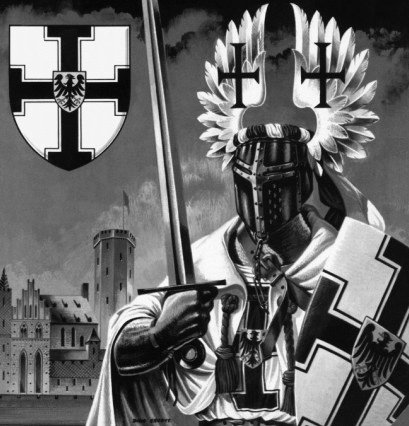
Outside of Europe in particular, it is often not realized the extent to which the crusades and the military religious orders that fought in them were largely national affairs. This may be partly because many people ignore the crusades that were not aimed at retaking the Holy Land as those were probably the most ‘inter-national’ of the crusades, yet, still more than I think most people realize, largely French. The Knights Templar, which is most famous for fighting in the crusades in the Holy Land, had a multinational membership but were, likewise, predominately French. The crusade to retake the Iberian Peninsula from the Muslims was, on the other hand, an almost entirely Spanish and Portuguese affair. The military religious orders that sprang up to fight in that crusade, the longest war in history, were likewise Spanish. Perhaps the least talked about is the largely German-driven crusade against the pagans of northeastern Europe on the shores of the Baltic Sea. Those who do know about this arduous and bitterly fought struggle will likely recall the Order of the Teutonic Knights (ancestor of the later Kingdom of Prussia and originator of the oldest families of the Prussian nobility, more about them here) but less well known was another German military religious order known the Livonian Brethren of the Sword. They should not be forgotten.
Unlike their fellow Germans of the Teutonic Knights, the Livonian Brethren of the Sword were not founded in the Holy Land but right on the spot in Livonia, specifically in Riga, the capital city of what is now Latvia. The order was founded by the Bishop of Riga, also known as the Prince-Bishop of Livonia, in 1202 and gained official recognition from Pope Innocent III in 1204. Their initial aim was to convert and or conquer the pagan tribes of the region and defend the Christian community from their attacks. The groups most often engaged by the Brethren of the Sword were the Latgalians, Selonians and Livonians in the area around Riga and more broadly the coastal region of what is today Estonia, Latvia and Lithuania, a region referred to at the time as Courland. As such, the order was known by several different variants of their official name. Their official name in Latin was Fratres Militiae Christi Livoniae but they were also known the Sword Brethren, The Militia of Christ of Livonia, the Livonian Brothers of the Sword, the Courland Brethren of the Sword, Christ Knights or the Order of the Porte-Glaive Knights (“Glaive” in this case likely referring back to the French for gladius or sword). Their symbol was a cross pattée over a sword, pointing down.
The knights were based at Fellin, which is today Viljandi in Estonia and they established other castles in the surrounding area with the commanders of these castles acting as the entourage of the Grand Master of the Sword Brethren. Officially, they were subject to the Catholic bishops, beginning with their founder Bishop Albert of Riga, however the Sword Brethren were an extremely hard fighting and strong-willed group of warriors so it soon became the case that their submission to the bishops was rather nominal as they often acted on their own. In the course of the Livonian Crusade, they quickly gained quite a reputation for ferocity and reckless courage as well as being rather unruly and difficult to control. They would also, at times, make agreements with neighboring monarchies as the situation dictated such as in 1218 when Bishop Albert called on King Valdemar II of Denmark for assistance, though in the end this amounted to little more than the Danes conquering northern Estonia for themselves. In 1232 Pope Gregory IX called on the Sword Brethren to aid in the defense of Finland from attacks by the Republic of Novgorod though no accounts of their activities on this front have survived. Ultimately this would result in a Swedish-led crusade that would see Finland united with the Kingdom of Sweden for the first time.
Over time, the many hard fought battles of the Sword Brethren saw threats from the east decreased and their focus moved toward the south and the Lithuanians and Semigallians (aka the Samogitians). This resulted in what was, in many ways, the Waterloo of the Sword Brethren with the Battle of Saule on September 22, 1236. Grand Master Volkwin led between 50 to 60 knights along with other troops amounting to 3,000 men against 5,000 pagan Samogitians led by their Duke Vykintas. The Christian forces were defeated and lost almost their entire army, some estimates putting losses at 2,700. Grand Master Volkwin died in battle and the Sword Brethren were wiped out as an effective, independent fighting force. Likewise, in the aftermath, other groups, previously conquered by the Brethren, saw their chance and rose up in rebellion. Latvia and Lithuania still mark the anniversary of this battle as a national holiday, not long ago jointly declaring it the ‘Day of Baltic Unity’.
This was, practically speaking, the end of the Livonian Brethren of the Sword. They would never be an independent military religious order again. However, those who survived the ordeal carried on, faithful to their vows, and were absorbed into the Teutonic Knights, retaining their traditions and leaders. As a branch of the Teutonic Knights they were known as the Livonian Order and still had their own Master though he was subject to the Teutonic Grand Master. Thirty years of fighting by the Sword Brethren had been brought to ruin by their defeat at Saule, however, as the autonomous Livonian Order within the Teutonic Knights, they reconquered Courland, Livonia and Semigallia, eventually buying the Duchy of Estonia from King Valdemar IV of Denmark after a devastating loss north of Riga at the hands of the Lithuanians, including, again, the death of their Master Bruno in 1298. As a result, two groups emerged and, due to their autonomy, they survived the secularization of the Teutonic Knights by Albert of Brandenburg fallowing his adoption of Lutheranism in 1525.
The Livonian Order was pushed farther back towards Estonia, where their comrades were based, and in 1453 joined together in the Livonian Confederation. This gave the Catholic remnant in the region some measure of unity and hope for self-defense but their enemies were many and increasing. The pagans may have been gone but Lutherans to the south and the Russian Orthodox to the east were constant threats. In 1560 they were again almost wiped out by a massive attack by Muscovite Russia, yet some still remained and, determined as ever, they still tried to carry on, seeking out and ultimately obtaining the patronage of Sigismund II Augustus, King of Poland and Grand Duke of Lithuania. However, not long after, the Livonian Order went the way of the Teutonic Knights when their Master, Gotthard Kettler, converted to Lutheranism and thereafter secularized the order. That proved the final end of the last remnants of what had once been the Brethren of the Sword. The lands they retained were quickly taken over by neighboring states and the order ceased to exist.
Showing posts with label crusades. Show all posts
Monday, April 3, 2017
Friday, August 16, 2013
The Teutonic Knights
When one thinks of the old-fashioned image of a knight, one probably first thinks of the Knights Templar or other Crusaders fighting in the bleak lands of the Middle East, most of them being southern Europeans and, early on, even more specifically, predominately French. However, one of the three most famous crusading orders of knighthood had a very pronounced German flavor to it and that was the Teutonic Knights. Rather than fighting bandits and Muslim warriors in the burning sands of the Levant, the Teutonic Knights fought pagan barbarian tribes in the snow, ice and dark forests of the Baltic coast. Still, like the Knights Templar and the Knights of Malta, the origins of the Teutonic Knights can be traced back to the Holy Land as well. The Order of the Teutonic Knights of St Mary’s Hospital in Jerusalem was first formed to protect pilgrims and care for the sick and rose to prominence in Acre protecting the ports there in that last bastion of Christendom in the Middle East. It was recognized by Pope Celestine III in 1192 as an order of hospice monks using the Augustinian Rule and in 1198 it became a military order under the authority of a Grand Master.
Under the Grand Master Hermann von Salza the Teutonic Knights became more prominent as the Holy Roman Emperor (and sometime excommunicate) Frederick II, the “Wonder of the World” made the Grand Master a Prince of the Empire and when Emperor Frederick II came to the Church of the Holy Sepulchre to be crowned King of Jerusalem it was the Teutonic Knights that served as his escort. However, as the Middle East was completely conquered by Muslim forces the Teutonic Knights were forced to relocate, which they did to what might seem an unlikely place; Transylvania. In 1211 King Andrew II of Hungary employed the Teutonic Knights to defend Burzenland from the Cumens, a powerful warrior nation of nomads from the steppes of what is now southern Russia. This they did, bringing numerous German colonists with them, and they stayed until 1225 when their growing power combined with an effort to place themselves under the direct authority of Pope Honorius III caused the King of Hungary to expel them.
The Teutonic Knights wore a white garment with a black cross as their uniform and the black and white colors of the knights and their style of cross would become a long-established symbol in the history of the German and particularly the north German people and it all goes back to the Teutonic Knights. The black and white colors of Prussia, the decoration of the Iron Cross and even the symbol of the Federal German military today can all be traced back to the Teutonic Knights. In 1226 Duke Konrad I of Masovia, in what is now Poland, called upon the knights to defend his land from the pagan Prussians in the Baltic. So, for the next fifty years the Teutonic Knights fought fiercely but successfully in what became known as the conquest of Prussia. It was a long, bitter war that is not very well remembered today but one which was marked by extreme heroism on the part of the Teutonic Knights who fought usually against immense odds, facing the most horrific consequences if they were taken alive. History records knights captured by the pagans being roasted alive in their armor and offered as sacrifices to their pagan gods. They fought in bitter cold and in dark, dense forests and like most knights they built strong castles on this frontier of Christendom that were often islands of safety in a sea of pagan hostility.
Over time, however, the pagan tribes were defeated and the local nobles began to be converted to Christianity. This became the core of what would become the Prussian nobility. The Holy Roman Empire, in agreement with the Pope, eventually bestowed upon the Teutonic Knights political control over the area as a sovereign monastic state under the nominal authority of the Pope. Slowly but steadily these pagans who had practiced everything from polygamy to cannibalism were converted and civilized. Clinging to the Teutonic Knights for protection it was only natural that they grew to become something of a warrior race yet again but from then on of a Christian variety. More than defeating the pagan tribes outright in a climactic clash, these people were gradually assimilated into Christendom under the leadership of the Teutonic Knights. This was also aided by the colonization of the lands of the order by German, Belgian, Dutch and Scandinavian Christians.
Livonia (Estonia) and Lithuania were absorbed into the Teutonic Order as well as were parts of Poland that had not yet become Christian. The expansion into Lithuania, however, came only after a significant setback. Previously, the plan had been to convert/conquer the Russians. However, the Teutonic Knights suffered what was probably their most famous defeat at the “Battle of the Ice” in 1242 at the hands of Prince Alexander Nevsky of Novgorod (today recognized as a saint himself in the Russian Orthodox Church). So, after having their fingers burned by the Russians, the Teutonic Knights turned to Lithuania in a bitter war that lasted for most of two hundred years. Resentment can still be seen today, yet the sizeable minority of Baltic Germans in these countries can be traced back to these original campaigns of the Teutonic Knights. When their focus fell on Poland the Teutonic Knights captured Danzig, driving out the invading Brandenburgers in the process. There were plenty of sad events of great cruelty but few people consider these events in the context of a group of hardened warriors who had spent their lives fighting the most ferocious enemies Christendom had ever faced, peoples far more savage and barbaric than the worst of the Muslim enemies other knights had battled in the Holy Land.
In about the Fourteenth Century the Teutonic Knights reached their peak of power and influence with vast lands stretching across what is today northern Germany and Poland, Lithuania, Estonia and even parts of Sweden. However, the reason for their existence as a religious military order was rather undercut by the first union between Poland and Lithuania at the start of the rise to prominence of the Polish Jagiello dynasty. With that Lithuania became as firmly Christian as Poland and the Teutonic Knights were left with little to do. When the Poles and Lithuanians joined in attacking the order the Teutonic Knights suffered a terrible reverse (the battle of Tannenburg). Their capitol of Marienburg was besieged but successfully defended, nonetheless, the war was a devastating blow to the power and prestige of the order. Later, after the Protestant revolt, the Grand Master Albert of Brandenburg converted to Lutheranism in 1525 and he secularized the Order at which time his uncle, King Sigismund I of Poland, gave him control of the territory of the Teutonic Knights as the Duke of Prussia. This, of course, later became the Kingdom of Prussia which never lost the warrior tradition it had inherited from the Teutonic Order.
The Order of Teutonic Knights continued, of course, but it was never quite the same again. Over time, more and more lands were taken by other local rulers until the order was somewhat reorganized in 1531 under the Holy Roman Emperor Charles V after which a new headquarters was established in Wurttemberg. Protestants gained control of more and more of the lands of the Teutonic Order to the point that it existed almost in name only until it was finally abolished in 1809 by Napoleon Bonaparte who confiscated whatever was left. Some Teutonic Knights remained of course, mostly in Austria and the House of Hapsburg took control of the nominal leadership of the order and it continues to this day but only as a purely religious order with nothing other than the faith of the Catholic Church to connect it to those original warrior-monks who had fought off the pagan tribes of northern Europe on the frontier of Christendom. Nonetheless, they left a lasting legacy of which traces remain to this day in both the Christian presence that remains in the region of the old lands of the Order and in the symbols, colors and warrior traditions of many of the German people, growing out of the Kingdom of Prussia, prior to which was the Duchy of Prussia, prior to which had been the Order of the Teutonic Knights.
Under the Grand Master Hermann von Salza the Teutonic Knights became more prominent as the Holy Roman Emperor (and sometime excommunicate) Frederick II, the “Wonder of the World” made the Grand Master a Prince of the Empire and when Emperor Frederick II came to the Church of the Holy Sepulchre to be crowned King of Jerusalem it was the Teutonic Knights that served as his escort. However, as the Middle East was completely conquered by Muslim forces the Teutonic Knights were forced to relocate, which they did to what might seem an unlikely place; Transylvania. In 1211 King Andrew II of Hungary employed the Teutonic Knights to defend Burzenland from the Cumens, a powerful warrior nation of nomads from the steppes of what is now southern Russia. This they did, bringing numerous German colonists with them, and they stayed until 1225 when their growing power combined with an effort to place themselves under the direct authority of Pope Honorius III caused the King of Hungary to expel them.
The Teutonic Knights wore a white garment with a black cross as their uniform and the black and white colors of the knights and their style of cross would become a long-established symbol in the history of the German and particularly the north German people and it all goes back to the Teutonic Knights. The black and white colors of Prussia, the decoration of the Iron Cross and even the symbol of the Federal German military today can all be traced back to the Teutonic Knights. In 1226 Duke Konrad I of Masovia, in what is now Poland, called upon the knights to defend his land from the pagan Prussians in the Baltic. So, for the next fifty years the Teutonic Knights fought fiercely but successfully in what became known as the conquest of Prussia. It was a long, bitter war that is not very well remembered today but one which was marked by extreme heroism on the part of the Teutonic Knights who fought usually against immense odds, facing the most horrific consequences if they were taken alive. History records knights captured by the pagans being roasted alive in their armor and offered as sacrifices to their pagan gods. They fought in bitter cold and in dark, dense forests and like most knights they built strong castles on this frontier of Christendom that were often islands of safety in a sea of pagan hostility.
Over time, however, the pagan tribes were defeated and the local nobles began to be converted to Christianity. This became the core of what would become the Prussian nobility. The Holy Roman Empire, in agreement with the Pope, eventually bestowed upon the Teutonic Knights political control over the area as a sovereign monastic state under the nominal authority of the Pope. Slowly but steadily these pagans who had practiced everything from polygamy to cannibalism were converted and civilized. Clinging to the Teutonic Knights for protection it was only natural that they grew to become something of a warrior race yet again but from then on of a Christian variety. More than defeating the pagan tribes outright in a climactic clash, these people were gradually assimilated into Christendom under the leadership of the Teutonic Knights. This was also aided by the colonization of the lands of the order by German, Belgian, Dutch and Scandinavian Christians.
Livonia (Estonia) and Lithuania were absorbed into the Teutonic Order as well as were parts of Poland that had not yet become Christian. The expansion into Lithuania, however, came only after a significant setback. Previously, the plan had been to convert/conquer the Russians. However, the Teutonic Knights suffered what was probably their most famous defeat at the “Battle of the Ice” in 1242 at the hands of Prince Alexander Nevsky of Novgorod (today recognized as a saint himself in the Russian Orthodox Church). So, after having their fingers burned by the Russians, the Teutonic Knights turned to Lithuania in a bitter war that lasted for most of two hundred years. Resentment can still be seen today, yet the sizeable minority of Baltic Germans in these countries can be traced back to these original campaigns of the Teutonic Knights. When their focus fell on Poland the Teutonic Knights captured Danzig, driving out the invading Brandenburgers in the process. There were plenty of sad events of great cruelty but few people consider these events in the context of a group of hardened warriors who had spent their lives fighting the most ferocious enemies Christendom had ever faced, peoples far more savage and barbaric than the worst of the Muslim enemies other knights had battled in the Holy Land.
In about the Fourteenth Century the Teutonic Knights reached their peak of power and influence with vast lands stretching across what is today northern Germany and Poland, Lithuania, Estonia and even parts of Sweden. However, the reason for their existence as a religious military order was rather undercut by the first union between Poland and Lithuania at the start of the rise to prominence of the Polish Jagiello dynasty. With that Lithuania became as firmly Christian as Poland and the Teutonic Knights were left with little to do. When the Poles and Lithuanians joined in attacking the order the Teutonic Knights suffered a terrible reverse (the battle of Tannenburg). Their capitol of Marienburg was besieged but successfully defended, nonetheless, the war was a devastating blow to the power and prestige of the order. Later, after the Protestant revolt, the Grand Master Albert of Brandenburg converted to Lutheranism in 1525 and he secularized the Order at which time his uncle, King Sigismund I of Poland, gave him control of the territory of the Teutonic Knights as the Duke of Prussia. This, of course, later became the Kingdom of Prussia which never lost the warrior tradition it had inherited from the Teutonic Order.
The Order of Teutonic Knights continued, of course, but it was never quite the same again. Over time, more and more lands were taken by other local rulers until the order was somewhat reorganized in 1531 under the Holy Roman Emperor Charles V after which a new headquarters was established in Wurttemberg. Protestants gained control of more and more of the lands of the Teutonic Order to the point that it existed almost in name only until it was finally abolished in 1809 by Napoleon Bonaparte who confiscated whatever was left. Some Teutonic Knights remained of course, mostly in Austria and the House of Hapsburg took control of the nominal leadership of the order and it continues to this day but only as a purely religious order with nothing other than the faith of the Catholic Church to connect it to those original warrior-monks who had fought off the pagan tribes of northern Europe on the frontier of Christendom. Nonetheless, they left a lasting legacy of which traces remain to this day in both the Christian presence that remains in the region of the old lands of the Order and in the symbols, colors and warrior traditions of many of the German people, growing out of the Kingdom of Prussia, prior to which was the Duchy of Prussia, prior to which had been the Order of the Teutonic Knights.
Wednesday, May 15, 2013
The Knights of Malta
Next to the Knights Templar, probably the most well known group of Crusader knights is the Knights of Malta, also known as the Hospitallers and the Knights of St John. Alongside the Templars they were one of the preeminent defenders of the Christian presence in the Holy Land, mostly the Latin Kingdom of Jerusalem. Their names come from the fact that St John the Baptist was their patron saint (hence, Knights of St John) and because they originally ran a hospital for Christian pilgrims in Jerusalem they became known as the Hospitallers. Later, after the fall of the Latin Kingdom of Jerusalem they took the name of whatever their base of operations was, particularly Rhodes and finally Malta. The Knights of St John were one of the earliest military orders, founded around 1099 in the aftermath of the First Crusade and the capture of Jerusalem by the Christian forces. As their name suggests, they got their start simply running a hospital, founded by Blessed Gerard Thom, a native of southern Italy (exactly where is disputed) who became guardian of a hospital built in Jerusalem. Eventually, the need for military protection became more evident as his organization grew until it was granted official sanction by Pope Paschall II in 1113. This was because pilgrims became more and more in need of armed escorts to ensure their safety throughout the region but, it is important to note, even when they became a specifically military religious order, the Knights Hospitaller never lost their commitment to their humanitarian medical role.
Like other religious military orders, the Knights Hospitaller had religious as well as military discipline to keep but they always maintained both a fighting arm and a medical arm to look after the sick and injured pilgrims. Even the most illustrious and high born knights were still expected to spend time caring for the most poor and destitute of the hospital. In fact, the earliest records of the Knights Hospitaller deal exclusively with their medical role and it is not until much later that we can find documents dealing with the rules and regulations for their soldierly role. The “uniform” was a black robe with a white 8-pointed cross; another symbol being a white cross on a red field to distinguish them from the Templars who displayed a red cross on a white field. There were three types of Knights Hospitaller; the military brothers, the medical brothers and the religious brothers or chaplains who were the clergymen attached to the order and loyal to the grand master of the order. On the battlefield, the Knights Hospitaller were quick to distinguish themselves as one of the most elite groups of soldiers of the Christian powers and their reputation spread throughout both the territories of Christendom as well as the Islamic lands. As they grew with their success the Knights Hospitaller established hospitals and fortified bases throughout the Holy Land with seven major castles and over a hundred smaller outposts throughout the region.
Eventually, however, the Muslim forces were able to come together and drive out the Christian presence from the Holy Land, conquering (or re-conquering) Jerusalem in 1187. The Knights Hospitaller relocated their main base to the County of Tripoli until the last Christian foothold in the Holy Land, Acre, was captured by the Muslims in 1291. It was at that point that the Knights Hospitaller withdrew to the island of Rhodes, after a brief stay on the Kingdom of Cyprus where they found the political atmosphere not to their liking. So, at that point, many began to refer to the order as the Knights of St John of Jerusalem of Rhodes. This took time though as Rhodes was then held by the Byzantine Empire (sometime ally and sometime enemy of the Latin Crusaders) and it took more than two years to conquer Rhodes and the surrounding islands which the Knights then held for some time thereafter. Once secure in their new base, the Knights won more battles and earned greater fame. They also got a considerable boost with the unfortunate dissolution of the Knights Templar, many of whom chose to continue their vocation by joining the Knights of St John.
The Hospitallers became such a large and significant military order that they reflected almost the entirety of European Christendom in their ranks. Because of that the order was divided into “tongues” which were Aragon, Castile, Italy, France, Auvergne, Provence, England and Germany based on language. Obviously, as with much of the Crusades in general, the French presence was usually the largest but the ranks included knights from all across Christendom. They also attracted an increasingly illustrious membership with many members of the most old and noble families joining the order. One example of this was a member of the House of Savoy, which eventually became the Royal Family of Italy, and the motto of the Savoy comes from the ancestor who defended Rhodes with the Knights of St John and the Savoy arms of a white cross on a red shield are obviously those of the Knights of St John (or at the time, the Knights of Rhodes). During this time the military duties of the knights became increasingly dominant as a matter of necessity. Besides harassment from Barbary pirates, the Knights had to defend Rhodes from a number of Muslim invasions, defeating forces vastly greater than their own. Because this was rather embarrassing, the Ottoman Sultan made the eradication of the Knights of Rhodes a top priority and after conquering Constantinople in 1453 the Turks came after the knights with a vengeance.
In 1522 Sultan Suleiman the Magnificent sent an invasion force of 400 ships and more than 100,000 troops to conquer Rhodes which was defended by a scant 7,000 knights and their auxiliaries. Obviously, the odds were hopeless for the knights, but they fought with immense tenacity and held out for some six months before finally accepting the Turkish terms for surrender which allowed the survivors to evacuate to Sicily. The Knights were then homeless for a time until the King of Spain and Holy Roman Emperor Charles V granted the Knights the island of Malta in return for a rather unique annual rent payment which was a Maltese falcon to be paid to the Viceroy of Sicily every year on All Souls Day. Today, at least among film noir fans, “The Maltese Falcon” is quite famous even if few know exactly where it comes from. In any event, the move to Malta was of great benefit to the Knights, thereafter known as the Knights of Malta, who settled in and began to grow and strengthen again while still standing guard on the southern frontier of Europe to ward off the ever present Barbary pirates and the occasional Turkish offensive. The Ottoman Sultan was still determined to see the Knights of Malta eliminated and once they reappeared on Rhodes, Suleiman sent another invasion force against them.
This was the spearhead of what was planned as a major invasion of southern Europe. The idea was to conquer Malta, then Sicily and then to advance up the “boot” of Italy to capture Rome itself. Suleiman the Magnificent sent about 180 ships and 31,000 men against the Knights of Malta who numbered only 641 knights backed up by 8,000 auxiliaries. They were led by Grand Master Jean Parisot de la Valette who had himself spent a year as a slave in a Turkish galley. He had a religious process, led by the Blessed Sacrament, in La Valette (at least as it is now known) to invoke the help of God as the Turkish fleet approached. The attack began on May 18, 1565 and the Turks attacked with determined ferocity, at one point launching six attacks on the Christian walls in one day. However, despite taking terrible losses, the Knights and their companions just managed to hang on and repel each attack. They knew, again, the odds against them were hopeless, but they fought on while waiting for a Spanish fleet sent by King Philip II to come to their rescue. The battle was long, hard and desperate. Maltese civilians pelted the Turkish attackers with stones, taken from the rubble of the holes blasted in the walls by Turkish artillery. Women fought on the walls and children carried food and water to the fighting forces. Everything was in ruins, ammunition supplies were so exhausted that the Knights had to fire back the canon balls the Turks shot at them and eventually there were only 600 Christian defenders left alive. But, just as the Turks were preparing what would likely have been the final attack, the Spanish fleet arrived and the Turks, who had taken heavy losses themselves plus being weakened by sickness and the climate, withdrew.
This was undoubtedly the most famous battle and “finest hour” for the Knights of Malta but they carried on for quite a while afterwards. Because of their island location they became as much a naval power as they had been a cavalry force in the Holy Land. They sent ships to fight with the Christian fleet at the battle of Lepanto and their war galleys escorted Christian vessels in the Mediterranean to protect them from pirates and hostile powers. When money became scarce they began to hire out their ships to the navies of France and Spain. Money became an ever bigger problem, especially after the spread of Protestantism meant that many who had previously supported the Knights would no longer do so and many Catholics had other priorities closer to home to deal with and could no longer make their usual donations. So, the Knights of Malta adapted and despite being a Catholic order did their best to make friends with Protestant powers as well. The increase in mercenary work, usually for France, also meant that at times the Knights of Malta would be allied with their old enemies the Turks while fighting against the Catholic Spanish who had once been their saviors. Still, they did the best they could to survive and carry on. They remained secure on their island fortress of Malta until 1798 when the French forces of Napoleon Bonaparte conquered the island on their way to Egypt.
The Knights would never rule Malta again as, after the French occupation ended, the island would become part of the British Empire. Some of the Knights joined other orders, most simply waited for a new home to be provided for them as had happened in the past. One monarch who wanted to come to their rescue was Tsar Paul I of Russia who welcomed a large number of Knights to St Petersburg. He admired their traditions and sympathized with their plight. Catholic authorities were rather shocked when the knights in Russia elected the Tsar as their Grand Master and he founded a Russian establishment for the Knights of Malta that was open to all Christians rather than only Catholics (which was necessary for his new “job” as he, of course, was a devout Russian Orthodox). The Catholic Church did not and does not recognize the Grand Mastership of Tsar Paul as legitimate but the Russian establishment carried on for the rest of the life of the Russian Empire and even afterwards in the exile community. In Western Europe, the order was homeless and fatherless until 1879 when Pope Leo XIII appointed a new Grand Master and in 1834 it was more formally revised as the Sovereign Military Order of Malta, a purely humanitarian organization with nothing military about it aside from their traditional attire. This order was given a home in Rome and still exists today, including among its ranks a great many nobles, royals (mostly non-reigning royals unfortunately) and some of the most successful people in the world. However, they are really not the same as the knights of old and are purely a charitably organization which carries out and funds medical and social work.
Protestant countries founded several different orders inspired by the Knights of Malta and there are numerous groups which make use of the name, or some variant of it, with no real connection at all to the original order (much like the Knights Templar). The Sovereign Military Order of Malta is the only valid continuation but, again, it is for all intents and purposes something new. Among those royals who have been granted ranks in the Knights of Malta are King Juan Carlos I of Spain, Prince Albert II of Monaco, King Albert II of the Belgians, Grand Duke Henri of Luxembourg and Vittorio Emanuele Prince of Naples (former Crown Prince of Italy). There are over 10,000 members of the order around the world, membership is by invitation only and until recently was exclusive to the aristocracy. Today, however, the lower ranks are open to commoners while the higher still require an extensive pedigree.
Monday, July 11, 2011
King Baldwin the Leper, A Second Look
It was on this day in 1174 that King Amalric I died and was succeeded by one of my very favorite monarchs King Baldwin IV of the Latin Kingdom of Jerusalem, who I have mentioned before and will doubtless mention again. Rather like St Joan of Arc, it is impossible for me to look at the life of King Baldwin IV and not come to the conclusion that some divine power had to be operating on his behalf. God is the only explanation for how is life was possible. Here is a look back at his life:
The Crusades, while undeniably a just cause (because the Holy Land was originally part of the Roman Empire and the Christians were only taking back what was first taken from them), are often a touchy subject because of the painful fact that many of the Crusaders did not always behave in a manner reflecting the Faith and Church they were fighting for. However, a great example of the true spirit of the Crusaders was King Baldwin IV of Jerusalem. He must stand among the best examples of Christian chivalry in the struggle for the Holy Land. He was a man who understood suffering, who understood the Church and who understood the principles behind the chivalric code of Christianity. He was born in 1161 to King Amalric I of Jerusalem and Queen Agnes of Edessa. When playing as a child it was noticed that he seemed to feel no pain in his limbs, an examination discovered that he had leprosy. A chronicler wrote, "all of his life was nothing more than a struggle against the irreversible evil. And, more yet, much more, it was a testimony to the powers of a man over himself and of the amazing incarnation of his highest obligations".
King Amalric I died on July 11, 1174 and Baldwin IV ascended the throne at the tender age of 13 and so his power was exercised by a regent, Raymond of Tripoli, though Philip of Flanders attempted to seize control in 1176. When he finally became old enough to rule on his own, he ruled well, but age never stopped him from doing his duty. When he was still 13-years-old, in 1174, he attacked Damascus to draw the Muslim Sultan, the fierce Saladin, away from Aleppo. In 1176 he led similar attacks at Damascus and Andujar repelling Muslim attacks, always leading personally from the front, sharing the danger with his men. In 1177 he responded to an attack by Saladin on Ascalon, though he had only 500 men to come to the city's aid. Saladin, thinking Baldwin was trapped and Jerusalem defenseless, split his huge army to take both cities. Saladin was mistaken. King Baldwin summoned the Knights Templar from Gaza and launched a joint attack with them on the forces besieging Ascalon.
The combined force then turned to pursue Saladin, overtaking him near the city of Ramleh. Despite his reinforcements, the Christian knights were still outnumbered, but they put their faith in God and none moreso than King Baldwin IV. The Bishop of Bethlehem was with them, carrying the True Cross, before which the King prostrated himself in prayer. Baldwin lured the Egyptians over a ravine and then turned and charged at the crucial moment when his enemy was most vulnerable. The Christian knights saw a vision of St George in the sky over the battlefield and dealt the Muslims a crushing defeat. Saladin himself would have been captured if his bodyguard had not been sacrificed to buy time for his escape.
The Sultan was not finished yet though and he attacked the Holy Land again in 1181 but was defeated at Belvoir castle by the Jerusalem army near the Sea of Galilee. He then turned toward Beirut but once again King Baldwin was waiting and again defeated Saladin's attack. However, after a period of internal conflict among the Muslims, Saladin was back again in 1183, attacking Kerak Castle. Once again, King Baldwin came to the rescue. Despite being so frail and sick that he had to be carried on a litter, Baldwin again defeated Saladin and forced him to retreat. The Muslim commander was to threaten Jerusalem again, but unfortunately there would be no one like Baldwin IV to defend the city. The leper king died on March 16, 1185, not long after the death of his mother. He had reigned longer than anyone thought and won victories that many would have dismissed as impossible. Baldwin the Leper represented what was best about the crusading spirit and fully deserves to stand alongside the likes of Raymond of Toulouse, Bishop Ademar, Godfrey de Bouillon and Richard the Lion-Heart.
The Crusades, while undeniably a just cause (because the Holy Land was originally part of the Roman Empire and the Christians were only taking back what was first taken from them), are often a touchy subject because of the painful fact that many of the Crusaders did not always behave in a manner reflecting the Faith and Church they were fighting for. However, a great example of the true spirit of the Crusaders was King Baldwin IV of Jerusalem. He must stand among the best examples of Christian chivalry in the struggle for the Holy Land. He was a man who understood suffering, who understood the Church and who understood the principles behind the chivalric code of Christianity. He was born in 1161 to King Amalric I of Jerusalem and Queen Agnes of Edessa. When playing as a child it was noticed that he seemed to feel no pain in his limbs, an examination discovered that he had leprosy. A chronicler wrote, "all of his life was nothing more than a struggle against the irreversible evil. And, more yet, much more, it was a testimony to the powers of a man over himself and of the amazing incarnation of his highest obligations".
King Amalric I died on July 11, 1174 and Baldwin IV ascended the throne at the tender age of 13 and so his power was exercised by a regent, Raymond of Tripoli, though Philip of Flanders attempted to seize control in 1176. When he finally became old enough to rule on his own, he ruled well, but age never stopped him from doing his duty. When he was still 13-years-old, in 1174, he attacked Damascus to draw the Muslim Sultan, the fierce Saladin, away from Aleppo. In 1176 he led similar attacks at Damascus and Andujar repelling Muslim attacks, always leading personally from the front, sharing the danger with his men. In 1177 he responded to an attack by Saladin on Ascalon, though he had only 500 men to come to the city's aid. Saladin, thinking Baldwin was trapped and Jerusalem defenseless, split his huge army to take both cities. Saladin was mistaken. King Baldwin summoned the Knights Templar from Gaza and launched a joint attack with them on the forces besieging Ascalon.
The combined force then turned to pursue Saladin, overtaking him near the city of Ramleh. Despite his reinforcements, the Christian knights were still outnumbered, but they put their faith in God and none moreso than King Baldwin IV. The Bishop of Bethlehem was with them, carrying the True Cross, before which the King prostrated himself in prayer. Baldwin lured the Egyptians over a ravine and then turned and charged at the crucial moment when his enemy was most vulnerable. The Christian knights saw a vision of St George in the sky over the battlefield and dealt the Muslims a crushing defeat. Saladin himself would have been captured if his bodyguard had not been sacrificed to buy time for his escape.
The Sultan was not finished yet though and he attacked the Holy Land again in 1181 but was defeated at Belvoir castle by the Jerusalem army near the Sea of Galilee. He then turned toward Beirut but once again King Baldwin was waiting and again defeated Saladin's attack. However, after a period of internal conflict among the Muslims, Saladin was back again in 1183, attacking Kerak Castle. Once again, King Baldwin came to the rescue. Despite being so frail and sick that he had to be carried on a litter, Baldwin again defeated Saladin and forced him to retreat. The Muslim commander was to threaten Jerusalem again, but unfortunately there would be no one like Baldwin IV to defend the city. The leper king died on March 16, 1185, not long after the death of his mother. He had reigned longer than anyone thought and won victories that many would have dismissed as impossible. Baldwin the Leper represented what was best about the crusading spirit and fully deserves to stand alongside the likes of Raymond of Toulouse, Bishop Ademar, Godfrey de Bouillon and Richard the Lion-Heart.
Sunday, March 21, 2010
Favorite Royal Images: King Baldwin the Leper
One of my favorite images and one of my favorite monarchs, this painting shows the young King Baldwin IV of Jerusalem at the battle of Montgisard, forced to be carried on a litter and wrapped in bandages because of his advanced leperosy he nonetheless lifts his sword and leads his knights forward against the superior forces of the formidable Muslim champion Saladin. It was a stunning victory for the Crusaders but the Christians had not seen the last of Saladin...
Wednesday, October 21, 2009
M.M. Movie Review: Kingdom of Heaven
As for the cast, Liam Neeson plays the father of our would-be hero Godfrey of Ibelin, the would-be hero himself, Balian of Ibelin, is played by Orlando Bloom; possibly the most annoying character in the movie. David Thewlis is an unnamed knight Hospitaler, Marton Csokas is Guy de Lusignan, a character totally out of step with his historical counterpart, much like the star of the show; Eva Green is Princess Sibylle, Jeremy Irons plays a guy called Tiberius, the Marshal of Jerusalem but based on Count Raymond of Tripoli, Ghassan Massoud does a good enough job as Sultan Saladin, he might easily be mistaken as the hero of the film given his portrayal; Brendan Gleeson plays the maniacal Reynaud of Chatillon with about the right level of cruel fanaticism and finally Edward Norton portrays excellently the part of King Baldwin IV of Jerusalem. In my opinion, as well as at least one other I know, the movie would have been much better and certainly more inspirational and uplifting had it simply been about him.
Perhaps even more so than "Gladiator" the historical inaccuracies in "Kingdom of Heaven" are numerous. The attempt to add modern moral lessons is clumsy and arrogant and takes up time that could have been better spent showing actual, exciting events central to the story like the battle at the Horns of Hattin for instance, which happens off screen in this movie. There is plenty of action to be sure, but the siege of Jerusalem is the only really big battle depicted on screen. Probably the worst part of the movie is Orlando Bloom. His character is totally inaccurate, annoying and rather pathetic. Rest assured the actual Balian of Ibelin was nothing like this. In the movie he is a simple blacksmith until Godfrey of Ibelin rides up and announces he had a one-night-stand with his mother and Balian was the result. He assures the young man that his mother was taken willingly -oh yeah, what a gentleman.
The character is totally unbelievable. The movie would have us believe that he is not in the least bothered by finding out that he is the illegitimate son of a noble lord who never came to see him in his whole life, nor made any provision for him or his mother to ensure that his son did not have to become, well, a blacksmith in a dirt poor French village lets say. Furthermore, after being a blacksmith all his life he somehow learns to be a knight in less than a day, after only one unfinished lesson before dear old daddy bites the dust. He continues on to the Holy Land as his father wished, to serve the king and the people, though he arrives there after a somewhat bewildering shipwreck that really was not necessary. He then kills a Muslim who challenges him and has the man's servant escort him to Jerusalem, after which he gives the man his freedom and his horse. Evidently, this man then spread word of this great act of charity to every single Muslim on the planet so that they all like Balian in the future and know what a great guy he is.
Once in Jerusalem he goes to see King Baldwin IV. On the way he sees Knights Templar being executed for violating the peace agreement with the Muslims. Marveling at what a great king they had, Balian remarks that these men were killed for doing what the Pope would have commanded them to do. Nothing like that happened in real life of course, but it is important for the filmmakers to highlight just what an evil warmonger the Holy Father was. In town he meets the sister of the king, Princess Sibylle who takes an instant liking to the heartthrob Balian even though she is married to rough and tough Guy of Lusignan who naturally takes just as strong a disliking to our would-be hero. Princess Sibylle is portrayed as a woman trapped in a loveless and unhappy marriage, when in fact the opposite was true. Guy was basically a big, dumb brute, but she was very devoted to him in real life.
Finally, Balian meets King Baldwin IV, the man who SHOULD have been the star of the movie. In this case, the filmmakers mostly get it right. Baldwin IV was, in reality, a very good, upright, wise and heroic ruler who really did come down with leprosy when he was only nine years old. He didn't actually ride around wearing a silver mask, but that is easily forgiven since it looks so cool. In fact, by the end of his young life Baldwin the Leper, as he was called, was so covered by sores that he could not walk at all but had to be carried everywhere on a litter. He is the best man in the movie and my favorite character by far. Of course, they try to portray him as being somewhat more "modern" than he actually was, not one of the religious fanatics, though in fact the young leprous king was a pious man and a great warrior who bested the fierce Saladin more than once when he was only a teenager. Undoubtedly my absolute favorite scene of the entire movie is when King Baldwin confronts the wicked Reynaud of Chatillon. Ordering him to his knees, Baldwin announces, "I am Jerusalem" before taking off his left glove to reveal his withered and sore-covered hand, extending it to Reynaud and ordering him to give him the kiss of peace. Once this is done he gives the bad knight a good thrashing with his riding crop. That is a scene everyone would have to appreciate, and, as a side note to something the movie got right, Saladin really did send his doctors to try and treat the gallant young Christian king.
When the young king finally dies it is a truly sad and touching scene. His sister is there to comfort him and after his death she removes his mask to reveal the ravages of the disease he had kept hidden for so long. However, in his last moments, as he remembered the happier days of his youth, she correctly remarks that he was a man beautiful in every way. That is, in the way that really matters -in the heart. However, as much as I prefer Baldwin, I should get back to the star of the show, Balian of Ibelin. Just to refresh, the real Balian was not illegitimate, he was not French, not a blacksmith and not humble born. He was actually born in the Holy Land, head of a noble family with ambitions of his own, his wife was a Byzantine princess and he did not have a one-night-stand with Princess Sibylle. Oh, did I forget to mention that? The star of the film having an affair with the only babe on screen, boy, I bet no one saw that coming did they? Oddly enough, in the movie (none of this happened in real life) King Baldwin offers to knock off the wicked Guy of Lusignan and marry his sister to Balian. After all, in the movie Sibylle does not love Guy, she does love Balian and this way the Kingdom of Jerusalem will pass to a good guy rather than a murdering thug. The ideal plan right? You would think so, but Balian won't go along with it since our agnostic knight who complains that God does not know him has moral qualms about being responsible for the killing of the wicked and murderous Guy. Oddly enough he didn't seem to have any moral qualms about sleeping with the man's wife! It is just another reason why Balian is such a terrible movie hero. So, ultimately, a maniac takes the throne, provokes a war with Saladin that the Christians cannot win and brings about hundreds or thousands of deaths and the fall of Jerusalem all because Balian does not want to be involved in the death of a bad man who deserved to die anyway. And, I might add, the sole reason given for Balian becoming agnostic is that he went to Calvary and felt no different afterwards. I guess his whole faith hung on visions of angels and a booming voice from the sky telling him everything is okay. For crying out loud, he could have just gone to confession!
Anyway, that is how it works out. The upright King of Jerusalem dies, Baldwin the Leper, and his sister becomes Queen. She automatically makes Guy the new King and he and Reynaud pick a fight with the Muslims by massacring some Arab pilgrims and kidnapping the sister of Saladin (Reynaud was a jerk -most Christians and Muslims would probably agree on this). They are then defeated by Saladin at the Horns of Hattin, after which the Muslim army marches on Jerusalem. It is up to Balian to defend the city even though the local Patriarch advised immediate surrender on any terms. This is another character the films gets wrong, from what I have read the real Patriarch was an upstanding guy. In any event, Balian leads the defense of the city, which is accurate, and does surrender the city after threatening to fight to the death and destroy every holy place therein, which is also true though I think in actuality he only threatened the Muslim sites and I cannot imagine Saladin thinking that might be a good idea (rest assured though Christians come off looking worse there is plenty that would offend devout Muslims as well). Once again, we see how Balian is not the standard sort of hero when his greatest claim to fame is giving up the Holy City. The film then ends on even greater distortions of truth. In fact, Saladin did not let the Christians go free, he ransomed them and anyone who could not pay the ransom was sold into slavery. The film really loses touch with reality when Balian and Sibylle go back to France to live happily ever after where Balian is once again a blacksmith in his same shop (the film ignores the fact that Balian is a wanted criminal here at the start of the film and burns his shop down, so the movie is not even accurate to its own story line) and he turns down an invitation to return to the Holy Land by King Richard I of England. In truth, the real Balian never left and he and Richard were enemies in a bitter dispute over the kingship of Jerusalem, but evidently the film totally abandoned history by the end, throwing up its hands and saying WE JUST DON'T CARE! Of course, what is possibly the least believable thing is that a Medieval princess turned Queen would go off to live in a hut and be the wife of a blacksmith.
Now, with that out of the way, let me say that there were things about this movie that I liked. Ridley Scott knows how to do good battle scenes as we saw in "Gladiator" and this movie has great ones and would have been even better if they had shown the so-called marriage siege at Kerak castle and the Horns of Hattin. There are some great scenes and great lines in this film to compensate for the bad ones. One of my favorites is when the Muslim soldier sees dust on the horizon and announces that "Jerusalem has come" as the Latin knights come marching and riding in, with the True Cross held up front before them and Baldwin the Leper riding in the vanguard. Of course, all of his scenes are touching, and I love how they had his horse trained to kneel so the leper king could step off rather than dismounting in the traditional way. I did not like the way the Templars were portrayed to be a bunch of bloodthirsty fanatics, but there is a lesson to be learned in expecting that God will get you out of any fight just because you are a Christian. What happens at Hattin is a slight parallel to what happened to the Israelites in the Bible when they think they can fight for their own reasons and still gain help from God by carrying the Ark of the Covenant before them, only to have God prove them wrong and allow them to be defeated in spite of the presence of the Ark.
The movie also does show, though only slightly, that there was peace and tolerance in the Latin Kingdom of Jerusalem, that there were real heroes like Baldwin the Leper and that knights were expected to live by a moral code to protect the weak and innocent, which Balian does before the Muslims at Kerak. The film moves well, the only notable exceptions being the time wasted showing Balian spruce up his inherited fiefdom and the boring affair between him and Sibylle. The look of the movie was good, and though I would be wary about recommending it to just anyone because of the anti-religious slant and the gross inaccuracies, I would say it is worth a look if only for the portrayal of the noble Christian King, Baldwin IV and the touching and truthful scenes he is the center of. Once again we see that Hollywood knows all the technical tricks to make a good movie, they just need better stories; better writers.
Subscribe to:
Posts (Atom)