
This year is the centenary of the 1911 Revolution that brought an end to the imperial system in China which had lasted for an astounding 2,132 years roughly. There have been a number of commemorations of this event, both on the mainland and the Republic of China. Both, however, have become just slightly uncomfortable with the occasion. On Taiwan the revolution has been used as a political football by the independence and nationalist factions while on the mainland the Communist authorities endeavor to be properly respectful while at the same time refusing to set it on too lofty a pedestal since they must hold the revolution to have been imperfect until Chairman Mao proclaimed their “ideal” People’s Republic of China. In their effort to appear open and reasonable, the Communist authorities have even allowed their media to hold some very controlled discussions on the subject of the 1911 Revolution but being careful to mostly focus on the results, on Sun Yat-sen and not on the Qing Imperial Dynasty. It should come as no surprise that, as with the French Revolution and the Russian Revolution I am absolutely astounded by the fact that anyone could see the 1911 Revolution in China as anything other than a catastrophe.

The communist lackey professors I saw discussing the subject did mention the efforts at reform made by Emperor GuangXu but then quickly discounted the sincerity of the reformers by pointing out that when these efforts failed the reformers, such as Kang Youwei, “became conservatives” which proves their real goal was to save the imperial system and not real reform. They take for granted that one could not possibly be a well-intentioned supporter of the Qing Dynasty and the Chinese Empire. As I have heard many say about the French Revolution and the Reign of Terror, they start from the assumption that the destruction of the monarchy was an absolute good no matter how wrenching or horrific the consequences. Frankly, I find it rather hard to have a rational discussion with anyone of that mindset. Additionally, for all of the modern complaining about the Qing Dynasty they never did anything unspeakably awful. When pinned down on the subject most of the criticism is based on their inability to deal with foreign aggression -though they are also criticized for when they did fight back as well- or simply that they were representatives of “feudalism” which is used in China as a derogatory term for the imperial period at large. In other words, the bias shows when monarchs are criticized simply for being monarchs.
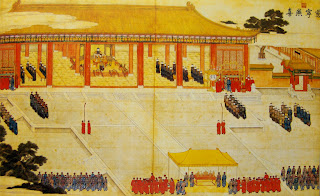
In fact, Imperial China reached its peak of size and power under the Qing Dynasty and whatever failings the Qing emperors may have been guilty of they in no way warrant the throwing away of over two thousand years of imperial history and sacred tradition. Even if they were positively terrible rulers no objective observer could honestly claim that what came after them was an improvement. There was the chaos and bloodshed of the warlord period, China being in a state of near anarchy as republican elites vied for power, followed by one of the bloodiest civil wars in Chinese history (and they’ve had some horrific ones) which was only ended by the oppressive tyranny of the communist dictatorship that went on to be one of if not *the* most destructive in terms of the loss of human life in the history of the world with a death toll numbering in the tens of millions. This was due, in large part, because of the typical revolutionary mentality that all of China and everything traditionally “Chinese” had to be totally destroyed and replaced by an entirely new (and foreign) philosophy, way of thinking and so on. It was not just an effort to change the government, it was an effort to change China itself and the Chinese themselves and that is what really caused the most horror.

You can see this most clearly with Mao and his policies but it goes all the way back to the start of the 1911 Revolution and Sun Yat-sen. From the age of 13 to 17 he was raised and educated in the U.S. state of Hawaii, learned English, learned about democracy and republicanism and so on. He was later baptized by an American missionary into the Congregational Church of the United States. He came to have a fawning devotion to everything western and utter contempt for everything traditionally Chinese. He willing allied with notorious organized crime elements to pursue his goals which he identified, early on, as provoking a violent revolution to overthrow the Qing Dynasty, the institution of democracy and the redistribution of property. Sound familiar? Even some of his fellow anti-Qing revolutionaries denounced him for his criminal activities and his extensive foreign ties while simultaneously maintaining such an anti-foreign attitude. After the 1911 Revolution Sun Yat-sen returned to China accompanied by an American charlatan from Colorado, dressed in a ridiculous military costume, as his “military advisor” even though he had no military training at all but claimed to be a relative of the late Confederate General Robert E. Lee.

On the other side, there were of course those who supported continuing the imperial system as it had been but these were relatively few as most, by that time, because of the defeats China had suffered at the hands of Japan and the European powers, viewed some sort of change as necessary. Those who advocated reform within the existing imperial framework were those who led the reform movement under Emperor GuangXu which was suppressed by the Empress-Dowager. It was at that point that the monarchist Kang Youwei and the monarchist who later turned republican Liang Qiqao formed the “Protect the Emperor Society” while in exile in Vancouver, Canada. After the death of the Emperor and the accession of the little Prince Aisin-Gioro Pu-Yi as Emperor Xuantong they became the constitutional monarchy party. The original plan they seized on was based on the Meiji Constitution of Japan, adapted to Chinese traditions and with greater powers reserved for the Emperor. It was this movement that established the first national assembly in Chinese government and, although there were complaints about how little power they had and how princes of the Aisin-Gioro clan dominated the body, it was still the first step in the direction they wanted China to take; modernization while also preserving traditional Chinese forms and styles.
However, with the notable exception of Kang Youwei, most of these people were not truly loyal to the dynasty either and most joined the revolution when it broke out and eventually their constitutional party became the “Progressive Party”. In doing so they effectively put themselves out of a job. They had ceased to represent a legitimate alternative to those advocating a western style republic and thus most support swung over to the republican nationalists, eventually (and that took time) consolidated by General Chiang Kai-shek. Remaining monarchists were scattered, not well organized (partly because the young Emperor and court came to regard any political party as suspicious) and increasingly dependent on foreign support, which is never an ideal position to be in. However, there was nothing outrageous about Chinese monarchists looking to the example of Japan. Japan was the one Asian country that had modernized without throwing away their own culture and traditions and they had been immensely successful, rising in an extremely short period from essentially medieval conditions to the status of an industrialized regional power.

It is also important to remember, though the modern authorities would never admit it or even allow it to be discussed, that a meaningful reform of Imperial China was possible. It cannot ever happen overnight but the first steps had been taken and in the person of the last Emperor there was great potential for leadership in that direction. Emperor Xuantong (“Henry” Pu-Yi as the world knows him better) was very modern-minded, open to innovation and yet still reverent toward traditional values and customs. Had he been given a chance to rule, or if Emperor GuangXu had not died when he did (possibly by design) things might have turned out very differently. The fact that they did not cannot be changed but the ideas they had should not be forgotten. Being the reactionary that I am, I would also say that the pre-reform imperial system should not be totally discounted either. It worked well enough to survive for over a thousand years and with modern technical advances I think many old systems could function perfectly well in our modern age if people would only give them a chance. However, as a traditional monarchy or a constitutional monarchy there is no doubt that China would be better off today if the 1911 Revolution had never happened. If you don’t believe me, simply refer to the tens of millions of people killed in the warlord era, World War II, the civil war, the Great Leap Forward, the Cultural Revolution, Korea, Vietnam and in purges and the oppression that continues to this very day. Republicanism is a totally alien concept to Chinese culture and anything other than the imperial system will always be unnatural and dysfunctional. Give the Qing their job back or enthrone a new dynasty, either way, China will again be true to itself. Down with both republics and 10,000 Years to the Emperor -whoever that may be.


