
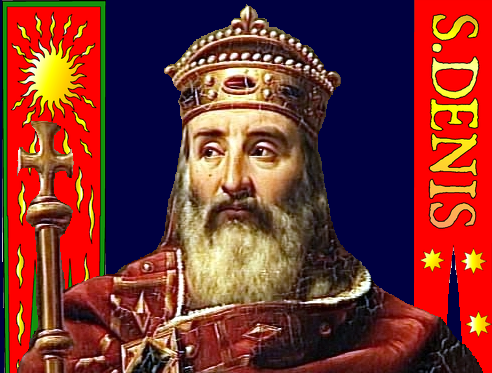
It would be hard to overestimate the impact on western history of Charlemagne, whose feast day falls on today (at least by those who recognize it). Considered something of a “founding father” by both the nations of France and Germany, Charlemagne brought a great deal of new “light” to the “Dark Ages” by defeating barbarian raiders, restoring law and order and stable government throughout much of western and central Europe. His reign would also see a restoration of Rome, in a way, as his coronation as “Emperor of the Romans” marks the birth of the Holy Roman Empire. Royals from France, Germany, Austria and Italy have attached themselves to his legacy, the Christendom of the old Roman Empire began to revive under his rule and no less a figure than HH Pope John Paul II referred to him as the “father of Europe”. He was an astute statesman, a fairly tolerant lawgiver and a bold warrior whose accomplishments would not be rivaled for centuries to come. No matter which way one looks at him, Charlemagne was quite a man.

Not much is known about his origins, his birth place being listed as various places, usually western Germany or Belgium. Charles (Charlemagne - Charles the Great - Carolus Magnus -we all know that right?) was a descendant of Charles Martel, “the Hammer” who defeated the Muslim invasion of France at Tours. His son was Pepin, King of the Franks, who was the father of Charlemagne and Carloman. When Pepin died in about 768 he divided his lands between his two sons but after Carloman died in 771 Charlemagne got it all, roughly what is now western Germany, Switzerland, the Netherlands, Belgium and France. From the start, and certainly by the time of his death, no one had ruled more of western Europe since the days of the old Roman Emperors. However, there was no mistaking the fact that Charlemagne was what the Romans would have called a “barbarian” himself, meaning he was of the Germanic rather than the Latin branch of the European tree. His private life was not always exemplary, he was a Christian certainly but not above carrying out forced conversions, he was illiterate yet was not uneducated and was multi-lingual with a knowledge of many of the available scholarly works of his time even if he could not read them himself. In the tumultuous days of the Dark Ages, things like reading and writing were left to scribes and monks as the paramount duty of a king was to be a warrior, defending his land and people.
Right from the start he marched his knights into the eastern lands of Germany, where no Roman legions had ever tread, to take on the pagan Saxons who were still occasionally carrying out human sacrifices and eating each other -not exactly civilized behavior by any definition. Charlemagne and his mostly Frankish army gave the Saxons a sound thrashing, made them promise to be good little boys and girls and then marched off to their next adventure. That came when the Pope in Rome started having trouble with the Lombard kingdom in northern Italy. So, it was Charlemagne to the rescue, wiping out Lombardy and possibly having the Iron Crown placed on his head -that’s not definite but in any event he made himself King of the Lombards by conquest before going on to Rome to accept the thanks of a grateful Pope, see the sights and buy a few postcards for the wives. But, just as he was picking up coliseum t-shirt word came that the Saxons were running wild again and he had to round up his knights and march back to Germany. Once again, he gave them a good drubbing but this time decided that there would be no peace until the Saxons found Jesus. Being a man of action rather than words, Charlemagne had all the Saxons rounded up, pointed a few swords and lances at them and “encouraged” them to become good Catholics.
.JPG)
With that done and dusted, Charlemagne turned his attention to Spain which had been almost completely conquered by the Muslims. Unfortunately, the Muslims proved a much more formidable adversary than the northern barbarians had been and Charlemagne wasn’t exactly at the top of his game. To make a long story short, Charlemagne took a dusting and was forced to give up on the idea of liberating Spain and go back to France. Many mistakes were made and about the only good thing to come out of it was the famous tribute to suicidal bravery in the “Song of Roland”. Charlemagne was pretty bummed after this and devoted himself to more peaceful campaigns to develop his still strengthening Carolingian Empire. Combat was never too far off in those times though and soon, you guessed it, those naughty Saxons were causing problems again in 782.
It seems when everyone was swearing to be good Catholics some of the Saxon big-shots had their fingers crossed and it took a long, grueling war for Charlemagne to subdue them again. There were still armies in the field when Charlemagne and the Saxon king agreed to peace with Charlemagne leaving Saxony to the Saxons so long as the King was baptized. He did, Charlemagne loaded him down with gifts, the Pope sent him a pat on the back and there was much rejoicing. Charles then settled down in the town of Aachen, taking time out occasionally to thrash the Avars and punish heretics and corrupt clergymen. Although he did not take ‘sins of the flesh’ very seriously, at least concerning himself and his own family, Charlemagne was very conscious of being a Christian monarch and was determined to keep Church affairs orderly. He was, in this regard, not unlike the first Christian Emperor Constantine who was not without his personal flaws but who wanted a clearly understood and defined religion everyone could unite behind and he was willing to use his position to ensure that the Church was protected, its message was clear and its clergy upright.

All of this coincided with his efforts to increase defensive measures against the Vikings from the north, the pagans from the east and the Muslims to the south. Finally, the most triumphal moment for Charlemagne came on Christmas of 800 when he was crowned Emperor of the Romans at St Peter’s Basilica by Pope St Leo III. There is still some debate over whether this was planned, if Charlemagne knew it was going to happen or not but in any event it did happen and it was a pivotal moment in the history of western Europe. It marked the start of what would be known as the Holy Roman Empire (later the Holy Roman Empire of the German Nation), a revival of the Imperial Roman legacy in the west and, somewhat controversially, a sign that the Pope had more or less ‘given up’ on the Byzantine Empire of the east as the protector of the Latin Church in the west. The Great Schism was still some way off but squabbles and tensions had been going on for some time even at that point and by crowning Charlemagne the Pope was effectively saying that he felt it more prudent to trust the converted former barbarians than the remnant of the Roman Empire ruled from Constantinople.
Charlemagne died not too many years after in 814. His empire was divided up among his sons, none of whom could quite match his achievements and the Holy Roman Empire would have to wait until the reign of Otto the Great to see itself reformed and solidified into a major power again. Nonetheless, European history would certainly not have developed as it did without Charlemagne, King of Franks and Lombards and Emperor of the Romans. He had rescued Europe from the worst period of the Dark Ages and set the stage for the rebuilding of Christian civilization in the west. Much was left to be done but none of it would have happened without the giant historical figure of Charlemagne. In recognition of his great achievements he was locally beatified soon after his death as Blessed Charles the Great, his feast day being January 28 where it is celebrated. Pope Benedict XIV much later confirmed this beatification and though he was formally canonized by the anti-Pope Paschal III in 1166 this step was never taken by the official Church hierarchy. However, his great contributions cannot be denied, his influence is still felt and the Latin West lost its first Holy Roman Emperor 1,198 years ago today.


.JPG)


