Sunday, November 18, 2012

MM Sunday Scripture


A divine sentence is in the lips of the king: his mouth transgresseth not in judgment.
-Proverbs 16:10

Saturday, November 17, 2012

Royal News Roundup

Far away in Oceania, the Prince of Wales and Duchess of Cornwall continued their tour for the Diamond Jubilee, visiting New Zealand. There was a traditional Maori greeting for the royal couple after which they visited Auckland where the Prince of Wales was in his usual good humor. When visiting Australia and being asked about being named as a fashion icon by GQ the Prince said, “Every 25 years I seem to come back in fashion”. The couple visited Wellington and the Prince met with one of the dwarves from the popular “Lord of the Rings” spin-off movie coming out soon. The Prince of Wales celebrated his birthday during the trip along with the wife of the PM who shares a birthday with the Prince. He was given 64 small cakes to mark the occasion and the dwarf, played by Mark Hadlow, dropped to one knee and said director Peter Jackson had released him to Prince Charles “to command as you see fit”. The Prince of Wales jokingly said, “This is the best birthday present I’ve had for a long time”. The royal couple went on to visit Feilding and Palmerston North, talked to some animal lovers and the Prince offered his condolences to the family of a recently slain New Zealand soldier. Before leaving they also visited Christchurch which is still recovering from the massive earthquake that devastated the area last year.

The most critical news this week has all been out of the Middle East where existing monarchies are trembling and Israel and Palestine are on the brink of war, a conflict which could certainly spread to include many others. In Kuwait tens of thousands of protestors packed Parliament square to protest voting law changes enacted by the Emir to protect national unity. “Arab Spring” slogans were chanted which does not bode well for the monarchy considering that the movement has led to the downfall of four national leaders so far. The opposition consists mainly of Islamists, tribal groups and liberal lawyers and students. These protests have been common for some time but have been becoming more broadly based and more defiant towards the monarchy itself in recent days. Onlookers have said that events in Kuwait could set a trend for radical change in the other Gulf State monarchies.

Perhaps even more seriously, the usually orderly Kingdom of Jordan has been subject to similar protests and after the announcement of a recent increase in fuel prices (later rescinded) these erupted into violent riots which threaten the very existence of the Hashemite monarchy. Leftist parties joined with the Islamic Action Front (a branch of the Muslim Brotherhood) last month and protests which were once directed solely at the government have more and more been directed at the monarchy itself with protestors chanting, “Freedom is from God, in spite of you, Abdullah”. This in a country were criticizing the King is a criminal offense, yet this is how far things have fallen. King Abdullah II and Queen Rania were once the beloved faces of a modern, moderate Islamic country with a friendly face to the world and well known in America with the King appearing on “The Daily Show” and the Queen a frequent guest of Oprah. Now angry mobs are burning their portraits in the streets. When whipped up, people will criticize anything and the King has been slandered for something as simple as his blue eyes and accent and the Queen for being featured in glamour magazines, hobnobbing with western celebrities and for being Palestinian in a country where some natives resent the large Palestinian presence. In 2010 a group of prominent generals actually published a letter denouncing the Queen. She began to take on a lower-profile but unfair criticism only shifted toward the King instead.

Other monarchies in the region have cut back on their support for Jordan (a resource poor country) and this has forced the King to depend more on the United States which, in recent years, pushed for more liberal reforms and greater democracy, particularly as the Obama administration embraced the “Arab Spring” as a positive development. The King tried to walk a fine line between maintaining his authority and increasing democracy but the public seems to have developed un-realistic expectations and when these were not fulfilled, discontent has grown. Much of it, however, would not exist were it not for the worsening economic situation, with loans from the International Monetary Fund increasingly hard to come by. This was worsened by the outbreak of civil war in Syria which has caused Jordan to be flooded by hundreds of thousands of Syrian refugees. There are also now increasing worries about a war between Israel and Palestine and whether countries like Jordan or Egypt will intervene. Speaking of the potential war in Israel, ailing King Abdullah of Saudi Arabia called for “reason” and “wisdom” in the unfolding crisis in a telephone conversation with Egyptian President Morsi whose comments have been rather more strident to the point of making thinly veiled threats of Egyptian intervention.

In Europe, the week started off with royals from the former Allied nations paying their respects to veterans on the anniversary of Armistice Day, marking the end of World War I. King Albert II of the Belgians visited the Tomb of the Unknown Warrior while over in London Queen Elizabeth II joined the Duke and Duchess of Cambridge at the Cenotaph to honor British war dead and veterans. In Norway, the Royal Palace announced, after some controversy, that they would be revoking the king’s service medal given to Trond Ali Linstad, a Norwegian Muslim convert who had been given the award for his work in integrating Muslim immigrants into Norwegian society but who had also made numerous anti-Semitic remarks as well as remarks viewed by some as homophobic and anti-democratic particularly in his support for the Islamic Republic of Iran. The Palace chief of staff apologized to Linstad for putting him into this position which has brought to light his previous controversial statements. And, after more than half a century on foreign soil, the late Ahmed Zogu, President-turned-King of Albania have been sent home. Ahmed Zogu became President of Albania and declared himself king in 1928. In 1939 he fled the country when Italian forces occupied Albania and with the communist takeover after World War II he was never able to return and died in France in 1961. His grandson and heir to the Zog royal legacy, Prince Leka, works as a political advisor for President Bujar Faik Nishani and some have been critical of the return of King Zog, claiming that the President is trying to gain political points by doing so. However, Albania is currently celebrating the centenary of its independence from the Turkish Ottoman Empire and so reconciling with the past is a completely appropriate thing at this time. King Zog will be laid to rest in a new mausoleum built by the royal family with those ceremonies taking place this weekend.

Thursday, November 15, 2012

The French Colonial Empire


Even most monarchists today prefer not to defend the colonial empires of old, though more monarchists are likely to than the mainstream which tends to totally condemn any and all colonialism even while they turn a blind eye to even worse but more subtle or indirect forms of colonialism today, usually carried out by republics. Yet, even more than that, even when it comes to monarchists, most will not respond favorably to any coupling of the words “French” and “empire”. I will not, today, be addressing the Napoleonic French Empire specifically (though each played a role and the second empire particularly had a lasting impact) but rather the wider, historical French colonial empire. It was the second largest colonial empire in the world, surpassed only by the British and although many monarchists dismiss it as a ‘republican empire’ the truth is that the roots of that massive colonial empire go back to the old Kingdom of France even if it reached its peak under the republics. As with all colonial empires, the French made their mistakes and there were examples of cruelty and injustice one could list. However, as with colonialism in general, these examples are often overblown or used to cast all colonialism in a negative light. In truth, the French “mission of civilization” was often just that and in the best sense of the term. Many parts of the world owe a great deal to La Belle France.

French colonialism could be traced back to the very beginnings of France or even before France was a united country. For the purposes of this article, we will not, but it should be remembered that it was French knights who made up much of the forces that fought in the Crusades and it was the Normans (originally Norsemen who settled in France) who fought and conquered from England to Ireland to Sicily and almost everywhere in between. There were, in the Middle Ages, Frankish kings (of the House of Anjou or the Angevins) on the thrones of England, Hungary and Croatia and Jerusalem. Earlier, of course, the Frankish Empire of Charlemagne covered most of central and western Europe. However, the colonial period of French history as most know it, began for the most part with the reign of King Francis I who, in 1523, encouraged the Italian explorer (who had already visited the North American coast on a French ship) Giovanni da Verrazzano to explore the area between Florida and Newfoundland in the hope of finding a passage to the Pacific. It was also King Francis I who, in 1534, commissioned the intrepid Jacques Cartier to undertake a similar mission and it was he who claimed the land he called “Canada” (which Verrazzano had dubbed “New France”) for King Francis I. This was the beginning of French Canada or Quebec as we know it today.

There were French efforts to claim areas of what is now Brazil and Argentina but problems at home and the already established powers of Spain and Portugal prevented these being successful. However, in 1608, Samuel De Champlain founded Quebec and, under the great King Louis XIV, the explorer La Salle claimed the Mississippi River valley for France, naming the area Louisiana after his King and Queen and also established a French fort on the coast of Texas (ensuring that the Fleur-de-lis still flies over the Lone Star State). The French colonial empire was obviously most extensive in North America and that is where most of the focus was along with some island holdings in the Caribbean which proved extremely lucrative though one in particular, Haiti, would prove extremely troublesome in the long run. When it comes to the French colonial presence in North America, one thing to keep in mind, is that real colonialism was extremely limited. Unlike the British, France did not send over large numbers of settlers to North America. Some came of course, but the French presence in North America was mostly identified with the rough and rugged frontier fur-trappers and the intrepid Catholic missionaries who worked to convert the natives to Christianity.

Because of this, the French were careful to avoid conflict with the American Indians if at all possible. They were more likely to befriend them and early on forged alliances with them. France did not want to conquer and displace the natives, the fur traders wanted to do business with them and the priests wanted to convert them and teach them Latin -both of which requires their goodwill rather than their hostility. Nor did they tend to hold themselves apart from the natives as, by comparison, the British did and there was much more intermarriage between the French and the Native Americans which ultimately produced the mixed-race ethnic group called the Métis in modern Canada. Today, most are as “White” as any other European-Canadian but they still hold on to the special status that their original native ancestry gives them. The fact that, when war broke out between France and Britain in North America, that so many of the Indians sided with the French shows clearly that they considered their interests to be better served in the hands of the King of France than in those of the Hanoverian King of Great Britain and Ireland. This would surely not have been the case if the French had been systematically oppressing the natives or being terribly cruel to them. The French, for the most part, were not viewed as foreign conquerors but as the people who shared new knowledge with them and traded valuable goods to them which they had never had before.

The French islands in the Caribbean were, unfortunately, a different story and life for the slaves on the sugar plantations there was usually horrible. However, while accepting that, one needs look no farther to see the value of the French presence even in this area than to compare the fate of Haiti after independence to those islands still under French administration today. The Kingdom of France established some outposts in west Africa but these were limited. More progress was made in India where, for a time, it was a real possibility that French influence would surpass that of Great Britain on the subcontinent. It was from their base in India that France made their first serious effort to gain a foothold in Southeast Asia by allying with the growing power of the Nguyen Dynasty. This was during the reign of King Louis XVI and, unfortunately, the outbreak of the Revolution meant that this original, greatly preferable relationship, would never have a chance to grow and subsequent Franco-Viet relations would not be so ideal. Likewise, the colonial empire of the old Kingdom of France was fairly well decimated in a series of clashes with Great Britain. British troops and their allies blocked the French in India during the Carnatic Wars and a British victory in the French and Indian War saw the end of French Canada. There were hopes of restoring Canada to French rule by intervention in the American War for Independence but this was thwarted when the fledgling United States signed a separate peace with Great Britain, leaving France with nothing but debts.

The Revolution, needless to say, was a disaster for the old French colonial empire and on the international front things were not improved by the creation of the actual “French Empire” under Napoleon who resigned himself to the loss of Haiti and sold the massive Louisiana Territory to the United States. He preferred to focus on expansion in Europe, though, for a brief period, he extended French influence over Egypt and the area of Palestine and Syria. Many view the sight of French Napoleonic troops tramping past the pyramids as an odd sight, but of course King St Louis IX had invaded Egypt with his French knights in the past and then as now the French language was not unknown in the Middle East. In the aftermath of the Napoleonic Wars, it was King Charles X who sent troops into Algeria, firmly bringing that area into the orbit of France for the first time. French power overseas and the “mission of civilization” was further expanded during the reign of Emperor Napoleon III. In fact, most of the French colonial empire as it is remembered today was built on the foundations established under the second Napoleonic empire.

Under Napoleon III, the French presence in Algeria was furthered and strengthened, French influence in the Middle East increased and the first armed intervention in Indochina was accomplished which would eventually lead to French control over all of modern Laos, Cambodia and Vietnam. It was also, famously, Napoleon III who made an effort to create a new French sphere of influence in the Americas with his intervention in Mexico as well as plans for French footholds in Central America and on the Pacific coast of South America. The French Empire is usually criticized for this, and certainly there is much to criticize, however, such failings are not the whole story and many great and beneficial deeds were accomplished. Good government tended to follow in the footsteps of the French Foreign Legion from Mexico to Algeria to Djibouti. Many Mexican villages had never known such basic advances as a regular and reliable postal service and freedom from bandit extortion until the arrival of the French Imperial Army. Although few would want to admit it today, when the French Imperial Army first marched into Mexico City they were met by mobs of cheering citizens.

Mexico, of course, did not work out due to the Union victory in the American Civil War, however, Napoleon III left a lasting French presence and influence in Africa and particularly the Far East. This included not only Indochina but also a sphere of influence in southern China after the Sino-French War and enclaves on the Chinese coast. There was also an expedition to Korea though that ended badly and was swiftly swept under the rug. When it comes to monarchy, while not perfect, the French Empire had a pretty good record. France sponsored the restoration of the monarchy in Mexico and, had that worked out, might have done the same in South America. The native monarchies of Indochina were maintained, even assisted in consolidating power in the case of Laos. Vietnam was a more unfortunate case but, even there, the real damage to the monarchy came after the fall of Napoleon III when the French Republic was running things. One reason this was possible was because of the degree to which colonial policy was the domain of the French navy and the French navy had a very strong Catholic and conservative officer corps, something seen all the way up to Admiral Georges Thierry d’Argenlieu after World War II who was one of the most adamant advocates of the restoration of the last Vietnamese emperor to lead a pro-French, non-communist Vietnamese state.

Unfortunately, when Napoleon III was tossed aside the French republic was, not surprisingly, far more anti-monarchy in their colonial policy. French rule in Africa was greatly expanded, Madagascar was brought into the empire but this time with the local monarchy being destroyed in the process. French rule expanded in Indochina but the republic planted the seeds of its own downfall by humiliating the Vietnamese emperor and by simply by their education of native peoples. Imagine a young Vietnamese boy like the future Ho Chi Minh going to a French school and being taught all about “liberty, equality and fraternity” and how the revolution against King Louis was a great and glorious thing only to then be expected to go home and kowtow to the emperor. Given these mixed signals, it is no wonder that so many of those who would become revolutionary leaders in the anti-colonial period, leading the fight against France, were themselves French educated. Future murderous dictators like Ho Chi Minh and Pol Pot were both members of the French Communist Party in France before such a thing even existed in Indochina.

Like other colonial powers, World War I saw the French empire in full flower with participants from Senegal to Saigon serving in France to contribute to the war effort. Likewise, World War II proved to be the beginning of the end of the French colonial empire. At first, France determined to fight to maintain it and in Indochina few people realize how effective the French forces were. They fought a longer and more aggressive war than the United States later did and France did it without ever resorting to conscription at home. The French forces were actually winning the war for the most part, despite sabotage on the home front, until all was lost in the desperate gamble at Dien Bien Phu. Even then, were it not for chaos and war weariness at home, France could have carried on even after that setback, but it was not to be. Other colonies fell away later until a serious effort was made to hold on to Algeria, which was even declared a part of metropolitan France. However, Algeria was eventually given up and the loss basically took the Fourth Republic with it.

Much of the memory of French colonialism is colored by the wars in Vietnam and especially Algeria. This is unfair and overlooks the benevolent record of the Kingdom of France in North America and the fact that, under Napoleon III, French colonialism was usually based on treaties with local rulers. It is also rarely considered how former colonies fared after independence. French rule in Indochina was not always pretty, but it was paradise on earth compared to the millions who were slaughtered later by native communist dictators. Even in Algeria, as ugly as the war was, things did not improve after independence. Algeria almost immediately fell into civil war, there have been conflicts and accusations of human rights abuses made by the Berbers against the Arabs and most of the last two decades have been spent with Algeria in a perpetual state of emergency with the repression that goes with it. It is also worth pointing out that some areas, such as French Guiana in South America (most famous for being the home of Devil’s Island) have been offered independence by the French government but adamantly prefer to remain a part of France. Clearly the French colonial empire had a considerable beneficial impact on many parts of the world and certainly more so during the days when monarchs still held sway over France.

Wednesday, November 14, 2012

Mexico, the Latino Vote and Maximilian


I addressed this issue somewhat during the controversy over the SB1070 bill in Arizona but given the high profile Hispanics (the majority of whom are Mexican-Americans) in all the talk about the recent election, I thought it worth addressing again. Also because some common and often repeated misconceptions need to be cleared up. I have heard over and over again that Hispanics were the key demographic in the last election; they are the reason Obama won and Romney lost. This makes sense considering that Hispanics are the fastest growing segment of the population in the United States with, again, Mexican-Americans making up the largest part of that group. In fact, there are now more Mexicans living in the United States than in Mexico. That, in and of itself, should tell the world something about what kind of country Mexico is. It is no paradise and they certainly cannot blame the tiny monarchist minority. Mexico only ever had two monarchs who together ruled for less than a decade and they shot both of them. But I have noticed some rather glaring inconsistencies when it comes to people, particularly on the political right in the United States, evaluating the state of the average Latino and/or Mexican-American at this time. Allow me to explain:

Over and over again I have heard that the Mexican-American community shares many traditional values with the American “right”. Over and over again I have heard that these people are overwhelmingly Catholic, very family oriented and value hard work and individual achievement. They should be voting for conservatives! Yet, at the same time, many of these same “talking heads” repeat statistics which almost totally contradict that line about Mexican-Americans that they continue, nonetheless, to repeat. First of all, yes, the vast majority are baptized Roman Catholics. They are, in fact, the vast majority of all Catholics in the United States at this time. However, only about 30% of baptized Catholics in this country actually attend mass regularly. That leaves a whopping 70% that do not. This shows when you consider that Latinos in this country have voted consistently, by wide margins, for the Democrat Party which champions numerous things opposed by the Catholic Church, including gay “marriage”, taxpayer-funded birth control and most importantly abortion. I am, as most know, from the great state of Texas and am very familiar with this situation. Hispanics are the majority of the population in Texas. Take a look at a map of abortions in Texas and you will see that the majority of them are done in the area along the southern border where there is the highest concentration of the Mexican-American population. It is this same area which is the most solidly Democrat in terms of voting allegiance in an otherwise very Republican state.

The same holds true on strong families and family values. People say that Hispanics value these things and yet Hispanics have the second highest illegitimate birth rate in the entire country with only the African-American community having more. So, these very Catholic, very family oriented Hispanics have a divorce rate comparable with other ethnic groups, the second highest number of illegitimate births and the second highest number of abortions. Like the rest of America, in terms of Catholics at least, most of them, likewise, do not attend Church regularly. Now, I should not have to state (but I shall) that these are general statistics. There are, of course, many devoutly Christian Hispanics, very family oriented Hispanics and these tend to support more conservative candidates. However, it is simply a fact that these are not the majority and it should be no surprise as to why. That is the point I think everyone is missing. Not only is much of what is said about Latinos factually incorrect but there is no reason why anyone should think those things would be true in the first place because they are based on false assumptions about Mexico itself.

Things like family values are strongly entwined with religion and religious beliefs and despite the popular perception of Mexico as a very religious and very Catholic country, this is simply not the case. Growing up right next door to Mexico, it took a good number of years before I ever even realized most of the rest of the U.S.A. saw Mexico as such an overwhelmingly Catholic country. I never did. Sure, almost every Mexican has a statue or picture of Our Lady of Guadalupe in their home and a rosary hanging from their rear-view mirror, but it is also a country famous for corruption, where anything and anyone can be purchased. I suppose growing up with both sides of the coin on constant display, I never noticed many people were only seeing one side. Another thing everyone on the border grows up with is the weekend rush of high school guys to the Mexican border towns. And no one went there to go to Church -trust me. So, even at a very early age, yes, I knew that most Mexicans were at least nominal Catholics but I also knew Mexico as the country where prostitution was legal, anyone could buy alcohol and where all the drugs came from. Statistics which list the religious affiliation of a people do not tell the whole story of the depth of faith of a country.

The fact is that for most of the recent history of Mexico, not only has it not been a devoutly Catholic country, it has in fact been a very anti-Catholic and generally anti-Christian country. Where did it all start? Believe it or not, it pretty much started with the fall of the last effort at a monarchy in Mexico. Actually, it was slightly earlier, but still a part of the same overall struggle. The reign of Emperor Maximilian was actually the last great hope for Mexico to be the devout and solidly Catholic country that everyone imagines it to be. I do not say that because of my own bias, it is perfectly true. The short-lived First Mexican Empire of Agustin de Iturbide had been very Catholic and even the republican regime that succeeded it generally maintained good relations with the Church and many of the succession of generals who subsequently seized power often had close ties with the Church. Even under so notorious a sinner as Santa Anna, Catholicism remained the one and only religion of Mexico with the acceptance of Catholicism one of the requirements for citizenship. However, all of that changed during the presidency of Ignacio Comonfort and the new constitution drawn up largely by his Chief Justice; Benito Juarez.

It was at that time, for the first time, hereditary titles were abolished, religious holidays were banned, religion was removed from the schools, religious marriages were no longer valid and public officials were even banned from attending Church. Catholicism was also dropped as the state religion. This was 1857 so, obviously, the roots of anti-clericalism in Mexico go back pretty far (and the country had only existed since 1821). This was a major part of the reason for the outbreak of the civil war between the anti-clerical liberals and pro-Catholic conservatives that preceded the French intervention and the establishment of the Second Mexican Empire in 1864. Benito Juarez also provoked conflict by confiscating all Church property and this certainly influenced Pope Pius IX in blessing the effort of Emperor Maximilian to restore Mexico to the status of an officially Catholic empire. As it turned out, Maximilian was not as strident as the Pope and the local Church hierarchy would have liked. Truth be told, there was plenty of blame to go around for the state Mexico was in when the new Emperor arrived and the Church had done a pretty terrible job at catechizing the people (not an uncommon problem, then or now).

Emperor Maximilian incurred the wrath of the Catholic Church by refusing to restore the vast properties Juarez had previously taken from then and for his insistence that religious freedom be upheld in his empire. Of course, he restored Catholicism as the official state Church but he would not punish people for not adhering to it. The Church could not have known (though they perhaps should have looked at the state of the world and been a bit more farsighted) that this was the best “deal” they were ever going to get in Mexico. Had Maximilian succeeded and the Mexican Empire survived, the religiosity of the country would certainly have been different than how things actually unfolded. For one thing, among the large volunteer corps sent over from Austria-Hungary, single, solidly Catholic men from across the Hapsburg realms were preferred in the hope that they would settle in Mexico after the war, marry and raise families, increasing the ethnic diversity of the country but strengthening its Catholic character at the same time. The fight between the monarchists and republicans in Mexico was, even if not everyone realized it at the time, the real pivotal clash between the clerical and the anti-clerical over domination of the country.

Anti-clerical = national hero
When Juarez emerged victorious, his anti-Church measures came back into effect and his successors were no better. His immediate successor, Sebastian Lerdo de Tejada, upheld the anti-clerical laws and even expelled the Sisters of Charity from Mexico. He was later overthrown by General Porfirio Diaz (who had gained fame fighting for Juarez during the second empire). A dictator, Diaz did bring about a period of law and order for the first time most Mexicans could remember. He took a somewhat more pragmatic stance with the Church and did not enforce the most repressive laws against them but neither would he repeal them. If any Church official displeased him, he could always invoke the law to take action. Diaz came down in “the” Mexican Revolution (the one most people think of though there have been many) and after a long period of chaos and civil war a very anti-Christian and Marxist faction seized power, establishing what would become the decades long tyranny of the Institutional Revolutionary Party (who actually regained the presidency in the last Mexican elections). Their leaders made Juarez look like an altar boy. Priests were killed, Churches were closed (or turned into anything from garages to brothels) and the persecution became so intense that Catholics in Mexico began waging a guerilla war against the government, which the hierarchy eventually stopped. Even the most revered holy relic in Mexican history, the original image of Our Lady of Guadalupe, had to be smuggled out of the country to prevent it from being destroyed.

The wholesale slaughter was stopped but the Church remained extremely restricted in Mexico until fairly recently. Politicians could not attend public services, priests and religious could not wear their habits in public and foreign religious were not allowed in the country at all. Even to this day the Church is treated with suspicion by the Mexican government. This is why it is amazing to me that so many still view Mexico as a solidly Catholic country full of nothing but devoutly religious people. Again, many people are, but obviously many more have been very far from that. It is all the more amazing considering that the United States was, during the worst period of persecution, inundated by Mexican Catholic refugees fleeing the anti-Christian barbarity of their own fellow countrymen. And, as I mentioned, those persecutions were carried out by the party whose candidate the Mexican people just elected to the presidency. Mexico is no more strongly Catholic than the United States is strongly Protestant and actually probably less so as the United States has never had anything close to the level of religious persecution seen south of the border. But, let’s face it, one fifth of Americans no longer identify themselves with any religion at all and the number of people who “used to be” Christians outnumber those who actually are and then there is a whole host of people who are “spiritual” but not “religious” and the “I believe in something but don’t really go to Church” crowd.

pious emperor = national villain
If Mexico was a strongly, overwhelmingly Catholic country it would not be in the state it is now. If the United States was a strongly Christian country of any sort it would not have just reelected Barack Hussein Obama (and probably wouldn’t have nominated someone like Mitless Romney either). The fate of Mexico was sealed that tragic day on the Hill of Bells at Queretaro when Emperor Maximilian and Generals Miramon and Mejia (who should probably have a cause for his canonization if politics truly never entered into those decisions) were executed. From that time on the rulers have done all in their power to beat the Catholicism out of the people and after more than a hundred years it would be foolish to think they have had no impact. Of course, there is always the hope that the Mexican people can be fully reunited with their Catholic roots but I doubt that will happen in the United States but should be done in Mexico which at least had, for quite some time, a Catholic culture.

The bottom line is that no group of people who would (by such a wide margin) vote for the author of the HHS mandate, support gay “marriage” and who is the most pro-abortion president in American history is simply not a “strongly Catholic” or “inherently conservative” group of people. An amnesty bill will not win them over with the media, education system and Hollywood all having drummed it into their heads for decades that the political right is the land of bigots and racists. Now, if the Republicans embraced amnesty, open borders, more social welfare programs, more government spending and a cradle-to-grave nanny state they might win them over, along with many other groups, but then they would just be Democrats wouldn’t they? And if you want to see what happens to conservatives who try to be liberal-lite just take a look at the deplorable numbers of the Tory Party in Britain under Cameron and the growing support for alternative voices like UKIP. Policy changes are not the answer and a more dynamic political leader is not the answer. I will have to agree on this point with Patrick J. Buchanan. America doesn’t need another politician, America needs a Saint Paul.

To reiterate the point, I hope no one takes this as a tirade against Mexico or Hispanics in general (though undoubtedly some will). You cannot grow up and live where I do and have attitudes like that. Probably 8 out of 10 people I have known my whole life are Mexican-Americans, in this area Texas and Mexico really overlap. The vast majority of kids I grew up with, went to school with and, yes, go to church with, are Mexican-Americans. They are my friends, in some cases my family. My point is that many people seem to have a very narrow and misguided view of the population as a whole. Republicans eager to ride back to political victory on the backs of faithful Hispanic Catholics will be in for a big let-down. Hispanics are no more inherently religious than any other group of people and for nearly the last hundred years they have grown up in and come from a country in which Christianity was persecuted and which was under one party socialist rule. Sadly, the majority of the people have not turned their backs on that and, if voting records are to be the standard of judgment, have even turned towards it again. If what Republicans are assuming about the Mexican population was true, Benito Juarez would not be a celebrated national hero in Mexico to this day and Emperor Maximilian still considered a villain. I wish the reverse were true, but sadly, it is not.
 

Tuesday, November 13, 2012

Monarchist Quote

“The president of a republic is as though you pick a player from one of two teams and make him umpire.”

-Czar Simeon II of Bulgaria

Favorite Royal Images: Casiraghi Couple

Stefano Casiraghi and HSH Princess Caroline of Monaco

Monday, November 12, 2012

Mad Analysis: My Problems with the Libertarians


Ever since the Presidential election in the United States, everyone, particularly on the “right” has been trying to explain it and diagnose the reason behind the defeat of the hapless Mitt Romney. And, if one is expecting to find people behaving with reason and common sense, it certainly calls for a thorough investigation. After all, never in the lifetime of most voters has a President been reelected when unemployment, the debt, the deficit, gas prices, food prices and general cost of living have been so high. Looking at the numbers, one would think that the Republicans could have nominated anyone and still coasted to an easy and overwhelming victory. Since Obama has been President, more people are unemployed and more people are having a harder time making a living if they do have work. So why did he win? More people voted for him than Romney. Simple. But why? Blacks voted almost uniformly for the President, Latinos voted overwhelmingly for him as did single women in spite of the fact that these groups have suffered the most during his first term. If one expects to find a rational reason for that, you are going to be searching for quite a while. The reason, it seems, was because Romney seemed worse. True, unemployment is worse among these groups but because of that they still voted for more of the same because more of these people are receiving government assistance and were told that Romney was going to cut off the government gravy train (which of course he could not do so long as the Democrats hold the Senate but, again, common sense has nothing to do with this). Some have blamed the Republican message while others have blamed the ability of Republicans to “sell” their message. Balderdash!

Some eminent Republicans have said that Hispanics are the key and that the GOP should embrace the idea of amnesty (with border security) to win over Latino voters. They are wasting their time. In the first place, this has been tried before and the left will never go along with increasing border security. However, if Latinos were most concerned with this they would have been more reluctant in voting for Obama considering that he has deported far more illegal aliens in one term in office than George W. Bush did in two. And why are these Republicans talking about attracting Latino voters rather than Blacks? Probably because (aside from considering them a lost cause due to the overwhelming loyalty Blacks have for the Democrat Party) this would reveal the stupidity of their position. If they think amnesty will win them long-term Latino support they should look to Black Americans and remember that it was the Republican Party that abolished slavery in this country and yet Blacks still do not support Republicans and so we have the ironic picture of the first African-American President of the United States belonging to the same political party as the late President of the Confederacy. Did Blacks defect to the right when Herman Cain was running for the top job? Did they get behind George W. Bush for appointing the first Black Secretary of State or did they embrace the Republican Party for George H. W. Bush appointing only the second Black Supreme Court Justice? Every time, “no” and if they think they will no longer be seen as the “racist” party by embracing amnesty they have another thing coming.

The left, of course, says what they say after every Republican defeat which is that the conservatives could win if they just dropped all that conservatism. What I find most entertaining though is the extent to which the Libertarians are saying the exact same thing. Since the election I have seen a parade of people from the Cato Institute and Reason magazine blaming the GOP defeat on their clinging to traditional moral values, immigration control and the “war” on drugs. Meanwhile, they are cheering the fact that Colorado voted to legalize marijuana and that several states voted to legalize gay “marriage”. Further, they bemoan the fact that conservatives will not drop their opposition to abortion and gay “marriage” in order to join with the libertarian throngs in saving the country from economic ruin brought about by the big-spending left. So, in other words, give up your deeply held beliefs to help foster our agenda. Again, much like the Democrats. Aside from the condescending nature of such an argument, one problem with that is the priorities of these libertarians. The argument also betrays the extent to which even the good ideas of libertarianism are often overtaken in their own minds by their most ridiculous arguments.

Can't you leave me alone BEFORE you take over?
Gay “marriage” is a good example. If the libertarians really believed in what they claim, they would not be championing so-called “marriage equality” but rather for an end to all government involvement in marriage at all and an end to all benefits for married people be they gay, straight, polygamists or any other perverse combination. This really pains me because, as the national debt becomes higher and higher (and it is already to the point that I doubt it could ever be reasonably expected to be paid off) the libertarian argument is increasingly more likely to be the only possible solution. Yet, they want conservatives to abandon their values and come to them in order to unite on fiscal issues rather than themselves giving ground on narcotics and homosexuality to save the national economy. It seems ridiculous to the point of hilarity to me that it is the traditional right that must make concessions rather than the libertarians on the social issues because each side agrees that the current economic trend leads to disaster but by libertarians refusing to compromise on their moral positions they act as though they think these are somehow as important as the fiscal crisis. Can they be serious? Countries will certainly go to ruin if they spend more than they earn but I have never heard of a country going to ruin because there was not enough sodomy, abortions or drug use going on.

Libertarian candidate Gary Johnson
Demographics do matter, partly because demographic change is permanent change. Laws, policies and regulations can all be repealed (though they seldom are) but once a population has changed it can never be changed back. This matters to the political race because the left has, for some time, controlled the culture, the media and the education system and have successfully branded the Republican Party as the party of racism and there is nothing the GOP can do at this point to “prove” they are not racists -and God knows they have tried. Take a look at the Bush cabinet or the last GOP convention which was essentially a parade of minorities, and women minorities better still. Because of the success of the left on this branding campaign, and because immigrants are more likely to depend on government benefits (as are single women -yes there is a pattern here) they tend to vote Democrat. Go down the list of ethnic groups; African-American, Hispanic-American, Jewish-American, Arab-American, Asian-American, Native-American: they all tend to vote Democrat. The Democrats realize this, which is why they oppose any effort to enforce immigration laws or secure the border. Rest assured, if Mexican-Americans voted the way Cuban-Americans have in the past, the Democrats would have built a border fence on our southern frontier to dwarf the Great Wall of China.

The left, the party of government dependency, therefore has always embraced the ideal of open borders because they know it means more and more people who will loyally vote Democrat no matter the circumstances. Here again though, I marvel at the libertarians of the Cato Institute and Reason and so on for making the same argument. Their belief in absolute individual liberty is such that they too want open borders even though this has resulted in more and more popular support for the very government programs these same libertarians claim to most oppose! But, unlike the conservatives of the GOP, they will never change because it is a matter of principle to them and they see no distinctions when it comes to their principles of the “self” above all. That is why, apparently, they see the fact that some states refuse to condone homosexuality as just as big a problem as the fact that the USA is $16 trillion in debt and almost half the population depends on the government to some degree. I will repeat, there is a great deal I agree with libertarians on even though I could never be a total one, mostly because, like most political groups, they would not have me even if I wanted to join them.

Legalize and regulate -even though they oppose regulation
Again, I think the libertarian ideal of a “wall of separation” between economy and state is rapidly becoming not just a better solution but the only possible solution. However, fundamentally, I could never be a total libertarian because I do have some attachment to my own people, I do regard tradition as important and, most fundamentally, because, like Thomas Hobbes, I think that if left totally to his own devices the life of man would be, “nasty, brutish and short”. I agree with them on most of their economic ideas, I certainly agree with them when it comes to the debt and the dollar and I totally agree with them when it comes to private property and their opposition to socialism and communism. But I cannot agree with them on everything and I cannot agree with their priorities. For example, they think all narcotics should be legal. Having seen the damage drugs can do to people (and not just the people who take them), that scares me a little but I see the merit of their argument. However, I would never, ever go along with legalizing drugs until the welfare state was abolished because I don’t want to be saddled with paying for the 24/7 care of a population of drug-addled wretches. I have never understood why the libertarians do not first devote themselves to abolishing the welfare state and THEN campaign to legalize drugs. Well, maybe I do, because a great deal of their support comes from pot smoking college kids. Similarly, why fight for “marriage equality” instead of getting the government out of marriage altogether which would result in the same thing anyway?

Another problem I have with them is national security. And, again, it is not that I disagree with their position as much as I disagree with their priorities. In most cases, I agree with them that the policy of interventionism has been a disaster but I could never adopt their position while they also adhere to the open borders policy. Right now, a major concern is the nuclear program of Iran. They don’t care if Iran gets the bomb but I do. However, I do specifically because of how open our borders already are. If Iran got the bomb right now there is still no way they could directly harm the United States. They have no missiles to stick it on that could reach America and they have no bombers that could get close to America without being shot down. But if we adopt the libertarian policy of open borders it would not be terribly difficult to get a “dirty bomb” into the country and wreak havoc. In fact, the whole “War on Terror” would never have been an issue if the USA had simply taken greater care about who is coming into the country and what they are doing while on American soil. None of these terrorist groups control any ballistic missiles, tank divisions or long range bombers. They can only attack America by getting inside and hijacking a plane or setting off a bomb. If America had real border security none of these terrorists could ever touch the United States at all. I have often been eager to tell the rest of the world to fight their own battles but I cannot go along with the libertarian position so long as they refuse to stop potential enemies overseas and at the same time refuse to allow the military to guard the borders at home.

You know, if you voted in a state that mattered...
Finally, and perhaps most importantly, there is the issue of abortion, something I will never support nor even tolerate at all, period, no discussion. Not all libertarians support abortion (I know Judge Andrew Napolitano does not, God bless him -and I also salute him for having the courage to point out that FDR manipulated the US into World War II by provoking Japan -not a popular truth) but every major libertarian institution that I know of does and certainly the people at Reason and Cato I have seen on TV do. I understand why they do, because they believe in absolute individual rights and the absolute inviolability of the “self”. An individual woman has every right to an abortion if she wants one just as, in the libertarian view, she has every right to prostitute herself if she wants to. When it is all about “me” and a pregnancy would be detrimental to “my” happiness, abortion is perfectly acceptable. However, at the same time, this libertarian position puzzles me because they also claim to be all about individual responsibility (and I am certainly in favor of that -all the way). They say they want personal freedom and personal responsibility. However, abortion seems to me to be the total negation of that position.

Consider it like this: we live in a world where women have access to every variety of artificial birth control known to man (and the shrinking population to prove it). So, other than in the event of a rape (which are thankfully relatively rare in the United States) if a woman is impregnated it is because she made a decision and exercised her individual right to have “unprotected” sex or chose to do something that would interfere with her clear thinking (like getting drunk) and as a result made a bad decision and ended up getting pregnant. It does not seem at all ‘libertarian’ to me to then allow this woman a medical “bail out” from a situation she willingly got herself into. Of course, I also believe it is the murder of an innocent child but I’m assuming libertarians do not, otherwise they would apply their principles to the individual rights of the unborn child. But even from their own perspective, I do not see how supporting abortion is in keeping with their devotion to personal responsibility. But then, that half of the equation often seems to be neglected doesn’t it? They favor allowing drug abuse without first eliminating the welfare state that would force drug addicts to be responsible for their own actions and they support abortion even when rape is not a factor which allows people to avoid taking responsibility for their own actions. To me, that just seems crazy. But, it would, being … The Mad Monarchist.

(Note: Libertarians may not leave angry messages in the comment box below telling me what a horrible person I am but please, whatever you do, don't click on the "libertarian" label below and read any of the other articles I have posted on the subject in support of various libertarian positions or it just might cause serious damage including brain injury to you. -MM)

Sunday, November 11, 2012

MM Sunday Scripture


My son, fear thou the Lord and the king: and meddle not with them that are given to change.
-Proverbs 24:21

(Sounds very current these days doesn't it?)

Saturday, November 10, 2012

Royal News Roundup

Starting in the Land Down Under, TRH the Prince of Wales and Duchess of Cornwall, after a visit to Papua New Guinea, landed in the great Commonwealth of Australia as part of the Diamond Jubilee tour, hopefully strengthening ties with the monarchy. The Duchess made friends with a joey and on day three the royal couple took in the races for the Melbourne Cup. They met with some of the jockeys and the Duchess of Cornwall was proud to present the prized cup to the winner, Nick Williams, owner of “Green Moon”. The Duchess is an avid fan of horse racing and was all smiles for the event. After visiting a tapestry workshop, the Prince visited the Melbourne International Cricket Ground where he talked to some children and praised the program which aims to bring young people of different races and religions together with sport. The Prince of Wales also looked in on the work being done by his own charity in Australia, in conjunction with others, to work toward similar goals.

In southeast Asian royal news, the family of a man from the southern Malaysian state of Johor is rather upset that he was arrested for posting insulting remarks about the revered Sultan of Johor on Facebook. Last July a blogger was arrested on similar charges. Also in Malaysia, the Sultan of Selangor has spoken out, expressing his regret over the statement of a local politician that Malays are free to choose their own religion. The Sultan firmly rejected the idea that anyone could embrace a new religion and denounce Islam, the religion of the vast majority of the Malaysian people. Elsewhere in Asia, in the lofty land of Nepal, former King Gyanendra Shah recently gave a fiery speech, criticizing the current republican political leadership of the country whose lack of “foresight” have brought “disarray”. In a stirring call to embrace old fashioned values the King said, “Our religion [Hinduism], cultural practices and tradition are the only things to ensure our secured continuity always guiding us towards the path of truth”. He also reminded the audience that it was the royal family which, with divine help, brought the country into being.

In the Middle East, HM the King of Saudi Arabia named Prince Mohammed bin Nayef to the post of Minister of the Interior. It was this prince who led a crackdown against terrorist radicals, predominately Al-Qaeda and who himself only narrowly survived an attack by a suicide bomber. Prince Mohammed is the first of the second-generation royals of the Al-Saud dynasty to hold such a ministerial position. Meanwhile, in neighboring Qatar, the Emir had called for better public services, adopting some of the same criticisms as the protestors he has consistently opposed. Perhaps a sign that improvements can be made in a calm and deliberate fashion. And in Kuwait, HH the Emir has spoken out over unprecedented unrest and turmoil in the usually calm Gulf state. In a meeting with security officials, the Sheikh said, “We are required today to choose between the state of law and constitution…or the path to chaos and undermining constitutional authority,”. He praised the army and police for their handling of the unrest. So far the opposition has consisted of a motley collection of Arab nationalists, liberals and Islamic fundamentalists.

In Belgium, the Royal Family has been uncharacteristically combative in response to a horrible, slanderous book which accuses the Royal Family of all sorts of things. In particular the Crown Prince, Philippe Duke of Brabant, was hurt and angered by the book which accuses his marriage of being a loveless sham and his children the products of IVF. The Crown Prince, in response, said, “The day that Mathilde said ‘Yes’ to my proposal was the happiest day of my life” and anyone who has seen them and their children together should be able to see the truth of his words. I have to say, I think the Belgian crown prince has been the most grossly and unjustly maligned and derided royal heir in the world. He is a good, upstanding, intelligent man and his detractors can never point to anything concrete in their criticisms of him. Given an honest chance, I have no doubt he will prove a noble and capable monarch when his time comes.

Across the border in The Netherlands, HM Queen Beatrix swore in the new Dutch cabinet and later in the week visited the town of Sneek to open the new ‘Cultural Quarter’ and took in some demonstrations of local dances. The Dutch postal service has also saw an upsurge in business thanks to the popularity of a new set of stamps featuring the three girls of Crown Prince Willem-Alexander and Crown Princess Maxima. Such stamps are released each October and proceeds from their sale goes to various charities dedicated to helping children. The photographer was none other than the Prince of Orange himself. And, speaking of children, down in the Principality of Monaco, the big news was the announcement from Tatiana Santo Domingo that she and her husband-to-be Andrea Casiraghi are expecting their first child in January of next year, so Princess Caroline is set to be a grandmother. Andrea and Tatiana have been an item for the last seven years and announced their engagement in July. Andrea is currently next in line to the Monegasque throne, which could change if any children are forthcoming from TSH Prince Albert II and Princess Charlene. Congratulations to the happy couple on their upcoming new addition. The Sovereign Prince himself has been on an official visit to Turkey this week where he has met with the Turkish President and His All Holiness the Ecumenical Patriarch of Constantinople Bartholomew I.

Friday, November 9, 2012

French Imperial Army in Mexico, Part II

Continued from Part I

Marechal de France Bazaine
Bazaine had started out as a private and worked his way up through the ranks, becoming a lieutenant while serving with the legion in Algeria. He had distinguished himself in Crimea, Italy and at the battles of San Lorenzo and the siege of Puebla. He was popular and well respected by his men but over time problems did develop between him and Emperor Maximilian. Even some on the French side feared that he was going too native and might have had aspirations toward local power after he married an obscenely young girl from the Mexican aristocracy. Bazaine was quickly promoted to Marshal of France and set out on a campaign to crush the remaining resistance under Juarez who was driven from San Luis Potosi to Saltillo, four hundred miles farther north. With every French victory more Mexicans defected to what seemed to be the winning side and soon Juarez was reduced to little more than a fugitive on the run in the barren deserts of northern Mexico. By the spring of 1864 the French controlled most of Mexico and had a force of 38,000 men plus 1,800 Mexican auxiliaries.

However, the situation was not as good as it seemed on paper or as sunny as the reports Marshal Bazaine was sending home to his Emperor in Paris. The French could not effectively garrison every area and the Juaristas were quick to flee before them only to return as soon as the French marched away. After suffering so many defeats Juarez adopted a guerilla warfare policy and Mexican republicans were reduced to behaving more like bandits than regular soldiers, avoiding confrontations with the French unless the odds seemed extremely stacked in their favor. The French also suffered from having small arms that were quite behind the times. At first this was not of very great consequence as the Mexican liberals were even more poorly armed. However, after 1865 the United States was able to send large numbers of the latest weapons to their republican allies in Mexico including repeating rifles and rifled artillery. French artillery was very good but none was left behind for the benefit of the Mexican Imperial Army once the French pulled out of Mexico.

By the fall of 1864 the French army reached the northern border with Texas and was able to benefit from the lucrative trade with the embattled Confederate States of America in the Civil War north of the Rio Grande. Also, in the far south, Bazaine defeated and forced the surrender of 8,000 republican troops in Oaxaca in early 1865. Juarez was, by that time, living constantly on the run in the northern reaches of Chihuahua just south of the Arizona border. Still, bandits were running rampant throughout the country acting in the name of the republicans to give legitimacy to their age old occupation. Bazaine also had to juggle a bad relationship with Emperor Maximilian and with disgruntled subordinates like General Felix Douay. The Mexican Emperor resented the power the French held in the country as well as what he saw as the effort to strengthen their own position at his expense. As an example, one dust up involved the case of Colonel Charles Dupin, commander of the fearsome contra-guerillas. Maximilian objected to the colonel and his brutal tactics and obtained his transfer back to France. However, once there Dupin was able to convince Napoleon that with a few troops and a free hand he could clean out the bandits in northeast Mexico. Napoleon was convinced and sent him back which Maximilian (mistakenly) believed to be the work of Bazaine and an affront to his authority. It did not help that Dupin considered Maximilian a vacillating weakling and was not hesitant to say so. General Douay also argued that Bazaine did not understand the country and was not doing enough to reduce republican harassment.

Time was also against him as, ever since mid-1864 when things seemed pretty much under control the French public had begun to call for the troops to come home. There was also the typical problems of an overseas force dealing with guerilla warfare. There were fewer smashing victories to proclaim in the newspapers yet a small but steady stream of casualties from raids and ambushes as well as disease and desertion. As time went on morale also dropped as the French forces were marched back and forth across the country through often inhospitable terrain with seemingly no end in sight. All of that being said, it is often overlooked just how much the French military accomplished and especially how much good they did while deployed in Mexico. Even people who opposed the whole enterprise had to admit that even the most backward villages deep in the wilds of Mexico received hitherto unknown gifts of law, order and government efficiency thanks to the French forces. They erected telegraph lines between Queretaro and Veracruz (and, more miraculously, kept them running), built a railroad along the gulf coast and established a reliable postal service.

Emperor Napoleon III
It is sadly true that many of these advances receded as Emperor Maximilian took firmer control of the government and was eager to place more responsibility in the hands of native Mexicans. He had the best intentions in doing so, but the corruption and selfishness of the Mexican governing class was a major reason for the country being in so dilapidated a condition in the first place and few, if any, saw fit to change their ways. The tensions between the French army and Mexico City were also exacerbated by the arrival of the foreign volunteers from Austria and Belgium. Maximilian wanted them under his own control, Bazaine wanted them under his and the Austrians wanted an independent command of their own. The French troops were also torn as the threat of war with Prussia grew and most were more eager to defend France from the Prussians than to defend Mexico from liberal republicans. Morale began to drop and even the famed Foreign Legion, which suffered a higher casualty rate than any other unit, began to be plagued with desertions. On one march along the Texas border the Legion lost 93 men in one day to desertion.

Despite his earlier assertions of victory Bazaine had been forced to restrict himself to defensive operations as French forces simply held their fortified outposts in strategic areas. In the end though, it was no decisive defeat that evicted the French from Mexico but rather the diplomatic pressure and threat of military forces from the United States after 1865. A huge American army, fresh from victory in the Civil War, was dispatched to the border and the U.S. all but ordered Napoleon III to withdraw from Mexico or face the consequences. The Emperor bowed to the inevitable and ordered his forces to begin their evacuation. Despite the popular perception, this was not always popular with the Mexican public. In some small villages, the people begged the French to stay, even the presence of just one man in uniform would save them from the ravages of marauding (but cowardly) bandits and their common practice of extortion. But, this was not possible and the French army contracted its position further and further and began pulling out and marching to the coast. It is also noteworthy that the Mexican republicans were content to let them leave in peace. They shadowed the French army but never made any effort to actually do battle with them. Emperor Maximilian was offered safe conduct out of the country but, of course, refused and once the French had gone he bravely marched out with his loyal Mexican brigades to make his last stand at Queretaro.

Thursday, November 8, 2012

French Imperial Army in Mexico, Part I


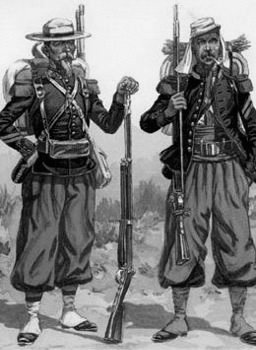
The French intervention in Mexico began in January of 1862 just after the arrival of Spanish and British troops in Veracruz. This initial commitment consisted of 2,000 French marines and 600 zouaves from the French Army of Africa. With the perpetual chaos in Mexico about the only revenues the government could count on were the import tariffs collected at the coast such as the principal port of Veracruz. However, the low lying coastal areas of Mexico are notorious hotbeds for disease and it is no wonder that Mexican President Benito Juarez took no action against the foreign presence and allowed sickness to decimate their ranks for him. By the middle of the following month the Spanish and British had had enough and after receiving new promises from Juarez pulled their troops out. The French, however, remained and had more far reaching goals in mind.

The Legion in Mexico
The French Imperial Army was strengthened by some 3,000 men under the command of the Brigadier General Ferdinand Latrille, Comte de Lorencez. On the same day that the other powers pulled out the French Empire effectively declared war on the liberal republican regime in Mexico City. After advancing to Cordoba General Lorencez issued a pronouncement which stated that France would pacify the country, restore order and he actively called for the recently defeated conservative faction to launch a counterrevolution. The French army was, at that time, fresh from victories in Africa, Italy and the Crimea and was considered possibly the best in the world. Throughout the length of the French intervention in Mexico the troops involved by the French Imperial Army included elements from 6 line infantry regiments, 3 zouave regiments, 4 light infantry battalions, squadrons from 3 cavalry regiments, 6 artillery batteries, 5 companies of engineers, 1 supply train squadron, colonial troops from Martinique, Algeria and the Foreign Legion, 1 marine regiment, 1 battalion of sailors and 1 battery of naval (marine) artillery. According to the treaty signed with then Archduke Maximilian of Austria the French Foreign Legion was supposed to remain in Mexico for 6 years even after all other French forces had withdrawn to form a corps around which the new Imperial Mexican Army could be built.

General Forey
To be sure, the French Imperial Army was a grand spectacle and carried an illustrious reputation with them as they began the march inland to Mexico City. However, this may have worked against them by causing a severe case of overconfidence. This was realized on the famous battle of the fifth of May when General Lorencez launched a frontal assault on the liberal stronghold at Puebla defended by Mexican troops under General Ignacio Zaragoza. The French were soundly repulsed in a bloody battle celebrated as a national holiday ever since and General Lorencez was forced to withdraw back to Orizaba to lick his wounds and wait for reinforcements. Emperor Louis Napoleon of France responded by increasing the size of the French forces in Mexico to 28,000 and gave the top command to General Elie Frederic Forey. As the French prepared to renew their advance Forey was most concerned with his long supply lines from Veracruz. To keep these lines open he entrusted their defense to the Foreign Legion and a battalion of Sudanese troops provided by the Khedive of Egypt. It was thought these African soldiers would be better able to resist the disease-ridden climate on the coast. Whether that was true is debatable but they earned a reputation for discipline, good order and for considerable cruelty toward the local populace.

After the debacle at Puebla it seemed that the French army began to take the whole enterprise more seriously. Many officers even adopted a more native appearance, in typical French style, wearing their coats open with wide sashes and large sombreros on their heads to shield them from the tropical sun. They also made use of allied Mexican forces such as the conservative troops under the fearsome General Leonardo Marquez who won a smashing victory at the battle of San Lorenzo in March as the French moved up to take Puebla again, this time by siege. This time, however, it was the Mexican republicans who made a stupendous mistake. Puebla was the only really half-way defensible place on the road to Mexico City and Juarez decided to gamble everything on holding Puebla despite the fact that the French were better trained, better disciplined, better armed and more experienced that his own forces and, despite the earlier Mexican victory there, in any face-to-face fight between the French and Mexicans the smart money would be on the French army. Nowhere was this more evident than in a little battle along the French line of supply that may not be as widely celebrated as Cinco de Mayo but is actually an even more remarkable battle and is still celebrated today as the official holiday of the French Foreign Legion.

The battle revolved around a French wagon train that was taking a payroll of three million in gold from Veracruz to the French forces at Puebla. The liberals quickly sent a force of republican cavalry and militia to grab the gold and a company of the Foreign Legion was dispatched to intercept them. The two sides met at the hacienda of Camaron on April 30, 1863 where Captain Jean Danjou and 62 legionnaires confronted 2,000 Juaristas. The legionnaires repulsed several cavalry charges after being caught in the open before barricading themselves in the nearby hacienda where they repelled attack after attack inflicting heavy losses on the Mexican republicans. After almost literally fighting to the death the legionnaires were overwhelmed and forced to surrender with only five of the original 62 still alive. This was a stunning example of the tenacity and effectiveness of the French Imperial forces and demonstrated why it was a good idea for the Mexican republicans to avoid formal battles with them considering the trouble they had defeating 62 men with 2,000 at their disposal.

Given that, it was not surprising that after two months under siege the Mexican republicans at Puebla surrendered on April 17, effectively clearing the way to Mexico City. Juarez, for his part, did not even try to defend the city and evacuated his government to San Luis Potosi and a week later General Forey and the French army marched into Mexico City and began establishing the conservative junta that would direct national affairs until a new government could be formed. It was this junta that eventually gave way to the triumvirate that invited Archduke Maximilian of Austria to become Emperor of Mexico. However, Napoleon III was bothered by the fact that his top commander, General Forey, seemed to have lost faith in the expedition and was extremely critical of the situation on the ground and the long term prospects for success. However, as he could hardly punish such a successful commander the Emperor decided to kick him upstairs by promoting him to the rank of Marshal of France, recalling him and replacing him with one of his divisional commanders General Francois Achille de Bazaine.

To be concluded in Part II...

Related Posts Plugin for WordPress, Blogger...