Monday, November 26, 2012

Story of Monarchy: Albania

The story of modern Albania as we know it today began in 1912 when lasting Albanian independence from the Turkish Ottoman Empire became a reality. Of course, the roots of Albanian history go back much farther. The area was settled, early on, by the Roman Republic and was part of the Roman Empire, later the East Roman Empire, for centuries. With the decline of East Roman power it came under Slavic control and part of the Bulgarian Empire with the Albanian people we think of today and a unique Albanian state emerging later in the Middle Ages. During the period of Turkish rule, Albania was often neglected and for a considerable period of time the coastal areas came under the control of the Italian city-state of Venice. Yet, Albania produced a great many people who became very prominent officials in the Ottoman Empire. Many of the men who held the position of Grand Vizier (high advisor or roughly equivalent to a prime minister) to the Sultans were from Albania and it was, as most monarchists know, an Albanian general in the Ottoman army which founded the dynasty that ruled Egypt until 1953.

Skanderbeg
During this early period the greatest Albanian national hero came on the scene who led an early fight for independence against the Turks. This was George Skanderbeg (a Catholic convert from Islam) who became, not only an Albanian national hero but a fighting celebrity across Christendom for his decades long struggle against Turkish expansion in his area. He was actually intended to be the chief commander of the crusade Pope Pius II called for but which never came about. Skanderbeg was involved in other political causes outside Albania and was famous far and wide but to his own people he was an inspiration for independence. Strictly speaking he recognized the King of Naples as his feudal overlord but in effect he ruled Albania independently though Ottoman rule was restored after his death. Still, his example would provide an honored memory for later independence advocates to rally around. However, when that time came, the attitude of the rest of Europe would be somewhat different than it was in the time of Skanderbeg.

There were rebellions and struggles against a weakened Ottoman Empire after 1910 with Albanians finally declaring their independence. The nations of Europe recognized this in 1913 but many Albanians were upset at how their borders were drawn and they had trouble finding a national leader or a national leader the rest of Europe would respect. The first modern Albanian monarchy came about in early 1914 with the elevation of the German Prince Wilhelm von Wied to be Sovereign Prince of Albania (to the rest of Europe, in Albania he was titled as King). His aunt, the Queen of Romania suggested him for the job and he turned it down before the Austrians persuaded him to accept. He went to Albania to take up his throne, adopting the reigning name of Skanderbeg II in tribute to the traditional Albanian hero. But the odds were certainly stacked against his long-term success. Naturally, many Albanians viewed him as an outsider but even many in the rest of Europe were not ultimately of help because few seemed to take Albanian independence seriously. During the “Scramble for Africa” the Kingdom of Italy had wanted Tunisia but hoped to gain credit for being quiet and modest. They received nothing, France grabbed Tunisia and when Italy complained they were told to look to Albania if they wanted a colony. Likewise, many in Romania expected Albania to follow their wishes because Prince Wilhelm had been nominated by the Queen and Austria-Hungary, which heavily subsidized Albania, practically viewed the principality as an unofficial part of the Hapsburg empire (and got rather testy when Prince Wilhelm refused to contribute Albanian soldiers to the Austro-Hungarian war effort in World War I).
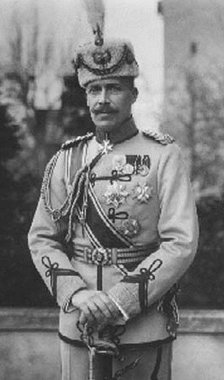
Prince Wilhelm
Inside Albania there was a good deal of opposition to Prince Wilhelm and the war was a good excuse by others to make grabs for Albanian territory and the Albanians themselves were still upset about their national borders. Civil war soon broke out, Greek forces, acting independently (that country was highly divided as well) invaded southern Albania and as the chaos spread Italian forces landed, eventually linking up with the Allies from Greece to form a united front in the Balkans. By that time, Prince Wilhelm had already left the country, it having become ungovernable by the fall of 1914, and moved to Venice though he did not abdicate his throne. He joined the Imperial German Army under an alias and hoped that he might be restored once the Austro-German armies had driven the Serbs and Montenegrins out of Albania but this was not to be. Needless to say, because he chose to join the losing side, he would never return to Albania as the Allied powers would certainly not have tolerated it. When talk began of restoring the Albanian monarchy under a local ruler, Prince Wilhelm reiterated his claim, pointing out that he had not abdicated and that the Albanian throne rightly belonged to his family. He remained defiant to the last and died in Romania in 1945, still claiming to be Prince of Albania.

In the aftermath of World War I the situation in Albania was still far from stable and it was not until 1924 that a new government was officially declared and recognized by the other powers. Again, however, one has the impression that most outsiders did not take Albanian independence seriously as the Allies effectively recognized it as an Italian protectorate as well. There had been plans to partition the country and Albania was plagued by in-fighting and assassinations. A list of all the marriage-alliances, foreign ties, coup attempts and actual coups could fill a library. Suffice it to say though that the most successful man on the ground was Ahmed Bey Zogu. He first seized power in 1922, during a time of great confusion, but by 1924 was forced to step down and leave the country. However, in time he came back with support from the Kingdom of Yugoslavia, anxious to increase their influence. Ahmed Zogu accepted their help but had no intention of putting their interests before those of Albania. After taking power again, a republic was declared with Ahmed Zogu as President with dictatorial powers and to compensate for the loss of Yugoslavian support (who felt themselves betrayed) he turned to the Kingdom of Italy, by that time under the control of Benito Mussolini.

King Zog I
In 1928, having secured his position as much as possible under the circumstances, the Albanian government restored the monarchy and named the President “King of the Albanians”. King Zog (who also took the name of Skanderbeg III in keeping with the tradition established by Prince Wilhelm) began his efforts to turn Albania into a more modern country. However, he was plagued by problems from the very start. Many of the established elites resisted his reform efforts and after a number of assassination attempts the King lived mostly in seclusion. In 1938 he married the glamorous Hungarian-American Geraldine Apponyi de Nagyappony who he made a princess prior to the marriage. However, being self-named royals, the other dynasties of Europe never really accepted them as one of the club, though doubtless attitudes would have changed had they been able to maintain themselves longer. Life in Albania remained a struggle for most people and harsh divisions remained and many of the Muslims who had been his base of support were turned off of King Zog because of his “western” lifestyle, his wife, his fondness for gambling or any number of things. King Zog was in an unenviable position and it is, perhaps, no wonder that he came to hold the world record for being the heaviest smoker in history, puffing away some 225 cigarettes a day.

Development was occurring but it was painfully slow and the warring factions never really went away. Most dangerous for King Zog was the extent to which Albania had become indebted to and dependent on Italy for financial support. The King realized this and tried to distance himself but it was too late and Albania was still not able to stand alone. He nationalized the Catholic schools, dismissed Italian military advisors, cut the national budget and tried to make other alliances. However, Yugoslavia was unfriendly, as was Greece (whom the British were allied to) and Germany was on the side of Italy. In any event, the Nazi Party could not have been pleased when King Zog humanely opened Albanian borders to Jews fleeing persecution in Germany. Despite all the foreign investment, Albania also remained quite poor and in 1939 King Zog defaulted on the loans from Italy. Mussolini ordered the occupation of Albania shortly afterward, Italian troops landing just after King Zog and his family left the country for Greece.

King Victor Emmanuel III
King Zog settled in England while the Albanian government declared him deposed and King Victor Emmanuel III of Italy added “King of Albania” to his list of titles. The situation was stabilized, by force, but the old divisions remained. Some supported the Italians, some supported King Zog, some wanted another option and some supported a communist dictatorship. It was, however, during World War II, after the Axis conquests of Yugoslavia and Greece, that the “Greater Albania” so many nationalists had yearned for became a reality. The Kingdom of Albania was enlarged by the annexation of Kosovo from Serbia, border areas of Montenegro and parts of northwest Greece. The circumstances, however, by which this was achieved left many still dissatisfied. But, it was not to last and in 1943 came the dismissal of Mussolini by King Victor Emmanuel III who also abdicated as King of Albania. It was, oddly enough, the King of Italy who would be the last monarch to actually reign over Albania. King Zog was declared restored by the government but he did not return home, Albania was quickly occupied by the Germans and in the aftermath of World War II the Soviet Union ensured that the communists seized power. King Zog would never see his country again, despite his best efforts to restore himself from exile.

Albanians loyal to King Zog never wavered in their support of him over the years and declared his son Crown Prince Leka to be “King of the Albanians” as his father had been when Zog died in 1961. However, the Kingdom of Albania was never really able to firmly establish itself and become accepted nor was the title of King Zog ever widely recognized by the international community. Part of this was the means by which he became “King of the Albanians” and part was the title itself, implying claims to Albanian populated territories within the borders of Allied countries from World War I like Serbia or Greece. The royals courts, at that time, were also still reluctant to accept self-made royalty. Royals marrying commoners was still illegal in most European monarchies and taken altogether it is not surprising that, when in power or in exile, the other royal families had little to do with the House of Zog. That attitude, however, has not been replicated by most monarchists and I at least have been surprised by how much widespread monarchist sympathy there is for the legacy of the late King of the Albanians. To compare, I have seen more objections to the Emperor Napoleon as not being a “real” royal figure than I have to King Zog even though one might expect the reverse. Why is this?

"King Leka I" and "Queen Susan"
I can only offer an educated guess but I would point to several factors. For one, the history and details of Albania and King Zog are not widely known and people are more apt to feel strongly about a subject they feel closer to or know more about. For another, King Zog lost his throne because of an invasion launched by Mussolini and anyone who is a victim of the forces of Fascism gains automatic sympathy with the wider world. The biggest reason though, I think, was the fate of Albania after the triumph of communism in the absence of Zog after World War II. There was probably no more nightmarish country in the whole of Europe. Under the Marxist fanatic Enver Hoxha, Albania had the lowest standard of living of any country in Europe. The man was such a radical, bloodthirsty and fanatical Stalinist that eventually the Soviet Union, Red China and Communist Yugoslavia all shunned his regime as being far too extremist. When Chairman Mao thinks you’re taking Marxism too far -you know you have a problem. Given that, while far from ideal, the reign of King Zog was positively paradise in comparison.

Leka II and Elia Zaharia
It is also to the credit of King Zog and Crown Prince Leka that, in spite of the obstacles against them, they did not just accept their exile and settle down to a comfortable life. They never surrendered their claims and never gave up the struggle to one day restore the Kingdom of Albania. This went on even when it included risks and got Crown Prince Leka into some trouble for stockpiling illegal weapons. Then, after the collapse of the Soviet bloc, when a referendum (no more fair than any prior Albanian votes) found against the monarchy and in favor of the republic, he attempted an armed uprising (damn straight) before being forced to leave the country again. I know, probably not the sort of thing most would condone, but I cannot help to cheer a little bit when a royal pretender takes some action rather than just sitting down and accepting unfair treatment. Anyway, since that time he was pardoned and allowed to return, kept up the political fight and was able to die in the country of his birth. Since that time his son, Leka II, has carried on the family legacy, recently seeing his grandfather’s remains returned to Albania for reburial. He works as an advisor for the current president but still maintains the royal legacy as well as support for the unification of the Albanian peoples including the annexation of Kosovo. Some monarchists might cringe at a royal claimant working for a president but in the case of Albania it seems a legitimate way of staying relevant and engaged on the national scene. And, after all, his grandfather was president before he was king. Restoring a monarchy is always extremely difficult but, in Albania, the chances seem brighter than in a great many other countries. Leka II might be just the young man to do it.

Sunday, November 25, 2012

Christ the King Day

MM Sunday Scripture

But the king shall rejoice in God; everyone that sweareth by him shall glory: but the mouth of them that speak lies shall be stopped.
-Psalm 63:11

Saturday, November 24, 2012

Royal News Roundup

In the Far East, last Saturday Their Imperial Majesties the Emperor and Empress of Japan visited Okinawa for the first time in eight years where Their Majesties met with survivors of the battle there and paid their respects to those who lost their lives in the brutal battle that saw the largest amphibious assault of World War II in the Asia-Pacific theater. This was the fourth visit of the Imperial Couple since His Majesty became Emperor of Japan. During the four day trip Their Majesties visited the peace memorial, the national cemetery for war dead and had exchanges with several groups of survivors. One such survivor was Masakatsu Takara who lost nine family members on the Tsuchima Maru, a civilian ship evacuating civilians which was sunk by an American submarine, taking the lives of 1,400 people on board, about half of whom were children. This tragedy bears a special significance for the Imperial Couple who say a special prayer every year on the anniversary of the sad event. All those present were deeply touched by the concern of Their Majesties and hoped they would visit again. A diary, just made public, revealed that His Majesty the Showa Emperor had previously sought to visit Okinawa shortly after it reverted to Japanese control but was never able to do so. Also, in a recent interview, HIH Princess Hisako of Takamado spoke of how she still misses her late husband, Prince Takamado, even ten years after his death. And, to the south, on Sunday, President Obama and Secretary Clinton visited HM King Bhumibol Adulyadej the Great of Thailand at the Siriraj Hospital in Bangkok where the King has been staying since 2009.

In the Middle East, despite the near war in Gaza, the embattled King of Jordan remained in the news. In a meeting with former British PM Tony Blair, King Abdullah II called for, “the need to speed up regional and international efforts to bring an immediate halt to Israeli aggression and military escalation” and called the Israeli air campaign against Hamas rocket sites and leaders a, “dangerous threat to the security and stability of the region, increasing the suffering of Palestinians in the strip”. He called again for a “two-state solution”. However, his own problems closer to home remain as the people protesting in the streets take on a more anti-monarchy tone. Some still claim the King is not the target of their anger but demonstrations increasingly include chants of “Down, down with the king”. Protests have turned violent and have provoked clashes with police forces. The howling mob blame the democratic reforms the King introduced for not going far enough. One member of the Muslim Brotherhood stated that they were not calling for the overthrow of the King but held the anger against him out as a warning to give in to their demands.

On the European front, TSH the Prince and Princess of Monaco presided over National Day celebrations with HSH Prince Hans-Adam II of Liechtenstein as their special guest of honor. In the Low Countries, Belgian Crown Prince Philippe and Crown Princess Mathilde came to the Commonwealth of Australia at the behest of the Belgian Foreign Trade Agency and which includes a delegation seeking closer ties between Australian and Belgian universities in several areas. In The Netherlands, HRH Princess Margriet was awarded an honorary law degree by McMaster University in Canada for her lifelong commitment to humanitarian causes. Closer to home, there may be signs of a turnaround for Prince Friso who has been in a coma for the last nine months following a skiing accident. Previous reports seemed to say to expect the worst but now tests have shown “signs of limited awareness”. The second son of HM Queen Beatrix is being treated in Wellington hospital in London for severe brain damage after being buried in an avalanche for 25 minutes. His wife, Mabel, said, “This is the most challenging period of my life. My love for Friso, the support of family and friends, and the many signs of compassion give me strength in these difficult times”. On a happier note, Princess Maxima of Orange and her girls were on hand to welcome Santa Claus (or Sinterklaas) to Scheveningen as part of a long standing tradition honoring the national patron St Nicholas.

Up in Scandinavia, HM the King of Norway is still apologizing over that medal controversy from last week. In Sweden, HM King Carl XVI Gustaf handed out the Prince Eugen medals for artistic achievement while the Queen met with leaders from North Africa. HRH Princess Madeleine, back in the USA, visited Lawrence County, Ohio to check in on the GRADS project that supports teenage parents (“mothers” would probably be more accurate, I saw no dads in the pictures). Across the North Sea in Britain, HRH the Prince of Wales has agreed to a secret out-of-court settlement to the butler who claims he was “bullied” for refusing to work at Clarence House. The Prince of Wales also said that if he we don’t all embrace the “green” movement we’re pretty much all going to die! I for one am quite confident I’m going to die in any event. A recent poll showed that HRH the Duke of Cambridge is the most popular royal in recent history with HM the Queen taking second place in “job approval” and Prince Harry coming in third. And in a bit of heartwarming news HM the Queen and HRH the Duke of Edinburgh celebrated their 65th wedding anniversary this week making Her Majesty the longest wedded monarch in British history.

In more sober news, HM King Juan Carlos I of Spain entered the hospital on Friday for hip replacement surgery, his sixth operation in two years and the most extensive I think so far. However, His Catholic Majesty was his usual casual self about it, joking with reporters that, “Today I am definitely going into the workshop” as he entered the San Jose Hospital in Madrid. All of this comes at a difficult time for the Spanish monarchy as economic problems have caused many to lash out in any direction and seize on anyone as a focus of public anger. It does not help that the King’s son-in-law is now facing a four million euro bail payment and that the King’s private (and privately funded) trip to Africa was overblown to such an extent. Protests against government cut-backs have become common, with many of the protestors carrying republican flags and there has been growing support for the secession of Catalonia. God save the Kingdom of Spain.

Thursday, November 22, 2012

Happy Thanksgiving

As most long-time readers know, I don't "do" Thanksgiving, but for those of you who do, I wish you all a happy one. I will spare a repeat of my position regarding the holiday but will simply point back to an older post on the real first Thanksgiving which was, of course, in Texas. Read about it here.

Be on the lookout in the coming days for a new series here at The Mad Monarchist called "The Story of Monarchy" which will be short histories (with commentary of course) on the overall history of monarchies of the world and, for those which are now republics, how they have fared since. -MM

Restore the Red Ensign!

I would like to direct the attention of readers (particularly those in the Commonwealth and Her Majesty's Dominion of Canada) to this video with Canadian journalist Brigitte Pellerin on the removal of the Canadian flag by the minority government of Quebec. I applaud Ms. Pellerin and could not agree with her more. She points out that, aside from their flag antics, members of the Bloc Quebecois frequently "mumble" their required oath of loyalty to Her Majesty the Queen, basically acting childish about a supremely solemn moment because of their stupid anger, some even shouting "Vive la Republique" at the end, but who still are glad to accept the Queen's salary. Particularly though, I agree with Ms. Pellerin in pointing out (correctly) that the adoption of the Maple Leaf flag in the first place was an effort to placate Quebec and that if this flag is no longer acceptable then it should be discarded entirely and the Canadian Red Ensign restored as the national flag of Canada. I like the Maple Leaf fine but the Red Ensign was the first, true national flag of Canada and there was no reason to get rid of it. I would be thrilled to see it come back. God Save the Queen of Canada!

Wednesday, November 21, 2012

Consort Profile: German Empress Augusta von Saxe-Weimar-Eisenach

Often overlooked by history, when King Wilhelm I of Prussia presided over the unification of the German states to become the first German Kaiser, the woman at his side, through it all, was Augusta von Saxe-Weimar-Eisenach. She was born Her Serene Highness Princess Augusta Marie Luise Katharina von Saxe-Weimar-Eisenach on September 30, 1811 in Weimar, the second daughter of Grand Duke Karl Friedrich and Grand Duchess Maria Pavlovna of Russia (who was the daughter of Tsar Paul I of Russia). Although her father was a rather simple man, her mother was a known intellectual who befriended and corresponded with some of the most famous thinkers of her day and thanks to her influence the Princess Augusta received an exemplary education. Very well rounded, she was brought up to appreciate the usual subjects of language, history, mathematics, politics and so on as well as being well versed in the arts, particularly music and painting. Her introduction to the heirs of the King of Prussia came at a very early age.

King Friedrich Wilhelm III of Prussia thought the daughters of the Grand Duke excellent choices for his sons as brides and Princess Augusta met his second son, Prince Wilhelm, in 1826 when she was 15-years-old. At the time, Prince Wilhelm was infatuated with a Polish girl and in any event considered Princess Augusta less attractive than her sister Maria. She was off-limits though as his younger brother Prince Karl had his eye on her and the two were married the following year. Still, Wilhelm thought Princess Augusta a nice and charming girl and King Friedrich Wilhelm III encouraged him not to dismiss her as a potential bride. His marriage was considered of prime importance since the Crown Prince had yet to produce any children and so it looked as though it would fall to Prince Wilhelm to secure an heir to the Prussian throne. His Polish sweetheart lacked the pedigree suitable for a future Queen of Prussia. Finally, he came back to Princess Augusta and with pressure mounting to marry and start a family the two were finally engaged in 1828. It was not, exactly, a match made in Heaven.

The two were married in Berlin on June 11, 1829. Prince Wilhelm was fourteen years older than his new bride and admitted to his sister that he was not totally in love with her. He appreciated her kind nature and keen mind but, unfortunately, she just did not ‘stir’ his blood at all. Princess Augusta knew nothing of this and had an exalted view of her new husband and was filled with hopes for happiness, a house full of children and total domestic bliss. However, her rose-hued glasses soon fell away. Her intellectual interests made her rather unappreciative of the very militaristic Prussian court and she could not help but feel slightly put off by her sister-in-law, the Crown Princess, being given pride of place even though everyone knew the future of the succession would depend on Augusta. She thought well enough of the Crown Prince but soon fell into an ever deeper state of sadness due to the neglect of her husband. Too bookish for his tastes, in time he began seeing more “feminine” mistresses and Princess Augusta fell victim to bouts of depression. It was not until 1831 that the succession was finally secured when Princess Augusta gave birth to the future Kaiser Friedrich III. It would take seven more years for another child to be born, Princess Louise, and no more were forthcoming. There were other pregnancies but, tragically, all ended in miscarriage.

However, Princess Augusta was not unappreciated everywhere. Her friends and connections in intellectual circles fostered in her a growing support for social change. As such, she became rather well regarded in the liberal circles that had hoped for the accession of King Friedrich Wilhelm IV to bring about a new, democratic and united Germany, only to see their hopes dashed. Unfortunately, this reputation certainly could not have helped her situation at home considering the very traditional and conservative views of her husband. Crop failures and rabble rousers helped bring about a growing discontent that resulted in several small rebellions before the outbreak of the revolutions of 1848. Princess Augusta hoped her brother-in-law would work with the liberals and unite Germany as well as giving Prussia a constitution. He would do neither and Prince Wilhelm was at the head of those urging his brother to set the army loose on the liberal mobs, which probably did not please his wife. Even after the worst danger was suppressed, public anger was so great that Prince Wilhelm had to leave the country. Frustrated liberals hoped that, perhaps, the King and Prince Wilhelm could be made to abdicate and Princess Augusta, who was more to their taste, could rule as regent in the name of the little Prince Friedrich to create the sort of state they desired.

Because Augusta later burned all of her papers from this period it can never be known if she was party to or even supportive of such designs. She was certainly disappointed that the King did not take the lead in the unification efforts but outwardly she always remained supportive of her husband and the Prussian monarchy as it was. They moved to the Rhineland when Prince Wilhelm was posted there and more liberal-minded people continued to visit her. The court in Berlin, naturally, disapproved of this as they disapproved of her ideas on education, her tolerance of and friendship with Catholics and the way she was raising little Prince Friedrich, ensuring his training was academic as well as military. The liberal attitudes Friedrich later displayed were often (mostly in Berlin) “blamed” on his British wife but the upbringing his mother gave him also had a great deal to do with it and she was, naturally, perfectly thrilled when he became engaged to the Princess Royal for the same reason Queen Victoria and Prince Albert were. Aside the personal happiness they clearly had together, she too hoped that they would be the future rulers of a united Germany that was a democratic and progressive constitutional monarchy.

Nonetheless, she was never a pushy woman and never even tried to exercise much political influence on her husband, despite often being accused of doing so after Wilhelm succeeded his brother as King of Prussia in 1861. When Bismarck came to power he assumed that Queen Augusta was responsible anytime King Wilhelm I did not immediately bend to his wishes and it was no great secret that Augusta and Bismarck despised each other. The Queen was distressed at how Bismarck handled the government and was positively outraged when he provoked a war with Austria to push the Hapsburgs out of German politics. Over time she became more and more opposed to the entire direction Prussian foreign policy was taking and this also caused a falling out with Crown Princess Victoria (“Vicky”) who, despite her own differences with Bismarck, allied with the chancellor in his goal of uniting the German states under Prussian leadership. Her opinion of her daughter-in-law fell lower and lower as she regarded her as being insufficiently religious and lacking in her sense of duty to the monarchy. She did, however, think very highly of her first grandson, the future Kaiser Wilhelm II, and put her hopes for the future in him.

Augusta despised the outbreak of war with France just as deeply as she did the war with Austria and (rightly) blamed Bismarck for all of it. Warfare went against her very nature as an open-minded, intellectual type and she devoted herself to organizations to care for the wounded. When, in the aftermath of the defeat of France, she became German Empress alongside her husband, she was not at all flattered and considered it a calamity. She was convinced that only moral persuasion could unite the Germans and that a unity based on military conquest would never last. She was unhappy about it but it was, sadly, only the latest unhappiness in a married life that seemed to be filled with little else. Nonetheless, she was dutiful to the last, even when infirmity confined her to a wheelchair. Her marriage had long been little more than a formality but she and the Kaiser did finally reconcile but only a year before his death of extreme old age. She lived to see her son and grandson become German Emperor in their turn before she finally passed away on January 7, 1890 in Berlin at the age of 78.

Tuesday, November 20, 2012

Favorite Royal Images: Belgian Cherub

HRH Princess Marie Jose of Belgium, who would go on to be the last Queen of Italy

Monarchist Quote

“We have been given an assignment as a monarchy, and we do as well as we can…We try to be as little populistic as possible. We don’t do anything on the spur of the moment to win an opinion poll, or short-term popularity.”

-King Harald V of Norway, 2005

Monday, November 19, 2012

National Day in Monaco

Today is 'National Day' in the Principality of Monaco and this year there was a special guest of honor; HSH Prince Hans-Adam II of Liechtenstein (micro-monarchy solidarity!). Photos can be seen at our sister-weblog Mad for Monaco, with more to come tomorrow.


Slander Against the Belgian Heir

Recently, the gutter press has produced an infamous book (the latest of several) slandering the Belgian Royal Family. This one, however, is somewhat different than the rest. It is disturbing in its origin, coming from a member of the Walloon press whereas most slanderous attacks on the Royal Family have originated in the vile ranks of the Flemish separatists. In the past, it has often seemed that whenever one side made trouble for the monarchy, the other would instinctively rally to support it. If attacks begin to come from both sides at once, it certainly does not bode well for the wellbeing of all Belgians as a whole. Another is that, in this book, the slander extends beyond the ‘usual suspects’. The King himself has often been a target and he has occasionally ‘put a foot wrong’. The same can be said for Prince Laurent, a fine man but one who any observer would have to say has not always displayed the best judgment. This book, however, also includes slander against the Queen and the Duke and Duchess of Brabant. Additionally, whereas previous attacks often included exaggerations of problems or taking some small bit of embarrassment and trying to stretch it to the level of scandal, this work, frankly, lies blatantly and ostentatiously with no regard for fact or the slightest ounce of believability.

The whole thing is beyond reprehensible and should cause any decent person to recoil in disgust and certainly any proud, patriotic and loyal Belgian (let us pray for those still in existence) in particular. It is, however, the attacks on Prince Philippe, Duke of Brabant, that personally infuriate me the most. The same goes, of course, for his lovely wife Princess Mathilde, but she has not suffered the same level of ridicule as her husband though she herself has also been treated with the most gross injustice too. The attitude toward Prince Philippe has troubled me for years. I think he is one of the most unfairly treated royals in the world today, due certainly in part to the fact that, in my opinion, he is one of the best. Of the reigning monarchies, I don’t think there is any royal heir I hold in higher regard than Prince Philippe. Yet, not everyone seems to share my opinion and I cannot imagine why. At least, I cannot imagine any valid reason why and it causes me greater distress to imagine that Prince Philippe is actually being ridiculed not in spite of but because he is such a good, decent, upright and God-fearing man.

A few years ago I saw a story about the low “approval rating” Prince Philippe had in Belgium and this prompted me to put my own perceptions aside and investigate, to see if there was some scandal I was unaware of that would account for this. After all, the report said that his approval rating was even lower than the Prince of Wales who, let us be honest, has had a few embarrassing scandals, had gone through a messy divorce and attracted a great deal of anger (most of it unjustified but what else is new). I scoured royal gossip columns and the royal message boards and I found nothing scandalous at all in the history of Prince Philippe, but I was alarmed at what I did find. Based on my own findings, rather than Prince Philippe and Princess Mathilde, it is the public and the gossipmongers and royal watchers who are the abnormal ones, who seem too “uptight” and who need to “just relax”. Never have I seen so much made of so little! No, I cannot even say ‘of so little’ since that would imply there is some little something there at all when there is absolutely nothing! It leaves me, frankly, baffled (as a lot of things these days seem to).

There has been no divorce, no affairs (nor even rumors), no international insults, no recorded phone conversations, no interns under the desk and no getting sick on foreign officials. There have been no scandals of any sort and no doubt about the couple being totally devoted to their duties, their people and country. All the criticism I saw was so un-specific and full of phrases starting with, “he seems”, “she appears”, “they come off as” or “I get the feeling that…” For so many people to have such a low opinion of the Crown Princely couple based on nothing more substantial than feelings and appearances is frankly alarming to me. Some things are matters of taste -who “seems” confident or who doesn’t, how the Princess dresses and so on. Other things are just, again, baffling. I noticed the word “clumsy” being tossed around a great deal. Why? Again, there was no substantial reason to point to that would justify it. Prince Philippe never pulled a Gerry Ford and he never dropped one of his children or anything like that. No, it all goes back to “he seems”, “he comes off as” and “I have the feeling that…” which just infuriates me.

Anyone who takes an honest look at the Belgian crown princely couple will see nothing but an upright, dedicated and affectionate couple. Prince Philippe, who is so often described as “stuffy”, “uptight” or “awkward” will see him, when in the presence of his children even to this day, shed his years and appear as a delighted and loving first-time father. One need only look at the photos and videos of the couple, and see them simply look at each other to see the true affection they have for one another. Why did it take so long for Prince Philippe to marry? I have a simple answer; a good woman is hard to find. Sometimes it takes time and for someone in the position of a royal heir, it is certainly understandable to take more time than usual to find that someone special and Princess Mathilde certainly seems to me to be well worth the wait. She has every quality I could imagine being necessary for a future Belgian queen-consort. Likewise, her husband has every quality necessary for a future king though, undoubtedly, many are trying their best to undermine one thing he needs which is the respect of his people.

All of this is why I can only assume that Prince Philippe is being ridiculed for being a good man rather than otherwise. How far Belgium has fallen since the reign of the late King Baudouin. In his time, already his people had fallen far from the character of their monarch, yet, his virtues were still respected even if a majority of his subjects no longer shared them. Today, on the other hand, Prince Philippe seems to be singled out for slander for sharing those same values. Much of this has to do with faith, make no mistake about it. King Albert II and Queen Paola, for all of their difficulties, have raised good and faithful children. Prince Laurent may make the eyes roll on occasion, but he has a lovely family and is devoted to them. Princess Astrid is a member of Opus Dei and takes faith as seriously as one would expect given that. Prince Philippe, who shares many of the same admirable qualities of his late uncle, is often ridiculed because of his faith and morality. When he served his time in the Belgian senate he dared to introduce a bill against pornography and he was met with laughter and derision as though he had made some mistake rather than having stood up in opposition to something which causes the abuse and objectification of women.

No, it is clear, the Crown Prince and the Crown Princess are being slandered not because of anything they have done wrong but because of all they do that is right. It is a deliberate effort by those who wish to see the monarchy destroyed (so as to destroy Belgium itself) to undermine the respect and affection the people should have for the future king and queen. It is also a sign of how far morality has fallen in Europe that virtue is mocked, faith is ridiculed and any who take religion seriously are derided as hopelessly “un-cool”. My heart goes out to them in the midst of these ceaseless slanders and to their faithful and patriotic people who have to endure so much for their good intentions by their very ill-intentioned countrymen. I am glad to see, with this book, the Royal Family ‘hitting back’ (so to speak) more forcefully than in the past and I hope all loyal monarchists and people of good faith everywhere will rally to their defense.

Sunday, November 18, 2012

MM Sunday Scripture


A divine sentence is in the lips of the king: his mouth transgresseth not in judgment.
-Proverbs 16:10

Saturday, November 17, 2012

Royal News Roundup

Far away in Oceania, the Prince of Wales and Duchess of Cornwall continued their tour for the Diamond Jubilee, visiting New Zealand. There was a traditional Maori greeting for the royal couple after which they visited Auckland where the Prince of Wales was in his usual good humor. When visiting Australia and being asked about being named as a fashion icon by GQ the Prince said, “Every 25 years I seem to come back in fashion”. The couple visited Wellington and the Prince met with one of the dwarves from the popular “Lord of the Rings” spin-off movie coming out soon. The Prince of Wales celebrated his birthday during the trip along with the wife of the PM who shares a birthday with the Prince. He was given 64 small cakes to mark the occasion and the dwarf, played by Mark Hadlow, dropped to one knee and said director Peter Jackson had released him to Prince Charles “to command as you see fit”. The Prince of Wales jokingly said, “This is the best birthday present I’ve had for a long time”. The royal couple went on to visit Feilding and Palmerston North, talked to some animal lovers and the Prince offered his condolences to the family of a recently slain New Zealand soldier. Before leaving they also visited Christchurch which is still recovering from the massive earthquake that devastated the area last year.

The most critical news this week has all been out of the Middle East where existing monarchies are trembling and Israel and Palestine are on the brink of war, a conflict which could certainly spread to include many others. In Kuwait tens of thousands of protestors packed Parliament square to protest voting law changes enacted by the Emir to protect national unity. “Arab Spring” slogans were chanted which does not bode well for the monarchy considering that the movement has led to the downfall of four national leaders so far. The opposition consists mainly of Islamists, tribal groups and liberal lawyers and students. These protests have been common for some time but have been becoming more broadly based and more defiant towards the monarchy itself in recent days. Onlookers have said that events in Kuwait could set a trend for radical change in the other Gulf State monarchies.

Perhaps even more seriously, the usually orderly Kingdom of Jordan has been subject to similar protests and after the announcement of a recent increase in fuel prices (later rescinded) these erupted into violent riots which threaten the very existence of the Hashemite monarchy. Leftist parties joined with the Islamic Action Front (a branch of the Muslim Brotherhood) last month and protests which were once directed solely at the government have more and more been directed at the monarchy itself with protestors chanting, “Freedom is from God, in spite of you, Abdullah”. This in a country were criticizing the King is a criminal offense, yet this is how far things have fallen. King Abdullah II and Queen Rania were once the beloved faces of a modern, moderate Islamic country with a friendly face to the world and well known in America with the King appearing on “The Daily Show” and the Queen a frequent guest of Oprah. Now angry mobs are burning their portraits in the streets. When whipped up, people will criticize anything and the King has been slandered for something as simple as his blue eyes and accent and the Queen for being featured in glamour magazines, hobnobbing with western celebrities and for being Palestinian in a country where some natives resent the large Palestinian presence. In 2010 a group of prominent generals actually published a letter denouncing the Queen. She began to take on a lower-profile but unfair criticism only shifted toward the King instead.

Other monarchies in the region have cut back on their support for Jordan (a resource poor country) and this has forced the King to depend more on the United States which, in recent years, pushed for more liberal reforms and greater democracy, particularly as the Obama administration embraced the “Arab Spring” as a positive development. The King tried to walk a fine line between maintaining his authority and increasing democracy but the public seems to have developed un-realistic expectations and when these were not fulfilled, discontent has grown. Much of it, however, would not exist were it not for the worsening economic situation, with loans from the International Monetary Fund increasingly hard to come by. This was worsened by the outbreak of civil war in Syria which has caused Jordan to be flooded by hundreds of thousands of Syrian refugees. There are also now increasing worries about a war between Israel and Palestine and whether countries like Jordan or Egypt will intervene. Speaking of the potential war in Israel, ailing King Abdullah of Saudi Arabia called for “reason” and “wisdom” in the unfolding crisis in a telephone conversation with Egyptian President Morsi whose comments have been rather more strident to the point of making thinly veiled threats of Egyptian intervention.

In Europe, the week started off with royals from the former Allied nations paying their respects to veterans on the anniversary of Armistice Day, marking the end of World War I. King Albert II of the Belgians visited the Tomb of the Unknown Warrior while over in London Queen Elizabeth II joined the Duke and Duchess of Cambridge at the Cenotaph to honor British war dead and veterans. In Norway, the Royal Palace announced, after some controversy, that they would be revoking the king’s service medal given to Trond Ali Linstad, a Norwegian Muslim convert who had been given the award for his work in integrating Muslim immigrants into Norwegian society but who had also made numerous anti-Semitic remarks as well as remarks viewed by some as homophobic and anti-democratic particularly in his support for the Islamic Republic of Iran. The Palace chief of staff apologized to Linstad for putting him into this position which has brought to light his previous controversial statements. And, after more than half a century on foreign soil, the late Ahmed Zogu, President-turned-King of Albania have been sent home. Ahmed Zogu became President of Albania and declared himself king in 1928. In 1939 he fled the country when Italian forces occupied Albania and with the communist takeover after World War II he was never able to return and died in France in 1961. His grandson and heir to the Zog royal legacy, Prince Leka, works as a political advisor for President Bujar Faik Nishani and some have been critical of the return of King Zog, claiming that the President is trying to gain political points by doing so. However, Albania is currently celebrating the centenary of its independence from the Turkish Ottoman Empire and so reconciling with the past is a completely appropriate thing at this time. King Zog will be laid to rest in a new mausoleum built by the royal family with those ceremonies taking place this weekend.

Thursday, November 15, 2012

The French Colonial Empire


Even most monarchists today prefer not to defend the colonial empires of old, though more monarchists are likely to than the mainstream which tends to totally condemn any and all colonialism even while they turn a blind eye to even worse but more subtle or indirect forms of colonialism today, usually carried out by republics. Yet, even more than that, even when it comes to monarchists, most will not respond favorably to any coupling of the words “French” and “empire”. I will not, today, be addressing the Napoleonic French Empire specifically (though each played a role and the second empire particularly had a lasting impact) but rather the wider, historical French colonial empire. It was the second largest colonial empire in the world, surpassed only by the British and although many monarchists dismiss it as a ‘republican empire’ the truth is that the roots of that massive colonial empire go back to the old Kingdom of France even if it reached its peak under the republics. As with all colonial empires, the French made their mistakes and there were examples of cruelty and injustice one could list. However, as with colonialism in general, these examples are often overblown or used to cast all colonialism in a negative light. In truth, the French “mission of civilization” was often just that and in the best sense of the term. Many parts of the world owe a great deal to La Belle France.

French colonialism could be traced back to the very beginnings of France or even before France was a united country. For the purposes of this article, we will not, but it should be remembered that it was French knights who made up much of the forces that fought in the Crusades and it was the Normans (originally Norsemen who settled in France) who fought and conquered from England to Ireland to Sicily and almost everywhere in between. There were, in the Middle Ages, Frankish kings (of the House of Anjou or the Angevins) on the thrones of England, Hungary and Croatia and Jerusalem. Earlier, of course, the Frankish Empire of Charlemagne covered most of central and western Europe. However, the colonial period of French history as most know it, began for the most part with the reign of King Francis I who, in 1523, encouraged the Italian explorer (who had already visited the North American coast on a French ship) Giovanni da Verrazzano to explore the area between Florida and Newfoundland in the hope of finding a passage to the Pacific. It was also King Francis I who, in 1534, commissioned the intrepid Jacques Cartier to undertake a similar mission and it was he who claimed the land he called “Canada” (which Verrazzano had dubbed “New France”) for King Francis I. This was the beginning of French Canada or Quebec as we know it today.

There were French efforts to claim areas of what is now Brazil and Argentina but problems at home and the already established powers of Spain and Portugal prevented these being successful. However, in 1608, Samuel De Champlain founded Quebec and, under the great King Louis XIV, the explorer La Salle claimed the Mississippi River valley for France, naming the area Louisiana after his King and Queen and also established a French fort on the coast of Texas (ensuring that the Fleur-de-lis still flies over the Lone Star State). The French colonial empire was obviously most extensive in North America and that is where most of the focus was along with some island holdings in the Caribbean which proved extremely lucrative though one in particular, Haiti, would prove extremely troublesome in the long run. When it comes to the French colonial presence in North America, one thing to keep in mind, is that real colonialism was extremely limited. Unlike the British, France did not send over large numbers of settlers to North America. Some came of course, but the French presence in North America was mostly identified with the rough and rugged frontier fur-trappers and the intrepid Catholic missionaries who worked to convert the natives to Christianity.

Because of this, the French were careful to avoid conflict with the American Indians if at all possible. They were more likely to befriend them and early on forged alliances with them. France did not want to conquer and displace the natives, the fur traders wanted to do business with them and the priests wanted to convert them and teach them Latin -both of which requires their goodwill rather than their hostility. Nor did they tend to hold themselves apart from the natives as, by comparison, the British did and there was much more intermarriage between the French and the Native Americans which ultimately produced the mixed-race ethnic group called the Métis in modern Canada. Today, most are as “White” as any other European-Canadian but they still hold on to the special status that their original native ancestry gives them. The fact that, when war broke out between France and Britain in North America, that so many of the Indians sided with the French shows clearly that they considered their interests to be better served in the hands of the King of France than in those of the Hanoverian King of Great Britain and Ireland. This would surely not have been the case if the French had been systematically oppressing the natives or being terribly cruel to them. The French, for the most part, were not viewed as foreign conquerors but as the people who shared new knowledge with them and traded valuable goods to them which they had never had before.

The French islands in the Caribbean were, unfortunately, a different story and life for the slaves on the sugar plantations there was usually horrible. However, while accepting that, one needs look no farther to see the value of the French presence even in this area than to compare the fate of Haiti after independence to those islands still under French administration today. The Kingdom of France established some outposts in west Africa but these were limited. More progress was made in India where, for a time, it was a real possibility that French influence would surpass that of Great Britain on the subcontinent. It was from their base in India that France made their first serious effort to gain a foothold in Southeast Asia by allying with the growing power of the Nguyen Dynasty. This was during the reign of King Louis XVI and, unfortunately, the outbreak of the Revolution meant that this original, greatly preferable relationship, would never have a chance to grow and subsequent Franco-Viet relations would not be so ideal. Likewise, the colonial empire of the old Kingdom of France was fairly well decimated in a series of clashes with Great Britain. British troops and their allies blocked the French in India during the Carnatic Wars and a British victory in the French and Indian War saw the end of French Canada. There were hopes of restoring Canada to French rule by intervention in the American War for Independence but this was thwarted when the fledgling United States signed a separate peace with Great Britain, leaving France with nothing but debts.

The Revolution, needless to say, was a disaster for the old French colonial empire and on the international front things were not improved by the creation of the actual “French Empire” under Napoleon who resigned himself to the loss of Haiti and sold the massive Louisiana Territory to the United States. He preferred to focus on expansion in Europe, though, for a brief period, he extended French influence over Egypt and the area of Palestine and Syria. Many view the sight of French Napoleonic troops tramping past the pyramids as an odd sight, but of course King St Louis IX had invaded Egypt with his French knights in the past and then as now the French language was not unknown in the Middle East. In the aftermath of the Napoleonic Wars, it was King Charles X who sent troops into Algeria, firmly bringing that area into the orbit of France for the first time. French power overseas and the “mission of civilization” was further expanded during the reign of Emperor Napoleon III. In fact, most of the French colonial empire as it is remembered today was built on the foundations established under the second Napoleonic empire.

Under Napoleon III, the French presence in Algeria was furthered and strengthened, French influence in the Middle East increased and the first armed intervention in Indochina was accomplished which would eventually lead to French control over all of modern Laos, Cambodia and Vietnam. It was also, famously, Napoleon III who made an effort to create a new French sphere of influence in the Americas with his intervention in Mexico as well as plans for French footholds in Central America and on the Pacific coast of South America. The French Empire is usually criticized for this, and certainly there is much to criticize, however, such failings are not the whole story and many great and beneficial deeds were accomplished. Good government tended to follow in the footsteps of the French Foreign Legion from Mexico to Algeria to Djibouti. Many Mexican villages had never known such basic advances as a regular and reliable postal service and freedom from bandit extortion until the arrival of the French Imperial Army. Although few would want to admit it today, when the French Imperial Army first marched into Mexico City they were met by mobs of cheering citizens.

Mexico, of course, did not work out due to the Union victory in the American Civil War, however, Napoleon III left a lasting French presence and influence in Africa and particularly the Far East. This included not only Indochina but also a sphere of influence in southern China after the Sino-French War and enclaves on the Chinese coast. There was also an expedition to Korea though that ended badly and was swiftly swept under the rug. When it comes to monarchy, while not perfect, the French Empire had a pretty good record. France sponsored the restoration of the monarchy in Mexico and, had that worked out, might have done the same in South America. The native monarchies of Indochina were maintained, even assisted in consolidating power in the case of Laos. Vietnam was a more unfortunate case but, even there, the real damage to the monarchy came after the fall of Napoleon III when the French Republic was running things. One reason this was possible was because of the degree to which colonial policy was the domain of the French navy and the French navy had a very strong Catholic and conservative officer corps, something seen all the way up to Admiral Georges Thierry d’Argenlieu after World War II who was one of the most adamant advocates of the restoration of the last Vietnamese emperor to lead a pro-French, non-communist Vietnamese state.

Unfortunately, when Napoleon III was tossed aside the French republic was, not surprisingly, far more anti-monarchy in their colonial policy. French rule in Africa was greatly expanded, Madagascar was brought into the empire but this time with the local monarchy being destroyed in the process. French rule expanded in Indochina but the republic planted the seeds of its own downfall by humiliating the Vietnamese emperor and by simply by their education of native peoples. Imagine a young Vietnamese boy like the future Ho Chi Minh going to a French school and being taught all about “liberty, equality and fraternity” and how the revolution against King Louis was a great and glorious thing only to then be expected to go home and kowtow to the emperor. Given these mixed signals, it is no wonder that so many of those who would become revolutionary leaders in the anti-colonial period, leading the fight against France, were themselves French educated. Future murderous dictators like Ho Chi Minh and Pol Pot were both members of the French Communist Party in France before such a thing even existed in Indochina.

Like other colonial powers, World War I saw the French empire in full flower with participants from Senegal to Saigon serving in France to contribute to the war effort. Likewise, World War II proved to be the beginning of the end of the French colonial empire. At first, France determined to fight to maintain it and in Indochina few people realize how effective the French forces were. They fought a longer and more aggressive war than the United States later did and France did it without ever resorting to conscription at home. The French forces were actually winning the war for the most part, despite sabotage on the home front, until all was lost in the desperate gamble at Dien Bien Phu. Even then, were it not for chaos and war weariness at home, France could have carried on even after that setback, but it was not to be. Other colonies fell away later until a serious effort was made to hold on to Algeria, which was even declared a part of metropolitan France. However, Algeria was eventually given up and the loss basically took the Fourth Republic with it.

Much of the memory of French colonialism is colored by the wars in Vietnam and especially Algeria. This is unfair and overlooks the benevolent record of the Kingdom of France in North America and the fact that, under Napoleon III, French colonialism was usually based on treaties with local rulers. It is also rarely considered how former colonies fared after independence. French rule in Indochina was not always pretty, but it was paradise on earth compared to the millions who were slaughtered later by native communist dictators. Even in Algeria, as ugly as the war was, things did not improve after independence. Algeria almost immediately fell into civil war, there have been conflicts and accusations of human rights abuses made by the Berbers against the Arabs and most of the last two decades have been spent with Algeria in a perpetual state of emergency with the repression that goes with it. It is also worth pointing out that some areas, such as French Guiana in South America (most famous for being the home of Devil’s Island) have been offered independence by the French government but adamantly prefer to remain a part of France. Clearly the French colonial empire had a considerable beneficial impact on many parts of the world and certainly more so during the days when monarchs still held sway over France.

Wednesday, November 14, 2012

Mexico, the Latino Vote and Maximilian


I addressed this issue somewhat during the controversy over the SB1070 bill in Arizona but given the high profile Hispanics (the majority of whom are Mexican-Americans) in all the talk about the recent election, I thought it worth addressing again. Also because some common and often repeated misconceptions need to be cleared up. I have heard over and over again that Hispanics were the key demographic in the last election; they are the reason Obama won and Romney lost. This makes sense considering that Hispanics are the fastest growing segment of the population in the United States with, again, Mexican-Americans making up the largest part of that group. In fact, there are now more Mexicans living in the United States than in Mexico. That, in and of itself, should tell the world something about what kind of country Mexico is. It is no paradise and they certainly cannot blame the tiny monarchist minority. Mexico only ever had two monarchs who together ruled for less than a decade and they shot both of them. But I have noticed some rather glaring inconsistencies when it comes to people, particularly on the political right in the United States, evaluating the state of the average Latino and/or Mexican-American at this time. Allow me to explain:

Over and over again I have heard that the Mexican-American community shares many traditional values with the American “right”. Over and over again I have heard that these people are overwhelmingly Catholic, very family oriented and value hard work and individual achievement. They should be voting for conservatives! Yet, at the same time, many of these same “talking heads” repeat statistics which almost totally contradict that line about Mexican-Americans that they continue, nonetheless, to repeat. First of all, yes, the vast majority are baptized Roman Catholics. They are, in fact, the vast majority of all Catholics in the United States at this time. However, only about 30% of baptized Catholics in this country actually attend mass regularly. That leaves a whopping 70% that do not. This shows when you consider that Latinos in this country have voted consistently, by wide margins, for the Democrat Party which champions numerous things opposed by the Catholic Church, including gay “marriage”, taxpayer-funded birth control and most importantly abortion. I am, as most know, from the great state of Texas and am very familiar with this situation. Hispanics are the majority of the population in Texas. Take a look at a map of abortions in Texas and you will see that the majority of them are done in the area along the southern border where there is the highest concentration of the Mexican-American population. It is this same area which is the most solidly Democrat in terms of voting allegiance in an otherwise very Republican state.

The same holds true on strong families and family values. People say that Hispanics value these things and yet Hispanics have the second highest illegitimate birth rate in the entire country with only the African-American community having more. So, these very Catholic, very family oriented Hispanics have a divorce rate comparable with other ethnic groups, the second highest number of illegitimate births and the second highest number of abortions. Like the rest of America, in terms of Catholics at least, most of them, likewise, do not attend Church regularly. Now, I should not have to state (but I shall) that these are general statistics. There are, of course, many devoutly Christian Hispanics, very family oriented Hispanics and these tend to support more conservative candidates. However, it is simply a fact that these are not the majority and it should be no surprise as to why. That is the point I think everyone is missing. Not only is much of what is said about Latinos factually incorrect but there is no reason why anyone should think those things would be true in the first place because they are based on false assumptions about Mexico itself.

Things like family values are strongly entwined with religion and religious beliefs and despite the popular perception of Mexico as a very religious and very Catholic country, this is simply not the case. Growing up right next door to Mexico, it took a good number of years before I ever even realized most of the rest of the U.S.A. saw Mexico as such an overwhelmingly Catholic country. I never did. Sure, almost every Mexican has a statue or picture of Our Lady of Guadalupe in their home and a rosary hanging from their rear-view mirror, but it is also a country famous for corruption, where anything and anyone can be purchased. I suppose growing up with both sides of the coin on constant display, I never noticed many people were only seeing one side. Another thing everyone on the border grows up with is the weekend rush of high school guys to the Mexican border towns. And no one went there to go to Church -trust me. So, even at a very early age, yes, I knew that most Mexicans were at least nominal Catholics but I also knew Mexico as the country where prostitution was legal, anyone could buy alcohol and where all the drugs came from. Statistics which list the religious affiliation of a people do not tell the whole story of the depth of faith of a country.

The fact is that for most of the recent history of Mexico, not only has it not been a devoutly Catholic country, it has in fact been a very anti-Catholic and generally anti-Christian country. Where did it all start? Believe it or not, it pretty much started with the fall of the last effort at a monarchy in Mexico. Actually, it was slightly earlier, but still a part of the same overall struggle. The reign of Emperor Maximilian was actually the last great hope for Mexico to be the devout and solidly Catholic country that everyone imagines it to be. I do not say that because of my own bias, it is perfectly true. The short-lived First Mexican Empire of Agustin de Iturbide had been very Catholic and even the republican regime that succeeded it generally maintained good relations with the Church and many of the succession of generals who subsequently seized power often had close ties with the Church. Even under so notorious a sinner as Santa Anna, Catholicism remained the one and only religion of Mexico with the acceptance of Catholicism one of the requirements for citizenship. However, all of that changed during the presidency of Ignacio Comonfort and the new constitution drawn up largely by his Chief Justice; Benito Juarez.

It was at that time, for the first time, hereditary titles were abolished, religious holidays were banned, religion was removed from the schools, religious marriages were no longer valid and public officials were even banned from attending Church. Catholicism was also dropped as the state religion. This was 1857 so, obviously, the roots of anti-clericalism in Mexico go back pretty far (and the country had only existed since 1821). This was a major part of the reason for the outbreak of the civil war between the anti-clerical liberals and pro-Catholic conservatives that preceded the French intervention and the establishment of the Second Mexican Empire in 1864. Benito Juarez also provoked conflict by confiscating all Church property and this certainly influenced Pope Pius IX in blessing the effort of Emperor Maximilian to restore Mexico to the status of an officially Catholic empire. As it turned out, Maximilian was not as strident as the Pope and the local Church hierarchy would have liked. Truth be told, there was plenty of blame to go around for the state Mexico was in when the new Emperor arrived and the Church had done a pretty terrible job at catechizing the people (not an uncommon problem, then or now).

Emperor Maximilian incurred the wrath of the Catholic Church by refusing to restore the vast properties Juarez had previously taken from then and for his insistence that religious freedom be upheld in his empire. Of course, he restored Catholicism as the official state Church but he would not punish people for not adhering to it. The Church could not have known (though they perhaps should have looked at the state of the world and been a bit more farsighted) that this was the best “deal” they were ever going to get in Mexico. Had Maximilian succeeded and the Mexican Empire survived, the religiosity of the country would certainly have been different than how things actually unfolded. For one thing, among the large volunteer corps sent over from Austria-Hungary, single, solidly Catholic men from across the Hapsburg realms were preferred in the hope that they would settle in Mexico after the war, marry and raise families, increasing the ethnic diversity of the country but strengthening its Catholic character at the same time. The fight between the monarchists and republicans in Mexico was, even if not everyone realized it at the time, the real pivotal clash between the clerical and the anti-clerical over domination of the country.

Anti-clerical = national hero
When Juarez emerged victorious, his anti-Church measures came back into effect and his successors were no better. His immediate successor, Sebastian Lerdo de Tejada, upheld the anti-clerical laws and even expelled the Sisters of Charity from Mexico. He was later overthrown by General Porfirio Diaz (who had gained fame fighting for Juarez during the second empire). A dictator, Diaz did bring about a period of law and order for the first time most Mexicans could remember. He took a somewhat more pragmatic stance with the Church and did not enforce the most repressive laws against them but neither would he repeal them. If any Church official displeased him, he could always invoke the law to take action. Diaz came down in “the” Mexican Revolution (the one most people think of though there have been many) and after a long period of chaos and civil war a very anti-Christian and Marxist faction seized power, establishing what would become the decades long tyranny of the Institutional Revolutionary Party (who actually regained the presidency in the last Mexican elections). Their leaders made Juarez look like an altar boy. Priests were killed, Churches were closed (or turned into anything from garages to brothels) and the persecution became so intense that Catholics in Mexico began waging a guerilla war against the government, which the hierarchy eventually stopped. Even the most revered holy relic in Mexican history, the original image of Our Lady of Guadalupe, had to be smuggled out of the country to prevent it from being destroyed.

The wholesale slaughter was stopped but the Church remained extremely restricted in Mexico until fairly recently. Politicians could not attend public services, priests and religious could not wear their habits in public and foreign religious were not allowed in the country at all. Even to this day the Church is treated with suspicion by the Mexican government. This is why it is amazing to me that so many still view Mexico as a solidly Catholic country full of nothing but devoutly religious people. Again, many people are, but obviously many more have been very far from that. It is all the more amazing considering that the United States was, during the worst period of persecution, inundated by Mexican Catholic refugees fleeing the anti-Christian barbarity of their own fellow countrymen. And, as I mentioned, those persecutions were carried out by the party whose candidate the Mexican people just elected to the presidency. Mexico is no more strongly Catholic than the United States is strongly Protestant and actually probably less so as the United States has never had anything close to the level of religious persecution seen south of the border. But, let’s face it, one fifth of Americans no longer identify themselves with any religion at all and the number of people who “used to be” Christians outnumber those who actually are and then there is a whole host of people who are “spiritual” but not “religious” and the “I believe in something but don’t really go to Church” crowd.

pious emperor = national villain
If Mexico was a strongly, overwhelmingly Catholic country it would not be in the state it is now. If the United States was a strongly Christian country of any sort it would not have just reelected Barack Hussein Obama (and probably wouldn’t have nominated someone like Mitless Romney either). The fate of Mexico was sealed that tragic day on the Hill of Bells at Queretaro when Emperor Maximilian and Generals Miramon and Mejia (who should probably have a cause for his canonization if politics truly never entered into those decisions) were executed. From that time on the rulers have done all in their power to beat the Catholicism out of the people and after more than a hundred years it would be foolish to think they have had no impact. Of course, there is always the hope that the Mexican people can be fully reunited with their Catholic roots but I doubt that will happen in the United States but should be done in Mexico which at least had, for quite some time, a Catholic culture.

The bottom line is that no group of people who would (by such a wide margin) vote for the author of the HHS mandate, support gay “marriage” and who is the most pro-abortion president in American history is simply not a “strongly Catholic” or “inherently conservative” group of people. An amnesty bill will not win them over with the media, education system and Hollywood all having drummed it into their heads for decades that the political right is the land of bigots and racists. Now, if the Republicans embraced amnesty, open borders, more social welfare programs, more government spending and a cradle-to-grave nanny state they might win them over, along with many other groups, but then they would just be Democrats wouldn’t they? And if you want to see what happens to conservatives who try to be liberal-lite just take a look at the deplorable numbers of the Tory Party in Britain under Cameron and the growing support for alternative voices like UKIP. Policy changes are not the answer and a more dynamic political leader is not the answer. I will have to agree on this point with Patrick J. Buchanan. America doesn’t need another politician, America needs a Saint Paul.

To reiterate the point, I hope no one takes this as a tirade against Mexico or Hispanics in general (though undoubtedly some will). You cannot grow up and live where I do and have attitudes like that. Probably 8 out of 10 people I have known my whole life are Mexican-Americans, in this area Texas and Mexico really overlap. The vast majority of kids I grew up with, went to school with and, yes, go to church with, are Mexican-Americans. They are my friends, in some cases my family. My point is that many people seem to have a very narrow and misguided view of the population as a whole. Republicans eager to ride back to political victory on the backs of faithful Hispanic Catholics will be in for a big let-down. Hispanics are no more inherently religious than any other group of people and for nearly the last hundred years they have grown up in and come from a country in which Christianity was persecuted and which was under one party socialist rule. Sadly, the majority of the people have not turned their backs on that and, if voting records are to be the standard of judgment, have even turned towards it again. If what Republicans are assuming about the Mexican population was true, Benito Juarez would not be a celebrated national hero in Mexico to this day and Emperor Maximilian still considered a villain. I wish the reverse were true, but sadly, it is not.
 

Tuesday, November 13, 2012

Monarchist Quote

“The president of a republic is as though you pick a player from one of two teams and make him umpire.”

-Czar Simeon II of Bulgaria

Favorite Royal Images: Casiraghi Couple

Stefano Casiraghi and HSH Princess Caroline of Monaco

Related Posts Plugin for WordPress, Blogger...