It was on this day in 1552 that Rudolf von Habsburg, the future Holy Roman Emperor of the German Nation, was born in Vienna, Austria to Emperor Maximilian II and his Empress Maria of Spain. He came to the various Habsburg thrones from 1572 to 1576 as King of Hungary and Croatia, King of Bohemia, King of Germany and finally as the Emperor-Elect. Today, when Emperor Rudolf II is remembered, he tends to be remembered as one of the oddballs of the Habsburg dynasty at best and at worst he is blamed for the outbreak of the horrific Thirty Years War which devastated central Europe for decades and left Germany in ruins for many decades to come after. It was one of the most truly devastating events in all of German history and probably nothing like it was seen until the utter destruction of defeat in 1945. Emperor Rudolf II will certainly not make my list of “favorite Habsburg monarchs” but the fact that he is so ridiculed or outright despised by so many people on both ends of the political spectrum means that I cannot help but at least have some sympathy for him.
What is the problem with Emperor Rudolf II? Why is so much ridicule and blame heaped on him? There is certainly, if most accounts are believed, much in him worthy of criticism. However, I think the reason why so much is heaped on him is, at least to a large extent, because he managed to alienate both ends by trying to steer a middle course in his policies. One will also notice that, to justify opposition or a negative opinion of Emperor Rudolf II, critics will more readily address his personal life rather than his policies because, if one looks at his policies, I think it becomes much more difficult for the “left” and the “right” (so to speak) to criticize him without more than a bit of hypocrisy or revealing their overreach. People want to look for scapegoats, they want to find a “villain” for every story and for many on both sides of the political spectrum, Emperor Rudolf II was an obvious target. What can make the disinterested observer feel some pity for Rudolf II is that, in modern times, he will be attacked from the right for doing certain things, attacked by the left for doing other things yet never praised by the left or the right for doing the things that the other side attacks him for.
There are, of course, people on the left today who will criticize Emperor Rudolf II simply for being an emperor, pointing to him as a totally unfit person who came to power simply because of an accident of birth who was inept, corrupt and tyrannical. Yet, few right-wing monarchists will defend Emperor Rudolf II because of his policies or personal life and much of this comes down to the religious divide in western Christianity between Catholics and Protestants. Each have some valid points to make yet, I would say that the fact that these divisions existed in his own lifetime to such an extent, even within his own family, that this rather disproves the notion that blame for the Thirty Years War could be laid solely at his doorstep. Catholics dislike Rudolf II because, honestly, he was not much of a Catholic, he certainly was not devout or personally pious and if certain accusations about him are to be believed, he was very far from that. He also made concessions to the Protestants which angered the Catholics immensely. However, this did not, in turn, win him much loyalty from the Protestants since, after all, no matter how nominally, he was still a Catholic and the head of a traditionally Catholic dynasty and leader of an officially Catholic empire.
In this regard though, I think Rudolf II was a victim of bad timing and those who heap undue amounts of blame on him, I think, tend to forget the historical context of his life. For example, Emperor Charles V, Rudolf’s great-uncle, also made concessions to the Protestants and, as those familiar with the horrific ‘Sack of Rome’ know, even used Protestant soldiers to make war on the Pope. Yet, Emperor Charles V was known to be a very staunch Catholic personally and, as a champion of Christendom, Catholics tend to forgive him for these things. Yet, it highlights the precedent that he set. Charles V had fought the Protestants to be sure but he ultimately made concessions to them because he considered it more important to have peace and at least some degree of unity in Germany so that he could focus on fighting the French, the Italians and the Turks. His younger son and heir to the German half of his continental empire, Emperor Ferdinand I (Rudolf’s grandfather), also opted for a policy of religious neutrality between the Catholics and Protestants in order to maintain the peace in Germany. He pushed for reform in the Catholic Church, was generally tolerant of Protestants but allowed them no further power, hoping that the division would be solved by reconciliation.
Finally, Emperor Rudolf’s father, Emperor Maximilian II, went even farther with trying to bring both sides together. He was more generous toward the Protestants, so much so that some suspected him of having Protestant sympathies, yet he still refused to give them access to the ‘top tier’ as it were of imperial power by allowing Protestant prince-bishops. However, at the same time, he pushed for the Catholic Church to change in ways that would make it more acceptable to the Protestants, again, in the hope that the religious division could be ended by finding a middle ground that would accommodate both the Catholic and Protestant camps. Obviously, he was not successful but, given the actions of his predecessors, it should hardly come as a surprise that Emperor Rudolf II would not have the makings of a religious zealot about him. Emperor Rudolf II was, in my view, simply not very religious at all, which is not to say he was an atheist or completely uncaring about the subject but that the theological divisions between the Catholics and Protestants were on a level that simply did not interest him and I can imagine him being baffled as to why the two sides could not just stop arguing about such things and get on with other business.
Emperor Rudolf II did make even further concessions to the Protestants but it was not because he agreed or sympathized with them but rather that he wanted to stop them from rebelling and if some greater degree of rights and privileges would do the job, he would give those to them. The reason why the outbreak of the Thirty Years War is so often laid at his feet is that it was these concessions which seemed to be threatened by his successor and which the Protestants rose up to demand be honored that led to the initial outbreak of hostilities. However, as well as what happened under the emperors before him, people also tend to forget what happened after him as his end ultimately came when his brother Matthias rebelled against him and ultimately deposed him, fearful that Rudolf was diminishing the imperial power. However, to gain the support of the Protestants in order to take power from his brother, Matthias too had to make further concessions to them and he too carried on the tradition of trying to find a middle path that would, if not reconcile, at least keep the peace between the Catholic and Protestant factions. Things only really boiled over when Emperor Matthias died and was succeeded by Emperor Ferdinand II who, for a change, was a very serious Catholic and who was most intent on seeing religious divisions ended in the empire by restoring Catholic supremacy.
As we know, that never quite worked out either and ultimately both sides eventually had to learn to live with each other. Emperor Rudolf II did do something which, I would think, traditional Catholics would applaud him for, yet it is more often a source of criticism against him which was to push for another crusade. He hoped that he could unite the Christians of Germany and, perhaps, Christendom as a whole, by another war against the Ottoman Turks. The Muslims, after all, saw no difference between a Catholic infidel and a Protestant infidel so, perhaps, Rudolf reasoned that this would bring the bickering Christians of Europe together against a common enemy. Unfortunately for him, this did not work and the war was a long, grueling affair which ultimately accomplished almost nothing. Spain made some contribution as did most of the Italian states to this frustrating conflict known as “the Long War” but it proved to be a bloody stalemate with neither side gaining a clear advantage. For Rudolf II, it was a drain of men, resources and brought no greater Christian unity as, in order to prosecute the war, as emperors almost invariably had to do, he was compelled to make concessions to the various subsidiary princes to contribute men and resources to the ultimately fruitless conflict.
So, his religious policies angered Catholics while still not earning any great loyalty from the Protestants and his foreign policy proved to be ineffective and costly. All of these concessions to various groups also encouraged opposition from within the Habsburg family ranks as they saw imperial power being diminished further and further yet, as mentioned above, the younger brother who ultimately dethroned him would find that he would have no choice but to do the same. Most, however, choose to focus on the personal life of Emperor Rudolf II and he was an unusual and rather colorful character to be sure. As monarchs do not tend to make a public issue of their sexual proclivities, I prefer to avoid the subject, to the frustration of some readers I have noticed. Rest assured, I am well aware that many regard King Frederick the Great of Prussia or King James I of Great Britain as homosexuals, I simply do not care. I think one could argue the point and I do not see how it could be proven with any degree of certainty one way or the other and, while I certainly think it matters in moral terms, as long as they keep it to themselves, it does not matter *to me*. Were they so inclined and were they to make a public issue of it, trying to push this as acceptable or praiseworthy behavior, then I would certainly have a problem with it.
As with a growing list of historical figures, Emperor Rudolf II has now also been deemed by many to have been a homosexual. Personally, I do not know what his sexual preferences were and would rather keep it that way. There are some such royals about whom I have no doubts, some prominent cases which most accept but which I tend to disbelieve but with Rudolf II, I really have no idea one way or the other. There seems to be just as much “evidence” to me that he was as there is that he was not. He talked about marriage a lot but never went through with it, there are rumors of some homosexual relationships yet there are even more rumors of heterosexual relationships and illegitimate children that he produced. My only conclusion is that he does seem to have been a rather lustful man which is hardly uncommon. Rumors of affairs are things I put very little weight in as gossip is often spread maliciously but the, sometimes rather explicit, erotic artwork Rudolf collected is the primary basis for my admittedly banal assessment of his private life. Was he or wasn’t he? I don’t know but Emperor Rudolf II did seem to be a bit of a pervert.
I only mention this at all because it is something that Rudolf II does tend to be criticized for and yet, I have noticed that this is usually a red herring. Particularly among those who think there should be no limit to sexual practices, partners or proclivities at all, there is a noticeable habit of always trying to paint those you dislike as some sort of sexual deviant. Everyone knows, for example, that Eva Braun was the mistress of Adolf Hitler and everyone knows that Clara Petacci was the mistress of Benito Mussolini. Does anyone know the name of Franklin Roosevelt’s mistress? Does anyone know of any affairs by Winston Churchill or Joseph Stalin? I doubt this is an accident. Consider also, if you live in the west, how many times you have seen those photos of Vladimir Putin riding a horse without a shirt splashed across the media. This, I think, illustrates my point well enough. Everyone knows who Eva Braun was but I bet no one reading this could name FDR’s secretary he had the affair with without looking.
Aside from this issue though, Rudolf II was also accused of being so devoted to intellectual and artistic pursuits that he neglected government. This may actually be true, however, I have not failed to notice that be it Emperor Rudolf, Britain’s King Edward VIII, President Trump or President Obama, people seem to complain the most about rulers who shirk their duty even though they think those exact rulers are ruling badly. If they are not good at their job, one would think you would be happy to see them abdicating, playing golf or, in the case of Rudolf II, devoting himself to art, music and certain currently discredited fields of science. Again, it is certainly true that Rudolf II spent a great deal of time and money collecting works of art, however, criticism for him over this may be more due to the fact that it can no longer be appreciated. Unlike other monarchs whose art collections became great national treasures, that of Emperor Rudolf was lost, sold or destroyed in the years and reigns after his death so that it cannot be appreciated but it is still easy to criticize him for accumulating it.
Perhaps the thing about Rudolf II that seems the most odd today, however, is his fascination with two particular subjects which have been discredited and those are astrology and alchemy. Now, to be fair, the Emperor was rather obsessive, particularly in regards to alchemy and I think it is safe to say allowed the subject to occupy much more of his time and attention than he should have. Rudolf was positively obsessed with alchemy, even having a private alchemist laboratory of his own and spent his life trying in vain to find the elusive “Philosopher’s Stone”. He even hired two brothers named Edward and Alphonse to, ..no, wait, never mind (inside joke). Today, of course, people regard astrology and alchemy as so much superstitious nonsense, completely absurd and unscientific. I would agree that the Emperor spent rather too much time on the subject, however, I would push back on criticism of the Emperor on this front almost more than any other. Today, we view astrology as basically a swindle for the superstition but, at the time of Rudolf II, astrology was considered scientific “fact”. Practically every European government embraced it and every monarch, even the Pope in Rome, had an official court astrologer.
Astrology is something I point to frequently today in comparison to the evolutionists or the global warming/climate change phenomenon. We are told that these things are scientific facts by the scientific community and yet, once upon a time, the scientific community also said that astrology was a scientific fact and that one could concoct an elixir that would turn lead into gold (maybe they never got their Transmutation Circle just right). My point being that, while I think it is fair to criticize Rudolf II for going overboard on these subjects and allowing them to monopolize his time, it is completely unfair to portray him as some sort of occultist lunatic for doing so. Interest in astrology may have led some to a better understanding of actual astronomy and we know as a matter of historical fact that the study of alchemy was a step along the process of developing scientific understanding and played a part in the establishment of modern chemistry and medicine as we know them today.
In the end, it is safe to say that Emperor Rudolf II was not a successful monarch. He never married or produced legitimate offspring, imperial power was diminished under his rule, his foreign policy won no great victory and he provided no lasting stability as evidenced by the fact that he was ultimately overthrown by his younger brother. His critics are many and there is much in him that can be validly criticized. However, I do think some of the criticism of him is unfair and much of it, even if fair, is certainly unfortunate and does not cast his critics in a very favorable light either. In regards to the most serious accusation against him, that he must bear responsibility for the Thirty Years War is, I think, a considerable overstatement and lays too much blame on him for a disaster which was caused by the cumulative policies and events spanning the reigns of a number of German emperors. He certainly was not one of the best, but he was also far from being the worst national leader the world has ever seen.
Those interested may wish to read…
My Favorite Habsburg Emperors
MM Mini-View: The Habsburg Emperors
Showing posts with label holy roman emperor. Show all posts
Tuesday, July 18, 2017
Thursday, March 30, 2017
Monarch Profile: Emperor Leopold II
His Royal Highness Peter Leopold Josef Anton Joachim Pius Gotthard von Habsburg-Lothringen, Prince Imperial and Archduke of Austria, Prince of Hungary and Bohemia, Prince of Tuscany was born in Vienna, Austria on May 5, 1747 the ninth child and third son of Emperor-Elect Francis Stephen and Empress Maria Theresa, Archduchess of Austria and Queen of Hungary. When his older brother, Archduke Charles, died of smallpox early in life in 1761 he became next in line for the Habsburg throne after his eldest brother who would be Emperor Joseph II. As it was not expected that he would inherit the numerous thrones of the House of Habsburg, as a child he was first given an education aimed at his joining the priesthood. However, even while quite young he did not take well to his religious education and it soon became clear he was not cut out to be a priest. Instead, it was decided to ‘farm him out’ to Italy and as a child he was engaged to marry the heiress of the Duchy of Modena. This never came to be but Italy was still in his future.
In an effort to keep as much of Italy within the Habsburg family as possible, an agreement was made to marry him to the Infanta Maria Luisa of Spain, daughter of His Catholic Majesty King Carlos III, and make him heir to the Grand Duchy of Tuscany which was then held by his father. As such, when Francis Stephan died in 1765 and his older brother became Emperor Joseph II, Archduke Leopold became the Grand Duke of Tuscany, though even as a young man he had little to do. His formidable mother, Empress Maria Theresa, appointed most of the officials who actually administered the country and his brother the Emperor also made sure that Tuscany stayed in step with the rest of the Habsburg lands. As such he had little to do in Florence and, unfortunately, occupied much of his time with a string of extramarital affairs. However, he was not without ambition and ideas of his own and in 1770 he was able to free himself from Vienna and take matters in hand himself.
After taking power into his own hands, Grand Duke Leopold lowered taxes, enacted a public works program, streamlined the bureaucracy, cut government regulations, abolished the death penalty and tried to appropriate the property of the Church, which he did not succeed at but which was illustrative of his problems with the Catholic hierarchy and the source of considerable tensions between himself and the Pope. He was not very popular with his Italian subjects, however, as his entire personality was very much at odds with the culture of Tuscany. He was austere, private, preferred to live simply and, like his brother, wanted rationality in all things. His people rather liked displays of pageantry, grandeur and had become used to the way things had been since the days of the Medici. There were corruptions, but they were corruptions the people had become comfortable with and the tension with the Church also caused problems. All in all, Leopold was simply too German or Austrian for his very Italian subjects. His improvements of public health, provision for the mentally ill and abolition of corporal punishment were things most people approved of, but he simply did not act like a typical Italian prince was expected to. Where he was expected to be grand, lavish and vibrant, he was plain, not very sociable and rather reclusive.
The family life of Leopold II was rather similar. His Spanish Bourbon wife, Maria Luisa, was rather more devoutly religious than he was but she was also a devoted, tolerant wife who was very supportive of her husband, ignored his numerous affairs and seemed genuinely attached to him despite her being more of the warm and friendly type and he being more of the cold, silent type. Nonetheless, their marriage, odd as it looked, seemed to work for them as they had sixteen children together, securing the future of the Habsburg-Lorraine dynasty. As far as his older brother was concerned, Leopold and Joseph were as close as two siblings of their nature could be. Leopold was supportive of his brother, approved of his policies and the two were essentially on the same page on most any issue. He had genuine concern for him, yet was still cold and calculating enough to keep his distance from Joseph II over policies which were unpopular, even though Leopold himself approved of them. At the end of his reign, Joseph II was beset by problems; unrest in Belgium, unrest in Hungary, tensions with the Church, opposition to his policy of Germanization, but when he was on his deathbed and tried to have his younger brother take over as regent, Leopold refused and it was some time after the death of Emperor Joseph II that Leopold left Florence for Vienna in 1790.
Once he became Emperor-Elect Leopold II of the Holy Roman Empire/First German Reich, Leopold became one of those monarchs who falls between the two larger personalities. Historians tend to give little attention to his reign, Leopold II serving as little more than a temporary bridge between the reigns of Emperor Joseph II and Emperor Francis II (later Francis I of Austria). Yet, Leopold II came along at a critical time in the history of Europe and western civilization in general. The French Revolution was building steam, and without France, Austria had no support against the growing powers of Prussia to the north and Russia to the east. The Ottoman Turks were also a constant irritant to the south. Within the empire, there was also unrest among the Hungarians, Bohemians, Belgians, the clergy and the nobility. Emperor Leopold II tried to steer a middle course, repealing just enough of the policies of his autocratic brother to gain support but holding to most of the same principles.
Leopold II adopted a ‘divide an conquer’ strategy to restore imperial rule over Belgium, then secured a pact with the King of Prussia to oppose the revolution in France. However, this was an agreement neither had any intention of acting on, at least for the time being, but it served to prevent any moves by Russia in the east while the German states were engaged in the west. He arranged a truce with the Turks to put off any trouble on that front and made renewed efforts at friendship with the British, aided by the fact that his brother Emperor Joseph II had been the most vociferous European monarch in condemning the recent rebellion in the British colonies in America. He relented on some of his brother’s efforts to bring “rationality” to Catholicism but still maintained state controls over the Church and papal pronouncements. He maintained many of the public services of his brother but revoked emancipation and returned some peasants to serfdom in order to win back the support of the Bohemian nobility. He placated the Hungarians by having a Hungarian coronation (which his brother had never done) and granting the Magyar nobles a more prominent voice in national affairs, seen by some as the first step toward the eventual “dual-monarchy”.
Naturally, the growing French Revolution increasingly occupied the mind of the crowned heads of Europe. Emperor Leopold II had taken no action against the revolutionaries, at times seemed to think the situation had resolved itself with King Louis’ forced acceptance of a constitutional monarchy, yet later Leopold called for monarchist solidarity in opposing the Revolution after the arrest of the French King and Queen. However, again, he took no action, refusing to break his scheduled priorities and focusing on his peace negotiations with the Turks. The situation in France was worsening by the day when Emperor Leopold II suddenly dropped dead in Vienna in March of 1792 after only two years on the imperial throne, passing the Habsburg dominions to his son who became Emperor Francis II, later Emperor Francis I of Austria. It would be left to him to be the primary continental opposition to the forces of the French Revolution, the empire of Napoleon and to lead the forces of counterrevolution in Europe in the Nineteenth Century.
All in all, Emperor Leopold II did not make much of an impression during his reign. Perhaps, had he reigned for more than two years, he would be viewed differently. However, as it was, he had much the same views as his brother and predecessor, while being more politically flexible, less autocratic and more inclined to be pragmatic. This had made him, in turn, more criticized by both ends of the political spectrum. Still, at a time when Europe was on the brink of upheavals that would be almost unprecedented, Emperor Leopold II did secure his countries, ending less important problems to focus on the growing threat of revolution and took the first steps towards an alliance of the crowned heads of Europe to stand opposed to the spread of carnivorous republicanism. He tended not to be a very likable man but no one could call him an incapable one.
In an effort to keep as much of Italy within the Habsburg family as possible, an agreement was made to marry him to the Infanta Maria Luisa of Spain, daughter of His Catholic Majesty King Carlos III, and make him heir to the Grand Duchy of Tuscany which was then held by his father. As such, when Francis Stephan died in 1765 and his older brother became Emperor Joseph II, Archduke Leopold became the Grand Duke of Tuscany, though even as a young man he had little to do. His formidable mother, Empress Maria Theresa, appointed most of the officials who actually administered the country and his brother the Emperor also made sure that Tuscany stayed in step with the rest of the Habsburg lands. As such he had little to do in Florence and, unfortunately, occupied much of his time with a string of extramarital affairs. However, he was not without ambition and ideas of his own and in 1770 he was able to free himself from Vienna and take matters in hand himself.
After taking power into his own hands, Grand Duke Leopold lowered taxes, enacted a public works program, streamlined the bureaucracy, cut government regulations, abolished the death penalty and tried to appropriate the property of the Church, which he did not succeed at but which was illustrative of his problems with the Catholic hierarchy and the source of considerable tensions between himself and the Pope. He was not very popular with his Italian subjects, however, as his entire personality was very much at odds with the culture of Tuscany. He was austere, private, preferred to live simply and, like his brother, wanted rationality in all things. His people rather liked displays of pageantry, grandeur and had become used to the way things had been since the days of the Medici. There were corruptions, but they were corruptions the people had become comfortable with and the tension with the Church also caused problems. All in all, Leopold was simply too German or Austrian for his very Italian subjects. His improvements of public health, provision for the mentally ill and abolition of corporal punishment were things most people approved of, but he simply did not act like a typical Italian prince was expected to. Where he was expected to be grand, lavish and vibrant, he was plain, not very sociable and rather reclusive.
The family life of Leopold II was rather similar. His Spanish Bourbon wife, Maria Luisa, was rather more devoutly religious than he was but she was also a devoted, tolerant wife who was very supportive of her husband, ignored his numerous affairs and seemed genuinely attached to him despite her being more of the warm and friendly type and he being more of the cold, silent type. Nonetheless, their marriage, odd as it looked, seemed to work for them as they had sixteen children together, securing the future of the Habsburg-Lorraine dynasty. As far as his older brother was concerned, Leopold and Joseph were as close as two siblings of their nature could be. Leopold was supportive of his brother, approved of his policies and the two were essentially on the same page on most any issue. He had genuine concern for him, yet was still cold and calculating enough to keep his distance from Joseph II over policies which were unpopular, even though Leopold himself approved of them. At the end of his reign, Joseph II was beset by problems; unrest in Belgium, unrest in Hungary, tensions with the Church, opposition to his policy of Germanization, but when he was on his deathbed and tried to have his younger brother take over as regent, Leopold refused and it was some time after the death of Emperor Joseph II that Leopold left Florence for Vienna in 1790.
Once he became Emperor-Elect Leopold II of the Holy Roman Empire/First German Reich, Leopold became one of those monarchs who falls between the two larger personalities. Historians tend to give little attention to his reign, Leopold II serving as little more than a temporary bridge between the reigns of Emperor Joseph II and Emperor Francis II (later Francis I of Austria). Yet, Leopold II came along at a critical time in the history of Europe and western civilization in general. The French Revolution was building steam, and without France, Austria had no support against the growing powers of Prussia to the north and Russia to the east. The Ottoman Turks were also a constant irritant to the south. Within the empire, there was also unrest among the Hungarians, Bohemians, Belgians, the clergy and the nobility. Emperor Leopold II tried to steer a middle course, repealing just enough of the policies of his autocratic brother to gain support but holding to most of the same principles.
Leopold II adopted a ‘divide an conquer’ strategy to restore imperial rule over Belgium, then secured a pact with the King of Prussia to oppose the revolution in France. However, this was an agreement neither had any intention of acting on, at least for the time being, but it served to prevent any moves by Russia in the east while the German states were engaged in the west. He arranged a truce with the Turks to put off any trouble on that front and made renewed efforts at friendship with the British, aided by the fact that his brother Emperor Joseph II had been the most vociferous European monarch in condemning the recent rebellion in the British colonies in America. He relented on some of his brother’s efforts to bring “rationality” to Catholicism but still maintained state controls over the Church and papal pronouncements. He maintained many of the public services of his brother but revoked emancipation and returned some peasants to serfdom in order to win back the support of the Bohemian nobility. He placated the Hungarians by having a Hungarian coronation (which his brother had never done) and granting the Magyar nobles a more prominent voice in national affairs, seen by some as the first step toward the eventual “dual-monarchy”.
Naturally, the growing French Revolution increasingly occupied the mind of the crowned heads of Europe. Emperor Leopold II had taken no action against the revolutionaries, at times seemed to think the situation had resolved itself with King Louis’ forced acceptance of a constitutional monarchy, yet later Leopold called for monarchist solidarity in opposing the Revolution after the arrest of the French King and Queen. However, again, he took no action, refusing to break his scheduled priorities and focusing on his peace negotiations with the Turks. The situation in France was worsening by the day when Emperor Leopold II suddenly dropped dead in Vienna in March of 1792 after only two years on the imperial throne, passing the Habsburg dominions to his son who became Emperor Francis II, later Emperor Francis I of Austria. It would be left to him to be the primary continental opposition to the forces of the French Revolution, the empire of Napoleon and to lead the forces of counterrevolution in Europe in the Nineteenth Century.
All in all, Emperor Leopold II did not make much of an impression during his reign. Perhaps, had he reigned for more than two years, he would be viewed differently. However, as it was, he had much the same views as his brother and predecessor, while being more politically flexible, less autocratic and more inclined to be pragmatic. This had made him, in turn, more criticized by both ends of the political spectrum. Still, at a time when Europe was on the brink of upheavals that would be almost unprecedented, Emperor Leopold II did secure his countries, ending less important problems to focus on the growing threat of revolution and took the first steps towards an alliance of the crowned heads of Europe to stand opposed to the spread of carnivorous republicanism. He tended not to be a very likable man but no one could call him an incapable one.
Wednesday, April 29, 2015
Monarch Profile: Emperor Francis I of Austria
The man who would be the last “Holy Roman Emperor”(elect) and the first “Emperor of Austria”, Francis II and then Francis I, was born in Florence, Italy on February 12, 1768 to then Grand Duke Leopold II of Tuscany, who was the younger brother of Emperor Joseph II. Named Francis (or Franz as you please) like the founder of the Hapsburg-Lorraine family line, his mother was the Infanta Maria Luisa of Spain, daughter of His Catholic Majesty King Carlos III, he was the second of sixteen children. For little Francis, while his childhood years were happy ones, basking in the bosom of his family and the sunshine of Italy, his parents were not to be a major part of his life ultimately. The liberal-minded, autocratic Emperor had no heirs and so, Francis was obviously the one in whom the future of the House of Hapsburg and its empire would be invested. So, at the age of 16, he was plucked from his family and his uncle the Emperor took charge of his upbringing personally. The experience was one that might have made even the children of ancient Sparta gape in amazement.
Young Francis was deemed to be utterly unsatisfactory, his uncle basically describing him as spoiled, clumsy and dim. He was subjected to a vigorous regime of study and exercise to correct these problems and was shut up in isolation as a way to make him more self-reliant. The Emperor himself said that his approach toward his nephew was, “fear and unpleasantness”. The Emperor, who seemed to turn cold after the death of his beloved first wife, was a man who was beloved by the common people for the actions he took to improve their welfare. However, it would be a mistake to think that this was due to his compassionate nature. Rather, it was because Emperor Joseph II had a fixation, perhaps even obsession, with orderliness, justice and making all things reasonable and rational. Taking any sixteen-year-old boy from any background and trying to make him orderly and reasonable would seem an impossible task for most and may, perhaps, explain why the Emperor could seem such a tyrant. Nonetheless, he filled his nephew with a respect for him that would last as long as Francis lived. Francis admired his uncle with ‘fear and trembling’ and the impact he had on Francis, and which Francis subsequently had on the rest of Hapsburg history, would ensure that Emperor Joseph II would be upheld as the standard by which all Austrian emperors were judged.
When Francis was sent to join the imperial army (a regiment on garrison duty in Hungary) it was probably the least demanding part of his training for the crown. In 1790 Emperor Joseph II died and was succeeded by Leopold II whose reign was to be a very short one. He spent most of his time trying to regain the support of all those his brother had offended while simultaneously retaining most of his policies. Archduke Francis acted on his behalf while his father was engaged in those duties and within a very short time Leopold II grew ill and died. At the age of only 24 on March 1, 1791 Francis became King of Hungary, Croatia and Bohemia and was in due course (when all the formalities were attended to) was named Emperor-elect of the Holy Roman Empire of the German People, King in Germany and all the rest as Francis II. He inherited a Reich beset by threats but he was a good man to meet them. On the whole, more traditional than his uncle, he was just as, if not more, pragmatic and would make decisions he thought in the best interests of his empire, whether it cast him in a positive light or not. His first and immediate concern was France where revolution was raging and where revolutionaries were threatening to take their torches beyond their borders to set fire to the whole of monarchial Europe.
If one were to assume that the fate of the Austrian-born Queen of France, Marie Antoinette, was foremost on the mind of Emperor Francis II (Kaiser Franz II), one would be mistaken. He did not really know his aunt and was not prepared to deal with traitors in order to save her. Emperor Joseph II had concocted a scheme to rescue his little sister but, at that time, Marie Antoinette and King Louis XVI thought it precipitous and a dereliction of duty to escape the country. By the time Francis II came along, the Queen was a prisoner and while Danton was willing to negotiate for her release (though considering the character of Danton it is entirely possible he was being false in the whole matter) Emperor Francis II refused to make any concessions and in due course the tragic queen was sent to the guillotine. For Francis, the only way to deal with the French Revolution was war and his empire went to war with France the same year he came to the throne. At first, he tried to take matters into his own hands during the failed Flanders campaign but he wisely decided to leave military matters to the experts and handed the army over to Archduke Charles, Duke of Teschen. This was the right choice as the Archduke would prove to be the most formidable continental opponent of Napoleon, even if he was not quite able to best the brilliant Corsican.
The war policy of Emperor Francis was one of resistance whenever possible, peace when necessary but to always strike again when the situation seemed favorable. At the outset, Austria was defeated and Francis decided to come to an agreement with the French republic, ceding land in Germany in exchange for half of the territory of the Republic of Venice which had tried to remain neutral. In the War of the Second Coalition, Austrian troops marched against France again and again in the War of the Third Coalition but both were French victories and most critically saw France take leadership in the German states away from Hapsburg Austria. This greatly alarmed Francis II and he decided to take a drastic and unprecedented step. With the reorganization of Germany and the victorious Napoleon making no secret of his imperial pretensions, Francis feared that the Corsican would apply sufficient pressure to have himself elected Holy Roman Emperor a title which, elections aside, the Hapsburgs had come to view as their property. The idea was too terrible to contemplate so Francis II decided to abolish the empire rather than see it fall into the hands of Napoleon. He dissolved the historic institution, abdicating his throne on August 6, 1806 and became instead Emperor Francis I of Austria.
This is something which some people remain at odds about even today, which is probably unavoidable for a move which was so historic. Did Francis have the authority to do what he did? Ultimately, the whole argument is academic. So much of what had been the Holy Roman (German) Empire was rather vague to begin with, being one thing in theory but something else in fact. It came about in an odd way and survived for so long because it was so changeable. Before the Revolution it had become essentially the Austrian Empire already plus those minor states allied to them with the Kingdom of Prussia being effectively independent. No emperor had actually been fully emperor, crowned by the Pope, for centuries and the electoral nature of it had long been a mere formality. Francis simplified things and brought what existed in fact into existing in name as well. His struggle with France was certainly not over and thanks to his leadership the Austrian Empire would remain as the dominant German power in the end.
In 1809, taking advantage of what Napoleon called “the Spanish ulcer” Emperor Francis I of Austria went to war again but once again suffered a stunning defeat. What was worse, Napoleon was determined to make major changes in regards to his relationship with Austria because of this. After all, if these numerous lost wars can seem disheartening from the Austrian point of view, one must keep in mind that they were extremely damaging to Napoleon even though he was always victorious. Emperor Francis I had the land, the population, the resources and an able general to remain Napoleon’s most dangerous continental foe and Napoleon was tired of having to fight them over and over again. Finally, it seemed, Napoleon had the Austrians where he wanted them. Always a pragmatic man, the Kaiser decided he had no choice but to come to terms with l’empereur. He gave up considerable territory and even the hand of his daughter in marriage to Napoleon as well as joining the “Continental System” the French had set up in an (ultimately futile) effort to starve Britain into submission. This may have been the peak of Napoleon’s career. He seemed to have broken the back of his most powerful enemy on the continent of Europe and by his marriage to Archduchess Marie Louise he gained an heir to his throne and, what was seen anyway as, acceptance into the ranks of the established dynasties of Europe.
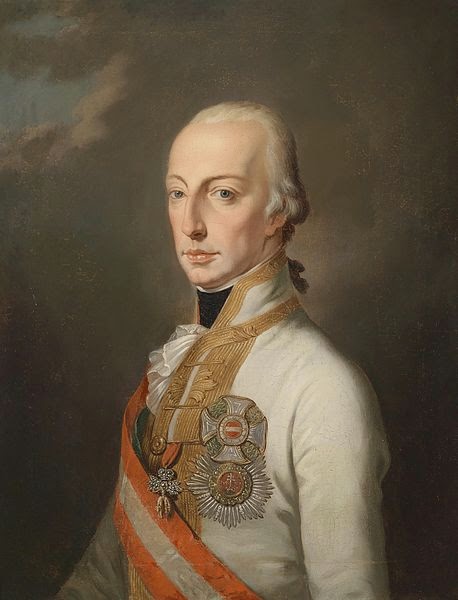
However, Emperor Francis II was simply being pragmatic and he would do what was necessary at the moment and bide his time to come out on top in the end. If it meant doing something unfortunate, so be it. The same thing occurred in relation to the great Austrian monarchist hero Andreas Hofer. At one point, the land Hofer had fought so hard for and which he had won in fair combat was handed over by the Emperor to the Bavarian allies of France. It had to be a difficult moment for the loyal Austrian patriot but the Emperor was making the hard choices that were necessary and he would ultimately get it all back. Despite the efforts of his daughter to convince him that Bonaparte was not such a bad guy, Emperor Francis had never truly accepted him as a legitimate monarch and never would. Thankfully for Austria, Napoleon could not resist overreaching and this he did with his invasion of the Russian Empire. The steppes of Russia swallowed the Grande Armee and in the aftermath a sixth coalition was formed, including Austria, to bring Napoleon down. Russian and Prussian armies pushed the French out of Germany, the Swedes hit Napoleon’s Danish ally and the British pushed up from Spain into southern France. At battles such as Kulm and Leipzig, Austrian forces played their part in a string of allied victories. Austria had a talented commander on hand in the person of Field Marshal Karl Philipp, Prince of Schwarzenberg who had actually been picked by Napoleon himself to command the Austrian contingent of the invasion of Russia.
Emperor Francis I risked everything in this war, betting all the chips that Austria had but this time Napoleon was defeated and as the allied armies closed in on Paris in 1814, the French emperor abdicated and was exiled to Elba. A short time later, he would return to make his last bid for power but met with a crushing and decisive defeat at Waterloo after which he was sent to St Helena, never to return. For Emperor Francis of Austria, this was the high point of his reign and a moment of the greatest prestige for Austria. Allied leaders met in his capitol, in the Congress of Vienna, to redraw the map of Europe and organize a new, post-revolutionary international order. The Austrian Empire benefited greatly, giving up territories such as Belgium which was distant and next to impossible to defend while regaining the Tyrol and other areas and gaining new territory in Italy and Dalmatia (what had been the Republic of Venice).
More significant though, was the pride of place that the Austrian Empire received with the creation of the German Confederation, of which the Austrian Emperor was President, and the Holy Alliance of Prussia, Austria and Russia to safeguard religion and monarchy in central and eastern Europe (though Britain, the Pope and the Turks disliked it -an odd assortment). It was a very conservative and pragmatic new order that settled over Europe and that made it very much to the liking of Emperor Francis I whose chancellor, Prince Metternich, had arranged much of it. The Emperor and Metternich understood each other and worked well together, establishing an international order in Europe based on legitimacy and periodic international congresses to resolve disputes that prevented another pan-European war for a hundred years. Perhaps their only failing in this area was in their rejection of nationalism as a whole, thinking it could be suppressed rather than taking hold of it to steer in a beneficial direction. Nonetheless, what they did do produced undeniable results and, on the whole, worked for a very long time.
As a man and as a monarch, Emperor Francis I was probably unlike what most would suppose him to be. For enemies of the Austrian Empire he is often portrayed as a harsh, reactionary tyrant, paranoid and militaristic, cold and calculating. In fact, he was a complex man who understood the enormous responsibility he had as monarch and who tried to always do what was best, not for the sake of popular opinion but as a sacred duty. It is true that he had a very active and extensive secret police and his policies would today be seen as restrictive. They were certainly illiberal but no more so than many that exist in Europe today, the only difference being who they were aimed at stopping and the fact that, unlike modern European leaders, Emperor Francis never claimed to a liberal. His network of spies and use of censorship was a reaction to the horror and world war that came with the French Revolution and he was determined to prevent such words, ideas or movements ever gaining a foothold in the Austrian Empire. Much of Europe today has laws just as restrictive but where Francis banned “revolutionary rhetoric” or “egalitarian” or “anti-religious” and “republican” talk, today what is banned is called “hate speech” or “racist” or in some way offensive and “politically incorrect” talk. His ban on all things Jacobin could be compared to the current ban in Germany on all things Nazi and would be defended on the same grounds; that some ideas are too dangerous to tolerate.
To the charge of being a reactionary (which not everyone would consider a bad thing) Emperor Francis was more nuanced than most realize. He was certainly a man of very traditional and staunchly conservative politics but neither was he a radical legitimist. He favored policies which were as conservative as possible but was never so ideologically zealous as to hinder his pragmatism. This was partly why he opposed nationalism, because it interfered with the sort of monarchial territorial horse-trading that could benefit his empire. So, he had no qualms about northern Italy being absorbed by the Austrian Empire rather than being restored to Venice and he was more supportive of the King of the French, Louis Philippe, than the very traditional King Charles X of France whose policies, though the Emperor was probably sympathetic to, he feared were impractical and could lead to another revolution and potential trouble for the rest of Europe.
Although he famously said that he had no knowledge of “the people” but only “subjects” he was not some distant, aloof sort of autocrat as he is often portrayed. Each week he set aside two half-days to meet with any of his subjects, whether high born or low, who made an appointment to see him. He would listen to their opinions or concerns and was able to converse with them in their own language, no matter what part of his polyglot realms they came from. In that way he was more accessible to the public than just about any republican president in any European country today (or most in the rest of the world at large for that matter). In a way, he inherited qualities from both of his immediate predecessors. From his father, who it was said ran the most successful secret police force in the world as Grand Duke of Tuscany, he had a talent at keeping himself well informed about what was going on within his empire and from his uncle Joseph II he had the ability to talk easily to anyone, be they prince or ploughman.
If Emperor Francis was busy with his public duties, his private life was just as eventful. He married first in 1788 to the charming Elisabeth of Wurttemberg, a bride chosen by Emperor Joseph II, but she died in childbirth in 1790, her baby girl surviving her by less than a year. Later that year he married his first cousin, Princess Maria Theresa of Naples and Sicily, who bore him twelve children, though four died young. These offspring included a future Empress of the French and Queen of Italy (while Napoleon ruled), a future Emperor of Austria, Empress of Brazil and Queen of Saxony. They had a successful marriage and mostly a happy one, though she was very lively and he very serious. She died in 1807 at only 34, no doubt thoroughly exhausted. The following year he married another first cousin, Maria Ludovika of Austria-Este, a refugee from the Napoleonic conquest of Italy, but she died in 1816 at only 28. Later that year he married Princess Caroline Augusta of Bavaria who was quite popular and who survived him.
At home, Emperor Francis I kept things calm and orderly. Trade was not much promoted and agriculture remained the primary industry of most imperial subjects. In this area, Francis can be faulted somewhat as his policy, summarized by his words, “I won’t have any innovations,” and “Let the laws be justly applied; they are good and adequate” as this allowed more business-friendly Prussia to have an economy and industry that expanded faster than Austria. The army was also neglected in terms of spending (while the overall debt continued to climb) which had negative effects for Austria later. Dissent in Hungary, however, remained as problematic for Francis as it had been for his predecessors and after a meeting of the Central Hungarian Diet in 1825 he was forced to agree not to raise taxes without their consent. In foreign matters, his primary concern was in suppressing any hints of nationalist or revolutionary sentiment in Germany and Italy. In the short-term, these were successful but in the long-term they proved fruitless. Nonetheless, Francis I was convinced that he was correct and that it only took a firm hand and a sharp eye to ensure that things remained as they were.
After ruling for 43 years, quite unexpectedly, Emperor Francis I of Austria came down with a fever and died on March 2, 1835 at the age of 67. In character to the end, his last advice was to “change nothing”. Additionally, he advised his son and heir to preserve the unity of the Imperial Family. That would be done, though after the traumas of 1848 his eventual successor, Emperor Francis Joseph I, would be forced to make some considerable changes. History, on the whole, has not been kind or very fair to Emperor Francis I, portraying him as a narrow-minded arch reactionary who liked nothing more than fiddling with his wax seals or making toffee. However, in truth, he was the driving force behind all that was Austria for nearly half a century. Metternich usually gets the glory (or the blame, depending on one’s view) but he only persisted in his position because the Emperor wanted him there. Francis I saw Europe torn apart by revolution, took a firm stand in stamping it out and did his best to ensure that it never happened again -and so long as he lived it did not. He could be short-sighted and sometimes he had to make tough decisions for the good of his empire but by his actions, the Austrian Empire survived and finally triumphed over Napoleonic France, regaining the dominant position in German affairs and central Europe. While there were problems in isolated areas, the actions and leadership of Emperor Francis prevented widespread unrest until 1848 and created a system in Europe based on facts rather than idealism, legitimacy rather than populism and established peace and stability for the better part of a century. Not a bad record that.
Young Francis was deemed to be utterly unsatisfactory, his uncle basically describing him as spoiled, clumsy and dim. He was subjected to a vigorous regime of study and exercise to correct these problems and was shut up in isolation as a way to make him more self-reliant. The Emperor himself said that his approach toward his nephew was, “fear and unpleasantness”. The Emperor, who seemed to turn cold after the death of his beloved first wife, was a man who was beloved by the common people for the actions he took to improve their welfare. However, it would be a mistake to think that this was due to his compassionate nature. Rather, it was because Emperor Joseph II had a fixation, perhaps even obsession, with orderliness, justice and making all things reasonable and rational. Taking any sixteen-year-old boy from any background and trying to make him orderly and reasonable would seem an impossible task for most and may, perhaps, explain why the Emperor could seem such a tyrant. Nonetheless, he filled his nephew with a respect for him that would last as long as Francis lived. Francis admired his uncle with ‘fear and trembling’ and the impact he had on Francis, and which Francis subsequently had on the rest of Hapsburg history, would ensure that Emperor Joseph II would be upheld as the standard by which all Austrian emperors were judged.
When Francis was sent to join the imperial army (a regiment on garrison duty in Hungary) it was probably the least demanding part of his training for the crown. In 1790 Emperor Joseph II died and was succeeded by Leopold II whose reign was to be a very short one. He spent most of his time trying to regain the support of all those his brother had offended while simultaneously retaining most of his policies. Archduke Francis acted on his behalf while his father was engaged in those duties and within a very short time Leopold II grew ill and died. At the age of only 24 on March 1, 1791 Francis became King of Hungary, Croatia and Bohemia and was in due course (when all the formalities were attended to) was named Emperor-elect of the Holy Roman Empire of the German People, King in Germany and all the rest as Francis II. He inherited a Reich beset by threats but he was a good man to meet them. On the whole, more traditional than his uncle, he was just as, if not more, pragmatic and would make decisions he thought in the best interests of his empire, whether it cast him in a positive light or not. His first and immediate concern was France where revolution was raging and where revolutionaries were threatening to take their torches beyond their borders to set fire to the whole of monarchial Europe.
If one were to assume that the fate of the Austrian-born Queen of France, Marie Antoinette, was foremost on the mind of Emperor Francis II (Kaiser Franz II), one would be mistaken. He did not really know his aunt and was not prepared to deal with traitors in order to save her. Emperor Joseph II had concocted a scheme to rescue his little sister but, at that time, Marie Antoinette and King Louis XVI thought it precipitous and a dereliction of duty to escape the country. By the time Francis II came along, the Queen was a prisoner and while Danton was willing to negotiate for her release (though considering the character of Danton it is entirely possible he was being false in the whole matter) Emperor Francis II refused to make any concessions and in due course the tragic queen was sent to the guillotine. For Francis, the only way to deal with the French Revolution was war and his empire went to war with France the same year he came to the throne. At first, he tried to take matters into his own hands during the failed Flanders campaign but he wisely decided to leave military matters to the experts and handed the army over to Archduke Charles, Duke of Teschen. This was the right choice as the Archduke would prove to be the most formidable continental opponent of Napoleon, even if he was not quite able to best the brilliant Corsican.
The war policy of Emperor Francis was one of resistance whenever possible, peace when necessary but to always strike again when the situation seemed favorable. At the outset, Austria was defeated and Francis decided to come to an agreement with the French republic, ceding land in Germany in exchange for half of the territory of the Republic of Venice which had tried to remain neutral. In the War of the Second Coalition, Austrian troops marched against France again and again in the War of the Third Coalition but both were French victories and most critically saw France take leadership in the German states away from Hapsburg Austria. This greatly alarmed Francis II and he decided to take a drastic and unprecedented step. With the reorganization of Germany and the victorious Napoleon making no secret of his imperial pretensions, Francis feared that the Corsican would apply sufficient pressure to have himself elected Holy Roman Emperor a title which, elections aside, the Hapsburgs had come to view as their property. The idea was too terrible to contemplate so Francis II decided to abolish the empire rather than see it fall into the hands of Napoleon. He dissolved the historic institution, abdicating his throne on August 6, 1806 and became instead Emperor Francis I of Austria.
This is something which some people remain at odds about even today, which is probably unavoidable for a move which was so historic. Did Francis have the authority to do what he did? Ultimately, the whole argument is academic. So much of what had been the Holy Roman (German) Empire was rather vague to begin with, being one thing in theory but something else in fact. It came about in an odd way and survived for so long because it was so changeable. Before the Revolution it had become essentially the Austrian Empire already plus those minor states allied to them with the Kingdom of Prussia being effectively independent. No emperor had actually been fully emperor, crowned by the Pope, for centuries and the electoral nature of it had long been a mere formality. Francis simplified things and brought what existed in fact into existing in name as well. His struggle with France was certainly not over and thanks to his leadership the Austrian Empire would remain as the dominant German power in the end.
In 1809, taking advantage of what Napoleon called “the Spanish ulcer” Emperor Francis I of Austria went to war again but once again suffered a stunning defeat. What was worse, Napoleon was determined to make major changes in regards to his relationship with Austria because of this. After all, if these numerous lost wars can seem disheartening from the Austrian point of view, one must keep in mind that they were extremely damaging to Napoleon even though he was always victorious. Emperor Francis I had the land, the population, the resources and an able general to remain Napoleon’s most dangerous continental foe and Napoleon was tired of having to fight them over and over again. Finally, it seemed, Napoleon had the Austrians where he wanted them. Always a pragmatic man, the Kaiser decided he had no choice but to come to terms with l’empereur. He gave up considerable territory and even the hand of his daughter in marriage to Napoleon as well as joining the “Continental System” the French had set up in an (ultimately futile) effort to starve Britain into submission. This may have been the peak of Napoleon’s career. He seemed to have broken the back of his most powerful enemy on the continent of Europe and by his marriage to Archduchess Marie Louise he gained an heir to his throne and, what was seen anyway as, acceptance into the ranks of the established dynasties of Europe.
However, Emperor Francis II was simply being pragmatic and he would do what was necessary at the moment and bide his time to come out on top in the end. If it meant doing something unfortunate, so be it. The same thing occurred in relation to the great Austrian monarchist hero Andreas Hofer. At one point, the land Hofer had fought so hard for and which he had won in fair combat was handed over by the Emperor to the Bavarian allies of France. It had to be a difficult moment for the loyal Austrian patriot but the Emperor was making the hard choices that were necessary and he would ultimately get it all back. Despite the efforts of his daughter to convince him that Bonaparte was not such a bad guy, Emperor Francis had never truly accepted him as a legitimate monarch and never would. Thankfully for Austria, Napoleon could not resist overreaching and this he did with his invasion of the Russian Empire. The steppes of Russia swallowed the Grande Armee and in the aftermath a sixth coalition was formed, including Austria, to bring Napoleon down. Russian and Prussian armies pushed the French out of Germany, the Swedes hit Napoleon’s Danish ally and the British pushed up from Spain into southern France. At battles such as Kulm and Leipzig, Austrian forces played their part in a string of allied victories. Austria had a talented commander on hand in the person of Field Marshal Karl Philipp, Prince of Schwarzenberg who had actually been picked by Napoleon himself to command the Austrian contingent of the invasion of Russia.
Emperor Francis I risked everything in this war, betting all the chips that Austria had but this time Napoleon was defeated and as the allied armies closed in on Paris in 1814, the French emperor abdicated and was exiled to Elba. A short time later, he would return to make his last bid for power but met with a crushing and decisive defeat at Waterloo after which he was sent to St Helena, never to return. For Emperor Francis of Austria, this was the high point of his reign and a moment of the greatest prestige for Austria. Allied leaders met in his capitol, in the Congress of Vienna, to redraw the map of Europe and organize a new, post-revolutionary international order. The Austrian Empire benefited greatly, giving up territories such as Belgium which was distant and next to impossible to defend while regaining the Tyrol and other areas and gaining new territory in Italy and Dalmatia (what had been the Republic of Venice).
More significant though, was the pride of place that the Austrian Empire received with the creation of the German Confederation, of which the Austrian Emperor was President, and the Holy Alliance of Prussia, Austria and Russia to safeguard religion and monarchy in central and eastern Europe (though Britain, the Pope and the Turks disliked it -an odd assortment). It was a very conservative and pragmatic new order that settled over Europe and that made it very much to the liking of Emperor Francis I whose chancellor, Prince Metternich, had arranged much of it. The Emperor and Metternich understood each other and worked well together, establishing an international order in Europe based on legitimacy and periodic international congresses to resolve disputes that prevented another pan-European war for a hundred years. Perhaps their only failing in this area was in their rejection of nationalism as a whole, thinking it could be suppressed rather than taking hold of it to steer in a beneficial direction. Nonetheless, what they did do produced undeniable results and, on the whole, worked for a very long time.
As a man and as a monarch, Emperor Francis I was probably unlike what most would suppose him to be. For enemies of the Austrian Empire he is often portrayed as a harsh, reactionary tyrant, paranoid and militaristic, cold and calculating. In fact, he was a complex man who understood the enormous responsibility he had as monarch and who tried to always do what was best, not for the sake of popular opinion but as a sacred duty. It is true that he had a very active and extensive secret police and his policies would today be seen as restrictive. They were certainly illiberal but no more so than many that exist in Europe today, the only difference being who they were aimed at stopping and the fact that, unlike modern European leaders, Emperor Francis never claimed to a liberal. His network of spies and use of censorship was a reaction to the horror and world war that came with the French Revolution and he was determined to prevent such words, ideas or movements ever gaining a foothold in the Austrian Empire. Much of Europe today has laws just as restrictive but where Francis banned “revolutionary rhetoric” or “egalitarian” or “anti-religious” and “republican” talk, today what is banned is called “hate speech” or “racist” or in some way offensive and “politically incorrect” talk. His ban on all things Jacobin could be compared to the current ban in Germany on all things Nazi and would be defended on the same grounds; that some ideas are too dangerous to tolerate.
To the charge of being a reactionary (which not everyone would consider a bad thing) Emperor Francis was more nuanced than most realize. He was certainly a man of very traditional and staunchly conservative politics but neither was he a radical legitimist. He favored policies which were as conservative as possible but was never so ideologically zealous as to hinder his pragmatism. This was partly why he opposed nationalism, because it interfered with the sort of monarchial territorial horse-trading that could benefit his empire. So, he had no qualms about northern Italy being absorbed by the Austrian Empire rather than being restored to Venice and he was more supportive of the King of the French, Louis Philippe, than the very traditional King Charles X of France whose policies, though the Emperor was probably sympathetic to, he feared were impractical and could lead to another revolution and potential trouble for the rest of Europe.
Although he famously said that he had no knowledge of “the people” but only “subjects” he was not some distant, aloof sort of autocrat as he is often portrayed. Each week he set aside two half-days to meet with any of his subjects, whether high born or low, who made an appointment to see him. He would listen to their opinions or concerns and was able to converse with them in their own language, no matter what part of his polyglot realms they came from. In that way he was more accessible to the public than just about any republican president in any European country today (or most in the rest of the world at large for that matter). In a way, he inherited qualities from both of his immediate predecessors. From his father, who it was said ran the most successful secret police force in the world as Grand Duke of Tuscany, he had a talent at keeping himself well informed about what was going on within his empire and from his uncle Joseph II he had the ability to talk easily to anyone, be they prince or ploughman.
If Emperor Francis was busy with his public duties, his private life was just as eventful. He married first in 1788 to the charming Elisabeth of Wurttemberg, a bride chosen by Emperor Joseph II, but she died in childbirth in 1790, her baby girl surviving her by less than a year. Later that year he married his first cousin, Princess Maria Theresa of Naples and Sicily, who bore him twelve children, though four died young. These offspring included a future Empress of the French and Queen of Italy (while Napoleon ruled), a future Emperor of Austria, Empress of Brazil and Queen of Saxony. They had a successful marriage and mostly a happy one, though she was very lively and he very serious. She died in 1807 at only 34, no doubt thoroughly exhausted. The following year he married another first cousin, Maria Ludovika of Austria-Este, a refugee from the Napoleonic conquest of Italy, but she died in 1816 at only 28. Later that year he married Princess Caroline Augusta of Bavaria who was quite popular and who survived him.
At home, Emperor Francis I kept things calm and orderly. Trade was not much promoted and agriculture remained the primary industry of most imperial subjects. In this area, Francis can be faulted somewhat as his policy, summarized by his words, “I won’t have any innovations,” and “Let the laws be justly applied; they are good and adequate” as this allowed more business-friendly Prussia to have an economy and industry that expanded faster than Austria. The army was also neglected in terms of spending (while the overall debt continued to climb) which had negative effects for Austria later. Dissent in Hungary, however, remained as problematic for Francis as it had been for his predecessors and after a meeting of the Central Hungarian Diet in 1825 he was forced to agree not to raise taxes without their consent. In foreign matters, his primary concern was in suppressing any hints of nationalist or revolutionary sentiment in Germany and Italy. In the short-term, these were successful but in the long-term they proved fruitless. Nonetheless, Francis I was convinced that he was correct and that it only took a firm hand and a sharp eye to ensure that things remained as they were.
After ruling for 43 years, quite unexpectedly, Emperor Francis I of Austria came down with a fever and died on March 2, 1835 at the age of 67. In character to the end, his last advice was to “change nothing”. Additionally, he advised his son and heir to preserve the unity of the Imperial Family. That would be done, though after the traumas of 1848 his eventual successor, Emperor Francis Joseph I, would be forced to make some considerable changes. History, on the whole, has not been kind or very fair to Emperor Francis I, portraying him as a narrow-minded arch reactionary who liked nothing more than fiddling with his wax seals or making toffee. However, in truth, he was the driving force behind all that was Austria for nearly half a century. Metternich usually gets the glory (or the blame, depending on one’s view) but he only persisted in his position because the Emperor wanted him there. Francis I saw Europe torn apart by revolution, took a firm stand in stamping it out and did his best to ensure that it never happened again -and so long as he lived it did not. He could be short-sighted and sometimes he had to make tough decisions for the good of his empire but by his actions, the Austrian Empire survived and finally triumphed over Napoleonic France, regaining the dominant position in German affairs and central Europe. While there were problems in isolated areas, the actions and leadership of Emperor Francis prevented widespread unrest until 1848 and created a system in Europe based on facts rather than idealism, legitimacy rather than populism and established peace and stability for the better part of a century. Not a bad record that.
Subscribe to:
Posts (Atom)


