Showing posts with label emperor of austria. Show all posts

Wednesday, April 29, 2015

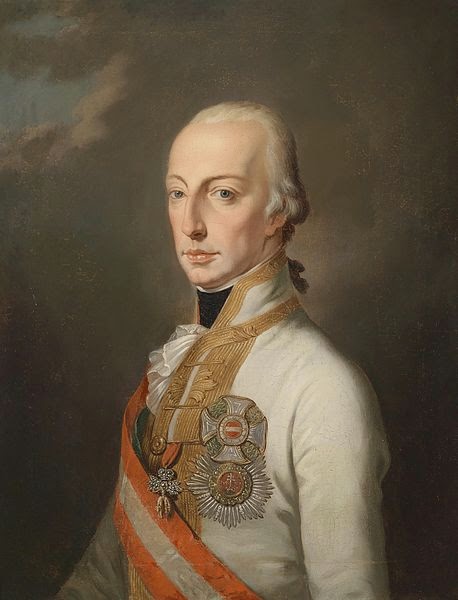
Monarch Profile: Emperor Francis I of Austria

The man who would be the last “Holy Roman Emperor”(elect) and the first “Emperor of Austria”, Francis II and then Francis I, was born in Florence, Italy on February 12, 1768 to then Grand Duke Leopold II of Tuscany, who was the younger brother of Emperor Joseph II. Named Francis (or Franz as you please) like the founder of the Hapsburg-Lorraine family line, his mother was the Infanta Maria Luisa of Spain, daughter of His Catholic Majesty King Carlos III, he was the second of sixteen children. For little Francis, while his childhood years were happy ones, basking in the bosom of his family and the sunshine of Italy, his parents were not to be a major part of his life ultimately. The liberal-minded, autocratic Emperor had no heirs and so, Francis was obviously the one in whom the future of the House of Hapsburg and its empire would be invested. So, at the age of 16, he was plucked from his family and his uncle the Emperor took charge of his upbringing personally. The experience was one that might have made even the children of ancient Sparta gape in amazement.

Young Francis was deemed to be utterly unsatisfactory, his uncle basically describing him as spoiled, clumsy and dim. He was subjected to a vigorous regime of study and exercise to correct these problems and was shut up in isolation as a way to make him more self-reliant. The Emperor himself said that his approach toward his nephew was, “fear and unpleasantness”. The Emperor, who seemed to turn cold after the death of his beloved first wife, was a man who was beloved by the common people for the actions he took to improve their welfare. However, it would be a mistake to think that this was due to his compassionate nature. Rather, it was because Emperor Joseph II had a fixation, perhaps even obsession, with orderliness, justice and making all things reasonable and rational. Taking any sixteen-year-old boy from any background and trying to make him orderly and reasonable would seem an impossible task for most and may, perhaps, explain why the Emperor could seem such a tyrant. Nonetheless, he filled his nephew with a respect for him that would last as long as Francis lived. Francis admired his uncle with ‘fear and trembling’ and the impact he had on Francis, and which Francis subsequently had on the rest of Hapsburg history, would ensure that Emperor Joseph II would be upheld as the standard by which all Austrian emperors were judged.

When Francis was sent to join the imperial army (a regiment on garrison duty in Hungary) it was probably the least demanding part of his training for the crown. In 1790 Emperor Joseph II died and was succeeded by Leopold II whose reign was to be a very short one. He spent most of his time trying to regain the support of all those his brother had offended while simultaneously retaining most of his policies. Archduke Francis acted on his behalf while his father was engaged in those duties and within a very short time Leopold II grew ill and died. At the age of only 24 on March 1, 1791 Francis became King of Hungary, Croatia and Bohemia and was in due course (when all the formalities were attended to) was named Emperor-elect of the Holy Roman Empire of the German People, King in Germany and all the rest as Francis II. He inherited a Reich beset by threats but he was a good man to meet them. On the whole, more traditional than his uncle, he was just as, if not more, pragmatic and would make decisions he thought in the best interests of his empire, whether it cast him in a positive light or not. His first and immediate concern was France where revolution was raging and where revolutionaries were threatening to take their torches beyond their borders to set fire to the whole of monarchial Europe.

If one were to assume that the fate of the Austrian-born Queen of France, Marie Antoinette, was foremost on the mind of Emperor Francis II (Kaiser Franz II), one would be mistaken. He did not really know his aunt and was not prepared to deal with traitors in order to save her. Emperor Joseph II had concocted a scheme to rescue his little sister but, at that time, Marie Antoinette and King Louis XVI thought it precipitous and a dereliction of duty to escape the country. By the time Francis II came along, the Queen was a prisoner and while Danton was willing to negotiate for her release (though considering the character of Danton it is entirely possible he was being false in the whole matter) Emperor Francis II refused to make any concessions and in due course the tragic queen was sent to the guillotine. For Francis, the only way to deal with the French Revolution was war and his empire went to war with France the same year he came to the throne. At first, he tried to take matters into his own hands during the failed Flanders campaign but he wisely decided to leave military matters to the experts and handed the army over to Archduke Charles, Duke of Teschen. This was the right choice as the Archduke would prove to be the most formidable continental opponent of Napoleon, even if he was not quite able to best the brilliant Corsican.

The war policy of Emperor Francis was one of resistance whenever possible, peace when necessary but to always strike again when the situation seemed favorable. At the outset, Austria was defeated and Francis decided to come to an agreement with the French republic, ceding land in Germany in exchange for half of the territory of the Republic of Venice which had tried to remain neutral. In the War of the Second Coalition, Austrian troops marched against France again and again in the War of the Third Coalition but both were French victories and most critically saw France take leadership in the German states away from Hapsburg Austria. This greatly alarmed Francis II and he decided to take a drastic and unprecedented step. With the reorganization of Germany and the victorious Napoleon making no secret of his imperial pretensions, Francis feared that the Corsican would apply sufficient pressure to have himself elected Holy Roman Emperor a title which, elections aside, the Hapsburgs had come to view as their property. The idea was too terrible to contemplate so Francis II decided to abolish the empire rather than see it fall into the hands of Napoleon. He dissolved the historic institution, abdicating his throne on August 6, 1806 and became instead Emperor Francis I of Austria.

This is something which some people remain at odds about even today, which is probably unavoidable for a move which was so historic. Did Francis have the authority to do what he did? Ultimately, the whole argument is academic. So much of what had been the Holy Roman (German) Empire was rather vague to begin with, being one thing in theory but something else in fact. It came about in an odd way and survived for so long because it was so changeable. Before the Revolution it had become essentially the Austrian Empire already plus those minor states allied to them with the Kingdom of Prussia being effectively independent. No emperor had actually been fully emperor, crowned by the Pope, for centuries and the electoral nature of it had long been a mere formality. Francis simplified things and brought what existed in fact into existing in name as well. His struggle with France was certainly not over and thanks to his leadership the Austrian Empire would remain as the dominant German power in the end.

In 1809, taking advantage of what Napoleon called “the Spanish ulcer” Emperor Francis I of Austria went to war again but once again suffered a stunning defeat. What was worse, Napoleon was determined to make major changes in regards to his relationship with Austria because of this. After all, if these numerous lost wars can seem disheartening from the Austrian point of view, one must keep in mind that they were extremely damaging to Napoleon even though he was always victorious. Emperor Francis I had the land, the population, the resources and an able general to remain Napoleon’s most dangerous continental foe and Napoleon was tired of having to fight them over and over again. Finally, it seemed, Napoleon had the Austrians where he wanted them. Always a pragmatic man, the Kaiser decided he had no choice but to come to terms with l’empereur. He gave up considerable territory and even the hand of his daughter in marriage to Napoleon as well as joining the “Continental System” the French had set up in an (ultimately futile) effort to starve Britain into submission. This may have been the peak of Napoleon’s career. He seemed to have broken the back of his most powerful enemy on the continent of Europe and by his marriage to Archduchess Marie Louise he gained an heir to his throne and, what was seen anyway as, acceptance into the ranks of the established dynasties of Europe.
However, Emperor Francis II was simply being pragmatic and he would do what was necessary at the moment and bide his time to come out on top in the end. If it meant doing something unfortunate, so be it. The same thing occurred in relation to the great Austrian monarchist hero Andreas Hofer. At one point, the land Hofer had fought so hard for and which he had won in fair combat was handed over by the Emperor to the Bavarian allies of France. It had to be a difficult moment for the loyal Austrian patriot but the Emperor was making the hard choices that were necessary and he would ultimately get it all back. Despite the efforts of his daughter to convince him that Bonaparte was not such a bad guy, Emperor Francis had never truly accepted him as a legitimate monarch and never would. Thankfully for Austria, Napoleon could not resist overreaching and this he did with his invasion of the Russian Empire. The steppes of Russia swallowed the Grande Armee and in the aftermath a sixth coalition was formed, including Austria, to bring Napoleon down. Russian and Prussian armies pushed the French out of Germany, the Swedes hit Napoleon’s Danish ally and the British pushed up from Spain into southern France. At battles such as Kulm and Leipzig, Austrian forces played their part in a string of allied victories. Austria had a talented commander on hand in the person of Field Marshal Karl Philipp, Prince of Schwarzenberg who had actually been picked by Napoleon himself to command the Austrian contingent of the invasion of Russia.

Emperor Francis I risked everything in this war, betting all the chips that Austria had but this time Napoleon was defeated and as the allied armies closed in on Paris in 1814, the French emperor abdicated and was exiled to Elba. A short time later, he would return to make his last bid for power but met with a crushing and decisive defeat at Waterloo after which he was sent to St Helena, never to return. For Emperor Francis of Austria, this was the high point of his reign and a moment of the greatest prestige for Austria. Allied leaders met in his capitol, in the Congress of Vienna, to redraw the map of Europe and organize a new, post-revolutionary international order. The Austrian Empire benefited greatly, giving up territories such as Belgium which was distant and next to impossible to defend while regaining the Tyrol and other areas and gaining new territory in Italy and Dalmatia (what had been the Republic of Venice).

More significant though, was the pride of place that the Austrian Empire received with the creation of the German Confederation, of which the Austrian Emperor was President, and the Holy Alliance of Prussia, Austria and Russia to safeguard religion and monarchy in central and eastern Europe (though Britain, the Pope and the Turks disliked it -an odd assortment). It was a very conservative and pragmatic new order that settled over Europe and that made it very much to the liking of Emperor Francis I whose chancellor, Prince Metternich, had arranged much of it. The Emperor and Metternich understood each other and worked well together, establishing an international order in Europe based on legitimacy and periodic international congresses to resolve disputes that prevented another pan-European war for a hundred years. Perhaps their only failing in this area was in their rejection of nationalism as a whole, thinking it could be suppressed rather than taking hold of it to steer in a beneficial direction. Nonetheless, what they did do produced undeniable results and, on the whole, worked for a very long time.

As a man and as a monarch, Emperor Francis I was probably unlike what most would suppose him to be. For enemies of the Austrian Empire he is often portrayed as a harsh, reactionary tyrant, paranoid and militaristic, cold and calculating. In fact, he was a complex man who understood the enormous responsibility he had as monarch and who tried to always do what was best, not for the sake of popular opinion but as a sacred duty. It is true that he had a very active and extensive secret police and his policies would today be seen as restrictive. They were certainly illiberal but no more so than many that exist in Europe today, the only difference being who they were aimed at stopping and the fact that, unlike modern European leaders, Emperor Francis never claimed to a liberal. His network of spies and use of censorship was a reaction to the horror and world war that came with the French Revolution and he was determined to prevent such words, ideas or movements ever gaining a foothold in the Austrian Empire. Much of Europe today has laws just as restrictive but where Francis banned “revolutionary rhetoric” or “egalitarian” or “anti-religious” and “republican” talk, today what is banned is called “hate speech” or “racist” or in some way offensive and “politically incorrect” talk. His ban on all things Jacobin could be compared to the current ban in Germany on all things Nazi and would be defended on the same grounds; that some ideas are too dangerous to tolerate.

To the charge of being a reactionary (which not everyone would consider a bad thing) Emperor Francis was more nuanced than most realize. He was certainly a man of very traditional and staunchly conservative politics but neither was he a radical legitimist. He favored policies which were as conservative as possible but was never so ideologically zealous as to hinder his pragmatism. This was partly why he opposed nationalism, because it interfered with the sort of monarchial territorial horse-trading that could benefit his empire. So, he had no qualms about northern Italy being absorbed by the Austrian Empire rather than being restored to Venice and he was more supportive of the King of the French, Louis Philippe, than the very traditional King Charles X of France whose policies, though the Emperor was probably sympathetic to, he feared were impractical and could lead to another revolution and potential trouble for the rest of Europe.

Although he famously said that he had no knowledge of “the people” but only “subjects” he was not some distant, aloof sort of autocrat as he is often portrayed. Each week he set aside two half-days to meet with any of his subjects, whether high born or low, who made an appointment to see him. He would listen to their opinions or concerns and was able to converse with them in their own language, no matter what part of his polyglot realms they came from. In that way he was more accessible to the public than just about any republican president in any European country today (or most in the rest of the world at large for that matter). In a way, he inherited qualities from both of his immediate predecessors. From his father, who it was said ran the most successful secret police force in the world as Grand Duke of Tuscany, he had a talent at keeping himself well informed about what was going on within his empire and from his uncle Joseph II he had the ability to talk easily to anyone, be they prince or ploughman.

If Emperor Francis was busy with his public duties, his private life was just as eventful. He married first in 1788 to the charming Elisabeth of Wurttemberg, a bride chosen by Emperor Joseph II, but she died in childbirth in 1790, her baby girl surviving her by less than a year. Later that year he married his first cousin, Princess Maria Theresa of Naples and Sicily, who bore him twelve children, though four died young. These offspring included a future Empress of the French and Queen of Italy (while Napoleon ruled), a future Emperor of Austria, Empress of Brazil and Queen of Saxony. They had a successful marriage and mostly a happy one, though she was very lively and he very serious. She died in 1807 at only 34, no doubt thoroughly exhausted. The following year he married another first cousin, Maria Ludovika of Austria-Este, a refugee from the Napoleonic conquest of Italy, but she died in 1816 at only 28. Later that year he married Princess Caroline Augusta of Bavaria who was quite popular and who survived him.

At home, Emperor Francis I kept things calm and orderly. Trade was not much promoted and agriculture remained the primary industry of most imperial subjects. In this area, Francis can be faulted somewhat as his policy, summarized by his words, “I won’t have any innovations,” and “Let the laws be justly applied; they are good and adequate” as this allowed more business-friendly Prussia to have an economy and industry that expanded faster than Austria. The army was also neglected in terms of spending (while the overall debt continued to climb) which had negative effects for Austria later. Dissent in Hungary, however, remained as problematic for Francis as it had been for his predecessors and after a meeting of the Central Hungarian Diet in 1825 he was forced to agree not to raise taxes without their consent. In foreign matters, his primary concern was in suppressing any hints of nationalist or revolutionary sentiment in Germany and Italy. In the short-term, these were successful but in the long-term they proved fruitless. Nonetheless, Francis I was convinced that he was correct and that it only took a firm hand and a sharp eye to ensure that things remained as they were.

After ruling for 43 years, quite unexpectedly, Emperor Francis I of Austria came down with a fever and died on March 2, 1835 at the age of 67. In character to the end, his last advice was to “change nothing”. Additionally, he advised his son and heir to preserve the unity of the Imperial Family. That would be done, though after the traumas of 1848 his eventual successor, Emperor Francis Joseph I, would be forced to make some considerable changes. History, on the whole, has not been kind or very fair to Emperor Francis I, portraying him as a narrow-minded arch reactionary who liked nothing more than fiddling with his wax seals or making toffee. However, in truth, he was the driving force behind all that was Austria for nearly half a century. Metternich usually gets the glory (or the blame, depending on one’s view) but he only persisted in his position because the Emperor wanted him there. Francis I saw Europe torn apart by revolution, took a firm stand in stamping it out and did his best to ensure that it never happened again -and so long as he lived it did not. He could be short-sighted and sometimes he had to make tough decisions for the good of his empire but by his actions, the Austrian Empire survived and finally triumphed over Napoleonic France, regaining the dominant position in German affairs and central Europe. While there were problems in isolated areas, the actions and leadership of Emperor Francis prevented widespread unrest until 1848 and created a system in Europe based on facts rather than idealism, legitimacy rather than populism and established peace and stability for the better part of a century. Not a bad record that.

Friday, April 19, 2013

Monarch Profile: Emperor Ferdinand I of Austria

Although he may not have been what the world would consider a “successful” monarch, I have always had a soft spot for the Austrian Emperor Ferdinand I. He was, undoubtedly, handicapped but probably not so disabled as most people think and he was a very kind man, a devoutly religious man and a monarch who did the best he could for as long as he could. He was born on April 19, 1793, the first son of the Holy Roman Emperor Francis II and his consort Maria Theresa of Naples and Sicily. Unfortunately, because the two were so closely related (being double first cousins), Ferdinand was born with some severe disabilities. The Emperor was overjoyed with the birth of his little boy, looking with his heart rather than his head, and hurriedly announced the arrival of a “healthy” baby which was certainly not the case. Medical staff had to work hard to keep him alive and it was evident from his unusually large head that he had severe problems. Among his ailments were water on the brain, soft bones and severe epilepsy, causing him to have as many as twenty seizures a day. There were also other neurological problems that became evident as he grew older. He was, for example, very slow in learning to talk and when he did, suffered from a considerable speech impediment. 

His health was always fragile and, unlike most Hapsburg heirs, his formative years were spent only with feminine attendants, being six years old before he was given a male tutor. Because of his disabilities, learning was difficult but not impossible, though it often seemed his education was not appropriate to his position. Still, he enjoyed studying heraldry and was fascinated with new technologies and farming. His mother had always kept him rather hidden from public view but things changed following her death (when Ferdinand was only 14) when he was given a new stepmother in the person of Maria Ludovika of Modena. She dismissed his old tutors, considering their regimen unhealthy, and appointed a new staff that would push him toward a more “normal” life. He became more independent, was taught how to read and write, how to ride a horse, to dance, fence and was even given piano lessons. He enjoyed drawing and the Empress encouraged this but after a problem with his tutor, his education was declared sufficient and he was moved on to study military theory, science and the like. Despite being handicapped, he kept a regular diary and was capable of making good sense, even becoming known for his sharp eye and witty remarks. By the time he was 36-years old in 1829 he was sitting in on State Council meetings to prepare him for his future role as emperor.  

The following year, in 1830, at the insistence of his father, the heir was formally crowned King Ferdinand V of Hungary on September 28 in Pressburg (modern-day Bratislava). The Hungarian elite presented him with a gift of 50,000 ducats which he donated to the poor of Hungary. As this marked Ferdinand coming more into his own, it was necessary for him to marry and, as usual for the time, the Imperial Family and government took up the matter with Ferdinand having little say. The choice they agreed on was Princess Maria Anna of Savoy, daughter of King Victor Emanuel I. Obviously, the disabled crown prince was not the sort of man a young girl dreams of marrying and the Italian princess reportedly burst into tears when told of her fate. However, with the selfless dedication of so many daughters of her house, she carried on and did her duty. The two were married and, happily, became a touchingly devoted couple. Despite his repeated best efforts, Ferdinand’s seizures made it impossible for him to ever consummate their marriage but he loved his wife and she took great care of her rather infirm husband throughout his life with never a word of complaint. She looked beyond his disabilities to see the sweet natured, good man underneath. Of course, not everyone displayed such a Christian attitude and not long after the crown prince narrowly survived an assassination attempt in 1832, an occupational hazard the House of Hapsburg was all too familiar with. The good nature of Ferdinand was displayed again at his wedding when he donated his wedding gifts to build a new waterworks for the city of Vienna.

On March 2, 1835 Emperor Francis passed away and his son succeeded him as Emperor Ferdinand I of Austria, as well as, of course, King of Hungary and Croatia, King of Bohemia and King of Lombardy-Venetia among his long list of titles. Emperor Ferdinand was, in fact, the last to be crowned King of Bohemia and the last to be crowned with the sacred Iron Crown of Lombardy (he would be crowned King of Lombardy-Venetia in 1838 and crowned King of Bohemia with the Crown of St Wenceslas in 1836). Obviously, because of his disabilities, public appearances could be problematic and the new Emperor needed a great deal of assistance in governing the Austrian Empire. Because of that, the effective running of the multi-nation state was left to a three-man regency council led by the veteran statesman Prince Metternich. However, it must be remembered (though all too often it is not) that Emperor Ferdinand was never declared to be incapacitated, he was able to perform many physical activities from riding to fencing to shooting, was conversant in five languages and could play two musical instruments. The idea that he was some sort of mental vegetable is completely untrue and unfounded.

It was during the reign of Emperor Ferdinand that industrialization took off with great speed in the Austrian Empire and his time on the throne was particularly known for the boom in railroad construction. He also saw the establishment of the Austrian Academy of Sciences and the Emperor took a great interest in all of these areas. It is also untrue that, despite the popular perception, Emperor Ferdinand I never had to deal with any major problems and folded at the first crisis to come along. There was, for example, a rebellion in Poland in 1846 which was put down by Austrian troops and paved the way for the annexation of Cracow to the Austrian Empire. However, undoubtedly, Emperor Ferdinand was a peaceful man who preferred compassion to military confrontation. Some felt he was often too kind such as when, in the aftermath of his coronation as King of Lombardy-Venetia, he granted a general amnesty that released many Italian nationalists and revolutionaries who would continue on with their goal to see the Austrians driven out of Italy. Still, his disabilities, while they should not be exaggerated, certainly cannot be ignored. It is, however, unfortunate that all many people seem to remember about Emperor Ferdinand is the story of his supposedly only coherent command  being, “I am the Emperor and I want dumplings!”

Emperor Ferdinand was not helpless nor an imbecile as he is so often portrayed. In fact, he should be credited for having the intelligence to know his own limitations and those limitations were reached with the outbreak of the Revolutions of 1848. In seemed to take no time at all for nearly the whole of Europe to be thrown into rebellion and turmoil. It was a monumental crisis and Emperor Ferdinand realized as much as anyone that he was simply not up to the job. Even the formidable Prince Metternich fled the country as riots broke out in Vienna. When viewing the mob from a palace window, the benign and somewhat perplexed Emperor turned to an attendant to ask, “But, are they allowed to do that?” The Imperial court was forced to leave Vienna for the safety of Innsbruck and there began to plan the counter-revolution to take back the capital and restore order to the empire. To command this campaign, a younger, healthy monarch was needed and Archduchess Sophie, a formidable woman without question, was quick to point to her son Francis Joseph (her husband being both less capable and less willing to assume the throne). Emperor Ferdinand could easily see that this was the best course of action, he had the advice of the able statesman Prince Felix von Schwarzenberg, and abdicated in favor of his nephew, handing power over to him and pledging his own allegiance. 

When the 18-year old new monarch thanked his former emperor, Ferdinand replied, “Don’t mention it, Franzl, it was a real pleasure”. During his reign (especially in Bohemia) he had been known as “Ferdinand the Good” but after his abdication the wittier members of the rebellious mob dubbed him “Goodinand the Finished”. No doubt they were less glib after a taste of the determination of the new monarch and the fire of marshals Radetzky and Windisch-Graetz. For his part, Emperor Ferdinand, who referred to his change in status as a ‘transfer of government’ rather than an abdication, retired with his beloved wife to Prague Castle. He and his wife devoted much time to the Church, both being devoutly religious people, and (to the surprise of the misinformed) he actually showed himself to be a quite competent businessman, dealing in local Bohemian goods, increasing the trade and profits of the region, in the process amassing a considerable fortune for himself which made up much of the wealth of Emperor Francis Joseph following the death of his uncle. Emperor Ferdinand I died in Prague on June 29, 1875 at the age of 82 and was buried in the Imperial Crypt in Vienna with his predecessors.

It is unfortunate that all too often Emperor Ferdinand I is remembered only for odd sayings and portrayed as someone who barely comprehended the world around him. He is the sort, rare though such cases are, upheld by revolutionaries as an example of the “danger” of monarchy and hereditary authority. The truth, of course, is that Emperor Ferdinand, while certainly disabled (through no fault of his own) was much more capable than he is usually given credit for. He was a good man, a devoted husband and a faithful and pious son of the Church. Slightly slow, perhaps, but still more intelligent than a great many perfectly healthy people and he was a man who knew his own limitations. His abdication (or “transfer of government”) was based on his sense of duty to the Austrian Empire and that sense of duty had guided his life. Despite his limitations, he worked hard to do the best job he could for his countries and all his peoples. Far from being an example of the “danger” of monarchy, the case of Emperor Ferdinand shows that just because a monarch is handicapped, things do not fall apart. The outbreak of revolution in Austria cannot be attributed to his disabilities as such unrest broke out in France and Germany with perfectly healthy rulers. When it was realized that he was not up to the challenge, Ferdinand I accepted that the best thing for his house and his empire was to step down in favor of another. It was all handled “in house”, quickly, smoothly and to the benefit of all. That is how Emperor Ferdinand should be remembered; as a good, faithful man and monarch who persisted in spite of adversity to do the best for his empire.

Monday, September 12, 2011

Monarch Profile: Emperor Francis Joseph I of Austria-Hungary

The last monarch of the old school, as he called himself, Kaiser Franz Josef I von Österreich-Ungarn, was practically an institution himself by the end of his long life and eventful reign which encompassed the greatest challenges faced by the Austrian Empire and, later, the Dual-Monarchy of the Austro-Hungarian Empire. He was, over all, one of the good ones. Like any mortal he had his flaws and made his mistakes, however, even his errors were honorably made. He always had the best intentions and the peace and preservation of his empire at heart. As Emperor of Austria and King of Hungary, Francis Joseph was driven, first and always, by duty, duty, duty. He had an appreciation for history and looked back on the Hapsburg legacy, to the likes of Emperor Charles V, Empress Maria Theresa or his grandfather Emperor Francis I (whom he greatly admired) and was determined that he would not do them dishonor. He came to the throne in a time of crisis and left it in a time of crisis but through it all displayed his matchless work ethic, providing an anchor of stability, a bulwark of conservative tradition and doing his best, as he told President Teddy Roosevelt, to protect his people from their governments.

Francis Joseph was born in Vienna on August 18, 1830 to Archduke Francis Charles (Franz Karl) of Austria and Princess Sophie of Bavaria. Even very early on Francis Joseph was noticeably disciplined and serious, yet kind. As a boy he was very attached to his younger brother, Ferdinand Maximilian, and when he was quarantined with sickness wrote his little brother letters and drew him pictures every day. Given the state that Emperor Ferdinand I was in, and the nature of his father, Princess Sophie raised Francis with the expectation that he would, sooner rather than later, be Emperor of Austria. He was schooled in statecraft by Prince Klemens von Metternich and at the age of 13 was made a colonel in the Austrian army, starting his military education and what would be a lifetime of austere habits. For the rest of his life he almost always wore the uniform of a junior army officer and slept on a simple army cot. When the Revolutions of 1848 broke out he saw his baptism of fire fighting the Italians with Marshal Radetzky. Imperial leadership was needed in such a crisis and so, with his father willing to be passed over, on December 2, 1848 Emperor Ferdinand I abdicated in favor of his nephew and Francis Joseph I became Emperor of Austria, inheriting an empire in crisis.

The new Emperor got to work right away, putting down the rebellions against the Hapsburg Crown. Marshal Radetzky was successful in suppressing the Italians but a serious revolt had broken out in Hungary that loyal elements seemed powerless to stop. Francis Joseph sought the aid of HIM Tsar Nicholas I of Russia, the “Gendarme of Europe” who obligingly sent 200,000 Russian troops to Hungary to stamp out all revolutionary dissent. With all opposition having been put down, the Emperor set about instituting reforms in an effort to prevent such a thing from ever happening again. Alexander Bach was appointed Interior Minister to lead this effort and the results, endorsed by Francis Joseph, made the Austrian Empire one of the most efficient and just governments in the world. The law courts were reformed and made independent of the executive so that each could balance the other, trial by jury was established, the tax code was reformed to be more fair and internal passports to travel from one country to another within the empire were abolished. The educational system was reformed, government offices were opened to anyone of talent regardless of their ancestry and the requirement that peasants work a set period of time solely for the benefit of their landlords was abolished.

Austria began to industrialize, somewhat later than other powers but without the oppression and horrid conditions that existed in other countries. Emperor Francis Joseph was adamant that the strong would never tyrannize the weak in his empire and he took special steps to ensure justice for all. In addition to the special protection given to the peasants and workers, he also made special provision for the Jewish minority, respecting their religion and granting them exemptions from anything that would violate their customs. Because of this, he was very popular with the Jews who seized on one of his often overlooked titles and hailed him as the “King of Jerusalem” (though the title was also claimed by the Bourbons and Savoys as well). The Emperor also insisted on a formal court protocol with a great deal of pomp and ceremony. Some have tried to use this to portray Francis Joseph as stuffy and aloof but it was done specifically to emphasize the importance of the monarchy, the sacred nature of the “office” which he regarded as a trust given him by God and which was the one crucial element that held his disparate peoples together.

The one area that was neglected was the military. The Austrians had never been a militaristic people and, although the Emperor was interested in military matters and loved his army, he was not a military man. Money was spent on civil priorities while the military lagged behind in modern improvements, new weapons and tactics. They looked perfectly grand and colorful on the parade ground but, as time would tell, the lack of attention paid to the armed forces would tell in time of war. In 1853 he was caught in the middle of the Crimean War between Russia on one side and Great Britain, France, Ottoman Turkey and Piedmont-Sardinia on the other. Each expected Austria to support their side but Francis Joseph regarded neither as justified and deplored the whole conflict. He tried, without success, to arrange peace and while the Russians responded to his efforts to limit the fighting the French and British would not. In the end Russia was defeated and felt betrayed by Austria, who was indebted to them for their assistance in 1848. It was not a happy time for the Emperor who was also distracted by his recent marriage to the Bavarian Princess Elisabeth who was feuding with his formidable mother and, shall we say, having difficulty adapting to life as an empress.

However, he had little time to dwell on issues in the east as Italy was once more approaching the boiling point. Nationalist sentiment was growing in the Austrian Kingdom of Lombardy-Venetia and the elites there looked to support from the Kingdom of Piedmont-Sardinia. When Count Camillo Cavour mobilized the Piedmontese army, Francis Joseph reacted at once. When he brought up the issue with the retired Prince Metternich the old statesman said, “For God’s sake Majesty, no ultimatum! No ultimatum!” to which the Emperor replied, “It went out last night”. Calling for a total disarmament of Piedmont-Sardinia there was no chance of it being accepted and the Second French Empire could intervene on the side of the Italians with Austria occupying the role of the big bully. Austrian troops invaded but moved so slowly that France had time to block them and the resulting fighting was bloody and inconclusive. Nonetheless, Austria had been blocked and a disheartened Francis Joseph ordered a retreat. Lombardy was lost, but not Venice though it would go later as the unified Kingdom of Italy was created. On the world stage the prestige of the French Emperor Napoleon III grew as he was seen as having defeated the venerable Austrian Empire.

At home, the Empress had suffered her first major nervous breakdown and new troubles began to arise from the Kingdom of Prussia which, under the leadership of Bismarck, was aiming to surpass Austria as the first power among the German states. Prussia began moving in on Austrian-allied territories and, though Francis Joseph wanted no conflict, his long-held suspicions toward the Italians was again used to provoke him into war. A little movement by Piedmont-Sardinia was sufficient to prompt Francis Joseph to call out his army and Bismarck at once declared that Austria was threatening Prussia and declared war. It is important to remember that, prior to this, liberal agitation had pressured Francis Joseph into setting up a parliament which had budget oversight. This was not regarded as too critical but it allowed them to further cut back on military spending. So it was that the Austrian army was in a poor state of preparedness to take on the very modernized and efficient army of Prussia which had reveled in their military prowess since the days of Frederick the Great. The result was a swift and stunning defeat for Austria in the Seven Weeks War which saw the Prussians firmly replace the Austrians as the dominant German-speaking power and bringing Bismarck one step closer to his goal of a united Germany ruled from Berlin. This was also taken as a demonstration of Austrian weakness by many nationalists in Hungary who began increasing their demands for autonomy, independence or even total separation. The result was the famous Compromise of 1867 by which the Hapsburg realm became a “Dual Monarchy” consisting of the equal and independent Austrian Empire and the Kingdom of Hungary. Each would have their own governments, legal systems, militaries and so on but remained joined in a personal union with the Hapsburg Crown. Only the military and foreign affairs remained under central control, though even then Austria and Hungary each had their own ministries for each.

That same year also saw the tragic end of the Emperor’s younger brother Maximilian who, in 1864 had gone against his elder brother’s advice to the Americas to be crowned Emperor of Mexico. The French Emperor Napoleon III was backing the venture, which did not endear the enterprise to Francis Joseph, and the two Hapsburg brothers had had something of a falling out over the issue, so adamantly was Francis Joseph opposed to it. Ultimately, it all came down to the civil war raging in the United States. When the southern secession movement was crushed the U.S. was able to threaten Napoleon into withdrawing his troops and then ensure the victory of the Mexican revolutionaries who captured Emperor Maximilian and had him executed by a firing squad. In 1889 more tragedy came with the death of the Emperor’s only son, Crown Prince Rudolf, at Mayerling. The two had not really gotten along well, Rudolf being too liberal and influenced by the wrong crowd as his father saw it. Officially the death is considered a suicide though there remains considerable evidence that this may not have been the case.

The Empress was deeply hurt by the death of her son but in 1898 she herself was assassinated by an anarchist in Switzerland. Emperor Francis Joseph was never quite the same, even though the two often had problems and he had become rather used to enduring heartaches. Still, he was a man devoted to duty and nothing ever hindered his daily routine. He carried on with his work, keeping Austria-Hungary stable and at peace for decades. When his nephew and heir Francis Ferdinand insisted on an unequal marriage the Emperor seemed inordinately disturbed by the idea and the two never really got along because of it. In 1903 Francis Joseph ruffled some feathers in Rome when he invoked his veto power in the papal conclave called after the death of Pope Leo XIII. The expected choice was HE Mariano Cardinal Rampolla but the Emperor blocked his election, though the reason why has never been known. Most assume it was for fear that Rampolla would be too favorable toward the French. In any event, the veto worked and Pope Pius X was elected instead -and promptly did away with the imperial veto which was a left-over from the days of the old Holy Roman Empire (the Kings of France and Spain had also claimed the right but it had not been used since 1830/31 when King Ferdinand VII of Spain blocked the election of Cardinal Guistiniani).

In the lead-up to the First World War, Francis Joseph always advised caution and patience. He knew from first-hand experience that wars never seemed to end well for Austria-Hungary. Many professed outrage at the Austro-Hungarian annexation of Bosnia but the province had long been occupied by Austria-Hungary and the Bosnians, Christians and Muslims alike, fared well under Hapsburg rule. However, nationalism was a constant threat from a number of surrounding countries and Serbia was no exception. Given that his wife and brother had been murdered, when his nephew Archduke Francis Ferdinand was assassinated in Bosnia in 1914 it is not surprising that Emperor Francis Joseph wanted harsh measures taken. Like a song everyone had heard before, a strident ultimatum was sent to Serbia, certain to be refused, and the fuse was lit for a war that would be disastrous for Austria-Hungary. However, Francis Joseph was no warmonger and it ultimately took a lie (his Foreign Minister claiming that Serbian troops had already attacked Austria-Hungary) for the Emperor to consent to the declaration of war.

Even then, the Emperor ordered only a partial mobilization against Serbia alone but Russia, under pressure from the French, intervened, causing full mobilization, with Germany supporting Austria-Hungary the result was a world war. Emperor Francis Joseph had been very cautious about the whole affair though he did at times reason that a military confrontation with Serbia would have to come sooner or later to put an end to the constant agitation aimed toward the Slavic population of the Dual-Monarchy. Once the war came, the Emperor, old and weary, had little to do with how it was pursued. Finally, after almost 68 years on the throne, Emperor Francis Joseph I died in Vienna at Schönbrunn Palace at the age of 86. His rule had been a succession of tragedies and disasters for the Hapsburg empire but through it all the Emperor had been a source of strength, unity and calm. He was an upright man, matchlessly devoted in his duty and a monarch who recognized the sacred nature of his position. He could be stubborn at times and did make some mistakes but they were always honest mistakes and every action he undertook was done with the best of intentions to hold his empire together and to live up to the legacy of his most celebrated forebears. He was, perhaps, fortunate in that he did not live to see the dissolution of the empire he had spent his entire life defending, dissolved in a most outrageous and underhanded way.

Friday, November 12, 2010

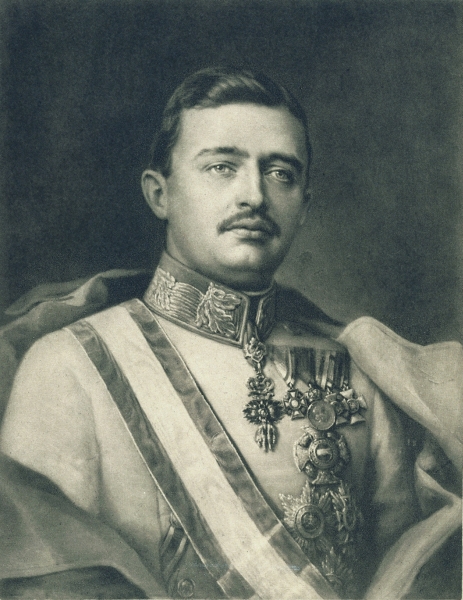
Monarch Profile: Blessed Emperor Charles I


Blessed Charles I (Kaiser Karl) was the last Emperor of Austria and King of Hungary and in many ways a symbol of the last remnants of traditional Europe that were swept away by the First World War. He was born His Imperial Royal Highness Karl Franz Joseph Ludwig Hubert Georg Otto Marie von Habsburg-Lothringen on August 17, 1887 to Archduke Otto Franz of Austria and Princess Maria Josepha of Saxony. From his earliest days his character was evident; serious, kind, dutiful and devoutly religious. Quite a way down on the list of succession he never had any thought of succeeding to the throne one day and, as was expected, entered into a military career as a young man. In 1911 he married HRH Princess Zita of Bourbon-Parma. The two were extremely devoted to each other and had much in common, most importantly their sincere Catholicism. Monarchists and royal watchers noted that by their marriage there had once again been a union of the two most prominent Catholic royal families of Europe; the Hapsburgs and the Bourbons.

Archduke Charles and Archduchess Zita settled down to a quiet family life, completely content, when their lives changed forever in 1914 with the assassination of Archduke Francis Ferdinand in Sarajevo. Not only did this event precipitate World War I, it also made Charles heir to the throne of Austria-Hungary at a time of crisis and at a time when everyone knew the venerable Emperor Francis Joseph would not be around for much longer. Nonetheless, Charles did not have too much time to prepare himself as he was forced to divide his time between his duties as an army commander and his obligations as heir to the throne in preparing himself for becoming monarch and dealing with political issues. On the battlefield his service was solid and although the fortunes of war did not often favor Austria-Hungary the Italian front, on which Archduke Charles served, was one area in which the Imperial-Royal forces were the most consistently successful. The hardest part for Charles was certainly being away from his family so much but everyone did their part to be strong and supportive. In 1916, when the mood across Austria-Hungary was already fairly gloomy, Emperor Francis Joseph passed away. Most people could not remember a time when Francis Joseph was not their monarch and there were worries when the Crown passed to their new sovereign who became Emperor Charles I of Austria and King Charles IV of Hungary.

Because of wartime conditions there was no coronation in Vienna but a coronation in Hungary was required as Charles took very seriously his oath to God as Apostolic King of Hungary when the Crown of St Stephen was placed on his head. He very much viewed monarchy as a sacred trust, a duty to God to care for his people, protect them and champion their cause. By this time, however, the war was going very badly for Austria-Hungary and ethnic nationalists were threatening to tear the Hapsburg empire apart. Emperor Charles reshuffled the military high command and began drawing up plans for greater autonomy for the ethnic regions of the empire. This had been talked about before under such names as the ‘United States of Greater Austria’ or a conversion from the “dualism” of Austria-Hungary to a system of “trialism” in which the Slavic peoples would be given co-equal status with the German-Austrians and Magyar-Hungarians. However, nothing much could be accomplished so long as the war was raging and in which Austria-Hungary was rapidly becoming completely exhausted and ever more dependent on German assistance for their survival.

Emperor Charles had always been rather wary of the Germans and though he realized Austria-Hungary would be crushed without them he also saw them as dragging his empire down to ruin in a war that no one, winners or losers, would emerge from intact. Pope Benedict XV had called for a peaceful end to the war with no winners or losers but a return to the status quo, for which he was either ignored or ridiculed. The deeply Catholic Charles, now Emperor, was willing to give the papal idea a chance. However, he had to proceed very carefully as any talk of peace on his part would immediately arouse the suspicion and possible retaliation of the Germans. Emperor Charles used the family connections of his wife, Empress Zita, who had been a Bourbon princess and whose brothers, Prince Sixtus and Prince Xavier, were serving in the Belgian army on the western front. This seemed a possible way forward as the Belgian King Albert I was also favorable toward a peaceful end to the war. Using Prince Sixtus and Prince Xavier as their go-between Emperor Charles sent a proposal of peace to the Allies.

Unfortunately, things did not go well. The Allies demanded concessions from Germany and Turkey that the Emperor of Austria-Hungary certainly had no power to deliver. Furthermore, the French and British had made any peace with the Hapsburgs rather impossible through the secret treaties they had already made with the Italians, Serbs and others wherein they had promised vast tracts of Hapsburg territory to these various peoples in return for supporting the Allied side. The effort at peace came to nothing and to make matters worse news of the peace proposal leaked out. Naturally the Germans were furious and when Emperor Charles denied the Allied claims French Prime Minister Georges Clemenceau made the Sixtus letters public. This doomed any effort by the Austro-Hungarians to achieve a separate peace and effectively made them hostages of Germany for the duration of the conflict, the Germans even drawing up a contingency plan for the invasion of Austria. As the war drew to a close the ethnic nationalists, who had long been supported by the Allies, took a greater hold, encouraged by the call for ethnic self-determination on the part of U.S. President Woodrow Wilson.

Emperor Charles tried to save his crumbling empire by agreeing to a confederation of autonomous states under the Hapsburg crown but this was no longer sufficient to calm the ethnic tensions nor would it have passed muster with the Allies who had already promised most of the Hapsburg lands to Romania, Serbia or emerging state of Czechoslovakia. Emperor Charles worked feverishly until the last possible moment. The Polish lands were given independence and plans were drawn up for an Austrian federal state of German, Czech, Slav and Ukrainian members but the Allies opposed such a move and it all came too late as the French, British and Americans had already recognized the creation of Czechoslovakia and the cession of all Slavic land to Serbia (what would eventually become Yugoslavia). These areas declared their independence and on October 31, 1918 the Hungarians dissolved the personal union with Austria. With the German-Austrians rising in opposition as well the government advised Charles to abdicate and leave the country.

As a man who saw kingship as a sacred duty, Charles refused to abdicate and instead relinquished “participation” in the Austrian government in recognition of the fact that the country was no longer under his control in any event. He felt he had no right to give away a duty God had imposed on him alone. In 1919 the Emperor and his family went into exile in Switzerland with Charles still asserting his sovereignty and stressing that the actions of the government in power had no validity in the eyes of the House of Hapsburg. The goal of restoration was never far from his thoughts and although the prospects in Austria were slim at that time, conditions in Hungary seemed more favorable, factions were struggling for power and royalists were a force to be reckoned with. In name at least the monarchy was maintained with the former admiral Miklos Horthy assuming the position of regent and suppressing a communist revolution. Admiral Horthy claimed to be holding power in the absence of the King (Charles) only until the time was right for their monarch to return to them. However, twice in 1921 Emperor Charles attempted to restore himself in Hungary, with considerable support, and yet on each occasion Horthy refused to step down and took measures to defend his position. Not wanting to be the cause of a civil war Charles returned to his exile.

However, after these political moves the Swiss did not want the Emperor and his family back and the Allies were adamant that measures be taken to prevent a Hapsburg restoration. As a result, Charles was sent to the Portuguese island of Madeira where he could be easily watched. The living conditions for the exiled Imperial Royal Family were very poor and the long suffering monarch did not last long there. He caught a cold while out for a walk which developed into bronchitis which developed into pneumonia. After suffering two heart attacks in his sick bed the last Emperor of Austria and King of Hungary died on April 1, 1922 in the presence of his wife and 8 children (the last yet unborn at the time). Many unkind things were said about Charles during his lifetime and even after his death, yet many more and from a variety of backgrounds, described him as a great and even saintly man who was despised because of his very goodness. That goodness was at last recognized on October 3, 2004 His Holiness Pope John Paul II formally beatified Emperor Charles I with October 21 (his wedding anniversary) declared his feast day. His canonization as a saint of the Catholic Church is not considered to be too far distant.
Related Posts Plugin for WordPress, Blogger...