Thursday, September 14, 2017

The Siamese in the Great War

Most people, outside of the country itself, probably have no idea that the Kingdom of Siam (Thailand) was a participant in the First World War. This is not too surprising given that the Siamese contribution was necessarily limited but the southeast Asian kingdom was a member of the Allied nations and, unlike some who declared war simply as a symbolic gesture, Siam actually participated militarily. World War One brings to mind the trenches and cratered landscape of Belgium and France but it was a global affair and Southeast Asia was actually fairly well represented in the conflict. Forces from French Indochina (Vietnam, Cambodia & Laos) participated on the Salonika and Western Fronts for example, the British had a potentially dangerous mutiny by Muslim forces on their hands in Singapore (dealt with by the Japanese) and so on. The Kingdom of Siam, like many others frankly, had no real reason to get involved given that Germany, Austria-Hungary, Bulgaria or Turkey had done them no harm but it was considered that participation would bring real benefits to Siam both domestically and on the world stage.

King Vajiravudh
The driving force behind the Siamese intervention was King Vajiravudh (Rama VI). This was when Siam was still an absolute monarchy but the King was not as all-powerful as he seemed from the outside. It was a time of great energy, hopes and aspirations for Siam and the King who was British-educated and who, after graduating from Sandhurst, was briefly an officer of the Durham Light Infantry in the British army. He thus had personal ties which made a totally dispassionate view of the First World War impossible. Which is not to say that he allowed personal attachments to cloud his judgment; far from it. He was very displeased with a recent treaty signed with the British which had seen Siam cede territory in the south to the British in what is now Malaysia. He valued his education and wished to see the same sort of education made available to his people but he was still annoyed at the unequal treaties Siam had made with numerous powers and the special privileges these allowed them, particularly France and, yes, Great Britain. He also faced internal threats to his authority and perhaps even the monarchy itself.

The collapse of the imperial system in China and the abdication of the Qing Dynasty in 1912 was a momentous event in world history that is generally not treated as such. However, it was positively earth-shattering and sent tremors all throughout east and southeast Asia, including Siam. A group of dissident army officers conspired to launch a military coup and abolish the monarchy, pledging to make Siam a constitutional democracy. Thankfully, word of the plan leaked to the authorities and they were arrested, tried and sentenced to death or life in prison. King Vajiravudh, however, wishing to appear strong and magnanimous, released all of them on the grounds that their intentions had been good in that they believed they were acting in the best interests of the country. Given what these men had said about the King personally, this had to be very difficult but for the King it underscored the need for greater national unity and to strengthen the monarchy. Many in Siam still had the mentality of the past when most of Siamese history was dominated by palace intrigue, family feuds and wars between rival city-states. King Vajiravudh wanted to usher in a new era of Siamese nationalism, place the kingdom on an equal footing with the other countries of the world and to bolster the power and prestige of the monarchy in the process.

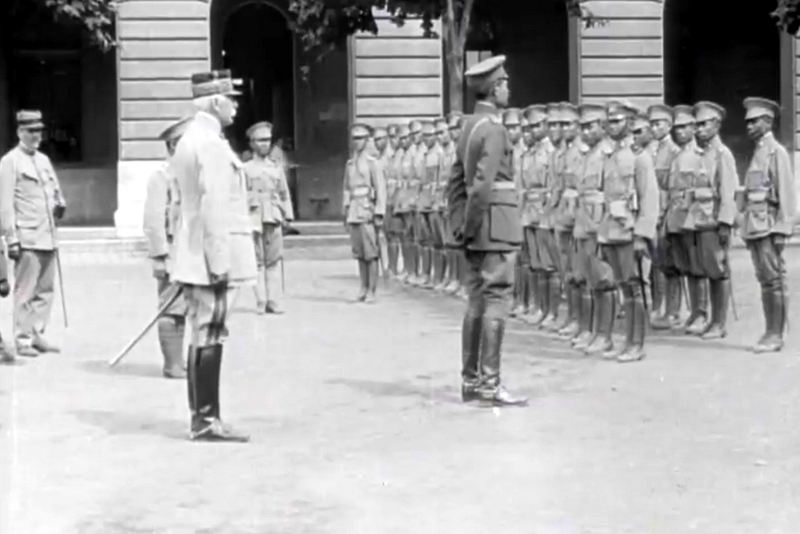
French general inspects Siamese troops
The First World War was seized upon as an opportunity to do all of these things. The war itself was, of course, an absurdity that never should have happened and many still fail to grasp this, insisting that the problem was the wrong side won when the problem was that the war happened at all. However, the hopes of King Vajiravudh are at least understandable. By intervening in the war, he hoped to have a cause to rally his people around the monarchy and the First World War was the biggest cause going at the time. It would mean that the Kingdom of Siam was participating in the pivotal event in world affairs at the time and would give Siam leverage against its neighbors, the British and French colonial empires, to redress grievances in the future Siam had with both. Many in Siam were still annoyed, for example, that France had taken into its empire Laos and Cambodia which Siam regarded as vassal states of their kingdom. By intervening in a conflict which was an existential threat to Britain and France, particularly with no vital need to do so, Siam expected to gain greater moral authority in dealing with these two powers. Likewise, as the King issued the declaration of war in the summer of 1917, it could be expected that the war would not last for much longer anyway.

The King called upon all of his people to unite behind this cause, to take their place as a participant in world affairs and even adopted a new national flag using the red, white and blue colors of the major Allied nations. The three colors, as announced in Siam, were to represent a new national unity of 1 people, 1 faith and 1 king. As the Siamese Expeditionary Force was assembled, more people actually volunteered than could be accepted. As it was, Siam could, of course, only afford a relatively minor force of mostly support personnel with medical and transportation contingents as well as air forces though these would have to be trained by the French. The SEF, under the command of Major General Phraya Bhijai Janriddhi, landed at the port of Marseilles on July 30, 1918 about 1,300 strong. While the pilots and air crew were set off for their new training, the general observed the operations of the other Allies to gain some experience in how things worked and, not too surprisingly given the times, the first use of the Siamese was when a contingent was organized into a labor detachment.

SEF Battle flag was a hybrid of the old & new designs
By September, the Siamese forces started to be actively employed at the front with combat units being filtered into the line and the medical and transport personnel being engaged in the Meuse-Argonne Offensive. None of the air personnel finished their training in time to participate before the November armistice but those units on the ground who did see action acquitted themselves quite well. Their involvement was not extensive but they had been involved and earned their place in the victory parade in Paris when the war was over and a detachment participated in the Allied occupation of the Rhineland. Losses had been extremely light with only 19 casualties. The Kingdom of Siam was present for the Versailles peace negotiations, not that it mattered much, and was one of the founding members of the League of Nations (again, not that the League ultimately mattered much). The Siamese contribution to the war had been limited and only for the closing months of the conflict, was inexpensive in terms of lives lost and had earned Siam a place among the victors when it was over.

However, the overall results of Siamese participation in the Great War were somewhat mixed. At the outset, it seemed to have achieved all that the King had hoped. They had been a part of the great event of the time, were on the winning side, the prestige of the monarchy had gone up and there were some benefits to found. Siam got to keep the German ships they confiscated at the outset and within seven years the British, French and Americans had all given up their extraterritorial rights in Siam. However, in the long-term, these benefits could be seen as inconsequential or of limited duration. The ensuing economic collapse hit Siam hard and internal divisions, which the King had hoped to eliminate for good, soon reappeared and, to some extent, have become a mainstay of Thai politics. The financial crisis caused Siam to go into debt to the British which, in a way, could be seen as offsetting the new equality gained by Britain giving up her extraterritorial rights. All of this stress also benefited the dissident crowd and soon those advocating for a constitutional monarchy were back. King Vajiravudh would not live to see it but his successor, his younger brother King Prajadhipok, would go down in history as the last absolute monarch of Siam, the result of the Revolution of 1932 and the only king of Chakri dynasty to date to abdicate the throne.

Tuesday, September 12, 2017

How New York Got Its Name

Previously, more than once, I have bemoaned the lack of familiarity most Americans have with colonial history. Sadly, I do not see that as likely to change in the foreseeable future given how the population is increasingly becoming less connected to the people who established the colonies which eventually came together into the country that exists today. This is unfortunate as, without the participating European colonial empires there would be no United States (nor any other country as exists today in the Americas) but even among those who are at least vaguely aware of the state of affairs prior to the independence of the “Thirteen Original Colonies”, fewer still are aware of just how many European colonial empires were involved in the settlement of North America. The Spanish, French, English and Russians all played a part as did still less remembered powers such as the Kingdom of Sweden (at the time Sweden and Finland) which established a North American colony in the reign of Queen Christina and, likewise, so did the Seven United Provinces of The Netherlands.

Dutch West Indies Company
Although mostly centered on what is today New York, the Dutch colony covered parts of what is today New York, New Jersey, Delaware, Connecticut and even small areas of Pennsylvania and Rhode Island. The Dutch got their start with the employment of Henry Hudson, an Englishman, by the Dutch East India Company to try to find the elusive northwest passage to Asia. In his famous ship the Half Moon, he explored much of the coast of northeast America, giving his name to a river and a large bay in Canada. He did not make it to Asia but he returned to Holland with glowing reports of land ripe for colonization. More expeditions followed to survey and chart the area in greater detail and to trade with the native population all of which were funded by the New Netherland Company. In 1621 the Dutch West India Company was granted a charter to gain for The Netherlands a piece of the lucrative fur trade in North America. It is also noteworthy (though often forgotten) that their charter forbid them to take possession of any land that was not legally purchased from the native inhabitants.

Peter Minuit
Today, this presents a problem to the egalitarian crowd as even many who know practically nothing about this period will remember that the Director of New Netherland colony, Peter Minuit, purchased Manhattan Island from the natives for 25 Dutch guilders worth of trade goods. Many, keeping in mind that today Manhattan is home to some of the most highly valued property on the planet, portray this as Minuit cheating the Indians out of a fortune in real estate with a chest full of trinkets. This, however, runs counter to the argument for egalitarianism since, if this was such a huge swindle and if all people are equal, the Indians should have known they were being cheated. One cannot, on the one hand, demand that everyone be treated equally and then, at the same time, demand that special allowance be given to the ignorant. The truth, however, is that the Indians were not so ignorant and the Dutch did not swindle them. Yes, the land is worth a huge fortune today but, at the time, it was empty wilderness, no different than the other vast tracts of empty wilderness that covered the continent. Land was something that seemed endlessly plentiful whereas the manufactured goods offered by the Dutch were items which the Indians did not have and could not make for themselves, thus each gave up something they had in abundance for something the other could not obtain on their own, the very definition of a successful business transaction.

New Amsterdam, capital of New Netherland, soon became a busy hub of trade, settlement and privateering. The Dutch brought in colonists from Europe and, in an act for which they have been condemned since, also brought in the first African slaves to North America. However, operations were still more expensive than the Dutch West India Company liked and they tried various methods to cut costs. In an act that should be considered an educational moment, the very business-minded and technically republican Dutch authorities found it beneficial to revert to a sort of feudalism. This became known as the patroon system by which a major investor would be given the title of patroon, a large tract of land and extensive control over it with powers quite similar to those held by feudal lords in the monarchies of the Old World. The patroon was, for his part, expected to bring in at least 50 families of colonists within four years of receiving his title. This did result in growth for the colony, though still not as much profit as was hoped for.

Peter Stuyvesant
There were also conflicts to deal with as well as commerce such as the two-year long war fought with surrounding native tribes by Director Willem Kieft as well as, in 1655, the conquest of New Sweden by a Dutch force of about 700 led by the feisty, one-legged Director Peter Stuyvesant. He was a more hard-line figure than New Netherland was used to, cutting back on religious freedom in favor of adherence to the Dutch Reformed Church, trying to limit Jewish immigration, encouraging Jewish settlers to leave and becoming increasingly anxious about the rapid growth of the neighboring English colonies and their competition with the Netherlands. Stuyvesant was accused of being rather on the tyrannical side and opposition to him sprang up in the colony. Unfortunately, it was at precisely this same time that New Netherland faced its greatest crisis. That crisis arose when King Charles II of Great Britain, recently restored to his throne, determined to conquer the Dutch colony. Although Charles II had been sheltered in The Netherlands during the Interregnum, his preferred foreign policy was one of friendship with France and hostility toward the Dutch.

James, Duke of York
An expedition of four ships and 450 men, led by royalist civil war veteran Richard Nicholls, set out from Plymouth and arrived to besiege New Netherland on August 27, 1664. As was his character, Stuyvesant wanted to put up as much of a fight as possible but, by this time, he lacked the support of many of his own colonists, some of whom were angry about his policies and others who simply wished for nothing to interfere with their business. They preferred trading their Dutch flag for an English one rather than have a destructive battle that would disrupt commerce. This lack of cohesion meant that there was no chance of the Dutch, under Stuyvesant, standing a chance against the English forces and so, on September 8, 1664 Stuyvesant formally surrender the colony to the King of England and New Netherland was no more. The royal connection in all of this was that King Charles II had promised this area of North America to his brother the Duke of York (later King James II) and Richard Nicholls was Groom of the Chamber to the Duke of York and it was the Duke who had chosen him to command the expedition. It seemed only natural then that New Netherland should be renamed New York in the Duke’s honor.

Even though this episode of American colonial history is not well remembered, the evidence of it still exists in New York City today if you know where to look. Perhaps the most famous landmark is St Mark’s Church in-the-Bowery which was built by Stuyvesant and is where he is buried. His family later sold the property to the Church of England (under conditions) and it is the oldest church in continuous use in New York City. It also features a bust of Stuyvesant which was sent over by Queen Wilhelmina of The Netherlands in 1915. The flag of New York City is based on the orange-white-blue tricolor of the Netherlands, “the Prince’s Flag” and even the famous financial center of Wall Street, has its name because that site was formerly where a road was along the palisade surrounding New Netherland and thus came to be referred to as Wall Street. The Dutch population and language persisted in parts of New York longer than most probably realize. President Martin Van Buren, for example, grew up speaking Dutch as his first language and many Dutch words, names and even some traditions still survive in parts of New York to this day.

In any event, that is how New York went from being a Dutch colony to being named after the heir to the English throne and Britain’s last Catholic monarch.

Sunday, September 10, 2017

The Italian Submarine Campaign of World War II

As detailed previously on these pages (see here), none of the military forces of the major participant powers in World War II have been as unjustly maligned as those of the Kingdom of Italy. Italian defeats have been exaggerated and Italian successes often downplayed or ignored entirely. Because of this, the details of the Italian submarine campaign will no doubt come as a surprise to a great many people. However, the Regia Marina (Italian Royal Navy) entered the war with the largest submarine fleet in the world by tonnage and while most tend to think of the “Battle of the Atlantic” as solely a fight between German U-boat “wolf packs” and Allied convoys, the Italians participated as well, in fact, at one point there were more Italian submarines operating in the Atlantic than German ones. Italian boats also saw extensive service in the Mediterranean (naturally) and the Indian Ocean as well as undertaking operations to East Asian waters and the South Atlantic; areas beyond the range of the smaller, typical Type-VIIC German U-boats. Finally, Italian submarines did a great deal of damage, despite facing many difficulties, against the Allies.

The Smeraldo
When the Kingdom of Italy entered World War II with the declarations of war against Britain and France in June of 1940 the Regia Marina possessed 84 operational submarines under the overall command of Admiral Mario Falangola, succeeded at the end of the following year by Admiral Antonio Legnani. At the outset, their failures outnumbered their successes, which is not too surprising as, aside from some secretive operations in support of Franco in the Spanish Civil War, they had never been tested and both men and boats had bugs that needed working out. However, they had a spirit and determination that would prove formidable. The Smeraldo, for example, a Sirena-class boat of the short to medium range 600 series made the first torpedo attack on British shipping by an Italian submarine but the heavy seas caused the torpedo to miss. However, this same boat later endured the most intense anti-submarine warfare attack of any boat in history with British ships dropping 200 depth charges on her, and she still survived (ultimately this boat was sunk by running into a British mine some time later).

Capt. Enzo Grossi decorated by Adm. Doenitz
After the conquest of France and the establishment of German naval bases on the French west coast, Italian submarines were invited to participate in the campaign to strangle the British Isles. This, of course, meant a dangerous passage through the Straits of Gibraltar under the very noses of the British Royal Navy. Many German U-boats were lost in the straits but, though few are aware of it, no Italian submarine was ever sunk slipping through these dangerous waters. The Italians established themselves at Bordeaux under the name BETASOM (Beta [Bordeaux] Som [Sommergibili]) with 27 submarines in early 1941. Originally, the idea was the German and Italian submarines would work together in coordinated attacks against Allied shipping, however, this soon proved to be more troublesome than effective and few seem to understand why. Ultimately the cause was a difference in training and how German and Italian boats operated as well as the Germans not being what we would call “team players”.

Fairly quickly in the war, German submarines developed a preferred tactic of attacking on the surface at night, submerging to escape counterattack. Italian submarines, however, usually made underwater attacks during the daytime. This was one of the differences that made cooperation difficult. Probably the most significant, however, was the unwillingness of the Germans to place a German communications officer on Italian submarines, though they held overall command of joint-operations. The result of this was that an Italian submarine making contact with the enemy would have to signal Bordeaux which would then have to send the message to Paris to the German naval command which would then relay the message out to the German submarines in the area. Needless to say, this meant that by the time the Germans were told of an enemy convoy, it was too late for them to do anything about it.

Capt. Primo Longobardo
There was also an unwillingness on the part of the Germans to train the Italians to fit in with their preferred way of doing things and what training they did provide was inadequate, expecting the Italians to learn in only two months what it had taken the Germans years to develop and become proficient at. There is evidence that when Italian submarine captains were allowed to train with the Germans, the results were obvious. One such officer was Commander Primo Longobardo, one of the few to train with the Germans, and he proved one of the most successful Italian submarine commanders of the war. As captain of the submarine Torelli he once sank four Allied ships on a single patrol and ultimately accounted for 42,000 tons of Allied shipping sunk. In any event, when coordinated training was finally agreed to, joint operations had already been canceled and each submarine force operated on their own with the Italians mostly hunting in waters around the Azores and some boats dispatched for the South Atlantic, such as in the Brazilian shipping lanes, which they were able to reach more easily because of their greater range.

A lack of cooperation was also evident in the reluctance of the Germans to share their torpedo technology with the Italians. The Germans tried many innovations with their torpedoes, causing some problems as certain designs didn’t work but ultimately resulting in a more effective weapon. The Italians, on the other hand, simply stuck to their older but more reliable model which was not as effective and the Germans would not share their magnetic trigger technology with Italy until it was too late to be of best use. It is for this reason that Italian submarines frequently engaged in surface action as quite often they would make a successful underwater attack using their torpedoes but the target would be badly damaged but not sunk at which point the Italian submarine would surface and finish off the enemy with their deck gun. Italian sub crews also became, out of necessity, quite adept anti-aircraft gunners and this came about due to the nature of their boats.

A submarine on the surface is vulnerable and aircraft are a particularly dangerous enemy. They can be upon you very quickly and do immense damage, making it a life or death matter for a submarine to be able to submerge as fast as possible. As Italian submarines tended to be larger than their average German counterpart, this meant that they were slower to dive. A typical German submarine could submerge in about 20 seconds, whereas the average Italian submarine took between 60 and 120 seconds to get below the waves. One result of this was that, by the time an enemy aircraft was spotted, it was often better to take your chances shooting it out on the surface than be shot full of holes while trying to dive. It was not an enviable situation but it did make Italian AA fire more effective than in other navies. In fact, it was an Italian submarine, which had been shifted to the Germans after 1943 and then to the Japanese after the German surrender, which fired the last shots of World War II, using her AA battery against American bombers while in port in Japan.

Victory for the Leonardo DaVinci
In spite of their boats having their limitations, torpedoes that were not the best and a less than fully cooperative ally, Italian submarines still did a great deal of damage thanks to having some extremely skilled commanders. None was more famous than Gianfranco Gazzana-Priaroggia, captain of the Leonardo DaVinci, the most successful Italian submarine of the war. Nicknamed “Ursus atlanticus”, Gazzana-Priaroggia would ultimately sink over 90,000 tons of Allied shipping, his biggest score being the massive British troopship the Empress of Canada. He was even set to lead a special forces submarine attack on New York harbor but this was postponed and ultimately never carried out due to the 1943 armistice. Earlier that year, Gazzana-Priaroggia was sadly killed in action but was posthumously awarded both the Gold Medal for Military Valor by the King of Italy and the Knights Iron Cross by the Germans for his achievements. By most accounts (there is some dispute as the U.S. ‘updated’ their stats several times after the war) Gazzana-Priaroggia was the most successful non-German submarine commander of all time.

Todaro, the humane hunter
It is also worth noting, given that the Allies later justified their use of unrestricted submarine warfare by retroactively pointing to its use by Italian subs in the Spanish Civil War, that Italian submarines also had a reputation for gallantry and compassion. Every major participant of the war that made extensive use of submarines; the Germans, Americans, Japanese and British, were guilty of sometimes committing atrocities, invariably killing survivors of sunken ships. Japan had by far the most, the British and Americans extremely few and the Germans, well, given the details of the “Laconia Incident”, it is hard for anyone to blame them. However, the Italians were never accused of such cruelty and, indeed, came away from the war with a reputation for actually showing some basic humanity when it was not required. The most famous example of this was Captain Salvatore Bruno Todaro of the Commandante Cappellini which went above and beyond to rescue survivors of sunken ships and put them safely ashore on the Azores. At the same time, Todaro and his boat had multiple victories to their credit and were among the most successful of the Italian submarine fleet. When all was said and done, the Italian submarines sank over a hundred Allied ships in the Atlantic.

However, the Mediterranean Sea was, of course, always supposed to be the primary area of operations for all units of the Regia Marina and it was an enclosed sea of hazards with major British naval installations at Gibraltar, Malta, Alexandria and Cyprus. Italian submarine commanders pulled off some extremely daring victories against the British in these waters and aside from merchant shipping also took a heavy toll on Royal Navy warships. Notable successes include the cruisers HMS Bonaventure, HMS Calypso and HMS Coventry which were all sunk by Italian submarines in 1940-41. However, Italian industry could not produce new boats fast enough and the Allied breaking of Axis codes was also a huge blow to the submarine campaign. Nonetheless, Italian submarines in the Mediterranean would open up a new type of undersea warfare which had dramatic results, producing a new type of warrior who could be seen as the precursor of America’s feared SEAL teams.

X-MAS infiltrating the enemy harbor
A special unit, composed of both fast-attack surface craft and undersea weapons known as “human torpedoes” was formed known as the Decima Flottiglia MAS (for Mezzi d’Assalto) or X-MAS (in English, ‘Tenth Assault Vehicle Flotilla’). One man very much associated with this new unit was Prince Junio Valerio Borghese, captain of the submarine Sciré. The “human torpedoes”, as they are often called, were actually nothing of the sort as no torpedoes were involved and, while highly dangerous, were not suicide weapons. The Italians referred to them as ‘maiale’ or ‘pigs’ because these were basically miniature submarines that Italian sailors would ride ‘piggy-back’ into an enemy harbor after being brought into the vicinity by a submarine making a submerged approach. They would cut through any anti-submarine nets, approach the underside of major ships in the harbor and attach mines to the hull. Once they were safely away the mines would detonate and the ships would be crippled or sunk. The sailors would have no hope of returning to their submarine and so could either try to make it to neutral territory or simply surrender after accomplishing their mission.

In December of 1941 such an attack was launched on the British naval base at Alexandria, Egypt with the battleships HMS Queen Elizabeth and HMS Valiant being crippled, a Norwegian tanker sunk and a destroyer, HMS Jervis, being badly damaged. Men of the X-MAS, brought in by the submarine Sciré, launched a similar attack on Gibraltar in September, sinking three enemy ships. Later, operating out of an old tanker in the Spanish port of Algeciras more attacks on Gibraltar were made in December of 1942, sinking two ships and damaging two more. Two more British freighters and an American Liberty Ship were sunk in 1943 prior to the armistice. These attacks, which were almost impossible to guard against, caused considerable panic in the Allied naval forces operating in the Mediterranean. Even after the war, exploits of the Italian undersea warriors were featured in British films such as “The Silent Enemy” of 1958 and the 1962 Anglo-Italian film “The Valiant”. The X-MAS also continued its service with the Italian Social Republic after Mussolini was restored to power by the Germans and would go on to have a reputation as fiercely loyal Fascists. Their commander, Prince Borghese, would ultimately become a pariah among his fellow members of the Roman nobility for attempting a neo-Fascist coup against the post-war Italian Republic.

Capt. Carlo Fecia di Cossato
Ultimately, the armistice, division of Italy and finally the end of the war all caused confusion among the Italian submariners. Most remained loyal to the King and followed orders, turning their boats over to their former enemies, some were seized and forced into the German and later Japanese navies and some, like Prince Borghese, cast their lots with Mussolini and the Germans, to carry on to the bitter end. A most tragic case was that of Captain Carlo Fecia di Cossato, the man who sank more ships than any other Italian submarine commander at the helm of the Tazzoli. Loyal to his King above all, when the armistice came, he followed orders and even sunk seven more ships, German this time, in his new command. However, the abrupt change troubled him, becoming worse as it became clear that the Allies still considered Italy a defeated enemy and would strip Italy of her empire, even territory gained well before the Fascist Era. He was torn apart by conflicting feelings of loyalty and dishonor until he committed suicide in Naples in 1944.

When the war was finally over, with all of the confusion, bitterness and divisions which that caused, the feats of the Italian submarine campaign stand out as further proof of how wrong the popular misconception is of the Royal Italian military in World War II. Italian submarines sank about a million tons of Allied shipping from mid-1940 to 1943. This was almost as much, indeed somewhat more according to some statistics as the ultimately far larger submarine force the Imperial Japanese Navy sunk from the end of 1941 to 1945, the disparity in numbers all the more significant given that over-worked Italian industrial capacity meant that Italy could only commission 30 new boats during the war years whereas Japan commissioned 126 additional subs (not counting midget boats) during the conflict. Italy was also not very far behind the tonnage sunk by the British Royal Navy during the entire course of the war from 1939 to 1945. They played a significant part, did considerable damage to the Allied fleets and did so with skill, heroism and gallantry in the face of immense odds.

Thursday, September 7, 2017

What Countries Are Made Of

Many people in the west today seem to be in total ignorance of what makes a country. No one else in the world, be it South Africa, Israel, India or China is as ignorant on this subject as the west. For some, no doubt, it is not ignorance but for others I can find no other rational explanation. Certainly, on the part of the far-left, I do not believe ignorance is the issue as they despise western civilization and have convinced themselves that the world will be a better place once it disappears entirely. However, those who are dragged along by them are no doubt simply ignorant and the other group which I must believe is ignorant on this subject are the libertarians. It certainly makes no sense for the people who claim to be the most suspect of government and the ones who most glorify the individual to also believe that countries are made by governments rather than by their population. If they truly believe the things they claim to, ignorance is the only possible explanation for this bizarre belief.

In demonstrating how peoples make countries, one will also see quite clearly how, even in our very republican-dominant age, monarchies loom very large given the fact that throughout most of human history, in every part of the world, monarchy has been the dominant form of government, growing naturally from the expansion of families into clans, clans into tribes and tribes into nations. I shall use, for example, the United States and Mexico to demonstrate this and the underlying fact is that, as my old university history professor said, history is the most important subject there is. People make countries and people are the product of their histories. Everything that has happened in the past accumulates to create the people of the present and everything about them, some of it good, some of it bad but all essential to the finished product. This relates to something else I pointed out recently with the controversy over Christopher Columbus. Whether you like Columbus or not, it was his discovery which prompted the colonization of the Americas by the European powers and whether you like European imperialism or not, none of the countries in the Americas today would exist without it.

The United States of America and the United Mexican States, though neighboring countries, are extremely different. One is a global superpower, the other is a country most of its people would like nothing better than to flee from and regard being sent back to as a most cruel and inhumane punishment. Why are they so different? They are different because of their peoples and the vastly different histories of their peoples. The American and Mexican populations have been formed by vastly different historical experiences which have all come together to make for very different peoples with very different attitudes, customs, values and overall worldviews. These two peoples are not the same and they are not interchangeable. If the United States, for example, came to have a majority Mexican population, it would not be like the USA of the present but would be more like Mexico. Similarly, if the last Mexican Emperor and Empress had had their way, at least according to the letters of Empress Carlota, Mexico would have invited in large numbers of Europeans, changing the population and making Mexico a country more like central Europe than it is today.

The United States as it exists today is the product of a long succession of accumulated history. To pick out a few examples, modern America has been formed most of all by the history of the Kingdom of England. Things such as the Magna Carta, the English Reformation, the English Civil Wars, the Westminster Parliament, Common Law, the “Glorious” Revolution of 1688 all had an impact. The men of the English colonies who formed the United States were themselves formed by these historical events, and others. Modern America is further the product of the War for Independence (obviously), the “frontier mentality” of the westward settlements, the War Between the States, Reconstruction, the world wars and so on, all merging together to create the people and thus the country as it exists today. The United States is the way that it is because of the American people, what decisions they make and what decisions their ancestors have made all the way back through history. Were you to take an American and plant him or her in Thailand, he or she is not going to be interchangeable with the native population, even if they master the language and take up Buddhism. It simply is not possible and if Thailand was suddenly inundated with American immigrants, it would quickly cease to resemble Thailand and resemble the United States.

Mexico, likewise, is the product of a totally different people with a totally different history from any other. In the first place, the vast majority of the Mexican population has not only European roots but American Indian roots. The history, habits and thinking of the Aztec, Zapotec, Mayan and others are all part of what makes the majority of the Mexican population what it is today. On the side of their European ancestry, events which have formed Mexico today include things such as the ‘Reconquista’, the “fueros de los Españoles” and the Inquisition. America had the Pilgrims, Mexico had the Conquistadors, America came from a constitutional monarchy, Mexico from an absolute monarchy. The Bourbon centralization of power, the uprising of Father Hidalgo, the way Mexican independence was achieved, the long hold on power of General Santa Anna, the civil wars, Benito Juarez, the dictatorship of Diaz, the Mexican Revolution and the decades long rule of the PRI and so on, are all part of what has shaped modern Mexico by shaping the Mexican population and, taken altogether, make Mexico what it is today. As with the United States, some of these events were good, some were bad but the opinion of anyone about them is irrelevant, all that matters is that, right or wrong, they happened and they have shaped the Mexican public of the present time.

This explains why people are different and why certain people can adapt to or “assimilate” into certain countries better than others. The more similar the background which has formed a people, the more easily they can assimilate. It is easy to see this at work if one imagines alternate histories. If, for example, the Spanish had never liberated their homeland from the Moors and it was, instead, these Arab-Moorish people who crossed the ocean and conquered Mexico, obviously, the modern Mexican people would be totally different than what they are now. On the other hand, the United States would perhaps not be as different from what it is now if the Norman conquest of England had never taken place since the differences between the Normans (essentially Vikings who had adopted French culture) and the Saxons were not so great, both being north European, Germanic peoples of the same religion and basic values. Things would certainly be different, but not as different because a Saxon descendant of Vikings and a Norman descendant of Vikings are obviously not as dissimilar as a Spaniard and an Arab or a Moor.

People make countries just as people make cultures and when people move from one country to another they take their culture and all that has formed them to their new home. When the English moved to America, they established New England, built English homes, operated according to English law and so on. They did not start living as the Mohawk or Iroquois or Huron lived simply because they were in North America. Similarly, when the Spanish came to Mexico, they did not start wearing Quetzal-feather headdresses, building pyramids and taking up human sacrifice. They brought Spanish culture with them, though there was a greater blending of people in Mexico because the Spanish did not bring any women with them, only soldiers and priests. Hence why the majority of the population in Mexico is mixed-race and the population of the United States has been predominately European. All the actions and inactions of all who have gone before them have made each population what it is today. Even when people try to imitate others, they are still bound by their own accumulative history. The first German Reich, for example, called itself the “Holy Roman Empire” but it was still quite different in a number of ways from the original Roman Empire because the German and Italian people were different and had vastly different histories.

Another pair of examples, which might prove illustrative is South Africa and Liberia. One country, South Africa, was established by European colonists while the other, Liberia, was established by African-American colonists. Each established societies very different from those of the natives who surrounded them and each were also extremely dissimilar from each other and have had very different histories. This should be obvious considering that the life experiences and accumulated history of emancipated slaves from America and Dutch and later British colonists were radically different and would invariably cause each to build very different societies. Likewise, if people are interchangeable, regardless of their origins, South Africa would still be functioning the same today, under Black African rule, as it previously functioned under British or Afrikaner rule which it clearly is not.

That is the bottom line; that peoples are not interchangeable. Mexico, The Philippines, the Republic of China and numerous Latin American and African countries have, to varying degrees and at various times in their past, for example, emulated the U.S. Constitution. None of them, however, have functioned in the same way that the United States has functioned because what has formed them is nothing like what has formed the United States and certainly not those “Founding Fathers” who established the United States. Peoples make countries, governments do not and if the population of Japan were to become predominately Indonesian, it would no longer resemble Japan as it is now or has ever been, even if all of the government framework remained in place. The character, experiences and accumulated history of a nation matters, no two are exactly alike and no two are interchangeable nor can that accumulated history ever be totally wiped away.

Tuesday, September 5, 2017

When the Soaring Dragon Fell from the Sky

The year 1945 was an eventful one for the lands of French Indochina part of which was previously known as Vietnam. Within a matter of only a few months, Vietnam would experience a shift from French colony to nominally independent empire to a revolutionary republic and the end of an imperial dynasty which had ruled over all of Vietnam since 1802 and over the southern half of the country for far longer still. 1945 was the year that everything changed for Vietnam and then changed again, to the point that once these changes began, they seemed unable to stop. The unprecedented became standard procedure in a country which had, even in the colonial era, had much the same form of government for almost countless centuries.

French Indochina
At the beginning of the year, the three regions of Vietnam were still under effective French colonial rule but with the additional presence of the occupying forces of the Empire of Japan and under the direction of the French regime in Vichy. The system had not changed but changes there were nonetheless. The Japanese, for example, took great pleasure in emphasizing that, while the French colonial authorities remained, it was only because Japan allowed them to. They gave subtle encouragement to anti-French and generally anti-western sentiment and the Vietnamese began to pepper their speech with Japanese words and phrases rather than French ones and those who were already disposed to be anti-French took great pleasure in seeing the European population humiliated in numerous minor ways by the Japanese. For the Vietnamese monarchists who remained friendly with France, they were much happier with the state of affairs which prevailed after the establishment of the “State of France” based out of Vichy.

Maurras
The values of the French Republic had always been at odds with those of traditional Vietnam and its Confucian monarchy. Vichy France, however, was much more compatible and the French royalist author Charles Maurras became a popular figure in colonial Vietnam during this period. They emphasized the shared values of folk nationalism, sacred kingship and the centrality of the family which they both shared. The Vietnamese monarchists also hoped that, with this new French regime, the treaties which established the Franco-Vietnamese relationship, which were not that bad or unfair as written, would be more scrupulously adhered to by Vichy than they had previously been by Paris. It had always, previously, been a poisonous double-standard for the French in Vietnam who taught the Vietnamese in their schools about democracy, egalitarianism and brotherhood only to then expect these students to bow to their traditional monarch, respect their mandarins and accept a second-class status to the French themselves. Now, for a change, it seemed possible for the French and Vietnamese establishments to be more perfectly aligned in their outlook.

Unfortunately, this was an all-too fleeting state of affairs as the 1944 Allied invasion of France quickly resulted in the downfall of the Vichy regime and the Japanese no longer had any reason to tolerate the French presence in Indochina. Likewise, with the war situation going so bad for Japan, Tokyo was desperate to enlist more pan-Asian support for their war effort and the standard strategy for this was portraying the war not as “Axis vs. Allies” but as a racial war of Asians vs. Caucasians, an anti-colonial struggle to eradicate the forces of western civilization in East Asia. In 1945 Japan was well into their existing plan to supplant the French in Indochina and encourage the nations under French rule to rise up and fight alongside Japan or, as was more actually the case, to support and sacrifice for the Japanese war effort against the western powers. The Japanese had a pretender to the Vietnamese throne, an anti-French prince who had long resided in Japan, ready to go if he was needed but they preferred to work with the existing authorities if that was possible so as to avoid unnecessary infighting.

Imperial Japanese Army in Saigon
A key, though often overlooked figure in this transition, was Jean-Marie Yokoyama. A Japanese subject whose mother was French and who had himself married a French woman and who was Catholic. He worked in the Japanese consulate in Hanoi before being moved to Hue to coordinate with the Nguyen imperial court, a task to which he was well suited thanks to his French wife, giving him connections in Saigon as well. Still, the Vietnamese Emperor, Bao Dai, was unaware that anything momentous was on the horizon and, indeed, was away on a hunting trip when the Japanese launched their anti-French coup on March 9, 1945. Being already effectively in control of the country, most French forces surrendered without a struggle but those who tried to or who refused to surrender were massacred, some in very brutal ways. Nonetheless, when Emperor Bao Dai returned to the Forbidden City he learned that the French were gone and that Japan was now in control of the situation. On March 10, Ambassador Jean-Marie Yokoyama went to the Kien Trung Palace to advise the Emperor to declare Vietnamese independence and work in collaboration with Japan as a part of the “Greater East Asia Co-Prosperity Sphere”. Given the situation, there was practically no other option for the Emperor but to comply, nor, frankly, was there any good reason for him to refuse.

Flag of the Empire of Vietnam
The following day, at an official ceremony, Emperor Bao Dai declared all the treaties with France to be nullified and proclaimed the independence of the Empire of Vietnam (Ðe quôc Viêt Nam) as well as pledging his support for the Empire of Japan and the “Greater East Asia Co-Prosperity Sphere”. After failing to make contact with a royalist and nationalist mandarin named Ngo Dinh Diem (future first President of South Vietnam), the Japanese settled on Tran Trong Kim as prime minister. There was a flurry of excitement and activity, at least on a bureaucratic level, as the newly reunited Empire of Vietnam began to take shape on paper. French street names were replaced with those of Vietnamese heroes, a new government framework was drawn up and a new national flag was designed; yellow with three red stripes. The Japanese, on the grounds that they were fighting for the Vietnamese, stripped the country for the sake of their war effort, contributing to a devastating famine which greatly diminished the popularity of the new imperial government and helped boost the reputation of the communist-led Vietminh resistance movement as it broke into storehouses to distribute rice to the starving peasants.

This was the guerilla movement led by the shadowy, Marxist, revolutionary Ho Chi Minh, at the time still better known by his previous alias Nguyen Ai Quoc (‘Nguyen the Patriot’) and, because they promised to rescue downed Allied pilots and opposition to Japan, which also enjoyed the support of the American OSS, forerunner of the modern CIA. This cost them very little as there were few American pilots that needed rescuing and the Japanese were clearly about to lose the war anyway. They denounced the new regime as stooges pandering to an Asian master in place of a European one and, given that Japan had dismantled the French colonial military establishment, they had no reason to fear it. Their reach and influence spread rapidly throughout the few months that the Empire of Vietnam existed. Each passing week brought Japan closer to defeat and the nominally independent Vietnamese empire closer to total isolation and inevitable collapse.

Emperor Bao Dai
That collapse seemed imminent by July when the Allies issued their demand for the unconditional surrender of the Japanese, something no one expected to have happened if there was any doubt about an Allied victory. As such, the disintegration of the Empire of Vietnam began with many officials abandoning their posts and with the Kim government becoming increasingly unable to find anyone willing to accept any position within the regime. The Vietminh became increasingly brazen with mass public gatherings often punctuated by the raising of the Vietminh flag, red with a single yellow star in the center. By the first week of August, revolution was breaking out in the north and the empire was rapidly coming apart. Tran Trong Kim was no longer able to lead an effective government and Emperor Bao Dai found no one willing to serve in a new one. That was August 7 and on August 8 the Soviet Union declared war on Japan and invaded Manchuria, ending the last, and extremely naïve, Japanese hope for a Soviet-mediated negotiated peace. When, on August 9, a second atomic bomb was dropped on Nagasaki, it became clear to all that Japan was finished and the Empire of Vietnam was doomed.

Japanese surrender in Saigon
Ton Quang Phiet, a prominent official of the Vietminh, immediately began pressing the Emperor’s secretary, Pham Khac Hoe, to advise Bao Dai to abdicate in favor of Ho Chi Minh, someone the Emperor had never heard of though they did ultimately determine that this was the same man who had previously been known as Nguyen Ai Quoc. By the following week, the Emperor’s newly appointed representative to the south, Nguyen Van Sam, was delayed in taking up his post in Saigon as the Vietminh launched a general uprising throughout the country upon word that the Empire of Japan had surrendered. This caused another division in the country which was already being partitioned, in a way, by the Allied plan to have the Chinese take the surrender of Japanese forces in the north and British imperial troops to take those in the south. The Japanese were split over what to do in the meantime and the division was based on the conflicting political narratives of what Japan had been fighting for. Some, who held to traditional authority, opposed communism and wished to remain loyal to the regime they had previously supported, wanted to shore up the Empire of Vietnam as best they could, some making a token effort to free imperial officials who had been arrested by the Vietminh. Others, however, who saw the war as a racial struggle, liberated Vietminh sympathizers, turned their weapons over to them and even joined their ranks. Most did not find any welcome but, all the same, several hundred Japanese stayed behind to fight alongside the Vietminh in the upcoming war to expel the French.

The King's Knight
On August 17 it became clear who held control of the situation when a political demonstration of Empire of Vietnam bureaucrats, celebrating the unity and independence of Vietnam, was co-opted by the Vietminh. In Hue, even within the Holy Citadel and Forbidden City, people started to abandon their posts. Soldiers of the Imperial Guard looked on while young revolutionaries pulled the imperial standard down from the “King’s Knight”, the large flag pole across from the Ngo Mon Gate, replacing it with the red flag. The tutor to the little Prince Imperiale Bao Long suggested to Emperor Bao Dai that he go to the imperial tombs and rally loyalists there but, remembering his history as a schoolboy in France, Bao Dai refused, recalling what fate had befallen the French Royal Family after they tried to flee from the Revolution. On August 22, the Japanese colonel commanding the (now surrendered) garrison offered to deploy his forces to defend the Holy Citadel but, again, Emperor Bao Dai refused, knowing what fate would surely befall him if the Japanese began shooting down Vietnamese people on his behalf.

More demands came in from various revolutionary groups and committees demanding the Emperor’s abdication and on August 23, at the last cabinet meeting the Emperor would preside over, it was decided that Bao Dai would abdicate, handing power over to the Vietminh in exchange for a guarantee that the lives and property of the Nguyen Dynasty would be respected. The Emperor also wanted an orderly transfer of power with a formal ceremony to mark the occasion and for the imperial flag to fly one last time. When Phan Khac Hoe returned with word that the Vietminh accepted this arrangement, he found the palace resembling an odd sort of temple, echoing with the Buddhist prayers of the Dowager Empress-Mother and her attendants and the Catholic prayers of the Empress Nam Phuong and her attendants. The same day the end of the imperial system was announced at a huge gathering in the local sports stadium. By the following day, perhaps because there was no longer an immediate threat of violent mobs storming the “Great Within”, Emperor Bao Dai began to have second thoughts and many members of his family urged him to cancel the agreement but, neither the Emperor nor any of those who objected, could come up with a viable alternate plan.

A Vietminh demonstration in 1945
Emperor Bao Dai wrote out his formal edict of abdication in which he criticized his own shortcomings, urged unity and support for the new regime, asking only in return that the new government care for the tombs and temples of the Nguyen Dynasty. The edict was posted and many people were moved by it, so much so in fact that the Vietminh authorities warned the court against any further utterances which might arouse loyalist sympathy among the people. This was important as many of the leaders of the Vietminh, all of whom were members of the Indochinese Communist Party, had been just as displeased by the imperial edict. They wanted Bao Dai to denounce his imperial ancestors and the monarchy in general while also wanting to ignore him completely on the grounds that they recognized him as nothing more than a front-man for first the French and then the Japanese, possessing no real power to hand over to them. The public reaction, particularly in the area around Hue and central Vietnam, showed the communists that many remained loyal to the dynasty and the traditional beliefs it embodied which persuaded them that it was better to go along with the imperial court so long as they were surrendering and not risk causing unnecessary problems.

Tran Huy Lieu, Deputy Chairman of the National Liberation Committee, was sent down from Hanoi to Hue to accept the abdication of the Emperor in a formal ceremony. He left early on August 27 but did not arrive in Hue until August 29, stopping frequently along the way to give speeches to assembled crowds of locals, though some clearly did not understand the scale of the changes taking place, speaking of a “new dynasty” or asking who exactly was going to be the new emperor. When he did arrive, Lieu informed the court that the government intended to care for the dynastic tombs and temples but that the Imperial Family would have to vacate the palace, keeping only their personal effects, as all property would be confiscated by the revolutionary government. He did agree to raise the imperial flag one last time prior to lowering it forever and the imperial court allowed their cortege to pass through the central gate to the Holy Citadel, an honor traditionally reserved only for the Emperor, the French Governor-General and the representative of the Emperor of China previously.

Bao Dai in traditional regalia
On August 30, 1945 crowds gathered before the Holy Citadel, the “Yellow Imperial City” to watch the historical hand-over. Lieu and his party arrived, drove just inside and were greeted by Prince Nguyen Vinh Can, the Emperor’s cousin, and Phan Khac Hoe. They climbed the steps to the top of the Ngo Mon Gate where Emperor Bao Dai waited for them, wearing his traditional robes for the last time. Tran Huy Lieu, using loud speakers, addressed the crowd first, informing them that Ho Chi Minh would be reading out their declaration of independence in Hanoi in three days (a declaration which was almost a verbatim copy of the American declaration of independence). At that, Emperor Bao Dai, in his most solemn and ceremonial tone, read out his message of abdication. The crowd was uproarious but even many of those who cheered admitted to mixed feelings at the scene. For the ordinary Vietnamese people, it was the first time they had ever heard the Emperor speak and it was to bring thousands of years of imperial tradition to an end. The imperial dragon flag was lowered from the “King’s Knight” and once again replaced by the red flag of the Vietminh. The Emperor then handed over the imperial sword and seal, emblems of the authority of the Nguyen Dynasty, which Lieu held up to be seen by the crowd in a rather triumphal display.

That simple ceremony marked the end of the traditional monarchy in Vietnam. In the aftermath, Emperor Bao Dai, from that point known as “Citizen Vinh Thuy” received a message inviting him to Hanoi to serve as “Supreme Councilor” to the new government, an offer he was advised not to refuse, particularly considering the uncertainty that still remained regarding the dynasty. He and his family would be leaving but what would become of the Dowager Empress and the other wives of the previous monarch, Emperor Khai Dinh, who wished to remain in the “Great Within” which was their only home? There was even a wife of the Emperor’s grandfather, Emperor Dong Khanh, still living there. Their fate was still uncertain and they were entirely at the mercy of the new regime. Emperor Bao Dai, for his part, would go to Hanoi and take up his post with the new government but learned very quickly that it was an empty position and that the supposedly nationalist coalition of the Vietminh was nothing more than a front for the Communist Party. At the first available opportunity, a diplomatic mission to China, he would abandon the regime and take up residence in Hong Kong where he would remain until being restored as “Chief of State” by the French.

Communist display of the event
That restoration was not, however, a restoration of what had previously been the “Great South”. While it was effectively a monarchy in all but name, the “State of Vietnam” was certainly not the traditional monarchy which had always existed previously. That had ended in 1945 and it was to the detriment of Vietnam as well as countries far across the world that the Empire of Vietnam had not been maintained and supported. Not only was an ancient cultural, political and spiritual tradition lost but it would lead to partition, ideological conflict, republican infighting and horrific wars which would engulf Indochina for decades to come. Truly, everything had changed in Vietnam during 1945 and, ultimately, none of these changes were for the better.

Saturday, September 2, 2017

The Eclipse of Empires at Sedan

It was on this day in 1870 that the Battle of Sedan, between the forces of the French Emperor Napoleon III and the German forces led by the King of Prussia, ended in a decisive defeat for France. It was a day in history which saw one empire come to an end and another marching on to be born. For France, the battle would mark the end of their Second Empire while for Prussia and her allies it would mark the beginning of the Second German Reich. The French would not forget this humiliation and it would drive them to plunging headlong into the First World War in August of 1914, vowing to avenge Sedan and to recover Alsace-Lorraine, the provinces they would lose in the final peace agreement. For the Prussians, particularly Bismarck, it was the final step in his methodical plan to demonstrate that the Kingdom of Prussia had mastered her traditional rivals; Austria and France, showing the other German states that their fates would be bound to that of Prussia, making German unity a reality. Yes, quite a lot was determined by this two-day battle in the Ardennes.

Bismarck, Roon and Moltke
For quite some time, the Kingdom of Prussia had been a power that could not be ignored but one which was considered no more than a regional power. The stunning victories of Frederick the Great were far in the past and while the battles against the first Napoleon were a proud memory and ones that had revived German nationalism, it was lost on no one that they had been won in cooperation with several other, stronger, allied nations. Furthermore, many discounted the military expertise of the Prussians, rightly judging their most famous commander, Bluecher, as a great leader but certainly no great strategist. They failed to take notice of the more brilliant but less inspiring staff officers of the Prussian army at that time. King Wilhelm I may not have been another Frederick but his most eminent subjects; Bismarck, Graf von Roon and Graf von Moltke made up for the difference. Although he does not always receive the recognition he deserves, Graf von Moltke was undoubtedly one of the greatest military geniuses the German people would ever produce. Their victory over the Austrians in 1866 had been so swift and so overwhelming that many attributed the outcome more to the deficiency of Austria than the strength of Prussia.

Nonetheless, the Prussians, with recent victories over Denmark and Austria behind them, definitely had the momentum going forward into 1870. The French Second Empire was, contrarily, certainly not at its best but still was subject to higher expectations. Not that long before, Napoleon III had seemed to have done the impossible. Not only had he brought about the restoration of the Bonaparte house to power and revived the Napoleonic French Empire but he had also managed to make a Bonaparte emperor acceptable to the crowned heads of Europe. He had ended the traditional antagonism between France and Britain, his armies won laurels for their hard fought victories against mighty Russia, secured control of southern Vietnam and made Cambodia a French protectorate. They won battles in China, Africa and, though it was a hard fought and bloody affair, had seen the Austrians removed from Lombardy. Armies around the world copied French fashions and while the royalists refused to accept him, he still managed to make even the Pope in Rome his dependent. It was a high point for French influence around the world.

Napoleon III at Sedan
However, the war against Austria in Italy had not been the total victory that was hoped for and both parties were left rather unsatisfied. The age old rivalry over the Italian peninsula would ultimately prevent either from the cooperation both could have benefited from in the face of the rising power of Prussia. A new effort at Franco-Austrian cooperation came when French armies succeeded in placing a Habsburg on the throne of Mexico, the first step in what Napoleon III envisioned as a new era of monarchical expansion in the Americas. However, while French troops dominated the battlefields, Mexico became a drain on resources, money and manpower with the republicans resorting to low-level banditry. When the American Civil War ended with the defeat of the Confederacy, the United States was able to send all necessary support to her republican lackeys south of the border and order the French to clear out. French prestige was lowered by this withdrawal at the command of another power and, particularly in light of the noble, tragic death of the Habsburg Emperor of Mexico, Napoleon III himself came out looking like a man who lacked commitment and whose word could not be relied upon.

Because of this downturn in French fortunes, it was all the easier for Bismarck, cunning character that he was, to provoke Louis Napoleon into instigating a war with Prussia. The French were not prepared, taking far too much for granted, while the Prussians were not. To use a not-so-technical term, France was basically curb-stomped by the Germans and the defeat at Sedan was the climax, though certainly not the end as France still had the ignominious end of the Paris Commune to look forward to. Neither army matched their traditional stereotype in this conflict. The French were slow, stuck rigidly to their plans and showed little initiative. The Germans, on the other hand, kept flexible, took risks and, as the old saying  goes, ‘marched toward the sound of the guns’. Napoleon III himself, rather like his famous uncle at Waterloo, was not at his best on this occasion. Whether the King of Prussia was or not hardly mattered, Graf von Moltke was and that is all that ultimately mattered.

Wilhelm I takes Napoleon's sword
At Sedan, by the second day, the French had been totally outmaneuvered and were trapped. The French Emperor, practically surrounded and outnumbered, ordered a succession of desperate attacks in an attempt to break out. None were successful and his army, which had hoped to relieve the siege of Metz, was itself finally forced to surrender. Napoleon handed over his army and his sword to King Wilhelm of Prussia and within only a couple of days the French Empire collapsed. Napoleon III would live out the rest of his life in exile while the Prussians went on to deal with the Paris Commune and then, at the Hall of Mirrors in Versailles, to have the assembled German princes proclaim the King of Prussia, “German Emperor”. All of this was a little too innovative for the very conservative Hohenzollern monarch, having an Austrian Kaiser and a German Kaiser seemed rather excessive and he refused to have “Sedan Day” made a national holiday in the new German Reich, though it was widely celebrated nonetheless, every year until the end of the First World War which was also the end of the Second Reich. All the same, Sedan had secured the unity of the German nation.

Monarchists played a major part in all of the events surrounding this momentous moment of European history. The war between France and Prussia was set off by the search for a new King of Spain after the overthrow in 1868 of Queen Isabella II who, having been unacceptable to the Carlists from birth, became unacceptable to the constitutional monarchists as well for being too conservative. Napoleon’s effort to find an ally to aid him against the Germans was also thwarted by monarchist opposition on two fronts, both regarding Italy as well as an at least perceived threat to the monarchy in Austria. The most important ally France could have had against Prussia was the Austrians. However, the Austrians were engaged in placating the Hungarians by implementing the “dualism” that would result in the Austrian Empire becoming Austria-Hungary which rather kept them busy. Austria also feared that if they became engaged in a war with Prussia, alongside France, the Italians might take advantage of the situation and go to war against them, so if Austria was to come on side, they wanted the Italians on side as well (where they could keep their eye on them).

Proclaiming the King of Prussia "German Kaiser"
However, this proved impossible for the same reason that Napoleon was unable to secure the new Kingdom of Italy as an ally against the Prussians. That reason, of course, was the presence of a French army in Rome propping up the rule of Pope Pius IX. While King Victor Emmanuel II was sympathetic to France, the Italians would have none of it so long as French troops remained on Italian soil and Napoleon dared not risk the wrath of the French royalists by withdrawing his army which was the only thing keeping the Pope in power in Rome. The result was that the French Empire was isolated with no other European power willing to take their side while Prussia, having already dealt with the Austrians, had the south German states ready to realign themselves to Berlin rather than Vienna.

Finally, there was also the issue of the royalists in France itself. Napoleon III had, throughout his reign, repeatedly taken action in the utterly futile cause of winning over the French royalists but, while many would fight for France, none would fight for him. Patrice de MacMahon, the commander of his army at Sedan, would fill the void left by Napoleon III with royalist support after suppressing the Paris Commune. The resulting national assembly had a monarchist majority, MacMahon was open to a restoration and the feuding French royalists had even managed to work out an acceptable compromise over who should take the throne. However, the designated heir, the Comte de Chambord, famously refused as he was told that the French tricolor would not be replaced with the Bourbon white as the national flag. That rather ended the discussion and while royalists thought that they could wait until the passing of Chambord for the next-in-line to the throne to bring about a restoration, Chambord lived longer than anyone expected and by the time he did go, the Third French Republic had taken root. The matter decided by the Battle of Sedan thus, ultimately, affected the House of Bourbon as well as the Houses of Bonaparte and Hohenzollern.
Related Posts Plugin for WordPress, Blogger...