Showing posts with label World War I. Show all posts

Thursday, September 14, 2017

The Siamese in the Great War

Most people, outside of the country itself, probably have no idea that the Kingdom of Siam (Thailand) was a participant in the First World War. This is not too surprising given that the Siamese contribution was necessarily limited but the southeast Asian kingdom was a member of the Allied nations and, unlike some who declared war simply as a symbolic gesture, Siam actually participated militarily. World War One brings to mind the trenches and cratered landscape of Belgium and France but it was a global affair and Southeast Asia was actually fairly well represented in the conflict. Forces from French Indochina (Vietnam, Cambodia & Laos) participated on the Salonika and Western Fronts for example, the British had a potentially dangerous mutiny by Muslim forces on their hands in Singapore (dealt with by the Japanese) and so on. The Kingdom of Siam, like many others frankly, had no real reason to get involved given that Germany, Austria-Hungary, Bulgaria or Turkey had done them no harm but it was considered that participation would bring real benefits to Siam both domestically and on the world stage.

King Vajiravudh
The driving force behind the Siamese intervention was King Vajiravudh (Rama VI). This was when Siam was still an absolute monarchy but the King was not as all-powerful as he seemed from the outside. It was a time of great energy, hopes and aspirations for Siam and the King who was British-educated and who, after graduating from Sandhurst, was briefly an officer of the Durham Light Infantry in the British army. He thus had personal ties which made a totally dispassionate view of the First World War impossible. Which is not to say that he allowed personal attachments to cloud his judgment; far from it. He was very displeased with a recent treaty signed with the British which had seen Siam cede territory in the south to the British in what is now Malaysia. He valued his education and wished to see the same sort of education made available to his people but he was still annoyed at the unequal treaties Siam had made with numerous powers and the special privileges these allowed them, particularly France and, yes, Great Britain. He also faced internal threats to his authority and perhaps even the monarchy itself.

The collapse of the imperial system in China and the abdication of the Qing Dynasty in 1912 was a momentous event in world history that is generally not treated as such. However, it was positively earth-shattering and sent tremors all throughout east and southeast Asia, including Siam. A group of dissident army officers conspired to launch a military coup and abolish the monarchy, pledging to make Siam a constitutional democracy. Thankfully, word of the plan leaked to the authorities and they were arrested, tried and sentenced to death or life in prison. King Vajiravudh, however, wishing to appear strong and magnanimous, released all of them on the grounds that their intentions had been good in that they believed they were acting in the best interests of the country. Given what these men had said about the King personally, this had to be very difficult but for the King it underscored the need for greater national unity and to strengthen the monarchy. Many in Siam still had the mentality of the past when most of Siamese history was dominated by palace intrigue, family feuds and wars between rival city-states. King Vajiravudh wanted to usher in a new era of Siamese nationalism, place the kingdom on an equal footing with the other countries of the world and to bolster the power and prestige of the monarchy in the process.

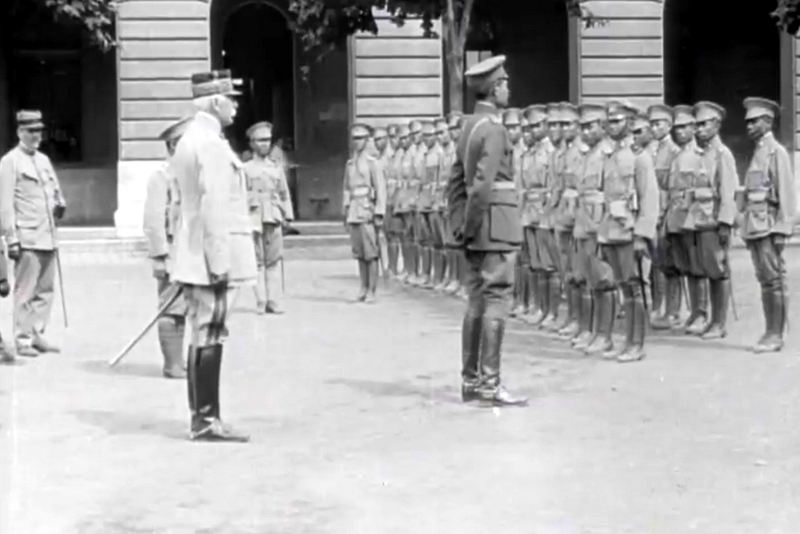
French general inspects Siamese troops
The First World War was seized upon as an opportunity to do all of these things. The war itself was, of course, an absurdity that never should have happened and many still fail to grasp this, insisting that the problem was the wrong side won when the problem was that the war happened at all. However, the hopes of King Vajiravudh are at least understandable. By intervening in the war, he hoped to have a cause to rally his people around the monarchy and the First World War was the biggest cause going at the time. It would mean that the Kingdom of Siam was participating in the pivotal event in world affairs at the time and would give Siam leverage against its neighbors, the British and French colonial empires, to redress grievances in the future Siam had with both. Many in Siam were still annoyed, for example, that France had taken into its empire Laos and Cambodia which Siam regarded as vassal states of their kingdom. By intervening in a conflict which was an existential threat to Britain and France, particularly with no vital need to do so, Siam expected to gain greater moral authority in dealing with these two powers. Likewise, as the King issued the declaration of war in the summer of 1917, it could be expected that the war would not last for much longer anyway.

The King called upon all of his people to unite behind this cause, to take their place as a participant in world affairs and even adopted a new national flag using the red, white and blue colors of the major Allied nations. The three colors, as announced in Siam, were to represent a new national unity of 1 people, 1 faith and 1 king. As the Siamese Expeditionary Force was assembled, more people actually volunteered than could be accepted. As it was, Siam could, of course, only afford a relatively minor force of mostly support personnel with medical and transportation contingents as well as air forces though these would have to be trained by the French. The SEF, under the command of Major General Phraya Bhijai Janriddhi, landed at the port of Marseilles on July 30, 1918 about 1,300 strong. While the pilots and air crew were set off for their new training, the general observed the operations of the other Allies to gain some experience in how things worked and, not too surprisingly given the times, the first use of the Siamese was when a contingent was organized into a labor detachment.

SEF Battle flag was a hybrid of the old & new designs
By September, the Siamese forces started to be actively employed at the front with combat units being filtered into the line and the medical and transport personnel being engaged in the Meuse-Argonne Offensive. None of the air personnel finished their training in time to participate before the November armistice but those units on the ground who did see action acquitted themselves quite well. Their involvement was not extensive but they had been involved and earned their place in the victory parade in Paris when the war was over and a detachment participated in the Allied occupation of the Rhineland. Losses had been extremely light with only 19 casualties. The Kingdom of Siam was present for the Versailles peace negotiations, not that it mattered much, and was one of the founding members of the League of Nations (again, not that the League ultimately mattered much). The Siamese contribution to the war had been limited and only for the closing months of the conflict, was inexpensive in terms of lives lost and had earned Siam a place among the victors when it was over.

However, the overall results of Siamese participation in the Great War were somewhat mixed. At the outset, it seemed to have achieved all that the King had hoped. They had been a part of the great event of the time, were on the winning side, the prestige of the monarchy had gone up and there were some benefits to found. Siam got to keep the German ships they confiscated at the outset and within seven years the British, French and Americans had all given up their extraterritorial rights in Siam. However, in the long-term, these benefits could be seen as inconsequential or of limited duration. The ensuing economic collapse hit Siam hard and internal divisions, which the King had hoped to eliminate for good, soon reappeared and, to some extent, have become a mainstay of Thai politics. The financial crisis caused Siam to go into debt to the British which, in a way, could be seen as offsetting the new equality gained by Britain giving up her extraterritorial rights. All of this stress also benefited the dissident crowd and soon those advocating for a constitutional monarchy were back. King Vajiravudh would not live to see it but his successor, his younger brother King Prajadhipok, would go down in history as the last absolute monarch of Siam, the result of the Revolution of 1932 and the only king of Chakri dynasty to date to abdicate the throne.

Sunday, March 12, 2017

The British Submarine Campaign of World War I

During the First World War it was the submarines of Imperial Germany that certainly got the most attention in the world press. Theirs was the first major submarine campaign undertaken by any nation, the German u-boats sank the most ships by far and it was the submarines belonging to the Kaiser which pushed American popular sentiment to the Allied side and, though few realize it, they came extremely close to winning the war for the Central Powers all on their own. Whenever one thinks of the British, even with the proud and famous history of the Royal Navy which dominated the seven seas for centuries, it is usually in the context of being on the receiving end of submarine warfare rather than instigating it. This is certainly understandable given that twice in the last century, the British were driven to the brink of defeat by German submarine campaigns and, because of that, the British became masters at anti-submarine warfare. However, the British have never been without success in naval warfare under the waves as well as upon them. From the First World War to today the Royal Navy has been a major submarine power and it was in the Great War that the British produced their first submarine war heroes whose names are still household words amongst the submariners of the world.

HMS H-4
The Royal Navy entered World War I with a small collection of submarines designed to operate in coastal waters or not too far from a friendly port. These were the B, C, D, and E-class boats. It is a credit to the men that sailed them that boats of each of these classes were to achieve success in World War I, even the oldest of the B, C and D-classes. After the war had started, a new class of coastal submarine, the H-class, was built in Canada based on an American design and with American parts (U.S. neutrality at the time prevented them actually being built in America). The H-class was a little slow to catch on but ultimately proved to be a very successful design with some boats remaining in service in World War II and with other navies into the early years of the Cold War. The wartime G-class and L-class boats were more ambitious but did not see much action. As the Royal Navy grew more accustomed to submarines and ambitious in their thinking, these boats represented a step in the process toward the design of fleet submarines intended for major offensive operations. Continuing in that were the J-class, the very “creative” K-class which was steam-powered and the very fierce-looking M-class which resembled a sort of miniature, submersible battleship. The K-class proved problematic and only one M-class boat was clear for sea before the war ended and it was kept far from the action for fear that the Germans would copy the design for their own boats.

Probably the most successful British submarine design of World War I was the E-class. It is the type of boat most imagine when they think of British submarines from the First World War and it no doubt helps that all three of the most famous British submarine commanders of the Great War skippered E-class boats. They were small but sturdy and meant business with, unusually, bow, stern and beam torpedo tubes. A deck gun, originally lacking, was added in the course of the war. These, as with most British submarines tended to operate in the North Sea, the Baltic Sea and the Mediterranean Sea. Long-range offensive submarine operations were always going to be rather limited for the British since their boats tended to be limited to coastal range and in areas such as the North Atlantic they had few potential targets since the domination of the Royal Navy surface fleet tended to sink or keep in port most German merchant ships and, because of the German submarine campaign, there was always the danger of “friendly fire”. The terrible toll taken by German u-boats meant that when any British warship spotted a submarine, they tended to shoot first and ask questions later.

Centenary RN submarine flags
It was World War I which saw the birth of the British submarine tradition which continues even today. They had a spirit of reckless courage and tenacity born of adversity. The salty, old sea-dogs of the Admiralty were slow to accept the submarine as the formidable weapon of war that it is. Rightly proud of their massive battleships and with Britannia having ruled the waves for so long, such an innovation seemed unnecessary at best. Submarines were something generally associated with the enemies of the British Empire. The very first submarine attack (which failed) was made during the American War for Independence by the rebel colonists against HMS Eagle. Likewise, the original Holland-class boats had first been designed with the intention of their being used by the Fenian Brotherhood of Ireland to launch sneaky attacks on British shipping. A vessel that slipped, unseen, beneath the waves and which could attack an enemy unawares also seemed rather underhanded to the British sense of honor and chivalry. One British admiral even went so far as to denounce the submarine as “damned un-English!” while another suggested that, with the Germans in mind, all submariners should be considered pirates and hanged if captured. The British underwater sailors did not take kindly to this comparison and so decided to wind up the admirals by flying the Jolly Roger pirate flag after a successful cruise. That little show of defiance became a Royal Navy submarine tradition and when the HMS Conqueror returned home after sinking the Argentine battle cruiser General Belgrano in the Falklands War, she flew a Jolly Roger of her own design. (this, by the way, was the first and so far only nuclear submarine to sink an enemy vessel in combat)

However, the success of the German u-boats soon proved to even the most conservative British admirals that submarines were a weapon they had to take seriously and so King George V was to send his own out to do battle for King and Country. There were certain places were only submarines were able to operate effectively, areas which only they could reach and it was the British in the First World War who found out what naval experts today still know to be true; the best weapon to use against a submarine is another submarine. Three German u-boats were sunk by obsolete British C-class submarines, D-class subs sank two u-boats, the E-class sank five and British mine laying submarines accounted for a large number of destroyed German u-boats as mines took the heaviest toll of all on the Kaiser’s underwater fleet. The three primary area of operations for British submarines was the North Sea and waters adjacent to the British Isles, the Baltic Sea and the Mediterranean Sea. The North Sea would see the least success for, not only was it dangerous due to the threat of the German fleet and the presence of German submarines but also, because of this, was an area in which British ships could be just as dangerous to British submarines.

Sir Max Horton in 1940
Nonetheless, it was in home waters that the British boats scored their first success when Lt. Comm. Max Horton, captain of HMS E-9, sank a German light cruiser on September 13, 1914. Within two weeks he also sank a German destroyer, a major accomplishment and earning himself the Distinguished Service Order. Sir Max Horton was well on his way to becoming the most famous British submarine commander of all time. However, these successes were the only ones for Royal Navy boats in 1914 and they lost three subs before the year was out. It was soon decided to send them into action somewhere the Royal Navy surface ships could not reach: the Baltic. Submarines would be able to slip past the Germans, get into the Baltic and, it was hoped, cut off the supplies of iron ore being shipped from Sweden to Germany and support the Russian Empire. The first three British boats dispatched to the Baltic were commanded by men who would prove to be the very best; Max Horton in E-9, Noel Laurence in E-1 and Martin Naismith in E-11. However, the E-11, the last to make the run, was spotted by German patrols and forced back. The Central Powers had not seen the last of him though.

In the Baltic, Horton and Laurence raised havoc on German shipping. Sometimes they operated together, other times independently and the Russian port of Lapvik served as their home base. Horton proved that a submarine could operate even in the frigid conditions of January as long as one did not dally too long on the surface. Laurence, in E-1, attacked and badly damaged the German battle cruiser Moltke in the Gulf of Riga, forcing the Germans to cancel their plans for a landing there. Czar Nicholas II hailed Laurence as the “Savior of Riga” and decorated him with the St George Cross. Horton, in E-9, also sank a number of German transports, minelayers, escorts and damaged the cruiser Prinz Adalbert. He too was awarded the St George Cross by the Russian Czar and took such a heavy toll on German shipping in the area that the Germans began referring to the Baltic as “Horton’s Sea”. Their success proved to the British high command that their submarines could accomplish great things and soon more were sent in, some directly and some by being broken up and sent by rail overland from Archangel. This was an area that British surface warships could not penetrate but British submarines could and soon crippled German shipping in the area and fouled up their land operations on the coast as well.

LtComm Francis Cromie
As well as practically paralyzing German merchant shipping, the British boats also took a heavy toll on the Kaiser’s navy. Lt. Comm. Francis Goodhart, commanding HMS E-8, sank the Prinz Adalbert, E-19 commanded by Lt. Comm. F. Cromie sank the light cruiser Undine and so on. Cromie, who would take command of the five boat submarine flotilla in the Baltic after Horton was withdrawn, was another major Royal Navy hero for the submariners, on one cruise destroying over 22,000 tons of enemy shipping in a single day. The Germans had the second largest navy in the world and the Baltic was practically their backyard and yet all shipping there had been totally paralyzed by a force of only five British submarines. If further proof were needed that the subs of the Royal Navy were good value for money, their operations in the Baltic certainly proved it. By 1917 successes dropped off simply because there was nothing left to shoot at and the collapse of Russia after the revolution forced the British to scuttle their boats rather than see them handed over to the Germans as stipulated in the Treaty of Brest-Litovsk.

In the Mediterranean Sea, British submarines were dispatched to once again go where no surface warship could: the Dardanelles. Based on the island of Mudros, the original British force consisted of only six Allied submarines, three of which were the pre-war, British B-class boats which were largely obsolete. However, in the hands of a talented British captain, even these boats proved capable of success and, luckily for Britain, just such a captain was tasked with making the first foray into Turkish waters, Lt. Comm. Norman Holbrook of HMS B-11. On December 13, 1914 Holbrook and his men went in, but pushing against the strong currents made progress slow and maneuvering a struggle. Nonetheless, Holbrook was able to sight a target and with one well placed torpedo the outdated B-11 sent the Turkish cruiser Messudieh to the bottom. Holbrook managed to escape though it was a nerve-shattering experience and by the time he was able to get clear and surface his batteries were totally exhausted and the engines so totally deprived of oxygen that it took thirty minutes before they could be restarted. For this stunning victory, Holbrook became the first British submariner to earn the Victoria Cross.

HMS E-14
The next to go in was Lt. Comm. Courtney Boyle in HMS E-14. He had a hard time but managed to sink a minelayer and a Turkish troopship loaded with 6,000 soldiers and a battery of artillery. After all his torpedoes had been fired, Boyle handed out rifles to his sailors and stayed on patrol, chasing another Turkish transport onto some rocks before returning home. Boyle was also awarded the Victoria Cross. Then, of course, there was the legendary patrol of Lt. Comm. Martin Naismith, later Sir Martin Dunbar-Naismith of E-11 which penetrated the Turkish Sultan’s bathtub and brought shipping to a standstill. Forced to rely on the Berlin-Baghdad railway to supply their troops holding back the Allies at Gallipoli, Naismith sent his first officer ashore to blow up a section of the railroad, putting it out of action and forcing supplies to move by the sea again with E-11 sending more ships and boats to the bottom. Naismith would also receive the Victoria Cross for his fantastic accomplishments in the Sea of Marmara and for sinking the last Turkish battleship (formerly the German vessel Prince-Elector Friedrich Wilhelm). You can read more about these exploits here.

All told, the British submarine campaign in Turkish waters had been a resounding success thanks to the skill of the Royal Navy officers and sailors. By the time it was over, they had basically wiped out the Turkish navy by 1916 and sunk about half of the entire Turkish merchant marine as well. Efforts to use submarines in conjunction with the surface fleet proved unsuccessful, epitomized by the fate of the big K-class boats, and in the later stages of the war emphasis shifted to countering the u-boat menace. In this, again, the British submarines proved highly successful, sometimes hunting on their own and, at other times, in conjunction with a surface ship. Up until 1917 only five German u-boats were lost to British submarines but from then until 1918 the British boats managed to sink thirteen of the underwater raiders. All in all, British submarines accounted for 10% of all German submarine losses, more than were sunk by aircraft or the infamous Q-ships.

HMS E-11
Today, as mentioned at the outset, the British submarine campaign of World War I remains overshadowed by their German counterparts. This is understandable given that the German campaign was larger and accounted for many more sinkings, driving Britain to within a mere few weeks of defeat. However, the submarines of the Royal Navy did have a major impact on the war, particularly in the Baltic and in Turkish waters. They proved to a doubting admiralty just how effective submarines could be and they laid the foundation for the proud submarine tradition that is still maintained today. Five Victoria Crosses were awarded to British submariners during World War I and the greatest heroes of the British submarine campaign in World War I, Horton, Laurence and Naismith, are still household words to British submariners and others around the world. In their fight for King and Country, they had more than proven their worth.

Saturday, November 29, 2014

The Belgian Army in World War I

Among the countries involved in the outbreak of the First World War, each must bear some measure of blame for the disaster. That is, all but the Kingdom of Belgium who was guilty of no more than being a victim of geography. Belgium was a neutral country and took that neutrality seriously. Caught between the feuding peoples of France and Germany, the Belgians had no reason to trust one side more than the other. The Germans may have seemed the more intimidating but, in the past, it had been the French who seemed most eager to take Belgium for themselves. The Germans and Belgians had had their differences but their King, Albert I, had also married a Bavarian princess and she was quite popular. In matters of defense, the Belgian government trusted in its scrupulous observation of neutrality to protect the country and was extremely reluctant to spend money on the military. As usual, the Belgian government would have been much wiser to have listened more closely to the advice of their monarchs.

During the Franco-Prussian War of 1870 King Leopold II had mobilized the Belgian army as a precaution in case either side violated Belgian sovereignty. Fortunately, neither did but many esteemed military figures, such as General Brialmont, were concerned enough to support King Leopold II in calling for military reforms. The most pressing was the need to do away with the old system of filling the ranks of the army by a lottery and replacing it with national conscription. The politicians saw this as unnecessary but there was finally sufficient support to get the appropriate bill passed which King Leopold II signed into law on his deathbed. Unfortunately, the planned enlargement of the army would not be completed by the time war came in 1914. The new monarch, King Albert I, was just as concerned as his uncle had been and was also just as frequently brushed aside. National defense was something the King naturally took more seriously as Belgian law stipulated that, in the event of war, it was the duty of the King to take command of the army. Also of concern was how rapidly military technology was changing. When the Belgians began building new, impressive fortifications at strategic points throughout the country, particularly the “National Redoubt” of Antwerp, the massive stone fortresses were already obsolete by the time they were completed due to the rapid advance in artillery technology.

In 1914 the Belgian national defense consisted of one field army made up of six divisions as well as garrisons for the fortified zones of Liege, Namur and Antwerp. The military plans in place for Belgium called for the army to fight defensively in these fortified zones and behind the three major rivers until such time as the larger military forces of those powers pledged to defend Belgian neutrality could arrive to turn the tide against the invader. The critical moment came on August 2, 1914 when the German ambassador informed the Belgian government that Luxembourg was being occupied and that German troops would soon be entering Belgium. The Germans pledged to respect Belgian property if no action was taken against them but that if the Belgians resisted that they would be treated as enemies. King Albert I did not hesitate, he would defend his country against any invader no matter how hopeless the situation seemed, famously saying that, “Belgium is a country, not a road”. On August 4, the King informed the British, French and Russians that German forces had crossed the Belgian border and appealed to them to come to the aid of Belgium in resisting the invader. The Belgians braced themselves for the first blow from the most advanced, heavily armed military on earth.

General Leman
The German First and Second Armies that crossed into Belgium expected that the Belgians would either not resist or that, if they did, could be easily pushed aside. Neither assumption was to prove correct. King Albert I deployed his forces as best he could; the 3rd and 4th Divisions were posted on the right along the Meuse River at Liege and Namur, the remaining four divisions would hold the gap between the Gette and Dyle Rivers to block the German advance on Brussels in the center and Antwerp to the north. As the Germans marched into Belgium the first major obstacle they encountered was the fortress of Liege, defended by General Gerard Leman, a tough Belgian soldier who had tutored King Albert I in the art of war. He faced 130,000 German troops with massive artillery support all under the command of General Otto von Emmich. When Leman refused to surrender, von Emmich launched a massive attack, sending nine brigades into the gaps between the Belgian forts. To his shock, every attack was repulsed with such heavy losses for the Germans that several divisions had to be withdrawn back to the Fatherland. There was even some panic in Aachen that the Belgians might counter-attack and invade Germany.

However, the German generals kept their cool, brought in immense numbers of reinforcements and outflanked the Belgians guarding the gaps, forcing them to retire. The forts continued to hold out and fire at the German lines and the Germans proceeded to the frustratingly slow task of reducing these forts one by one with their superior heavy artillery. It was not until August 17 that the last Belgian fort was destroyed. General Leman had been knocked unconscious in the rubble and made it clear that this was the only reason he had been captured and that he had not surrendered. General von Emmich was so impressed by the tenacity of his Belgian foe that he returned the generals’ sword to him and General Gerard Leman became the first bona fide hero of the Great War for the Allies. Fortress Liege had fallen but it had taken precious time that the Germans desperately needed for their plan to conquer France to work and the tenacious Belgian defenders had inflicted 42,712 casualties on the German invaders.

The next area of resistance was the Belgian forces assembled at the Gette River, 20 miles behind the Meuse. For the most part, they kept watch but when the Germans ventured too close the Belgians made them pay for it. The most famous battle in this sector was fought at Haelen in Limburg where four regiments of the German cavalry corps were soundly beaten by the Belgian cavalry division (including one battalion on bicycles) on August 12. It became known as “the Battle of the Silver Helmets” because of the numerous German cavalry helmets that littered the field when the fight was over. Ultimately, however, there could be only one outcome with the Belgians having what amounted to two army corps up against eleven corps for the Germans. Hard-pressed on their front and being encircled on each flank, the Belgians were forced to fall back toward Antwerp or risk being cut off from the “National Redoubt”. Fighting numerous rearguard actions, the Belgians fell back and the Germans marched into Brussels on August 20. That same day the siege of the fortress of Namur began which was isolated by the retreat of the army. Again, the Germans began the methodical task of blasting the Belgian forts to pieces one by one. Outranged by the German and Austrian guns, the Belgians could simply endure. The last fort at Namur was destroyed on August 24.

The Germans, already behind schedule, decided to bypass Antwerp and rush forward, ultimately meeting the British for the first time at Mons. However, they had to leave behind a considerable number of troops to watch the Belgians who had withdrawn behind the stout but outdated fortifications. Again, the Belgians had deprived the Germans of time and men at a crucial moment. King Albert I was not content to sit and wait and, although it cost his army, ordered two raids outside the city walls against the Germans in an effort to support the Allies fighting at the Marne. The Germans were forced to divert three divisions that were supposed to reinforce General Alexander von Kluck’s 1st Army. Once the German plan was finally frustrated at the battle of the Marne, they turned back toward Antwerp to finally deal with the Belgians once and for all. Again, huge guns were brought forward and a massive bombardment began on September 28, 1914.

It was clear immediately that Antwerp could not hold out and what help came from the Allies was too late to make any difference. King Albert gave the order to retreat in order to save his army. The forts would have to hold out to the last man, supported only by some Belgian artillery, British infantry and French marines while the army escaped up the coast toward the French border. The defenders fought like heroes, saving the army and the hope of their country in the process. Finally, on the last patch of unoccupied Belgian soil, King Albert I stopped his army at the Yser River and determined to retreat no more. It was a miserable, soggy place to fight a war. “Trenches” had to be built above ground because digging only uncovered water as little as 2-3 feet below the surface. The Belgian army was tattered, exhausted and disorganized but they fell into line and fought like heroes as the inevitable German attack came. This coincided with the famous “Race to the Sea” as the Germans and Allies tried to outflank each other, moving ever northward, to prevent a stalemate. Thanks in no small part to the tenacious Belgian defenders of the Yser, it was a race the Allies would win. Throughout October the Germans attacked again and again until finally, the Belgians were forced to flood the countryside but ultimately, against all odds, the Belgian army held its ground and the Germans finally gave up and began moving their attack southward toward the British at Ypres.

For the next three years the Belgians stood guard on the Yser, skirmishing with the Germans while rebuilding their army until it was even stronger than it had been before the war. It was a sector of waterlogged misery where perpetual dampness took a heavier toll than the enemy, leaving many men crippled for life. And so the war went on. King Albert I met to discuss strategy with the other Allied commanders, Queen Elizabeth cared for the wounded and Crown Prince Leopold served in the trenches alongside his future subjects. The little Belgian air force made its presence known with the ace Willy Coppens gaining fame with 37 victories and a reputation as the preeminent Allied “balloon buster” of the war (which is a more respectable feat than most realize as observation balloons were heavily guarded). In central Africa the Belgian Force Publique, operating out of the Congo under General Charles Tambeur, drove the Germans out of Rwanda and Burundi and captured the outer capitol of Tabora in German East Africa. In a gesture of solidarity with her allies, Belgium sent a contingent of troops, equipped with armored cars that had first seen action at Antwerp, to the Eastern Front to aid the Russian war effort.

In April of 1918 the Belgian right wing came under attack during the famous “Kaiser’s Offensive” or Operation Michael which was Germany’s last, desperate gamble to win the war at a stroke. Breaking through the point where the French and British lines came together, the Germans pushed outward to expand the breach, eventually making contact with the Belgians. A captured German soldier was found carrying orders which included the optimistic note that, “The Belgians are not used to being attacked in force; success is certain. They will be overthrown before they know we are there.” Once again, the Germans would pay dearly for underestimating the resolve of the Belgian army. On April 17, 1918 the Germans struck; the first Belgian outposts fell quickly, though it took considerable effort and much hand-to-hand fighting to accomplish this. The Germans reached the Belgian support line by mid-day but were halted by heavy Belgian artillery fire. Then, under a moving barrage, the Belgian infantry counter-attacked and began regaining their lost trenches. The Germans were stunned and the attack fell apart, some units retreating and others fighting on in isolated pockets. By nightfall the Belgians had recovered almost all of the lost ground and taken 800 German prisoners.

This engagement surprised observers on both sides as the Allies realized that the Belgians could attack as well as defend. Marshal Ferdinand Foch, supreme Allied commander, arrived to decorate the Belgian heroes and to confer with King Albert about the coming counter-offensive against the Germans. The Belgian King was made commander of the Flanders Army Group, responsible for the northernmost sector of the Allied advance that would carry on through November of 1918. Aside from the Belgian army, his command included the British II Army and French VI Army. From September 28-30 the Belgian divisions broke through the German lines, at one point advancing up to eleven miles. At the beginning of October, the Belgians attacked again and forced the Germans back another eight miles. The second phase of the Flanders offensive, later known as the battle of Thourout-Thielt was launched by King Albert on October 14, 1918. The engagement saw the Germans pushed out of Flanders for good. Supported by the French on one side and British naval fire from the coast, the Belgians steadily drove the Germans back. By October 17 the Belgians reached Ostend and the outskirts of Bruges.

King Albert I
On the Lys the Germans put up heavy resistance, showing that despite their weakened condition by this time, they were still a formidable foe. The Allied advance stalled but eventually began to gain ground again. After heavy fighting the Belgians gained a foothold on the east bank of the Lys and moved on to meet up with the French at Ghent. It was in that area that the Belgians remained until the Germans agreed to an armistice, ending the war. The Kingdom of Belgium had lost 44,000 men in the war as well as 9,000 civilians, far less than other powers, but a heavy toll for so small a country. However, the Belgian armed forces had done their country proud by their plucky resistance against unspeakable odds. The well-known phrase amongst the Allied countries of “Brave Little Belgium” was certainly well-deserved and no Belgian was more widely respected around the world than King Albert I for his calm, steady and courageous leadership during the greatest crisis his country had faced up to that time. He had been steadfast in the defense of his country and yet never vindictive. In fact, he was the only Allied leader to support the call by the Pope for making peace and had tried to arrange such a peace with Emperor Charles I of Austria-Hungary, but no avail.

After the war there was talk of Belgium being given Luxembourg or even control of Palestine but, in the end, Belgian territorial acquisitions were modest. In addition to reparations Belgium received mandates of Rwanda-Burundi in central Africa and the addition of the German territories of Eupen, St Vith and Malmedy, adding German as the third official language of the Kingdom of Belgium. Today, many remember the Belgians as some of the most unfortunate victims of the Great War, the small, peaceful country caught between warring powers. This was certainly true but the great accomplishments of the Belgian army should not be ignored. Faced with a hopeless situation, the Belgians mounted a stubborn defense that proved very costly to the Germans, throwing off their timetable and giving the Allies the chance to beat them at the Marne. Again, in the “Race to the Sea” it was Belgian tenacity that ensured the Germans did not gain a strategic advantage by turning the Allied flank. The Belgian army may have been small but it fought with immense courage, endured incredible hardships and played a decisive role in the ultimate Allied victory.

Saturday, October 4, 2014

The Ottoman Empire in World War I

There can be no doubt that Turkish intervention in the First World War was the worst decision ever made by the Ottoman Empire. An empire that had withstood storm and stress from within and without for more than 600 years was ruined beyond repair in less than four. Here was a country which had dominated the cross roads of the world, the most lucrative trade routes, which had ruled all of north Africa and much of southern Europe for centuries, brought down by choosing the losing side in the First World War. The Ottoman Empire did not collapse immediately as the war ended like Austria or Germany, nor did it come down during the war like Russia but although it may not get the attention of the German, Austrian and Russian Empires falling, it was really even more of an historic event. The Ottoman Empire had existed long before the first Hapsburg ever achieved imperial status, long before the Prussians ever had a country of their own and long before the Romanov dynasty came to power in Russia. At their height of power, the Ottoman Empire was the sole superpower of the western/near eastern world and yet all of that glory seemed to be but a faded memory to most of the world in 1914. Most did not give the Turks much time.

The Kaiser visits Constantinople
For years the Ottoman Empire had been in decline and for no small amount of time had been called, dismissively, the “Sick Man of Europe”. Their tenuous hold on Algeria and Tunisia was lost to France, Egypt and the Sudan became autonomous and later dominated by Britain, the provinces that are today Libya were taken by the Italians and Ottoman power was pushed almost completely out of Europe by the Balkan Wars. It seemed that the Ottoman Empire would have collapsed much, much sooner were it not for the intervention of other powers like Britain and France to prop it up and save it from being crushed by the Russians. It is almost amusing now to look back and consider that this was done because, in those days, the Great Powers feared the chaos and wars that might result in the Middle East if the order imposed by Turkish rule was lost. Imagine that. Because of this very long, downward spiral, many viewed the Ottoman Empire as a power unworthy of serious consideration, as a people not to be taken seriously. That was a mistake and one man who understood the potential that rested in the Ottoman Empire was the German Kaiser Wilhelm II. When few others cared to give the “Sublime Porte” the time of day, the Kaiser actively courted the Turks as a friend and ally.

Sultan Mehmed V
The Germans invested heavily in Turkey and were given a warm welcome by the new crop of ambitious officers who had come to power known as the “Young Turks”. These men, it should be mentioned, were not exactly devoted monarchists and the Ottoman Empire went into the war as perhaps the most nominal monarchy of all with the sovereign, Sultan Mehmed V, being little better than a prisoner in his own palace. In fact, for much of his life he had been a prisoner in his own palace but the “Young Turks” who seized power in 1908 put him on the throne a year later as a figurehead. The empire was dominated by three pashas, the most famous being Enver Pasha who was so enamored of Germany that he even took to wearing a Wilhelm-like moustache. For his part, Sultan Mehmed V was dubious about the new friendship with Germany and thought intervening in World War I to be a great mistake, like almost every other monarch at the time. Yet, there did seem to be some hope that the war could be a successful one for the Ottoman Empire, particularly since so many of their enemies had come to underestimate them. In fact, the Ottoman Empire had been rebounding with great advances in industry, trade and improving the infrastructure of the empire, illustrated by the much talked about “Berlin to Baghdad Railway”. When it came to war, the Turks would prove more formidable than almost any of the Allies expected.

Enver Pasha
For quite some time the military sciences had stagnated in Turkey but prior to World War I there was a massive campaign of revitalization. Armies were armed with the latest German weaponry, German officers came to advise in training and tactics and the average Turkish soldier proved to be a tough and tenacious warrior. It was a naval incident that ostensibly brought Turkey into the war but a secret alliance was quickly signed and Turkish ships attacked the Russian coast on the Black Sea. On November 1, 1914 the Russians declared war on the Ottoman Empire, followed by Britain and France a few days later. Other powers would later join in as the Turks had grander aspirations than almost any other of the Central Powers. Given the lofty heights from which their empire had fallen, this is not a great surprise. If the Central Powers had won the First World War, the Turks had quite a long “wish list” to be filled. They hoped to regain practically the whole of North Africa (central and southern Africa being left to the Germans) and toward that aim sent support to rebels in Libya, planned an invasion of Egypt, sent arms to Muslim dissidents and the Emperor of Ethiopia in the hopes of dominating the Horn of Africa, planned for great gains in southern Russia and to expand eastward to reclaim their central Asian homeland. If the war had gone differently, the world would have looked quite different indeed.

Reading out the declaration of jihad
The Turks also called upon religion to help them in their efforts to instigate rebellions in Allied colonies and not long after joining the war Sultan Mehmed V, as the Caliph of Islam, formally declared a jihad, a holy war, on the Allied nations, calling on all Muslims to rise up and fight. The Kaiser had hoped that rebellion would spread around the world and cause Britain to lose India, the crown jewel and capstone of the British Empire, and there certainly seemed to be no downside to such a tactic. Almost half of the Muslims in the world lived under the direct or indirect rule of one of the Allied nations with Britain, France, Italy and Russia all holding colonies or territories with large Muslim populations. Yet, though there were small scale attacks in Libya, Somalia and Egypt-Sudan, and an isolated mutiny of Muslim troops in Singapore (suppressed with help from Japan) the majority of Muslims felt no compulsion to rise up and fight because the Sultan of Turkey, Padishah Emperor, Caliph of Islam etc, etc had commanded them to do so. It was also somewhat disingenuous given that the triumvirate ruling the Ottoman Empire at this time were hardly the devoutly religious sort. Enver Pasha would, after the war, make common cause with the Soviets, Djemal Pasha supposedly proposed making peace with the Allies if he could be left in control of what was left of Turkey and Talaat Pasha had taught at a Jewish school and had an affair with a Jewish girl as a young man. The “Young Turks” had always been known as being more inclined toward secularism than religious fervor. Still, they would take up the flag of Islam when it seemed useful but a pan-Islamic movement was not an easy fit with Turkish nationalism. It probably also didn’t help that this call came with Turkey allied with three Christian powers.

Turkish troops in the Caucasus
Focus on more modern, western ideas had brought advances to the Ottoman Empire. However, despite the rapid progress that had been made, the Ottoman Empire still had many disadvantages going into the war. Their commanders were often not up to the task of fighting a modern war, their system of logistics was quite weak and the farther one traveled from Anatolia, the harder it was to support armies and the less reliable was the loyalty of the locals. It is easy to conclude that the new leadership were a bit overconfident in their ability to succeed in conquering such vast swathes of territory. As it happened, their first major action in the war proved to be a resounding failure. This was an offensive against Russia, long planned and hoped for, to ultimately gain control of the Baku oil fields. On December 22, 1914 this invasion was launched under the leadership of Enver Pasha himself but it quickly turned into a disaster. Despite all their planning, the Turks lack of experience was shown in their failure to prepare for the harsh winter conditions of the Caucasian mountains and the Russian Imperial forces resisted fiercely. In a bitter four day battle at the start of January, 1915, at Sarikamish the Turks were totally defeated and almost entirely wiped out by the Russians. 95,000 Turks had invaded Russian territory but only 18,000 survived the ordeal. Fighting continued but there would never be another major Turkish offensives against Russia.

Baron Kressenstein
Only a short time later, the Turks launched an attack towards Egypt aimed at seizing control of the Suez Canal from the British and instigating a major uprising by the local population against them. Djemal Pasha, another member of the triumvirate, was in overall command of the southern theatre but it was a Bavarian colonel, Friedrich Freiherr Kress von Kressenstein who effectively led the attack. He made careful preparations for crossing the desert and the canal but, though it was a masterful advance, the British learned that it was coming and were fully prepared to meet the Turks when they arrived. With relatively little difficulty, the British were able to force the Turks to retreat back across the desert after two days of fighting. All in all, the war was off to a disastrous start for the Ottoman Empire but things were about to turn around. In fact, these early Turkish defeats may have caused the British in particular to further underestimate them. This is unfortunate given that initial operations in wartime are rarely resounding successes and are seldom an indication of what the enemy is truly made of. Yet, the British, particularly Winston Churchill, became convinced that Turkey was the weak link in the Central Powers chain and the key to an easy victory in the war.

Gen. Limon von Sanders
The British planned an attack on the Dardanelles, ultimately to capture the capitol of Constantinople. This would knock Turkey out of the war and open up a naval route to keep Russia well supplied and in the war. After naval power alone proved insufficient, the Allies launched an invasion at the Gallipoli peninsula in April of 1915. However, being so close to the nerve-center of the whole Ottoman Empire meant that not only did the Turks fight with greater tenacity than on any other front but also that they were closer to their sources of supply. It also happened that the troops defending the peninsula, the Turkish Fifth Army, were the best in the empire and under the command of the talented German general Otto Limon von Sanders. The result was a disaster for the Allies that was much worse than the statistics alone suggest. In the end, losses were about the same for both sides but the Allies had been hoping for a quick and easy victory and what they got was a bloody stalemate, ending in a retreat with absolutely nothing gained. The Turks fought with incredible tenacity and earned the grudging respect of their enemies. The success was a huge morale boost for the Ottoman Empire and proved that they could win battles against the Allies. The British and ANZAC troops lost over 200,000 men, the French nearly 50,000 before finally retreating from Turkish soil. It was also this battle which saw the rise to prominence of Mustafa Kemal Ataturk who would later become the first President of Turkey.

Baron von der Goltz
Elsewhere in 1915, British overconfidence also ended in disaster at the hands of Turkish forces. A small excursion from the Persian Gulf to secure the local oilfields was expanded into a major operation because Turkish resistance was initially so weak. A British army (consisting largely of Indian troops) advanced up the Tigris River under Major General Charles Townshend with the ultimate goal of seizing Baghdad. However, his advance was stopped by a Turkish army under the veteran German Field Marshal Colmar Freiherr von der Goltz. The British fell back to Kut-al-Amara where they were besieged. More Turkish reinforcements were rushed in and British attempts to relieve the starving garrison all failed. Finally, on April 29, 1916 Townshend surrendered, marking another major victory for the Ottoman Empire. It was the largest mass surrender of British forces up to that time, surpassing the defeat at Yorktown in the American War for Independence and would remain the largest British surrender until the fall of Singapore to Japan in World War II.

A Turkish line in the sand
However, in the summer of 1916 another Turkish advance on the Suez Canal by Baron Kressenstein again ended in failure. The Turks were better prepared but so were the British and such a major campaign across so much desert proved an insurmountable obstacle for Turkish logistics. It was the last such offensive and the initiative switched to the Allies (primarily the British though token forces of French and Italian troops also participated) as General Sir Archibald Murray advanced to the border of Palestine. However, Baron von Kressenstein and his Turkish forces redeemed themselves by stopping Murray cold at the First Battle of Gaza in March of 1917. The next month the British tried again but were again defeated by the Turks in their strong defensive positions, backed up by effective artillery. Allied losses were heavy compared to their enemies and Murray was sacked and replaced by General Sir Edmund Allenby who came with considerable reinforcements. 1917 was to be a gloomy year for the Ottoman Empire. Previously, the British made an alliance with the Arabs who rose in revolt against their Turkish rulers and this played a major part in the Allied victory. Turkish logistics were always a weakness and the Arab revolt exploited this by constant raids that left Turkish forces ill-supplied and which forced the dispersal of troops to defend railways and supply lines. Even with assistance from Germany and Austria-Hungary, it was simply too much for the Turks to face the Allies at their front and the Arab harassment on their flank and rear.

Staff of the 6th Army in Iraq
Gaza was taken, Jerusalem was taken and soon the British were advancing in Iraq again where Baghdad was taken. With the Battle of Megiddo the Turkish army began to come apart. Limon von Sanders had been in command there but the victor of Gallipoli could perform no miracle against the Allied forces that so outnumbered his own. This was also partly due to Russian action in the Caucasus where it was feared that an offensive was in the making which forced the Turks to weaken their southern front to defend the north. In 1918 the Ottoman forces did win some victories against Armenian separatists and actually succeeded in capturing Baku from the British who had rushed in to secure the area but it was too late to do any good. Resistance in the south had disintegrated and on October 1, 1918 the Arabs occupied Damascus and Aleppo fell later in the month while in Iraq the Turkish Tigris Army was forced to surrender. On October 30, 1918 the Ottoman Empire signed an armistice with the Allies, one month after Bulgaria had done the same. Allied troops arrived later to occupy Constantinople and most of the Ottoman Empire was partitioned between the French and British. The Turks had fought to the bitter end and while their opening offensives had ended in defeat, they proved capable of determined resistance, throwing back every Allied attack on their territory. Ultimately, however, the superior Allied numbers and the number of fronts that had to be defended proved impossible to overcome. The Arab Revolt was the final straw and there was simply no way for the Turkish forces to prevail.

Ottoman regimental flag on Gallipoli
Nonetheless, the Turkish forces had played a pivotal part in the Central Powers war effort. They had forced the Allies to extend themselves greatly, diverted forces that could have been used elsewhere and had proven themselves more than a match for their enemies with victories at Gallipoli, Kut and Gaza. None of the troops involved in these operations, who encountered the fierce Turkish resistance, would have ever thought of the Ottoman Empire as the “Sick Man of Europe”. For a “Sick Man” he had put up one hell of a fight and inflicted on the British what will probably always remain the second-largest defeat in British military history. They had succumbed to overwhelming numerical and material superiority and by being forced to fight irregular rebels as well as the enemy at the front but they had proven themselves a match for their enemies and that they could accomplish great feats of arms. This gave the Turks a pride that carried on and saw them succeed in subsequent conflicts almost as soon as the First World War was over.

Thursday, July 10, 2014

Impact of the Great War & Loss of Monarchy

Many people know, at least vaguely, how pivotal the Great War was in world history. It is something that has been mentioned here often enough and monarchists are  probably more aware of it than most. In a sense we are one step removed from it but it is only one step and not a large one in that, we live in a world order created by the Allied victory in World War II and opinion is pretty much unanimous that there would have been no World War II if there had not been a World War I. However, it was not just the political changes and the shifts in world power that brought this about but also a reaction against the values, social norms and a myriad other things that existed before the First World War that has shaped our life as it is today. One of those things was the turn away from traditional monarchy toward various democratic and republican ideologies. There were also some things that existed before but became much more dominant in the aftermath.

For instance, nationalism certainly existed before World War I, indeed it was one of a number of subsidiary causes of the conflict. However, in many places nationalism was ratcheted up considerably afterwards, particularly in Central Europe. Socialism, similarly, certainly existed before World War I and the world prior to 1914 was certainly not one of pure, unadulterated capitalism, but after World War I there was a much more widespread rejection of capitalism in favor of socialism. It had existed previously but never before were entire regimes based on socialism and expanding socialism in various forms from the National Socialism of Germany to the international socialism of the Soviet Union. The United States was not untouched by this, going in a much more socialist direction under the FDR administration. Even in the regimes that denounced socialism, there was still an effort to create and advance some new sort of mixed economy that rejected capitalism as well. There was a backlash against both the aristocracy and the middle class as well as what was derisively called “middle class morality”. Traditional religious institutions were increasingly disregarded in favor of more “New Age” type spiritualism or neo-paganism.

As it concerns monarchy, those on the Allied side had survived but none were as secure as they were before World War I. In Britain, socialist agitation grew rapidly, particular in the trade unions and was one of the reasons, even before the war ended, of Britain refusing asylum to the Russian Imperial Family. The British Empire had expanded but it was far from secure economically. America had surpassed Britain as the largest economy around 1870 and Britain had gone heavily into debt to the United States in the Great War and would do so even further in World War II. The Kingdom of Belgium came out of the conflict in better shape than most but even there radical parties rose up that threatened national unity. In the Kingdom of Italy, communist subversion was rampant with strikes and riots breaking out at such regularity that the country seemed on the verge of revolution before Mussolini and his blackshirts suppressed them, taking power in the process. This, combined with the failure of the other Allies to make good on the extensive promises they had made to induce Italy to join the war all helped bring the Fascists to power. If that had not happened, that might have been enough to prevent the rise of Nazi Germany alone since Adolf Hitler made no secret of the fact that Mussolini has been his inspiration and the Fascist March on Rome convinced him that he could do the same in Germany.

That World War II, in Europe at least, was a direct result of World War I no one can deny. And it was specifically the loss of the monarchies of Germany and Austria-Hungary that was responsible. With the economic tumult that Germany went through, it is possible that Hitler could have still managed to have become a significant political figure (not as likely, but possible). However, there is simply no way that someone like him could have come to power and maintained himself in power if Kaiser Wilhelm II had still been on the German and Prussian thrones. Under the constitution of the German Empire, the Chancellor was not elected by anyone but appointed by the Kaiser. Before the First World War, only one chancellor was appointed who was not a prince or aristocrat and the idea that an Austrian commoner with no higher education and no record of any sort of success behind him at all could have been appointed by the Kaiser is simply beyond belief. And, of course, even if he had been, he could have been dismissed at any time. There is simply no way Hitler could have become dictator of Germany if the monarchy had been retained after the First World War.

World War II in Europe would have easily been averted had the German Kaiser retained his throne. Less clear cut is World War II in Asia but evidence points to the answer being the same. Much of the motivation for Japanese involvement on the Asian mainland was, after all, the result of the expansion of the Soviet Union with Soviet-backed communists taking control of Mongolia and supporting a growing subversive element in the Republic of China. Were it not for these communist threats, all of which came about as a result of the Bolshevik Revolution in Russia, there may have been no need for Japanese intervention in China. Similarly, for the wider war, it all started because of the provocations of the Roosevelt administration aimed at forcing Japan to take aggressive action which would turn public opinion in favor of American intervention in World War II, specifically in Europe. If there had been no war in Europe, there likely would have been no application of American pressure against Japan leading to war. There would also have not been the antagonism between Japan and the Western Allies that grew as a result of the Japanese delegates to Versailles being ignored and the later naval arms reductions agreements which treated Japan as a second-class power to Britain and America. But, to stay on course, this about the results of monarchies falling, not the war itself.

One major but often overlooked example is the Indian subcontinent. There the world has seen horrific violence brought about by the partition of the Empire of India into the republics of India, Pakistan and Bangladesh (originally East Pakistan) but also a continuous stand-off, with both sides now possessing nuclear weapons. There would have been a move for independence in any event and it would have been achieved in any event, both because it is only natural for people to resent being ruled by others and also because the British could have never maintained their rule by force. From the very beginning, British rule in India was based on voluntary cooperation; it is not as though British forces actually conquered the whole subcontinent and subdued an empire of 500 million against their will. However, the end of the monarchy when it happened and as it happened proved disastrous. In the best of times, the British monarch as Emperor of India had united people, inspiring them to work together and take pride in being part of something that was far greater than they could ever be on their own. India was not independent, but it was not as though it was thought of with contempt, rather, it was the crown jewel of the British Empire. If one is to be a possession, one would certainly prefer to be the greatest and most prized possession. In the worst of times, the imperial monarchy had provided a common enemy to unite Hindu and Muslim nationalists. Once it was gone, all they had was their own animosity.

Lord Mountbatten, the last Viceroy, tried to bring both sides together but it was to no avail and one by one the parts of the former Empire of India abandoned the status of Commonwealth Realms to become republics. Independence was to be welcomed as it would benefit both sides but if the Empire of India could have been maintained, whether with a Viceroy in personal union with the British Crown or under a restored Indian monarch, so much terror and bloodshed might have been avoided, not only in the conflicts between India and Pakistan but as a result of the support from radical elements inside Pakistan to terrorist forces and rogue regimes around the world. If there had been no World War I and thus no World War II, this might have been possible.

For the United Nations, the first great test was the Korean War, something which came about only because of the blindness of the Allied leaders in World War II. Former Japanese prime minister, prior to his execution by the Allies, General Hideki Tojo correctly predicted that Korea would be the battleground between the communist and anti-communist forces of the world. Without the Great War there would have been no conflict in Korea as there would have been no Soviet Union to occupy the north after partition and no Communist China to save North Korea from total defeat. If there had been no World War II there would have been no partition of Korea at all as it would have remained a constituent kingdom within the Empire of Japan. Even if events would have transpired to make independence happen, it still might have made a difference to preventing the Korean War if there had not been such a rejection of monarchy. It could have been perfectly simple; restore the Kingdom of Korea (or Han Empire as you please) as it existed prior to 1910 with no other powers gaining a foothold. That would have prevented a war in Korea, certainly on the scale that it happened, but this was not done because of a prejudice against monarchy, the Soviet desire to grab territory at the end of World War II and because of bigotry against the last King/Imperial Crown Prince of Korea who had served as a very high ranking and respected officer in the Imperial Japanese Army. Still, at minimum, the basic fact remains that without the communist influences of the Soviets, whose state was a direct result of the Great War, there would have been no Korean War and no tense standoff on the Korean peninsula which continues today.

In similar vein, one can look at all the small anti-colonial wars that swept across Africa in the wake of World War II. All of these were the result of communist subversion supported by the Soviet Union which send in political officers, weapons and lots of propaganda. Again, it is hard to imagine European rule continuing but the process of independence would have been much more peaceful and less traumatic. There might also still be an Emperor in Ethiopia had it not been for Soviet-backed subversion on the African continent. Likewise, often overlooked (probably because it was so successful) was the British anti-communist campaign in Malaysia. This was farther removed from the Great War but were it not for the Soviet support for the communists in China there might have been no communist uprising in Malaysia. This started out as an almost purely Chinese communist movement and during World War II it was even supported by the British because the Chinese communists were so anti-Japanese (not too different from American support going to Vietnamese communists because they were anti-Japanese). For that matter, would there have been a war in Vietnam? It seems not or at least not nearly so disastrous a war (or series of wars as it was). Again, without the Great War there would have been no Soviet Union and the Soviets became the primary backers of North Vietnam, there would likely have been no communist China and possibly no World War II which was when Vietnam was first partitioned. Without World War I there also would have been no promises from the Allies which encouraged subject peoples in colonies around the world to think that independence was right around the corner only to then be all the more disappointed when this proved not to be the case.

Looking across a wider area, if there had been no Great War, there would have been no Soviet Union, thus no Soviet invasion of Afghanistan, thus no Taliban militia and possibly no 9-11 and “War on Terror”. If there had been no Great War there would have been no Soviet Union to bring down the monarchies of Romania, Bulgaria and Serbia (without the Great War there would have been no Yugoslavia as there would have still been an Austria-Hungary or perhaps the “United States of Greater Austria” as some federalists envisioned). There would have then been no crackdowns and massacres such as were seen in every country of the Eastern Bloc. There would have been no division of Germany and just imagine how much more prosperous Eastern Europe, including Russia, might be today if they had not spent so many decades in the shackles of Soviet communism. The possibilities are almost endless.

Looking at the Middle East, there is no case more simple to illustrate the effects of World War I since so little has changed since then, World War II not touching too much on the region. Prior to the Great War there was not so much a “middle east” at all as it was almost entirely the Ottoman Empire. If there had been no Great War, if the Ottoman Empire had not collapsed, there would have been no Six Day War, no Yom Kippur War, no Intafadas, no Iran-Iraq War (possibly no Iranian Revolution either) and with no Saddam Hussein there is no Gulf War, no Second Gulf War, no Baathist dictatorship in Syria, no Syrian civil war, no Lebanese Civil War and perhaps no rise of radical Islam. The ISIS terrorists causing so much trouble today would have no reason to exist as their caliphate would still be standing in the form of the Ottoman Empire. Of course, saying that, it must also be pointed out that, at the time of the Great War, the caliphate was not foremost on the minds of the Arab Muslims at that time. It is rather ironic to see these gangs and armies of Arab Muslims today fighting for an Islamic caliphate when, during the First World War, it was the Arab Muslims who fought alongside Christian powers like Britain and France to bring down the Ottoman Empire and thus, ultimately, the last Caliph of Islam who was the Ottoman Sultan.

For Europe, setting aside World War II, there is no doubt that the most ugly and horrific tragedies to befall the continent have been a direct result of World War I and in many cases the dissolution of the “Dual-Empire” of Austria-Hungary. There were tensions, of course, that would have existed in any case but changes were coming, whether when Archduke Franz Ferdinand came to the throne or when Charles I received the crown. Both favored some changes, whether to unite the Slavic peoples into a third constituent kingdom or to federalize the whole empire. In any event, much of the anger would have been dissipated and for what remained there was the combined strength of the others under the Imperial Crown to prevent it from becoming problematic. There may still have been some conflict between the Hapsburg Empire and Serbia but, perhaps, after shedding some other smaller minorities and their territory to win wider support, the Slavs would have become united as part of the Hapsburg empire. Who is to say? In any event, had Austria-Hungary not been dissolved there would have been no Croatian and Slovenian Wars, no Bosnian War and no ethnic cleansing such as was seen in the traumatic break-up of Yugoslavia.

Whether Europe, Asia or Africa there are few major, modern conflicts that have not been a direct or at least indirect result of the First World War. Australia was affected as was North America with South America probably having been the least impacted, though even there the case can be made that the economic consequences played a part in the revolutions that caused so much warfare and turmoil. If World War I had never happened the world would be a much better place and even if it had happened, at least to some extent, people all across the globe would have been spared considerable suffering if the monarchs of Germany, Austria-Hungary, Turkey and Russia had not lost their thrones in the process.
Related Posts Plugin for WordPress, Blogger...