Tuesday, July 24, 2012

Monday, July 23, 2012

Images Page

Letting everyone know that the Images Page will be updated first thing tomorrow. The Romans will be out and the Romanovs will be in. The Russian monarchs featured will include Alexander I, Alexander II, Alexander III, Nicholas I, Nicholas II, Peter III, Empress Elizabeth and Paul I. As usual, if the images page is not terribly interesting, let me know what you might like instead, something new or something old brought back? You tell me.

Monarch Profile: King Carlo Alberto of Piedmont-Sardinia

King Carlo Alberto of Piedmont-Sardinia was the last head of the royal House of Savoy before the foundation of the modern Kingdom of Italy. His reign occurred at a time of great divisions, struggles and opportunities, many of which he would embody in his own life. He was born Prince Carlo Alberto Amedeo on October 2, 1798 in Turin to Prince Carlo Emanuele of Carignano and Princess Maria Cristina of Saxony, the first of their two children. Carlo Alberto was born into the era of the French Revolution and so, along with the traditional education from his family on the glories of the House of Savoy and conservative values, the displacement of the family meant that he also received a very liberal education in Geneva and later in Paris during the first French Empire. This had a lasting impact on him as throughout his life he displayed a commitment to the idea that the House of Savoy must take a leadership role in northern Italian affairs and also a lasting friendship with France, something many in his family, given what they had been through, certainly did not share. Nonetheless, as none of the sons of King Vittorio Amedeo III produced an heir to the throne, there was an early assumption that Carlo Alberto would one day inherit the leadership of the family and the throne of Piedmont-Sardinia.

Toward the end of the Napoleonic Wars, Prince Carlo Alberto had finished his education and was appointed to the rank of lieutenant of dragoons by Emperor Napoleon I in 1814. After the fall of the French Empire he returned to Turin and the elder members of the family set him on a new educational program intended to rid him of his pro-French and moderate liberal sympathies. They were not entirely successful and throughout his life Carlo Alberto would try to reconcile these two opposing world views he had been raised with. 1817 saw the happy occasion of a royal wedding when Prince Carlo Alberto married Archduchess Maria Theresa of Austria, Princess of Tuscany, on September 30 in Florence. She was a great woman, a devoted wife and a woman of very conservative opinions and a deeply sincere Catholic faith. In time three children were born; the future King Vittorio Emanuele II, Prince Ferdinando Duke of Genoa and the little Princess Maria Cristina who sadly died in infancy. Princess Maria Theresa was an excellent wife and mother whose influence was soft but strongly felt in both her husband and in the future reign of her son.

In 1821 King Vittorio Emanuele I abdicated, leaving the throne to his brother who became King Carlo Felice. However, he was, at that time, in Modena and so it was Prince Carlo Alberto who had to act as regent until he returned. That year a revolutionary movement took up the tricolor and demanded a constitutional monarchy as well as Savoy leadership in a movement to unify the states of Italy into one kingdom. Prince Carlo Alberto was sympathetic to these ideas and granted the first Piedmontese constitution. The very traditional and conservative King Carlo Felice, however, was certainly not and as soon as he returned to Turin he revoked the constitution, cracked down on dissident elements and sent Prince Carlo Alberto to join the French royal forces in Spain that were fighting to restore the absolutist King Fernando VII to his throne, hoping this would help put his priorities in order.

During this campaign, Prince Carlo Alberto won laurels as a champion of the old order. He was recognized for his great skill and bravery at the battle of Trocadero in 1823, defeating the constitutionalists and restoring the absolute monarchy of King Fernando VII. The part Prince Carlo Alberto played in this victory also earned him admiration in the Austrian Empire, which began to take notice of him as a rising star on the European stage. They were eager for a friendly face in Turin as they had been greatly at odds with the ultra-conservative King Carlo Felice. When he died in 1831 his last words to his successor Carlo Alberto were rumored to be, “Hate Austria”. In Piedmont-Sardinia there was joy and optimism upon the succession of the new King known as ‘Carlo Alberto the Magnanimous’. Here was a man who was committed to the glory of the monarchy, a man of vision and yet also a man who throughout his life had been torn by two conflicting world views. King Carlo Alberto would finally make Piedmont-Sardinia a constitutional monarchy, yet who was so traditional and conservative in his own tastes that he once called Prince Metternich a ‘radical’. He would be opposed by the extremes on both sides of the political spectrum yet it was King Carlo Alberto who would lay the foundation for the future Kingdom of Italy.

King Carlo Alberto went to work immediately, tearing down the internal customs borders in his kingdom to advance a free economy. Although sympathetic with some of their nationalist aims, he also suppressed the conspiracy of the adherents of Giuseppe Mazzini because he would not tolerate republicanism or anything which threatened the monarchy. As his later actions would prove, this was not out of any desire for arbitrary power on his part but because King Carlo Alberto (wisely) believed that republicanism would only divide and weaken a country, leaving it vulnerable to attack by more powerful neighbors. He was determined to defend the rights and freedoms of his people but realized that a monarch was necessary to do so rather than placing the freedom of the people at the mercy of self-serving political representatives. Rather, he looked to the examples of the constitutional monarchies of France and Belgium where traditional structures were preserved and individual rights were respected. In his model, however, the role of the monarch would be much more central and carry more authority in the political process.
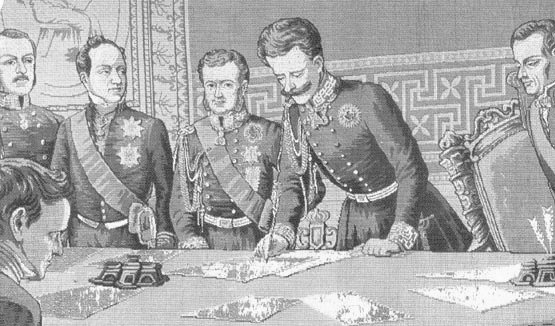
Another area King Carlo Alberto looked at with concern was the faith of his country and the growing trend toward secularism, pushed by many of the secret societies that wanted the monarchy abolished. In a very poignant letter to His Holiness Pope Pius IX, King Carlo Alberto said, “…we have reached a point so distressing for Religion that I can scarcely bring myself to speak of it. Our country used to pass for a model of piety; Religion was triumphant there; daily she made immense progress” but, the King went on to say, feuding clerics and a lack of enforcement from the hierarchy had allowed decay to set in which the anti-clericals were only too willing and able to exploit. Also blaming the influence of the neighboring French Republic, the King lamented, “…so great is the evil, Most Holy Father, that it is beyond human power to repair it…” This was part of an overall trend across Europe and no place, even the Papal States themselves, were immune from it. We can also detect an implied criticism against the liberalism and optimism that characterized the early years of the reign of Pope Pius IX, a position he would soon radically reverse.

Things came to a head with the Revolutions of 1848. It was in that critical year that King Carlo Alberto earned his “magnanimous” title by enacting the constitution that would serve throughout the remaining years of the Kingdom of Piedmont-Sardinia as well as throughout the life of the Kingdom of Italy; the Statuto Albertino. Previously he had remarked that it was his desire for the liberation of Italy that caused him to oppose a constitution but when it became clear to him that this movement was the way of the future, he adeptly got out in front of it and earned the respect and admiration of his people by codifying in law their rights and representation in government while reserving final authority for the King. The Italian tricolor became the new national flag of Piedmont-Sardinia with the arms of the Savoy Royal Family as its central motif. Absolutists from Madrid to St Petersburg condemned the King for taking this action, taking the side of the reformist movement, yet the communist revolutionaries Karl Marx and Friedrich Engels singled out King Carlo Alberto as their greatest enemy. The absolutists, they argued, were discredited but Carlo Alberto had robbed the revolutionaries of their greatest propaganda weapon by making himself the champion of the freedom of his people.

King Carlo Alberto, although he had no ambitions to march down the length of the Italian peninsula, was determined to see Austrian rule removed from the north and when Milan, Venice and neighboring areas rose in rebellion against Austrian rule he stepped forward as their protector and declared war on Austria. In doing so, he beat the republicans to the punch and turned many would-be republicans into ardent supporters of the Savoy monarchy. This was the First Italian War of Independence and Piedmont-Sardinia allied with Tuscany and (for a short time) the Papal States and the Kingdom of the Two-Sicilies against the Austrian Empire. At first his armies were successful but on July 24 came the disastrous battle of Custoza which was a decisive Austrian victory and forced the Piedmontese to agree to an armistice. It was his misfortune to face Field Marshal Joseph Graf Radetzky, one of the most capable commanders in the Austrian military. The conditions Austria demanded for peace were so severe that King Carlo Alberto was reluctant to agree to them. However, he had no choice and so accepted all responsibility upon himself for the defeat. On March 23, 1849 he abdicated the throne in favor of his son and went into exile in Portugal. Heartbroken at the loss, he did not survive the year and died in Porto on July 28 at the age of 50.

Saturday, July 21, 2012

Mad Analysis: Individual Responsibility

The big news in America this week is certainly the mass-shooting in Aurora, Colorado. I assume everyone has heard about the horror of it, the victims and the accused murderer. Of course, all of our sympathy goes to the victims and their families but, saying that, I get a slightly sick feeling whenever I heard media people expressing their sympathy for the victims they interview on TV. It really bothered me hearing Diane Sawyer saying “we embrace you” to the mother of a murdered daughter. I’m sure they are sincerely sorry for these people but, realistically, by next week they won’t remember the names of any of these people, the next big story will come along and so it goes. That’s not really important right now, it’s just something that bothers me a little bit. I don’t want to accuse anyone of anything but it seems just a little bit too much like exploiting grief to me. In any event, not even one hour had elapsed since I first heard this on the news before the blame game started.

Not even one hour had passed before I started to hear the ‘talking heads’ bring up the need for stricter gun control, added security at theaters, questions about how the alleged killer was raised, questions about whether the movie itself was related to the murders (and why the alleged killer referred to himself as “the Joker” (it was a Batman movie if you haven’t heard]) and if the film industry bears any blame for what happened. This really annoys me. More than that, it disgusts me because it seems to relate to what I think is one of the most devastating root problems that exists today. What happened in Colorado is the fault of NO ONE but the one who pulled the trigger. That’s it and that’s all. Anything else takes away from the one and only person who should bear all the guilt for this tragedy. Stop harassing his parents, stop harassing his old professors and stop trying to blame Hollywood. Some people are just evil and some relatively good people just snap one day and do horrible things. No law can ever or will ever prevent that from happening.

This irritates me especially because it is proof again of just how little individual responsibility is left in modern society. How many years ago now was the Genovese case? Have things gotten any better? I don’t doubt that things may come out that might help explain somewhat why this person did what he is alleged to have done but I don’t want anything to in any way take away from his own personal responsibility for the horrible crime he committed. I don’t like the way his father was hounded from his home to the airport on his way to Colorado. It’s not his dad’s fault that he did what he did. I don’t care if he had the world’s greatest dad or the world’s worst -he was a grown adult who made his own decision and one of those decisions was to gun down tens of innocent people. The guilty party is the guilty party and there the list should end. I really have no patience for the whole ‘the movie made me do it’ or ‘society made me do it’ or ‘the music made me do it’ or ‘the video game made me do it’ or ‘my overbearing parents made me do it’ or any of the other of countless excuses that always come out at times like this.

I still want everyone to know that I am certainly under no illusions as to the effect that the media and the entertainment industry has on society. I like some pretty violent and horrifying movies myself, but there are some that even I think cross a line. There are at least a few that I’ve simply heard about that I am convinced would destroy the soul of anyone who watches them. I’ve never been in favor of censorship in my life but, in recent years, I have had to change that position because of some very extreme cases. We should endeavor to have a healthy society after all. What we cannot do is blame the actions of one person on anyone else or in any way lessen their guilt and individual responsibility by trying to make the responsibility shared. If I do wrong there is no one to blame but myself. I do the crime, I do the time. Likewise, if I make a dumb decision, no one should be forced to help me out of a mess caused by my own stupidity. I shouldn’t have to bail you out for your mistakes either. If you have friends or family that want to help you out, fine, but you cannot blame me for your mistakes which is what you are doing if I am forced to help you out of them.

No one seems to have any grasp at all of individual responsibility these days. Even among those one would think would be the greatest champions of it, we do not have unanimity. There are relatively few in this day and age who champion individual “rights” but there are fewer still who stand up for individual responsibility. Everyone wants the “rights” but not many seem to want the responsibility. For example, why do so many libertarians and (all) Objectivists/Randists support abortion? They say it is because they support individual “rights” and individual choice but it seems to me that by supporting abortion you are supporting individual irresponsibility. Being stupid and getting pregnant are individual choices but getting an abortion is just a medical way of escaping the responsibility of your own actions and choices you already made. One side of the political spectrum tends to throw all individualism out the window but even on the other side of the scale, everyone seems to want to have their cake and eat it too. No one wants to be responsible for their own actions and these days we seem less and less forced to do so.

For example, just take the film everyone was seeing at this theater where the tragic mass-murder took place. Notice how many young children were among the victims? Some were extremely young. What were they even doing there? Personally, I was shocked to find out the movie was rated PG-13 and even more shocked when I looked it up and found that the previous “Dark Knight” movie was also PG-13. Aside from the original movie with Adam West (my first Batman), I don’t think any of the Batman movies have been suitable for small children. If I had children, I wouldn’t let them watch stuff like that at such a young age. But, of course, how many parents are simply willing to abdicate their responsibility to the MPAA to determine if something is okay for their children to watch? I don’t think I’m being too extreme when I say that I think we should each be responsible for what we do. I don’t think we should we are all responsible for everything and I don’t think we are all responsible for nothing. I don’t think we should be called upon to be responsible for or care about everyone but we should at least care about how family and those immediately around us. That’s all.

Friday, July 20, 2012

Consort Profile: Empress Marie-Claire of Haiti

The first Empress consort of an independent Haiti was born Marie-Claire Heureuse Felicite sometime in 1758 to Bonheur Guillaume and Marie-Elisabeth Sainte-Lobelot, two poor but free Haitians in Leogane. Her aunt, Elise Lobelot, the governess of a religious order, was entrusted with her education as a child and undoubtedly deserves a great deal of credit for forming the kind-hearted and often heroically compassionate woman that her niece grew into. Marie-Claire had a fairly ordinary, humble childhood for her time and place and when she was still young was married to the master-cartwright to the Brothers of Saint-Jean de Dieu Pierre Lunic. Not much is known of her marriage or her first husband but he died in 1795 leaving Marie-Claire a widow. This was a crucial and traumatic time for Haiti when the slaves were rising in revolt against their French masters. The traditional story is that it all began in the summer of 1791 when a Voodoo priest at “Alligator Woods” called on his countrymen to rebel and attack the plantations. Many were soon burning and the rebellion spread quickly across the island. The fighting was fierce, between both the French struggling to maintain power and among the Haitians over who would supplant them as the authority in Haiti.

In 1800 Marie-Claire met the man she would one day marry at the grueling siege of Jacmel. Her heart went out to the poor, starving and suffering people of the city and she arranged a meeting with one of the besieging commanders, Jacques Dessalines, to persuade him to open a few roads so that she could bring some relief to the people. Dessalines agreed to this and Marie-Claire led a group of humanitarian volunteers (mostly women and children) into the embattled city carrying food, clothing and medical supplies. Wasting no time on formalities she helped prepare the food right on the streets to immediately feed the wounded and starving masses. The people were grateful and Marie-Claire was an instant celebrity, an angel of mercy who would never be forgotten. Dessalines would also not forget her and on October 21, 1801 the two were married. One cannot help but wonder how much choice she felt she had in the matter as no two people could be more dissimilar. She was elegant, friendly, warm, forgiving, patient and the very picture of compassion. Her husband was flamboyant, bombastic, capable of quite extreme cruelty and a habitual philanderer. However, Marie-Claire never made a scene and even legitimized and cared for as her own the numerous children her husband sired by other women.

In early 1804 Jacques Dessalines (who, unlike his wife, had been a slave), in a drastic move he felt absolutely necessary, ordered the extermination of the entire White population of Haiti, with the exception of a few non-French minority communities. The original order was for the execution of all White males above a certain age but later this was extended to include women and children as well though some women were spared if they married a Black husband. Dessalines was of the opinion that this had to be done to secure the country, make France think twice about attempting to restore White rule and because he viewed it as just punishment for all the slaves had suffered in Haitian history. However, Marie-Claire was adamantly opposed to this policy and make no secret of the fact. She had already proven that her mercy was colorblind as she worked to alleviate the suffering of prisoners and wounded men whether they were Black, White or mixed-race. From her earliest days she had been, effectively, a nurse and a teacher and she had been raised to have compassion for anyone in pain, regardless of race, be they young, old, male or female. When the massacres began she went down on her knees to beg her husband to desist, which rather infuriated him. Nonetheless, although he would not relent, she did what she could herself to save lives, even hiding one hapless Frenchman under her own bed until he could be smuggled out of the country.

On October 8, 1804 (after the massacres were finished) Jacques Dessalines was crowned Emperor Jacques I of Haiti and Marie-Claire was crowned Empress alongside him at the Church of Champ-de-Mars. It was hoped that this would be the start of a new and glorious era for an independent Haiti but for Marie-Claire, her time as Empress would be all too fleeting. The Emperor tried to keep the plantations in operation without slavery (they were the only source of wealth on the island) but the harsh measures he had to employ to do this left many feeling like little had really changed and their remained bitter divisions in the upper echelons of the new government. Soon a conspiracy was underway and after only two years on the throne Emperor Jacques I was assassinated in a coup in 1806. Empress Marie-Claire, re-titled Dowager Princess, who had only ever tried to do good for those around her, was cast aside and almost forgotten, living in poverty with precious little of the kindness she had shown being returned.

Yet, through it all, she maintained her principles and values. King Henri I of Haiti, one of the leaders in the coup against her husband, had offered to let her stay in his household but she refused. It was not until 1843 that she was granted a modest pension by the government but not as a former imperial consort but simply because all of the extensive properties of Jacques I had been confiscated, leaving her with nothing. However, she had an opportunity for better fortunes following the election of the President-turned-Emperor Faustin I. He was an avid fan of Emperor Jacques I, admiring him as a strong and zealous national leader and Faustin wanted to do honor to his memory. That included honoring his wife and he offered the former empress a much larger pension that would have improved her life greatly. However, Marie-Claire did not have many fond memories of her late husband by that time and felt that to accept such a reward simply because of her relationship to him would have been an endorsement of some sort of his actions which she still very much opposed. In an act of great sacrifice she refused the money and instead lived out the rest of her life with her granddaughter in very poor conditions until her death on August 8, 1858 at the age of 99 or 100.

All these years later, in a way that was certainly not possible in their own lifetimes, Emperor Jacques I and Empress Marie-Claire have become something of an idealized couple. As the first emperor, Jacques I is today again revered in Haiti as a national hero and one of their founding fathers with few remembering his less pleasant actions. Empress Marie-Claire is remembered, rightly so, for all of her admirable qualities. They are often presented in popular art as a happy and ideal couple. This, of course, was far from the truth of the matter but by all accounts Empress Marie-Claire deserves all the praise and admiration she receives for her kindness, compassion and blind mercy to all those in need, toward anyone who suffered for any reason.

Thursday, July 19, 2012

Lese-Majesty in Thailand


Recently the lese-majesty laws of Thailand were in the news again, the specific case not being very important in the context of this discussion -a yellow shirt repeated something a red shirt said and now both are in trouble- but it prompted me to say something I’ve been wanting to say for a long time. The “world” media really needs to stop picking on Thailand. It is really becoming ridiculous and, personally, I am sick to death of it. Thailand has problems like any other country but the monarchy nor even anything related to the monarchy is not among them. The lese-majesty laws of Thailand are probably the most well-known in the world -and they shouldn’t be. Think about it; how many times have you heard a news story concerning lese-majesty laws that was NOT about Thailand? I didn’t think so. Thailand is not the only country that has laws like this, even many European countries have similar laws but they are rarely enforced and certainly not when it comes to monarchs. Poland, Germany and Switzerland are republicans with laws against insulting the President. Monarchies have them on the books as well but in the United Kingdom no one has been prosecuted under the lese-majesty laws since 1715. In Denmark no one has ever been prosecuted for lese-majesty. The only recent case in The Netherlands involved a man who made sexually threatening remarks about the Queen directly to a police officer and the only recent case in Spain involved a magazine that printed a cartoon of the Prince and Princess of the Asturias engaged in a sexual act on their front page. Obviously, these were cases of people wishing to cause trouble.

Furthermore, most Islamic countries have strict laws against any speech which insults or displays irreverence toward holy teachings, holy persons, Allah or the Prophet. Yet, when anyone is prosecuted for violating these ordinances, it rarely makes the news in western countries and when they do it is usually because pre-existing tensions have caused a fixation on a particular Islamic country by the media. However, it seems that whenever anyone is ever charged with or prosecuted for lese-majesty in Thailand it always makes the news and is used to portray the Kingdom of Thailand in a negative light. Other countries have laws restricting speech about religious or political figures but laws which restrain people from speaking disrespectfully of monarchs, it seems, are a special case and something that should not be tolerated. Why else do foreign media make such a big deal about this law being invoked in Thailand on each and every occasion? It is an anti-monarchy prejudice at work, pure and simple. Not long ago, in the United States, a small western town put on a parade that included an actor making fun of President Obama. No one went to jail of course but the Secret Service was called in and everyone involved was thoroughly investigated. But royals are supposed to be ridiculed in the minds of these people and they will be first to cry “tyranny” at the slightest effort to restrict them.

I have often said, when asked about this issue in the past, that if you are in Thailand and go around speaking derogatorily about HM the King, the lese-majesty law will be the least of your worries. You will be wishing for the police to show up and arrest you just to save you from the beating your likely to take from the ordinary people who admire and revere their beloved King and would not tolerate anyone defaming him no matter what laws existed about it. Of course, that in itself is something alien to most western countries. The leftist media elites particularly cannot even fathom the idea of a people being so devotedly loyal to their monarch that they would take great personal offense at any disrespectful words being directed at him. Mocking and ridiculing royalty has become so common in the west that it is simply expected at this point. That is a shame. Not only is it shameful, it is harmful and Thailand is actually quite correct to keep (and enforce) lese-majesty laws.

The King of Thailand is, of course, a constitutional monarch. His actual authority is restricted in many ways, yet, he has been able to play an invaluable part in the political affairs of his country because he is so widely respected and revered. He does not need the power to command when a simple suggestion can have the same effect. During critical times of crisis for Thailand, the King has been able to call together opposing factions and compel them to step back from the brink of violence for the good of the country. How was he able to do this? He could not force anyone to do anything but because the vast majority of the people love and respect their King political elites and military leaders alike recognize that it would be very unwise to disregard his wishes. In this way, the King of Thailand has proven that a monarch does not always need sweeping political powers if he is respected and if his position is respected and revered by all of his people. In my view, this is exactly how a constitutional monarchy should work. The King is the source of unity and common agreement and the embodiment of the nation as a whole and as such no slander or disrespectful words or deeds toward him should be tolerated.

In virtually every modern monarchy the reigning monarch is expected to be a national symbol and a source of unity, a figurehead that everyone can get behind and support regardless of political faction or party. At least, that’s how it is supposed to work. It should work. After all, if a monarch has no power to influence or enact legislation, there is no legitimate, practical reason for any faction to have a problem with them. They are supposed to be a living symbol of the nation as a whole, its history and culture and if you find something so vague as the nation as a whole objectionable, you’re probably what would be classically defined as a traitor. However, we know that many people still do object to this; they’re called republicans and they will ridicule and verbally attack the monarch in any way they can in order to advance their agenda. They are not punished for this and feel not the slightest guilt in the hypocrisy of using the very rights and freedoms their monarch provides them to attack the monarchy itself. By not enforcing laws that protect the dignity of the monarchy and allowing anyone to mock and ridicule the sovereign the monarch is robbed of their ability to stand as a figure of national unity. The Kingdom of Thailand understands this but relatively few in the west seem to.

The modern constitutional monarch is an utterly harmless figure. They are legally prevented from doing harm to anyone. They cannot enact legislation that would be detrimental to anyone, they cannot have anyone arrested and they cannot command anyone to do anything against their will. The governments can do all of that in the name of the monarch of course but the monarch himself or herself cannot. I would argue that this also denies them the ability to do as much good as they should be able to do but the point here is that they can do none harm. Therefore, there is no legitimate reason why anyone should have a “right” to mock and ridicule them. Their purpose is to be symbolic, to be completely above all factions and arguments and to be a source of unity. This works in Thailand very well and when there is a crisis the monarch is able to play the vital role of mediator to sort out potentially dangerous problems. Yet, in the west, this is often much more difficult if not impossible because the monarch is allowed to be a figure of fun, the subject of a crude punch line or the object of ridicule. Thailand should not be criticized for their lese-majesty laws. They should, in fact, be emulated.

Wednesday, July 18, 2012

Monarchist Profile: General Sir Guy Carleton

Although he is probably not as well known as he should be, Sir Guy Carleton was a major figure in the history of North America, the last commander of British forces during the American War for Independence and a pivotal leader in the early history of modern Canada. He was born on September 3, 1724 in Strabane, County Tyrone in Ireland to a Protestant military family that had been there since the Seventeenth Century. Orphaned at fourteen he had little formal education and along with three of his brothers entered the British army fairly early in life. He was seventeen when he was commissioned Ensign of the 25th Foot in 1742 and gained promotion to lieutenant in 1745. According to some accounts he befriended the young officer James Wolfe (who would die a glorious death in Quebec) at fought alongside him against the Jacobites at the battle of Culloden but this is not certain. We do know that in 1747 Carleton and his regiment were sent to Flanders during King George’s War where he fought against the French until a peace was negotiated.

As usual, peace brought cuts to the military and Carleton was frustrated that no promotions would be forthcoming in the new tranquil atmosphere. However, he had some good contacts and had done fairly well to distinguish himself and in 1751 was able to join the 1st Foot Guards where he was promoted to captain the following year. When the Duke of Richmond was in need of a guide to take him on a tour of the battlegrounds of the last war, Wolfe suggested his friend Carleton and the Duke chose him. Because of this, Carleton gained a powerful and well placed friend and patron who would be of great help to him in the advancement of his career. Carleton was a reasonable and practical man but not without his prejudices. During the French and Indian War his old friend General Wolfe recommended Carleton to serve as his Quarter-Master General but King George II at first refused to allow it as Carleton had previously made some rather unflattering statements about the quality of German soldiers, which the still quite German George II took great offense over. However, others prevailed upon the King to change his mind and Carleton went to America.

During the war Carleton, by then a lieutenant colonel, served with Wolfe in Quebec, keeping the British forces supplied and overseeing the placement of artillery and defensive works in his role as an engineer. He was not directly involved in the famous attack that cost Wolfe his life but won Canada for the British Crown. After returning to Britain, Colonel Carleton was dispatched with a force to capture the French island Belle ÃŽ le off the coast of Brittany. Carleton was wounded in the initial attack and unable to play any subsequent role in the battle, which was nonetheless a British victory. Once he was sufficiently recovered he was promoted to full colonel in 1762 and sent back to the American neighborhood to participate in the British invasion of Cuba. The battles for Havana again secured a decisive British victory but, again, Carleton was wounded while leading an attack on a Spanish outpost. By this time Carleton had made a solid military career for himself, nothing too spectacular but he had shown himself to be a brave and reliable officer. Considering that his accomplishments up to that point had been entirely military with no forays into politics it came as a surprise to some when he was appointed acting Lieutenant Governor and Administrator of Quebec in 1766. The appointment was likely due to the friendships Carleton had formed throughout his career, particularly that with the Duke of Richmond.

Not long after arriving in Canada, Carleton soon clashed with Governor James Murray over government reform issues. Carleton gained the support of the growing merchant class as a man they could work with and who would make common sense decisions. The biggest issue of contention was over officials charging fees for their services which Carleton opposed, preferring a regular salary instead. Nonetheless, when Murray resigned in 1768 Carleton succeeded him as Governor of Quebec and Captain-General of the British forces there. Carleton realized that to succeed in his position, and for British sovereignty over Canada to be secure and lasting, he would have to have the support of the local French elites and clergy. In the past, the British had been rather heavy-handed in their treatment of the French Canadians and the result was a great deal of lingering animosity and many leaving Canada (some of whom settled in south Louisiana). Carleton recommended a new approach, treating the French as partners rather than conquered enemies.

Carleton was promoted to major general and in 1774 the Quebec Act was passed based on his recommendations and it enacted many of the changes he had been lobbying for. These included allowing the French to maintain their own customs, recognizing their property rights, allowing full freedom of religion for Catholics and allowing Catholics to hold government positions (something forbidden in Britain) as well as making French law the basis for the legal system in Quebec. This greatly upset the Protestant colonies to the south (in what would become the United States) but it proved extremely beneficial for the peaceful development of Canada. When the American Revolution broke out the disgruntled colonials expected their new realm to include all of British North America but, because of Carleton and the reforms he pushed for, Canada remained loyal to the Crown. In fact, the Catholic clergy in Quebec went so far as to threaten anyone who would join the revolution or display disloyalty to the King with excommunication. Given what was said and done in the colonies to the south, they were confident that their rights would be much better protected by the King in London than by the Congress in Philadelphia.

Not long after the war broke out the colonial rebels launched a two-pronged invasion of Canada, one led by Richard Montgomery who had fought alongside Carleton in the British attack on Cuba. Canada had not been well defended to begin with and Carleton had been forced to dispatch two regiments to Boston when that port city was besieged. He was thus in an extremely vulnerable position when the Americans launched their offensive. He tried to make up for the loss by recruiting a French Canadian militia but was less than impressed with the results. They would not join the revolution but Britain was still not so loved that the public would rush to defend the empire. Nonetheless, Carleton made do with what he had. At first things went badly. Montreal fell to the Americans and Carleton himself only barely escaped being captured. However, despite outnumbering their enemies, by the time the Americans arrived at Quebec they were exhausted, hungry and freezing. During a howling snow storm on December 31, 1775 the Americans attacked but Carleton with his motley assortment of British troops and Canadian militia utterly smashed them. Montgomery was killed, Benedict Arnold was badly wounded and hundreds were taken prisoner. It was the first really disastrous defeat for the Americans in the war and ensured that throughout the rest of the conflict Canada would remain firmly in British hands.

The following year General Carleton launched a modest counter-offensive against the Americans, winning the battle of Trois-Rivieres in 1776 and the naval engagement at Valcour Island on Lake Champlain. Some still complained that he displayed a lack of aggression but he was honored with the Order of the Bath for his victories. He was extremely upset when he was passed over for command of the major offensive southward in favor of General John Burgoyne and requested that he be recalled but this was refused. As it happened, General Burgoyne rolled the dice and lost and was forced to surrender after the battle of Saratoga, the victory which encouraged the King of France to recognize the United States and join the war on their side. After General Howe was replaced by Sir Henry Clinton as supreme commander of Crown forces in America the focus of the war shifted to the southern colonies, leaving Carleton with relatively little to do. In 1781, after the disastrous defeat at Yorktown, General Clinton was recalled and Sir Guy Carleton became the last commander-in-chief of the British forces during the war.

By that time, of course, there was little to do but oversee the withdrawal of British troops once London recognized the independence of the American states. Carleton had moved to New York City when he received his promotion and was determined to carry on with the war in the best way he could. Once he learned that London had decided to throw in the towel he tried to resign but was persuaded to stay on to oversee the evacuation of British forces as well as the loyalists who would face persecution and the Blacks who had sided with the Crown who would be enslaved again if left behind. Once that job was done General Carleton did return to Britain where he argued in vain for the creation of a Governor-General of Canada (the post would be created in the future). He was ennobled in 1786 as Lord Dorchester and returned to America again as Governor of Quebec, Nova Scotia and New Brunswick. He retired to his estate in Hampshire ten years later and died on November 10, 1808. Though a dependable officer he was criticized for his slowness in the counter-offensive after the American attack on Quebec but General Carleton deserves great praise for his actions as governor which doubtless saved Canada from falling to the American republic by keeping the local population on the side of the Crown.

Monday, July 16, 2012

Royal Profile: Princess Elizabeth of Toro

With the often traumatic history that most African countries have gone through over the years, the ranks of African royalty have produced some remarkable figures with very diverse and colorful backgrounds. Certainly one such individual is Princess Elizabeth Bagaaya of Toro, Toro being one of the subsidiary nations of Uganda. During her life she has gained a level of fame around the world for her kind nature, stunning appearance and exceptional intellect, breaking all sorts of new ground in the process. She was born Princess Elizabeth Christobel Edith Bagaaya in 1936 to Lieutenant Sir George David Matthew Kamurasi Rukidi III or King George Rukidi III and Lady Kezia Rukidi in 1936. Her father was the eleventh king or Omukama of Toro from 1928 to 1965. Her mother, Lady Kezia Byanjeru Abwooli was a daughter of a senior tribal chief named Nikodemo Kakoro. Her original title was Omubiitokati which roughly translates to princess. During her childhood the Kingdom of Toro was at the height of its prestige as part of the British Empire and the Princess had many opportunities previously unknown to girls like her, even royal ones.

She attended a local elementary school before going on to Gayaza High School in Buganda, a prestigious boarding school for girls. After graduating she was sent to England to the Sherborne School for Girls where she felt the pressure of being the only Black student. This motivated her to study harder and push for success as she felt that her performance, as the only Black student, would reflect on all those like her. She sufficiently proved herself that within one year she was accepted to Girton College in Cambridge, only the third African woman to ever attend the institution. She graduated in 1962 with a law degree and in 1965 became the first East African woman to be admitted to the English Bar. She was successful working lawyer but that same year was called back to Africa by the death of her father. She was present at the enthronement of her brother Rukirabasaiia Patrick David Matthew Koboyo Olimi VII as the twelfth Omukama of Toro at which time she received the title of Batebe or ‘Princess Royal’. In the traditional hierarchy, this made her the highest ranking woman in the kingdom and a close confidant of her brother the king.

However, this was a troubled time for Uganda as the exhilaration many felt with the end of colonialism and the hope of a new future turned into a downward spiral of intrigue, infighting and conflict. Upon obtaining independence King Frederick Mutesa II of Buganda became the ceremonial leader of the tribal kingdoms as the first President of Uganda with the untrustworthy Milton Obote as prime minister. Soon Obote was plotting to seize power for himself and in collusion with the commander of the army, General Idi Amin, he launched an attack on the palace, forcing “King Freddie” (as he was affectionately known) to flee the country. Obote became president and in 1967 abolished all the traditional, subsidiary tribal kingdoms of Uganda. Princess Elizabeth was afraid her brother would be killed in the ensuing turmoil but, thankfully, he managed to escape to London. Threatened by the political establishment in her own country, Princess Elizabeth traveled to the United States, moved to New York at the suggestion of Jackie Kennedy Onassis and quickly made a career for herself as an actress and model. Her star rose rapidly and soon she was being featured on the covers of Vogue and Harpers. She was also featured in such films as “Sheena” and “Things Fall Apart and No Longer at Ease” which was her first starring role.

Princess Elizabeth had obtained great fame in America, but her royal roots gave her an urge to serve her native country. During her time away President Obote had been overthrown in a military coup led by General Idi Amin and in 1971 he issued a special invitation to Princess Elizabeth to return to Uganda and serve as an ambassador to the world for her country. In those early days hopes for a better future were high and the Princess returned but was soon abroad again after being appointed by Amin to serve as Uganda’s ambassador to the United Nations. Idi Amin wanted to put the best possible face on his regime and his appointment of Princess Elizabeth was part of that plan. In 1974 Amin made Princess Elizabeth his Minister of Foreign Affairs. However, it quickly became more and more obvious to people in and outside of the country that Idi Amin was a bloodthirsty tyrant and possibly out of his mind.

Princess Elizabeth determined to have nothing more to do with Idi Amin or his government, which of course the dictator took as an act of betrayal. For a time the Princess was in great danger and fear for her life, not always knowing who she could trust or who might be coerced into acting against her. Yet, unlike a great many of her fellow Ugandans, the Princess remained alive and managed to escape to Kenya in February of 1975. From there she moved to Vienna and finally to London. After years of his nightmarish rule, Idi Amin was overthrown in a coup and the princess was invited back to Uganda to help oversee their first free national elections since the fall of King Freddie. Still wanting to help her people, in spite of everything she had been through, Princess Elizabeth came back. However, things did not change much for the better. The original author of the country’s misfortunes, President Obote, gained power again and began taking retribution on his political enemies in a campaign of revenge. Princess Elizabeth and her boyfriend Prince Nyabongo managed to escape to London in 1980 and were married the following year.

In 1985 President Obote was brought down by another military coup and though conditions in Uganda did not immediately improve, the situation at least became more stable so that progress could be made. By then a respected figure in her own country and around the world, the next year Princess Elizabeth was made ambassador to the United States, serving in that post until 1988. Sadly, in 1989, her husband Prince Nyabongo was killed in a plane crash. After that, she devoted much of her time to charity and stayed away from politics. However, after the end of the dictatorship she had provided invaluable assistance in the restoration of her brother and the other sub-national kingdoms. So many people had been killed, particularly among the tribal elders and chiefs, that few people knew anything about the traditions and protocol of the old monarchies and the Princess helped see that all was done properly and that the ceremonies were set down for future generations.

After the death of her brother King Olimi VII in 1995, Princess Elizabeth was one of the guardians of his young son, the new King of Toro and she has helped in his upbringing as well as the continued reconstruction of the Kingdom of Toro and the subsidiary monarchies of Uganda. Finally returning to national service, Princess Elizabeth has been the Ugandan ambassador to Germany and the Vatican before her most recent appointment as High Commissioner for Uganda in Nigeria. She published a book about her eventful life called “Elizabeth of Toro: The Odyssey of an African Princess”. Her story is a remarkable one with many ups and downs, from the heights of being a Princess Royal, Uganda’s first female lawyer, a successful actress, supermodel, minister and diplomat as well as being on many occasions in the greatest danger because of her heritage and political positions. Through it all though she has remained devoted to her country, her people and their traditional culture, truly an example to all.

Saturday, July 14, 2012

Bastille Day - The Farce


In some ways, Bastille Day is a very appropriate holiday for a republic to have. Republics, after all, tend to be based on a minority telling lies to the majority, pretending to be looking out for their best interests, and the majority pretending to believe them, going along with the charade even though they know perfectly well they are being lied to. One side pretends to care, the other pretends to believe them and all go along with it because they want to believe the narrative and don’t wish to be confused with the facts. In the same way, Bastille Day is, like Napoleon himself said about history, “a set of lies agreed upon”. The official story is that the storming of the Bastille on July 14 was a symbolic assault on tyranny, officially marking the beginning of the French Revolution as a heroic struggle for liberation from the “bondage” of traditional authority (the monarchy, the aristocracy and the clergy) and traditional moral values which upheld such authority. Monarchists know, and everyone else should too, that the facts are very far from this ideal narrative which is celebrated today as the national French holiday.

The Kingdom of France was, undoubtedly, at a low point at the time. The economy was in shambles, hunger and poverty were widespread, too many in the aristocracy were living lives of indulgence far away from the people they should have been looking after and many in the clergy were more concerned with their own comfort than with administering the sacraments and teaching their people. However, the two young people at the pinnacle of power in France, His Most Christian Majesty King Louis XVI and Queen Marie Antoinette, were not blind or uncaring to these problems. Both had each been working in their own way to solve the immense problems they had so recently inherited. King Louis XVI enacted many common sense policies to alleviate the suffering of his people. He cut expenses at Versailles, cut government expenditures overall, refused to go deeper into debt and refused to raise taxes. He ended the government monopoly on grain which allowed for lower prices that more people could afford. He taxed wealthy landowners for the first time and, though he was not required to, paid his own share as any other landowner would. Likewise, Queen Marie Antoinette helped to educate poor children, had her own kitchen opened to the poor, cut down on lavish parties (yes, despite all you’ve probably heard) and simplified her own wardrobe in an effort to make frugality chic.

Unfortunately, the accumulated problems of decades could not be overcome quickly and the radical firebrands were doing everything possible to mislead, misinform and radicalize the public while spreading the most vicious lies they could think up about their King and Queen. For example, partly in an effort to pay for the war against Great Britain on behalf of the United States, King Louis XVI enacted a tax reform which raised revenues but lowered taxes for the poor. Revolutionary propagandists played their game of misinformation, only telling people that the King would be collecting more money (not less from the poor) and implying or stating outright that this was all for his own enrichment rather than paying for the needs of the country. King Louis had done everything in his power to be reasonable and accommodating. Early in his reign he had encouraged local parliaments and he recalled the Estates-General. However, the firebrands only increased their agitation, whipping the mob into a frenzy and blaming the King for ills he had absolutely no control over. Finally, someone pointed to the prison-fortress of the Bastille as the imposing symbol of absolute royal power that had to be wiped out.

On July 14, 1789 a Parisian mob stormed the Bastille, which was actually nothing like what they had been told or what most people today think it was. Naturally, it looked very harsh and foreboding from the outside, but inside the prison conditions were not terrible, certainly no worse than any other prison of the time and probably better than most. The fact was that there was practically no one in the Bastille. The popular portrayal would have one believe that the Bastille was crowded with the poor, tortured victims of an autocratic monarch. In fact, it was almost empty of prisoners. The only people present to be liberated were four forgers, two lunatics and a pervert who had been locked up at the request of his own family. The real victims were the unfortunate men who just happened to be doing their job guarding the prison. All 120 soldiers were brutally massacred by the hatchet-wielding mob and the governor had his head cut off and stuck on a pike. This was the bloody and inglorious start of the horrific bloodbath known as the French Revolution.

The episode is so ridiculous that it would almost be an occasion to laugh were it not for the death and horror involved. The Bastille was not a ghastly torture-chamber full of unfortunates to be saved by the rebel mob. It was a run-down bastion holding a couple of crazy people and a few petty criminals. The real victims were the men wearing the King’s coat who were savaged by a mob who had not found what they expected. They also later demolished the Bastille and so it is that the ridiculous charade continues as tourists from all over the world come to Paris expecting to see the famous Bastille only to be told no such place exists or has for centuries. Again, rather fitting for a celebration that is a farce, based on a lie about a period of history that was more gory than glorious, that was more about licentiousness than liberty, more about evil than equality and more about fratricide than fraternity. What could be a better holiday for the French Republic when you think about it?

Of course, the real cause for celebration will be when France rejects the lies and illusions of the Revolution and returns to the path of God, glory and the Ancien Régime.

Vive le Roi!

The Mad Monarchist

Friday, July 13, 2012

Monarch Profile: King Felipe II of Spain


The monarch whose reign has traditionally been used to mark the zenith of Spanish power was King Felipe II. Although the Spanish empire would reach its peak size much later it was under Felipe II when Spain came the closest to upsetting the rise of England (and thus later Britain) in her rise to dominate the oceans. Given the numerous foes on multiple fronts King Felipe II faced it is difficult to imagine that he, or anyone, could have triumphed over them all completely. However, it is no exaggeration to say that, to a considerable extent, Felipe II saved Roman Catholic Christendom from almost total collapse from the combined threats of Protestantism in northern Europe and Muslim expansion in the Mediterranean. He is rightly remembered by Catholics even today as one of the great champions of the Counter-Reformation. However, because he came so close to defeating England but was unsuccessful, the image of him that has been propagated in the English-speaking world is that of a cruel and villainous tyrant. In fact, nothing could be further from the truth, though the values of his time were certainly not those of today, and would come as a surprise to King Felipe II himself who considered one of his greatest flaws to be overly sensitive.

Felipe II was born on May 21, 1527 in Valladolid to the Holy Roman Emperor Charles V (King Carlos I of Spain) and his queen Isabella of Portugal. He grew up at the Spanish court and was culturally always Spanish first and foremost whereas his father had always been a bit more cosmopolitan, growing up in Belgium and spending much of his time in Germany. The glory of Spain and the defense of the Catholic Church were, from his childhood throughout his life, the two dominant priorities in his heart. This is not that surprising considering the example of his father, Emperor Charles V, who saw himself as the great champion of Catholic Christendom and who retired, renouncing the royal life to spend his final years in prayer. Of course, the Emperor had at times been at odds with the Catholic hierarchy, even waging a bitter and horrific war on the Pope himself. In the same way, though to a lesser extent, depending on the political situation, Felipe II would also at times have an adversarial relationship with certain popes. The Inquisition was going strong in Spain under Felipe II and it sometimes seemed to him that even the Pope was not ‘Catholic enough’. He has since been criticized for his burning of heretics but, one must remember, such measures did spare Spain the horrific and bloody religious wars fought by France, Germany and to a lesser degree in the British Isles. In terms of human life, the Inquisition was comparatively very cost effective.

Charles V had hoped that Felipe would succeed him on the imperial throne but this was opposed by the Austrian branch of the House of Hapsburg under his brother Ferdinand. To keep peace in the family, Charles V left his German and Italian holdings to his brother who became Emperor Ferdinand I and his holdings in the Low Countries, Spain and Spanish America to his son. Felipe II succeeded to his first of many thrones in 1554 when his father made him King of Naples in preparation for his marriage to the Queen of England so that the two would be of equal royal status. The marriage to Queen Mary I of England, Ireland and (nominally) France was also an effort to secure the reunification of Christendom following the reigns of Henry VIII and Edward VI. It was arranged and not a love match at all, at least not as far as Felipe II was concerned. He was never accepted or popular among the English people and himself did not enjoy spending time in the country. Queen Mary I was much older than Felipe, yet the two had a solid marriage. Unfortunately, in typical Tudor fashion, the Queen was unable to have children and Felipe’s duties on the continent kept him away for long periods. This caused Queen Mary great distress as she was intensely devoted to her husband.

The unpopularity Felipe II faced in England was really quite unfair. Propagandists played on nationalism and xenophobia to blame every unpopular measure on the wicked, foreign influence of King Felipe. In fact, Felipe II was among those who advised mercy and moderation in dealing with the Protestants in England, recognizing the degree to which their beliefs had become accepted and entrenched. Nonetheless, Queen Mary I, despite her intense love for Felipe, was her father’s daughter and was adamant that she ruled England and she alone would make the decisions. In 1556 Felipe II was crowned King of Spain and returned to England the following year, the last he would see of Mary before her death. He urged her to maintain the succession and allow her half-sister Elizabeth to inherit the throne. Despite this, Queen Elizabeth was to prove a bitter enemy of King Felipe II. Over time, he may have regretted this but, at the time, he realized how much popular support Elizabeth had and did not want to see England become another trouble spot. He even broached the subject of marriage in order to maintain the Anglo-Spanish alliance but, of course, nothing came of it.

Meanwhile, there was scarcely a corner of western Europe that King Felipe II was not involved in. He had brought England into a war with France, which did not go so well for the English and cost them their last foothold in France at Calais. However, in 1559 Felipe II defeated the French at the Battle of San Quentin and signed a peace treaty with King Henri II. In an action typical of the man, to give thanks to God for the victory King Felipe built a monastery-palace and devoted it to St Lawrence. As he was a young widower, part of the treaty included the marriage of the King to Isabel d'Valois (aka Elizabeth of France), the eldest daughter of King Henri II and Queen Catherine de‘ Medici. This was actually his third marriage. His first had been to Princess Maria Manuela of Portugal but she died shortly after the birth of their first and only son, Prince Carlos. France, however, was of particular concern for King Felipe II, in part because of the rising influence of the Protestants in the country. As he feared, not long after peace had been declared the Wars of Religion broke out in France between the Protestant Huguenots, supported by the English, and the Catholics under the Duc d'Guise. Many churches were sacked and innocent people on both sides were killed. Naturally, Felipe sent Spanish troops to support the Catholic forces in thwarting the rebel armies.

This was certainly not the only foreign relations problem the King faced. Another major problem in international relations was the renewed Turkish invasions under the legendary Sultan Suleiman the Magnificent. Under his rule, the Ottoman Empire entered a period of power and expansion that made southern Europe tremble. When the Muslim forces attacked the island of Malta the Knights of St John called on King Felipe for help. He rushed his fleet and troops in as fast as he could and they arrived just in time to save Malta from disaster. Again, thanks were given to God for the rescue of the island, but there was no time to rest as Felipe II was also being plagued by a Protestant revolt in the Netherlands, this time republican as well as Calvinist, and again aided by the English. Queen Elizabeth I had found a cost-effective way of keeping Spain off-balance without risking direct confrontation by sending assistance to Protestant forces in France and Holland which tied down much of the Spanish army. There was no doubt that Felipe II was the rightful King of the area, nor that many of the leaders of the revolt were driven by greed as much as religious conviction, but as Felipe sent in more troops so did other Protestant leaders of Europe. Furthermore, the mighty Spanish fleet was constantly being harassed by English and Huguenot privateers at sea. It was a costly and frustrating struggle and the King’s heartache increased in 1568 when Felipe lost both his wife and his only son. A few years later he married again to Anne of Austria, but only one of their four children lived to adulthood.

The situation in the northwest was still not settled satisfactorily when Europe came under another attack by the Ottoman Turks, threatening to sack Rome itself and turn St Peter’s Basilica into a mosque. The combative and zealous Pope St Pius V called for a new Crusade against the Turks (even hoping in vain that Constantinople might be recovered). However, not many Catholic rulers (and certainly no Protestant rulers) shared the concerns of the Pontiff. In fact, in all of Christendom, the only major royal ruler to answer the Pope's call was King Felipe II of Spain. However, Papal Rome and the Italian states sent warships as well and the Pope called on all Catholics to pray the rosary for victory. In a dramatic and pivotal engagement off the Greek coast, the Turkish invasion was blunted at the Battle of Lepanto. The Ottoman navy would recover but would never again threaten the western Mediterranean. Still, difficulties remained in France and the low countries as traditional Catholic, royal authority was challenged by widespread rebellion. Driven by such intense beliefs, hatred soon got out of hand and massacres occurred on both sides. King Felipe achieved success in Holland thanks to his general, the Prince of Parma, one of the greatest captains of the age. Yet, just as the final victory was in sight, the English again intervened and the war went on. It is for this reason that the Low Countries became divided between the Protestant Dutch in the north and the Catholic Belgians in the south.

This, combined with other attacks at sea and on the Spanish mainland as well as the shocking execution of Mary Queen of Scots led Felipe to believe that he had no recourse to end the debilitating harassment of the English forces but to launch a full-scale invasion of England, remove the Protestant government and restore the country to Catholicism. It was for this purpose that the famous Spanish Armada was formed. King Felipe II nearly emptied his treasury and deforested Spain to launch this great invasion fleet and a great deal depended on the outcome. Many mistakes were made in the process and Spain suffered a great deal of simple misfortune in the execution of it. In the end, all of this, combined with bad weather and some talented English commanders, made the attempted invasion one of the worst defeats in Spanish history. The sea power of Spain would never fully recover, yet the response of the King to this disaster speaks very well for the man. When Felipe II heard of the defeat he asked the monks of El Escorial to sing a hymn of praise and accepted it as God's will that he bear this along with the other sufferings he had been obliged to face. He paid a great deal of money to ransom those taken prisoner and to care for the survivors. And truly, despite such a setback Felipe II never lost his determination to defend the Church and the Catholic cause in Europe. In the aftermath he sent Spanish troops from the Netherlands to the relief of the besieged Catholics in Paris and to Ireland where English forces had been crushing local rebellions.

King Felipe II of Spain died on September 14, 1598 and was buried in a humble coffin according to his previous instructions. Although he had known a great deal of hardship during his reign, and had seen many defeats, his steadfast devotion to God and his people ensured that Catholicism would be preserved in Belgium, France and Ireland where it might otherwise have been turned entirely to Protestantism. He had been instrumental in saving southern Europe from Muslim invasion at a time when the Ottoman Turks seemed virtually unstoppable. Far from being a cruel or malicious man, King Felipe II was a man who firmly stood on the principles he had been raised with; to defend the Kingdom of Spain and the Catholic Church regardless of the circumstances. This was the right as he saw it and there was no such thing, in his mind, of going too far or being too extreme in the defense of the right. He would probably not be so despised in other parts of the world had he not been so largely successful throughout his reign. He did not win every battle but he ensured that Catholic Christendom did not fall and that, while he was alive, Spain was the dominant power in Western Europe. He was a man of principle, devotion, integrity and gallantry. He is a monarch the Spanish-speaking world can be justly proud of.

Thursday, July 12, 2012

Consort Profile: Queen Rambai Barni of Siam

A remarkable woman, the last Queen consort of Thailand before the current occupant of that role, was born Her Serene Highness Princess Rambai Barni Svastivatana on December 20, 1904 to Prince Svasti Sobhana of Svastivatana and Princess Abha Barni Gaganang. Her father was one of the sons of the famous King Mogkut of Siam by Princess Piyamawadi, one of his many consorts. Known as Princess Na she was sent to the royal palace at the age of two to have her education overseen by Queen Saovabha, consort of King Chulalongkorn the Great, in keeping with Thai tradition. She lived mostly at Dusit Palace until the death of King Chulalongkorn in 1910 when she moved to the Queen’s School at the Grand Palace where she developed a closer friendship with her cousin HRH Prince Prajadhipok of Sukhothai. He held commissions in both the Siamese and the British armies and had hoped to serve on the western front in World War I but his future changed following the succession of his elder brother as King Vajiravudh who ordered him to resign his rank in the British army and return to Siam to take up his duties as heir-to-the-throne and spend some time as a monk in 1917.

During this time the relationship between Prince Prajadhipok and Princess Rambai Barni grew stronger and stronger and in 1918 the two were married, with the blessing of the King, at Bang Pa-In Palace. The two moved in to Sukhothai Palace to begin their wedded life together. They never had children but were deeply attached to each other and had similar upbringings, both being well acquainted with royal duty and having western as well as traditional educations. In 1925 the King died and the princess became Queen consort to King Prajadhipok (Rama VII). The devotion the King had to Queen Rambai Barni as well as their willingness to adopt western ways was evidenced by his abandonment of polygamy. The Queen would be his one and only wife and for that time on royal concubines became a thing of the past. Setting another lasting change, the King and Queen increasingly wore western clothes instead of traditional Siamese styles. There were also some revisions made to the very ceremonial court protocol as the King and Queen wanted to project an image of a modern monarchy in step with the rest of the world. They disliked the atmosphere in Bangkok and preferred to spend their time at their summer palace at Hua Hin.

Siam was going through a traumatic period at the time. The country was still an absolute monarchy but many political and military elites were growing rebellious. King Vajiravudh had accepted making some reforms toward constitutional monarchy but the idea was put on hold after a failed coup attempt in 1912. King Prajadhipok had instituted changes as soon as he came to the throne, setting up an oversight council to fight corruption, cutting his own allowance and instituting social welfare programs which required income taxes on the wealthy. Many elites, obviously, opposed this and they could count on the support of many Thai students who had gone abroad to study and were then coming home. After years in Europe or America many had adopted western attitudes and viewed the traditional absolute monarchy of their own country as primitive and ‘out of step’ with the modern world of democratic republics and constitutional kingdoms. All of this came to a boil in June of 1932 when the King and Queen were informed at their summer palace of a revolution (actually a coup) led by the so-called “People’s Party”, a group of civilian and military officials who had joined together in Paris, France which was the first political party in Thai history.

The absolute monarchy was abolished and the King was forced to sign into effect a new constitutional monarchy which deprived him of all of his traditional rights and authority. Fearing for the safety of himself and Queen Rambai Barni along with their adopted son (a nephew) Prince Jirasakdi, the King went into exile in England in 1933, ostensibly for an eye operation. The political elite became more intransigent and in 1935 the King officially abdicated, passing the throne to his nephew. The former King and Queen settled down to a quiet private life in Surrey. Through it all, Queen Rambai Barni had been a source of strength for her husband, worrying over his personal safety but encouraging him to be firm and trust his own good judgment. She spent much of her time in England gardening. Little did she know that even more difficult times were ahead but she would certainly rise to the occasion.

As World War II broke out and spread around the world, neither the recently renamed Thailand or the former King and Queen would be left untouched. Their adopted son, Prince Jirasakdi, joined the Royal Air Force and became a fighter pilot, serving gallantly in the epic battle of Britain until he was killed in action in 1942. It was the second tragedy the former Queen had to deal with. As a result of the increased bombing of the German Luftwaffe the royal couple had to move, eventually to Wales, for their own safety. The King had suffered a heart attack and died there in 1941. Before that time, Queen Rambai Barni had always felt it her duty to stay on the sidelines and simply support her husband in any way possible. Now that he was gone, she decided to speak up for herself about the political situation in her homeland. Thai nationalists had seized power and made General Plaek Pibulsongkram (Phibun) the effective dictator of the country. He had been involved in the 1932 coup and had suppressed a royalist rebellion aimed at restoring the absolute monarchy. He favored a military dictatorship and had allied with Imperial Japan, allowing Japanese forces to occupy Thailand in 1941 as part of their campaigns against the Allied powers.

Queen Rambai Barni became a major leader in the Free Thai Movement, organized mostly by Thais living outside the country in western nations, to support their people at home who opposed the Japanese and would fight against them in cooperation with the United States and Great Britain. The Queen helped organize Thais living in the United Kingdom, mostly students, into a resistance movement and volunteered herself to serve in any non-military capacity in which she could be of use. She used her influence with members of the British government and leading figures in Thailand to support the Free Thai Movement and gave a great deal of money to fund their operations. This went to aid Free Thai guerillas which sabotaged Japanese forces in Thailand and increase opposition to the rule of General Phibun. Finally, the dictator was overthrown in a coup by pro-Allied leaders, King Ananda Mahidol was invited to return and the country reverted to its old name of Siam. In 1949 Queen Rambai Barni was at last invited to return home herself and did so, bringing the ashes of her late, beloved husband with her. After the accession of King Bhumibol Adulyadej the Great, the dowager Queen continued to serve her country, just as she had before, living at the Sukhothai Palace where she and her late husband had first started their life together. She died, after a lifetime of great service to her country, in 1984 at the age of 79.
Related Posts Plugin for WordPress, Blogger...