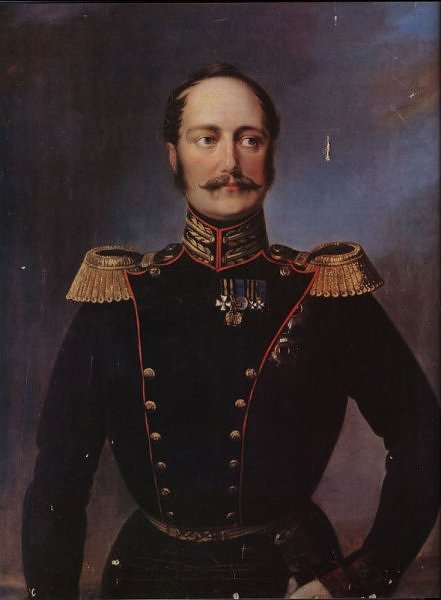
One of the more controversial monarchs Russia has had, both in his own time and today, is Czar Nicholas I. For being ready, willing and able to stamp out threats to traditional authority across the continent, he was known in his own time as the “Gendarme of Europe”, the policeman walking the beat on watch for revolutionary republicans. Later he would also be nicknamed, “the Iron Czar” and more recently he is often referred to, slanderously by those who I think are showing their political bias, as the ‘Stalin of Imperial Russia’. This, needless to say, is absurd as the two men were absolutely nothing alike in terms of character, background, worldview or their policies. It is said, I think, for the simplistic reason that both made use of secret police forces, both were intolerant of dissent and that is about where the similarities end. The same, of course, could be said about the vast majority of leaders of countries throughout history and even today. Personally, I think the comparison is more often due to a desire to ‘normalize’ Joseph Stalin in an effort to deny the truth which is that he was the most vicious, sadistic, incompetent and murderous ruler the Russian people have ever had to endure and no one comes close to him in comparison.
Czar Nicholas I, however, did not murder tens of millions of his subjects, he did not stamp out talent wherever he could find it, he did not encourage rebellion and terrorism around the world nor did he have any desire to dominate the planet. He was an autocrat and he was, thus, autocratic but the Czar himself would not have considered this an insulting or derogatory term. He believed to his last breath that it was his duty to God to be autocratic and that his autocracy was exercised in the service of his people as an obligation from God. Czar Nicholas I was a man of deep faith, a man who passionately believed in Russian Orthodox Christianity, in Christian monarchy, traditional authority and in the “Divine Right of Kings” to use a rather outdated term. Czar Nicholas I was also very much a nationalist. His greatest affection was for the Russian people, he believed that Russia was for the Russian people and should be as Russian as humanly possibly. Secondarily, he also had great affection for the Slavic peoples of Europe and felt that it was his duty, after safeguarding the Russian people, to safeguard or liberate to the extent possible other Slavic peoples. His views and priorities could be best illustrated by the slogan for his reign which was, “Orthodoxy, Autocracy, Nationality”. Those are the things he valued most, in that order and each being derived from the former.
Nicholas Pavlovich Romanov was born at Gatchina on June 25, 1796 to Czar Paul and his wife Czarina Maria Feodorovna (Dorothea of Wurttemberg). He did not lead a pampered childhood at all, as was common in Russia despite what people think of royalty in general. He was made to sleep on an army bed, a habit he kept up for the rest of his life (just as Kaiser Franz Joseph of Austria would) and kept to a very strict routine of study and exercise overseen by General Count Lamsdorf. He was not fond of study but very early on came to love the army and military life. He also had instilled in him a very strong and sincere Orthodox Christian faith, which he also tended to view in military terms. God was his supreme commander, he would be His general and lead people on the path to salvation. He joined the Imperial Russian Army in 1814 but, to his deep regret, did not see action in the battles against the French that made Russia famous.
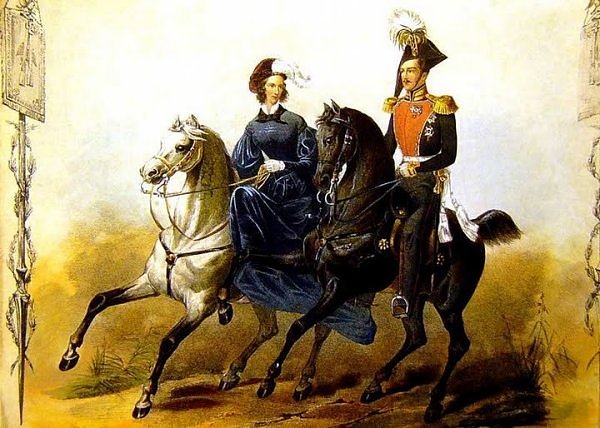
In 1815 he visited Berlin where, as a military man, he was awed by the discipline and professionalism of the Prussian army. He was also very much taken by the daughter of King Friedrich Wilhelm III, Princess Charlotte and he was decisive in his choice of wife. In 1817 the two were married, beginning many years of marital bliss as the two were deeply attached to each other. Taking the Russian name of Alexandra Feodorovna, she gave birth to their first child, the future Czar Alexander II, a year later in 1818. With his army life and his Prussian bride, he was as happy and contented as he could be. Despite his appearance, being a strict and no-nonsense military man, he was a very passionate individual and could become quite emotional at times. One such occasion, when he burst into tears, was when he was told that his brother Constantine had no desire to be Emperor of Russia and that the duty would likely fall on him. His life was just as he wanted it and he did not aspire to the imperial throne. However, as a man of duty, he would do as duty required even if it was a sacrifice for him.
The problem was that there were deep divisions in the upper echelons of the Imperial Russian Army at the time of the death of Czar Alexander I in 1825. During the wars against Napoleon, many Russian officers had picked up a great deal of French thinking and wanted to import these ideas to Russia. Many also disliked Nicholas because he was so strict as a commander and expected everyone to obey army regulations to the letter, regardless of how lofty their rank. Because of this, and because Constantine did not wish to be Czar but refused to make a public statement to that affect, Nicholas was caught in an awkward position. Taking advantage of Constantine’s obstinacy, the liberal army officers began plotting a military coup, thinking they could overthrow Nicholas and have Constantine, a man who had no wish to rule, as a puppet Czar who would do nothing while they made Russia more like Napoleonic France. Some, like Colonel Pavel Pestel, of the Southern Society, even wanted to overthrow the monarchy and establish a republic. Fortunately for Nicholas, someone informed him about what these secret societies were up to.
On December 14, 1825 Nicholas was proclaimed Emperor and Autocrat of all the Russias and only hours later a group of these army dissidents, known as Decembrists, gathered in Senate Square in St Petersburg, demanding a constitution for Russia, emancipation of the serfs and pledging themselves loyal to Constantine. Nicholas was ready for them and soon came out with his loyal troops to surround them. There was a period of tension as Nicholas demanded that these men return to duty as he wished to avoid spilling Russian blood if at all possible. However, there would be no stepping down for the Decembrists and, as much as he disliked doing so, Czar Nicholas I would not shirk his duty and he ordered the artillery to open fire on them. The attempted uprising was crushed at the outset and 56 men were killed. The new Czar spent the first night of his reign at the Winter Palace interrogating the dissidents and, in the end, 253 were punished with various terms of imprisonment or exile, 31 were sent to spend the rest of their lives in hard labor in Siberia but only 5 were executed.
There would certainly be no constitution and no emancipation of the serfs for the Russian Empire under Nicholas I and this incident on the very first day of his reign only convinced him that revolutionary republicanism was a disease that was easily spread and he would have to be all the more strict and all the more on guard that it never be allowed to take root in Russia. He would be a very ‘hands-on’ ruler, toured the country extensively, had studies taken of the situation and would enact any needed changes gradually and carefully. In domestic policy, his focus was on stability. In foreign policy, he was certainly no warmonger, fearing that wars cause stress that could be exploited by revolutionaries. However, war was not long in coming to his door due to the traditional enemies of Russia in Persia and Turkey. In 1826 the Persians (Iranians) arrested the Russian ambassador and launched a war to regain provinces in the Caucasus lost to Russia in a previous conflict. Czar Nicholas responded swiftly and forcefully.
From the spring of 1826 to 1828 the Russians and Persians fought for control of the Caucasus. In the end, Russia was again victorious and Armenia, Azerbaijan and what is now Igdir Province were ceded to Russia and Russia was able to have a fleet on the Caspian Sea. This was the last of the official Russo-Persian Wars but they still resonate today. Russia, which aids and has helped to arm and strengthen modern-day Iran, mostly does not remember these conflicts but the Iranians certainly do and still consider all of these areas, as well as parts of what is today southern Russia, to rightfully belong to them and they still intend to take it all back someday. That Russia would assist in strengthening Iran is a notion that Czar Nicholas I would have considered too ridiculous to even be entertained for a moment. The Turkish Ottoman Empire was also a regime that the Czar never trusted for a moment, yet it was a more difficult issue. He detested the fact that the Caliph of Islam continued to rule over large populations of Orthodox Christians in the Balkans, yet he also believed in traditional authority and that, as the legitimate monarch, all of the subjects of the Ottoman Sultan had a duty to submit to him.
The Persian conflict had been one of self-defense, forced on him by the Persians. However, as long as the Turkish Sultan did not attack Russia, he could take no action. Again, he knew how easily revolution can spread and just as the Turkish Sultan would not want his Christian subjects to rebel, the Czar would not wish the Catholic, Lutheran or Muslim subjects of the Russian Empire to rebel against him. Instead, he cooperated with the British and French to push for the Greeks to be given autonomy within the Ottoman Empire and for Russian merchant ships to have access to the Straits to reach the Mediterranean. However, the Sultan refused to grant autonomy to the Greeks and after signing an agreement granting Russian ships access to the Straits, the Sultan then closed the Straits, and this finally induced the Czar to declare war on the Turks in 1828. Once again, the Imperial Russian Army was everywhere victorious on both the Balkan and Caucasian fronts. When Russian troops captured Adrianople in August of 1829, moving toward Constantinople, the Turkish Sultan decided to sue for peace. The resulting treaty gave autonomy and Russia the right to occupy Moldavia and Wallachia until the Turks completed their war reparations payments and gave autonomy to Serbia. It also gave Turkish recognition to Russian sovereignty over Armenia and Georgia and granted autonomy to Greece which, by 1830, the major powers of Europe agreed to advance to complete independence for a Greek kingdom.
The early years of the reign of Nicholas I had been ones of calm at home and glorious victories over Russia’s enemies abroad. Things were going very well. However, in 1830, the Czar was alarmed when revolution broke out in France in July and in Belgium (then part of the United Netherlands) in August. The situation in France ended fairly quickly but the Czar was slow to recognize the new regime of King Louis Philippe, however, he did finally do so as he soon had his own problems to deal with. As he was always eager to help any brother monarch threatened by revolution, when the Belgians rose in revolt, he quickly messaged King Willem I of the Netherlands with an offer of a Russian and Polish army to help him crush the Belgians. This, however, set off an uprising in Poland as the Poles had no desire to do such a thing, particularly considering that they were Catholics living under an Orthodox monarch and could sympathize with the Catholic Belgians who were subjects of a Protestant monarch. The Polish uprising of November 1830 was very serious indeed. Many Poles had never been happy ever since the Habsburg, Hohenzollern and Romanov monarchs had partitioned their country out of existence and suppressing them would take a fair amount of time and energy. It was not until September of 1831 that Russian Imperial troops were able to regain control of Warsaw.
In the aftermath of this rebellion, Czar Nicholas I was convinced that previous Russian monarchs had been far too lenient on the Poles. He considered Poland vital to the status of Russia as a power in Europe, placing it within reach of the western powers and he would not tolerate any dissent there. He closed down Polish universities, abolished the Polish parliament and the separate Polish army. Poland would be ruled more directly from St Petersburg and he also began forcing the Poles to speak Russian. The Czar who believed in, “Orthodoxy, Autocracy and Nationality” wanted to suppress disunity in his empire and one way was to have everyone be conversant in the same language. He placed similar requirements on Belorussia and Ukraine in what has since been called a campaign of ‘Russification’. To the extent possible, he wanted to make Russia an empire of one people, with one faith under one monarch. Obviously, there would be differences among his subjects but he wanted to at least apply pressure toward greater unity in language and religion.
Despite what many have said since, the Russian economy grew during the reign of Czar Nicholas I, though certainly not as quickly as occurred in some other countries. The Czar was not a fan of modernization and feared that railroads would ‘weaken the moral fiber of Russian society’. However, if it could help in suppressing revolution, he could be persuaded. When he saw how quickly the British were able to dispatch their redcoats from Manchester to Liverpool to respond to a rebellion in Ireland, he thought he might give railroads a chance and so the first Russian rail line, running from Tsarskoe Selo to St Petersburg, was opened in 1837. Russia still lagged behind the other great powers but things were certainly not stagnant as they are often portrayed. Wars, which the Czar did not start but had forced upon him, did tend to cause inflation but it did not get out of control and exports of wheat increased and the cotton industry grew.
When it came to serfdom, which the Decembrists had wanted to abolish, Czar Nicholas I was, again, quite different from how he is often portrayed. The Czar did not like serfdom, indeed, he strongly opposed it. Yet, the Czar did not feel it would be right to impose emancipation on the nobility who depended on serfdom. To do so would doubtless inflame the nobility against the monarchy and it could cause immense social unrest by raising expectations, not only among the emancipated serfs, but the rest of the Russian populace as well. Instead, true to character, Czar Nicholas tried to lead by example. The Crown Estates of Russia covered vast tracts of the country and were home to a huge number of serfs. The Czar ordered the general in charge of these lands to enact changes to improve the lives of the serfs who lived and worked on these imperial properties. Poorer serfs were allotted more land, schools were built for their children and new model farms were established. Nicholas hoped that the rest of the nobility would follow his example in this regard and do similar things to improve the lives of their own serfs. Some noble Russian aristocrats did exactly this but, unfortunately, most did not.
Another internal matter for which Nicholas I is often attacked is in the area of education. Modern historians tend to associate the reign of Nicholas I with censorship and excessive use of the secret police. However, the Czar increased spending on education and opened a number of new technical and vocational schools. The Czar was certainly not opposed to education or thought it of no value, he simply insisted that the education teach things of practical value (imagine that) and teach students to be loyal, patriotic and pious Russians. He would not tolerate the dissemination of revolutionary ideas and these things did tend to circulate most heavily among the educated class which is why the Czar tended to distrust them. What is also often overlooked is that the Third Section, tasked with hunting down subversive elements, was also tasked with finding and eliminating corruption within the government, dishonest and incompetent officials which is something that is almost always overlooked. It is also worth noting that despite this intolerant atmosphere of censorship that liberal historians moan about, newspaper circulation increased under Nicholas I and Russian literature flourished. Nicholas I was also very interested in architecture and patronized a number of building projects throughout his reign.
The one area at home in which Nicholas could be faulted somewhat was in his private life. Unlike Alexander III or Nicholas II, Czar Nicholas I did have a mistress, one Vervara Nelidova, one of his wife’s ladies-in-waiting. However, I am more inclined to be forgiving of the Czar on this score than I would be with most other monarchs because of the circumstances. As stated previously, Nicholas and his wife truly loved each other and that never changed. They were extremely close, very affectionate and very familiar with each other. She called him “Nicks” and he called her “Mouffy”. Unfortunately, the Czarina began to suffer from increasingly poor health and was eventually diagnosed with a heart condition. She became increasingly frail and finally the doctors advised that she cease from performing her marital duties. It was only at that point that Nicholas began his affair with Nelidova. He never lost any of his respect or affection for his wife and would have preferred restricting his affections to her but, as her condition did not allow this, the Czar found that while the spirit indeed was willing, his flesh was weak. He would not endanger the health of his beloved wife so he would satisfy his physical desires with Nelidova. It was a purely sexual relationship and the Czarina always remained his most beloved and his most trusted confidant. Unfortunately, gossip of such things does tend to spread and when, due to his own health problems, the Czar began to show his age, his enemies spread lurid tales that greatly exaggerated his extramarital escapades. Whispers grew to the effect that Nelidova was wearing him out and things of that nature. It was not true of course but it arose from the one blot on an otherwise spotless record of moral fortitude.
As the Czar of Russia, Nicholas of course had many obligations to distract him from such things and one subject that remained a constant problem was the Turks. Nicholas worried a great deal about the state of the many Orthodox Christians living under Turkish rule, yet he showed more astute judgment than many Twentieth Century politicians would in that he understood that the collapse of the Ottoman Empire would lead to chaos. By supporting the Turks against the Egyptians he gained a favorable agreement regarding the Straits and he also agreed with the King of Prussia and the Emperor of Austria that the Ottoman Empire should be maintained and to oppose the French in their efforts to increase their influence by undermining the Turks. The three monarchs agreed that, if the Ottoman Empire should begin to dissolve, they would work together to see to it this would be done in an orderly way, particularly in the Balkans, under their cooperative guidance. Privately, Nicholas thought that the Ottoman Empire was doomed but he was convinced that it would require all of the great powers working together to handle this when the time came. Unfortunately for him, while Nicholas thought that the British were on the same page as he was, the British did not think he was being sincere and with their liberal press full of stories portraying Nicholas as a harsh, authoritarian tyrant, they were convinced that he intended to expand Russian territory at the expense of Turkey and that they should, therefore, support the Turks. This would have very disastrous consequences in the years to come.
The Turkish situation soon faded to the background when the worst thing possible in the mind of Nicholas I occurred in 1848 when revolutions began breaking out all across Europe. Whereas, in 1830, the Czar had been quick to offer help to any imperiled monarch, this time he was slower to respond, fearing trouble at home as the unrest spread so far, so quickly. He did not want to have his army far away in a foreign country if a major rebellion suddenly broke out in the Russian Empire itself. However, the threat of revolution on the doorstep of Russia was another matter. He stamped down calls for a constitution in Moldavia and Wallachia but the real crisis arose when revolution broke out in the Austrian Empire. The Hungarians rebelled and the Polish areas under the Habsburg Crown rose up as well to support them. This greatly alarmed the Czar as he feared the bulk of the Polish population, under the Romanov Crown, might follow their example. However, there were uprisings in almost all parts of the Austrian Empire, even in Vienna itself but most seriously in Italy and Hungary and the Austrians simply could not cope with them all. Czar Nicholas I decided to intervene and sent the Imperial Russian Army into Hungary to crush the rebellion there in support of the new Austrian Emperor Franz Joseph. A fair-minded man, he also intervened in Germany to prevent Prussian aggression against Denmark, resulting in an agreement by 1850.
Although there had been no serious unrest in Russia itself, the revolutions of 1848 caused Nicholas to redouble his efforts to guard against any hint of unrest or dissent and not unreasonably so. He was more vigilant than ever, yet, the next great crisis would be the most serious of his reign and it would come from without rather than within. It all started in the Holy Land where the French, under Napoleon III, demanded privileges from the Ottoman Sultan for the local Catholic population which had previously been given to the Orthodox Christians. Czar Nicholas, quite understandably, objected to this and intervened with the Sultan on behalf of the Orthodox Christians, seeing himself as their protector. He also did not want to see French influence spread in the region and assumed that, as in the past, the British and Austrians would be in agreement with him, particularly as he had just pulled Austria’s chestnuts out of the fire in Hungary. However, they did not and, backed by the French and British, the Turks were defiant and soon Russia broke off diplomatic relations and sent an army to the Russo-Turkish border in the Balkans.
The British media worked the public into a furor on the issue and the politicians made harsh denunciations of Russia that they could not back down from, accusing Russia of preparing for a war of conquest against the Turks. The Czar wanted no such thing and tried to settle the issue by compromise but, emboldened by the French and British showing support, the Turkish Sultan refused to budge and furthermore demanded that the Russians withdraw from Moldavia and Wallachia. In October of 1853 Russia and Turkey began what became known as the Crimean War. Britain and France soon joined in on the side of Turkey, the Italian Kingdom of Piedmont-Sardinia would later as well. This was all bad enough, but the most infuriating thing of all was when the Emperor of Austria demanded that Russia evacuate Moldavia and Wallachia as well, threatening to join the war on the allied side otherwise. Nicholas thus had no choice but to comply but he was positively enraged that the Habsburg monarch, of all people, would do such a thing, having so recently come to his rescue when the Habsburg monarchy was in real danger of total collapse. It was a slight that the Russians would not forget.
As the war went, the initial battles with the Turks had been Russian victories. However, as the British and French landed expeditionary forces on the Crimean Peninsula, things began to go badly. The shortage of railroads meant that the Russian generals could not get troops and supplies where they were needed quickly enough. The Russians were not as well equipped as the French and British, and whereas they could focus on the Crimean front, Russia had to maintain troops there, in the Balkans and in the Caucasus against the Turks. The war devolved into a bloody stalemate and siege warfare, focused around Sevastopol in a way that would look very familiar to observers of the last year of the American Civil War or most of World War I. More than half a million Russians would die in the conflict and it would end in defeat, a bitter blow for the nation which had previously known victories over the pan-European army of Napoleon, the Shah of Persia and the Ottoman Sultan. Many believed that Czar Nicholas I would have sooner killed himself than agree to the peace Russia was eventually forced to make but he did not live long enough to see the end. He caught pneumonia after a military parade and died on February 18, 1855.
As the length of this profile probably indicates, I will admit to being very partial to Czar Nicholas I and likely all the more so because he tends to be so often and unjustly criticized. In his own time, his fellow monarchs almost invariably had a low opinion of him which seems like a disgusting level of ingratitude for the man who was ever ready to rush to the defense of any one of them in their time of crisis. He was a very monarchist monarch, a man of principle and integrity. He was a man of faith and a ruler who took his duties to God and his nation very seriously. He was a man of good character and a much more capable and successful ruler than most are willing to give him credit for. Modern liberal historians describe him only in terms of a reactionary who oppressed everyone and enforced stagnation on his country. Not true. Literature and architecture flourished under his reign, the economy expanded and he ruled over a Russian Empire that was larger than it had ever been before or ever would be again. True, other powers advanced more quickly in technology and industry but given the fact that Nicholas was confronted by one crisis after another, from his very first day on the throne, it is entirely understandable that he would make security and stability his top priorities. He was a great man and a great monarch. Russia was fortunate to have such a man at such a difficult time.
Showing posts with label Russia. Show all posts
Wednesday, August 2, 2017
Monday, July 31, 2017
The Crimean War All Over Again?
The U.S. Senate, you know, the upper house of the American legislature with a Republican majority that could not muster enough Republican votes to appeal ‘Obamacare’ which they spent the last seven years promising to do, did manage to pass a sanctions bill against Russia, with Iran and North Korea added as an afterthought, with a huge bi-partisan majority of Republicans and Democrats. Because North Korea was added it must now go back to the House of Representatives but is certain to pass there, again, with Democrat and Republican support, with a large enough majority to override any presidential veto. The Trump has said he will sign it, despite some earlier misgivings, I think simply because he will look impotent if he vetoes a bill that becomes law anyway. Some people, on both the left and the right by the way, have warned that this is insane as sanctions usually end with war and, as Russia has thousands of nuclear weapons, such a thing could be disastrous.
What is the reason for this? It depends on who you ask. The Democrats, of course, are still wailing about Russia “hacking” the 2016 election, “attacking our democracy” and so on while the Republicans justify their support (as some Democrats do too) by pointing to Russian actions in Ukraine. The Ukrainians, coincidentally I’m sure, have also recently been talking about joining NATO and the European Union but no one in the halls of power in Washington DC or Brussels think Russia should have any reason to worry about that. However, the European Union (pertinent here as it contains most of Europe’s remaining monarchies) has said they are less than thrilled about these sanctions which will impact European companies which do business with Russia, particularly in the energy sector as Europe buys most of their natural gas from Russia. It is a far cry from the tone of the same European leaders who wailed about Russian interference in the French presidential elections or Russian interference in the “Brexit” vote and who backed the NATO military buildup in the Baltic. The EU, it seems, wants to endlessly provoke Russia but does not want to actually put their money where their mouth is.
The American politicians, needless to say, do not want war with Russia either (though a war with Syria or Iran is something I would not consider beyond them) and they would be doing none of this if they believed for a moment that Russia would ever fight back. The more dim even act as though they are completely ignorant of the fact that the choice between war or peace with Russia is one that is not only up to them but up to the leadership in Moscow as well. I really wish people would learn from history, the common lament of historians of all ages I am sure. All of this should remind us of the Crimean War and not just because Crimea and Ukraine are again at issue. For those not familiar or who would like to refresh their memory, read this past post about the Clash of Monarchies in the Crimean War. Suffice it to say that neither Britain or France really expected to get into a war with Russia over what amounted to a sort of turf-feud between Christian factions in the Holy Land. Napoleon III of France, who took the side of the Catholics (silly man), was satisfied by Turkish concessions on the issue and the British, being a Protestant country and not Catholic or Orthodox really had ‘no dog in the fight’, so to speak, concerning the original issue. How then did this all come to war?
The answer lies with the British, specifically the British politicians and their allies in the media. Already sounding familiar isn’t it? One political faction in Britain wanted to fight, or at least said that they did, while the other urged compromise. They were more concerned about fears of Russian rivalry on the wider world stage, about areas where the British and Russian empires were bumping up against each other in Central Asia. They portrayed the Russians as brutes and Czar Nicholas I as a ruthless tyrant who suppressed opposition, killed dissidents and so on. Doesn’t that sound familiar? They could not compare him to Hitler of course but no doubt they did the best they could along those same lines. Their allies in the media pumped up public outrage against the Russians, picking on the poor, victimized Turks, and the demand for action by the British government began to grow at an alarming rate. This is how, in the end, the Her Majesty’s government was forced by public pressure, their own alarmism and brinksmanship into a war they did not really want over issues that could not be clearly defined.
After having stoked the fires of anti-Russian sentiment to such a degree, the politicians in London were left with no other option but to make good on their threats rather than face the public humiliation of backing down from their hysteria. The Czar of Russia was not averse to talking the matter over but he was also not about to back down over an issue in which he clearly felt that he was in the right. He would not and, given his character, could not simply wash his hands of the large Orthodox Christian population living under Ottoman rule in the Holy Land and the Balkans. The result was a war in which nearly 40,500 British troops were killed, France lost over 100,000, Sardinia lost just over 2,000 and the Turks lost almost 45,500 men. The Russians lost the war of course and had casualties of over half a million, just over 500,000 compared to total Allied losses of just over 200,000. Their position was severely weakened and yet, what had the Allies really won with their victory over Russia in Crimea? The French abandoned their interests in the region when another republic replaced Napoleon III, brought down by the Germans in 1870, and the Russian Imperial Navy was soon back in the Black Sea and the British could do nothing about it since neither the French or Germans would support them. Hopes the British had of added Alaska to Canada were thwarted when Czar Alexander II sold the vast territory to the United States. What had Britain gained? Not much.
What is possibly the most frustrating thing for me about so many of these international issues is the empty preening of the political classes of the various countries which they often represent. For example, the U.S. is going to put harsher sanctions on Russia because they “interfered” in the last U.S. election and they invaded a neighboring country. Okay, let us suppose for a moment all of that is true, you could also say the same thing about Communist China and yet, not only does the U.S. refrain from putting sanctions on China but both parties howled in anguish when they thought the Trump was going to start a “trade war” with China. Are the Ukrainians more worthy of support than the Tibetans, Indians or Vietnamese? Was the Chinese desire for a Bill Clinton victory any more interfering than the Russian desire for a Hillary Clinton defeat? The answer is that putting sanctions on Russia has no impact on the U.S. because America does very little business with Russia anyway. It does a great deal of business with China, as everyone else does, even Taiwan, and so sanctions on China would be even more problematic for America than the sanctions on Russia are for Europe.
It is, I think, worthwhile to take a step back and look at the basic situation here. Russia does not have military forces or military bases in any country bordering the United States. Russia has not attacked the United States and the same European leaders who howled about Trump rubbishing NATO during the campaign and demanded reassurance of America’s commitment to their defense are now not wanting to get so tough on Russia after all. Iran, likewise, (and regular readers will know what I think of the monstrous and illegitimate regime in Tehran) is no threat to the United States and never have Shiite Islamic terrorists attacked the United States itself. Sunni Islamic terrorists have, many, many times and yet we are sanctioning the Islamic Republic of Iran while selling weapons to the (Sunni) Kingdom of Saudi Arabia. North Korea, finally, is more problematic and yet, one could make the case that they would not be threatening America if American forces were not right next door in South Korea and Japan. The South Korean government, particularly the new President, does not want to take a hard line with North Korea and is very friendly with China. So, on that front, my question is; if South Korea is not worried about the North, why should Americans be? Pull the U.S. forces out and let South Korea handle the situation.
Both sides of most of these issues are doing a great deal of talking and threatening and most of them do not really mean a word of what they are saying. However, my concern is that the Democrats and Republicans in America are creating a media hysteria that will pull them into a war with Russia, a stupid, pointless war even if it be victorious, just as happened to Britain in the Crimean War. I would also point out again that the ultimate decision between war or peace is not up to the stuff-shirts in Washington alone. The U.S. once put sanctions on Japan, tougher and tougher sanctions all while proclaiming how the U.S. only wanted peace. On the Sunday morning of December 7, 1941 they found out the hard way that the other side has a say in when wars start too, not just your own. I would hate to see that happen again, particularly when no vital interest is at stake and on behalf of alliances that are a total farce.
![]() |
| U.S. forces in Narva, Estonia (which borders Russia) |
The American politicians, needless to say, do not want war with Russia either (though a war with Syria or Iran is something I would not consider beyond them) and they would be doing none of this if they believed for a moment that Russia would ever fight back. The more dim even act as though they are completely ignorant of the fact that the choice between war or peace with Russia is one that is not only up to them but up to the leadership in Moscow as well. I really wish people would learn from history, the common lament of historians of all ages I am sure. All of this should remind us of the Crimean War and not just because Crimea and Ukraine are again at issue. For those not familiar or who would like to refresh their memory, read this past post about the Clash of Monarchies in the Crimean War. Suffice it to say that neither Britain or France really expected to get into a war with Russia over what amounted to a sort of turf-feud between Christian factions in the Holy Land. Napoleon III of France, who took the side of the Catholics (silly man), was satisfied by Turkish concessions on the issue and the British, being a Protestant country and not Catholic or Orthodox really had ‘no dog in the fight’, so to speak, concerning the original issue. How then did this all come to war?
![]() |
| British troops depart for Crimea |
After having stoked the fires of anti-Russian sentiment to such a degree, the politicians in London were left with no other option but to make good on their threats rather than face the public humiliation of backing down from their hysteria. The Czar of Russia was not averse to talking the matter over but he was also not about to back down over an issue in which he clearly felt that he was in the right. He would not and, given his character, could not simply wash his hands of the large Orthodox Christian population living under Ottoman rule in the Holy Land and the Balkans. The result was a war in which nearly 40,500 British troops were killed, France lost over 100,000, Sardinia lost just over 2,000 and the Turks lost almost 45,500 men. The Russians lost the war of course and had casualties of over half a million, just over 500,000 compared to total Allied losses of just over 200,000. Their position was severely weakened and yet, what had the Allies really won with their victory over Russia in Crimea? The French abandoned their interests in the region when another republic replaced Napoleon III, brought down by the Germans in 1870, and the Russian Imperial Navy was soon back in the Black Sea and the British could do nothing about it since neither the French or Germans would support them. Hopes the British had of added Alaska to Canada were thwarted when Czar Alexander II sold the vast territory to the United States. What had Britain gained? Not much.
![]() |
| President Vladimir Putin |
It is, I think, worthwhile to take a step back and look at the basic situation here. Russia does not have military forces or military bases in any country bordering the United States. Russia has not attacked the United States and the same European leaders who howled about Trump rubbishing NATO during the campaign and demanded reassurance of America’s commitment to their defense are now not wanting to get so tough on Russia after all. Iran, likewise, (and regular readers will know what I think of the monstrous and illegitimate regime in Tehran) is no threat to the United States and never have Shiite Islamic terrorists attacked the United States itself. Sunni Islamic terrorists have, many, many times and yet we are sanctioning the Islamic Republic of Iran while selling weapons to the (Sunni) Kingdom of Saudi Arabia. North Korea, finally, is more problematic and yet, one could make the case that they would not be threatening America if American forces were not right next door in South Korea and Japan. The South Korean government, particularly the new President, does not want to take a hard line with North Korea and is very friendly with China. So, on that front, my question is; if South Korea is not worried about the North, why should Americans be? Pull the U.S. forces out and let South Korea handle the situation.
![]() |
| Where sanctions tend to lead... |
Sunday, July 23, 2017
The Stumble Toward War, July 1914
It was on this day in 1914, in the wake of the assassination of the heir to the Habsburg throne, Archduke Francis Ferdinand, that the Imperial-Royal government of Austria-Hungary issued a list of demands which amounted to an ultimatum for the Kingdom of Serbia. They were demands which were so far-reaching that many have since speculated that the Austrian government never intended them to be accepted and was simply following the traditional pattern of issuing an ultimatum as a prelude to war. Yet, if Austria-Hungary was overreaching, it should be entirely understandable. The assassination of the heir to the throne was only the latest and most tragic act by Serbian terrorist groups in what had been a long campaign of antagonism. Vienna wanted this stopped and were prepared to use force to make that happen. The Emperor of Austria-Hungary, Francis Joseph, did not want war but he was also not prepared to let this anti-Habsburg campaign continue without response.
The world was shocked when the Kingdom of Serbia agreed to all but one of Austria's demands. There had been hardly anything in the ultimatum that any independent country would have agreed to and, yet, Serbia agreed to comply almost entirely. Why was this? They knew just how high up in the halls of power in Belgrade that the anti-Habsburg secret societies reached and they knew that if they did not comply, war would result and everyone expected that Austria-Hungary would completely crush Serbia in such a war. Serbia's only hope was Czar Nicholas II of Russia, as only the threat of Russian intervention might make Austria think twice about attacking Serbia. Czar Nicholas II was prepared to do the right thing, he was not prepared to tolerate the Austrian conquest of a Slavic, Orthodox nation yet, like Emperor Francis Joseph in Vienna, he did not want war either. Russia's last war, against Japan, had ended in defeat and with the monarchy badly shaken, both by internal unrest that was eager for any sign of weakness and by more professional revolutionaries paid by the Japanese to undermine the Czar. Any threat of war against Austria-Hungary would also surely result in the German Empire coming to the defense of their Austro-Hungarian allies.
Czar Nicholas II is almost never given credit for this, yet it was he who persuaded the Serbians to agree to all but one of the Austrian demands, something which could have stopped the outbreak of World War I. The Czar of Russia took a very clear position; if the Austrians insisted on invading Serbia, he would intervene but as long as there was any hope for a peaceful resolution, he would press the Serbs to agree to almost anything so that the crisis could be ended. King Peter I of Serbia and his regent Crown Prince Alexander, both supported the expansionist movement to create a Yugoslav state under Serbian leadership, yet they also knew that without Russian support, they stood little chance against Austria-Hungary and so, because of the part played by the Czar of Russia, agreed to all but one of the Austrian demands. In short, none of the monarchs involved wanted to go to war and Czar Nicholas II in particular deserves credit for doing all that he could to prevent such a disaster. Yet, it happened anyway. How? Even after the first declarations of war, it still seemed possible but was not.
Not a few historians have said that, rather than German Kaiser Wilhelm II (who had all blame heaped on him after the war), the real villain of the tragedy was Count Leopold Berchtold, the Austrian Foreign Minister. At Ischl, he presented the declaration of war against Serbia to Emperor Francis Joseph and obtained his signature by a flat out deception. He informed his monarch that the Serbs were already attacking Austria-Hungary, which was simply not true. The Serbs had mobilized first as there were hotheads in Belgrade just as eager for war as some in Vienna, but they had taken no hostile action. Berchtold thus obtained the Austrian declaration of war against Serbia by dishonesty and then allowed subsequent opportunities to stop the conflagration to pass by him on the grounds that Austria-Hungary had already declared war and the time for talks was over. If one were to insist on guilty culprits to blame for the outbreak of the Great War (and there was blame enough to go around), I would have to say that three men dominate the scene and none of them were reigning monarchs. There was the Austrian Foreign Minister Count Leopold Berchtold who lied to his monarch to obtain a declaration of war against Serbia and brushed aside opportunities for peace; there was the French Ambassador to Russia Maurice Paleologue who pushed relentlessly for war between Russia and Germany and finally Sir Edward Grey, the Labour Foreign Secretary of Great Britain who might have put the Germans off the whole affair if he had made it clear from the outset that Britain would intervene on the side of France and Russia.
Did two leftist foreign ministers and one Czech aristocrat start the First World War? No, that would be a considerable overstatement. However, they ultimately had far, far more culpability than did the emperors of Austria, Russia and Germany.
Sunday, January 15, 2017
The Russo-American Situation Today
This may be a bit off-topic but I am going to address it because I think its importance justifies doing so. It has become a tradition, sadly, in the United States of America to start out each new presidential term by trying to undermine the legitimacy of the incoming president. Leftists started this with their effort to de-legitimize George W. Bush following the Bush-Gore presidential contest which was so close it had to be decided by the U.S. Supreme Court. In the end, Bush won but because Gore won the “popular vote” the Clinton/Gore camp said that Bush was illegitimate. When Obama was elected there was nothing as serious as that but one prominent businessman, namely Donald J. Trump, took up the issue, which again originated with the Clinton family, that Obama had not been born in the United States as he claimed. The Republican Party did not want to touch the issue but Trump was all over it. Despite what many think, there were reasons to be suspicious. In publicizing his first book, Obama’s literary agent put out promotional material saying he had been born in Kenya and raised in Indonesia. This was not changed for 16 years until Obama ran for president. There were assertions that he was registered as a foreign student during his higher education but, as his school records were quickly sealed, no one could confirm this. In any event, Trump was accused of trying to undermine the legitimacy of Obama’s presidency.
Now, once again, the Democrats, liberals, progressives, leftists etc, particularly of the Clinton camp are trying to undermine the legitimacy of Trump by accusing him of being a stooge for Russian President Vladimir Putin and that Trump did not really beat Hillary Clinton in the election but that it was stolen from her by the Russians, aided by once again touting that Hillary won the “popular” vote despite her overwhelming loss in the Electoral College which actually chooses the president. It is unfortunate that this has become standard procedure but it is, I submit, even more dangerous this time because, unlike with Bush and Obama, this effort to de-legitimize Trump carries serious consequences for U.S. foreign policy and national security. The Clinton camp also has many allies in this given that the old boy network of the Republican Party has always opposed Trump, continues to oppose Trump and the issue has also been taken up by the Republican “war hawks” such as Senators John McCain, Lindsey Graham and Marco Rubio who seem to want nothing more than a humanity-ending war with Russia and will work with the Democrats in playing up the accusations that Trump was put in office by Vladimir Putin rather than the American people. This is not only wrong but it is dangerous but, unfortunately, it may have already worked and Trump has not even actually become President of the United States yet.
In the first place, it seems necessary to emphasize that the election was not as “close” as the Clinton camp likes to say. There is no such thing as “the popular vote” there is just “the vote”. Yes, more people in the country as a whole voted for Clinton but most people in most states voted for Trump and America is not a unitary country, it is a federal union of states -that is and always has been the basis of how the country is organized. Hillary gets her “popular vote” argument thanks to New York City and Los Angeles, the first and second most populous cities in the country. The Electoral College was established in the first place so that one state with an extremely large population could not rule the whole country according to its own interests and disregard the interests of all the other states. There is only one vote on election day and that vote is held in every state and determines which candidate that state’s electors will vote for. Most of the people in most of the states voted for Trump so the electors of those states voted for Trump and he was chosen to be President. Talking about the “popular vote” as if that were an actual ‘thing’ is pointless and doing away with the Electoral College in favor of direct democracy would, I think, simply destroy the country because a great many of the other 49 states are not going to be content to be ruled by whoever the voters in California thinks is best.
As to the allegations that Russia “stole” the election from Hillary, this is a more complicated issue because what exactly the Russian government is being accused of tends to be rather hard to pin down. You cannot “hack” an election as Obama himself stated before Trump surprised everyone by winning. There is, as stated above, no single vote in the country but 50 elections held in all 50 states using various voting methods. Some use machines, some use pencil and paper, in Alaska I think everyone shoots a moose with a candidate’s name on it, I’m not sure. The point is, there is no one vote that could be hacked. Even the Electoral College vote does not work like that. The electors get together and cast their votes in their state capitals and the results are then ratified by the Senate. When you boil down the “hacking” issue it basically comes down to this; you cannot “hack” the election but the Russians are accused of hacking into the email accounts of members of the Democrat party and Clinton campaign, passing these emails to “Wikileaks” which then made them public. These emails contained private information that was damaging to the Clinton campaign and, the Democrats argue, swung public opinion against Clinton causing her to lose the election.
Already, there are some obvious problems with this accusation. In the first place, none of the emails have had their veracity disputed. So, what the Russians are being accused of is getting facts to American voters that were obtained unjustly. American voters were told the truth and, evidently, the Democrats did not want that to happen and believes the truth harmed their campaign. But, on the other hand, the Democrats are the ones constantly trumpeting the fact that Hillary won the “popular vote” (as if that were a thing). So, how exactly did this impact the election? Looking at the country as a whole, most people were obviously unmoved by the emails if most people voted for Hillary Clinton, as most people did given that there are more people in New York and Los Angeles than in a number of entire countries in the world. Were the facts revealed in these emails more or less alarming depending on where they were read? Why would people in Michigan be more bothered by their contents than people in California? Can they really say for a fact that it was these leaked emails, supposedly provided by Russia, that caused Hillary to lose Wisconsin and not the fact that Hillary so took their votes for granted that she didn’t even bother to campaign in that state? I do not see how you possibly could.
Nonetheless, we are told that the Russians were “meddling” in the presidential election and that this poses a threat to American democracy and undermines the legitimacy of Donald Trump. Well, when Vice President Joe Biden went to Russia when Dmitri Medvedev was president and said that Vladimir Putin (the former president and then prime minister) should not be President of Russia again, was that not “meddling” in Russia’s next election? When Obama used government funds to try to stop Benjamin Netanyahu being reelected as prime minister was that “meddling” in the Israeli elections? In 2013 when Senator John McCain visited Kiev and told crowds of anti-government protestors that, “…Europe will make Ukraine better,” and, “…the destiny you seek lies in Europe,” could that in any way be seen as “meddling”? When the elected Ukrainian president was subsequently overthrown and replaced by a pro-Europe, anti-Russian one, no one in Obama’s administration seemed to think this was a threat to Ukrainian democracy or that this coup against a democratically-elected (though frankly terrible) president should be invalidated because of “meddling” by foreign powers. Obama himself might well be accused of “meddling” in British politics and trying to undermine British democracy when he went to London ahead of the “Brexit” vote and warned that if Britain left the EU he would put the British “at the back of the queue” when it came to trade matters.
This is all pure absurdity. I have no doubt that, given the choice of Clinton or Trump, the Russians would prefer the candidate who wanted to improve relations rather than the one who openly threatened war with Russia. One does not need a super-secret spy agency to come to that conclusion. Add to that the fact that, as yet, no evidence at all has been produced that the Russians were behind the “Wikileaks” revelations in the first place. All we have is the word of the U.S. intelligence agencies to go by that Russia was behind it all. National Intelligence Director James Clapper says the Russians did it. This being the same James Clapper who said that the NSA was not spying on US citizens only for it to come out that they actually were. I would not, personally, take his word that night is dark and day is light based on his record of honesty. This is when the patriot crowd starts to bellow about taking the word of foreigners over our own, all-American, intelligence agents. Sorry, that will not work with me. They have forfeited any claim to our trust by their own record of incompetence and dishonesty. They say they have evidence but as long as this evidence cannot be made public, all we can do is take their word for it and their word does not mean much to me at this point.
Added to this is how everything in the United States has become bitterly partisan at this point. No one trusts anyone from “the other side” and Russia, nor any other foreign power has any responsibility for that. James Clapper, in my book, forfeited my trust when he publicly lied about the NSA collecting data on US citizens. FBI Director James Comey forfeited my trust when he laid out a long list of infractions on the part of Hillary Clinton only to then refuse to bring charges against her. Of course, he then announced he was briefly reopening the case, in the last days of the election, which now has the Democrats baying for his blood since Hillary lost. And that is an illustrative case. When Comey said he was not recommending charges against Hillary, the Democrats held him up as an example of honesty and integrity. Today they are denouncing him as an untrustworthy political hack because Hillary lost. Prior to the election, Obama laughed off warnings from Donald Trump that the election might not be fair. Now that the Democrats have lost, he has placed sanctions on Russia for “meddling” in the election. Does anyone honestly believe he would have done the same if Hillary had won? When the intelligence community under George W. Bush said there were weapons of mass destruction in Iraq, the anti-war Democrats said they were wrong and subsequently trumpeted the news that none were found. Now these same Democrats are ready to take the intelligence community’s word for gospel that Russian “meddling” put Donald Trump in the White House. The loss of faith in American institutions is not the fault of any foreign power but the fault of both parties in the American government playing partisan politics with American intelligence agencies and American foreign policy.
Finally, we have the issue that makes this all particularly dangerous. Tensions between Russia and America are probably higher today than they have ever been since the Cuban missile crisis. Putin has been vilified by the American media and the American government like no Russian leader since Stalin, and even Stalin was portrayed as kindly “Uncle Joe” during the World War II years. The efforts to undermine the legitimacy of Bush and Obama did not involve a foreign power. The effort by the Clinton camp to undermine the legitimacy of Trump does and that makes this partisan game extremely dangerous. Trump said he wanted to “get along” with President Putin, suggested re-orienting NATO and working in cooperation with the Russians to fight Islamic terrorism. Hillary Clinton threatened to impose a “no fly zone” over Syria which, as one top American general told a seemingly incredulous panel of politicians, would mean war with Russia. Trump, against all expectations, won the election. The Democrats and Hillary Clinton in particular, were humiliated. This was not like losing to another Bush or losing to a Rubio or even a Ted Cruz but this was losing to a man they had all laughed at, who they had all discounted as being unworthy of serious consideration, a man they thought was not only “deplorable” but an absolute joke. The hysteria level on the left jumped to DEFCON 2.
Hillary had to have some way to explain away losing to this man for whom they had nothing but contempt. Russia and Vladimir Putin was seized on to serve this purpose. Russia immediately became the great, looming villain of the American political scene. Obama, who had once laughed off any concern about Russia, suddenly put sanctions on Russia, vilified the Russian president and dispatched troops to Eastern Europe. Republican war hawks like John McCain, who favored bombing Iran, bombing Iraq, bombing Syria, bombing Libya, happily added Russia to the list of enemies and it is perhaps no coincidence that he and his comrades too have always despised Donald Trump. However, the problem is that Russia is not like Iraq, Iran, Syria or Libya. Russia has the military capacity to hit back at the United States if it comes to that. Russia has no military forces in any country bordering the United States but the United States now has a great many military forces in a number of countries bordering Russia. Most Americans seem oblivious to that fact but the Russians certainly are not. The current NATO build-up, initiated by Obama is, as the Russians have pointed out, this biggest amassing of military forces on their border since the prelude to the Axis invasion of the Soviet Union in 1941. This is serious.
It is all the more serious because, with NATO having expanded to the Russian border itself, there is no room for Russia to back up any farther. During the Cuban missile crisis, Russia had military forces on the doorstep of America. A deal was agreed to and Russia removed these forces, the missiles were taken away and Russia backed off. Now America has military forces on the doorstep of Russia. The only way this ends is if America backs off and the anti-Russian hysteria, aimed at de-legitimizing Donald Trump, may have already made this impossible. The well has been poisoned. Before even taking office, Trump has been branded by the Democrats and the “establishment” Republicans as Putin’s pliant puppet, a stooge for the Kremlin. Any move he makes to remove the sanctions on Russia, ease tensions, draw back or even talk about some sort of cooperation with Russia will be immediately seized on as “proof” that all the accusations were true about him being the instrument of Moscow. Thus, the Democrats and their pro-war allies have made coming to any accommodation with Russia the purest political poison. Already I have heard from one European reader here saying that the election of Trump has made America, “Russia’s bitch”. Any hope of coming to an understanding between the United States and Russia may well have been destroyed before Trump even takes the oath of office.
So, if America cannot back down and Russia cannot back down; how does this end? No one in Washington seems to be thinking about or indeed the least bit concerned about the inevitable outcome of their actions. Consider the sanctions Obama just placed on Russia over their alleged “meddling” in the election; how do those ever end? Obama sanctioned Russia for something he says they have already done, so it is not as though they can stop doing anything in order for these sanctions to be lifted. What are these sanctions supposed to achieve? What does massing troops on the Russian border accomplish? These countries are already a part of NATO so they already have, effectively, a war guarantee from the United States to go to war with Russia if the Russians so much as lay a finger on them (a mistake in my view), so everyone already knows that if Russia makes a move on the Baltic republics or Poland that this means war with America. All this increased military presence does then is make the already nervous Russians even more nervous and increase the chances of something going wrong and starting a cataclysmic conflict. Does Obama, the Democrats and the McCain-Graham-Rubio trio hope to collapse Putin’s regime? That is not going to happen and it would not be pretty if it did. In the last century Russia collapsed twice and it is not going to happen a third time without others being dragged down with them. Russians today can remember when Russia had troops in Germany, now the United States has troops in Poland. Their backs are to the wall and a country with its back to the wall and a nuclear arsenal at their disposal should not be the focus of saber rattling for the sake of the wounded pride of one political party.
Finally, before anyone says so, no, I’m not a huge fan of Vladimir Putin and I have the articles here and the angry comments from his fan boys to prove it. I wouldn’t be a fan of any regime in Russia that did not have a Romanov at the top of it. However, Putin is not the worst guy in the world, he’s not Hitler and he’s certainly no threat to the United States. I don’t agree with or like many of his foreign policies and if I lived in certain European countries he would probably worry me but this is part of the problem. Saying we should see things from the Russian point of view, saying it would be better not to have World War III break out because Hillary is embarrassed, or just saying that the relationship between America and Russia should be talked about rationally should NOT cause someone to immediately be labeled as a “Putin apologist”. He’s not blameless, he’s done plenty that I do not like but he’s probably the best post-imperial leader Russia has had, which is not too difficult. Henry Kissinger, a man I am certainly no fan of, was, I think, nonetheless correct when he said that the demonization of Putin is not a policy. Right now, Democrats and Republicans are fond of saying that “Russia’s values are not America’s values” and that may be true but were the values of Soviet Russia or Imperial Russia any closer? The U.S. dealt with them and, in fact, was often quite friendly with Imperial Russia and no one claimed that the values of a secular federal republic were at all the same as those of an Orthodox absolute monarchy. What Americans have to do is stop vilifying, stop blaming, stop the hysterics and think, talk, debate and at least have the discussion.
This is not just serious, it is deadly serious and I know most people will probably just roll their eyes at that, confident in the belief that actual war could never happen. I hope you’re right but people said the same thing in 1939. They said it in 1914 and plenty of Americans probably said the same thing in 1861. There are people in the world who have legitimate disagreements with Russia and genuine causes for concern. The United States is not one of them. The United States has never fought a war with Russia, has no territorial disputes with Russia, shares no border with Russia and does relatively little business with Russia. Trump beating Hillary in an election is not justification for conflict with Russia, nor, in my view, does the fate of Syria, Ukraine, Estonia, Latvia or Lithuania rise to the level of being vital to American national security. For most of American history Syria belonged to Turkey and the other countries belonged to Russia and it had no impact on the safety of the United States at all. Let the Democrats find some other way of undermining the Trump presidency if they must because this one could get us all killed. Stop saying that Russia committed an “act of war” against the US and stop trying to get every Trump appointee to publicly call Putin a “war criminal”. It is stupid, it is not helpful and I cannot think they themselves even really mean it. It is just political theater for partisan political reasons, because if they really DID mean it, then they would be giving the orders to fire up the bombers, kiss your butt goodbye and prepare to meet Jesus because the world would be about to end. They are showboating for political reasons but, as I said before, the problem is that Russia is not Iraq or Afghanistan. They can hit back and in this scenario, it is not the United States alone that gets to decide when to go to war and when they have had enough. To repeat, Russia is not at America’s doorstep, America is at Russia’s doorstep. They have no room to back up and they are not going to have another 1917 or 1991. They have nowhere to go and nothing left to lose. The clowns in Washington should think about that or at least the American people should think about that and call a halt to this dangerous nonsense.
Tuesday, December 20, 2016
Trouble with Russia and Turkey
Most have probably seen the news, and even video, of the assassination of the Russian ambassador to Turkey yesterday. There were immediate fears that this could cause some serious trouble, though from the first I heard of it, I doubted that the Turks were about to feel the full fury of Russia. For one thing, the Turks shooting down a Russian fighter jet last year, despite a great deal of big talk from Moscow, resulted in little more than a minor bump in the road for Russo-Turkish relations. Turkish President Erogan has been given VIP treatment on a high-profile visit to Russia and the Russians quickly lifted trade and travel restrictions on Turkey after the incident. Erdogan expressed his regret about the incident but continued to assert that the Russian jet had violated Turkish airspace and has continued to refuse to recognize the Russian annexation of Crimea. The law pertaining to Crimea was passed by the Turkish government about a week before Russia resumed regular flights to Turkey.
After the assassination of the Russian ambassador, which the assassin claimed was in retaliation for Russian support for the Assad regime in Syria, which Turkey opposes, talk out of Turkey quickly went to allegations of a “false flag” operation by the United States, a clear effort to shift Russian anger toward a common enemy. Despite being a NATO member, the pro-Islamic fundamentalist Erdogan has had very strained relations with the United States, blaming America, for example, for the military coup attempt against him in July of this year. In short, my initial view, which could yet be proven wrong, was that if the Russians did not take serious action against Turkey over the shooting down of their jet, Turkish support of anti-Assad rebels and Islamic fundamentalist groups and opposition to Russia’s annexation of the Crimea, there is no reason to believe the Russian bear will now suddenly show its claws. To this observer it seems that the Turks have the stronger hand here and Russia desires good relations with Turkey more than the Turks desire good relations with Russia.
The history of Russo-Turkish relations is long and closely tied to the monarchist cause in both countries. For most of their histories, the Russian Empire and the Turkish Ottoman Empire have been implacable enemies. There have been no less than twelve wars between the Russian and Ottoman Empires with the Russians being successful more often than not. These were due to a number of circumstances such as the prevailing international politics of the day, the Russians taking up the cause of defender of the Orthodox Christians in the Ottoman Empire and the Russian wish to end Turkish domination of the Black Sea. However, looking at the bigger picture, the animosity was mostly inevitable and due to geography. Russian emperors for centuries have wanted to have secure Russian access to the eastern Mediterranean and a few have dreamed of taking Constantinople and restoring it as the heart of Orthodox Christianity. The Russian Empire also fought to liberate the Slavic and Orthodox Christian subjects of the Ottoman Empire in the Balkans.
The Ottoman Empire, throughout this time, was mostly on the defensive and fought most of these wars to defend themselves against the Russians. Turkish domination of the crossroads of the world rose up at a time when the Russians were still dominated by the successor states of the Mongol Empire. The Turks were able to gain a strong position before the Russians first started to go on the attack under Czar Ivan the Terrible. The aim of the Turkish Sultans was thus to defend their massive empire and domination of the region. Just as the Russian Empire, in those days, championed the cause of Orthodox Christians under Ottoman rule, so too did the Turks make common cause with the Islamic peoples conquered by the Russians or threatened by Russian expansion. So, in those days, the situation was fairly clear-cut, it was the Orthodox Christian Russian Empire against the Islamic Ottoman Empire, there could be no reconciliation, one would have to win and the other would have to lose.
World War I, however, saw events overtake both empires. Neither the Russian Empire nor the Ottoman Empire would ultimately survive the conflict. As the Russian monarchy was destroyed and finally replaced by the Soviet Union, the Ottoman Sultan was overthrown and replaced by a secular Turkish republic. Turkish nationalism, rather than pan-Islamism became the fashion in Turkey while in Russia, once the defender of Orthodox Christianity, became militantly atheist and Soviet founding father Vladimir Lenin immediately reached out to the revolutionary regime in Turkey, renouncing traditional Russian claims and establishing friendly relations between the Turkish Republic and the USSR. This only changed as a result of World War II in which the Soviets believed the neutral Turks to be rather too friendly with Hitler’s Germany (though Stalin himself had been friendly enough before the summer of 1941). Soviet dictator Joseph Stalin revived some of the old Czarist Russian claims against Turkey and, in response, the Turks shifted over to the Western Allies for guarantees of protection.
This return to the traditional antagonism was never quite as intense as it had been under the monarchy, with the Soviets even secretly backing the Turkish invasion of Cyprus in the hope that this would result in a split in NATO between pro-Greek and pro-Turkish factions. However, it all ended with the fall of the Soviet Union which has seen Russia make many unprecedented changes in policy, supporting, protecting and even arming neighboring countries which have been traditional enemies of Russia and which have historical grievances against Russia. Turkey, on the other hand, has been, particularly under Erdogan, shifting away from secularism and more toward Islamic fundamentalism. Turkey has been adopting a more robust foreign policy, supporting other Islamic powers and even Islamic powers that had been enemies of the Turks in the Ottoman days. In 2006 the King of Saudi Arabia visited Turkey for the first time in forty years and Erdogan has voiced his support of the Saudi intervention in Yemen against Iranian-backed factions. Turkey has been returning to a more ambitious, Ottoman-style foreign policy whereas Russia has been reversing many of the foreign policy attitudes of the Romanovs, sticking to Soviet-era relationships except, bizarrely, for those which coincided with Czarist policies.
Some of this has been understandable, given the extent to which many western countries continue to view Russia in the same way they viewed the Soviet Union. Western non-governmental organizations in particular practically pillaged Russia in the aftermath of the collapse of the Soviet Union and NATO and the EU have been steadily encroaching on Russia’s western border. Imperial Russia was always careful to never take a blanket anti-western foreign policy, preferring to ally with certain western powers against others as benefited their interests, the primary aim of which was access to a warm water port. Any Russian emperor would have thought it pure insanity to shelter, support and strengthen countries such as China, Iran or Turkey, all of which are within striking distance of Russia and have historical grievances against Russia which, even if the Russians have forgotten these pages of history, these powers certainly have not.
Will anything come of this latest incident? It is possible but, again, I am not too alarmed. Russia has shown that they want no trouble with Turkey in spite of even very blatant hostile actions. The Turks can, likewise, try to shift the blame and the Russians seem anxious to accept such a course. Turkey has their opposition to Assad and their threat to release more “refugees” upon Europe to maintain at least the grudging support of the western powers while Russia has never taken retaliatory measures in the past and the displeasure they have shown before was always of limited duration. Turkey seems to be in a strong position, able to annoy both sides of the east-west divide but with neither side being willing to do anything about it. They can maintain their current policy in the Middle East and negotiations with Europe. The Arabs are on their side and the NATO countries will almost certainly not wish to irritate all of them and if Russia has taken no action up until now in spite of Turkish support for anti-Assad radicals, opposition to the annexation of Crimea, the shooting down of the Russian fighter jet, it seems doubtful that they will suddenly decide to draw the line with this assassination.
Many have commented that Turkey, under Erdogan, is taking on a more Ottoman style. Relations were good between Turkey and Egypt when Egypt was ruled by the Islamic Brotherhood but have since soured. However, Turkey and Saudi Arabia have been on the same side in most regional conflicts, the Turks have invested in Iraq, Erdogan being the first Turkish PM to visit the Kurdish-populated area of Iraq in 2011 (to open a Turkish built airport), going on to visit several Shiite holy places. Turkish relations with Iran have improved, as have those with the Gulf states and Pakistan. In Syria the Turkish government has partnered with the Saudis and Gulf states in backing Islamic rebels against the Assad regime. Erdogan has been expanding Turkish involvement and influence throughout the Middle East, throughout the former Ottoman Empire. He has so mimicked the Ottoman style that some have suggested he intends to make himself Sultan. Rather than laughing off such an absurd suggestion, Erdogan replied that he would prefer to have a more ceremonial position, like Queen Elizabeth II of the UK which is not exactly a denial.
Russia, on the other hand, has reversed most of the long-standing foreign policy positions of the old Russian Empire. Imperial Russian opposition to the Turks, Persians and Chinese has been replaced by generous trade, military and energy agreements with Turkey, Iran and China by the Russian Federation. No danger from any quarter other than Western Europe or North America seems to be recognized and yet when it comes to the NATO countries, Russia has steadfastly refused to take a hard line. Whether this is good or bad depends on whether one takes the side of Russia or the west. If you side with the west, it has been good, because Russia has refused to actually challenge the west. If you side with Russia, it has not been good because the west carries on whereas, I have not the slightest doubt, if Russia were to ever actually do as NATO does and say, “do this and it means war”, the west would want no part of that. The current leadership of the western world are the sort to threaten war but not the sort to actually commit to it, at least not a war in which the other side has the capacity to hit back.
Thursday, November 17, 2016
Monarch Profile: Czar Alexander II of Russia
The reign of Alexander II Nikolayevich, Czar of all the Russias, stands as a tragic illustration of the old adage that, ‘no good deed goes unpunished’. His time on the Russian throne saw many important changes in Russia and in Russian interaction with the outside world. Actions which Alexander II took had a profound impact on his country and the world around him. At least as important as the actions he took, however, was the fate which befell him as this had a dramatic effect on the nature of Romanov rule in the eras of the two Russian emperors which followed after him. His reign reveals the immense potential that the Russian Empire possessed as well as revealing the great dangers that were festering in its midst which would ultimately lead to the downfall of this empire which had, for centuries, stood as a colossus on the world stage. Czar Alexander II was a man who tried to learn from the successes and failures of those who had gone before him and his own successors would take a hard lesson from how he fared as the autocrat known to history as, “the Czar Liberator”.
His Imperial Highness Grand Duke Alexander Nikolayevich of Russia was born in Moscow on April 29, 1818 to the “Iron Czar” Nicholas I and his consort Charlotte of Prussia. Obviously, with a father known to history as the “Iron Czar” and a mother who was the daughter of a Prussian king, the atmosphere in which Alexander was raised could be called extremely conservative to put it mildly. He had a somewhat liberal tutor for the time, upon whom historians have tended to put rather too much emphasis in explaining the later actions of Alexander but he was given a very well rounded if not extremely intricate education. It was, rather, life experience which was most to shape the views and actions of Alexander in his adult life. As is often the case, he was quite a different character from his very strict father and would come to possess a considerably different worldview from the Russian monarchs who preceded as well as succeeded him. His time as a free and unattached youth was rather short as his father passed away during the height of the Crimean War in 1855 when Alexander was only 37. The state of affairs that existed at the time of his coming to the Russian throne was to effect him profoundly.
On September 7, 1855 Czar Alexander II was crowned “Emperor and Autocrat of all the Russias” in a grand and solemn Orthodox ceremony. His distaste for military adventures was certainly impacted by the fact that he came to the throne at a time when Russia had lost the Crimean War and it had fallen to him to agree to the peace terms imposed by the Allies, primarily the British and French empires. The importance of this was quite significant. Czar Alexander II had seen his father stand as the champion of traditional authority in Europe. He had extended help to the Austrian Empire in suppressing rebellion and had offered it to others only to see these same powers collude against Russia, on the side of Ottoman Turkey, or at least take no action to come to the aid of Russia. Not only did this defeat sour Alexander II on the subject of war but it also caused him to take a more pragmatic and less idealistic view of foreign affairs than his father had. There was to be no ‘brotherhood of monarchs’ among the crowned heads of Europe and so, Alexander II would play the diplomatic game and seek to gain what advantage for his country he could and align himself with those powers most similar to Russia in their values, politics and system of government.
Austria and Prussia had at least remained neutral, though Austria had certainly threatened to intercede against Russia which caused a souring of relations which never really ended while he would always harbor suspicions of the French and British. The Crimean fiasco also prompted changes at home. Russia had been defeated, frankly, by relatively minor expeditionary forces which she should have been able to crush swiftly and completely. Czar Alexander II studied the matter closely and found rampant corruption and gross inefficiency in the upper echelons of his empire. This, not without foundation it must be said, he tended to blame on the aristocracy which he viewed as altogether too grasping and devoted to leisure rather than the good of the nation. His hopes, therefore, were placed on the great mass of the Russian peasantry, hard working, God fearing, loyal people who endured much and seemed more simplistic and wholesome.
As a result, not long after taking the throne, Czar Alexander II began instituting a series of reforms such as abolishing corporal punishment, allowing for elected judges and encouraging local self-government. Because of this, some historians have labeled Alexander II a “liberal” but he was far too sensible a man for that. Rather, it was his belief that the autocracy could be maintained as part of a modern state and his reforms were aimed at making Russia more efficient, more effective and more prosperous. He had supported the strict defense of the autocracy of his father and never wavered in that position, however, he thought that with the proper changes Russia could advance to the level of countries like Britain and France which had triumphed over Russia due to how backward Russia was in terms of industry, infrastructure and the state bureaucracy. In general, it was his ministers who carried out these reforms though the Czar did deal personally with some he took a particular interest in and he was instrumental in settling disputes between his top officials.
One act for which Alexander II remains famous in “the New World” was his decision to sell Alaska to the United States of America in 1867. Some, given the immense mineral wealth discovered there later, have criticized the Czar for this but, it must be remembered, at the time many Americans thought they were the ones who had gotten the worst of the deal. Before anyone knew of the gold and oil deposits there, it seemed that the U.S. had simply purchased a huge, frozen wilderness that was largely uninhabitable and devoid of prospects for development. In any event, Alexander II had sold the territory simply because of the continued tensions between Russia and the British Empire. The Russian presence in the region was extremely minimal and there was no way Russia could defend the territory. Alexander II feared, not unreasonably, that the British could easily move from Canada to seize Alaska and thus place themselves at the backdoor of the Russian Far East. It was far better to have Alaska in American hands as that would ensure the British never gained control of it and, at the time, the United States had a far friendlier relationship with Russia than Britain or France did.
The other act for which Czar Alexander II remains most famous is his emancipation of the serfs in 1861. This was a dramatic change for the Russian Empire but it was not so radical as many people think. A number of Russian monarchs, including his father Nicholas I, had wanted to end serfdom but never felt able to. Numerous conservative voices had, for some time previously, advocated abolishing serfdom on the orders of the Czar as a preferable alternative to having it end by means of a massive servile insurrection that might bring down the monarchy and destroy the Russian Empire entirely in the process. Liberals lauded Alexander II for this action but it stirred up considerable resentment on the part of the aristocracy and land owners. Nor was it a smooth transition, which is to be expected considering how deeply engrained serfdom was in Russia. The Czar took the ultimate step of freeing the serfs and insisted that they be given land to sustain themselves once they were free. Unfortunately, the landowners inflated the value of the land and the peasants had to go into considerable debt to the government to pay for it. Because of the way it was handled, Alexander II had to issue further reforms, dismiss a number of the ministers responsible for it and deal with a certain amount of unrest.
At home, Alexander II showed himself to be rather unlike his father but more akin to his more distant predecessors in his private life. In 1841 he had married Maria of Hesse-Darmstadt, the daughter of Hessian Grand Duke Ludwig II. It was a marriage willingly entered into by a loving couple rather than an arranged matter of state and the two initially had a very happy and successful wedded life. The two were certainly busy, having eight children before the death of the Czarina in 1880, however, long before that time the Czar began a series of affairs with a number of aristocratic ladies. Upon the death of his wife, the same year Alexander II married Katia Dolgorukaya, his latest mistress, by whom he had four more children. His infidelity was heartbreaking for his Hessian bride, who was a very sincere, good-natured lady, disliked by the more haughty ladies at court who often ridiculed her for being bothered by her husband’s affairs. Alexander II was known to be rather short-tempered and was often in poor health and not a few attributed this to his irregular private life.
On the world stage, the policy of Alexander II was to end the isolation the Russian Empire had been in since the end of the Crimean War, though to do so carefully. His greatest rival remained the British and while he was on friendlier terms with Prussia (being the son of a Prussian mother) the north German kingdom was then in no position to be of much help. During the American Civil War, some feared that the biggest and bloodiest conflict in the western hemisphere might draw the Old World into conflict as well. With the British and French empires being seen as sympathetic to the southern Confederacy, Russia had little choice but to foster good relations with the United States. Expansion in Asia was also underway at this time and there, again, the British were the primary opposition to Russia. 1861-62 saw the Russian Imperial Navy wintering in New York so that, in the event of war with Britain and France, the Russian fleet would be free to prey upon their ships in the Atlantic rather than being stuck in the ice blocked ports of the Russian coast. San Francisco, California also received a visit from the Russian navy.
The effort to foster better relations with the United States, it must be said, was not because of any political or ideological sympathy, despite what some historians have tried to portray as a friendship between President Lincoln and Czar Alexander II as two crusaders against slavery. At most, Russia wished to encourage the United States as a counter-weight against the British Empire, particularly at a time when Anglo-American relations were extremely poor due to the U.S. blockade of southern ports and the building of ships for the Confederate navy in England. It was also not as though the spread of the American Civil War to Europe was the only potential source of conflict. Russia was also at odds with the major European powers over turmoil in Poland.
Polish nationalists began orchestrating anti-Russian demonstrations in 1860 and some terrorist attacks, such as an outbreak of arson in St Petersburg, were blamed on Polish forces. Initially, Czar Alexander II responded in a conciliatory fashion by granting the Poles greater autonomy within the Russian Empire but this failed to satisfy the dissidents. They wanted nothing less than the restoration of complete Polish independence and this eventually escalated to outright rebellion in 1863 when Russian authorities tried to conscript the Polish leaders of this movement into the Imperial Army. When the rebellion spread to parts of Lithuania, Belorussia and Ukraine, Czar Alexander II abandoned his earlier effort at appeasement and reverted to brute force. The military was sent in to crush the rebellion, Polish officials were sacked and replaced by Russian officials and the teaching of the Russian language in Polish schools was made compulsory. Contact between Poland and the leadership of the Catholic Church in Rome was cut off and Ukrainian books were banned. Great Britain, France and the Austrian Empire were seen as being sympathetic to the Poles and thus antagonistic toward Russia and this caused a real concern that Russia could, again, be drawn into war.
Czar Alexander II hoped it would not come to that and set about trying to even the odds by getting one or more of the great powers to move away from the British and French and closer to Russia. The French Second Empire seemed the most likely candidate. Britain and Russia had too many conflicting interests, the Prussians were as yet too weak and a great deal of animosity still existed with Austria. In 1857 Czar Alexander II and Emperor Napoleon III met in Stuttgart and in the following years worked out a Franco-Russian agreement which stipulated that France would support a revision of the 1856 Treaty of Paris and that, in return, Russia would not support Austria in the clash between France and Austria in Italy everyone knew was coming. Unfortunately for Alexander II, this short-lived alliance proved to be a mistake. When war between France and Austria came, neither side emerged satisfied and the French resented the fact that Russia had not done more to help them, even though their agreement had promised only Russian neutrality. To make things worse, the Czar was alarmed by the upsurge of Italian nationalism the war caused, for which France was blamed, as this also inspired Polish nationalists to acts of anti-Russian resistance. When Napoleon III joined Britain and Austria in criticizing Russian actions in Poland, Alexander II regarded the agreement with France to be ended and focused on strengthening ties with their arch-enemy Prussia.
Russian expansion in Asia also prompted ill-will from the French as well as the British. Since the Crimean War settlement had effectively blocked in Russia from the west, expansion to the east, toward the Pacific seemed the only available option. Russia extracted treaties and territorial concessions from the Chinese, expanding Russian territory and leading to the establishment of Vladivostok in 1860. The British were becoming increasingly friendly with Japan, had extensive influence in China and the French, around this same time, were expanding in Southeast Asia and briefly became involved in Korea. Neither welcomed Russia as a competitor in East Asia and the tension this caused helped prompt the Czar to sell Alaska to the United States. Russian power also expanded in Central Asia, which alarmed the British, and the Caucasus which alarmed the Turks and Persians. By that time, however, Prussia was rising rapidly as a force to be reckoned with again, though this was potentially a double-edged sword for Russia. In the end, Czar Alexander II chose to shun the newly republican France for an alliance with the German and Austrian emperors though relations between Russia and Austria would never be very trusting or cordial.
The rise of the German Empire changed the situation in Europe and Russia and Britain, once bitter enemies, began to slowly drift more closely together. Aiding this was the rise of the Pan-Slav movement which opposed any friendship with Germany and Austria-Hungary, viewing the Austrians and Hungarians in particular as their greatest rivals for influence in the Balkans as Turkish power continued to decline and Slavic, Orthodox populations began to come ‘up for grabs’. A Serbian uprising against the Turks did finally spark another war between the Russian and Ottoman Empires in 1877, something that Alexander II had not wanted but likewise would not back down from either. By this time, his son and heir, Nicholas, had died and Alexander became noticeably more depressed and temperamental. His mood was not improved by the number of attacks against the Russian monarchy by revolutionaries, in spite of his many reforms and concessions. The war, this time with the Turks alone unsupported by Britain and France (who had been rather turned off by their former ally of the Crimean War after Turkish persecution of Christians in the aftermath), went quite well for Russia. The Russian armies joined with the Bulgarians in driving the Turks almost completely off of the European mainland.
Czar Alexander II obtained a favorable peace from the Turks but the war effectively ended the “Three Emperors League” as Austria objected to Bulgaria falling within the Russian sphere of influence and the Germans, under Bismarck, took the side of their Austrian brethren against the Russians so that many in Russia, particularly the Pan-Slav activists, felt robbed of the fruits of their victory. Russia would never be friendly with Germany and Austria-Hungary again and in the years to come would align with her former enemies of Britain and France, forming what would become the battle lines of the First World War. And, at the same time, Alexander II faced nothing but hardship on the home front. Attacks by revolutionary radicals included shootings and bombings and this prompted the Czar to take repressive measures, a change in attitude from his earlier efforts to encourage support for the throne through reforms and concessions.
The Czar also continued to suffer from numerous health problems and in 1880 the Czarina passed away. Only a few weeks later Alexander II married his latest mistress which prompted outrage from the Russian Orthodox Church and the ranks of his own family. In an effort to regain public support and calm instability, Alexander II began to shift again toward allowing greater freedom for his subjects. Unfortunately, it was just at this time that he came under attack by a gang of assassins who threw a bomb at his carriage. The vehicle was armored, so the Czar was unhurt but, in a rush of unthinking compassion, he left the carriage to attend to his wounded driver and the murderers immediately threw a second bomb at his feet which exploded, gruesomely and mortally wounding the “Czar Liberator”. He was taken to the Winter Palace and died on March 13, 1881, the throne passing to his son Czar Alexander III.
Throughout his reign, most epitomized by his emancipation of the serfs, Alexander II had endeavored to be a monarch of mildness and reason. Yet, his reforms angered the traditional elites while winning no support for the Crown from the liberals and certainly none from the revolutionaries. The lessons of his life were not lost on his successor Czar Alexander III. His father had extended a hand and had been brutally murdered for it. From that time on, a return to strict discipline and harsh repression would be the order of the day. On the world stage, the Russian Empire had expanded but, to the eyes of the Russians at least, had been betrayed by first Napoleon III and then by the Germans and Austrians. Alexander III would firmly plant himself in opposition to the Germans and Austrians, even if that meant an alliance with republican France, the ideological opposite of the Russian Empire at every level. So it was that the reign of Czar Alexander II, beginning with granting greater freedom, emancipation for the serfs and efforts at reconciliation, ended with the battle lines of World War One being formed and the assertion by his son and later grandson that reforms to win over liberals was a wasted effort and that only strength and stern measures would preserve the Russian Empire.
Subscribe to:
Posts (Atom)