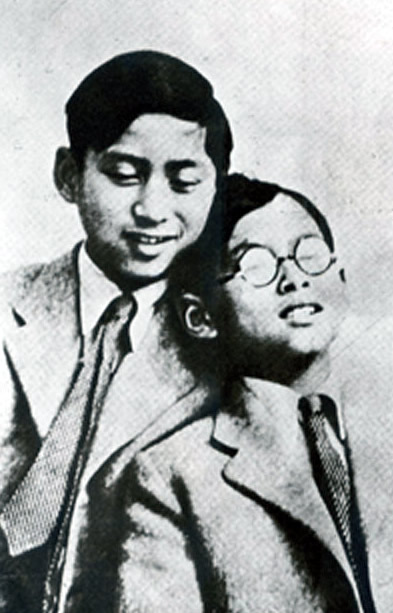
As most of you have probably heard, His Majesty Michael I, the last King of Romania, died yesterday in Switzerland at the age of 96. A sad day, to be sure, for the House of Hohenzollern-Sigmaringen, for all loyal Romanians and for monarchists everywhere. He was a good man and those interested can find out more at the links below about his life and the part he played in Romanian national life at a critical time for the world. When it comes to monarchs in general, what they represent is always far greater than the individual and their own virtues or flaws; so it is with the death of kings as well. King Michael I represented a great hope for a return to traditional authority in Romania or, at least, a hope for the future by providing a 'foot in the door'. Perhaps it is the emotion of the occasion but I cannot be as optimistic as I was before about a royal restoration of some sort in Romania now that the last king has gone to join his ancestors. There were brief occasions when it seemed a very real possibility, all of them missed opportunities but as long as he lived I thought there was a better chance than their could ever be without him.
King Michael I had lived long enough to see the collapse of the communist regime that forced him from his throne and into exile. He was able to return home, gain some official recognition from the existing (usurper) government and even undertook efforts on their behalf as a sort of unofficial ambassador-at-large for his country. Because of his actions in World War II, he was highly respected even among many who are not and would never think of themselves as monarchists. For that reason, I had long hoped that he might be able to be restored, at least as a ceremonial, constitutional monarch, as a sort of symbolic tribute to an elderly man who had lost everything for standing up to the communist oppressors. I could have seen a republican government doing that, seeing it, as they would, as a rather empty gesture of no real importance but one which would, nonetheless, restore the monarchy on an official basis and provide a place from which to advance farther toward a state of affairs more acceptable to Romanian monarchists. As the King entered extreme old age, I thought it unlikely but not beyond the realm of possibility that something might be negotiated to correct the past wrong and restore him to his throne before his death. Alas, it was not to be and I fear things will be much more difficult for Romanian monarchists going forward.
It must also be said that King Michael himself, the Royal Family and monarchists (not unusually unfortunately) also sometimes got in their own way. Changes to the succession, involvement in politics and other issues were not helpful. I am not as critical as I might be as changing the rules of succession for non-reigning dynasties has always been a difficult issue and the political situation is an impossibly fine line to walk. Stay aloof and you have nothing concrete to offer, get involved and you are seen as partisan and a source of division rather than unity. It is certainly a difficult situation. Hopefully, the next generation will carry on and will achieve success but without King Michael and his remarkable life story I think it will be much harder for them.
For more about the life of the late King:
Monarch Profile: King Michael I of Romania
The Story of the Kingdom of Romania
Romanian Royal Struggles in World War II
May the last King of the Romanians be welcomed by choirs of angels into the Kingdom of Heaven and May he Rest in Peace in the light of the Holy Face.
May his cause be vindicated by the successful restoration of the monarchy, a return to traditional authority, grounded in faith and family and may Romania be lifted to her full potential as a people and as a country.
This is my sincere wish. -MM
Showing posts with label death. Show all posts
Wednesday, December 6, 2017
Thursday, October 13, 2016
King Bhumibol Adulyadej the Great of Thailand (1927-2016)
It has just been announced that His Majesty, Bhumibol Adulyadej the Great, Lord of Life, King of Thailand, has passed away. Such news has been long expected but is no less tragic, nor is the impact mitigated by that fact. Few monarchs in the world today have been so loved, so respected and so revered by their subjects as the late King of Thailand. For the Thais, he has been a rock of stability, a beacon of hope, a helping hand, a kind father and a wise leader throughout his amazing 70 year reign. Beyond the borders of Thailand, he has also been a powerful presence in Southeast Asia, a firm and reliable figure throughout many years, even decades of troubled times. He was, in every way, providentially the right monarch in the right place at the right time. As Thai everywhere mourn the passing of this great and beloved sovereign it may be helpful for those unfamiliar with Thailand to take a look at some of the specific reasons why Rama IX is so popular, so revered and why he is referred to as “the Great”.
Born in the United States in 1927 while his parents were on a sort of world tour, King Bhumbibol succeeded his older brother as monarch in 1946. It was a delicate time for the Thai monarchy. After the end of the absolute monarchy in Thailand, King Prajadhipok abdicated and left the country and the young boy, King Ananda Mahidol was nominal monarch from 1935 until his death in 1946, having a regency the entire time. From the end of the absolute monarchy, instability and prevailed in Thailand and this was only ended with the establishment of an authoritarian military regime while the young king was out of the country. This was the regime which joined with Japan and the Axis powers during World War II so, in the aftermath of all of that, Thailand was in a very delicate position and the monarchy had been shaken and, for the first time in Thai history, to a large extent absent for an extended period of time. Many hopes were placed on young King Ananda Mahidol and when he died in 1946, it was yet another blow to an already bewildered people. Thailand had a new king, King Bhumibol Adulyadej, who had never expected to be king.
Known for his love of music, young King Bhumibol returned to school in Europe and switched his studies to political science and statecraft while the military regime continued to rule. This situation prevailed after his return until a conflict arose against the long-standing strongman Field Marshal Phibun (the man who had ruled throughout World War II). Phibun went to the King who advised him to resign before he was overthrown. Phibun did not listen and soon after was overthrown in a coup at which point the King, acting on his own, declared a state of emergency and took control of the situation himself. Public order was secured, the people were calmed and normalcy prevailed while the government situation was sorted out. For the first time since the end of absolutism, traditional royal customs were revived and the King took on a much more high-profile role in national life. The people were quickly drawn to the young man who traveled throughout the countryside, in simple clothes and dark glasses (worn since he had lost an eye in an automobile accident in Europe), looking into their concerns and coming up with his own solutions through government action or the private activities of his own charities.
Thailand experienced what could be called a sort of compassionate counter-revolution during this period. The monarchy was back in public life as it had not been for many years, traditions were restored that had long been dormant and the King obviously had a great deal of influence and was certainly not a captive of the government. At the same time, he was meeting regularly with ordinary people, he was acting outside the government, in person and through his own private agencies, to help people who needed it and improving the countryside in areas from infrastructure to agriculture. Whereas, in the past, the King had been the government, then the government had taken power while child monarchs were absent or powerless but now the King was rising above the government. The state was still there but the King could act in a private capacity without them and soon his moral authority was more powerful than any political authority held by the government of the day.
It was also during this period, in the 50’s and 60’s, that communism began to sweep Southeast Asia and the Kingdom of Thailand allied itself with the United States in fighting the spread of communist subversion. Most think of Thailand simply providing support to the U.S. forces in Vietnam, rest and recreation facilities, ports and air bases and the like, but Thai forces also joined the fight with Thai soldiers seeing action in Laos against the communist movement. There was a real fear that Communist China would dominate Laos and use it to gain entry to Thailand. The Kingdom of Thailand also sent the hard-fighting “Queen’s Cobra battalion” to South Vietnam where it served alongside American and South Vietnamese forces against the communists from 1965 to 1971. These days, of course, this long struggle is not viewed favorably anywhere but it was certainly not lost on the people at the time in Thailand that the victory of communism and the loss of the Vietnamese emperor and the kings of Laos and Cambodia went hand-in-hand with civil war, misery and tyranny whereas Thailand, for a time alone, remained a free and relatively prosperous country under their beloved King.
The end of this era came with the death of General Sarit Dhanarajata in 1963, after which the military governments became increasingly less stable as squabbling generals vied for power among themselves. This has become fairly common in Thailand but, thanks to the King and his wisely moderate use of his extensive moral authority and public prestige, Thailand could be said to have unstable governments but a stable country. The long period of military rule finally began to draw to a close when this government instability became so severe it threatened to destabilize the country as a whole. The King foresaw the danger and decided to intervene, though initially it was actually a non-intervention. He refused to endorse new regimes that took power by force during the 1980’s and this ensured that these dissident forces never lasted very long since, if the King did not recognize them, the vast majority of Thais likewise viewed them as illegitimate and ultimately power reverted back to the legal authorities. It was a precarious time, and there were minor outbreaks of violence, but what under other circumstances would have caused national collapse and civil war, ended with little major turmoil thanks to the King.
Finally, there came the issue of the transition to democracy. Thailand had actually had almost no experience with democracy, despite claims to the contrary, prior to the 1990’s. The end of royal absolutism brought to power a new class of political elites but they were not true democratic representatives of the public will and they were soon replaced by military leaders who had held power ever since. That changed with the military coup of 1991 in which General Suchinda Kraprayoon seized power, making himself dictator. However, this time, there was considerable public opposition and violence broke out as army units fought to suppress anti-government demonstrations. The chaos spread throughout Bangkok and fears began to rise that an all-out civil war was eminent.
Once again, the King saw that the situation was critical and warranted his intervention. He summoned General Suchinda and the leader of the democracy movement (a retired general) Chamlong Srimuang to the Royal Palace on May 20, 1992. The event was televised and the Thai public watched as these two generals, the two most powerful non-royals in the country, crawled on their knees and bowed down to the revered King. He urged them to resolve their differences peacefully, for the good of the country, nothing that sounds very radical. However, this was a hugely significant event. The dictator of the country had been seen humbling himself on national television, side by side with the leader of the dissidents and while the King did not openly take a side in the issue, by urging them to resolve their differences peacefully, this was a clear indication that he did not wish to see the army used to shoot down dissidents in the streets and that some accommodation would have to be reached. Without military force, that accommodation could only come by way of the democratic process. However, it also meant that the pro-democracy side would have to stop their riots and start talking policy and making their case to the Thai people.
Not long after, General Suchinda resigned and after a short time a general election was held and a democratic government came to power in Thailand. Again, a civil war had been averted and the transition from military rule to parliamentary democracy had taken place without a major, nationwide upheaval, thanks to the intervention of the King. The people did not forget, nor the many and on-going charitable works of the King which impacted their lives in a positive way. As the 1990’s passed beyond the year 2000, however, democracy began to take its toll quickly on Thailand. A leftist government, led by the wealthy and unscrupulous Thaksin Shinawatra came to power, basically by buying votes, promising people other people’s money and he held on to power by means of his media empire and intimidation by his bully-boy supporters. In time, accusations of corruption, violation of human rights, even murder were raised against the Thaksin government and people again called on their revered monarch to dismiss him and appoint a new prime minister of his own choosing in 2006.
The King refrained from doing so, on the grounds that Thailand had a democratic system and the democratic process was the proper way of dealing with things. However, many people increasingly distrusted the democratic process overseen by the Thaksin regime and in the next elections a great many people boycotted them. Thaksin claimed victory even though he clearly lacked a truly democratic mandate and there was an immediate uproar. Finally, after a private meeting with the King, Prime Minister Thaksin announced he was stepping down. Reports also leaked out of a treasonous alliance between Thaksin and the Thai communist party to overthrow the monarchy and assume absolute power. Thaksin denied this of course but left the country, also to avoid prosecution for the crimes committed while in office, but still maintained his power from abroad by having his sister, Yingluck Shinawatra, as the leader of his political faction in Thailand.
Yingluck was, as most probably know, removed from power by a military coup in May of 2014, charged and found guilty of abuse of power. This came after much of 2013 had been consumed with anti-government protests against her and her brother’s regime. The King endorsed the military action as the only way that law and order could be restored in the country as the clashes between the pro- and anti-government forces had become violent. He had earlier warned that the situation had been allowed to fester to the point where there were no good options. However, despite what some argued, the situation was secured, peace and order were restored and the military government has remained in place and will certainly remain in place for a while now, if for no other reason that to secure a peaceful transition from one monarch to another. To the very end of his life, he was concerned with the good of the nation, the welfare of the people and preventing them from coming to any harm.
This is why people in Thailand revered their king so sincerely. It was not just the new roads and bridges he had built, making their lives easier. It was not just his emphasis on education and national history in particular, it was not just his sending of his own medical team to treat poor people in the countryside or that he allowed many more poor Thais in the countryside to own their own farms with his land programs. It was the fact that, on numerous occasions throughout his reign, the King saved Thailand from chaos, disorder and civil war. After World War II, Burma, Vietnam, Laos and (for a time) Cambodia all got rid of their kings and people could see the result. Thailand, alone among them, always stood firm, thanks to the popularity of King Bhumibol, and easily became the most free and prosperous country of all her neighbors to the east and west. The King earned the love and respect of his people and he was able to use that love and respect for their benefit by stepping in to stop government dysfunction from damaging the whole country. He used his moral authority wisely and sparingly but always to the benefit of his people. He was a living example of what even a constitutional monarch can do if their people are fervently loyal and fervently support them.
King Bhumibol Adulyadej the Great will always be remembered as one of the most significant and successful and beloved monarchs that Thailand has ever had in her ancient history. He has deserved all of the accolades he has received, will always be missed and will always be remembered. For the time being at least, while people come to grips with his loss, the “Land of Smiles” has become a ‘land of tears’…
Born in the United States in 1927 while his parents were on a sort of world tour, King Bhumbibol succeeded his older brother as monarch in 1946. It was a delicate time for the Thai monarchy. After the end of the absolute monarchy in Thailand, King Prajadhipok abdicated and left the country and the young boy, King Ananda Mahidol was nominal monarch from 1935 until his death in 1946, having a regency the entire time. From the end of the absolute monarchy, instability and prevailed in Thailand and this was only ended with the establishment of an authoritarian military regime while the young king was out of the country. This was the regime which joined with Japan and the Axis powers during World War II so, in the aftermath of all of that, Thailand was in a very delicate position and the monarchy had been shaken and, for the first time in Thai history, to a large extent absent for an extended period of time. Many hopes were placed on young King Ananda Mahidol and when he died in 1946, it was yet another blow to an already bewildered people. Thailand had a new king, King Bhumibol Adulyadej, who had never expected to be king.
Known for his love of music, young King Bhumibol returned to school in Europe and switched his studies to political science and statecraft while the military regime continued to rule. This situation prevailed after his return until a conflict arose against the long-standing strongman Field Marshal Phibun (the man who had ruled throughout World War II). Phibun went to the King who advised him to resign before he was overthrown. Phibun did not listen and soon after was overthrown in a coup at which point the King, acting on his own, declared a state of emergency and took control of the situation himself. Public order was secured, the people were calmed and normalcy prevailed while the government situation was sorted out. For the first time since the end of absolutism, traditional royal customs were revived and the King took on a much more high-profile role in national life. The people were quickly drawn to the young man who traveled throughout the countryside, in simple clothes and dark glasses (worn since he had lost an eye in an automobile accident in Europe), looking into their concerns and coming up with his own solutions through government action or the private activities of his own charities.
Thailand experienced what could be called a sort of compassionate counter-revolution during this period. The monarchy was back in public life as it had not been for many years, traditions were restored that had long been dormant and the King obviously had a great deal of influence and was certainly not a captive of the government. At the same time, he was meeting regularly with ordinary people, he was acting outside the government, in person and through his own private agencies, to help people who needed it and improving the countryside in areas from infrastructure to agriculture. Whereas, in the past, the King had been the government, then the government had taken power while child monarchs were absent or powerless but now the King was rising above the government. The state was still there but the King could act in a private capacity without them and soon his moral authority was more powerful than any political authority held by the government of the day.
It was also during this period, in the 50’s and 60’s, that communism began to sweep Southeast Asia and the Kingdom of Thailand allied itself with the United States in fighting the spread of communist subversion. Most think of Thailand simply providing support to the U.S. forces in Vietnam, rest and recreation facilities, ports and air bases and the like, but Thai forces also joined the fight with Thai soldiers seeing action in Laos against the communist movement. There was a real fear that Communist China would dominate Laos and use it to gain entry to Thailand. The Kingdom of Thailand also sent the hard-fighting “Queen’s Cobra battalion” to South Vietnam where it served alongside American and South Vietnamese forces against the communists from 1965 to 1971. These days, of course, this long struggle is not viewed favorably anywhere but it was certainly not lost on the people at the time in Thailand that the victory of communism and the loss of the Vietnamese emperor and the kings of Laos and Cambodia went hand-in-hand with civil war, misery and tyranny whereas Thailand, for a time alone, remained a free and relatively prosperous country under their beloved King.
Finally, there came the issue of the transition to democracy. Thailand had actually had almost no experience with democracy, despite claims to the contrary, prior to the 1990’s. The end of royal absolutism brought to power a new class of political elites but they were not true democratic representatives of the public will and they were soon replaced by military leaders who had held power ever since. That changed with the military coup of 1991 in which General Suchinda Kraprayoon seized power, making himself dictator. However, this time, there was considerable public opposition and violence broke out as army units fought to suppress anti-government demonstrations. The chaos spread throughout Bangkok and fears began to rise that an all-out civil war was eminent.
Once again, the King saw that the situation was critical and warranted his intervention. He summoned General Suchinda and the leader of the democracy movement (a retired general) Chamlong Srimuang to the Royal Palace on May 20, 1992. The event was televised and the Thai public watched as these two generals, the two most powerful non-royals in the country, crawled on their knees and bowed down to the revered King. He urged them to resolve their differences peacefully, for the good of the country, nothing that sounds very radical. However, this was a hugely significant event. The dictator of the country had been seen humbling himself on national television, side by side with the leader of the dissidents and while the King did not openly take a side in the issue, by urging them to resolve their differences peacefully, this was a clear indication that he did not wish to see the army used to shoot down dissidents in the streets and that some accommodation would have to be reached. Without military force, that accommodation could only come by way of the democratic process. However, it also meant that the pro-democracy side would have to stop their riots and start talking policy and making their case to the Thai people.
Not long after, General Suchinda resigned and after a short time a general election was held and a democratic government came to power in Thailand. Again, a civil war had been averted and the transition from military rule to parliamentary democracy had taken place without a major, nationwide upheaval, thanks to the intervention of the King. The people did not forget, nor the many and on-going charitable works of the King which impacted their lives in a positive way. As the 1990’s passed beyond the year 2000, however, democracy began to take its toll quickly on Thailand. A leftist government, led by the wealthy and unscrupulous Thaksin Shinawatra came to power, basically by buying votes, promising people other people’s money and he held on to power by means of his media empire and intimidation by his bully-boy supporters. In time, accusations of corruption, violation of human rights, even murder were raised against the Thaksin government and people again called on their revered monarch to dismiss him and appoint a new prime minister of his own choosing in 2006.
The King refrained from doing so, on the grounds that Thailand had a democratic system and the democratic process was the proper way of dealing with things. However, many people increasingly distrusted the democratic process overseen by the Thaksin regime and in the next elections a great many people boycotted them. Thaksin claimed victory even though he clearly lacked a truly democratic mandate and there was an immediate uproar. Finally, after a private meeting with the King, Prime Minister Thaksin announced he was stepping down. Reports also leaked out of a treasonous alliance between Thaksin and the Thai communist party to overthrow the monarchy and assume absolute power. Thaksin denied this of course but left the country, also to avoid prosecution for the crimes committed while in office, but still maintained his power from abroad by having his sister, Yingluck Shinawatra, as the leader of his political faction in Thailand.
Yingluck was, as most probably know, removed from power by a military coup in May of 2014, charged and found guilty of abuse of power. This came after much of 2013 had been consumed with anti-government protests against her and her brother’s regime. The King endorsed the military action as the only way that law and order could be restored in the country as the clashes between the pro- and anti-government forces had become violent. He had earlier warned that the situation had been allowed to fester to the point where there were no good options. However, despite what some argued, the situation was secured, peace and order were restored and the military government has remained in place and will certainly remain in place for a while now, if for no other reason that to secure a peaceful transition from one monarch to another. To the very end of his life, he was concerned with the good of the nation, the welfare of the people and preventing them from coming to any harm.
This is why people in Thailand revered their king so sincerely. It was not just the new roads and bridges he had built, making their lives easier. It was not just his emphasis on education and national history in particular, it was not just his sending of his own medical team to treat poor people in the countryside or that he allowed many more poor Thais in the countryside to own their own farms with his land programs. It was the fact that, on numerous occasions throughout his reign, the King saved Thailand from chaos, disorder and civil war. After World War II, Burma, Vietnam, Laos and (for a time) Cambodia all got rid of their kings and people could see the result. Thailand, alone among them, always stood firm, thanks to the popularity of King Bhumibol, and easily became the most free and prosperous country of all her neighbors to the east and west. The King earned the love and respect of his people and he was able to use that love and respect for their benefit by stepping in to stop government dysfunction from damaging the whole country. He used his moral authority wisely and sparingly but always to the benefit of his people. He was a living example of what even a constitutional monarch can do if their people are fervently loyal and fervently support them.
King Bhumibol Adulyadej the Great will always be remembered as one of the most significant and successful and beloved monarchs that Thailand has ever had in her ancient history. He has deserved all of the accolades he has received, will always be missed and will always be remembered. For the time being at least, while people come to grips with his loss, the “Land of Smiles” has become a ‘land of tears’…
Tuesday, April 9, 2013
The Passing of Lady Thatcher
Yesterday morning I received the call from ABM that former British Prime Minister Margaret Thatcher had passed away and most news outlets have covered the story, some more prominently than others. Of course, here at The Mad Monarchist “we” take a rather dim view of politicians in general but to me, Mrs. Thatcher always seemed like one of the better ones. In my admittedly biased view, it probably helped that she was a figure of the 1980’s which is my favorite decade (at least in my own lifetime). The communists were still the bad guys, Reagan was in the oval office, Thatcher was in #10, God was in his heaven and all was right with the world. After the dreary, tacky, lackluster 70’s more people seemed to be waking up to the fact that socialism didn’t work. Margaret Thatcher came to power in a Britain that was in the socialist doldrums, being out-produced even by some on the other side of the iron curtain. So many successful people had fled the country that English had become practically the second language of Monaco. No one took Britain seriously and yet, after her term was over, the U.K. was more prosperous, more productive and more respected. Her record was not perfect of course, but no political leader can ever please everyone or avoid every mistake. Thatcher, at the very least, proved that the U.K. could compete, could stand up to the Soviet Union, the bureaucrats in Brussels and could -and would- defend itself against aggression.
It is admirable that Thatcher did not bend to the winds of passing popularity even though this meant that she would attract the ire of many people. Even today, when most try to avoid speaking ill of the dead, some people cannot contain their hatred for the woman. However, even there, she earns all the more sympathy from me. The way I see it, anyone who the IRA tried to assassinate and who the likes of Gerry Adams and George Galloway so strongly condemn must have had a great deal to recommend her. Even knowing nothing about her, the caliber of those who attack her would suggest to me that she was doing something right. In my case, it also helps that Ronald Reagan was such a friend as I consider him the least objectionable American president of my lifetime. He too was strongly anti-communist and I will always give him immense credit for speaking up in defense of the late Shah of Iran who his predecessor had so callously abandoned. I appreciate Lady Thatcher for her tough opposition to socialism in Britain, her courage in the face of republican terrorist attacks, her staunch opposition to the Soviet Union and her wise skepticism towards the growing European Union. I also appreciate the fact that she was a monarchist, though even there, her enemies will try to argue the point.
Every time I have said any kind words at all about Margaret Thatcher (and everyone knowing what an ardent monarchist I am), I have invariably been met with the claim that HM the Queen “didn’t like” Mrs. Thatcher or that the two practically hated each other. Nothing could be further from the truth. That should be cleared up right now. The whole story stems from one anti-Thatcher press secretary at Buckingham Palace who went to the press, putting his own prejudices in the mouth of the Queen. As soon as the story was made public by The Sunday Times, the Queen immediately contacted Mrs. Thatcher to assure her that there was not a shred of truth to it. The press secretary in question did not remain in his position for long after. Thatcher came from a staunchly royalist family and as her senior foreign policy advisor Charles Powell said, “No one could curtsy lower than Margaret Thatcher”. It is true that the Queen and Mrs. Thatcher were never what we would call ‘chummy’. They simply did not have compatible personalities for that but the Queen had great respect for Mrs. Thatcher, her talents and her achievements and Mrs. Thatcher had the utmost respect and reverence for the Queen and the monarchy itself. After Margaret Thatcher was ousted from power in a Tory Party coup, it was indicative of the respect the Queen had for her in how quickly Her Majesty bestowed on the former Prime Minister the Order of Merit and the Order of the Garter. Later, of course, she was also given a seat in the House of Lords though long-time readers will now that The Mad Monarchist does not take very seriously the idea of “life peers”.
When it comes to the domestic policies of Mrs. Thatcher, I am generally supportive for the simple reason that privately owned enterprises invariably tend to be better managed than collectively owned ones. In the field of foreign policy, of course, there was no bigger event in the early years of the Thatcher period than the war with Argentina over the Falkland Islands. This was more important for Britain than most may have realized at the time because, even now, I think few people realize how differently things could have very easily gone and because I don’t think it would have happened without Margaret Thatcher. I don’t think General Galtieri expected the British to actually put up a fight for the islands when he sent the invasion force in and, though I could be wrong, I doubt that there would have been had anyone other than Thatcher been in power. Most people had stopped taking Britain seriously, and with good reason. The economy was terrible shape, the military had been reduced to dangerously low levels and most probably thought that once Argentina grabbed the islands there would be some complaints at the UN, some conferences and so on but in the end, once Argentine rule had been imposed, it would never be dislodged. Mrs. Thatcher, however, took it very seriously and showed the world that Britain was not about to be pushed around and that British arms would defend Crown territory and subjects of the British Crown wherever they might be in the world. In the decades since the conflict, Argentina has continued to shout and complain at every possible venue about the issue of the Falklands but, the world will notice, they have never again actually tried to do anything about it. Evidently, the lesson was learned.
Finally, I have to add one more opinion just in case this rather tame article has not managed to offend anyone. As I said before, I think it speaks very well for the late Prime Minister that she is so reviled but such characters as Gerry Adams and George Galloway (y la presidenta Kirchner tambien) but I also admire the support she showed for someone most of the mainstream world today considers a terrible villain. I speak of course of the late General Augusto Pinochet of Chile. No one is going to win any popularity contests by defending, however mildly or in any way speaking up for Pinochet. However, he had done Britain a good turn and Margaret Thatcher was not going to remain silent when he was in his own hour of need. Many have condemned her for being cozy with a fascist dictator ever since, but that was to be expected and it makes me all the more proud of her for speaking up anyway. For myself, I do not think General Pinochet was nearly as bad as most claim, I think he saved Chile from a much worse fate and I think the country was far better off because of him, even if he will never get credit for that. Anyway, that is my view, and I certainly know that saying so will win you no friends and because of that, I admire Mrs. Thatcher all the more for doing what she thought was right regardless of the political fallout.
Again, as with any politician, I cannot be too effusive with my praise but I think Margaret Thatcher was one of the better ones and I am sad to see her go. I think, overall, she did right by her country, made things better rather than worse and who was not afraid to be unpopular. This was a woman, after all, who dared to speak some unpleasant truths about the French Revolution in an interview with a French periodical in the anniversary year of 1989. She remarked quite correctly that human rights were not something invented by the French Revolution, did not find their vaunted ideals very complete nor were they ever lived up to. Under her watch the civil list went up, the absurdity of royal taxation was averted and new (actual hereditary) peers were created for the first time in decades. All in all, the monarchy did quite well on her watch. She may not have been perfect but she was that rare politician who cared more for conviction than popularity and certainly stands out amongst the teenage nonentities who have come after her. She will be missed.
Sunday, March 18, 2012
The King is Dead, Long Live the King
From the Government of the Kingdom of Tonga:
He said...'It is with deep humility and profound sorrow, shared by the Royal Family, Nobles, Government, Church Leaders, and the people of Tonga, that I respectfully announce the most lamentable passing away of His Majesty King George Tupou V, which occurred in Hong Kong, at 3:00 PM on 18th March 2012, during his visit there.'
He added that His Royal Highness Crown Prince Tupouto'a Lavaka was at his bedside when the King passed away.
Today, let us joined together in prayer for the Royal Family and the people of Tonga, as the Prime Minister concluded the sad announcement.
Further details and the arrangements for the State Funeral will be made known once available.
Long live His Majesty ʻAhoʻeitu ʻUnuakiʻotonga Tukuʻaho, the new King of Tonga
Sunday, March 4, 2012
The IX Khalkha Jetsun Dhampa Passes Away
It was just brought to my attention that on Thursday, March 1, His Eminence the Ninth Khalkha Jetsun Dhampa Dorjee Chang Jampel Namdrol Choekyi Gyaltsen, spiritual head of the Janang tradition of Tibetan Buddhism and the spiritual Buddhist head of Mongolia, spiritual successor of the last Holy Khan of the Mongols, passed away at the age of 80 at 5.58am (IST) in Ulaanbaatar, Mongolia. A special prayer service was held by HH the XIV Dalai Lama in his memory. You can read his obituary here. Although his passing is a sad occasion, it is perhaps fortunate that it came at such a time when the Dalai Lama will be able to preside over the search for his reincarnation. Had this sad event happened later, I could imagine a great deal of division and discord over the selection of his successor.
Readers interested in learning more about this remarkable man and his situation can look back at posts on How the Revolution Came to Mongolia and The IX Bogd Gegeen and Monarchism in Mongolia. It is unfortunate that a full restoration was not possible in his lifetime, though some progress was made with some political and military officials favoring at least some sort of official, ceremonial role for the "Holy Shining One". Although little remembered, Mongolia suffered horribly at the hands of the communists (it was the first Soviet satellite state) and a cultural, spiritual, national and political revival is badly needed in that still suffering country which was once the center of the largest empire in history. We remember the man who should have been Bogd Khan and renew ourselves in the effort to see his successor recognized as such.
-MM
Readers interested in learning more about this remarkable man and his situation can look back at posts on How the Revolution Came to Mongolia and The IX Bogd Gegeen and Monarchism in Mongolia. It is unfortunate that a full restoration was not possible in his lifetime, though some progress was made with some political and military officials favoring at least some sort of official, ceremonial role for the "Holy Shining One". Although little remembered, Mongolia suffered horribly at the hands of the communists (it was the first Soviet satellite state) and a cultural, spiritual, national and political revival is badly needed in that still suffering country which was once the center of the largest empire in history. We remember the man who should have been Bogd Khan and renew ourselves in the effort to see his successor recognized as such.
-MM
![]() |
| HH the Dalai Lama presiding at a prayer service on Saturday for the late Bogd Gegeen |
Saturday, December 31, 2011
Wednesday, November 30, 2011
Crown Prince Leka of Albania 1939-2011
HRH Crown Prince Leka I Zogu died today at 7:40 at the Mother Theresa Hospital in Tirana at the age of 72 due to heart and lung trouble according to a spokesman for the Albanian Royal Family. He was the only son of Zog I, Prime Minister turned President turned King and was born only days before the Italian occupation (and eventually annexation) of Albania in 1939. He grew up in exile, first in London and then in Egypt as the guest of King Farouk (the Egyptian Royal Family being of Albanian origin) before moving on to other countries. After the end of German occupation in World War II the Soviets imposed a communist regime on Albania and forbid the return of the former Royal Family. In 1961 the Albanian government-in-exile proclaimed the prince King Leka I Zogu of the Albanians after the death of his father. He married an Australian school teacher in 1975 and the couple lived for a time in Spain as friends of King Juan Carlos before diplomatic problems with the Albanian government forced their departure. They moved on to Rhodesia and later South Africa. After the fall of communism he was able to return to the land of his birth in 1993 to visit. After the 1997 rebellion in Albania he returned again, still claiming the title of "King" but promised to accept the status of a private citizen if a referendum were held on restoring the monarchy and the Albanians decided against it. The referendum was held, the Crown Prince lost and of course there are doubts about how fair a vote it was. He left Albania again, was tried and convicted of sedition in absentia against the Albanian government but was pardoned in 2002. He returned and campaigned for his own political party though due to his royal status refused to vote. He retired from public life in 2006. The Crown Prince is succeeded by his son, Prince Leka II, who was born in South Africa in 1982. He is a student of international relations, has served in the Albanian military and made himself somewhat known by supporting the bid for the independence of Kosovo recently. He is currently working in the Interior Ministry of Albania. The Mad Monarchist sends condolences to the Albanian Royal Family and all Albanian monarchists on this sad occasion.
Thursday, July 28, 2011
Hurrah - Justice is Served
Just a quick note to give every monarchist something to smile about today. This is the 217th anniversary of the day Maximilien Robespierre the revolutionary, regicide, mass-murderer and all-around hate-filled republican hypocrit got a taste of his own poison as he was sent to the "national razor" by his own terrified comrades. Madame Guillotine never did better service. Long live the King!
Tuesday, July 5, 2011
Archduke Otto von Hapsburg 1912-2011
The world has lost a great man with the passing of His Imperial Royal Highness Archduke Otto of Austria-Hungary. He was born November 20, 1912 and, incredible as it may seem, I recall reading an interview with him in TIME in which he stated that he could, vaguely, recall the murder of Archduke Franz Ferdinand that set the old Europe on the road to suicidal war and which made his father the heir to the Hapsburg throne. In 1916 he became Crown Prince of Austria-Hungary and attended the coronation of his father in Budapest, Hungary. He watched his father try to enact federal reforms, end the First World War and hold his Dual-Empire together but, sadly, to no avail and in 1918 he went with his family into exile. In 1922 his father died and Archduke Otto, only 9-years-old, inherited the position of head of the Imperial Royal House of Hapsburg-Lorraine. He should have then become Emperor of Austria, King of Hungary etc but, of course, that was not possible.
For a time, it seemed that the possibilities for restoration were improving and Archduke Otto was involved in talks with the Austrian government toward that end. Once union with Germany had been forbidden by the Allies, a revival of Austrian national pride came with the rise to power of Engelbert Dollfuss and Kurt Schuschnigg. The Nazis, however, opposed this and assassinated Dollfuss and deposed Schuschnigg after invading Austria -the first victim of Nazi aggression. Needless to say, Archduke Otto was an implacably opposed to the Nazi Party as they were to him and all he represented. With a death sentence hanging over him, he traveled to the United States where he spent most of World War II. In the wake of the conflict, he proposed again trying to set right what had gone from after the First World War but no one listened. He felt strong ties to all of the former Hapsburg lands and it was a great pain to him to see almost all of them handed over to the Soviet Union as satellite states.
Thoroughly disgusted with nationalism, Archduke Otto entered politics as Dr. Otto von Hapsburg and from the start advocated for European unity. Although he favored monarchy where monarchy was the local tradition, he was no counterrevolutionary and always preferred to look forward rather than back. In 1961, in order to return to his ancestral homeland, the Archduke formally renounced his claim to the Austrian throne and pledged his loyalty to the republic. Later, he admitted to regretting this decision and socialist elements in government blocked his immediate return in any event. It was not until 1966 that he was able to go home again but he contented himself with running for office in Germany and in time he actually became a citizen of several formerly Hapsburg countries as well as obtaining German citizenship. None of it mattered much to him though as, when asked his nationality, he always said simply, “European”. Elected to the European Parliament he constantly worked for greater European unity as well as dialogue between Christians, Jews and Muslims.
None of this, however, represented a turning away from the history Archduke Otto represented as Head of the House of Hapsburg. His ideas about respecting history and tradition as well as European and particularly Central European unity provided the inspiration for the Black-Yellow Alliance which aims to restore the Hapsburg monarchy to a union of Austria, Hungary, Slovenia, Croatia, Czech and Slovakia. Furthermore, his ideas for a united Europe can also be seen as a continuation of the traditions of the Holy Roman Empire and the wider European Christendom of the Middle Ages or even the late Roman Empire. The Archduke was a head of the Austrian branch of the Order of the Golden Fleece and also a member of the Order of the Annunciation (Savoy, Italy), the Order of Charles III (Spain), the Papal Order of St Gregory the Great and a member of the Knights of Malta among his many other honors. The values represented by these Catholic orders of chivalry were immensely important to him as were the traditions they represented.
Archduke Otto was made famous around the world in 1988 when the meek and mild-mannered Hapsburg punched out the Northern Irish firebrand Ian Paisley on the floor of the European Parliament for hurling insults at Pope John Paul II when the Pontiff was invited to address the body. His Catholic faith was absolutely central to the Archduke, personally and for what it represented for his family and his “country” of Europe. He was a tireless defender of the record of his father, Emperor Charles I, and it was surely a proud moment when he saw his father beatified by Pope John Paul II in 2004. His ideas about European unity have little in common with those of the secularist bureaucrats of the modern EU. For the Archduke, the Christian faith was positively central to everything that made up Europe and western civilization and he never tired of pointing that out. He worked tirelessly until his retirement, and still kept pretty busy even after that. In 2007 he abdicated his duties as head of the house to his son Archduke Charles (Karl) and he was deeply affected by the loss of his wife only last year. As with many such devoted couples, the one usually follows the other in my experience.
The loss of the Archduke is a terrible blow and though he was 98 and we all knew this day was coming for a long time, it does nothing to mitigate the sorrow. He was one of the list living links with the older, grander Europe of yesterday. He was a good man, good natured, hard working, upright and I know of no one who ever wrote to him who did not receive an answer. He was also a Hapsburg and the House of Hapsburg is one of those royal family names that looms large over the whole history of the modern western world. It was the first European royal house to reign over my own home and native land as attested by the Hapsburg eagles one can still find set in stone on the oldest buildings and landmarks. Being the skeptic that I am, I could never embrace the ‘united Europe’ concept as he did but, again, his vision was an admirable one with unity based on tradition, culture, history and I suppose political values too but certainly not the sort of atheistic, socialist super-state most EU promoters today envision. However, one of the things I admire most about the late Archduke was that, without compromising his principles, he was always engaged and realistic. He did not sit on the sidelines and criticize, he got involved, accepted what could not be changed and worked to change what could. The man was never idle and always constructive. Monarchists everywhere could learn much by his example.
My His Imperial Royal Highness rest in peace and may he walk forever in the eternal light of the divine presence.
For a time, it seemed that the possibilities for restoration were improving and Archduke Otto was involved in talks with the Austrian government toward that end. Once union with Germany had been forbidden by the Allies, a revival of Austrian national pride came with the rise to power of Engelbert Dollfuss and Kurt Schuschnigg. The Nazis, however, opposed this and assassinated Dollfuss and deposed Schuschnigg after invading Austria -the first victim of Nazi aggression. Needless to say, Archduke Otto was an implacably opposed to the Nazi Party as they were to him and all he represented. With a death sentence hanging over him, he traveled to the United States where he spent most of World War II. In the wake of the conflict, he proposed again trying to set right what had gone from after the First World War but no one listened. He felt strong ties to all of the former Hapsburg lands and it was a great pain to him to see almost all of them handed over to the Soviet Union as satellite states.
Thoroughly disgusted with nationalism, Archduke Otto entered politics as Dr. Otto von Hapsburg and from the start advocated for European unity. Although he favored monarchy where monarchy was the local tradition, he was no counterrevolutionary and always preferred to look forward rather than back. In 1961, in order to return to his ancestral homeland, the Archduke formally renounced his claim to the Austrian throne and pledged his loyalty to the republic. Later, he admitted to regretting this decision and socialist elements in government blocked his immediate return in any event. It was not until 1966 that he was able to go home again but he contented himself with running for office in Germany and in time he actually became a citizen of several formerly Hapsburg countries as well as obtaining German citizenship. None of it mattered much to him though as, when asked his nationality, he always said simply, “European”. Elected to the European Parliament he constantly worked for greater European unity as well as dialogue between Christians, Jews and Muslims.
None of this, however, represented a turning away from the history Archduke Otto represented as Head of the House of Hapsburg. His ideas about respecting history and tradition as well as European and particularly Central European unity provided the inspiration for the Black-Yellow Alliance which aims to restore the Hapsburg monarchy to a union of Austria, Hungary, Slovenia, Croatia, Czech and Slovakia. Furthermore, his ideas for a united Europe can also be seen as a continuation of the traditions of the Holy Roman Empire and the wider European Christendom of the Middle Ages or even the late Roman Empire. The Archduke was a head of the Austrian branch of the Order of the Golden Fleece and also a member of the Order of the Annunciation (Savoy, Italy), the Order of Charles III (Spain), the Papal Order of St Gregory the Great and a member of the Knights of Malta among his many other honors. The values represented by these Catholic orders of chivalry were immensely important to him as were the traditions they represented.
Archduke Otto was made famous around the world in 1988 when the meek and mild-mannered Hapsburg punched out the Northern Irish firebrand Ian Paisley on the floor of the European Parliament for hurling insults at Pope John Paul II when the Pontiff was invited to address the body. His Catholic faith was absolutely central to the Archduke, personally and for what it represented for his family and his “country” of Europe. He was a tireless defender of the record of his father, Emperor Charles I, and it was surely a proud moment when he saw his father beatified by Pope John Paul II in 2004. His ideas about European unity have little in common with those of the secularist bureaucrats of the modern EU. For the Archduke, the Christian faith was positively central to everything that made up Europe and western civilization and he never tired of pointing that out. He worked tirelessly until his retirement, and still kept pretty busy even after that. In 2007 he abdicated his duties as head of the house to his son Archduke Charles (Karl) and he was deeply affected by the loss of his wife only last year. As with many such devoted couples, the one usually follows the other in my experience.
The loss of the Archduke is a terrible blow and though he was 98 and we all knew this day was coming for a long time, it does nothing to mitigate the sorrow. He was one of the list living links with the older, grander Europe of yesterday. He was a good man, good natured, hard working, upright and I know of no one who ever wrote to him who did not receive an answer. He was also a Hapsburg and the House of Hapsburg is one of those royal family names that looms large over the whole history of the modern western world. It was the first European royal house to reign over my own home and native land as attested by the Hapsburg eagles one can still find set in stone on the oldest buildings and landmarks. Being the skeptic that I am, I could never embrace the ‘united Europe’ concept as he did but, again, his vision was an admirable one with unity based on tradition, culture, history and I suppose political values too but certainly not the sort of atheistic, socialist super-state most EU promoters today envision. However, one of the things I admire most about the late Archduke was that, without compromising his principles, he was always engaged and realistic. He did not sit on the sidelines and criticize, he got involved, accepted what could not be changed and worked to change what could. The man was never idle and always constructive. Monarchists everywhere could learn much by his example.
My His Imperial Royal Highness rest in peace and may he walk forever in the eternal light of the divine presence.
Monday, July 4, 2011
The Passing of an Archduke
Today His Imperial Royal Highness Archduke Otto von Hapsburg-Lorraine, eldest son of the last Emperor of Austria and King of Hungary passed away in his home in Bavaria at the age of 98. "Dr. Otto von Hapsburg" as he preferred to be known, was a member of the European Parliament, Honorary President of the International Paneuropean Union and a long time advocate of a united Europe. He was an outspoken enemy of nationalism and communism and an advocate for the former nations of the Danube monarchy. A great man in many ways, the last living link with the old European order pre-1918, he will be greatly missed. The Mad Monarchist sends heartfelt condolences to the House of Hapsburg and all the peoples of the former Dual-Empire. May His Imperial Royal Highness rest in peace.
Wednesday, May 4, 2011
Madame Nhu Dies at 86
The always controversial Tran Le Xuan, better known as Madame Nhu, wife of Ngo Dinh Nhu, the un-official first lady of South Vietnam died on Easter Sunday in Rome at the age of 86. Having already posted on "The Dragon Lady", a great-granddaughter of Emperor Dong Khanh, I shall not re-tell her story. Although we would certainly be at odds on at least one topic, I always had rather a soft spot for Madame Nhu, a very tough lady who had a refreshingly blunt sort of honesty. It seems rather fitting that she died on Easter, given that she left Buddhism for Christianity and had all of the zeal of a convert, doing her best to uphold Catholic morality in the Republic of Vietnam. She was also an ardent anti-communist who wished that the Christian nations could show as much solidarity as the anti-Christian, atheistic ones did. Unfortunately, she will be mostly remembered, as she has been, in a very negative light, as the woman who said unkind things about monks burning themselves alive and the woman who managed to outlaw abortion, divorce and dance halls in Vietnam. She spent her long years of exile in France and Italy, mostly Italy, going out only to attend mass as she waited for the day she would be reunited with her husband. Like her or not, that day has come for Madame Nhu. I hope she rests in peace. MM
Wednesday, January 5, 2011
The Islamic Republic Claims Another Victim
Last night it was reported in a number of papers and the cable news outlets that HIH Prince Alireza of Iran, younger son of the late Shah, second in line to the late Peacock Throne, took his own life at his home in Boston. He was 44 years old. An official release from the heir to the throne, HIH Crown Prince Reza Pahlavi, said:
“It is with immense grief that we would like to inform our compatriots of the passing away of Prince Alireza Pahlavi.
Like millions of young Iranians, he too was deeply disturbed by all the ills fallen upon his beloved homeland, as well as carrying the burden of losing a father and a sister in his young life.
Although he struggled for years to overcome his sorrow, he finally succumbed, and during the night of the 4th of January 2011, in his Boston residence, took his own life, plunging his family and friends into great sorrow.
Once again, we are joined with mothers, father and relatives of so many victims of these dark times for our country.”
The sister spoken of was the very lovely and soft-hearted Princess Leila of Iran who likewise took her own life in a hotel room in London in 2001 at the age of 31. Prince Alireza studied at Harvard Divinity School, ancient Persian studies, as well as studying at Columbia. His death is another tragedy for an Imperial Family far too familiar with tragedy, their own personal suffering being a mirror of the suffering Iran itself and all of its people have endured since the Islamic Revolution. And there is no doubt in my mind that the republican regime is as guilty for the death of Prince Alireza if the Ayatollah himself had pulled the trigger. What ordinary person today can begin to understand the trauma that the Pahlavi family has endured at the hands of this criminal collection of terrorist fanatics? Torn from their people, chased from their homeland, forced to live in exile, forced to endure the endless vilification of their beloved father the Shah, not only by the republican regime but by its sympathizers and apologists in the west as well.
“It is with immense grief that we would like to inform our compatriots of the passing away of Prince Alireza Pahlavi.
Like millions of young Iranians, he too was deeply disturbed by all the ills fallen upon his beloved homeland, as well as carrying the burden of losing a father and a sister in his young life.
Although he struggled for years to overcome his sorrow, he finally succumbed, and during the night of the 4th of January 2011, in his Boston residence, took his own life, plunging his family and friends into great sorrow.
Once again, we are joined with mothers, father and relatives of so many victims of these dark times for our country.”
The sister spoken of was the very lovely and soft-hearted Princess Leila of Iran who likewise took her own life in a hotel room in London in 2001 at the age of 31. Prince Alireza studied at Harvard Divinity School, ancient Persian studies, as well as studying at Columbia. His death is another tragedy for an Imperial Family far too familiar with tragedy, their own personal suffering being a mirror of the suffering Iran itself and all of its people have endured since the Islamic Revolution. And there is no doubt in my mind that the republican regime is as guilty for the death of Prince Alireza if the Ayatollah himself had pulled the trigger. What ordinary person today can begin to understand the trauma that the Pahlavi family has endured at the hands of this criminal collection of terrorist fanatics? Torn from their people, chased from their homeland, forced to live in exile, forced to endure the endless vilification of their beloved father the Shah, not only by the republican regime but by its sympathizers and apologists in the west as well. H.M. Shah Mohammad Reza Pahlavi died in Egypt in 1980, only one year after his overthrow by the revolution in 1979. That was a dark day for Iran and for the world at large, countries next door and on the other side of the world suffering as a result. The people have endured the most but there is no one family that has endured the unique suffering of the late Shah's family and the regime in power today is the author of all of their misfortunes. The Mad Monarchist sends heartfelt sympathy to the family and in particular to Her Majesty Empress Farah who has had the intense pain of out-living two of her own children. May they all come through this to now happiness again, reunited with their countrymen and may Prince Alireza rest in peace.
Friday, December 31, 2010
Wednesday, September 15, 2010
The Death of the "Mad Baron"
It was on this day in 1921 that the former White Russian general, liberator of Mongolia and pan-monarchist Baron Roman von Ungern-Sternberg was executed by firing squad after a short show trial in Novosibirsk. Like everything involving the Baron's life, his trial and execution were rather odd. After his capture he was paraded across Siberia like an exhibition in a circus freak show. Crowds gathered at the train stations to gawk at the last White Russian commander leading troops in the field, who the Soviets had made out to be the most inhuman monster. Yet, unlike other real or alleged war criminals in similar circumstances, Baron von Ungern answered all questions calmly and frankly. He denied nothing and openly confessed to almost every charge made against him (he was adamant that he had never been guilty of treason against Holy Russia). The first Soviets to examine him concluded that he was, at the very least not 'psychologically healthy' if not absolutely insane.It was as well that he should have been so cooperative. Before the trial even started a telegram came from Vladimir Lenin that he should quickly be found guilty and shot. In fact, the New York Times reported his death four days in advance. However, while it was the Baron that sat before the Soviet judges, it was clear from the very start that they considered religion their real enemy and the root cause of the Baron's "crimes". The official word from the first was that he had been, "infected by mysticism" which was no doubt helped by the fact that his prosecutor, a Siberian Jew named Eme'lian Iaroslavskii, was a violent enemy of all religion and would go on to lead the "League of Militant Atheists". In his questioning he went to great lengths to make the Baron the image of Christian hypocrisy. However, the Baron was not allowed to present any evidence on his own behalf, absolutely no witnesses were called and the whole trial lasted a scant five hours and twenty minutes. Resigned to his fate, von Ungern declined to make a final statement.
It was 5:15 pm when he was condemned and he was immediately taken out to be executed. Many stories surround his death. He chewed up his St George Cross to keep it out of the hands of the godless Bolsheviks and how one of the bullets hit one of the amulets around his neck and a piece flew back and injured one of the Red soldiers. In any event, the Baron faced his killers calmly and bravely and his death was swift. Lenin and his fellow travellers could sleep a little more soundly at night knowing that the terrifying bogey-man of the Far East was safely in his grave. The Soviet press crowed their victory and inept Bolshevik scientists dissected the Baron's brain in an effort to find some explanation for his behavior. When the news reached Mongolia HH the Bogd Khan, once again a virtual prisoner in his own palace, ordered prayers said for their fallen liberator in all the Buddhist temples and monasteries of Mongolia. His reputation remains a black one even in Mongolia today, yet, few could deny that Mongolia would not exist as an independent country today had it not been for the actions of the Baron. He had restored the Mongol monarchy even if only temporarily before going down in defeat. His ultimate goal of restoring the Russian Empire remains yet to be accomplished. The life of Baron Roman von Ungern-Sternberg had been violent, mysterious, terrifying, exciting and rather short but it all ended before a Bolshevik firing squad 89 years ago today.
Tuesday, September 14, 2010
A Sad Anniversary
It was on this day in 1982 that HSH Princess Grace of Monaco departed this mortal coil after suffering a car crash with her youngest daughter Princess Stephanie. People mourned all over the world but none more so than in the United States and Monaco. Still the ideal princess consort in the eyes of millions she will never be forgotten.Video tribute at Mad for Monaco
Friday, September 10, 2010
The Murder of an Empress
It was on this day in 1898 that the Empress Elizabeth of Austria, Queen of Hungary, was murdered by an Italian terrorist in Switzerland. I will confess that, while I find her a fascinating character, I have never been a big fan of Sissi, but her murder was certainly a horrible act and one all monarchists and all decent people should find horrifying. Her murderer, Luigi Lucheni, famously said, "I wanted to kill a royal. It did not matter which one." Oddly enough it was in Switzerland, one of only two European countries at the time, without a monarchy, that he found one. It was one more tragedy for the long-suffering House of Hapsburg but it is also very revealing about the mentality of so many of those who oppose monarchy (even if they are not murderers). These people who so rail against "class" and social heirarchy and people being given favorable treatment because of their bloodline then turn around and insult people and insist that they be singled out for special punishments just because of their bloodline.
Tuesday, August 31, 2010
The Passing of a Princess
It was thirteen years ago today (rather hard to believe) that Lady Diana, Princess of Wales, left this mortal coil after a car wreck in Paris. I remember very well, I was laying on the living room floor watching 'Saturday Night Live' when the news broke in to say that Diana had been in a car wreck in Paris, shortly thereafter giving word that she had passed away. I was never a huge Diana "fan" though many in my family were and even in this remote area with no historical connection to Britain at all her passing was felt. She was not perfect by any means but she did do alot of good for alot of people. May she rest in peace.
Wednesday, August 18, 2010
The Passing of a Prince of Parma
Today in Barcelona, HRH Duke Carlos Hugo de Bourbon-Parma, died at the age of 80 after a long strggle with cancer. A funeral mass will be held in Barcelona after which, initial reports say, his remains will be taken to the Netherlands before final burial in the family crypt in Parma, Italy. The Prince of Bourbon-Parma, a Carlist pretender to the Spanish throne, was previously married to Princess Irene of the Netherlands, sister of HM Queen Beatrix -which caused no small amount of controversy. The couple divorced in 1981. Prince Carlos Hugo, a descendant of King Philip V of Spain, led the Carlist faction in the 1970's but in 1978 renounced his claim to the Spanish throne. The Mad Monarchist send condolences to the family and the loyalists of Parma on this sad occasion. R.I.P.

Saturday, July 31, 2010
Passing of a Great King
Member "Matterhorn" of the magnificent blog "The Cross of Laeken" reminds us that today is the anniversary of the passing of H.M. King Baudouin of the Belgians in 1993, one of my absolute favorite monarchs of recent years. He died unexpectedly of heart failure while on holiday in Spain at the age of 62. May he rest in peace and may his spirit and example continue to guide his country in the future.Tuesday, July 27, 2010
Passing of the Shah
The Radical Royalist marks the passing of Iran's last great ruler before the fundamentalist "Islamic Republic" takeover. His Majesty Mohammed Reza Pahlavi, King of kings and Light of the Aryans, came to the throne in a time of great uncertainty but led his country to its peak of prestige, power and prosperity and done while keeping peaceful relations with the major powers of the world. His overthrow was a disaster of the first order and marked the first time that terrorists of the stripe we have come to know too well were able to take control of an entire country. Iranian society was never so free and open as when he was on the throne and if he could at times be harsh we can see only too clearly today exactly why the enemies he was dealing with were worthy of such treatment. May he rest in peace and may his memory be one day vindicated.Free Iran!
Subscribe to:
Posts (Atom)