Showing posts with label flag. Show all posts

Sunday, July 31, 2016

Flag Day in Hawaii

Today is flag day in the state (and former kingdom) of Hawaii or Ka Hae Hawaii day. Among the state flags of the United States, Hawaii stands out. It looks like it belongs but not in the present day. It looks more like a flag from New England during the move towards independence. Indeed, there were flags used by New England regiments in the War for Independence that were very similar, almost identical. However, the state flag of Hawaii is, like the flag of Texas, the same flag as had been the national flag of Hawaii. It was intentionally made to reflect the styles of both the British Empire and the United States, the two foreign powers the Kingdom of Hawaii had most contact with. Originally, of course, Hawaii was not a country and no one had a flag or even really an idea of what one was. It was a totally foreign concept. However, that all changed with the arrival of the British and the Hawaiians took their example from the British. When King Kamehameha I united the Hawaiian islands into a single country under his rule, he used the British flag and the Red Ensign remained the only national flag used by the Kingdom of Hawaii until 1816.

By that time, things were changing around the world. The United States of America had established itself as a power that was here to stay and was starting to make contact with other nations around the world. Some stories say that the U.S. objected to the King flying a British flag during the War of 1812 but that is doubtful. In any event, advisers did warn the King that flying the flag of a foreign power, even an ally (as they regarded the British), was bound to cause problems with other foreign powers. So, the Hawaiians wanted a distinct flag of their own but one that would also show their friendship with United States as well as reflecting their history of close relations or protectorate status with the British Empire. The result was the Hawaiian flag as we know it today, the Union Jack in the canton as a reference to Great Britain and the field of stripes as a reference to the style of the American flag. The alternating white, red and blue stripes, eight in total, represent the eight inhabited islands of the Kingdom of Hawaii; Hawai'i, O'ahu, Kaua'i, Kaho'olawe, Lana'i, Maui, Moloka'i and Ni'ihau. This standardization of the number of stripes to represent the islands was done by King Kamehameha III.

The Kingdom of Hawaii was later overthrown in a U.S.-backed coup by American settlers who proclaimed a republic, however, rather like the short-lived "Republic of California" it was never regarded as a legitimate country, recognized by foreign powers but was simply a stepping stone on the road to annexation as a U.S. Territory. That happened on August 12, 1898 and so the flag of the Kingdom of Hawaii was retained and continued in use throughout the period and after Hawaii was accepted as a state of the Union on August 21, 1959 and on to today. The current heir to the throne of Hawaii is Quentin Kawananakoa or Prince Kawananakoa, who followed the tradition of his family in being involved in politics as a member of the Republican Party. Hawaii, however, being a very liberal, pro-Democrat state, some Hawaiian natives have rejected him because of this and give their support to members of other family lines whose political views are less conservative and more in line with their own.

Saturday, July 11, 2015

First They Came for the Confederates...

As (perhaps surprisingly) most readers of The Mad Monarchist hail from the United States, I am sure everyone knows about the recent campaign to purge all symbols of the former Confederacy on the grounds that these are symbols of hatred, racism and division. It started with the Confederate battle flag flying over a monument to Confederate soldiers in Columbia, South Carolina and very quickly expanded to banning the rebel banner from public view entirely. The campaign gained such momentum that the bodies of a dead Confederate general and his wife are now set to be dug up in Memphis and the 70's TV show "The Dukes of Hazzard" has been banished from the airwaves as the main characters drive a car with the offensive flag on the roof. What (I am sure someone is already asking) does any of this have to do with monarchy? Well, the symbol of one of the most prominent monarchies in the world may be next. It is a symbol prominently featured on flags across the United States and a symbol long identified with a kingdom near and dear to the hearts of many monarchists; the traditional Kingdom of France. Yes, I refer to the fleur-de-lis of the Bourbon monarchy.

On Thursday, at a New Orleans City Council meeting, the leader of the activist group "Remove Racist Images", one Rudy Mills, said that the fleur-de-lis is the next offensive symbol that should be removed from view. After applauding the removal of the Confederate ensign, Mr Mills said that the fleur-de-lis should go as well. "Check the history. It's also a very racist symbol" he said. Last month, this same man held a rally to demand the removal of this and any other symbol from New Orleans deemed to be offensive saying, "The rally is to start a movement to remove all the racist images that surround our city." At the same City Council meeting, New Orleans Mayor Mitch Landrieu (Democrat, son of a former mayor, brother of a former senator) said that, "New Orleans is a place where the original vision of America rings authentic and true, that all men are created equal. However, make no mistake, these statues and symbols that reflect the opposite of our shared American values have no place where they are today."

As New Orleans was the largest city of the longest-held foothold of the Kingdom of France in North America, the fleur-de-lis can be seen almost everywhere. It appears on the state flag of Louisiana, is carved into old buildings and markers, appears on the French flags flown along with other historic colors and is even emblazoned on the helmets of the NFL's New Orleans Saints football team. How did it suddenly become racist? Well, almost anything can be seen that way if one chooses to. If you have made up your mind to find something, no matter what it is, you will probably be able to come up with something to fit your criteria. In this case, Dr. Ibrahima Seck, described as a "slave historian", said that the fleur-de-lis was branded onto slaves in Louisiana under the Kingdom of France according to the "Code Noir" adopted in 1724 for French colonies across the globe. Seck told a local television station, speaking of escaped slaves that were re-captured, "He would be taken before a tribunal or court and the sentence would be being branded on one shoulder with the fleur-de-lis, and then they would crop their ears," also saying that if a second attempt was made to escape that another fleur-de-lis would be branded onto the slave and his hamstrings would be cut.

Now, monarchists and French royalists can be somewhat reassured that, in all probability, the Confederate flag will remain the only pariah in this country as no one is prepared to defend it. The fact that the French reign is so far distant in history, the fact that France supported the United States in winning independence from Britain and because it is so widespread, it is highly doubtful that this effort to ban the fleur-de-lis will be successful. Terence Fitzmorris, a Tulane history professor, said in a television interview that the symbol of Bourbon France cannot be seen in the same way as the Confederate flag. He said, "The fleur-de-lis was the symbol of a monarchy. The United States of America was a slave-holding republic, not just the south or the Confederacy. Where do you stop? Do you get rid of all symbols?" A valid question and one that appeals to common sense. However, common sense has been rather lacking in the rush of anti-Confederate hysteria (when you start digging up skeletons after over a century and banning TV shows that were about slapstick comedy and car chases, I think you have waved 'bye-bye' to rationality some time back). Personally, I doubt that enough people could be moved to outrage to start banning the fleur-de-lis. However, I would not dismiss those who worry. Recent events have shown just how easy it is to get such a campaign moving and if enough people choose to seize on it as a symbol of racism, no one is going to defend it.

Remember, as we have talked about before, other monarchial flags have been deemed offensive such as the St George Cross of England, the War Ensign of Imperial Germany, the Prince's Flag of the Netherlands, the Canadian Red Ensign or the Rising Sun flag of Japan. Stranger things have happened and the lilies of France may be next. With no Confederate flag to be the bogeyman anymore, a new target will have to be found. Again, I doubt this will succeed but I cannot dismiss it out of hand. I learned long ago never to underestimate the stupidity of people in large numbers or politicians who want to jump on every passing bandwagon that comes along.

Thursday, November 28, 2013

Flag Flaps, Part III, Australia

The debate over the Australian national flag is one of those annoying little issues that can be extremely frustrating. Those who advocate scrapping the Australian flag for a new design have never come anywhere close to gaining the support of a majority of the people and yet, partly thanks to an often treasonous mainstream media, the issue never seems to go away. It continues to be brought up and discussed over and over again in spite of the fact that no poll has ever shown more than 32% in favor of changing the flag and recent polls have shown even less support than that. Those who favor changing the flag invariably wrap themselves in the most popular, “warm and fuzzy” catch-phrases of modern political-speech like “uniqueness” and “multiculturalism”, yet, when you boil it down, it seems what they are most upset about is that Australia never had a really bloody, horrific revolutionary war in order to become an independent country. The Australian national flag came about in much the same way that the independent Commonwealth of Australia itself did, moderately, peacefully and over a period of time. That would seem to be the ideal way for a country to gain independence, yet it seems these people wish things could have been different and rather than be proud of how mature and reasonable Australia behaved in the past, they wish there had been a murderous tantrum instead. Does that sound mad? Give it some thought.

The primary complaint made by the anti-Australian flag crowd is the presence of the Union Jack in the canton. They dislike this because the Union Jack is also the flag of the United Kingdom of Great Britain and because it is a reminder of the colonial history of Australia as the flag is basically a modified British Blue Ensign. This is entirely understandable because Australia began as a collection of British colonies, as part of the British Empire and so the flag of the British Empire was not the flag of a foreign country, but the flag of Australia and every other part of the British Empire. As Australia came together as one country and gained independence the British Blue Ensign was modified to become the uniquely Australian flag we know today. This was not the case in, for example, the United States of America which started out with a defaced British Red Ensign but dropped the Union Jack (as it was then) also called the “King’s Colours” when independence was declared during the Revolutionary War. It would have been rather absurd for rebel colonists in America to continue flying the flag of a country they were at war with, whose soldiers they were trying to kill as best they could. Yet, none of that happened with Australia. Britain was never an enemy of Australia, they have never fought a war against each other and so the British flag was not the flag of an enemy but the flag of the “mother country” and the British Empire which was the seed bed that the Commonwealth of Australia grew in.

There was no radical change in flag design because there was no radical break with Great Britain. Australian independence came about step by step, legally and peacefully with no bitterness or animosity. It seems some wish it had not been so. These are the sort of people who are, make no mistake about it, traitors in their heart and soul who I am sure wince in physical pain when reading the words of the great Australian Prime Minister Robert Menzies who called himself, “British to the bootstraps” and who said that, “…the common devotion to the throne is part of the very cement of the whole national structure.” There should be no doubt that everyone agitating for changing the Australian national flag is also a republican (which makes them a traitor) and some will proudly admit it. Some will smugly proclaim that they oppose the Australian national flag because it features the Union Jack and the Union Jack symbolizes the British monarchy (which is also the Australian monarchy but good luck getting any of them to say that). So, again, it seems that they cannot enjoy being an independent country because that independence came with no hateful, violent break with the past.

Of course, the anti-flag crowd would never admit to such a thing. Instead, they complain that the Australian flag is too similar to other flags and that it does not represent the modern, multi-cultural Australia because all the symbolism on the flag is British (which is not entirely true but that is the argument). The idea that it is a problem that the flag looks too similar to some others is certainly an absurd one. The only other sovereign state with a flag similar to that of Australia is New Zealand, so it is not as though there is a great deal of confusion gripping the peoples of the world. One other flag is similar and that is all. There would be more grounds for confusion over the United States flag which is similar to at least two other countries; Liberia and Malaysia. Yet, no one complains. You will certainly never hear anyone in Texas complain that the beloved Lone Star must be tossed aside because some might confuse it with the flag of Chile. How about Turkey and Tunisia or Slovakia, Slovenia and Russia? What about Indonesia and Monaco? What about Mexico, Italy and Ireland? Chad and Andorra? It is, frankly, ridiculous and more than that, it contradicts their very own, paramount, argument concerning multi-culturalism.

There is, after all, a reason why the flags of New Zealand and Australia are similar just as there is a reason why the flags of Canada, India and South Africa used to be similar; all were a part of the British Empire. Obviously, those wishing to change the flag despise that fact and hate their own history but if they value multiculturalism so highly, surely there was never a more multicultural entity than the British Empire. The British Empire included the Anglo-Saxon and Celtic peoples (all of them outside the United States), French-Canadians in Quebec, Dutch Boers, Africans of various tribes, the Hindu states of India, the Buddhists of Burma, the Chinese of Hong Kong and the largest population of Muslims in the world. What on earth could be more multicultural than that? And how is it that the Union Jack (which is really the only part of the flag most of these people object to) cannot be considered a symbol of multicultural Australia when it is still the symbol of a very multicultural Great Britain which has sizeable minorities of peoples from countries as far flung as Jamaica, Poland and Pakistan? Of course, they will counter that with an even more absurd argument which is that it is just not “proper” for an independent country to have the flag of another country as part of its own. This, frankly, displays an astounding level of stupidity.

For one thing, it is not just “another country” but the country that, whether these people like it or not, founded and brought up what became the modern Commonwealth of Australia. These people cannot seem to get beyond their own prejudices and accept the fact that there would be no Australia if it had not been for the British Empire and those first British ships and British colonists who came and built the country from the ground up. However, the argument that it is “improper” for an independent country to feature, as part of its flag, the flag of another country, while being grossly insulting to other countries and states and provinces around the world that do the same, is so astoundingly absurd, I can really only think of one way to best respond to it and that is with a question. I would really like to pose this to one of the advocates of changing the Australian flag: “Why are you speaking English then?” After all, you’re a totally different and multicultural country now, so why do you still speak the language of your former “colonial masters”? Isn’t it “improper” for one independent country to speak the exact same language as another country? I know, I know, that sounds extremely silly but that is the whole point. Australians speak English because they were founded by English-speaking peoples just like how the Australian flag features the Union Jack because they were founded by people for whom the Union Jack was “their” flag and proudly so.

The Australian flag, the flag that has accompanied Australians to battle in both world wars and every conflict since, represents the entirety of Australian history whereas these people seem to want a flag that represents only the Australia of today which might not even be the Australia of tomorrow. It is absurd. However, it is part of a larger and more insidious effort to divorce Australia entirely from the traditions and values that made the country. Part of that, all here should take notice, is the monarchy. There is scarcely any argument made for changing the flag that could not, and for the most part has not been, used to argue for abolishing the monarchy as well. For many people across the entire English-speaking world those three crosses of St George, St Andrew and St Patrick that make up the Union Jack represent monarchy like no other symbol. The enemies of monarchy are always trying to hide it, change it and remove it from view and all monarchists in the world should stand together in opposition to this. All monarchists everywhere and most certainly all those in the English-speaking world should give all of our support to our loyal brethren ‘Down Under’ in defending and maintaining the Australian flag.

God Save the Queen! God bless Australia and keep it flying!

Thursday, October 31, 2013

Flag Flaps, Part II, France

Most monarchists are aware of the occasion on which the restoration of the Kingdom of France came to naught because of a dispute over the national flag. HRH Henri of Artois, Count of Chambord, the grandson of King Charles X, who should have been King Henri V of France, was offered the chance of reclaiming his birthright but turned it down because of the refusal of the National Assembly to revert the national flag to the white flag with the golden lilies that had flown during the days of the old Bourbon Kingdom of France. This resulted in the establishment of the Third French Republic, which many thought would last only as long as the life of the Count of Chambord after whose death the monarchy could be restored under the more compromising Count of Paris. As we know, that never happened and France has remained staunchly republican ever since. Needless to say, this caused no small amount of controversy, not just in France but for concerned people around the world and even among monarchists to this day. Upon hearing the news Pope Pius IX famously lamented, “And all that, all that for a napkin!” Many monarchists have the same attitude even today, rather disgruntled that such an opportunity was lost over a flag.

Certainly, a case can be made that the count was being unnecessarily rigid. The French tricolor of blue-white-red was, itself, not without monarchist connections. It was actually first adopted late in the reign of King Louis XVI when he had been, rather coerced, into making France a limited, constitutional monarchy. Many took it at the time as a compromise flag and, although it obviously came to be associated with the revolution and the republic it created, the tricolor was technically the last flag of the original Kingdom of France. It also remained the national flag during the French Empire of Napoleon Bonaparte, it was the national flag of the popular monarchy of King Louis Philippe and, most recently, had been the flag of the Second French Empire of Louis Napoleon III. It was after the defeat and downfall of Napoleon III that the royalists gained a majority in the National Assembly and the Count of Chambord was offered the throne. At that time, odd as it may seem today, the tricolor had actually been the national flag of more monarchial regimes in France than republican ones. There was also an effort made to compromise with the count to persuade him to accept the throne by which the tricolor would remain the national flag but the fleur-de-lis would be established in law as his personal royal standard. The count still said “non”.

an alternative, royalist version, of the tricolor
I have been asked my opinion on this issue numerous times and it is at this point that I have to say that, in my view, the count should have accepted that compromis, learned to live with the tricolor and allowed the restoration of the Kingdom of France. A genuine effort had been made to accommodate his views and as most monarchists know, it is so rare as to be downright miraculous for any monarchy to be restored once it has fallen and, in my view, it would have been best to accept the situation as it was and not make the perfect the enemy of the good. The French people, even at that time, had experienced a great deal of momentous history under the tricolor. French troops, even royalist ones, had bled and died under the tricolor and it was probably too much to expect that it just be tossed aside as much as ardent royalists (like myself) would wish it could be. It had become, perhaps because of the many regimes that made use of it, associated with France itself rather than just the first and second French republics. It had also been the flag of the empire and I have seen many devoted, right-thinking royalists remain completely unable to grasp why the empire had been so popular with so many people and, to a limited extent, can pull on French heartstrings even today. In the latter years of the Kingdom of France, one must remember, France had suffered a number of setbacks, usually at the hands of Britain. The morale of the nation was rather low and yet, despite ultimately ending in disaster, under Napoleon and the tricolor, France had come surging back to dominate almost the whole of Europe for a time. Also under Napoleon III the French once again became a prominent world power and that is something that the general public would not easily dismiss. It was probably unrealistic to expect or demand that all that had happened under the tricolor be suddenly shoved aside to have a King again.

For all of those reasons, I think the count should have taken the deal and perhaps he could have managed to have the flag changed later. All that being said though, I think I understand why the count was so unwilling to compromise and it is why I cannot have that negative a view of the man in spite of him allowing the opportunity for a royal restoration to slip through his fingers. The reason is because, I think for the Count of Chambord, the issue was not the French flag really but rather what the flag had come to represent, at least in his own mind and probably a great many others as well. It was also under the tricolor that King Louis XVI and Queen Marie Antoinette had been murdered and it was under the tricolor that the revolutionary regime in France had embraced every kind of outrage, cruelty, sacrilege and depravity. To the count, the tricolor represented the Revolution and in their reluctance to do away with the tricolor, the count saw a reluctance to do away with the ideas of the Revolution. The monarchy had been restored under King Louis XVIII only to be brought down again. King Charles X had tried to set things back to the way they had been under the traditional Kingdom of France and the people had turned against him in the end. King Louis Philippe had tried to steer a middle course between traditional France and revolutionary France and had failed to please either side of the political divide. The Count of Chambord was trying to keep things simple and clear-cut. In forcing the government to choose between the tricolor and the fleur-de-lis he was really asking them to choose between the revolutionary republic and the traditional Catholic monarchy. The two could not exist side by side and France had to decide which sort of country it wanted to be. If they chose the traditional Kingdom of France and the Bourbon flag, he would happily preside over it but if they were not prepared to finally turn their back on the monstrous crimes of the Revolution, he wanted no part of it.

I will repeat, with the dispassionate light of history, and knowing that France has not had a monarchy since the fall of the second empire, I think the count should have accepted the tricolor, which the public had “bonded” with by that point and restored the monarchy in the hope of improving it from there (and hopefully restoring the proper flag later on). However, I can understand why he could not bring himself to do such a thing and all I have to do in order to understand it is to imagine someone asking a member of the House of Romanov to be Tsar of Russia again but with the red flag of the USSR as the national flag. The very idea of it is positively repugnant and it is not just the flag itself but because retaining that symbol of the revolution implies that one has not completely rejected the thoroughly evil and godless system it represents. Now, the French tricolor is not the same as the red hammer and sickle flag. The tricolor, as stated, was originally supposed to be a compromise sort of flag, monarchs did use it and that is partly why I think the count should have taken the deal. However, I can certainly understand why he did not and I cannot be too hard on him for not doing so. After all, efforts at compromising with the revolutionary mindset had not exactly worked out in the past. If France today became a constitutional monarchy under the tricolor, I would be happy that such a great step in the right direction had been taken. If they fully embraced a return to the traditional monarchy under the fleur-de-lis however, I would be even happier. Ecstatic even. Those are my thoughts on the subject, feel free to share yours.

Friday, October 25, 2013

Flag Flaps, Part I, Japan

As long-time readers will know, your resident madman is a vexillologist, which is a very fancy name for folks interested in flags. Flags, like even the most ceremonial of monarchs, are powerful symbols and have the ability to arouse very strong feelings in people. I have ranted before about the misuse of monarchist flags and those who want to scrap flags with monarchist overtones, however, something else that bothers me a great deal is when a flag is unjustly criticized, especially a flag associated with an ancient and honorable monarchy. The primary example of this that most often arouses my anger today is the unjust vitriol poured out on the flag of the Japanese Maritime Self-Defense Force, the same flag as was used by the predecessor to that organization, the much more appropriately named Imperial Japanese Navy. Many refer to it as the “Rising Sun flag”, which is certainly not an official title and could be used to describe any Japanese flag, but there are many misconceptions about this flag that should be cleared up. One of which is the idea some people have that this was the flag of the Empire of Japan, which is not true of course. The white flag with the red disc in the center is and has always been the only official national flag of Japan. It was the national flag of the Empire of Japan during and before World War II and it is the national flag of the State of Japan today.

Imperial Japanese Army Flag
Similarly, the Japanese naval flag has never changed. The flag used by the Maritime Self-Defense Force today is the only official naval flag Japan has ever had. Unfortunately, many people, almost exclusively in the People’s Republic of China and the two Korean republics, have decided that the Japanese naval flag has militaristic, nationalistic and imperialistic connotations. This is, to put it simply, completely absurd. There is no reason that anyone today should find the Japanese naval flag offensive. All of the sore feelings surrounding the flag usually involve World War II, especially for the Chinese, or for the Koreans the era when Korea was a kingdom that was part of the Empire of Japan. Concerning this, my first thought is that there may be some mistaken identity at work here on the part of those who look for things to be offended about. After all, how much contact could there have been between the Chinese or Koreans and the Imperial Japanese Navy considering that, in those days, neither country had much of a navy at all? I can only speculate that some of these people may be confusing the flag of the Imperial Japanese Navy with that of the Imperial Japanese Army. They are quite similar, the most noticeable difference being that the Imperial Japanese Army flag had the sun disc in the center of the flag while that of the navy was slightly off center, closer to the fly.

Japanese Ground Self-Defense Force Flag
Are all of these people really offended by the Imperial Army flag and just do not know any better? I have wondered and any confusion is probably made worse by the fact that the Japanese Ground Self-Defense Force (successor of the Imperial Japanese Army) does not use the same flag as the old IJA but uses a similar but more simplified version. In any case, it is probably a waste of time trying to attach too much thought to this process anyway, it is most likely an emotional reaction and not a natural one at that but, I suspect, one that has been purposely stirred up by Chinese and Korean politicians to serve their own ends. The worst, and most ridiculous, comment that is often made about the Japanese naval flag is that it is no different than the flag of Nazi Germany. This absurd accusation really sets my blood to boiling. After all, it is such a tired tactic at this point; when you have nothing else, bring up the Nazis in order to smear someone or something. Fortunately, this is an easy accusation to refute, at least with anyone willing to use their brain because the Nazi flag was a purely political flag that really had nothing to do with Germany or the German people. It had never been a German flag or in anyway associated with Germany prior to the arrival of the Nazis. It was the flag of the Nazi Party which they made the national flag after taking power.

Italian Social Republic civil flag & ensign
The Japanese naval flag, on the other hand, was not the flag of any political party or faction and long pre-dated those who set policy immediately prior to and during the Second World War. The Japanese ensign was first adopted on October 7, 1889 before which there was no official, standard Japanese naval flag. It was the first and only flag that Japan has ever used at sea in an official capacity. There is nothing about it that was unique to the period of Japanese rule over Korea or the second Japanese war with China. It is not and never has been the flag of any faction or political party like the flag of Nazi Germany. To put it another way, no one is upset today that the flag of the Italian Republic is exactly the same as the Fascist puppet state Hitler put Mussolini in charge of in northern Italy. Few people may be aware of that because they are likely more familiar with the military flag that had an eagle and fasces on it but the national flag was a plain, green-white-red tricolor just like the flag of the Italian Republic today. Yet, no one says it is a Fascist flag because some probably know the Fascist flag was just a black flag with the fasces on it and more likely just realize that green-white-red are the Italian national colors and always have been and all they symbolize is Italy as they did long before Mussolini was ever born. In the same way, Japan has always been known as “The Land of the Rising Sun” and the image of the rising sun has always been a symbol of Japan.

Hinomaru
What worries me the most about these (rather childish) antics is that things could go much farther. The Japanese ensign represents nothing more than Japan or more specifically the Japanese navy and there is no more reason for the Chinese or Korean republics to hate that flag any more or less than the national flag of Japan, the Hinomaru. So, if the haters of today succeed in suppressing the version of the Japanese flag they dislike so much; what is to stop them from suppressing the national flag of Japan altogether? Already in Japan today there is so much concern about appearing too proud or too nationalistic or upsetting their extremely sensitive republican neighbors that the national flag is not widely displayed. Some leftists even objected to and opposed the law passed in 1999 to again officially designate the traditional flag as the legal national flag of Japan. Some schools object to displaying the flag just as some have said that the national anthem, a song honoring the Emperor, be abolished and replaced because they want to replace everything that existed in the days of the original Empire of Japan. It is a dangerous road to be on that, if accepted, can lead in only one direction which, make no mistake about it, would include the abolition of the monarchy itself -which would mean the end of Japan entirely, plain and simple.

All loyal Japanese should stand together in supporting all national symbols, be it the naval flag, the national flag, the army flag or the national anthem. Furthermore, all monarchists around the world should stand with the Japanese in defense of the “Rising Sun flag” just as we should all stand together anytime a symbol of monarchy is under threat, misused or attacked. Just because China and North Korea abandoned their traditional symbols (South Korea kept basically the same flag they have always had, they just need to restore the monarchy that created it) and just because self-hating leftists in Japan have personal issues, it is no reason to allow them to force a change on the majority of faithful and upright people.

The Rising Sun flag -long may it fly.

Thursday, November 22, 2012

Restore the Red Ensign!

I would like to direct the attention of readers (particularly those in the Commonwealth and Her Majesty's Dominion of Canada) to this video with Canadian journalist Brigitte Pellerin on the removal of the Canadian flag by the minority government of Quebec. I applaud Ms. Pellerin and could not agree with her more. She points out that, aside from their flag antics, members of the Bloc Quebecois frequently "mumble" their required oath of loyalty to Her Majesty the Queen, basically acting childish about a supremely solemn moment because of their stupid anger, some even shouting "Vive la Republique" at the end, but who still are glad to accept the Queen's salary. Particularly though, I agree with Ms. Pellerin in pointing out (correctly) that the adoption of the Maple Leaf flag in the first place was an effort to placate Quebec and that if this flag is no longer acceptable then it should be discarded entirely and the Canadian Red Ensign restored as the national flag of Canada. I like the Maple Leaf fine but the Red Ensign was the first, true national flag of Canada and there was no reason to get rid of it. I would be thrilled to see it come back. God Save the Queen of Canada!

Saturday, January 7, 2012

Flag Day in Italy

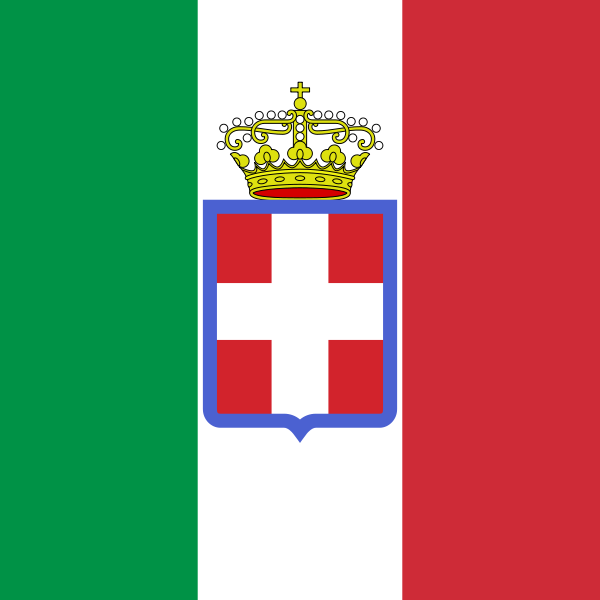
I never like to see a flag-related topic go to waste and today is Flag Day in Italy, marking the day in 1797 when the first Italian Tricolor was adopted by the Cispadane Republic, which later became the Cisalpine Republic which later became the (Napoleonic) Kingdom of Italy. The tricolor was then brought back in the 19th Century by the Italian national movement and again became an official national flag in 1848 when it was adopted by King Carlo Alberto of Piedmont-Sardinia with the addition of the Savoy coat of arms in the center. As such, it subsequently became the national flag of the Kingdom of Italy and, with the removal of the royal arms, has been the national flag of every subsequent Italian government, both Mussolini's Italian Social Republic and the present Italian Republic. Putting politics aside for a moment, I have always found it a simple and attractive design. Why might that be? Possibly because the green-white-red color combination is so familiar to my neck of the woods. It became the flag of independent Mexico after General Agustin de Iturbide (later the first Mexican Emperor) adopted it as the flag of his "Army of the Three Guarantees" (unity, independence and religion) and has been used, with slight modifications, by every Mexican government since. In Texas it was used by more conservative types who opposed full independence but wanted a return to the Constitution of 1824 (hence the famous "Alamo Flag" of a Mexican tricolor with the central arms replaced by the date 1824). In fact, I read at least once that it was proposed that the green-white-red color scheme be used for the current flag of the Republic of Texas to show that Texas came from Mexico unlike the eastern United States which came from the British Empire and stuck with their colors of red, white and blue. Obviously it didn't go through.

I should also point out that the republican officials in Italy today had to go all the way back to 1797 to find the current color scheme being used by republicans and even then, that republic -the Cisalpine Republic- was a French imposition and held sway only over the small portion of northern Italy allowed to them. The tricolor of the Kingdom of Italy, with the royal arms, was the first flag of the Italian nation as a whole since the break-up of the Roman Empire. Therefore, if any version of the Italian tricolor should be celebrated as the symbol of the entire Italian nation it should be no other flag but the royalist flag of the Kingdom of Italy.
1860 Flag of Piedmont-Sardinia
Ensign of the Kingdom of Italy
Flag of the First Mexican Empire
Flag of the Alamo
Proposal for the Texas flag using Mexican colors

Wednesday, December 14, 2011

Mad Rant: Mistreating Flags

As most long-time readers know, I have a bit of interest in what educated people call vexillology (a fancy word for things to do with flags). One of the things that really chaps my hide is the misuse of flags or people who ascribe certain character traits to flags. Of course, it speaks to the immense power of symbols (something monarchists should appreciate) but we must also be careful when it comes to calling something like a flag “evil”. At the end of the day it is a piece of colored cloth on a bit of stick -it cannot speak, it cannot toil nor spin and it certainly cannot hurt anyone. A flag has meaning only insofar as the meaning we, the public, choose to attach to it. I know I am going a little out of the way here, but I am coming to a point eventually I promise. It seems that almost every “First World” country has a problem related to this. In almost every country there are flags that are deemed politically incorrect or even “evil” because the nation or government they represent did something wrong. In some countries this has even resulted in certain flags being banned.

Being born and raised in Texas, I learned in high school what a controversial symbol the Confederate flag was in the United States. The argument over what it ‘means’ still flares up occasionally, though for the most part it is regarded as politically incorrect at the very least and is increasingly scarce. At first, I thought this was a unique situation, but it is not. It turns out that almost every North American and European country have a similar flag. Japan as well, which is really a problem for them as they have only ever had one national flag and it would be hard to imagine anything different. Up in Canada it has lately become the Canadian Red Ensign that has the bad reputation. In Great Britain it is the St George Cross of England and of course in Germany the Nazi German flag is strictly forbidden. Here is where my blood starts to come to a boil. Do you notice anything really wrong with the examples I just gave? Such as, why the hell would the Canadian Red Ensign, the English St George Cross and the flag of Nazi Germany be in any circumstances grouped together? The St George Cross originated in a different era of history and the brave boys from Canada fought under the Red Ensign in wiping out the Nazi German menace.

The problem is the misuse of flags and it seems to be becoming more and more widespread and really, really infuriates me. The most infuriating thing about it is that the regular people and the civic authorities let these malcontents who misuse flags get away with it! Let me calm down and explain: Nazi Germany was an evil regime and pretty much everyone on earth by now agrees on that point. So, the Federal Republic of Germany banned the Nazi flag, which was not and never had been a symbol of Germany or the Germans prior to Hitler gaining power. So, what were the modern, neo-Nazi malcontents to do since their beloved swastika was forbidden? They decided to misuse older flags such as the flag of the old German Empire and in particular the Imperial German Ensign. Now, because of that, many associate the symbols of Imperial Germany with the neo-Nazis. Such an association should be viewed as just as criminal as the flying of the swastika. It is outrageous that this has been allowed to happen. It is beyond contemptible that many now view the Imperial German flags as racist. These flags represented a German Empire in which Jews served in every level of government, the military and achieved great success in society. In some cases, these flags were carried by armies made up almost entirely of Africans, who won great fame, during the First World War. They are NOT symbols of racism.

And, of course, it doesn’t stop there. Only recently a Dutch politician was forced to remove the old, orange-white-blue flag from his office because those colors had been used by the Dutch Nazi Party in World War II and it is now associated with racism and political extremism. Just to be clear, this is the original Dutch flag, used by the old Dutch Republic and known as the “Prince’s Flag” because it bore the colors of the House of Orange. The Princes of Orange were the primary leaders of the Dutch Republic and, of course, later became the Royal Family of the Kingdom of the Netherlands. The modern, red-white-blue design of the Dutch flag became popular because of the influence of the French Revolution but the orange-white-blue design (chosen because they were the colors on the arms of the House of Orange) long predated that design. Just because some Nazis misused the Prince’s Flag is no reason to hand them the victory by considering it to be thus forever tarnished.

I find it even more ludicrous that the St George Cross, the English flag, should be considered politically incorrect today. It dates back to Medieval times as the English national symbol and is meant to represent, for crying out loud, a saint! St George, the gallant, brave knight who killed the dragon and saved the princess (or something like that, I’m sure others know the legend better than I). It is also a very widespread flag design used by people all over the world, English and non-English alike. I am not entirely sure how the English flag ever came to have negative connotations. Such a thing is rather rare for non-historical flags and the St George Cross is still, just as it has always been, the flag of England. Yet, evidently, in these hyper-sensitive times, some people who have been labeled as racist make use of the St George Cross and so it too has become guilty by association. As stated, I am not entirely sure how this association came about or who is responsible for it. It is true, though most would not believe it, that one can be opposed to multiculturalism without being a racist. This seems to be a mostly “First World” problem as it does not ever seem to apply to anyone else. No one views the former colonial peoples of the Third World as racists for wanting to “take back” their country for their own people and drive out all the Europeans -they are viewed as freedom fighters, not racists.

Speaking to that, one could, of course, make the argument that the English flag is evil because as times the Kingdom of England was involved in some rather unsavory undertakings. However, that could be applied to virtually any flag because no nation or government on earth has ever been perfect. Such is why we usually do not allow anyone to expropriate flags currently in use. The United States flag, for example, flew from slave ships, was carried by troops who wiped out the Indians and was carried by the Ku Klux Klan in their mass rallies and parades at the height of their power in the 1920’s. Yet, for most Americans, this changes nothing. They still view the “Stars and Stripes” as a symbol of liberty, freedom and all the best qualities of America. Another, perhaps more interesting, example is the French tricolor. It was the flag of the Revolution (Boo! Hiss!), the Reign of Terror but was also the flag of the First Empire, the July Monarchy, the Second Empire and is still the flag of the French Republic today. Most in France (who are sadly not monarchists) still view it in the best possible light as the symbol of “liberty, equality and fraternity” and, in a wider context, it has been used by so many different sorts of governments that most view it as simply “French” and nothing more, neither good nor bad in itself. If the most vile of racists do or were to wave the French tricolor, I doubt they would be allowed to change the perception of the flag to represent themselves alone.

Yet, when it comes to a flag not in official use, villains can get away with co-opting the colors. The Canadian Red Ensign is, evidently, another example. Again, I know of no formal groups that do so, but apparently some unsavory individuals have taken to adopting the Canadian Red Ensign as their own and have aided in the flag acquiring a rather bad reputation. I have heard it described as the Canadian version of flying the Confederate flag in the United States. In other words, politically incorrect and used by people the mainstream regard as rather villainous. This is particularly outrageous because the Canadian Red Ensign has long been a flag favored by many Canadian monarchists, United Empire Loyalists and those (with whom I am certainly in sympathy) who look back on Canada’s place in the British Empire with great pride and nostalgia.

Without getting into a debate on the reputation of the Confederate flag, to compare the Red Ensign to the colors of the Confederacy seems absolutely ludicrous. There never really was any slavery in Canada at all. The Canadian Red Ensign only came into widespread use after the American Civil War was over, it was never a flag of rebellion or dissent but was the flag of a country which developed and came to independence peacefully with (originally) no animosity but pride and respect for the British Empire it sprang from. The Canadian troops who came charging to the rescue of Great Britain and the other Allies in World War I and World War II carried the Canadian Red Ensign with them and for such people as in The Netherlands for example, the Canadian Red Ensign should be seen as a flag of liberation recalling the Canadian troops who marched in to free them from Nazi subjugation. Some, of course, do and always have objected to it because it is, well, just “too British” what with the Union Jack being on it and all. It’s too “colonial” and reminds them too much of the British Empire. Well, if the truth hurts I am sorry for you, but Canada would not exist today had it not been for the colonial era and the British Empire. That is just a simple fact of history. To allow a few undesirables to tarnish the Canadian Red Ensign is as despicable as their own misuse of it and it is an insult to the proud history of that flag and all who lived, fought and died under it to do so.

To get back to where we started, I am not big on making flags “good” or “bad”. I tend to assume the best as that goes. There are some I dislike of course, the obvious examples as well as others which annoy my monarchist sensibilities. Yet, I also see no point in holding a grudge against an inanimate object like a flag. For instance, I am (as most readers know) a patriotic Texan. When I see the flag of Mexico, I don’t see the flag of the perpetrators of the Goliad massacre or such things, I just see the flag of Mexico, the flag of a neighboring country and a flag that is part of our own history. One of my favorite local flags is the “Alamo flag” which is basically a defaced Mexican tricolor. Today many historians doubt it was the real Alamo flag (we cannot know for sure if it was or even if they had one, primary flag) and I know some who dislike it because it is “too Mexican”. All I see when I look at it is the flag most associated with the Alamo, a critical and heroic page in Texas history and the fact that it is of the same basic design as the flag of Mexico does not bother me in the least. Mexico was where Texas came from, not the United States, and it would be ridiculous as well as futile to try to cover up that fact. It is part of our uniqueness. My simple point is that we should not judge people simply by the flag they fly and we should certainly not judge a flag solely by the people who use or misuse it. Evil people (who are invariably revolutionary republicans by the way) who misuse and tarnish the flags of great kingdoms, royals and empires of the past make me a very, very … Mad Monarchist.

Saturday, August 27, 2011

My Flags

Having discussed this with some others, I thought I would list here some of my flags, in case some might find it of interest. I have long had an interest in what the educated folks call vexillology. Flags have a way of inspiring strong emotions in people that has never ceased to amaze me. Since I have a great many I will list here only those I have large enough for display outdoors (though at least a couple of them were not made durable enough for that) and with a few exceptions are 3’x5’.

The Grand Union Flag: This is the only American flag that I own and I fly it on those occasions in which I feel compelled to. There are a few misconceptions about this one. It was never an official flag of the United States as it was only used prior to the declaration of independence. However, it was the first flag to represent the thirteen colonies as a whole or the ‘American nation’ when they were still fighting simply for a redress of grievances while remaining within the British Empire. It was also the first American flag to ever fly over foreign soil in the brief capture of Nassau, Bahamas.

The Republic of Texas: This is the one that sees the most service and is the one that can usually be seen flying over my home. It is the flag of my country as I am one of those stubborn few who still adheres to the old idea of state sovereignty. So long as Texas adheres to the Union, I adhere but that is as far as it goes. It has been the official flag of Texas since December 10, 1836 though the basic symbol of the “Lone Star” is much older. Obviously not a monarchist flag, but nonetheless the symbol of my home and native land. As we say, “I’m Texas born, Texas bred and when I die; I’ll be Texas dead!” I’m also one of the few, even among Texans, who can sing the first two verses of the Texas national anthem, “Texas, Our Texas”.

The De Zavala Flag: Reading about this one always makes me laugh because someone will inevitably declare that this flag is a "myth"! Does that mean the one I own does not really exist? Silly. Of course it is no myth, it exists -I can hold it in my boney, nicotine-stained fingers. Whether or not it is an accurate depiction of the design suggested by Vice President Lorenzo De Zavala in 1836 I don't know, but it certainly exists and did at the time as well as the basic design, a blue field with a lone star, was quite common as were various words or mottos displayed on flags, the most common being "Texas" or "Independence". In any event, the historical facts regarding it are of little importance to me, I just think it is a nice design and it does quite well to convey my feelings to those passing by concerning the subject of Texas and our relationship with the Union.

The Confederate States of America: Here is one always sure to cause controversy. Some love it, some hate it and some hate anyone who would even display it. Well, for those, you’ll have to take a number and get in line, there will be quite a long wait. I also have the more familiar ensign but I prefer to fly this one, the third and last national flag of the Confederacy. I own it out of principle, my country voluntarily adhered to the Confederacy and was involuntarily forced back into the Union, which rather annoys me. It is not, I assure you, intended to show any support for racism or slavery. In fact, the nearest county to mine that existed at the time of the war voted unanimously in favor of secession and it had not a single ‘White’ resident at the time. I usually fly it on occasions when I am especially annoyed with the federal government in Washington. Tax day immediately comes to mind.

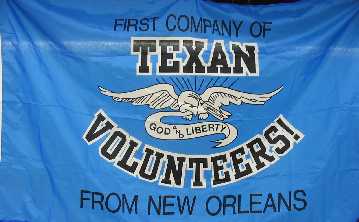
The New Orleans Greys: This one takes me back to my “Living History” period many years ago. The New Orleans Greys were two companies of volunteer militia from the United States (though it included members from Europe as well) which came to Texas in 1835 to aid in the War for Independence. They were ultimately wiped out almost to a man at the Alamo and the Goliad Massacre. This flag was presented to the first company by the ladies of Nacogdoches, Texas and flew at the Alamo where it was captured by Santa Anna and sent back to Mexico as a war trophy. Back when “W” was governor he tried to get it back, offering to exchange it for one of the Mexican flags captured at the battle of San Jacinto but Mexico said “no”. This has led some to think that the Mexicans either lost it or allowed it to deteriorate completely.

The Spanish Empire: This was the ensign of the Kingdom of Spain from 1785 to 1931 but, around here at any rate, is known as the Spanish imperial flag and can be seen in the more accurate displays of the Six Flags of Texas to cover the centuries during which Texas was part of the colonial empire of Spain. I bought it because of that, the Kingdom of Spain being the one monarchy Texas was longest associated with and though it does not see the light of day very often I do fly it occasionally on days significant to the Kingdom of Spain or just to cause annoyance on the sixteenth of September. What can I say? I’m a pain.

The Cross of Burgundy: I own this flag for much the same reason as that above. It was widely flown in the Spanish colonial period, though the only place I have ever seen one still flying today was at Mission San Jose near San Antonio. It is pretty rare and I was surprised to find one at my usual flag store and had to grab it immediately. I have never actually flow it though because it is significantly smaller than the rest and would not fit my flag pole. However, I like the flag, I like what it represented and it was also commonly used by the Carlists and the (historic) Carlist cause is one I have great sympathy for. Let us not, however, get into the debate again over those still using the name today.

The Cross of St George: This one I did not buy but was given to me as a gift by an Englishman. In fact, the first time I met this friend of mine ‘in the flesh’ he had this flag wrapped around him so he was certainly hard to miss. I like the English flag, I do not like the rather negative reputation many have attached to it today. It is also a part (one of many) of my ancestry and having had ancestors who fought for the King in the English Civil War it seems only appropriate to have an English flag. Alas, if it has ever been flown it was only briefly (I can’t really remember) as it was one of those not made for outdoor use but more for hanging on a wall inside.

The Dominion of Canada: As I have said before, I do prefer the old Canadian Red Ensign but I have nothing against the current design. I purchased this flag during my first visit to Canada (indeed the first time I had ever visited an existing monarchy) which was close to Dominion Day (aka Canada Day) and so a lot of Canadian paraphernalia was to be found in the stores. I also flew it the first time the friends I was there to visit came down to Texas. However, I don’t think it was made for extended outdoor use and in any event, given the odd shape of the Canadian flag compared to most, was not a perfect fit for my pole. It could be done but was bubbled a little in the center so was not exactly at its best. I do have some family in Canada as well, I’ve never met them and they live on an Indian reservation but -there’s that anyway.

The German Empire: I don’t recall what prompted me to buy this flag but it was a disappointment in any event. We will blame it on the German percentage of my ancestry and if I am going to have a German flag it was going to be the German Empire and not the republic and if it is going to be an Imperial German flag it was going to be the ensign as I just think it is much more attractive than the civilian flag. Anyway, when it actually arrived it was, again, a great disappointment. It was one of those printed versions and something must have been askew in the printing process as the colored portions in the central arms were almost all missing, so there is a cross but no orb, a tongue but no beak and so on. It just looks terrible. I did fly it once but it was not made for outdoor use. It also has some blood stains on it as I had it in my truck when I was in a bad accident and nearly broke my neck.

The Kingdom of Italy: This is my latest addition, which I bought this year to mark the anniversary of Italian unification. If I am going to fly the flag of Italy it is going to be the flag of the Kingdom of Italy and not the current dysfunctional republic, whose blank tricolor is just boring anyway. It was not made for extended outdoor display, which is probably just as well as down here it would probably just confuse people who would think it was some sort of version of the Mexican flag. Also, as with just about every Italian flag made outside of Italy the shade of green used is not quite correct. But, it serves its purpose and I like a flag with a crown on it in any event.

The Holy See: I do not remember the exact occasion I first bought this flag for but I do remember I had a hard time finding it at the flag store. I looked under “V” for “Vatican City”, then I looked under “P” for “Papal flag” and finally even looked under “C” for “Catholic Church” only to still find nothing. Finally I asked the clerk and it was quickly located, of course, under “H” for “Holy See”. Anyway, as the symbol of the tiny State of Vatican City it is the flag of the last Christian absolute monarchy in the world so significant for that at the very least. I do not often display it but it has been flown on Vatican “independence day” (the day the Lateran Treaty became official) and possibly some other days of papal significance.

The Principality of Monaco: Ever since buying my first Monegasque flag (whenever that was) I have always wondered if they didn’t lie to me and sell me an Indonesian flag instead. I may never know. The red and white come from the coat of arms of the House of Grimaldi which dates back nearly to time immemorial but the national flag was officially adopted by HSH Prince Charles III on April 4, 1881. Since I was knee-high to a duck the Monegasque monarchy was always most prominent in our home, no doubt because of the influence of the late, beloved Princess Grace, who caused a craze for monarchy and Monaco in particular across the United States. Ever since then, in our house at least, the Princely Family, being half-American, was seen as partly our own and it is from that, I suppose, that my fascination with the very long history of Monaco and the Grimaldi dynasty grew. I fly it on every significant Monaco-related occasion, be it National Day or any date significant to the Princely Family.

The Kingdom of France: Finally we come to the French. This flag I have had for quite a while and is probably the most common French flag one will see in my part of the world. I bought this flag both for my admiration for the ancien regime and because it is one of the Six Flags of Texas, during that brief period when we were claimed by King Louis XIV. That claim was made by La Salle with whom there is some local connection and while the blue flag with the three lilies is also often seen, it is the white flag that I have always preferred. I make it a point to fly this flag at least once a year, naturally on Bastille Day.

There are a few others on my 'list' to get that I just havn't gotten around to picking up yet, but I'm sure I've gone on long enough now on a subject of interest to very few if any. Moving on then...
Related Posts Plugin for WordPress, Blogger...