Showing posts with label cavalier. Show all posts

Monday, September 24, 2012

Monarchist Profile: Arthur Capel First Baron Capel of Hadham

Baron Capel was one of the top royalist commanders of the Second English Civil War. He was born on February 20, 1608, the only son of Sir Henry Capel of Rayne Hall in Essex and his wife Theodosia Montagu, daughter of the highly esteemed Sir Edward Montagu of Broughton Castle. He attended Queens’ College in Cambridge and in 1627 married the heiress Elizabeth Morrison which brought him considerable wealth. He gained still more from inheritance after the death of his grandfather in 1632, to the extent that he was then one of the richest men in England with holdings in ten counties. Capel put his wealth to work for him in getting involved in politics and he was elected to the “Short Parliament” in April of 1640 as MP for Hertfordshire. In November he was reelected to the same seat in the “Long Parliament”. During that time, few would have taken him for an ardent royalist as he delivered numerous criticisms of royal policy and the actions of King Charles I to pursue his own course of action regardless of the obstacles Parliament tried to put in his way.

In fact, Capel was the first MP to deliver a county petition protesting royal actions and he voted in favor of the execution of the Earl of Strafford. In that case, however, he seems to have had misgivings as he stated later that he regretted it for the rest of his life. By the summer of 1641 Capel had begun to be alarmed at the radical direction Parliament was taking. He had protested against certain things the King had done, but he saw Parliament increasingly setting itself against the King himself and this he found deeply disturbing. King Charles I was, by that time, in need of friends and someone with the wealth of Capel would be a valuable ally indeed. As he already seemed to be drifting away from the Parliamentarians, the King made a friendly overture to him in August of 1641 by raising him to the peerage as Baron Capel of Hadham, giving him a seat in the House of Lords. Lord Capel was seen to be firmly on the royalist side when he voted against the Militia Ordinance which was effectively an effort by Parliament to take control of the armed forces away from the King. When the First English Civil War broke out, Lord Capel put his money where his mouth was and raised and outfitted a cavalry regiment. In October of 1642 he fought in the Battle of Edgehill as a member of the King’s lifeguard.

Even though Lord Capel had absolutely no military experience prior to Edgehill, his standing earned him an appointment to command all royalist troops in north Wales, Cheshire, Shropshire and Worcestershire with the rank of lieutenant general though at least Sir Michael Woodhouse, an experienced veteran, was sent along with him. Lord Capel was certainly not lacking in bravery, audacity or devotion to his cause but he had the misfortune to be up against some of the better commanders of the Parliamentary forces. Capel came under attack by Sir William Brereton and despite some daring maneuvers and bold attacks, Capel was checked at every turn and became the object of some ridicule in the area, at least among those predisposed toward the forces of Parliament. Finally, at the urging of Prince Rupert of the Rhine, Lord Capel was replaced by Lord Byron in December of 1643. He spent most of the next year at court with King Charles I before next being assigned to the commission that discussed the Uxbridge Treaty of 1645 proposed by the Parliamentarians and the Covenanters of Scotland. There was little chance of this being accepted and it was not so Lord Capel moved on to serve on the Council of the Prince of Wales at Bristol where he formed two regiments, one of infantry and the other of cavalry, to serve as the Prince’s lifeguards.

When the western royalist forces surrendered in 1646 Lord Capel went with the Prince into exile on Scilly and then Jersey but the two parted company when the Prince of Wales went to France to join his mother Queen Henrietta Maria. Lord Capel had been invited to go along of course, but did not because he was uncomfortable around the very Catholic entourage of the Queen (not an uncommon sentiment at the time). In 1647 he returned to England and waited on the King who was being held prisoner at Hampton Court. All the while, Lord Capel, along with other royalists, was constantly involved in the effort to gain support for the King and especially to get the Scots to come on side for another effort at defeating the forces of Parliament. Ultimately, this led to the outbreak of the Second Civil War. In 1648 Lord Capel was charged with leading the royalist uprising in East Anglia. He joined with the troops loyal to the King at Chelmsford in Essex in June but they were pounced on by the Parliamentarians under General Fairfax who chased them to Colchester. Lord Capel commanded the rearguard that held off rebel attacks while the army fell back to the city.

Following the siege of Colchester, the city surrendered in August and Lord Capel was taken prisoner. Confined first at Windsor Castle and later the Tower of London to await trial, the intrepid Baron accomplished the remarkable feat of escaping from the Tower. He hid out for several days but was finally betrayed by a boatman hired to take him to a royalist safe house in Lambeth. In February of 1649, with four other prominent royalists, Lord Capel was taken before the “High Court of Justice” and sentenced to death as a “traitor” for remaining loyal to his King and country. Alongside the Duke of Hamilton and the Earl of Holland he was beheaded outside Westminster Hall on March 8, 1649. He had paid the ultimate price for his heroic loyalty but, in time, his sacrifice was recognized. After the restoration of the monarchy, King Charles II restored all confiscated lands to his family and made his eldest son Earl of Essex.

Wednesday, December 7, 2011

Monarchist Profile: Colonel John Penruddock

John Penruddock was an English royalist, most known for his leadership in a royalist uprising in 1655. The courage and loyalty of the cavaliers of the civil wars is fairly well known, but less well remembered are those brave and bold few who carried on the struggle during the years of tyranny under Oliver Cromwell. John Penruddock was born in 1619 and hailed from Compton Chamberlayne, a small village in Wiltshire near Salisbury. A loyal man, greatly attached to King and Country, had events not overtaken him there would surely be no mention of him in history. After reaching adulthood he married Arundel Freke, the daughter of John Freke, Esq. of Shrewton, Dorset and settled down to domestic life having two sons (George and Thomas) and four daughters (Elizabeth, Joan, Mary and Anne). In 1648, with the passing of his father, Sir John Penruddock of Compton Chamberlayne, the younger John inherited the family estate. By that time, of course, the first civil war had passed and the second was raging. John was firmly on the side of his King but, alas, it was not the side destined to win. King Charles I was treacherously executed and the military dictatorship of Oliver Cromwell was firmly set in place.

An ardent royalist, John Penruddock was a prominent member (though not one of the founders) of the monarchist secret society known as the Sealed Knot. The Sealed Knot worked clandestinely during the rule of Cromwell to bring about a restoration of the British monarchy. During the interregnum they made some eight attempts to bring down the Cromwellian regime and restore King Charles II to his rightful throne. Of these, the most famous was the Penruddock Uprising of 1655. Colonel John Penruddock was not the sole leader of the campaign, nor did he alone originate the plan for the rebellion but his part in the enterprise was the most comparatively successful and thus his name has gone down in history as that of the attempted rebellion as a whole.

The Sealed Knot planned to take key cities in England and instigate popular rebellions in other areas simultaneously after which, it was hoped, a general uprising would be sparked, Cromwell driven from power and the Stuart heir restored to the throne of his martyred father. The initial cities that were to be taken were Salisbury, Newcastle, York and Winchester with subsequent rebellions hopefully incited in Nottinghamshire and Cheshire. It was all supposed to happen in March of 1655. However, there was a snag before things had even gotten underway when more troops of the devastatingly effective “New Model Army” were sent to Winchester just before the uprising was to take place so efforts to secure that city had to be given up. Rattled by this setback, some people began to have second thoughts about their chances for success and when the call went out in Cheshire to rally for the Crown, no one came out. Those who did take to the field for the cause of their King were disheartened by how few they were. Even some of the leadership began to waver at what seemed to be a lost cause. One by one the groups disbanded and went home. Penruddock, and the group he was responsible for at Salisbury, however, did not.

Colonel Penruddock and Sir Joseph Wagstaffe gathered their fellow royalists, roughly three to four hundred men, and on March 11 marched in and occupied Salisbury, raising the Stuart Royal Standard. Despite a lack of success elsewhere, Penruddock was determined to go forward and on March 12 led his troops out of the city and marched west, passing through Blanford, Sherborne and Yeovil. He hoped to gather strength as he went but few volunteered. Even many who were sympathetic would not join a cause they judged doomed to defeat. On March 14 Penruddock and his little army arrived in South Molton in Devon where they were confronted by a horse troops of the New Model Army led by Captain Unton Crook. For three hours the royalists and roundheads fought in the streets before the superior training and professionalism of the New Model Army troops prevailed over the civilian volunteers of Penruddock. The royalist forces broke, many being killed, some managing to escape. Penruddock and the other leaders, however, were all taken by the parliamentary forces.

Immediately afterwards, Oliver Cromwell appointed Sir Hugh Wyndham as judge on a special commission to punish those responsible for the royalist uprising. As the primary leader of the effort, the fate of Colonel John Penruddock was never in doubt. He was executed, by beheading, at Exeter in May of 1655. The other leaders were beheaded as well with the remainder captured royalists being sold into slavery in the West Indies plantations. Still, his memory lived on as the leader of one of the few real domestic challenges to the rule of Cromwell and one of the more colorful episodes of the resistance during the interregnum. Control of the Penruddock family estates passed first to John’s eldest son George and upon his death in 1664 to his younger brother Thomas Penruddock who later served as a Member of Parliament for Wilton when the King enjoyed his own again.

Monday, June 20, 2011

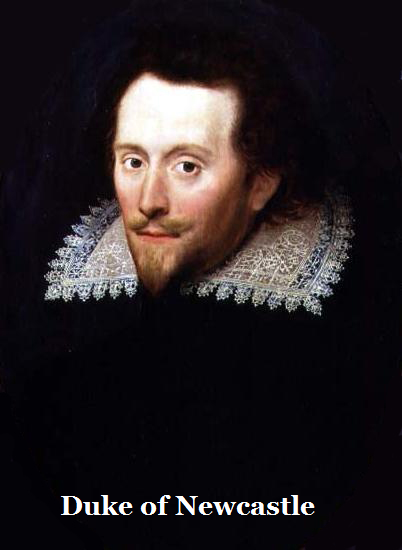
Monarchist Profile: William Cavendish, Duke of Newcastle

William Cavendish, First Duke of Newcastle-upon-Tyne, was one of the leading royalists of the English Civil War. He was born at Handsworth Manor in Yorkshire to Sir Charles Cavendish and Catherine Ogle. He grew up at Welbeck Abbey with his younger brother Charles with whom he was very close. Intelligent and curious, as he grew up he showed himself to be something of a ‘Renaissance Man’ dabbling in a number of fields from architecture to poetry and diplomacy and politics to the art of warfare. He attended St John’s College in Cambridge and when Prince Henry Frederick became Prince of Wales in 1610 William Cavendish was made a Knight of the Bath. He dabbled more in the diplomatic field as he traveled with the English ambassador to the court of the Duke of Savoy and upon his return Elizabeth Bassett, widow of the First Earl of Suffolk. He inherited a considerable fortune in his turn and became close friends with both King James I and later King Charles I.

He used some of his vast wealth to help King Charles fund his wars in Scotland which served as a prelude to the English Civil War, in which he was quick to cast his lot with his King. In 1628 Charles I had created him Earl of Newcastle-upon-Tyne and there was no doubt that his prestigious position would warrant him a top command in the Royalist army. Some, then or since, argued that Cavendish was not a military man, though he had military experience and that he was not suited to a command position. However, if the Earl lacked a total mastery of warfare he made up for this by surrounding himself with expert veterans such as Sir Marmaduke Langdale and George Goring. Using his own money he raised his own troops, equipping and maintaining them at his own expense. One troop, known as the ‘whitecoats’ became quite famous over the course of the conflict. From Newcastle upon Tyne he was called back to York where the Fairfax father and son were harassing the local cavaliers (royalists). His attack on Fairfax was repulsed but Fairfax was still forced to retreat and Cavendish secured the area for the King for the remainder of the war.

One of the benefits of the occupation of Newcastle had been that the Earl was able to keep open communications with Queen Henrietta Maria in France and he also oversaw the importation of supplies from the continent through that area to aid the royalist cause. In 1643, having returned to York, he was joined for a time by the Queen in person and also gained the highly esteemed soldier, James King, as his second-in-command. On June 30 at the battle of Adwalton Moor he defeated a smaller parliamentarian force under Lord Fairfax, securing all of Yorkshire and even capturing Fairfax’s wife, whom he gallantly let pass through the lines to join her husband. At Gainsborough the arrival of his forces helped the royalists win the day but he failed to follow up the victory and ignoring orders to march on London diverted to besiege Hull, in what was probably his greatest mistake, and the result was a total defeat for the royalists.

Setbacks such as that were always an occasion for others to call into question the military ability of the Earl of Newcastle and, by most accounts, he did not react well to these, being rather quick to take offense. In 1644 his problems were doubled when the Scots entered the conflict on the side of Parliament and he had to deal with both the Scots and the refurbished forces of Lord Fairfax. He made some progress against the Scots initially but was forced to fall back to defend York which was soon besieged by superior Parliamentary forces. Still, he had prepared his defenses well and determined to hold out until a relief force under the “Mad Cavalier” Prince Rupert could arrive. Fairfax tried to block the Prince but he slipped by him, reached York and the city was saved. However, the prickly Newcastle had taken offense at some of the communications sent by Prince Rupert and some attribute this to his slowness to respond to the build-up for the battle of Marston Moor.

In that engagement, Newcastle fought fiercely, taking out several enemy soldiers himself in close combat, but abandoned the field once all seemed lost and his famous ‘whitecoats’ were virtually annihilated. Still fuming about what others were saying about him, in the aftermath he handed the King his resignation and went into exile in Holland. This was a disaster for the royalists as many gave up hope after the departure of Newcastle and defected to the Parliamentary side. Once in exile he resumed his previous peacetime pursuits and eventually settled in Antwerp where he remained until the restoration of the Stuart monarchy. After that happy occasion he was compensated for his financial losses, restored to all his previous posts by King Charles II, given the Order of the Garter and promoted to the status of First Duke of Newcastle-upon-Tyne. He died at Walbeck Abbey on Christmas Day in 1676 and is buried in Westminster Abbey.

The Duke of Newcastle was certainly no Marlborough or Wellington, however, the efforts some have made to portray him as a complete incompetent are grossly unfair. He was of invaluable service to the royalist cause, won a number of important victories and if it could be said that he did not ‘play well with others’ the same could be said of many other men on both sides in those days when egos were large, pride easily wounded and dueling fairly common. More inclined to literary and artistic pursuits than anything else, Newcastle was a true conservative. He cared nothing for politics or ideology but knew simply that his first loyalty was to his King who was also his friend. It was that personal relationship that mattered most to him and it was that bond that he fought for to the best of his ability and he deserves to be remembered for that.
Related Posts Plugin for WordPress, Blogger...