Showing posts with label Siam. Show all posts

Thursday, September 14, 2017

The Siamese in the Great War

Most people, outside of the country itself, probably have no idea that the Kingdom of Siam (Thailand) was a participant in the First World War. This is not too surprising given that the Siamese contribution was necessarily limited but the southeast Asian kingdom was a member of the Allied nations and, unlike some who declared war simply as a symbolic gesture, Siam actually participated militarily. World War One brings to mind the trenches and cratered landscape of Belgium and France but it was a global affair and Southeast Asia was actually fairly well represented in the conflict. Forces from French Indochina (Vietnam, Cambodia & Laos) participated on the Salonika and Western Fronts for example, the British had a potentially dangerous mutiny by Muslim forces on their hands in Singapore (dealt with by the Japanese) and so on. The Kingdom of Siam, like many others frankly, had no real reason to get involved given that Germany, Austria-Hungary, Bulgaria or Turkey had done them no harm but it was considered that participation would bring real benefits to Siam both domestically and on the world stage.

King Vajiravudh
The driving force behind the Siamese intervention was King Vajiravudh (Rama VI). This was when Siam was still an absolute monarchy but the King was not as all-powerful as he seemed from the outside. It was a time of great energy, hopes and aspirations for Siam and the King who was British-educated and who, after graduating from Sandhurst, was briefly an officer of the Durham Light Infantry in the British army. He thus had personal ties which made a totally dispassionate view of the First World War impossible. Which is not to say that he allowed personal attachments to cloud his judgment; far from it. He was very displeased with a recent treaty signed with the British which had seen Siam cede territory in the south to the British in what is now Malaysia. He valued his education and wished to see the same sort of education made available to his people but he was still annoyed at the unequal treaties Siam had made with numerous powers and the special privileges these allowed them, particularly France and, yes, Great Britain. He also faced internal threats to his authority and perhaps even the monarchy itself.

The collapse of the imperial system in China and the abdication of the Qing Dynasty in 1912 was a momentous event in world history that is generally not treated as such. However, it was positively earth-shattering and sent tremors all throughout east and southeast Asia, including Siam. A group of dissident army officers conspired to launch a military coup and abolish the monarchy, pledging to make Siam a constitutional democracy. Thankfully, word of the plan leaked to the authorities and they were arrested, tried and sentenced to death or life in prison. King Vajiravudh, however, wishing to appear strong and magnanimous, released all of them on the grounds that their intentions had been good in that they believed they were acting in the best interests of the country. Given what these men had said about the King personally, this had to be very difficult but for the King it underscored the need for greater national unity and to strengthen the monarchy. Many in Siam still had the mentality of the past when most of Siamese history was dominated by palace intrigue, family feuds and wars between rival city-states. King Vajiravudh wanted to usher in a new era of Siamese nationalism, place the kingdom on an equal footing with the other countries of the world and to bolster the power and prestige of the monarchy in the process.

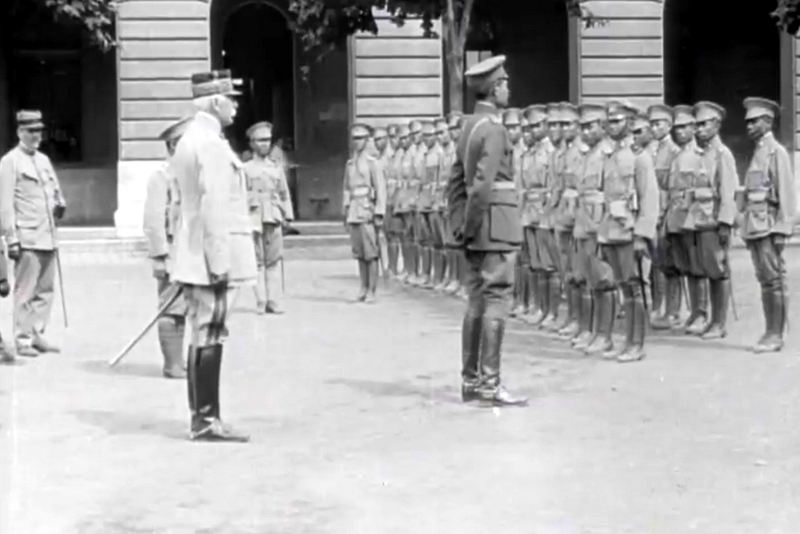
French general inspects Siamese troops
The First World War was seized upon as an opportunity to do all of these things. The war itself was, of course, an absurdity that never should have happened and many still fail to grasp this, insisting that the problem was the wrong side won when the problem was that the war happened at all. However, the hopes of King Vajiravudh are at least understandable. By intervening in the war, he hoped to have a cause to rally his people around the monarchy and the First World War was the biggest cause going at the time. It would mean that the Kingdom of Siam was participating in the pivotal event in world affairs at the time and would give Siam leverage against its neighbors, the British and French colonial empires, to redress grievances in the future Siam had with both. Many in Siam were still annoyed, for example, that France had taken into its empire Laos and Cambodia which Siam regarded as vassal states of their kingdom. By intervening in a conflict which was an existential threat to Britain and France, particularly with no vital need to do so, Siam expected to gain greater moral authority in dealing with these two powers. Likewise, as the King issued the declaration of war in the summer of 1917, it could be expected that the war would not last for much longer anyway.

The King called upon all of his people to unite behind this cause, to take their place as a participant in world affairs and even adopted a new national flag using the red, white and blue colors of the major Allied nations. The three colors, as announced in Siam, were to represent a new national unity of 1 people, 1 faith and 1 king. As the Siamese Expeditionary Force was assembled, more people actually volunteered than could be accepted. As it was, Siam could, of course, only afford a relatively minor force of mostly support personnel with medical and transportation contingents as well as air forces though these would have to be trained by the French. The SEF, under the command of Major General Phraya Bhijai Janriddhi, landed at the port of Marseilles on July 30, 1918 about 1,300 strong. While the pilots and air crew were set off for their new training, the general observed the operations of the other Allies to gain some experience in how things worked and, not too surprisingly given the times, the first use of the Siamese was when a contingent was organized into a labor detachment.

SEF Battle flag was a hybrid of the old & new designs
By September, the Siamese forces started to be actively employed at the front with combat units being filtered into the line and the medical and transport personnel being engaged in the Meuse-Argonne Offensive. None of the air personnel finished their training in time to participate before the November armistice but those units on the ground who did see action acquitted themselves quite well. Their involvement was not extensive but they had been involved and earned their place in the victory parade in Paris when the war was over and a detachment participated in the Allied occupation of the Rhineland. Losses had been extremely light with only 19 casualties. The Kingdom of Siam was present for the Versailles peace negotiations, not that it mattered much, and was one of the founding members of the League of Nations (again, not that the League ultimately mattered much). The Siamese contribution to the war had been limited and only for the closing months of the conflict, was inexpensive in terms of lives lost and had earned Siam a place among the victors when it was over.

However, the overall results of Siamese participation in the Great War were somewhat mixed. At the outset, it seemed to have achieved all that the King had hoped. They had been a part of the great event of the time, were on the winning side, the prestige of the monarchy had gone up and there were some benefits to found. Siam got to keep the German ships they confiscated at the outset and within seven years the British, French and Americans had all given up their extraterritorial rights in Siam. However, in the long-term, these benefits could be seen as inconsequential or of limited duration. The ensuing economic collapse hit Siam hard and internal divisions, which the King had hoped to eliminate for good, soon reappeared and, to some extent, have become a mainstay of Thai politics. The financial crisis caused Siam to go into debt to the British which, in a way, could be seen as offsetting the new equality gained by Britain giving up her extraterritorial rights. All of this stress also benefited the dissident crowd and soon those advocating for a constitutional monarchy were back. King Vajiravudh would not live to see it but his successor, his younger brother King Prajadhipok, would go down in history as the last absolute monarch of Siam, the result of the Revolution of 1932 and the only king of Chakri dynasty to date to abdicate the throne.

Wednesday, June 7, 2017

Movies, Monarchs and a Lesson from Thailand

Recently I have been watching the Thai historical film series “The Legend of King Naresuan” which started rolling out in 2007, the last chapter in 2011. The three films were grouped together for American distribution into two chapters under the name “Kingdom of War”. If the third has ever been made available overseas, I have yet to come across it. These films were written and directed by HSH Prince Chatrichalerm Yukol and tell the story of the famous Siamese monarch King Naresuan the Great of Ayutthaya. They can also be seen as something in the way of a sequel to his earlier lavish epic “The Legend of Suriyothai” which tells the story of Siam’s most famous queen; Queen Suriyothai of Ayutthaya. That film was the largest and most expensive production ever mounted by Thailand and “The Legend of King Naresuan” has gone considerably bigger than that piece. This is not a film review but I would say they are excellent movies though probably will not please everyone, certainly foreign audiences. Each are very epic in scope, no expense spared, visually stunning, engaging and a spectacle to behold. They both also have a huge number of characters, a great deal going on simultaneously so that foreigners in particular will probably have a hard time keeping track of everyone and everything going on, certainly if you are not familiar with the names and places.

What I think other royals could stand to learn from the Thais on this front is making use of film to tell the story of their own most significant ancestors. As stated, these are films made by a member of the Thai Royal Family about two of the most famous monarchs of Siamese history. As such, and because the Thais have not adopted the liberal habit of being too proud to take their own side in a quarrel, they are extremely positive films, not simplistic but certainly films that know what they are about and whose side they are on. As with many Thai historical dramas, the kingdoms of Siam are the “good guys” and the kingdoms of Burma are the “bad guys”. They are spectacles of great royal figures from history who led their people in great struggles and as such are not at all like the historical films that tend to be made in the liberal west where, other than World War II which is, of course, sacrosanct, films often tend to show as much, if not more, sympathy for the “other” side than for the home team. Whether they are the type of thing that would be of interest to readers here or not, the spirit that drives them is one I would very much like to see emulated in the monarchies of Europe.

Lately, I have felt more and more compelled to try and remind people from European countries in particular just how much they have to be proud of and how much greater they are capable of being than simply another province of the European Union. European monarchies have done films that are somewhat in the same vein as these but they often seem to get stuck on certain figures and so we have numerous films about Queen Elizabeth I of England or Napoleon Bonaparte but nothing about others. Many have also been made by people openly hostile to their subject and none have been made by royals or royal relatives themselves. In English history the nearest thing are the films done on Shakespeare’s plays about Henry V but one could make a great epic film about Henry V without re-doing Shakespeare. A film about King Edward III would be magnificent if done properly. King St Louis IX of France, King St Ferdinand III of Castile, Charlemagne, Emperor Otto the Great or Frederick Barbarossa for the Germans would all be excellent topics and highly entertaining I would think.

A World War I film focused on King Albert I of the Belgians seems sorely lacking to me, the colorful history of the Princely Family of Monaco would alone offer numerous potential topics given all of the war, drama and romance that has characterized the House of Grimaldi over the centuries. Yes, there was that recent film about Princess Grace and Prince Ranier but constitutional reform and tensions with France is hardly as entertaining as would be watching Rainier II raiding English shipping in the Channel, ransoming the Isle of Wight and fighting at the Battle of Poitiers. Jean I of Monaco would also make for a very entertaining film with his naval battles, efforts to smuggle a Byzantine emperor, betrayal and the defense of Monaco by his wife Pomelline Fregose while he was held prisoner by the Savoyards. The Dutch could make quite a film about the life of Maurice of Nassau, the Swedes about Charles XII or Gustavus Adolphus. With the Kingdom of Denmark being the oldest monarchy in Europe, it pains me that the only film I’ve seen about a Danish monarch was the one who was dismissed as insane. There is plenty of material to work with!

The point is that there are tremendous tools available to glorify the dynasties of the world and any number of great stories to tell that would fill people with pride and confidence in their royal houses and in their national history. It is no good waiting for others to do it for you. This is also something that has come up recently in Thailand as a Thai historical drama has come under criticism by the Burmese for how they are portrayed which is, in the context of virtually any story about the history of Siam, as the villains. This is silly and a waste of time. Years ago when the very well made but historically atrocious film “The Patriot” came out, I was quick to point out its flaws. However, even I, Tory at heart that I am, was rather annoyed by the criticism from the British about how they were portrayed in the film. Such criticism was certainly not unwarranted, I made it myself, but if you are British, you should not be counting on the Americans to tell your side of the story. There should, rather, have been a British film about the war in America in which the Americans were the “bad guys” and the British were the heroes. Likewise, Burma should not complain about how they are portrayed in Thai television, but make their own television drama showing their side of the story.

Naturally, there will be plenty of excuses as to why this is not possible. Usually it comes down to money and the complaint that no one can match the big budgets of Hollywood productions. I say, that is no excuse. The British Royal Family is not without means and royals on the continent might try asking the Prince of Liechtenstein for a loan. If the Dutch can make a quality historical drama about the republican naval hero Michiel De Ruyter, and they have, there is no reason why they cannot make just as quality a film about one of the Princes of Orange or any Dutch monarch. Where there is a will, there is a way and if the Kingdom of Thailand can do it, I see no reason why any other monarchy cannot do the same. I for one, would certainly like to see it.

Thursday, October 10, 2013

Consort Profile: Queen Suriyothai of Siam

One of, if not the, most famous royal consorts in Thai history is undoubtedly Queen Suriyothai of Siam from the Ayutthaya period of Thai history. Her fame is certainly well deserved and derives from her wisdom, her courage and her devotion to both her country and her family. In the person of Sri Suriyothai the Kingdom of Thailand has a warrior-queen to match the Trung sisters of Vietnam, Isabella of Castile, Eleanor of Aquitaine or Boudica of the Celts. Sri Suriyothai displayed prudent judgment and compassion balanced with an ability to make hard decisions in hard times on the political front and, when the greatest crisis of war came, she was not afraid to strap on her armor, mount her war elephant and go charging into battle. A stupa reliquary was built for her after her death and to this day she remains one of the greatest heroines in Thai history. In 2001 she even became the star of her own biographical film, “The Legend of Suriyothai” which was the most expensive Thai film ever made up to that time and partly funded by HM Queen Sirikit. Her story is certainly one made to order for anyone enthralled by drama, intrigue, romance and the clash of arms as well as by figures truly worthy of admiration.

Pimolrat Pisolyabutr as Suriyothai
No documentation of the early years of Queen Suriyothai have survived to the present day. In fact, only a few lines concerning her ultimate fate at the climax of her life have been handed down to us. Exactly where or when she was born is unknown. Because of this lack of hard facts, there has been the freedom for numerous legends to grow up around this iconic royal consort. One of the most popular is that she was of minor royal rank who, despite loving another prince, was married to the future King Maha Chakkraphat. Such a story may or may not be true but, if so, it certainly underlines the immense sense of duty Queen Suriyothai felt to be so devoted to a husband who was not her first choice and who she never completely loved. If it is not true, the later events of her life would seem to provide concrete evidence of just how deeply connected she felt to her royal husband. It is also supposed, and evidence would seem to support this, that Queen Suriyothai was a very strong and independent-minded woman. Given what we do know about her, this fits perfectly with the image of her character. She was a woman who was firm in her opinions, adept at seeing to the heart of matters, strong in her convictions and sense of duty as well as being immensely courageous.

To put Queen Suriyothai in a bit of context, throughout much of this period the Kingdom of Siam or Kingdom of Ayutthaya (as it is sometimes called, after its capital city) was the dominant power in Southeast Asia. At its peak, the kings of Ayutthaya ruled over all of what is today Thailand, Laos, Cambodia, parts of southern China, northern Malaysia and a considerable slice of eastern Burma. In Vietnam the Le Dynasty was about to give way to the Mac Dynasty and was in a great deal of turmoil which left the Kingdom of Burma as the primary rival in the region to Ayutthaya. In the early 1500’s the Toungoo Dynasty was starting a period of success and expansion that would create a Burmese empire stretching across Southeast Asia. Conquest was the order of the day and Burma was rapidly becoming the most militarily powerful force in the region. The story of Queen Suriyothai also fits in quite well with other military heroines of Southeast Asia such as Trieu Au and the Trung Sisters of Vietnam who gained fame for leading wars of liberation against the occupying forces of Imperial China. Southeast Asia was somewhat distinct in this way in that there was a tradition of strong female leaders, often fighting alongside of or to avenge their husbands, it did not upset the existing Confucian social structure but was enough to bring about a change in the way strong women figures were viewed in comparison to other regions.

Maha Chakkraphat
Sri Suriyothai showed her strength early on, before her husband came to the throne, probably saving his life. It was a chaotic time for Siam with Ayutthaya riddled with intrigue and conspiracy. Prince Thianracha (as King Maha Chakkraphat was known before taking the throne) was the uncle of the young King Yodfa. His mother, Queen Sudachan, was the real power in the country as regent and it is widely believed that she had her own son killed in order to put her lover on the throne, King Khun Worawongsathirat. Prince Thianracha was named co-regent but Sri Suriyothai suspected danger and that the Queen was setting him up to be killed as well. So, to save the true royal line, she persuaded her husband to enter a Buddhist monastery where no assassin could touch him. A palace coup by leading nobles later brought down the usurper and made Prince Thianracha the heir to the throne. When he ascended the throne as King Maha Chakkraphat, Queen Suriyothai was beside him, a woman who had always given good advice and who had probably saved his life. All of this also illustrates why Siam was in a weakened position, a position which all but invited attack by the powerful forces of a unifying Burma.

It was early in the reign of King Maha Chakkraphat in 1548 that Siam was attacked by King Tabinshwehti of Burma. This ambitious young monarch had been constantly at war since 1534 and had a long succession of victories behind him when he turned his attention toward Siam. With a large army, veteran commanders and many modern weapons purchased from Portuguese merchants, King Tabinshwehti commanded what was probably the most fearsome armed force of the time and he had little trouble sweeping aside the small Siamese garrisons that guarded the border. Upon learning of the threat, King Maha Chakkraphat ordered his forces to rally at Suphanburi, west of Ayutthaya to organize and prepare to meet the enemy. In the meantime, King Tabinshwehti and his Burmese army moved inexorably forward. The fortified city of Kanchanaburi was found unoccupied and as the Burmese marched east they easily captured the villages of Ban Thuan, Kaphan Tru and Chorakhe Sam Phan.

Queen Suriyothai in combat
To speed his conquest, the King of Burma divided his army into three columns led by the future Burmese King Bayinnaung, the Viceroy of Prome and the Governor of Bassein. The city of Uthong fell followed by the villages of Don Rakhang and Nong Sarai. Finally the Burmese reached Suphanburi where the Siamese troops offered fierce and determined resistance. However, they were hopelessly outmatched and were finally forced to retreat towards Ayutthaya. The King of Burma pursued them and closed in on the capital city, encamping his army north of Ayutthaya on the Lumpli plain. The King of Siam gathered his forces and rode out to meet the enemy in what was to be, not exactly a full scale battle, but more of a probing action. Taking his sons with him, Queen Suriyothai was not going to be kept from the side of her husband. With her daughter, the two disguised themselves in male clothes and armor and, mounted on a war elephant of their own, rode with the army into the battle. The Burmese force was the column of the Viceroy of Prome and, as was custom, the Viceroy and the King of Siam charged out in front of their armies on their war elephants to fight each other in single combat.

The two men clashed but, at a critical point, the elephant of King Maha Chakkraphat panicked and bolted from the fray. The Viceroy gave chase with the King an easy target on the back of a frightened, stampeding elephant. Queen Suriyothai spotted the danger and heroically raced to the rescue. Charging her animal in between the two opposing commanders, she warded off the blow that would likely have killed her husband. However, the Burmese spear fell on her instead, cutting her shoulder and chest open. Not long after, the heroic queen died, having sacrificed herself to save the life of her King and husband. The King was able to rally his forces and fight off the Burmese long enough for an orderly withdrawal back to Ayutthaya. He would eventually die still fighting to take Siam back from Burmese control. Queen Suriyothai, however, would go down in history as one of the greatest heroes in the history of the Kingdom of Thailand for her courage, determination and self-sacrifice. Her husband built the first monument in her honor, a stupa and today there is a memorial park near the old capital of Ayutthaya featuring a large statue of the courageous Queen on her war elephant, charging into battle to save the life of the King. Her story and example provided inspiration for generations afterward and no doubt will continue to do so as long as it is told.

Thursday, July 12, 2012

Consort Profile: Queen Rambai Barni of Siam

A remarkable woman, the last Queen consort of Thailand before the current occupant of that role, was born Her Serene Highness Princess Rambai Barni Svastivatana on December 20, 1904 to Prince Svasti Sobhana of Svastivatana and Princess Abha Barni Gaganang. Her father was one of the sons of the famous King Mogkut of Siam by Princess Piyamawadi, one of his many consorts. Known as Princess Na she was sent to the royal palace at the age of two to have her education overseen by Queen Saovabha, consort of King Chulalongkorn the Great, in keeping with Thai tradition. She lived mostly at Dusit Palace until the death of King Chulalongkorn in 1910 when she moved to the Queen’s School at the Grand Palace where she developed a closer friendship with her cousin HRH Prince Prajadhipok of Sukhothai. He held commissions in both the Siamese and the British armies and had hoped to serve on the western front in World War I but his future changed following the succession of his elder brother as King Vajiravudh who ordered him to resign his rank in the British army and return to Siam to take up his duties as heir-to-the-throne and spend some time as a monk in 1917.

During this time the relationship between Prince Prajadhipok and Princess Rambai Barni grew stronger and stronger and in 1918 the two were married, with the blessing of the King, at Bang Pa-In Palace. The two moved in to Sukhothai Palace to begin their wedded life together. They never had children but were deeply attached to each other and had similar upbringings, both being well acquainted with royal duty and having western as well as traditional educations. In 1925 the King died and the princess became Queen consort to King Prajadhipok (Rama VII). The devotion the King had to Queen Rambai Barni as well as their willingness to adopt western ways was evidenced by his abandonment of polygamy. The Queen would be his one and only wife and for that time on royal concubines became a thing of the past. Setting another lasting change, the King and Queen increasingly wore western clothes instead of traditional Siamese styles. There were also some revisions made to the very ceremonial court protocol as the King and Queen wanted to project an image of a modern monarchy in step with the rest of the world. They disliked the atmosphere in Bangkok and preferred to spend their time at their summer palace at Hua Hin.

Siam was going through a traumatic period at the time. The country was still an absolute monarchy but many political and military elites were growing rebellious. King Vajiravudh had accepted making some reforms toward constitutional monarchy but the idea was put on hold after a failed coup attempt in 1912. King Prajadhipok had instituted changes as soon as he came to the throne, setting up an oversight council to fight corruption, cutting his own allowance and instituting social welfare programs which required income taxes on the wealthy. Many elites, obviously, opposed this and they could count on the support of many Thai students who had gone abroad to study and were then coming home. After years in Europe or America many had adopted western attitudes and viewed the traditional absolute monarchy of their own country as primitive and ‘out of step’ with the modern world of democratic republics and constitutional kingdoms. All of this came to a boil in June of 1932 when the King and Queen were informed at their summer palace of a revolution (actually a coup) led by the so-called “People’s Party”, a group of civilian and military officials who had joined together in Paris, France which was the first political party in Thai history.

The absolute monarchy was abolished and the King was forced to sign into effect a new constitutional monarchy which deprived him of all of his traditional rights and authority. Fearing for the safety of himself and Queen Rambai Barni along with their adopted son (a nephew) Prince Jirasakdi, the King went into exile in England in 1933, ostensibly for an eye operation. The political elite became more intransigent and in 1935 the King officially abdicated, passing the throne to his nephew. The former King and Queen settled down to a quiet private life in Surrey. Through it all, Queen Rambai Barni had been a source of strength for her husband, worrying over his personal safety but encouraging him to be firm and trust his own good judgment. She spent much of her time in England gardening. Little did she know that even more difficult times were ahead but she would certainly rise to the occasion.

As World War II broke out and spread around the world, neither the recently renamed Thailand or the former King and Queen would be left untouched. Their adopted son, Prince Jirasakdi, joined the Royal Air Force and became a fighter pilot, serving gallantly in the epic battle of Britain until he was killed in action in 1942. It was the second tragedy the former Queen had to deal with. As a result of the increased bombing of the German Luftwaffe the royal couple had to move, eventually to Wales, for their own safety. The King had suffered a heart attack and died there in 1941. Before that time, Queen Rambai Barni had always felt it her duty to stay on the sidelines and simply support her husband in any way possible. Now that he was gone, she decided to speak up for herself about the political situation in her homeland. Thai nationalists had seized power and made General Plaek Pibulsongkram (Phibun) the effective dictator of the country. He had been involved in the 1932 coup and had suppressed a royalist rebellion aimed at restoring the absolute monarchy. He favored a military dictatorship and had allied with Imperial Japan, allowing Japanese forces to occupy Thailand in 1941 as part of their campaigns against the Allied powers.

Queen Rambai Barni became a major leader in the Free Thai Movement, organized mostly by Thais living outside the country in western nations, to support their people at home who opposed the Japanese and would fight against them in cooperation with the United States and Great Britain. The Queen helped organize Thais living in the United Kingdom, mostly students, into a resistance movement and volunteered herself to serve in any non-military capacity in which she could be of use. She used her influence with members of the British government and leading figures in Thailand to support the Free Thai Movement and gave a great deal of money to fund their operations. This went to aid Free Thai guerillas which sabotaged Japanese forces in Thailand and increase opposition to the rule of General Phibun. Finally, the dictator was overthrown in a coup by pro-Allied leaders, King Ananda Mahidol was invited to return and the country reverted to its old name of Siam. In 1949 Queen Rambai Barni was at last invited to return home herself and did so, bringing the ashes of her late, beloved husband with her. After the accession of King Bhumibol Adulyadej the Great, the dowager Queen continued to serve her country, just as she had before, living at the Sukhothai Palace where she and her late husband had first started their life together. She died, after a lifetime of great service to her country, in 1984 at the age of 79.

Thursday, June 9, 2011

Anniversary of the King of Thailand

It was today in 1946 that HM Bhumibol Adulyadej became King of Thailand upon the mysterious death of his older brother King Ananda Mahidol. He remains the longest serving head of state in the world today, beloved in his country for his service to his people and respected around the world for keeping Thailand on an even keel during many decades of tumult in the region. Long live the King!

Tuesday, April 19, 2011

Favorite Royal Images: Victorian Siamese

The Family of King Chulalongkorn the Great, Rama V, of Siam (Thailand) looking very Victorian

Monday, January 17, 2011

Monarchist Music: Sansoen Phra Barami


The glorious royal anthem of the Kingdom of Thailand, very loyal and very proper, as played at the start of each broadcast day on Thai television.

English lyrics

We, servants of His great Majesty,
prostrate our heart and head,
to pay respect to the ruler, whose merits are boundless,
outstanding in the great Chakri dinasty,
a great of Siam,
with great and lasting honor,
(We are) secure and peaceful because of the royal rule,
The fruits of your virtues preserve
The people in happiness and in peace,
May it be that
whatever you will,
be done
according to the hopes of your great heart
as we wish (you) victory, hurrah!

Sunday, April 11, 2010

The Face of the Foes in Thailand

(left: the criminal Thaksin Shinawatra, right: Head of the Privy Council Prem Tinsulanonda)

Due to the efforts of revolutionary agitators to spread confusion, it seems appropriate to be blunt about the two sides at odds in the current crisis in Thailand. Basically you have the red-shirted UDD on one side and the yellow-shirted PAD on the other. The reds are supporters of former populist PM Thaksin Shinawatra of the now-banned People's Power Party which ran on a typically vague platform of more social welfare programs and greater "democracy". More often they (and their current manifestations) have been known for what they are against; namely the royalist-dominated Thai military high command, the amount of influence of the King and aristocrats in government and of course the PAD which represents this. They have singled out Privy Council head Prem Tinsulanonda in what is widely regarded as a way to attack the King of Thailand without being subject to criminal prosecution.

General Prem, on the other hand, is widely known for his staunch support of the King and of royal rights and past royal programs. The yellow-shirted PAD whom the reds oppose is often accused of being "fascist" (by people in red shirts with "people's" and "democratic" in all their titles -go figure) since they include most of the traditional leaders of the country, aristocrats and the like, and have stated that they favor limits to absolute democracy (a good idea) in favor of a more careful selection process overseen by the monarch. The Reds naturally howl that if the changes favored by the PAD were put into effect most of the Parliament would end up being appointed by the King. Not surprisingly I see nothing frightening about that scenario. Toward this end the PAD founded the New Politics Party, essentially a new royalist party, to oppose the UDD and their allied red-shirted "For Thais Party" which also preaches populist socialism.

The UDD have been very adept at painting themselves as the righteous patriotic "good guys" but for anyone with any knowledge of southeast Asian politics or the situation in Thailand they cannot fool anyone. It is their leadership which is constantly arrested for defaming the Thai monarchy, it is they who adopt the revolutionary symbolism and use the traditional commie tactics of trying to incite the masses with promises of "democracy" and more government hand-outs while denouncing their enemies as "fascists" for favoring a greater role for the monarchy and the traditional authorities of the country. One side preaches a vague socialist populism, the other preaches royalism. For anyone from the monarchist camp it is no great problem deciding who the heroes and villains are in this unfolding drama.


ข้าวรพุทธเจ้า
เอามโนและศิรกราน
นบพระภูมิบาล บุญญะดิเรก
เอกบรมจักริน
พระสยามินทร์
พระยศยิ่งยง
เย็นศิระเพราะพระบริบาล
ผลพระคุณ ธ รักษา
ปวงประชาเป็นศุขสานต์
ขอบันดาล
ธ ประสงค์ใด
จงสฤษดิ์
ดังหวังวรหฤทัย
ดุจจะถวายชัย ชโย

Wednesday, April 7, 2010

Thai Monarchy in Crisis

The news media is now reporting that Thai Prime Minister Abhisit Vejjajiva has declared a state of emergency in Bangkok after the red shirts of the criminal former PM Thaksin Shinawatra forced their way into the grounds of the Thai parliament. This is the fourth time in the last two years that such an emergency has been declared. In the old days this would be about the time for the revered Thai monarch, HM King Bhumibol Adulyadej, to step in, summon both sides to an audience and make peace. However, with the health of the aged monarch still extremely frail that is no longer a possibility and rumors are thick that a potential coup may be in the making as Shinawatra's red shirts might decide to take advantage of the crisis, at the time of the King's death, to abolish the monarchy and restore their own leader to power.

One of the issues which gives them hope (and these types of rumors legs) is the relative unpopularity of HRH Crown Prince Vajiralongkorn about whom many people have doubts due to past problematic behavior. What is ironic is that one of the things the Crown Prince had been criticized for in the past was his alleged business dealings with Thaksin Shinawatra. How much of the rumors are true is hard to say but despite best efforts it seems clear that there are doubts about the abilities of the Crown Prince and few would deny that it would be impossible for anyone to fill the shoes of King Bhumibol for whom public devotion and reverence is extreme to an extent not seen probably since the reign of King Chulalongkorn the Great. My only hope is that his extensive past military service will allow the Crown Prince to have their full support when the sad (and hopefully far off) death of the King does happen which will allow him to crush the red shirts once for all; which would certainly be possible if they were to attempt such a radical, revolutionary effort. Time will tell...

Wednesday, September 30, 2009

Worries for the Thai King

After being hospitalized for more than two weeks there are growing fears in Thailand that the aged and frail "Lord of Life" may be nearing the end of his own. The palace has been trying to play down the seriousness of the beloved monarch's condition but as time passes more people are starting to worry. King Bhumibol Adulyadej the Great was hospitalized for fever and lung inflamation and it now seems that he must have suffered a stroke. Thais have been gathering outside the hospital clasping portraits of the King, chanting Buddhist prayers and wearing pink which, during an earlier illness, a royal astrologer said was a color beneficial to the King's health. In the south of the country the Muslim minority has directed prayers for the King's recovery. As the longest reigning head of state in the world most Thais cannot remember a time when Rama IX was not on the throne and his intervention in times of political crisis as well as his tireless efforts to improve the lot of his people has made him one of the most beloved and revered monarchs in the world; even by the standards of a country whose monarchs have traditionally been considered semi-divine to begin with. The Mad Monarchist joins all Thais and admirers around the world in wishing a swift and full recovery to the "Great King of Siam".
Related Posts Plugin for WordPress, Blogger...