Showing posts with label Scotland. Show all posts

Thursday, November 30, 2017

Sacrifice at Fort Carillon

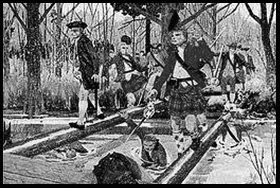
Today is St Andrew's Day, the "national day" of Scotland as the feast day of Scotland's patron saint, Andrew. As such, it is a day to celebrate all things Scottish and, for me at least, nothing symbolizes the best of Scotland like the highland regiments of the British army. Today they have been sadly reduced but best not to dwell on that now. One of, if not the, most famous of these regiments was the 42nd Royal Highland Regiment of Foot, better known as the "Black Watch". It was formed in the aftermath of the 1745 Jacobite Uprising and, naturally, consisted of highlanders who had supported the government which meant they tended to be Protestants in their religion and Whig in their politics. The Black Watch would have a long history of many great victories and ample military glory, however, one of her most famous engagements was not a victory at all but a very heroic, tragic and bloody defeat. It would go down in history as one of the worst British defeats but for the men of the Black Watch it would be remembered for the tremendous sacrifice their soldiers made. It was during the French and Indian War (which regular readers will know all about) and happened at a French fort called, at the time, Fort Carillon, later re-named Fort Ticonderoga on the east border of what is today the state of New York, south of Lake Champlain.

The French and the Indians
The French, and their Indian allies, had been winning stunning victories over the British despite the fact that they were outmatched and the governments in both Paris and London had focused mostly on the European front of the war. The Marquis de Montcalm, commander of the French forces in North America, had won a string of victories in 1756 and 1757 despite having the odds against him. Although he did not enjoy it, the lack of French support for the war in the American colonies meant that he had to augment his forces with American Indian tribes who were difficult to integrate into European-style warfare. However, for a change, in what was to prove his greatest victory, the French would be fighting on their own. The British government, after a number of embarrassing setbacks, decided to made North America the main focus of their war effort, seeing it as of greater long-term value which did not exactly best please King George II who was very concerned about his native Hanover in Germany falling into the hands of King Louis XV of France. However, his fears were set aside in favor of a new, major, offensive in North America.

The British planned for a huge, crushing blow that would strike northward, via Lake Champlain, retaking lost outposts and ending in a massive attack on Quebec City, the capital of New France (Canada) which would win them the war. Doing that, however, would mean that they would have to take Fort Carillon which the French had just built to guard the southern approach to Lake Champlain (the lakes and rivers being the most efficient ways to travel in North America at the time). On paper, this seemed to be no great challenge. General James Abercrombie would have nearly 30,000 British troops at his disposal, a huge army by the standards of the time and place, with many excellent units such as the Black Watch. The Marquis de Montcalm, on the other hand, would have only 3,600 soldiers to defend the fort and many of these would be Canadian militia rather than French regulars. However, perhaps overconfident because of all of this, Abercrombie would fight this battle with all of the strategic calculations of a bulldozer. The Marquis, on the other hand, had his men in well fortified positions, with men in trenches out in front with other men on the walls to give them covering fire and obstructions in front of all of them. Although his defenses could have been more solid still, they would prove more than up to the task given that Abercrombie's plan was simply to charge right in.

Abercrombie's force approached on July 8, 1758 with local militia units and the famous "Roger's Rangers" out front having no problem forcing the French skirmishers back. However, Montcalm had good troops under his command in the center with good protection for them and artillery in redoubts to cover his flanks. One of these was unfinished but, it would not matter, because Abercrombie would be charging straight in, confident that his regulars could smash the French without undue difficulty. He was, of course, to be proven completely wrong. In fact, from the outset, everything seemed to go wrong for the British. Units were drawn into battle early and not as planned which led to disorganized attacks that failed and were very costly. The Black Watch was supposed to have been kept in reserve but, seeing their comrades engaged, demanded to join the fight and so were sent in as well. The result was that the British troops charged into a killing zone of withering French fire. Montcalm, who had thrown off his coat and was dashing among his men in his shirtsleeves, kept up French discipline and morale while the British commander was far away from the action (which had broken out before he had planned). Nonetheless, Abercrombie ordered more attacks, thinking each one would break the French lines and carry the day. Instead, he simply sent more men to certain death.

To make matters worse, the British had no artillery to provide fire support for their attacks. The barges carrying the guns had gone the wrong way and ended up floating down within range of the French in Fort Carillon who quickly spotted them and sank several of the barges in quick order. Abercrombie then sent in his reserves, mostly local militia, but they too were ruined and finally he decided to admit defeat and call off the attack. However, heroically but tragically, just because he had had enough, did not mean the hard fighting highlanders of the Black Watch had. They refused to retreat and continued trying to push on, finally charging forward, they alone managed to reach the foot of the outer walls of Fort Carillon but those who tried to continue ran into French bayonets. When there were finally none left to carry on, the battle came to an end.

Montcalm triumphant
Ultimately, the Battle of Fort Carillon would prove to be the most vicious and bloodiest battle of the French & Indian War. The British lost nearly 3,000 men dead, wounded or missing. The heroic highlanders of the Black Watch lost more than half of their entire number. The French, on the other hand, lost only a little over 600 men, the vast majority of them wounded rather than killed. It was the greatest victory in the military career of the Marquis de Montcalm and would never be surpassed. Abercrombie, by contrast, would never command an army in the field again. The British offensive had been stopped cold and with bloody losses, bringing about a change in command, however, the overall situation did not change at all. The British continued to make North America the main focus of the war, the French would provide precious little support to their own forces in the region and Montcalm would go on fighting against the odds until his life and French rule over Canada both came to an end. Because of a lack of resources and defeats elsewhere, the French would later abandon Fort Carillon, leaving it to be occupied by the British who renamed it Fort Ticonderoga. It would remain in British hands until the outbreak of the American War for Independence.

Saturday, September 20, 2014

Thoughts on the Referendum Results

It is all over now, Britannia prevailed and the United Kingdom has survived, as predicted. Given the last-minute, desperate promises “Call Me Dave” Cameron made to the Scots about having even more powers devolved to Scotland (how many more could there be?) one might wonder if what was decided was no more than a matter of words with Scotland being, in the end, “independent” in all but name anyway. However, lest we forget, the vote was never for genuine Scottish independence in the first place nor is there anything for Scotland to become “independent” from. It is not as though Scotland was some conquered province, though many people seem to have been led to believe that. Just for a brief refresher, the Kingdom of Scotland and the Kingdom of England first came together because the Queen of England, Elizabeth I, never got married and had children so that the King of Scots became King of England as well. In all the years since, Scotland has never been the victims of England and it is wrong, and I would say insulting, to portray them as such. Whether one looks at the horrible Cromwellian period or the glorious Jacobite uprisings, the Scots themselves were partly to blame for their own suffering. The Scots had been the first to take up arms against the King, clearing the path for the English Civil Wars and in each of the Jacobite uprisings there were plenty of Scots who fought against the Stuarts, in fact, sometimes more Scots fought against the Stuarts than for them.

There was, undoubtedly, considerable pressure applied to Scotland to obtain its consent to the Act of Union but there is also no doubt that Scotland benefited immensely from the arrangement. The country became an industrial powerhouse in Great Britain and Scots tended to have high positions in the private sector, the army and the government. The sort of Scotland that the SNP envisions is nothing at all like the Scotland of old but rather is an insult to everything that previous generations stood for and believed in. A number of “Yes” supporters, speaking on American television said that they were simply following the example of the United States in wishing to be independent of England. I doubt that, but, if so, they are betraying all that the Scots of that time fought for because whether it was the highland regiments in the British army or the loyalist highlanders of the piedmont region in the Carolinas, the Scots fought for King George and the United Kingdom in that conflict, just as they fought for it on battlefields all over the world for centuries. The Scots were not victims of the British Empire but partners in it. Of course, in those days Scotland was known as the land where religion, frugality and loyalty prevailed. Today it is more a land with a Maoist First Minister promising a land of socialism, secularism and environmentalism though still funded by the oil industry.

It is the Labour Party that must bear the responsibility for having brought Scotland to this confused state as it was their members which first started spreading the socialist disease in the country; the country that had previously produced Adam Smith. They managed to engrain socialism so deeply in Scotland that they turned what may have been the most fiscally conservative country in the world into a country dependent on government benefits (what Americans would call ‘welfare’). They vote for the party that promises them more of the socialist narcotic they have been hooked on which is why the Tories could be forgiven for not even bothering to run candidates in Scotland and why UKIP members are attacked by angry mobs when they dare open their mouths. The SNP began to grow amongst those for whom the Labour Party was no longer socialist enough. Their claim to be for the de-centralization of power is easily misunderstood. True, they want the government in London to have less power but they want the government in Edinburgh to have even more. Despite the “No” vote coming out on top, it seems they will still be given the opportunity to be tyrannized by politicians in Edinburgh rather than London.

Of course, for the faction that was always characterized by being based on emotion rather than reason, the “Yes” side has not been entirely gracious in accepting their defeat. Watching the BBC, the losing “Vote Yes” side immediately began saying, bitterly, that the “campaign of fear” by the “Vote No” crowd was a success. Well, if that is true, it is surely immensely insulting to the Scots as to having any fortitude or courage at all. People who are in a position in which they are truly yearning to be “free” are not going to be frightened off the idea by an ad campaign, particularly not an ad campaign so inept as “Better Together” was. And surely there can be nothing more insulting to the Scottish reputation for courage and heroism than to say that they were actually intimidated by the likes of “Call Me Dave” Cameron and Gordon “Is Alive!” Brown. Give me a break! If that is true, Scotland has fallen far indeed into the socialist morass if the country that produced the highland charge and the “thin, red line” was frightened into voting “no” by the prospect of having to produce their own currency or losing out on some benefits.

What is truly unfortunate is that there seems to be no sign that this socialist mentality will be changing anytime soon. Relatively few people seem to realize what is going on right in front of them. During the coverage of the referendum, I noticed how broadcasters kept repeating, in making predictions, how impoverished areas and areas with the most people on benefits were most likely to vote SNP. That should tell people something, and the same applies to Labour as well as the SNP. Politicians can see such trends as easily as anyone in the media and anyone should have the intelligence to realize that a politician is motivated by a thirst for power and keeping his or her job and if people being poor and on benefits means they keep getting reelected, does anyone really believe such politicians will genuinely work to get people out of poverty and off of benefits? Of course not! Like leftist parties the world over, they do all that is in their power to keep as many people in poverty and dependent on benefits as possible. This is why they want to make benefits as widely available as possible and have them last as long as possible because the statistics clearly show that this means more reliable votes to keep them in power.

Now that the referendum is over, in fact almost before it was over, the new topic of the day became the “English question”. What will England do with Scotland getting so much more autonomy? There has, for some time, been at least some minor grumbling that while Scotland, Wales and Northern Ireland have their own parliament or assemblies in which the English have no vote, all of them still have votes in Westminster to decide on English issues. Devolution still seems to be the way things are going and, perhaps, there will be at least one good side to that. If a place like Scotland gains total autonomy within the United Kingdom, perhaps they will be forced to deal with the consequences of their own electoral decisions. Perhaps they will learn the hard way that socialism doesn’t work. I have to say “perhaps” because so many still cling to the notion despite the multitude of examples, past and present, all over the world that socialism does not work and cannot work. Take a people as intelligent and technically minded as the Germans, add socialism and you get an East Germany that couldn’t even build a decent car. Take Russia, which had farmland sufficient to feed the world, add socialism and you get a Soviet Union that had bread lines. Take a country with all the oil wealth of Venezuela, add socialism and you get a country that can’t even supply their people with toilet paper.

Decentralizing power, in principle, tends to be a good thing. What the SNP wanted was a disaster waiting to happen because, as I have mentioned before, it was not really independence. They wanted all the powers that go with independence but none of the responsibility, they wanted to break up with England but still be “friends with benefits”. So, they complained that all their economic woes were the fault of England but still wanted to use the English pound and piggy-back off the English economy. Similarly, they complained about being “forced” to go fight in “America’s wars” but still wanted to be part of NATO and so avail themselves of the protection of the American military. They also wanted to a totally non-nuclear, environmentalist “green” country while basing their entire economic model on oil. As the old, and somewhat confusing, saying goes, in every way they wanted to have their cake and eat it too. I do hope the realization of that was at least part of the reason why the “No” vote prevailed by a considerable majority.

Personally, I am mostly pleased that Scotland will remain a monarchy and that the ancient Scottish Crown will not be left at the mercy of the SNP and the “former” Maoist, “former” republican and now (thankfully) former First Minister. I am glad that the other separatists in the monarchies of the world did not get the big boost they were hoping for from a “Yes” vote and I am pleased that, after 307 years, the United Kingdom has survived. Aside from all the further political squabbling that will follow, I hope that the spirit behind the “Better Together” campaign will carry on and will begin to instill in the population of the United Kingdom a deeper sense of pride and patriotism. I hope they will highlight what a great and glorious country they are, what a proud history they have and what a force for good Great Britain has been in the world. Certainly that should also include the system of constitutional monarchy which proved such a success that peoples all over the world once tried to emulate it. Too much has been taken for granted in the UK and many, many other countries. With the dangers facing Britain today, it is absolutely vital that people begin to again have a better sense of themselves, a healthy national pride and a willingness to stand together and to stand up for themselves. Long live Britannia and God Save the Queen!

Monday, September 15, 2014

Scotland Vote, the Queen Speaks

As is seen in this article from the BBC, HM the Queen made her first public comments about the upcoming referendum in Scotland on pseudo-independence, saying that the Scots need to "think very carefully about the future". Previously there had been reports, the unconfirmed sort from 'anonymous sources' that the Queen was worried about the vote but the Queen herself had never spoken about the subject until now. It is very revealing to see how some people have responded to this with the usual suspects howling that the Queen, by this simple statement to a person in a crowd, had violated the policy of royal impartiality. They took this simple phrase as a ringing endorsement of the "Vote No" campaign. Think about that for a moment. The Queen said nothing at all about how anyone should vote, only that they should think carefully before doing so. By their reaction, the "Vote Yes" side has admitted that they are banking on people NOT thinking carefully before casting their vote for pseudo-independence. Of course, this should come as no surprise given how they campaigned for giving minors the right to vote, hoping that the voices of the young and ignorant would drown out those of the mature and experienced. Personally, I have no doubt that the Queen is hoping the vote will be "No" but she has certainly not taken a side in the issue. The fact that so many are taking this simple comment to be indicative of the Queen doing that shows both how they are counting on people voting emotionally rather than thoughtfully and just how little they think of the Queen and the place of the monarchy in British -and Scottish- society.

One can also tell a great deal about what this means for Britain by who has come out in support of the "Yes" Vote by those beyond British shores. North Korean communist dictator Kim Jung-Un has come out in support of the "Yes" side as have a number of people in high places in Russia. In the case of Korea's portly potentate, it is as simple as one Marxist supporting another, in the case of Russia, they want Scotland to set an example that their own partisans can follow in breaking away from Ukraine, as has been done in Crimea and which is trying to be done in the eastern lands of the country. In the Kingdom of Spain, Catalan secessionists are saying that a "Yes" result in Scotland would boost their cause as have their fellow republican separatists in Quebec who are hoping that a "Yes" vote will revive their flagging cause. The result could have an impact on some republics but it is the monarchies I most care about and who seem to be the biggest targets for these types of things. Canada, Spain and Belgium are at the top of every list of monarchies threatened by separatist movements. However, it goes wider than that, reaching even the Far East where a Red Chinese official recently said that the Ryukyu Islands should be independent and not considered part of Japan at all. There has long been a minor separatist movement on Okinawa and China would love to see such a thing happen so as to weaken Japan and strengthen their claim to the Senkakus. Even in Australia, those campaigning for a republic and to abolish the Australian flag have said that a "Yes" vote in Scotland would give them a helpful boost in their own agenda.

That is a common theme throughout all of the reaction to this issue and all those supporting the "Yes" vote in Scotland. It is all being done by people who want to see these monarchies diminished and weakened on the world stage. The European Union would be glad to see existing European countries further divided so that they can expand their power. After all, such small "independent" states could hardly make it on their own and would have to rely all the more on Brussels. It does not matter to them that some separatist movements are being driven by more comparitively right-wing forces or ardently left-wing forces since, whether one is talking about Scotland, Catalonia or Flanders, they have all stated that they will be joining the European Union as soon as "independence" is won, which of course means that it isn't independence at all. They are being totally disingenuous as is seen by how the EU responds when any country talks about leaving. Likewise, it takes no great clairvoyance to imagine how Russia, the DPRK or PRC would respond to any effort by any part of their countries to break away. Obviously, the history of England and Scotland has not always been peaceful and friendly but it is a distortion to think that Scotland has always had the worst of it. Even as early as the mid-1700's many a historian has commented that the British army leadership was dominated by Scots, many PM's have been from Scotland as have many of the biggest forces in business in Britain. Even if we want to go back to when things were a little more tense, it seems lost on many that when Scotland and England first came together it was by a Scottish monarch becoming the King of England and not the reverse. Scots should think carefully about the future and should consider why so many who do not have the best interests of Scotland in mind are hoping they vote "Yes".

Saturday, September 6, 2014

Scottish Independence, Is Their Any Doubt?

Very soon the Kingdom of Scotland will be voting on whether or not to become an independent country. No, I’m sorry, that’s not true because even if the “Yes” vote wins, Scotland will be no more independent than it is now, perhaps even less so, but it will be voting on whether to leave the United Kingdom of Great Britain and Northern Ireland and then submit to the ruling elite of the European Union directly. In the past, some people have been offended by my saying that any country that is a member of the European Union is no longer an independent country but I can see it in no other way. The EU enacts laws and its courts hand down rulings that are binding on member countries and these countries submit to that, which to my mind is the opposite of being independent. Right now, before anyone becomes too excited, all the polls indicate that the “No” vote is going to win by a fairly comfortable margin. What I found most amusing was that, at one point at least, more people in England favored Scotland going its own way than people in Scotland did. Tired and fed up with being blamed for every ill in Britain, many English seem to have taken the attitude of ‘don’t let the door hit you on the way out’ toward Scottish so-called independence.

However, even expecting the “No” vote to win, I still cannot be too optimistic about this ridiculous exercise. Either way, the United Kingdom is basically finished but like so many things in British life these days, appearances are one thing and actual fact is another. If Scotland votes “No” the country will still be called the United Kingdom and the Union Jack will still fly on official holidays but the country is anything but united these days. The United Kingdom, as most readers here surely know, was formed as the United Kingdom of Great Britain and Ireland. This was the coming together under one government of the three kingdoms of England, Scotland and Ireland which had long shared one monarch between them. Well, Ireland is now gone with even Northern Ireland being effectively “independent”, Scotland has its own parliament and even within England itself there is an assembly for Wales and talks of pseudo-independence for areas from York to Cornwall. Again, even if Scotland votes against pseudo-independence, the British government is already promising even more powers to go to the Scottish parliament so that the United Kingdom will be anything but. With a parliaments and assemblies in Ulster, Wales, Scotland and England, the British Isles seems positively packed with elected representatives and yet the voting public never seems to be any happier. Odd that (‘he wrote sarcastically’).

As far as monarchists are concerned, there is no reason at all for anyone to support Scottish pseudo-independence. I have seen a few e-people (who we all know are not real anyway) say they are monarchists and Scottish nationalists and support independence but, even if such a thing existed, their support only makes them the dupes of the radical leftists to oppose monarchy and nationalism. The Scottish National Party is a totally bogus entity, even its name is a lie. Their claim to be nationalists is just as blatant a falsehood as their claim to be advocates of independence as their undying, passionate love for the European Union clearly demonstrates. They are not nationalists of any sort. They are internationalists and are as far to the left and as far from monarchy as is humanly possible. Lately, I have the feeling that many people outside of the UK may not realize just what the political landscape of modern Scotland is like. It is the most radically leftist of the three kingdoms (or two and some change anyway). Scotland held on to its traditional ways longer than just about anyone and the clan system had to be broken up by force but when Scotland went to the left it went totally off the deep end.

There is no doubt, absolutely, positively, no doubt that a pseudo-independent Scotland would, in fairly quick order, abolish the monarchy. If Scotland becomes pseudo-independent it will be the “Socialist People’s Democratic Republic of Scotland” make no mistake about it. The evidence is all there, the leaders have the desire and they will have the opportunity. Consider that the lesbian-gay-bisexual-transgender advocates have come out in favor of pseudo-independence because they are confident that their agenda will be written into law when Scotland enacts a new constitution. That does not get too much media coverage but there will be a new constitution for Scotland and that would be the perfect opportunity for the SNP to simply abolish the monarchy at the stroke of a pen without even having to bother to have a popular vote ahead of time. Of course, the SNP has never come out and honestly admitted this but they all come from republican backgrounds and have, in the past, tried to promise everyone that a pseudo-independent Scotland would lose nothing while gaining everything, claiming they can keep the pound, the Queen, Royal Mail and Doctor Who which, in itself, should make anyone wonder just how seriously even they think their talk of “independence” is.

There is no difficulty in determining the prevailing political opinions in modern-day Scotland and how inimical these are to monarchy in principle. Look at any of the speeches and arguments made by both sides to appeal to the Scottish public and one phrase you will hear more than any other is “social justice”. This phrase is the “liberty, equality, fraternity” of our time and is a more attractive way of saying what Karl Marx said his philosophy was all about; taking from those who have more and giving to those who have less with the government keeping a sizable handling charge for the forced transaction. It is the same promise that socialists, communists, Marxists and all their permutations have been making since they first appeared on the political scene; using state power to make everyone “equal”. It never works out that way but these people have never been the sort to learn from experience nor to ever let the truth get in the way of an appealing political slogan. Obviously, such a philosophy runs counter to the principle of monarchy which is inherently based on the idea that we are not all the same and thus cannot and should not all be treated the same. It is counter to the idea that once can advance and achieve a higher status than you had before, that accomplishment warrants special recognition.

Finally, for those modern-day Jacobites who may be tempted to think that if Scotland becomes independent and if Scotland then dethrones Queen Elizabeth II it could lead to the restoration of the Stuarts, such notions should be dismissed immediately. First of all, as has been stated above, the leadership of this movement are totally opposed to the very fundamental basis of monarchy and everything that the grand old House of Stuart stood for. The Jacobites fought for a powerful, faith-based monarchy with respect for tradition, local custom, hereditary rights and government decentralization. The SNP, on the other hand, opposes monarchy in general, certainly opposes any role for the Christian religion in government, opposes tradition (being very pro-EU and welcoming of non-Scots into the country), they oppose hereditary rights and their support for decentralization applies only so long as Scotland remains in the United Kingdom. If they had their way and Scotland was on its own, they would favor massively more centralization of power in either Edinburgh or, truth be told, to Brussels. Admirers of the Jacobites should remember that they struggled for the restoration of the Stuarts across the whole of the British Isles, England and Ireland included and not for the separation of Scotland. However, more to the point, there is simply no Stuarts to restore anymore. The family has died out and the legitimate heir of the Stuart legacy, the Duke of Bavaria, has made it clear that he has no interest in being the King of Scotland. This is not at all unusual as no Jacobite heir has ever made a claim on the British throne since the male Stuarts died out centuries ago. Neo-Jacobites should not allow themselves to be the “useful idiots” of the SNP which is thoroughly anti-monarchist and should rather devote themselves to furthering the ideals and the values that those brave Jacobites of the past fought for and which are the polar opposite of the values of the SNP.

A “yes” vote in the upcoming referendum would be a vote for disaster. It would not achieve a genuinely independent Scotland at all, it would be bad for the economy and would make the country a non-entity in the backwater of the European Union. The monarchy would not long survive, there should be no doubt and it would be a further betrayal of the values and customs that have distinguished Scotland throughout most of its long history. The only ones who would benefit from it would be the political stooges of the EU ruling elite who would see Scotland turned into an overregulated, impoverished socialist republic. Anyone who loves Scotland should vote “no” and more than that, should devote themselves to turning Scotland back towards its traditional roots as a country of inspiring loyalty, strong families, economic frugality and deep faith. As a great admirer of Scotland, I hope to see that happen. God bless Scotland and God Save the Queen of Scots!

Wednesday, February 27, 2013

Highland Charge in America


It was on this day in 1776 that the battle of Moore’s Creek Bridge was fought near Wilmington, North Carolina. Unfortunately a victory for the republican side, it was nonetheless a display of great courage and heroism on the part of the loyal royalists and, as far as I am aware, the last example of a traditional “highland charge” in North America. The Revolutionary War had still not taken hold completely in the southern colonies prior to the battle and the Royal Governor of North Caroline, Josiah Martin, was, like others, convinced that with only a modest force of Redcoats the loyalists of his colony could be rallied to the cause of King and Country, subdue the rebels and restore the place to loyal obedience; and not only North Carolina but the whole of the south. These expectations proved to be rather overly optimistic as when the two sides met at Widow Moore’s Creek bridge, it was the loyalists who were outnumbered by the equally hastily organized rebel militia by a few hundred men. Perhaps the most memorable thing about the battle, and what our focus today will be, was that the loyalist side was made up almost totally of Scottish highlanders and, it is noteworthy, a great many Jacobites.

Governor Martin
After the glorious disaster known as the ‘45 Jacobite Uprising, many highland Scots had left the rather unpleasant atmosphere of Scotland for the New World and settled in the Piedmont area of North Carolina. Some today would probably not expect these men to have been likely sympathizers with the cause of King George III, however, not long after the troubles in America began, the Scotsman Allan Maclean obtained permission from the King to recruit loyal fellow Scots in North America to fight for the Crown in the Royal Highland Emigrants Regiment. Some of these men were long-time veterans of the British army but others had previously fought against it. For example, in North Carolina, to of the leading officers employed by Maclean in gathering Scotsman for the Royal Emigrants were Donald MacLeod and Donald MacDonald both of whom were veterans of the Battle of Bunker Hill. However, also recruiting for the cause of King George III was Allan MacDonald, a noted loyalist and the husband of the Jacobite heroine Flora MacDonald who had saved the life of “Bonnie Prince Charlie” and aided his escape to Skye. She supported the Crown as well and Allan MacDonald was appointed brigadier-general by the governor and rode himself across the colony from town house to country cabin urging people to take up arms for the King and in opposition to the rebels.

Those who responded had a variety of motivations. Aside from the pull of King and Country, there were local tensions to be considered. Since there settlement more and more people had started to move into the Piedmont area and these people tended to be of the Whig/Patriot persuasion and clashed with the more established residents of the area. Even those Scots not inclined to great adoration for King George III were often willing to fight for his side simply to stop the influx of colonists intruding on what had previously been their exclusive domain. For the Jacobites among them, there was also the memory that they had fought for something more than simply fidelity to the House of Stuart, as fervent as that was and as deeply felt as their personal loyalty to the “King across the water” had always been. Part of what was at the core of all of that was the idea that legitimate authority comes from God and so the idea of a democratic republic was unthinkable and downright wicked. King George III may not have been the monarch they would have most preferred, but better a Hanoverian king than a revolutionary republic and regardless of who was on the throne it was important that the ties between America and Britain (including Scotland) not be broken.

By 1776 Anglo-Scottish tensions had also eased considerably and it is a fact as well that even in the ‘45 at least as many Scots as supported Prince Charles just as fervently supported King George II. For many, it took the outbreak of republicanism in North America to reconcile the two sides in the common defense of the principle of monarchy. When they set out to confront the rebels they expected some assistance from Britain but the expedition intended to reinforce them was delayed by bad weather in Ireland and did not arrive. Neighboring Virginia had also known disaster was a hastily organized loyalist force with little support was overwhelmed by rebel forces and it was to be the same for North Carolina. Donald MacDonald, Donald McLeod and John Campbell led a little over 700 men into the fight at Widow Moore’s Creek where they were met by more than a thousand rebels. It was an awesome sight, coming on as they were in the ‘grand old style’ many in full highland dress and with bagpipes wailing away. At one point, Captain Campbell picked a group to charge across the bridge, which they did brandishing their claymores and shouting “King George and Broadswords!” only to be cut to pieces by withering rebel fire.

The aftermath was pretty bad for the cause of the Crown with loyalists being hunted down and taken prisoner or simply dispatched out of hand but, of course, it was only the beginning of the revolutionary war in the south and by no means the end. Today, however, I would suggest that monarchists take inspiration from those highland Scots who charged the rebel lines at Widow Moore’s Creek and the Jacobites in particular. Certainly it is an example of great bravery but from a somewhat unexpected quarter. Therefore it can also serve as something of a lesson for monarchists today, particularly those die-hard Jacobites who linger about the on-line world of theoretical monarchism. Far from sitting comfortably from a safe distance, pouring scorn on the existing authorities of the time, some of these men had actually suffered at the hands of Hanoverian troops, men who had shed blood and had their own blood shed in the cause of the House of Stuart and yet they put that past aside, never forgetting it and never ceasing to honor it, but in order to come together for the cause of kingship and traditional authority in opposition to revolutionary republicanism. That is an example that we would all do well to emulate.

Wednesday, October 17, 2012

Cries for Secession


There has been a great deal of talk lately about rising support for secessionist movements in several European countries, most of them monarchies. To get the republic out of the way first, there was recently some buzz around the drive for an independent Republic of Venice in northeast Italy and, for some time, there has been a sizeable minority in northern Italy generally advocating the break-up of that country. Personally, I mourn the loss of the Kingdom of Italy and regard it as unfortunate enough that there is one Italian republic, I certainly would not want there to be two or three. In the monarchies of Europe there are advanced secessionist movements in the United Kingdom, the Kingdom of Belgium, the Kingdom of Spain and I suppose I should hop over to America and mention the Dominion of Canada. Belgium has had probably the most long-standing secessionist movement with the nationalists in Flanders constantly keeping the world guessing as to whether or not Belgium is about to split in two. In Belgium, and outside the English-speaking world this seems to be a pattern, it is a case of a more economically prosperous region trying to break away from a country that is less successful overall. Honestly, I can fully understand where this kind of attitude is coming from.

Flanders has, for most of recent memory, been more prosperous than Wallonia. I am sure some of the more racist Flemish nationalists (and there are plenty of them) would likely attribute this to the natural superiority of the more Germanic Flemings over the more Latin Walloons. Actually, in racial terms, there is hardly any difference between the two and the real reason is that Flanders has followed a more intelligent economic policy compared to Wallonia which has long been dominated by the socialists and has an economy that shows this. I can completely understand the Flemings being upset that their hard-earned tax euros get shoveled over to the Walloons to compensate for their bad economic decisions. However, the answer to that problem does not require independence, it only requires getting the socialists out of Wallonia and a good way to start would be to see them cut off from outside help so they would be forced to face the economic reality that socialism simply does not work. If the Red Chinese can figure it out, so can the Walloons. Ignoring the huge problem that would be Brussels, there is also the problem of what to do with the two halves of the former Belgium if Flanders declared independence.

Contrary to what some think, the area of modern Belgium has been a distinct political area for quite some time before the declaration of independence in 1830. It was distinct during the period it was united to The Netherlands after the Napoleonic Wars and before that it had long been the westernmost outpost of the Hapsburg empire. Wallonia as a part of the French Republic holds no romance for me and would be an odd fit; the similarities of language aside. However, Wallonia is not the driving force behind this but rather Flanders. What would become of Flanders? There are two options: either Flanders remains independent or joins their fellow Dutch speakers in a “Greater Netherlands”. Neither option appeals to this monarchist. First of all, let there be no confusion on this point: an independent Flanders would be a republic. Period. Without doubt. So, in that scenario, Europe loses a monarchy and is cursed with another republic. In the second case; Flanders being annexed by The Netherlands, no new republics are created (assuming Wallonia joins France as is most likely) but Europe is still down one monarchy. Not good. Furthermore, I do not believe Flanders would be happy in The Netherlands anyway. They have too much of a regional mindset and are too used to being treated as something special for me to believe that they would be content to be just another Dutch province. So, I say “no” to a Flemish republic and “yes” to the Kingdom of Belgium (which, lest we forget, has been a country longer than Germany, Italy, Poland and a number of others).

Moving south to the Kingdom of Spain, Catalonia is likewise one of the more prosperous areas of Spain (though granted that is not much of an achievement these days) and has been increasingly threatening to secede. Here again, the real solution should be to have the whole of Spain make better economic decisions but there are also plenty of other reasons to be against Catalan independence anyway. Unlike some areas, Catalonia has never really been independent and the glory days of the Catalans of old was attained as part of the Kingdom of Aragon prior to the unification of Spain. Catalonia, again, would undoubtedly be a republic if Catalan independence is ever achieved. One more republic is not something I would like to see. It would also be possible that there would be more than one republic emerge as there are other nationalist groups in Spain that are pushing for the same thing. There are also a number of misconceptions about the Catalan region in particular with some people being under the mistaken impression that this is some sort of monarchist stronghold because of past Catalan support for the Carlist faction in the civil wars. However, that would be a gross over-simplification. Like the Basques and some other groups, many Catalans fought for Don Carlos, not because of their support for the traditional, absolute Catholic monarchy, but because they feared that the liberal monarchist faction, which favored greater uniformity, would take away the special privileges Catalonia had traditionally enjoyed under the old system.

It was not long after the First Carlist War, still during the reign of Queen Isabella II, that republicanism began to be a major force in Catalonia and, for the most part, it has only grown stronger since then. Today the Catalan nationalist movement is almost totally dominated by republicans and more often than not, republicans of a very radical stripe. It is also true that the Spanish government, in the past, bent over backwards to please Catalonia, which has long been the industrial heartland of Spain, such as in placing tariffs on imported goods that benefited greatly Catalan industry but which hurt the poorer, more rural areas of Spain. Since that time the local politics have grown ever more radical. Most were on the side of the republicans in the Spanish Civil War (and the Second Republic had made numerous concessions to them) and they regard it as the darkest period when Generalissimo Francisco Franco emerged victorious and reunited Spain under a central government that abolished all special privileges for individual regions. Today, an independent Catalonia would still join the European Union and would solve none of her economic woes based on the voting pattern of the populace that supports the nationalist parties and it would be a cause for potential trouble within Europe because the most ardent Catalan nationalists also claim territory that is currently within the borders of France. So what would be the result of Catalan independence? Another leftist republic, possibly the loss of a monarchy and even more republics, as well as potential danger over territorial claims. On every front the only answer is “no”.

Turning back north again we have the case of the increasingly dis-United Kingdom in which there is already a Welsh Assembly, a Scottish Parliament, a Northern Ireland Assembly and the British Parliament at Westminster. I cannot help but marvel that one island and a bit of leftovers requires more government assemblies than the whole of the Roman Empire did at the height of expansion but, of course, that is a common thing these days. Depending on who you talk to Northern Ireland is already an independent country, and there are murmurings from the Welsh but, of course, it is Scotland that commands most of the attention for threatening to secede from the United Kingdom. In fact, the Scottish National Party has managed to, it seems, win a promise for a 2014 referendum on the independence of Scotland from the current coalition government. Scotland is a unique case and worth taking a closer look at. The Kingdom of Scotland was, of course, a very old and long-established independent country prior to the union with England and, over the long process of the two halves of Britannia coming together, it could seem at certain points that it was Scotland dominating England rather than the other way around.

Personally, I cannot help but have a bit of nostalgia for the old, feudal Kingdom of Scotland and had I been alive at the time I would probably have favored the later Stuart policy of three kingdoms in personal union under the Crown rather than under one centralized government in London. The Scots would seem to have a good case to argue when it comes to demanding independence. After all, England did use some rather coercive tactics to gain their consent to it, England had been extremely brutal in the aftermath of the 1745 Uprising and the English had executed two Scottish monarchs in the past. However, many Scots have a selective memory when it comes to these outrages. The Scots had actually been the first to rebel against King Charles I long before the civil wars that brought about his eventual execution and Mary Queen of Scots was only in England to be executed because her own Scottish subjects had chased her out of the country with English support. Likewise, in the 1745 Uprising, although the highland clans are the most remembered, at least a third of Scotland was staunchly on the side of England and King George II (just as some Englishmen were for the Stuarts). So things are not always as simple as they seem by those who look at everything as “us” versus “them”. Even going back to the romantic days of Sir William Wallace, it is often forgotten that King Edward I of England only became involved in Scotland in the first place because the Scots themselves could not settle on a monarch and asked for his arbitration (big mistake).

All of that, however, is only of secondary importance to me. What I look at is how Scotland has fared since the union as compared to before. When England, Scotland and even Ireland were all playing on the same “team” (some, admittedly, more willingly than others) the result was the largest and most successful empire that had ever existed in the history of the world. Nor was this, at any point, an Anglos only club. The Gaelic Irish might have been excluded from the halls of power but the Scots most certainly were not. Scottish politicians pulled considerable weight in the government and, even in the eighteenth century, Scottish officers so dominated the British army one could be forgiven for thinking some sort of conspiracy might have been underfoot (though there wasn’t of course). What seems to make Scotland stand out today, as far as separatist movements go, is the fact that I see less going from Scotland to England and more going from England to Scotland. Again, partly because of the economic policies Scotland has embraced in the past. I know many Scottish nationalists will say that there is oil in them thar North Seas and that will allow them to all live like kings and laugh at the misfortune of poor, impoverished England. However, I have a hard time believing such a rosy picture considering that Scotland just doesn’t look like a very prosperous country these days. Most of the Scots seemed to have moved to England (or if they have the money of 007 to Bermuda). People do not tend to flee states that are economically strong.

Of course, I could be wrong, but the Scottish Nationalist Party is not doing a very good job of reassuring me by their reluctance for a total and complete break with England or their continued devotion to the European Union. That is one of the biggest problems I have with most of these independence movements is that it seems like everyone these days has completely forgotten what the word “independence” means. It means you have no one above you, you are utterly free and unattached, you are making it on your own Mary Richards. Today it seems more like a teenager telling their mom and dad that want to be treated like an adult but still want to live at home rent-free without paying utilities and instead of having their parents boss them around (never stand for that), will instead allow the parents down the street to boss them around at will. They seem to want to keep most of the benefits of United Kingdom membership while at the same time rejecting “rule from London” while openly embracing rule from Brussels. That may make sense to some people but I am certainly not among them. It also seems to me that when you want to extend the franchise to 16-year-olds you have pretty much admitted that you are not counting on rational, reasoned decision-making by the populace when referendum time comes.

At the end of the day, declaring “independence” while remaining in the EU is not to declare independence at all and certainly the Scots have more in common with the English than they do with the French, Germans, Poles, Belgians etc. Not only are there probably more Scots in England than in Scotland but most people have, by now, both Scottish and English (and Irish) blood in their veins who live in most any populated section of Britain. And, of course, there is the monarchy. The SNP, as far as I can tell, do not claim to be officially republican -which is a far cry from claiming to be officially monarchist. Their official position is that HM the Queen would remain their monarch after independence. However, balanced against that is the torrent of abuse I have seen myself leveled against the Queen and the monarchy from SNP supporters. Certainly most of the members that I have heard from in articles and interviews have been ardent republicans. True, one can still find the occasional, frustrated Jacobite who supports Scottish independence in the hope that the Queen will be given her walking papers and the Duke of Bavaria will be invited to take up residence in Edinburgh but there is about as much chance of that happening as there is of the Chinese Communist Party offering to kowtow to the Emperor of Japan. From all I have seen there is not a doubt in my mind that an independent Scotland would become just another minor leftist republic in the European Union. Under different circumstances I would have no problem with a reversion to simply a personal union as existed prior to the reign of Queen Anne, but that is not what is on offer today and that is why the only answer to the Scottish independence question is “no”.

Finally, though I am reluctant to even mention it, there is Canada (yes Canadians, you are a monarchy) and the issue of the secession of Quebec. I am hesitant to mention it because, frankly, I cannot take the Quebec separatists seriously. I mean, seriously … it’s Canada we’re talking about here. All they need do is ask nicely and they could leave anytime they wished. If Quebec was really serious about wanting to leave the rest of Canada, I think they would have done it by now. It’s not like the United States, they can leave whenever they want to. But though they have never done it, they keep bringing it up over and over again and so always remain the “special” Canadian province. Quebec, of course, has never been an independent country before and they are not really much more fond of the French than they are of the British or their fellow Canadians. The tensions between Quebec and the rest of Canada really make no sense whatsoever. Of course, no one would be happy with being conquered and at the outset they had real reason to worry but then along came a man named Guy Carleton. He was Governor-General of Canada just before and during the American Revolution. He helped get the Quebec Act passed which allowed Quebec to keep French as their language, maintain their French legal system, maintain their own territorial claims and exempted them from the British anti-Catholic laws. The British knew that being oppressive would only give the French Canadians a reason to rebel against them, so they didn’t do that.

For the most part, this system worked. Some still sympathized with the Americans, but even most of them did nothing about it and the local leadership and the Catholic Church firmly supported the Crown in the Revolutionary War because they realized that they enjoyed a special status as part of the British Empire that they would certainly not enjoy under the United States government. It is worth looking at areas like Louisiana in the U.S. and comparing that state to the province of Quebec. French is still the spoken language in Quebec but practically no one in Louisiana speaks French anymore. A large majority in Quebec are still (nominally) Catholic whereas in Louisiana, where, while the Catholic Church is the largest single religious group, the majority of the population is Protestant. No matter how you look at it, the fact is that Quebec has remained unique and distinctive within British North America and later Canada whereas otherwise they would be just like Louisiana; different but not in any dramatic way.

And, of course, the bottom line for me is the monarchy and the Quebec separatists make no secret of their hatred for the monarchy and pretty much for anything associated with Britain or English-speaking Canada. Likewise, they too don’t really want true independence but want a status in which they still receive all the benefits of being a Canadian province without any of the obligations. North America does not need another republic and no matter what language they speak those who push for independence as a republic are simply traitors to HM the Queen of Canada and nothing more. I cannot even give them the slightest minimum of respect I might if these were French nationalists longing for reunion with the French motherland. They seem whiny (and you don’t have to forget something to get beyond it), spoiled (special privileges no one else has and it’s never enough), disloyal and additionally, unserious. Again, what they want is not real independence anyway and if they really wanted it, they would have it by now. The only answer for any monarchist to the secession of Quebec is a resounding “no”. Am I against secession on principle? No. Have I been against every act of secession in history? No. However, I am a monarchist first and foremost (when it comes to politics) and none of the secessionist movements going today are ones that I, as a monarchist, could ever support. Not every secessionist movement in history has been bad for monarchy but, from where I sit, all of those agitating now certainly are.

Thursday, May 26, 2011

Monarch Profile: James V, King of Scots

James V, King of Scots, is one of those monarchs who clearly knew right from wrong, tried to follow the right path as king and yet had a major problem when it came to denying himself. In the Tudor period he was the Catholic champion of Scotland who steadfastly refused to follow the example of King Henry VIII of England. Yet, like Henry VIII, he had a real weakness when it came to women, however, in the case of James V this was his only real weakness and in every other way he was an astute monarch, devoted Catholic and loyal son of the Church who did his best in extremely difficult circumstances. He was born in April of 1512 (the exact date is still debated) at Linlithgow Palace in West Lothian and was little more than a year old when his father, King James IV, was killed at the battle of Flodden on September 9, 1513. The infant monarch was then crowned King of Scots in the royal chapel of Stirling Castle on September 21, 1513 initially with his mother, Margaret Tudor (sister of King Henry VIII of England) as his regent. This lasted only until the next year though when Queen Margaret remarried after which the regency passed to John Stewart, Duke of Albany. John himself was second in line for the throne after Prince Alexander, Duke of Ross, the younger brother of James V, who was born after the death of their father.

In 1525 the Earl of Angus, who was stepfather to James V, took the young king prisoner and ruled Scotland on his authority until James escaped in 1528 and took power himself for the first time. It was also in 1525 that the Protestant doctrines first began to spread into Scotland and James V was determined to resist them. He had parliament pass an act forbidding the importation of Lutheran books and the following year James wrote a letter to Pope Clement VII in which he promised to use all the power at his disposal to combat the spread of Protestantism in Scotland. In 1528 James V had Patrick Hamilton, a commendatory abbot with connections at court, burned at the stake at St Andrews for preaching heresy. The Protestant leader John Knox credited this action with being the starting point of the Protestant Reformation in Scotland. However, in Scotland as in other areas, there were power hungry men who adopted the Protestant cause simply because they were interested in revolt rather than reformation. Had they only been concerned with reforming the Church they would have found a useful ally in King James V who was himself devoted to reforming the clerical abuses that existed in his country. To deny the problem was no longer possible as the Catholic Church in Scotland had, by that point, become rather infamous across Europe for corruption and immorality.

In political matters James took immediate action against the Earl of Angus who had imprisoned him as well as cracking down on rebel factions along the border and troublesome chieftains in the Western Isles. He improved the financial situation of the monarchy by keeping a closer watch on the royal estates and by taking advantage of his traditional feudal rights over the nobles. James V spent much of this money on building projects at Stirling, Falkland, Holyrood and Linlithgow. On January 1, 1537 he renewed the alliance with France by marrying Madeleine of Valois, daughter of King Francis I. However, Madeleine died only a few months after being married and so as to maintain the political situation James marred Marie of Guise on June 12, 1538. Marie of Guise was a devout Catholic woman, the daughter of Duke Claude of Guise (the Guise family were the leaders of the Catholic League in France) and she was the widow of Louis of Orleans, Duke of Longueville by whom she already had two children. Together James and Marie had two sons, the Duke of Rothesay and the Duke of Albany, in 1541 and 1542 but neither of them survived. In 1542 the couple gave birth to a daughter, Princess Mary, on whose shoulders the future of Scotland and the Stuart dynasty would one day rest. However, showing his major weakness, James fathered at least nine illegitimate children (3 before he was even 20 years old) of whom James, Earl of Moray would prove the most troublesome in the future for his legitimate heir.

Probably the most pressing issue for James V was the overflow into Scotland of the religious divisions his uncle King Henry VIII introduced to England by breaking with Rome and establishing his own Protestant church. Just as this divided the English into Catholic and Protestant camps, so too would Scotland be likewise. King Henry tried to persuade his Scottish nephew to follow his example and break from Rome as well but the staunchly Catholic James V refused to do so. Scotland became divided between those who favored the position of Henry VIII of England and those who were loyal to the Church and King James. The, essentially, Protestant camp included most of the nobles, the English Queen mother and religious dissidents. The Catholic camp included some powerful nobles, most of the clergy and the vast majority of the common people who were loyal to their King and the old religion. One of his most faithful servants was James Beaton who was made a cardinal in 1538 and shortly thereafter Primate of Scotland. It is a mark of his quality that Henry VIII of England considered him his greatest nemesis north of the border. The King of England was further enraged when the pope transferred to the King of Scots the title, Fidei Defensor, which Pope Leo X had originally awarded to Henry VIII for his refutation of Luther.

Matters came to a head after the death of the English queen mother in 1541 after which war soon broke out between England and Scotland. King Henry VIII, angry that King James V had rejected his offer, ordered an invasion of Scotland and this raid forced James to order his own forces to assemble for war. At first things seemed to go very well when, on August 24, 1542, Lord George Gordon, Earl of Huntly, soundly defeated the English army of Robert Bowes at the battle of Haddon Rig. However, Scottish hopes were soon dashed when the Scots were defeated at the confused battle of Solway Moss on November 24, much of it caused by the breakdown of the Scottish command after the death of Lord Robert Maxwell, before the battle, which caused the remaining Scottish leaders to start feuding amongst themselves for command. There were relatively few losses but many Scots were captured and the battle was a humiliation since they had the English considerably outnumbered. King James V was not present on the battlefield but was then at Lochmaben. He reportedly fell into a feverish despair when news of the defeat reached him and he withdrew to Falkland Palace in a state of nervous collapse.

James V took to his deathbed and was there when his only living heir, a daughter, was born on December 8. That girl would soon become the famous but tragic Mary Queen of Scots. King James V was alleged to have said on his deathbed when word of the birth came that, "It began with a lass and it will end with a lass". This was a reference to the origins of the Stuart dynasty with the daughter of Robert the Bruce and would prove to be true as the last reigning monarch of the House of Stuart would be Queen Anne; a lass. King James V died on December 14 and was immediately succeeded by his daughter, Mary Queen of Scots, and he was buried at Holyrood Abbey alongside his first wife Queen Madeleine and his sons by his second wife Queen Marie of Guise who would soon be ruling as regent on behalf of her daughter. In many ways his reign had been the last gasp of Catholic Scotland. The country would never be quite the same again, neither was independent Scotland ever to be quite the same as it had been under King James V. It would for some time be a rather unequal partner with England, for some time be held under the boot of England and then finally restored to her full rights, but all in all things would never be quite the same as it had been before. It was only left to Queen Mary to carry the cause of Catholic Scotland to its tragic end.

Wednesday, May 25, 2011

Consort Profile: Queen Marie d'Guise

One of my favorite female royal figures from history, and one that does not get very much attention, is Marie d’Guise, Queen-regent of Scotland. The problems she had to deal with were immense and far-reaching, reliable support for her was scarce and fragile and many probably did not expect much from her in terms of success. Yet, she ruled during a period when, whether good or bad, strong royal women in national leadership was fairly common considering this time also saw Queen Mary I and Queen Elizabeth I in England and the formidable Queen Catherine in France. In fact, Marie d’Guise is one of the most important but often overlooked figures of the Tudor era in British history. She was born in 1515 to Claude Duc d’Guise and Antoinette de Bourbon-Vendome and was first married to Louis d’Orleans, Duc d’Longueville in 1533. King Henry VIII of England famously considered asking for her hand but Marie declined on the grounds that she had not a head to spare. Sadly, less than five years after her marriage she was a widow and in 1538 married the Stuart monarch, James V King of Scots (r.1513-42). France and Scotland had (and would be) old allies against the common threat of England, but the rise of Marie d’Guise as Queen consort of Scotland took things to a new level.

Despite his rather “colorful” private life, King James V and Queen Marie d’Guise both endeavored to due their royal duty but the royal couple’s only child, the famous Mary Queen of Scots, was born only a few days before the death of King James V. Queen Marie d’Guise was immediately faced with a crisis when King Henry VIII of England (always looking for ways to increase his power, at home, in France or northward) tried to take advantage of the situation and conquer Scotland, but was unsuccessful. No doubt he was also a bit disappointed that a previous English victory over the Scots had been won while he was away with his wife Catherine of Aragon acting as regent during the Scottish invasion. So, suffice it to say, there was danger and crisis from the beginning when Marie d’Guise was left alone in Scotland following the death of her husband. The child Mary Queen of Scots was spoken for by James, Earl of Arran (a Protestant pro-England Scot who later became a Catholic pro-French one and thus not entirely trusted by all) until 1554 when Marie d’Guise deposed him and became regent of the Kingdom of Scotland herself.

Queen Marie d’Guise faced a difficult situation. Come from the family that was well known as the leaders of the Catholic faction in France, she was a devout daughter of the Church of Rome which made her unpopular with many of the Scottish nobles who were adherents to the new, more austere, Protestantism of John Knox. However, Marie d’Guise was tolerant toward the Protestants and ruled in such an open manner that she made friends out of many who would have been her enemies. In fact, any claim that the Queen was intolerant is easily disproven by the fact that the Protestants even backed her decision to marry their young Queen to the Dauphin of France, Francois II. The Prince of Wales had been an earlier candidate and it proved extremely difficult to keep religion out of politics when England supported the Protestants and France supported the Catholics. Thus, Scotland easily could and often did become a battleground for the two more powerful nations to the south.

The Queen wanted to avoid this, knowing that the fragile coalition she had built between the Catholics and Protestants could be easily shattered. Nonetheless, problems soon arose with England. English support for the Scottish Protestants had dried up when the Catholic Queen Mary I was on the throne in London, but that changed with the accession of her Protestant sister, who soon began sending support to the Protestants in Scotland. Although Queen Elizabeth I had signed a peace treaty with Marie d’Guise, she sought to arouse the Protestants against their regent as a way to remove French influence in Scotland. Civil war broke out anew and Queen Marie d’Guise showed no hesitation in crushing the rebellion. Indeed, her forces had all but destroyed the Protestant rebels when the timely arrival of the English fleet staved off disaster. Marie d’Guise was forced to call in French troops and England forged an alliance with the Protestant Scottish nobles and supported them with an English army sent to invade Scotland. Fortunately for her, Queen Marie d’Guise defeated the English in a stunning victory at Leith. However, the resulting crackdown against the Protestants only widened the civil war.

In time, the Queen-regent was driven from power, but was later able to return. France and England continued to support the opposing sides but the Queen managed to hold the government together by sheer determination; the determination that she did not want her daughter to endure the same problems she had been forced to deal with. Her work was far from complete when Queen Marie d’Guise died of dropsy on June 11, 1560. However, even as her health failed her, she had continued to lead. While on her deathbed she gathered the Scottish nobles around her and pleaded with them to come to an agreement and restore the peace that had existed between the two groups at the beginning of her regency. Sadly, she died before the conference came to a conclusion and the divisions would outlive her. Her daughter, Mary Queen of Scots, was summoned from France and would continue to rule according to the dictates of her faith and sense of duty but, like her mother, would also be plagued by religious attacks, the conflicting interests of France and England until she too was driven from the country and eventually executed by Queen Elizabeth I.

Tuesday, February 8, 2011

Anniversary of a Tragedy

Today marks a tragic anniversary in the history of monarchy, at least in the western world. It was on this day, 424 years ago that Mary Queen of Scots was executed by order of her cousin Queen Elizabeth I of England, allegedly for involvement in plots against the English queen but, it is generally recognized today, the fundamental reason was that her own claim to the throne of England was a threat to Elizabeth I that she and her government were not willing to tolerate. She was, of course, not the first monarch or even the first Scottish monarch to be killed by a rival -sadly. Yet, the regicide of the Queen of Scots had very far-reaching effects. In fact, in some ways, the world we live in today, so generally hostile to the very concept of hereditary monarchy, was shaped by the regicide of Mary of Scots. The reason for this, why her death has such a special significance, is the manner of it.

For one monarch to be killed by another over a contested succession would have been nothing new. The Tudor dynasty in England began when King Richard III was killed at the battle of Bosworth Field in 1485 and his throne claimed by King Henry VII. However, what made the death of Queen Mary different was the veil of legality. The test of battle had long been accepted as a means of settling disputes, trusting that God would ensure that the righteous would prevail. It was quite another thing for one sovereign to undertake the death of another by means of the law. We are today so far removed from the sanctity with which the sovereign was once treated that it is hard for us to understand how significant this act was. Queen Elizabeth actually forced Mary Queen of Scots to answer to a court made up of Elizabeth’s own English subjects. A monarch, of much the same royal blood as their own Queen, was actually to be judged by the subjects of another. The verdict being a foregone conclusion, the sovereign of another independent kingdom was then to actually be put to death as a criminal.

This was shocking for the world at the time and sent waves of indignation all across Europe, particularly the Catholic royal courts. Religion certainly played a part in the whole affair. It was the English Catholics who most supported Mary of Scots as their own Queen, seeing Elizabeth I as illegitimate and thus it was the Protestants who most viewed her as an enemy. However, it is worth noting that, at the time, there was greater religious freedom in Scotland under the Catholic Queen Mary than in England under the Protestant Queen Elizabeth. To be fair though, such tolerance was the exception rather than the rule in those days and not viewed as the good, liberal ideal that it is today. Queen Mary (a devout Catholic) inherited a kingdom where Protestantism held most of the power and a policy of toleration for all was an effort on her part to avoid civil war (of course other reasons were found). In England, on the other hand, the Protestants were the base of power for Elizabeth I and one of the things they most expected in seeing her become their Queen was to get rid of the Catholics and restore the rule of the Protestant establishment. For Elizabeth to have shown toleration for Catholics would have been to alienate her staunchest supporters in favor of a group which did not view her as legitimate in the first place.

Given all of that, I would suggest that religion be put aside just for a moment in considering the ramifications of this tragedy. It cannot be put aside from the act itself for if the Queen of Scots had not been a Catholic she almost certainly would not have been executed; for that matter she may not have been forced out of Scotland and into the captivity of England in the first place. The evidence of the case against her can and has been endlessly debated, as has the religious aspects. In the same way people can argue whether or not the English were acting out of a justified strategy of defense or if the meddling in a Scottish civil war (which were far from uncommon) was more malicious. What cannot be debated was the unprecedented nature of the trial and execution of the Queen of Scots and the consequences this had for subsequent generations in Great Britain and to some extent the western world as a whole. Whether it was trial and regicide of King Louis XVI in the French Revolution or the trial and regicide of King Charles I in the English Civil War, both batches of regicides could look back to the case of Mary of Scots for precedent.

In the past, as stated, disputes between monarchs were decided on the battlefield. In some cases diplomacy was used and, before the rise of Protestantism at least, disputes between kings would be sent to Rome with both agreeing to submit to the judgment of the Pope; the only man on earth generally recognized by everyone as outranking a monarch. Taking the legitimate sovereign of a country to be judged in a court of law was something totally groundbreaking. Here was a monarch, someone of royal blood, not being judged by God, not by the Vicar of Christ or even by the nobility of her own country but being judged by a committee of noblemen who were the subjects of another queen. This was exacerbated by the fact that the Queen of Scots had come to England for refuge, had already been imprisoned for quite a few years and in the eyes of many her execution seemed unwarranted and vindictive, regardless of the evidence produced. She was already a prisoner, completely within the power of the English queen after all. Why on earth would one Queen strike a blow against the sacred nature of monarchy and royal blood by executing another Queen, her own cousin, who was already her prisoner?

If one can grasp just how outrageous this was considered by most of the crowned heads of Europe, it becomes a little more understandable that King Philip II of Spain launched his famous Armada against England the very next year. There were of course other and long standing reasons for the antagonism between England and Spain but it is nonetheless easy to view the regicide of the Queen of Scots as the last straw for Philip II, generally regarded as the Catholic royal champion of Europe in his day. That could have changed the course of history in a big way but, thanks to the weather and the English navy it did not have much of an impact. However, from the immediate reactions to it to the long-term consequences for the house of Stuart and the royal families of Scotland, England and France the regicide of Mary Queen of Scots set a very dangerous precedent indeed. This act sent a message that monarchs, even among themselves, could not take for granted their sacrosanct status and from that point on other peoples would look to royals, even their own, and say, ‘you can be judged’.
Related Posts Plugin for WordPress, Blogger...