Sunday, May 17, 2015

The Philippines and Monarchy

The Philippines, as we know it today, came into being as a result of the arrival of the Spanish in 1521 under the leadership of the Portuguese navigator Ferdinand Magellan (Fernão de Magalhães), the first to circumnavigate the globe (though not him personally but I assume most know the story) and the man who first laid claim to what became the Spanish East Indies, which included The Philippines. Now, that statement alone may offend some people (what doesn’t these days?) but it is nonetheless true. Of course, the history of the islands we call The Philippines goes back much farther but it was not one country but a multitude of minor warring states, small factions and segments of other larger powers. It was the Kingdom of Spain that grouped together and organized as one political entity what eventually became The Philippines and who contributed to the unique blend that makes up the modern Filipino culture. The multitude of other contributors are all important but, in all that happened for the roughly three hundred years that Spanish monarchs reigned over The Philippines, the country would be something very different if none of that had ever happened. It certainly would not be what it is today. One of the things that is most unique and most admirable about The Philippines is the strength of faith there. It is the only majority-Catholic country in the region and Roman Catholic Christianity plays a central role in Filipino history.

King Philip II of Spain
Obviously, the Spanish monarchy was deeply involved in this. At the time of the arrival of Magellan, when the Spanish flag was first planted on Filipino soil, the King of Spain was Carlos I, better known as Emperor Charles V (“of the German nation”). The arrival of Magellan coincided with the outbreak of the Catholic-Protestant split, begun by Martin Luther, that divided Christendom (or at least the Catholic part of a Christendom already divided between Orthodox and Catholic Christians). As Protestantism spread across Germany and northern Europe, Catholic, and particularly Spanish Catholic (as Spain was then the most powerful Catholic country) footholds in places like America and The Philippines became extremely significant mission fields. Ultimately, this more or less worked and about as many new Catholics were converted in places like Central America and The Philippines as were lost to the Church of Rome to Lutheranism. In The Philippines, as was common with European colonial expansion, the Spanish foothold began with the arrival of Magellan and his alliance with an existing local state against a neighboring enemy. In the case of Magellan, this resulted in a military adventure that ultimately cost him his life but other Spanish expeditions followed that claimed and eventually gained control of the islands for the Spanish Crown and it was Ruy Lopez de Villalobos who, in 1543, named them The Philippines in honor of King Philip II of Spain, Felipe II being the son and successor of King Carlos I (aka Emperor Charles V).

It was not until 1570 that the Kingdom of Manila, on the island of Luzon, was taken and it became the capital city and has remained so ever since. Until 1821 The Philippines were, within the Spanish empire, categorized with “New Spain” which was centered on what is today Mexico. It is interesting to note that Mexico was thus the Spanish colony most connected to The Philippines (in terms of trade and communication) and long after The Philippines were parted from Spain, the contribution of Mexico to the Allied cause in World War II, which consisted of the 201st Squadron (the “Aztec Eagles”) was in driving the Japanese out of The Philippines in 1945. The two countries have a unique connection. However, while Spanish forces were still expanding their control over The Philippines, threats of domination by another power were almost constant due to the key location of the islands astride the South China Sea trade routes. The powerful ruler of Japan, Hideyoshi Toyotomi, demanded that they become vassals of Japan but, of course, Spain was having none of that and Lord Hideyoshi was not in a position to do anything about it. There were attacks by the Dutch and the Portuguese on The Philippines, all basically fighting for control of commerce in the region and there was a very dangerous series of attacks from China. These invasions were not on the part of the Great Ming Empire but rather a notorious Chinese pirate named Limahong who tried to carve out his own pirate-kingdom in the islands. He managed to dominate some of the local rulers in eastern Luzon and attacked Manila but ultimately the Spanish and Filipino forces defeated him.

Empire of Brunei flag
The struggle of the Spanish in The Philippines could also be seen in the context of the larger war between Christian and Islamic forces in which Spain played a key part (North Africa, Malta, Lepanto, Vienna etc). The Empire of Brunei (yes, the tiny state was once an empire) had spread Islam in what would become The Philippines, replacing the earlier religious beliefs of the old states which had been most influenced by Indian culture (like much of Southeast Asia). Spanish and Filipino Catholic forces were thus fighting Islamic states in The Philippines at the same time Spanish and Austrian troops were battling Islamic expansion in Europe and the Mediterranean. However, the lack of political unity meant that the Islamic petty monarchies in the archipelago meant that they fought each other as much as anyone else and this enabled the Spanish to ultimately defeat all of them. In 1578 Spain declared war on Brunei after the local monarch, Sultan Saiful Rijal, refused an ultimatum from a Spanish envoy from The Philippines to allow Christian missionaries into his territory. The Sultan hoped to block the spread of Catholicism in The Philippines as well as to prevent Spain from gaining control of the local trade routes. In the resulting War of Castille, fought mostly by Filipinos on the Spanish side, the capital of Brunei was captured but the Catholic forces were decimated by disease and had to return to The Philippines.

My own tinkering -NOT an actual flag
Brunei still regards this as a great victory but it prevented Brunei from gaining control of Luzon and ended the largest foreign supporter of the Islamic forces still fighting the Spanish in Mindanao. The Spanish Governor-General of the time, Don Francisco de Sande, also worked to disestablish the large Spanish encomiendas (similar to feudal estates) where exploitation of the Filipinos was not uncommon. He enacted a law forbidding Crown appointees from owning such encomiendas. At one point, Spanish forces were so successful that footholds were established in the Maluku Islands of what is now Indonesia and on Formosa (what is now Taiwan) but these later had to be abandoned due to the threat of a Chinese attack on The Philippines themselves. Over the years, despite some alarms, Spain was able to protect The Philippines successfully from outside attack and to maintain control and protect commerce and communications throughout the many islands. This, however, points to one of the great misunderstandings of modern Filipino history or, at least, how it is told in relation to Spanish colonial power.

No people, whoever they are, enjoy being ruled by outsiders and there were plenty of examples of injustice on the part of Spain (and later the United States) for the Filipinos to have legitimate grievances over. However, while many today may not wish to acknowledge the fact, The Philippines were simply never presented with an option of being independent or subject to the colonial rule of a foreign power. The islands were not united, were not one country or one people before the Spanish and even if they had been, were too sparsely population because of rampant tropical diseases to ever be able to survive on their own. Thus, the only choice The Philippines ever had was which imperial power was going to have jurisdiction over them. If Spain had not ruled The Philippines, someone else would have and that fact was clear at the outset of the colonial period and would reoccur throughout Filipino history.

British King George III
Along with occasional attacks by Portuguese, Dutch, Chinese and Japanese raiders (which decreased over time until stopping altogether) the Spanish were employed in suppressing numerous local rebellions over the centuries. Sometimes, such rebels could find outside support but of the sort that only would have resulted in a change of flags over the capitol building in Manila rather than actual independence. One often overlooked example was the British seizure of Manila in 1762 during the Seven Years’ War (that’s the French & Indian War to Americans). The Spanish government did not even know it had happened until the war was over. British troops operating out of India invaded The Philippines and captured Manila within 10 days from the surprised garrison. So, from 1762 to 1764 The Philippines were actually under the reign of King George III of Great Britain and Ireland before being returned to King Carlos III of Spain after the war when the peace settlement was arranged. The British had promised considerable support to anti-Spanish rebels led by Diego Silang (and later his wife who led the rebellion after Diego was killed). Diego Silang led an uprising and was rewarded with the rank of a local governor by the British Governor-General but the British never secured control of all of The Philippines and were effectively bottled up in Manila, unable to send him the promised troops and the rebels forces were crushed by the Spanish and pro-Spanish Filipino forces. Even if they had been successful or if the treaty negotiations had gone differently, it would not have meant independence for The Philippines but only that the Union Jack rather than the Cross of Burgundy would have flown over Manila.

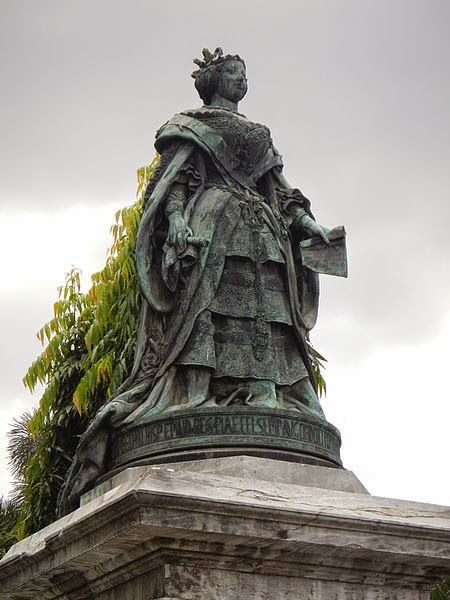
Queen Isabel II statue, Intramuros
In 1821, with the independence of Mexico, The Philippines seemed to be under the jurisdiction of the Viceroy of New Spain and were from then on under the direct oversight of the government in Madrid. The royalist struggles in Spain between the Carlists and Cristinos also reached all the way to The Philippines though not in a violent way. In the 1850’s the people of Manila donated money to erect a statue of Queen Isabella II of Spain which was placed in what is now Lawton Plaza in 1860 (what was then near the Alfonso XII theatre). This statue became very symbolic of the monarchy in general in The Philippines. In the “Glorious Revolution” of 1868 Queen Isabella II was overthrown and a very liberal Governor-General of The Philippines was appointed named Carlos Maria de la Torre (according to one source he had been a Carlist but, if so, his politics must have changed dramatically). He wanted all traces of the former monarchy removed and ordered the statue destroyed, however, the man entrusted to do the job was a loyalist and hid it away instead. Although he proved to be exceedingly popular with the local population, the Governor-General was replaced with Rafael de Izquierdo y Gutierrez in 1871, appointed by the new Italian King of Spain Amadeo I. He preferred the “iron fist” to the “velvet glove” of his predecessor.

Prince Yamagata Aritomo
Insurgents rose up again and began to increasingly become better organized and more politically astute during what would prove to be the last years of the reign of the Spanish Crown over the Philippines. What has become known as the Philippine Revolution began and only intensified as the years passed. Yet, not every agent of the King of Spain was harsh in his dealings with the Filipinos. Governor-General Ramon Blanco is an example, a man who tried to be lenient with the rebels. However, local conservatives forced him out of office and when the rebel leader Jose Rizal was killed by royalist Filipino troops the former Governor-General took his sword and sash and presented them to the rebel leader’s family as an apology for their loss. Yet, again, no government recognized the Filipino rebels and during this time of difficulty for Spain there were numerous other powers that envisioned taking The Philippines for themselves. The two who seemed most eager were the Empires of Germany and Japan. In 1894 Prince Yamagata Aritomo, later Prime Minister of Japan, offered the Spanish 40 million pounds sterling to sign over ownership of the archipelago to the Japanese. During the Spanish-American War, the German East Asian Squadron kept a close watch on the conflict at Manila in case any opportunity should present itself for Germany to step in and take control of the Philippines.

The child King Alfonso XIII would be the last monarch The Philippines would ever have. Unrest continued to grow, aided in no small part by the number of people from Latin America who came to the islands whether in private occupations or in government positions, bringing with them a background in republicanism and opposition to Spain. Despite the best efforts of the Queen-mother, acting as regent, in 1898 war broke out between Spain and the United States, mostly over American support for the rebellion in Cuba. The Philippines was a place hardly anyone in America had ever heard of or thought about. Yet, during the war it stood out as an inviting target. Spanish control had been pushed back practically to the walls of the old city itself, (known as Intramuros) in Manila. After a brief battle, mostly a show for honor’s sake, the Spanish surrendered and, so to speak, tossed the Americans the keys as they were leaving. The Spanish flag was lowered, never to be raised again and, to the frustration of the Germans and Japanese, the United States stepped in as the new colonial power, the Spanish being paid about $20 million for their lost territory.

King Juan Carlos in the Philippines
That was the end for monarchy playing a national part in The Philippines. The rebel government of Emilio Aguinaldo declared independence (as a republic) the same year the Spanish-American War started but neither the U.S. nor any other power recognized his government and after American troops were attacked by Filipino rebels it was the start of another brutal counter-insurgency campaign. The only other brush with monarchy that The Philippines would have was during World War II when the country effectively became a colony of the Empire of Japan. Though a collaborationist regime was in nominal control there was no doubt that the Japanese were really in charge. Yet, oddly enough, The Philippines is probably the only country that counts itself amongst the Allies that regards its collaborationist regime as being legitimate, something the Japanese have always pointed to as proof that the Filipinos remain fond of their time within the Empire of Japan (the situation would be similar to the King of Norway recognizing Vidkun Quisling as a legitimate prime minister for comparison). Shortly after the war, as a republic of course, The Philippines finally became an independent country.

Queen Sofia during her most recent visit to The Philippines
Fortunately, relations between The Philippines and the Spanish monarchy have improved since the colonial era. In 1974 Prince Juan Carlos and Princess Sofia, on behalf of the government of Generalissimo Francisco Franco which they were soon to succeed, visited the Philippines and were received by President Ferdinand Marcos. The statue of Queen Isabella II, which had narrowly avoided destruction in the 1860’s had been put on display again in 1896 at the Malate Church in Manila. It was blown down by a typhoon in 1970 but five years later, on the occasion of a visit by King Juan Carlos, it was restored and put on display again, this time at the Isabel II gate to Intramuros where it still stands today as an illustration of the restoration of friendship with the Spanish monarchy. Members of the Spanish Royal Family have visited a number of times since, Queen Sofia making her fourth visit to The Philippines in 2012. Ties between Spain and The Philippines have increased over the years but solely in the areas of history and culture rather than politics with the only active royalist presence in the islands being those attached to the Islamic former states that pre-dated Spanish rule.

Friday, May 15, 2015

Mystery and Treachery: Bulgarian Monarchy in World War II

World War II changed Bulgaria more than any other event in Bulgarian history. It certainly brought about the biggest change ever since the era of Turkish rule and the modern, independent Bulgaria that came into being after. The war changed many countries and, also like many others, Bulgaria never really wanted anything to do with the war. The monarch of Bulgaria, King Boris III (or officially “Tsar”), hoped to sit out the conflict, watching from the sidelines. However, the country was, perhaps inevitably, caught up in the cataclysm. As with several countries, it started out as a member of the Axis powers but later joined the Allied nations before the conflict was over. There were a great many divisions inside Bulgaria concerning the war. Some wanted to join in, others did not. Some favored the Axis, others favored the Allies. The story of Bulgaria in World War II is the story of a monarch who tried to walk a very thin line to do what was best for his country in a dangerous time as well as the story of a people who were naïve and that naivety cost them their freedom at the hands of the country that had once liberated them. This is that story.

Crown Prince Boris w/ Marshal Mackensen in WW1
As with almost everything involving World War II, the roots of Bulgarian problems go back to World War I in which Bulgaria, as one of the Central Powers, was defeated and forced to cede territory and pay reparations. Crown Prince Boris served in the First World War and with distinction but the loss had a destabilizing effect on the whole country. In 1918 King Ferdinand I was forced to abdicate and King Boris III came to the throne of a country which was impoverished and seething with resentment. The communists and the Agrarian Union wanted to abolish the monarchy, there was a military coup, a series of assassinations, assassination attempts and terrorist attacks as well as a brief war with Greece in the early years of the reign of Boris III. The country desperately needed peace, calm and order but there were many factions eager to cause trouble. The communists wanted a revolution and a socialist republic while many in the military wanted a dictatorship to wipe out all troublesome elements. There were also those who, naturally, wanted to regain what had been lost as a result of their defeat in World War I and during the inter-war years in Europe there were plenty of examples to follow.

Under similar conditions, Benito Mussolini and his Fascist Party had come to power in Italy. Political divisions were eliminated, law and order was restored and, as everyone knows, even the trains ran on time. More recently, Adolf Hitler and the Nazi Party seemed poised to assume total control over Germany. They too promised to end the threat of communist revolution, civil disorder and a redress of grievances from World War I. Many Bulgarian military leaders took inspiration from all of this and, shortly before Hitler did come to power in Germany, they led a successful coup in 1934 that effectively made Bulgaria a military dictatorship under Colonel Kimon Georgiev, leader of the Zveno or “link” organization that called for a union with Yugoslavia. King Boris III was reduced to being a ceremonial figurehead but that situation was not to last long. The Bulgarian monarch was not the sort of man to allow himself to be sidelined and do nothing about it. The following year he organized a royalist counter-coup that ousted Georgiev and replaced him with the monarchist General Pencho Zlatev as prime minister. Later, a civilian but still a loyal monarchist, Andrei Toshev, replaced him.

Queen Ioanna & the King wearing Italian decorations
For the moment, the situation seemed to be under control and a sense of normalcy seemed, at least, to be returning. King Boris III presided over a period of peace and increasingly prosperity that lasted for about five years, until the onset of World War II. The King was very much in control of things and he is due the largest share of credit for how well Bulgaria did in that time. Parliamentary government was restored but without the divisive political parties that seemed to be nothing but trouble. However, the monarchy still had its enemies, kept down but still there, biding their time. The great accomplishments of Boris III kept them sidelined, to their frustration. In 1930 he had married Princess Giovanna of Italy, daughter of King Victor Emmanuel III, giving the country some much needed color and celebration after so much hardship. In a meeting suggested by King George V of Great Britain, King Boris III met with King Alexander of Yugoslavia and worked out a reconciliation after tensions arose between the two countries over Macedonia. Everything seemed to be good in Bulgaria and only set to get better when the war intervened.

At first, King Boris III declared neutrality. There was no real consensus as to which side Bulgaria should join if it did fight. The King famously said, “My generals are pro-German, my diplomats are pro-British, my queen is pro-Italian and my people are pro-Russian.” However, the war crept ever closer and the Axis powers held out a number of temptations to win Bulgaria over such as reclaiming lost territory from Romania, Yugoslavia and Greece. At first, Hitler did not ask for Bulgarian involvement in the war but simply the right to establish bases for the German air force in Bulgaria and for German troops to move through the country in order to get at actual enemies like Greece and Yugoslavia. The King agreed and, at first, everything seemed to work out. Bulgaria gained territory without actually having to fight. However, things would change dramatically in the pivotal year of 1941. In that year Hitler launched the Axis invasion of the Soviet Union. Alongside the Germans, Finns, Italians, Hungarians and Romanians would participate (as well as smaller units from countries as far away as France and Spain) but Bulgaria refused to take an active role in any hostilities against Russia. Needless to say, Hitler was not best pleased.

King Boris III in World War II
The Bulgarians had long regarded Russia as something like a big brother. A fellow Orthodox, Slavic country, the Russian Empire had come to their rescue when they were being oppressed and persecuted by the Turks. The Russian Empire was largely credited with making Bulgarian independence from the Ottoman Turks possible and the Bulgarians did not forget that. However, the Russian Empire was a world apart from the Soviet Union and perhaps too few people in Bulgaria fully realized the importance of that distinction. In time, to their terror, they would find out all too well. Aside from refusing to take part in the war against Stalin, King Boris III infuriated Hitler in other ways as well such as his staunch refusal to allow the deportation of any Bulgarian Jews from his country for Nazi labor or death camps. So as not to infuriate Hitler to a point detrimental to his own country, Boris III did agree to join Germany in declaring war on Great Britain and the United States (Hitler had actually declared war on the U.S. immediately after the Japanese attack on Pearl Harbor, saving FDR the trouble of trying to explain to the American people why they needed to go to war with Germany after being attacked by Japan).

The United States was rather shocked by this, having no animosity toward Bulgaria and having previously refused to declare war on the country in World War I. Everyone believed that the Bulgarian declaration of war was the result of German pressure and so held off from retaliation. However, FDR finally decided that the situation demanded a response in kind and so, belatedly, declared war on Bulgaria in the summer of 1942. The following year, Sofia would be bombed by Allied air forces. However, Bulgaria was also in a difficult position with her Axis partner Germany. Hitler had been content to allow Bulgaria to sit out the war against Russia at first but in 1942 the tide began to turn and the Nazi dictator became increasingly difficult to deal with. In August of 1943 he demanded that King Boris III come see him and on that visit the Fuhrer launched a verbal tirade against the Bulgarian monarch demanding that he make a greater contribution to the Axis war effort. For hours Hitler ranted and cajoled but, after returning home, King Boris III remarked that he felt he had been successful in his resistance and keeping Bulgaria free of German control.

The worst of allies
However, one of the enduring mysteries of World War II emerged a couple of weeks later when King Boris III died on August 28, 1943 at the age of only 49. Officially the cause of death was listed as, “a thrombosis of the left artery to the heart, double pneumonia and a cerebral congestion” but not everyone was buying it, including the late tsar himself. He had returned to Sofia on August 17 and seemed to be fine. He took a week off, did some mountain climbing and it was not until four days after his returning that he began to complain of dizziness. By August 23 he was feeling worse and began to suspect that his staunch resistance to Hitler’s demands had prompted the Nazis to slip him a dose of slow-acting poison. Shortly after this he began vomiting and within days was dead. Many people to this day believe the German dictator assassinated Boris III. Yet, there is evidence to suggest otherwise. Hitler, while certainly not being above such methods, did not have a record of poisoning people; the Nazis were usually not so subtle. Also, on the flight back from Bavaria the King had complained that his oxygen mask had malfunctioned and, in the days of non-pressurized cabins in airplanes, flying at such a high altitude with faulty breathing equipment may have been to blame. However, enough questions remain to allow room for speculation.

For the Bulgarian Royal Family, the death of Boris III was the beginning of the end. It was also in 1943 that the King of Italy had dismissed Mussolini and sought an armistice with the Allies. This made the Germans all the more suspicious of the Bulgarians whose queen was the daughter of the King of Italy they considered a traitor to the Axis cause. She, Queen Ioanna (as Giovanna was called in Bulgaria), her daughter and her six-year-old son recently proclaimed King Simeon II were effectively prisoners in their own home at the hands of the Germans. However, even that was not expected to last long with the German forces on the Eastern Front crumbling and the Soviet Red Army pushing ever closer to the Bulgarian frontier. The Queen devised a plan to escape with her children to Syria, via Turkey, with a regency council holding power under Prince Kyril. There was never a chance to pull it off though. In 1944 the Red Army marched into Bulgaria after treacherously declaring war on the country that had gone to great pains to avoid giving Russia any cause for offense. Their advance was not resisted and opposition groups, the Agrarian republicans, communists and the “link” rose up against the monarchy at the same time, taking advantage of the situation. The regency was disbanded and (a year later) all its members were executed. About 200 would die in the overall purge.

King Simeon II of Bulgaria
World War II was over but the suffering had only just begun for Bulgaria. One thing was made abundantly clear to them: the Soviet Union was not their friend. The following year a referendum was held, under the guns of the Russian Red Army, which produced an overwhelming majority in favor of abolishing the monarchy and establishing a socialist republic. The boy-king, his mother and sister were all promptly exiled without little King Simeon II signing an instrument of abdication. No one seemed to think about it and it allowed Simeon II to assert his legitimate status as King of Bulgaria while in exile. For Bulgaria, their first republican dictator was a Soviet citizen, their first republican constitution was a direct copy of the Soviet constitution of 1936. Religion was banned or severely restricted, thousands were massacred and any dissent was brutally suppressed. Bulgarian leaders fought for power but the winner had to be approved by Moscow. All of this was a legacy of World War II as was the fact that, after the fall of the Soviet Union, Bulgaria petitioned to join NATO and was accepted in the fifth enlargement in 2004. Naturally, Russia was offended by this but the roots of the decision go back to the fact that Bulgaria had been invaded and brutalized by Russian forces when previously no other people had been more pro-Russian than the Bulgarians. The western Allies had their own acts of betrayal but for the Soviet Union the case of Bulgaria was probably the most treacherous act, simply because the people had been so sympathetic to Russia and Bulgaria had been so adamant to take no hostile action against the Soviet Union. Having plenty of company in the ranks of the betrayed likely does little to lessen the pain.

Tuesday, May 12, 2015

Monarch Profile: King George IV of Great Britain & Ireland

HRH Prince George Augustus Frederick was born on August 12, 1762 the first of fifteen children born to King George III and Queen Charlotte of Mecklenburg-Strelitz. Within days he was given the title Prince of Wales and as he grew up he fit into what seemed to be a pattern for royals of the House of Hanover and British monarchs in general with eldest sons having an antagonistic relationship with their parents as well as the way monarchial parents and royal heirs seemed to alternate between those who held firmly to traditional family values (George III, Victoria, George V) and sons who lived a ‘playboy’ lifestyle (George IV, Edward VII, Edward VIII). While his father was the first Hanoverian monarch in Britain who was faithful husband, was very disciplined, upright, frugal and so on, the Prince of Wales began to show opposite characteristics as soon as he reached adulthood. As soon as he gained the first degree of freedom from his parents, he showed a great fondness for food, drink, women and lavish living. However, like others that would come after him, these qualities did not make him terribly unpopular with everyone. He had qualities that were to his credit as well and was known to be a charming, likeable fellow.

As a child, the Prince of Wales proved himself to be a quick study and very bright. He would be the second Hanoverian monarch to speak English as his first language but he was also proficient in German, French and Italian. He was witty and a great conversationalist, the sort of man who seemed able to talk easily with anyone about anything. He had an informality that put people at ease while, in his younger days at least, a regal bearing that impressed people. His appearance was to change dramatically over the years but in his youth few failed to remark on how handsome he was. Tall, dignified and charming, he had a presence none could forget, only lady (a mistress) remarking on, “the grace of his person, the irresistible sweetness of his smile, the tenderness of his melodious yet manly voice”. However, his fondness for drink and over-eating left him increasingly overweight by his mid to late thirties. Earlier than that his high living and over-spending left him heavily in debt and thus increasingly at odds with his very frugal father. By the time he was fifty years old the descriptions of his appearance were the total opposite of what they had been in his youth. He could charm women and in the company of men could easily seem ‘one of the boys’ but when it came to the tensions with his father, he could display a cruel streak. Aside from his lifestyle, father and son disagreed over politics as well.

Probably more out of an urge to rebel and assert his independence from his father rather than genuine ideological agreement, the Prince of Wales openly associated himself with the very leftist and even anti-monarchial opposition leader Charles James Fox. During the American War for Independence, Fox and his clique openly took the side of the rebels, condemning the King and parading about in the blue and buff colors of the continental army. If the Prince of Wales only associated with Fox as a way to annoy his father, Fox likewise had little genuine use for the Prince as well. He disliked monarchy altogether but saw in the Prince of Wales someone he could use to gain power and who could be duped into helping him wreck the political establishment in Britain. However, the Prince of Wales was not the dupe Fox thought he was, as would be proven in due time. First, however, the Prince had to get through his first, really serious, scandal which arose from his love life. Yet, it was not because of the succession of mistresses he had but rather one woman who was actually one of the best things to ever happen to him and who just might have changed the course of his life.

The woman in question was Maria Fitzherbert, who was five years older than the Prince and a Roman Catholic. Where all else had failed, she actually succeeding in altering his habits. A very upright woman, she firmly refused to be his mistress. This put the Prince in a difficult situation as he was totally smitten with her and would do anything to have her. Maria made it clear that the only way that would happen is if they were properly married in the eyes of God. So, the Prince of Wales grabbed a churchman from debtor’s prison (promising him a bishopric when he became king) and had him married to Maria Fitzherbert. This may have made them husband and wife in the eyes of God (and they lived as such after that) but according to British law in had no validity as the King had not consented to the marriage and there was certainly no way he would have ever given such consent for the heir to the throne to marry a Catholic. For the Prince of Wales, he genuinely loved Maria but he was not a faithful man and soon left her for his next mistress (Lady Jersey). However, the fact that he went through a religious marriage with Maria would cause him problems for some time to come.

When the Prince of Wales did legally marry it came about not because of romance but because of his mounting debts. The King was absolutely opposed to any increase in his allowance because of his lavish spending. However, Parliament finally agreed to cover his debts if he would settle down and get married. So, in 1795, he agreed to marry his cousin Caroline of Brunswick. It was hardly a match made in Heaven. Bride and groom were repulsed by the other and the Prince was drunk at his own wedding (perhaps the only way he could go through with it). After the birth of their first child early the following year, a daughter, the two lived apart. Meanwhile, the Prince of Wales was becoming more critical to national life as King George III began to show signs of madness, actually the first symptoms of porphyria. As the behavior of the King became more erratic, more looked to the Prince of Wales for leadership. Yet, for some, the Prince seemed all too eager to snatch power from his father. He did himself no favors by associating with the opposition, mocking the King, spreading embarrassing stories about him and even speaking (though surely not seriously) about a sort of palace coup to seize the royal powers for himself. Despite rallying for a time, eventually the mental state of the King became such that he had to be set aside and the Prince of Wales was appointed regent to act on his behalf in 1811.

With his achievement of power, the Prince of Wales did not immediately become the creature of the Whigs as many had expected. The Tories continued in power and continued the vigorous prosecution of the war against Napoleon. He presided over the War of 1812 with the United States, signed the peace ending that conflict and he saw Napoleon finally defeated at the Battle of Waterloo. So central did that battle become to the British national narrative that the Prince Regent seemed to genuinely convince himself that he had actually been present on the field that day, which of course he was not. The final peace achieved at the Congress of Vienna saw the British Empire in a very strong position with new footholds around the world and the elevation of Hanover to a kingdom. In 1820 King George III passed away and, at 57, the Prince Regent came to the throne as King George IV. The occasion was marked by what was probably the most lavish and grandiose coronation in British history. Although some groaned about the huge expense, the people enjoyed the occasion and the grand style of George IV symbolized a British Empire that had emerged victorious from the French Revolutionary Wars and was growing around the world.

There was plenty of criticism during the rather short ten-year reign of King George IV for his personal habits, his spending and his interference in politics. That, however, should be kept in perspective. The criticism of his personal life was mostly accurate but his political meddling was mostly due to incorrect assumptions based on his previous association with the Whigs. In fact, he largely stayed out of politics and the era of royal involvement in government seen during the reign of his father stopped and the era of royal non-interference had begun with George IV (or resumed from the first two Georges). However, that fact alone meant that when he did involve himself in political matters, particularly to carry on certain policies of his father (such as blocking Catholic emancipation) caused it to stand out more than it should have. There was also more to the man than the drunken glutton portrayed in the press. Many consider him the most intelligent of the Hanoverian monarchs and, when he was sober, he could demonstrate his knowledge, wit and uncanny memory.

Surely the greatest contribution made by King George IV was in his great sense of style. He left the country far more grand than he found it. Many of the most famous landmarks of Britain are attributable to King George IV. Whereas his predecessors had lived more simply in the German style, George IV seemed more reminiscent of the great patrons of the arts from the Stuart era. He restored Windsor Castle and rebuilt the Royal Lodge (lately the home of the Queen Mother). Brighton Pavilion was probably his most grandiose architectural achievement, built in an Oriental style it had Near Eastern exteriors, Chinese interiors and it still stands as a monument to the cosmopolitan nature of the British Empire. It also turned Brighton from a largely overlooked community to a major holiday center. The King stayed there often and after 1800 lived again with Maria Fitzherbert who still regarded herself as his wife, in the eyes of God if not in the eyes of the law. Although not often known, she did help him considerably, nursing him back from a stomach ailment and managing to get him to cut down on his drinking. Whenever they were together she proved to be very good for him. His unstable legal wife, Caroline of Brunswick, had left the country to live a rather scandalous life in Italy only to return at the time of his coronation to claim her place as queen. She was turned away at the doors of Westminster Abbey and died in 1821. He had tried to divorce her but was told that to do so would throw into the public much about his private life that would do no one any good. So when Caroline died she at least died fairly popular with the public who had no idea of what she was really like, having most of the same disgusting habits as her husband but without anything like his winning personality.

During his reign, King George IV moved considerably to the right from where he had been in his rebellious youth when aligned with Fox. Once the responsibility of royal leadership was fully on his shoulders, George IV realized that the type of ideas espoused by Fox would lead to anarchy and the sort of revolutionary chaos seen in France. Because of this, the Whigs viewed him as a traitor to their cause and would never forgive him for it. However, he was not the sort of man to put up much of a fight in the political arena. By the time he was actually King, with a lifestyle that had aged him beyond his years, he preferred to avoid confrontation whenever possible. As a result, he often promised one group his support on a certain issue only to fail to give it when it seemed there would be resistance. This left him with an untrustworthy reputation that caused most to try to avoid him. He was secluded most of the time but when he did make public appearances he could still awe a crowd with his magnificent fashion sense and showed that he could still display the regal bearing and dignity of his youth, despite his increased years and even more increased waistline. He could still win people over and, while often discounted, his highly choreographed visit to Scotland (the first such royal visit since the Stuart era) did help bring the United Kingdom more closely together.

In the final years of his reign, as his health declined, George IV seemed to be increasingly out of touch with reality. He devoted his time to planning further even more grandiose building projects, none of which were to ever see fruition. He might also talk at length about his imagined exploits at the Battle of Waterloo where his imaginary role became ever greater and more heroic. He also became much more religious at the very end of his life and that end finally came on June 26, 1830 at the age of 67 at Windsor Castle. Despite all the criticism of his habits and private life, he had not been a terrible monarch even though he was certainly not a great one. The tragedy is that he could have been so much better. He had the intelligence and he had the presence to make for a great monarch but he lacked the discipline and work ethic. As it was, he seemed to be marking time until he was succeeded by his younger brother the Duke of Clarence (King William IV) who himself is often seen as a placeholder until the accession of Queen Victoria. He had many faults but his reign was certainly not a disaster and, if nothing else, George IV at least left behind a country with a few more beautiful buildings and a finer sense of style because of him.

Sunday, May 10, 2015

The Betrayal of Yugoslavia

More than one Balkan monarchy was treated with great injustice during World War II. However, the betrayal of the Kingdom of Yugoslavia stands out because of the extent to which the Allied powers were involved in both the start of the expansion of the war into that country and then its abandonment to the forces of revolutionary communism. The story that most people have heard about Yugoslavia in World War II is that Germany invaded the country so that Hitler could rush to the aid of his partner Mussolini whose rash invasion of Greece had ended in disaster. This is what most people have been told. Mussolini ordered an invasion of Greece, for no better reason than to keep pace with Hitler’s conquests, the Italians were beaten and, in danger of collapse, Hitler had to invade Yugoslavia in order to rush to the aid of Mussolini, crushing Greece and so securing his southern flank in preparation for the Nazi invasion of the Soviet Union. That is the story but it is almost entirely untrue. There was no urgent need for German involvement in Greece but, rather, British actions in Yugoslavia prompted the Axis invasion of that country.

Prince Paul with Adolf Hitler
Hitler had absolutely no interest in intervening in the Balkans until British agents arranged the overthrow of the Prince-Regent Paul, replacing him with the young King Peter II who would take Yugoslavia into the Allied camp. It was the removal of Prince Paul that prompted Germany (and Italy and Hungary) to invade Yugoslavia. Prior to this, every other power in the Balkans was either aligned with the Axis or at least desired to stay out of the war. That was all Hitler cared about; that they would not join with his enemies or endanger his expansion to the east. Prince Paul of Yugoslavia had taken his country into the Axis camp and when he was overthrown by a group of pro-Allied officers, supported by Britain, and replaced by King Peter II the German dictator took immediate action. Because of this, no Yugoslav royal has suffered such undue criticism as Prince Paul. That is a gross injustice that should be addressed at the outset. Despite how he was later portrayed by the Allies, Prince Paul was not some sort of Nazi sympathizer. His actions in joining the Axis camp have to be seen in context. He did it to specifically avoid conflict for his country and not because of any ideological admiration.

Prince Paul was actually much more pro-democracy than the previous monarch, King Alexander I, had been. When World War II broke out, he declared Yugoslavia to be firmly neutral and he took Yugoslavia into the Axis but he did so on three specific conditions, all aimed to keep Yugoslavia from actually playing any part in the war. When seen in context, these conditions and his actions in joining the Axis all make perfect sense. It must be remembered that there were numerous neighboring countries who had designs on Yugoslav territory (an unavoidable consequence of the way it was cobbled together after World War I). In the south were lands Bulgaria thought should belong to them, the same for Hungary in the northeast. Historically Italian areas in the west were also a potential cause of trouble. Prior to the conflict, the Italian military had most expected the next war Italy fought would be against Yugoslavia and Mussolini had given support to the Catholic Croatians who wanted to declare independence from Yugoslavia.

Prince Paul of Yugoslavia
To block the Hungarians from trying to reclaim lost territory and prevent a restoration of the Hapsburgs, Yugoslavia had formed the “Little Entente” alongside Romania and Czechoslovakia, backed up by the French Republic. However, by the outbreak of World War II, Czechoslovakia was gone and France was soon defeated as well and thus in no position to provide any assistance to these Balkan countries. As such, the only option Prince Paul had was to come to terms with Germany so as to prevent Hungary or Italy from taking any action against Yugoslavia. So, Prince Paul agreed to join the Axis on three conditions which reveal exactly what his priorities were. Those three conditions were that the Axis guarantee to respect the current Yugoslavian borders, that Yugoslavia not be called on to render any military assistance to the other Axis countries and that no Axis military forces could be transported across Yugoslavian soil. Obviously, this was an agreement to “join” the Axis that would effectively guarantee that Yugoslavia stayed out of the Axis war effort entirely while preserving their territory and independence. What is more, Prince Paul was obviously more pro-Allied than he was pro-Axis. He continued to be supportive of the French (as long as they lasted) and when Italy invaded Greece he actually sent aid to the Greeks.

Nothing could be more obvious than that Prince Paul was no Nazi or Fascist sympathizer. He wanted to stay out of the war and preserve his country the way it was. However, not all of the Serbian military agreed and the British were quick to encourage them. They did not want Yugoslavia to sit out the war but to join it on the Allied side. This was really quite a despicable thing for the British government to do since there was no realistic way they could support Yugoslavia in the war. Nazi Germany blocked any assistance from coming across the continent and, after the Italian occupation of Albania, Mussolini controlled the entrance to the Adriatic and so could block any help from the sea. The military may have pulled off the coup in any event but what the British were thinking in encouraging and supporting it is hard to fathom. It was the same sort of thinking that led to the humiliating fall of the Kingdom of Norway as but one example. Nonetheless, it happened on March 27, 1941 when a group of air force officers led by General Dusan Simovic forced Prince Paul to resign and go into exile in Greece. There was jubilation in some quarters and Churchill was certainly pleased but this was the start of a long period of suffering for all of the peoples of Yugoslavia and, effectively, the end of the Serbian monarchy.

King Peter II of Yugoslavia
At the time of the coup, the slogan that war was preferable to the Axis pact was not uncommon. Preferable or not, war is what Yugoslavia would have and an infuriated Hitler immediately ordered his military to take action. Belgrade was bombed and young King Peter II left the city and prepared to leave the country. No one with any grasp at all of military matters thought Yugoslavia could survive. German troops poured in from almost every neighboring country, two Italian armies committed forces to the operation, driving down the coast and, after a week, the Third Hungarian Army moved in to re-take the lands that had been part of Hungary before World War I. Britain tried to assist but it was a hopeless cause and as soon as the invasion began, ethnic uprisings began to break out, particularly in Croatian areas which had never been happy about being included in Yugoslavia in the first place. In short, the Royal Yugoslav military was beset from all sides, front and rear with almost no help and no means of retreat. It was a complete and utter disaster. Hundreds of thousands were taken prisoner by the Germans, almost the entire navy was capture by the Italians and on April 14 the Yugoslav high command realized the game was up. On April 17 the unconditional surrender was signed. Yugoslavia had been conquered in eleven days. The suffering would go on for much longer.

The unfortunate Prince Paul was taken into custody by the British and held in house arrest in British East Africa (Kenya) for the remainder of the war. King Peter II went eventually to London (via Greece, Palestine and Egypt) where he finished his studies and joined the British Royal Air Force as well as serving as titular head of the Yugoslavian government-in-exile. At home, Yugoslavia was divided among the Axis forces. Macedonia went to Bulgaria, formerly Hungarian lands were annexed by that country, coastal areas were occupied by Italy, Serbia was occupied by Germany and the Independent State of Croatia was proclaimed by Ante Pavelic. Some supported the Axis forces and others carried on armed resistance. The two primary resistance groups were the royalist Chetniks who continued to fight for King Peter II and the communist partisans led by Tito. In addition to fighting the occupying forces these two groups carried on a bitter civil war within the World War against each other. This is something which has attracted some criticism (invariably aimed at the Chetniks and never the communists) but it was, from a purely Yugoslavian point of view, the conflict that should have had priority. After all, no matter how successful they were, they were not going to win the war against the Axis powers all by themselves. That was up to the Allies. However, the outcome of the civil war would determine if Yugoslavia would survive, whether the former kingdom would continue or whether a Marxist dictatorship were established.

Chetniks flag
The guerilla war between the occupation forces and the resistance as well as the civil war between the communists and royalists was intensely vicious. It was a brutal, confused, bloody situation with numerous factions and numerous agendas at work. However, ultimately, the Allies decided to sell-out the royalist Chetniks of Yugoslavia in favor of the communists. Prime Minister Churchill and U.S. President Roosevelt agreed that Eastern Europe would be the domain of the Soviet dictator Joseph Stalin. Of course, there were promises that national sovereignty would be maintained and democracy would be assured but it would all be done under the supervision of the Soviet Red Army so there should not have been any doubts about what the future of these countries would be and that included Yugoslavia. Young King Peter II was effectively abandoned by his own allies and was himself, in turn, forced to abandon the hard-fighting royalist Chetniks who had been carrying on the war, fighting in his name, against the occupation forces. The Soviets, of course, had been supporting the communist partisans all along but after this agreement the Anglo-Americans shifted their support to the reds as well, giving them every advantage over their royalist adversaries. (Feel free to read past articles about the Chetniks and their commander)

This also coincided with a new strategic plan for the Allies. Consideration had been given to a more massive Allied invasion of southern Europe but Stalin objected to the plan. He wanted it all left to his forces and preferred for the British and Americans to invade Western Europe, opening a new front there to draw German forces away from his advancing Red Army. The Allies abandoned Yugoslavia, along with the other Balkan countries (save Greece which Britain had an interest in) and Eastern Europe as a whole to the monstrous Soviet regime. They abandoned the Chetniks who they had originally supported and who had fought for years, including launching very successful raids against Axis forces on their behalf. It is little wonder, given the situation, that some Chetniks (though not all) decided to join with the Germans and Italians who would at least help them resist the communist partisans. Their reputation has never recovered from this, and it is unfortunate but it should be remembered that it was the decision of the Allies which made the Axis powers the only option left for the Chetniks.

King Peter II in the RAF
King Peter II himself was forced to sell-out his most ardent supporters and give rank to Tito and his communists, though naturally they declared him deposed as soon as the war was over to create their socialist republic in Yugoslavia. It is no wonder that King Peter II had such a sorrow-filled life. Forced into the war by pro-Allied officers, Yugoslavia was swiftly conquered, occupied and dismembered by the Axis powers only to have the loyal, royalist troops still carrying on the struggle betrayed by the Allies who effectively handed over the country to the communists. As it turned out, they were communists who refused to be subservient to Stalin but their regime was no different from any other Bolshevik tyranny in its horror and ineptitude. King Peter II, understandably extremely bitter about how the Allies had treated his country -particularly the other monarchies of the Allied nations- later moved to the United States and tried to drown his sorrows. He died of liver problems in Denver, Colorado in 1970. The first royal victim of betrayal, Prince Paul, suffered as well. The communists declared him an enemy of the state, confiscated all his property and wanted to put him on trial as a “war criminal” (really absurd considering he played no part in the war and was overthrown because he wanted to stay out of the war). He avoided that fate but spent the rest of his life in exile, unjustly maligned and unfairly portrayed as some sort of Nazi-sympathizer until he died in Paris in 1976.

Looking back, it is easy to be critical of what the Allies did. We are not in the middle of a world war. However, some criticism is justified. Britain and France, as it turns out, entered into a war with Nazi Germany that they could not win on their own. That was their choice. To involve Stalin in the war as a member of the Allied nations, however, was not their choice. That choice was made by one Adolf Hitler when he invaded the Soviet Union in 1941. From that point on, Stalin was going to have some part to play in Eastern Europe whether his other Allies liked it or not, providing the Axis forces were defeated of course (which they were). Even so, what happened to Yugoslavia was a betrayal. Some have tended to exaggerate the role of Britain in the coup that brought down Prince Paul. It was an entirely Yugoslavian affair, however, Britain supported it and perhaps the YRAF officers would not have been so keen on the idea if Britain had not been or had been more realistic about what tangible assistance they could offer when German, Italian and Hungarian troops came surging across their borders. Even so, what happened to Yugoslavia was a betrayal. Finally, the agreement that consigned Eastern Europe to Stalin was not supposed to include the establishment of puppet dictators in every country. Even so, Churchill and FDR should have known better than to think that Stalin would allow other peoples privileges he refused to his own.

A King betrayed
Unlike other countries in the region, the Allies supported Yugoslavian royalists getting into the war, supported them actively during the war only to withdraw that support in the midst of the conflict, transfer it to their enemies and then consigned them to the communist sphere of influence when it was over. None of these things had to happen. If there had been no coup, Yugoslavia might have remained a nominal member of the Axis but effectively neutral and untouched for the duration of the conflict. There likely would have been some problems but it is at least possible. The Allies could have also taken a tougher stance on Soviet involvement in the region. They had a powerful bargaining chip in the form of the vast amount of (mostly American) supplies, weapons and equipment going to the USSR to sustain the Russian war effort. They could have easily told Stalin that if he had such surplus material to send aid to the communist partisans, he must not need so much from Britain and the United States and by that means curtailed the help going to the reds and ensured that only the royalist resistance fighters were supported. Of course, there are always circumstances and problems. War is ugly business and everyone understands that but the fact remains that the Kingdom of Yugoslavia and the hard fighting royalists of that country who were carrying on the fight were betrayed by the Allies, by their allies, and that fact, as well as the fate that befell the tragic King Peter II, is something everyone should recognize as shameful.

Thursday, May 7, 2015

Conflicts that Impacted the Cause of Monarchy

It is a simple fact of the human condition that the most major changes in the world often coincide with the most major conflicts. The history of monarchy is no different. While it does not benefit to dwell on it, most monarchists are aware of the obvious fact that the institution has been on the decline in the recent eras of history. Since monarchy was the natural form of government that developed spontaneously all around the world, this is really no surprise. Where do you go from ‘up’? For most of human history, monarchy was not something that most people fought about. It was something that was accepted and monarchies fought each other for various reasons but rarely fought over the issue of monarchy itself. However, there have been some conflicts that have proven critical to the success or failure of monarchy as an institution, as a form of government. Some of these I have considered will be obvious and expected but others are probably less well known. There have also been some conflicts which many have assumed have had a great impact on monarchy but which, in fact, have actually had a negligible impact on the cause of kings.

One which had an impact far out of proportion to its scope was the English Civil Wars. Even though the republican dictatorship of Cromwell ultimately failed and the monarchy was restored, the English Civil Wars did lasting damage to the monarchist cause. For one thing, political realities pushed most of the monarchies of Europe into recognizing the Cromwellian regime and so set the precedent for monarchies at least making peace with if not actively allying with a regicidal, anti-monarchial republic. The republican victory also provided an example that was taken up by others in the world, most significantly numerous of the “Founding Fathers” of the United States of America. Even though the republican dictatorship of Cromwell failed, the fact that his Roundheads were victorious on the battlefield was immensely significant. Because of this, even after the restoration of King Charles II, the anti-monarchy crowd never felt themselves beaten, never accepted defeat and so continued to hold the horrific image of the fate that befell Charles I before the eyes of his sons until Britain went through the so-called “Glorious Revolution” of 1688 when the nature of the monarchy was so fundamentally changed that the legacy continues to this day. It set a precedent, by events it set into motion, for the supremacy of parliaments over the Crown in fact even if not always in name.

As for the so-called “American Revolution” (more correctly the American War for Independence), the effects of it on the cause of monarchy has been considerable but probably not as significant as most think. Its importance tends to be exaggerated for two reasons; American hyper-patriots who like to think that the world revolves around the United States and everyone follows their example and longs to be just like America and, ironically, the anti-American crowd that has the same mentality but viewed negatively rather than positively. They also tend to look at how powerful the United States eventually became and so simply assume that so powerful a country must have had a great deal of influence on the rest of the world. It certainly did have some impact, even if for no other reason than that it made a new generation of people view republicanism as a viable possibility. It also aided in, indirectly, bringing about the more consequential French Revolution though it was certainly not the determining factor. Americans were more influenced by fashionable liberal thought in Europe than Europeans were by anything that came out of America.

For all of early American history, the United States simply did not matter that much on the world stage. The British also learned lessons from it that enabled monarchy to survive much longer in more diverse parts of the world than might otherwise have been the case. It certainly did not have much of an impact on its own neighbors. Canada staunchly refused to follow the American example and as for Latin America, it would take at least forty years for them to join in declaring independence from Europe and none of them adopted very American-style governments. Their independence came about mostly due to political disputes in Spain and the most significant powers among them, Mexico and Brazil, first became independent as monarchies. Eventually, the success of America would have an impact on others around the world without doubt but it is just as obvious that the revolutionaries who took to the streets in places as diverse as Russia or China shouted out verses of “La Marseillaise” and not “The Star-Spangled Banner” or “Yankee Doodle Dandy”. Most republics in the world have adopted the European model of parliamentary republicanism rather than the American presidential model.

Obviously, the French Revolution was a conflict that had enormous impact on the cause of monarchy worldwide. The Americas, Africa, Russia, even Southeast Asia have been impacted by the French Revolution in their republican movements. For example, the aforementioned political divisions in Spain that spurred the Latin American wars for independence were a direct result of the spread of the values of the French Revolution to Spain and eventually a new French-imposed regime on the ‘Land of the Setting Sun’. The civil wars that plagued Spain for so long afterward and which led to the loss of the empire were all based on political disputes that were born out of the French Revolution. Even the ultimate Allied victory in the Napoleonic Wars sometimes benefited the republican cause in certain cases depending on which changes, caused by the Revolution, were reversed and which were kept in place. It may not have been immediate but tensions remained that would ultimately prove detrimental to the monarchist cause. In both republics and monarchies the conflict coincided with an increase in nationalism across Europe. This did no harm, and in some cases even helped, monarchies which managed to make themselves the champion of nationalist causes but it proved very harmful to those who set themselves against it as people who were forced to choose between their monarch or their fellow countrymen tended to choose their countrymen.

France, it goes without saying, suffered the most from the French Revolution in terms of its effect on monarchy. Even though the monarchy was ultimately restored, as was the case in Britain, unlike the British the French never managed to come to a consensus that allowed the monarchy to survive. Efforts to reconcile the principles of the Revolution with the traditional values of the ancien regime never succeeded. Had the royalists of France been able to unite there would undoubtedly still be a Kingdom of France today but the rift in the Royal Family, caused by the Revolution, prevented this and ultimately republicanism prevailed, in the words of Adolphe Thiers because the republic was, “the form of government that divides France least”. The Revolution, by destroying the traditional Kingdom of France, also deprived the monarchist cause of what had previously been one of its sharpest swords. For conservative, Catholic France, which had once sent knights all over Europe, establishing monarchial states and spreading Christian monarchy, to become a secular, left-leaning republic had a huge impact on all sections of society and on countries and nations very far removed from Western Europe.

The French were also involved in the conflict that, I think, had a far greater impact on the monarchist cause than most realize which was the Franco-Mexican War of the 1860’s. It can, of course, be hard to be definitive and is very easy to romanticize “what might have been” but, having given that period of Mexican history no small amount of study over the years, I very much believe that it was one of the most pivotal struggles in the contest between republicanism and monarchy that the world has seen. I do believe that the subsequent history of not only Mexico but much of Latin America would have been changed dramatically for the better if the Second Mexican Empire had endured. I also tend to think that it would have had a beneficial impact on the institution of monarchy in Europe as well. Had Emperor Maximilian and Empress Carlota persevered on the Mexican throne, putting all of their plans into effect, and had Napoleon III carried on with his own further aspirations for the region, I see no reason why the Mexican Empire could not have become a monarchial power just as successful as the United States went on to become. Of course, the United States (or at least the northern half of it) is more responsible than anyone for the ultimate victory of Juarez and the defeat of Maximilian so that, one could say that the American Civil War was a pivotal conflict for the cause of monarchy as the victory of the free states over the slave states in that conflict doomed the cause of Maximilian and absolutely ensured the victory of Juarez and the republicans. Though, that may, perhaps, be the reason many monarchists do not wish to dwell on it.

Had Maximilian prevailed, the United States might today be the odd-man-out in an American hemisphere predominately consisting of monarchies. Maximilian envisioned the Americas with three primary powers; the United States in the north, the Empire of Brazil in the south (Maximilian loved Brazil) and the Empire of Mexico in the center. It may be stretching things a bit, perhaps even more than a bit, but it just might have had a beneficial effect on Europe as well. Suppose Napoleon had been more concerned with his “Kingdom of the Andes” project (perhaps working with President Gabriel Garcia Moreno of Ecuador who was a Catholic monarchist at heart) and his Panama Canal idea and these distracted him from falling into the trap set by Bismarck that provoked the Franco-Prussian War. It might have delayed German unification but, without the loss of Alsace-Lorraine, perhaps it may have prevented an Austro-Serb conflict from spreading into the First World War. Admittedly, that is quite a stretch but I do firmly believe that the loss of the monarchist enterprise in Mexico was much more far-reaching than most anyone today realizes. Under the sort of monarchy Maximilian endeavored to create, there really would have been no reason why Imperial Mexico could not have become just as successful as the United States. It would have had a diverse and growing population (they wished to encourage more European immigration just as America later had), it had plenty of natural resources and it would have had a monarch that believed in the same principles of economic freedom and private property rights that allowed the United States to overtake Britain as the world’s leading economy in the 1870’s. All the necessary ingredients would have been in place and the Maximilian-style monarchy could very easily have become an example to others in the region to start a new trend favoring monarchy throughout Latin America and, perhaps, beyond.

Another example which most will surely be expecting is the First World War. There is no doubt that World War I had a very negative impact on the monarchist cause, beyond simply the loss of the monarchies in Germany, Austria-Hungary, Russia and eventually Turkey. The war itself really did not have much of an immediate impact on the wider cause of monarchy beyond these countries but the events which the war set into motion certainly did. One area in which I differ from many monarchists I know is my belief that the war itself was the problem, not which side happened to win. I do not take the view that everything would have been uniformly better if the Central Powers had emerged victorious, though certainly in several cases that would have been true. Once started, I see no reasonably probable way in which it could have failed to end in disaster for both the winners and the losers. A negotiated peace, a “peace without victors” may have been better but given how much both sides had lost, I just don’t see that as being likely. The more one loses the more one is going to demand in order to justify such tremendous sacrifices. I also tend to think that, even if the United States had stayed out of the last year of the war, the Allies would still have won. The British blockade had been too successful, the advent of tanks would have broken the deadlock and the non-German Central Powers were already on the verge of collapse or in the process of collapsing before the United States made any significant contribution at all.

Two events which had an even bigger impact on the monarchist cause were the Russian Revolution and World War II but, of course, both of these were a direct result of the First World War and, in my view, would not have happened without it. They still, possibly, could have been avoided or minimized had different decisions been made but had it not been for the First World War the problems that caused them would not have surfaced in the first place. Poland and Czechoslovakia would never have been republics were it not for the First World War and in those cases it did matter that the Central Powers lost for sure. However, Romania, Bulgaria, Yugoslavia and Albania would all have remained monarchies were it not for the actions of the Soviet Union in World War II which only came about because of the Russian Revolution which could have been avoided or minimized had it not been for World War I. Of course, had the Axis powers won World War II, there would have been huge loss of monarchy in Western and Northern Europe (what would have happened in the east is harder to speculate about) but every ill-effect for the monarchies of Eastern Europe in World War II as it happened (Allied victory) was a direct result of World War I by way of the Russian Revolution. The fall of monarchies from Ethiopia to Indochina because of communist revolutionaries, backed by the Soviet Union can all be traced directly back to  the Russian Revolution and World War I.

Where the Second World War does stand alone, at least somewhat, as a conflict directly impacting the cause of monarchy was in the East Asian theater of the war. In this case, the outcome of the war does matter as much as the war itself in that the war upset the existing, mostly pro-monarchy status quo but another, also mostly pro-monarchy state of affairs could have emerged but only if the Empire of Japan had been victorious. The problem with that, of course, is that Japan never had a prayer of winning the war and so some will doubtless be bitter about Japan upsetting the existing state of affairs with the succession of attacks across Southeast Asia in late 1941 and early 1942. For the most part, the impact was in the fact that the dominant power in East Asia would have been a monarchy (the Empire of Japan) if Japan had won the war rather than republican powers like China and the United States when Japan lost. Other than that, not a great deal would have been different on a country-by-country basis except that Manchuria and, perhaps, Inner Mongolia, would have been monarchies after the war was over. China, the Philippines, Burma, India and Indonesia would have become republics no matter who won the war. Laos and Cambodia did remain monarchies but Vietnam did not and, if Japan had won, it is probable that the Empire of Vietnam that the Japanese belatedly established, would have endured with Japanese support.

However, when it comes to conflicts which had at least a regional impact on multiple monarchies, two or three stand out in my mind. The first was the 1911 revolution in China. The impact of this should be obvious as China has traditionally been the powerhouse of East Asia and the Qing Empire consisted of more than just one country. The republican victory spelled the end for monarchy in Manchuria, Mongolia and Tibet as well as giving moral and material support to republican copycat groups in other countries, particularly Vietnam whether with the communist VietMinh or the VNQDD which was effectively a Vietnamese version of the Chinese Kuomintang. Furthermore, if not for the fall of the Qing Empire, there might have been no Japanese intervention on the mainland beyond Korea and thus no World War II in Asia and no consequent collapse of monarchies with the end the colonial establishment in places like Indochina, Indonesia, Burma or possibly even India though the case of India is debatable. The other examples, and why I say “two or three” are the revolutions in Egypt and Iran because they have, effectively, handed off the role of bedeviling the cause of monarchy in their region.

The overthrow of the Egyptian monarchy in 1952 is often credited with awakening Arab nationalism but, in fact, that had already been done during World War I with the British-backed Arab Revolt against the Ottoman Turks. However, that led to a succession of almost uniformly Arab monarchies emerging, the sole exceptions being Syria and Lebanon (thanks to France). However, the Egyptian Revolution led to specifically republican, anti-traditional and largely secular nationalist revolutions or attempts at such throughout several areas of Africa and the Middle East. It provided the inspiration for the 1958 overthrow of the monarchy in Iraq and from 1962 to 1970 Egypt provided the most support for the republican rebels in the civil war in the Kingdom of Yemen with Saudi Arabia backing the royalists. The Nasser vision of authoritarian socialist republicanism was also taken up by rebels in Oman where royalist forces and republican forces clashed with sympathetic regimes backing each; Great Britain, Imperial Iran, Jordan, the UAE and Saudi Arabia backing the Oman monarchy and China, Soviet Russia and East Germany among those backing the rebels.

Since the Islamic Revolution in Iran in 1979 that country has become the primary antagonist of the Arab monarchies in the Middle East with the Ayatollah vowing to “export our revolution to the whole world”. An early attempt to reach out to the Islamic Republic by Saudi Arabia was slapped away by the Ayatollah, referring to Sunni Muslims as heretics and the regime stated openly that there was ‘no room’ for monarchies in Islam. It severed diplomatic relations with the distant Kingdom of Morocco simply for having allowed the exiled Shah of Iran to visit the country. However, more significant than its support for anti-monarchist groups throughout the region, the example of the Iranian regime has inspired religious radicals to rise up against existing monarchies just as the Egyptian revolution once inspired nationalist radicals to do the same. Over the years, Iran has pursued a very erratic foreign policy, originally dominated by rigid adherence to their brand of religion but later becoming much more unprincipled, in some cases (such as several involving China and Russia) taking the side of non-Muslims against fellow believers, even Shiites and people of Iranian ancestry. However, their opposition to monarchy has remained fairly consistent and the closer it is to Iran, whether in faith or in geography, the more they tend to oppose it. The revolution set into motion a new trend that spread even to Sunni countries which cast virtually all existing monarchies in the region as being insufficiently fervent in their religion and setting the example that a properly zealous cleric should rule in place of a monarch.

Today, there are not really any major conflicts that exist or seem eminent which would pose a threat to monarchy in general. Unfortunately, that is not quite as good as it sounds. The institution has been so greatly reduced that, though some fervent monarchists may not believe it, most major powers no longer consider it worthy of much consideration. Other priorities have taken precedence and various regimes may oppose or tolerate existing monarchies depending on their own national interest. It also means that the greatest threat to existing monarchies is almost entirely internal and that can be harder to deal with than external enemies. From what I have seen, there also seems to be a fairly radical breach between some people in existing monarchies and their governments (transcending parties and administrations) as to who exactly constitutes a threat to their continued existence. Many countries also like to maintain the appearance of cordiality, pretending to be friendly with practically everyone, even regimes that most everyone knows they thoroughly despise, that every individual has cover to pick and choose their own ‘state of the world’ as best pleases their existing views.

However, the best we can do is look to the past and try to gain the best benefit from experience as we can, being careful to avoid making justifications that would prompt us making the same mistakes again. On the largest scale, it would seem hard to overstate the impact of the French Revolution and the First World War on the monarchist cause around the world. Others, such as the English Civil Wars and the Franco-Mexican War would certainly not rise to that level but, nonetheless, have had much more far reaching consequences than I think most realize. These events can never be made not to have happened (which would be wonderful) but by recognizing what they caused and why, we can, perhaps, work to undo as much of the damage that they did as possible.
Related Posts Plugin for WordPress, Blogger...