Showing posts with label bulgaria. Show all posts

Friday, May 15, 2015

Mystery and Treachery: Bulgarian Monarchy in World War II

World War II changed Bulgaria more than any other event in Bulgarian history. It certainly brought about the biggest change ever since the era of Turkish rule and the modern, independent Bulgaria that came into being after. The war changed many countries and, also like many others, Bulgaria never really wanted anything to do with the war. The monarch of Bulgaria, King Boris III (or officially “Tsar”), hoped to sit out the conflict, watching from the sidelines. However, the country was, perhaps inevitably, caught up in the cataclysm. As with several countries, it started out as a member of the Axis powers but later joined the Allied nations before the conflict was over. There were a great many divisions inside Bulgaria concerning the war. Some wanted to join in, others did not. Some favored the Axis, others favored the Allies. The story of Bulgaria in World War II is the story of a monarch who tried to walk a very thin line to do what was best for his country in a dangerous time as well as the story of a people who were naïve and that naivety cost them their freedom at the hands of the country that had once liberated them. This is that story.

Crown Prince Boris w/ Marshal Mackensen in WW1
As with almost everything involving World War II, the roots of Bulgarian problems go back to World War I in which Bulgaria, as one of the Central Powers, was defeated and forced to cede territory and pay reparations. Crown Prince Boris served in the First World War and with distinction but the loss had a destabilizing effect on the whole country. In 1918 King Ferdinand I was forced to abdicate and King Boris III came to the throne of a country which was impoverished and seething with resentment. The communists and the Agrarian Union wanted to abolish the monarchy, there was a military coup, a series of assassinations, assassination attempts and terrorist attacks as well as a brief war with Greece in the early years of the reign of Boris III. The country desperately needed peace, calm and order but there were many factions eager to cause trouble. The communists wanted a revolution and a socialist republic while many in the military wanted a dictatorship to wipe out all troublesome elements. There were also those who, naturally, wanted to regain what had been lost as a result of their defeat in World War I and during the inter-war years in Europe there were plenty of examples to follow.

Under similar conditions, Benito Mussolini and his Fascist Party had come to power in Italy. Political divisions were eliminated, law and order was restored and, as everyone knows, even the trains ran on time. More recently, Adolf Hitler and the Nazi Party seemed poised to assume total control over Germany. They too promised to end the threat of communist revolution, civil disorder and a redress of grievances from World War I. Many Bulgarian military leaders took inspiration from all of this and, shortly before Hitler did come to power in Germany, they led a successful coup in 1934 that effectively made Bulgaria a military dictatorship under Colonel Kimon Georgiev, leader of the Zveno or “link” organization that called for a union with Yugoslavia. King Boris III was reduced to being a ceremonial figurehead but that situation was not to last long. The Bulgarian monarch was not the sort of man to allow himself to be sidelined and do nothing about it. The following year he organized a royalist counter-coup that ousted Georgiev and replaced him with the monarchist General Pencho Zlatev as prime minister. Later, a civilian but still a loyal monarchist, Andrei Toshev, replaced him.

Queen Ioanna & the King wearing Italian decorations
For the moment, the situation seemed to be under control and a sense of normalcy seemed, at least, to be returning. King Boris III presided over a period of peace and increasingly prosperity that lasted for about five years, until the onset of World War II. The King was very much in control of things and he is due the largest share of credit for how well Bulgaria did in that time. Parliamentary government was restored but without the divisive political parties that seemed to be nothing but trouble. However, the monarchy still had its enemies, kept down but still there, biding their time. The great accomplishments of Boris III kept them sidelined, to their frustration. In 1930 he had married Princess Giovanna of Italy, daughter of King Victor Emmanuel III, giving the country some much needed color and celebration after so much hardship. In a meeting suggested by King George V of Great Britain, King Boris III met with King Alexander of Yugoslavia and worked out a reconciliation after tensions arose between the two countries over Macedonia. Everything seemed to be good in Bulgaria and only set to get better when the war intervened.

At first, King Boris III declared neutrality. There was no real consensus as to which side Bulgaria should join if it did fight. The King famously said, “My generals are pro-German, my diplomats are pro-British, my queen is pro-Italian and my people are pro-Russian.” However, the war crept ever closer and the Axis powers held out a number of temptations to win Bulgaria over such as reclaiming lost territory from Romania, Yugoslavia and Greece. At first, Hitler did not ask for Bulgarian involvement in the war but simply the right to establish bases for the German air force in Bulgaria and for German troops to move through the country in order to get at actual enemies like Greece and Yugoslavia. The King agreed and, at first, everything seemed to work out. Bulgaria gained territory without actually having to fight. However, things would change dramatically in the pivotal year of 1941. In that year Hitler launched the Axis invasion of the Soviet Union. Alongside the Germans, Finns, Italians, Hungarians and Romanians would participate (as well as smaller units from countries as far away as France and Spain) but Bulgaria refused to take an active role in any hostilities against Russia. Needless to say, Hitler was not best pleased.

King Boris III in World War II
The Bulgarians had long regarded Russia as something like a big brother. A fellow Orthodox, Slavic country, the Russian Empire had come to their rescue when they were being oppressed and persecuted by the Turks. The Russian Empire was largely credited with making Bulgarian independence from the Ottoman Turks possible and the Bulgarians did not forget that. However, the Russian Empire was a world apart from the Soviet Union and perhaps too few people in Bulgaria fully realized the importance of that distinction. In time, to their terror, they would find out all too well. Aside from refusing to take part in the war against Stalin, King Boris III infuriated Hitler in other ways as well such as his staunch refusal to allow the deportation of any Bulgarian Jews from his country for Nazi labor or death camps. So as not to infuriate Hitler to a point detrimental to his own country, Boris III did agree to join Germany in declaring war on Great Britain and the United States (Hitler had actually declared war on the U.S. immediately after the Japanese attack on Pearl Harbor, saving FDR the trouble of trying to explain to the American people why they needed to go to war with Germany after being attacked by Japan).

The United States was rather shocked by this, having no animosity toward Bulgaria and having previously refused to declare war on the country in World War I. Everyone believed that the Bulgarian declaration of war was the result of German pressure and so held off from retaliation. However, FDR finally decided that the situation demanded a response in kind and so, belatedly, declared war on Bulgaria in the summer of 1942. The following year, Sofia would be bombed by Allied air forces. However, Bulgaria was also in a difficult position with her Axis partner Germany. Hitler had been content to allow Bulgaria to sit out the war against Russia at first but in 1942 the tide began to turn and the Nazi dictator became increasingly difficult to deal with. In August of 1943 he demanded that King Boris III come see him and on that visit the Fuhrer launched a verbal tirade against the Bulgarian monarch demanding that he make a greater contribution to the Axis war effort. For hours Hitler ranted and cajoled but, after returning home, King Boris III remarked that he felt he had been successful in his resistance and keeping Bulgaria free of German control.

The worst of allies
However, one of the enduring mysteries of World War II emerged a couple of weeks later when King Boris III died on August 28, 1943 at the age of only 49. Officially the cause of death was listed as, “a thrombosis of the left artery to the heart, double pneumonia and a cerebral congestion” but not everyone was buying it, including the late tsar himself. He had returned to Sofia on August 17 and seemed to be fine. He took a week off, did some mountain climbing and it was not until four days after his returning that he began to complain of dizziness. By August 23 he was feeling worse and began to suspect that his staunch resistance to Hitler’s demands had prompted the Nazis to slip him a dose of slow-acting poison. Shortly after this he began vomiting and within days was dead. Many people to this day believe the German dictator assassinated Boris III. Yet, there is evidence to suggest otherwise. Hitler, while certainly not being above such methods, did not have a record of poisoning people; the Nazis were usually not so subtle. Also, on the flight back from Bavaria the King had complained that his oxygen mask had malfunctioned and, in the days of non-pressurized cabins in airplanes, flying at such a high altitude with faulty breathing equipment may have been to blame. However, enough questions remain to allow room for speculation.

For the Bulgarian Royal Family, the death of Boris III was the beginning of the end. It was also in 1943 that the King of Italy had dismissed Mussolini and sought an armistice with the Allies. This made the Germans all the more suspicious of the Bulgarians whose queen was the daughter of the King of Italy they considered a traitor to the Axis cause. She, Queen Ioanna (as Giovanna was called in Bulgaria), her daughter and her six-year-old son recently proclaimed King Simeon II were effectively prisoners in their own home at the hands of the Germans. However, even that was not expected to last long with the German forces on the Eastern Front crumbling and the Soviet Red Army pushing ever closer to the Bulgarian frontier. The Queen devised a plan to escape with her children to Syria, via Turkey, with a regency council holding power under Prince Kyril. There was never a chance to pull it off though. In 1944 the Red Army marched into Bulgaria after treacherously declaring war on the country that had gone to great pains to avoid giving Russia any cause for offense. Their advance was not resisted and opposition groups, the Agrarian republicans, communists and the “link” rose up against the monarchy at the same time, taking advantage of the situation. The regency was disbanded and (a year later) all its members were executed. About 200 would die in the overall purge.

King Simeon II of Bulgaria
World War II was over but the suffering had only just begun for Bulgaria. One thing was made abundantly clear to them: the Soviet Union was not their friend. The following year a referendum was held, under the guns of the Russian Red Army, which produced an overwhelming majority in favor of abolishing the monarchy and establishing a socialist republic. The boy-king, his mother and sister were all promptly exiled without little King Simeon II signing an instrument of abdication. No one seemed to think about it and it allowed Simeon II to assert his legitimate status as King of Bulgaria while in exile. For Bulgaria, their first republican dictator was a Soviet citizen, their first republican constitution was a direct copy of the Soviet constitution of 1936. Religion was banned or severely restricted, thousands were massacred and any dissent was brutally suppressed. Bulgarian leaders fought for power but the winner had to be approved by Moscow. All of this was a legacy of World War II as was the fact that, after the fall of the Soviet Union, Bulgaria petitioned to join NATO and was accepted in the fifth enlargement in 2004. Naturally, Russia was offended by this but the roots of the decision go back to the fact that Bulgaria had been invaded and brutalized by Russian forces when previously no other people had been more pro-Russian than the Bulgarians. The western Allies had their own acts of betrayal but for the Soviet Union the case of Bulgaria was probably the most treacherous act, simply because the people had been so sympathetic to Russia and Bulgaria had been so adamant to take no hostile action against the Soviet Union. Having plenty of company in the ranks of the betrayed likely does little to lessen the pain.

Sunday, August 4, 2013

Saintly Royals Sunday

St Boris I, Knyaz of Bulgaria
He helped convert Bulgaria to Orthodox Christianity, suppressed paganism and supported the birth of Slavic literature and ensured that there would be an independent Bulgarian Orthodox Church.

Tuesday, November 13, 2012

Monarchist Quote

“The president of a republic is as though you pick a player from one of two teams and make him umpire.”

-Czar Simeon II of Bulgaria

Thursday, April 12, 2012

Consort Profile: Tsaritsa Giovanna of Italy

The remarkable woman who would be the last Tsaritsa of Bulgaria was born HRH Princess Giovanna Elisabetta Antonia Romana Maria of Italy in Rome on November 13, 1907 to HM King Vittorio Emanuele III of Italy and Queen Elena of Montenegro. She was their third daughter and fourth child, the next to the youngest. If there was one constant in the upbringing of all the princes and princesses of the House of Savoy, going all the way back to the former Kingdom of Piedmont-Sardinia, it was that the very long history of the dynasty and their duty to further the advancement of the Royal Family was stressed above all things. From her earliest days there was never any doubt that she would be married into a foreign royal family to secure or extend the influence of the House of Savoy and one area which had held Italian interest, practically since the Kingdom was born, was the Balkans. As a child Princess Giovanna was known for being bright, intelligent, compassionate and for her love of music (she played the cello) but all the time she knew it was her destiny to marry a foreign monarch or royal heir for the benefit of Italy and her Royal House.

Princess Giovanna spent much of her youth at the Villa Savoia, kept under the watchful eye of a notoriously strict governess. The princess was given an impressive education, learning history, literature, French, English and learning to play the piano. All the royal children were quite beloved in Italy and by Italians around the world. A much commented on incident was in 1923 when Princess Giovanna and her sister Princess Mafalda came down with typhoid and the daily reports on their condition were as greatly in demand by Italian-American newspapers in the United States as those in Italy itself. She grew up to be a remarkably compassionate and dutiful young princess and when it came time to find a suitable husband for her, Italian eyes fell on Bulgaria. There had been other possibilities of course. Some suggested the son of the Crown Prince of Bavaria, others one of the Hapsburg Archdukes and for those who could not abide foreigners there was the Marquis de Pinedo, a famous Italian aviator of daring reputation. He died in 1933 in a crash though and again and again attention returned to Bulgaria where a marriage might serve the House of Savoy and the Kingdom of Italy well in the future.

Princess Giovanna and the Bulgarian Tsar Boris III first met in 1927 when the Tsar was touring Europe along with his brother Prince Kyril. According to Princess Giovanna the Bulgarian Tsar barely noticed her on this first occasion but the subject of marriage was later broached between Prince Kyril and the Princess’ sister Princess Mafalda. A few years later, on January 8, 1930, the two met again when they each attended the wedding of Princess Maria Jose of Belgium to Princess Giovanna’s brother Crown Prince Umberto of Italy. A marriage of Italian and Bulgarian royalty was nothing new, Boris’ father, Tsar Ferdinand, had married a princess of the former royal houses of Parma and the Two-Sicilies, however, just as with that marriage, religion was to be a source of difficulty for the staunchly Orthodox Bulgars and the staunchly Catholic Italians. Only recently the Kingdom of Italy and the Roman Catholic Church had been reconciled and the Church was adamant that Tsar Boris III had to agree that any future children be raised in the Catholic faith before they would accept a marriage between him and Princess Giovanna. This was a touchy subject. Boris III himself was supposed to have been a Catholic but, of course, the Bulgarians would have had none of that and he became Orthodox. Pope Pius XI no doubt worried that the same thing would happen again. Once again, a Bulgarian Tsar promised the Pope to raise any future children as Catholics in order to marry an Italian princess (though he refused to sign a contract to that effect) and, again, the Pope agreed and the marriage date was set.

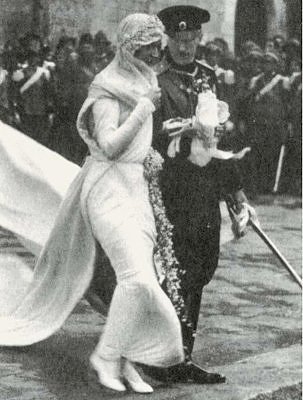
The negotiations had been difficult and at one point talks broke off entirely with Boris III declaring that he would remain a bachelor if he could not marry his beloved Princess Giovanna. The Princess likewise vowed to renounce her royal life and enter a convent if she could not marry the Tsar. So, finally, everything was worked out. The Tsar of Bulgaria and the Princess of Italy were married at the Basilica of St Francis of Assisi on October 25, 1930 amidst a great deal of public celebration. Wedding dresses were simple and conservative and no jewelry was worn but it was still a glittering affair with some 50 royal princes in attendance and, never being one to miss the spotlight, a typically puffed-up Mussolini. After that, the couple departed Italy on the Bulgarian liner “Tsar Ferdinand I” and Giovanna stepped ashore on Bulgarian soil at Burgas. The couple then traveled by train to Sofia where a second, Orthodox, wedding ceremony was held at the St Alexander Nevsky Cathedral where Giovanna took the Bulgarian form of her name and was presented to the public as Tsaritsa Ioanna of Bulgaria.

The new Tsaritsa was a very down-to-earth wife, astonishing the world when she revealed that she personally cooked meals for herself and her husband, saying how the Tsar loved home cooking and that, “The secret of domestic happiness is to be found in the kitchen”. In 1933 the Tsaritsa gave birth to the couple’s first child, Princess Marie-Louise, and despite the promise Boris III had made to the Vatican, she was, as expected, immediately baptized into the Bulgarian Orthodox Church. The Pope was rather upset at what he called “Balkan tricks” but nonetheless refrained from excommunicating the Italian Tsaritsa who remained a devoted Catholic throughout her life but always extremely reverent and respectful toward the Orthodox faith of her new country. In 1937 there were huge public celebrations, complete with torchlight celebrations, in honor of the birth of an heir to the throne, Prince Simeon. However, the happy mood of the Royal Family could not endure for long as the war clouds continued to gather across Europe. When Adolf Hitler invaded Poland, Britain and France declared war and for the second time in the 20th Century the world came apart in a torrent of death and destruction.

Like the rest of her family, Tsaritsa Ioanna hoped to stay out of World War II though she was naturally concerned about her native Kingdom of Italy (where her relatives likewise hoped to stay out of the conflict). Tsar Boris III is supposed to have said that his wife was pro-Italian, his ministers were pro-German and his people were pro-Russian while he was entirely neutral. However, when Axis troops conquered Yugoslavia and Greece with pro-Nazi regimes put in place in Hungary and Romania there was no hope for Bulgaria to remain totally uninvolved. Under great pressure the Tsar agreed to a limited sort of alliance with the main Axis partners of Germany, Italy and Japan. However, the Tsar and Tsaritsa of Bulgaria were anything but sympathetic to Hitler. On the contrary, they were horrified by his actions and refused to take part in any of his schemes. Risking the wrath of the dictator who ruled most of Europe, they refused to cooperate in the deportation of Bulgarian Jews to Nazi Germany -where they would ultimately have been massacred. Tsaritsa Ioanna intervened herself to obtain visas for Bulgarian Jews to escape the danger of Europe to the safety of Argentina.

Hitler was furious at how uncooperative the Bulgarian Royal Family was and when the Tsar suddenly fell ill and died in 1943 after a visit with Hitler (in which the Fuhrer flew into a rage when the Tsar refused to participate in his invasion of Russia) many suspected the Nazi leader of having the Tsar poisoned. Tsaritsa Ioanna was grief-stricken and all the more concerned to see her 6-year-old son proclaimed Tsar Simeon II of Bulgaria with three regents to act for him. If his father had been murdered, what fate might be in store for his son if they aroused the anger of the Nazis? However, the ultimate threat was not to come from Germany. The Nazis lost their war and despite Bulgaria not being involved in the invasion of the Soviet Union, Bulgaria was still invaded by the Red Army and doomed to become a Soviet satellite-state. In 1945 Bulgaria was taken over by the Communists, the three regents were murdered and a referendum was staged in order to justify the abolition of the monarchy. With only 24 hours given to them, Tsaritsa Ioanna gathered her children and fled into exile, first with her father, King Vittorio Emanuele III in Egypt and then finally to Spain where Generalissimo Francisco Franco was welcoming to any victims of communist aggression. Later she moved to Portugal to be near her exiled brother King Umberto II of Italy. However, she never ceased to be a Bulgarian queen, having a Bulgarian Orthodox chapel built alongside her residence.

The communists had destroyed the grave of Tsar Boris III but when the Soviet Union collapsed and the “Iron Curtain” came down, Tsaritsa Ioanna returned to Bulgaria in 1993 to reinter the heart of her beloved husband, which had been buried separately and was thus spared from the communist degradation in 1954. It was her last trip to her adopted homeland and she was very warmly welcomed by the Bulgarian people who never forgot the kindness and compassion she had always displayed toward them. She died in Portugal on February 26, 2000 at the age of 92 and was buried in Italy at the Basilica of St Francis of Assisi where she had first married her beloved husband. Throughout her life she had displayed great humanity, heroic compassion, risking her own life to save others and was always the most devoted wife and mother as well as queen. Her memory deserves to be honored and she will always be one of the brightest stars in the history of the Bulgarian monarchy and the Italian House of Savoy.

Thursday, April 5, 2012

The Monarchist Movement in Bulgaria

Bulgarian monarchists have had a pretty rough time of it, facing one crisis after another throughout the last century and they continue to struggle against many disadvantages today. Bulgaria knew high points and low points after emerging as an independent monarchy after the long era of Ottoman rule but, like her compatriots, faced a real crisis with defeat in World War I. Bulgaria had joined the Central Powers after the war was already well underway after Germany promised Bulgaria a large portion of soon-to-be-defeated Serbia. Bulgarian troops won some impressive early victories but finally the Allies broke through on the Salonika front and forced Bulgaria to come to terms. This military disaster was worsened by a crisis on the home-front where the privations brought on by the war played directly into the hands of the revolutionary agitators, particularly the communists, spreading their influence from beyond the Russian border. Bulgaria, like Romania, Hungary, Poland and others came under threat from communist revolutionaries. The Tsar abdicated but the monarchy was saved and the revolutionaries ultimately suppressed.

The problem was that the dominant figures in Bulgarian national life continued to be communist revolutionaries or opportunistic nationalists who were not always absolutely loyal to the monarchy. Tsar Simeon II, a mere child, was too young to provide leadership and was acted for by three regents while Bulgaria endured increasing radicalism, the economic depression and threats from her neighbors. In Bulgaria, as with almost all of her neighbors, various factors contributed to a lack in strong royal leadership, sometimes because there was no monarch at all, others because the monarch was overshadowed by a political strongman. Countries looking for a solution to their terrible situation unfortunately saw a political landscape dominated by men like Stalin in Russia, Horthy in Hungary, Metaxas in Greece, Mussolini dominant over Albania, a rapid turnover in leadership in Romania and a shaky regency in Yugoslavia. Not all of these were ‘bad guys’ certainly. Metaxas was a staunch royalist, Prince-Regent Paul of Yugoslavia was idealistic and did the best he could under difficult circumstances but a strong, reigning monarch was lacking with the only exception being the short-lived authoritarian reign of Carol II in Romania which was opposed by both extremes of the political spectrum.

Like so many others, the political field in Bulgaria came to be dominated by pro-Nazi or pro-Soviet factions and neither had much consideration for the monarchy. The royal government tried to walk a fine line between the two but were not helped by continuing communist infiltration of the country and a short-lived invasion by Greece both of which pushed Bulgaria toward the Axis camp. After the Axis came to dominate the Balkans, occupying Yugoslavia, Albania and Greece, Bulgaria had little choice but to come to some sort of an accommodation with Germany yet was still wary enough to refuse to participate in the Axis invasion of Soviet Russia. Of course, this did nothing to save them when the tide of war turned against the Axis and Joseph Stalin gained Allied acquiescence to his desire to dominate Eastern Europe. In 1944 the USSR declared war on Bulgaria and entered the country without opposition. A communist-backed coup ousted the sitting government, arrested the regents and replaced them with reliable communists. The Royal Family did their best to keep a low profile but, as expected, in 1946 (by which time the country had been under communist occupation long enough to guarantee the desired result) a plebiscite was held which abolished the monarchy, forcing the young Tsar Simeon II and his family to leave Bulgaria and go into exile.

Bulgarian monarchists were left in the lurch. Even after the 1944 coup, the royal government-in-exile had been forced to set up in Nazi Germany, which naturally caused the western Allies to view them as being tainted and although Simeon II continued to assert that he was the legitimate Tsar of Bulgaria, there was little in the way of an organized leadership or movement to support him during his many long years of exile. First he stayed with his exiled grandfather, King Victor Emmanuel III of Italy, in Egypt and then later was welcomed by the Spanish strongman Francisco Franco to relocate to Madrid. It was in Spain that he spent the most time and eventually established something resembling a royal court but though he was a focus for Bulgarian monarchists and anti-communist opposition, he was never able to form a real government-in-exile. Circumstances beyond his control had meant that a lack of monarchial leadership left the opposition to fracture and most gravitated toward political views and governments more well established and fashionable -which did not include an Orthodox monarchy unfortunately.

It was during these years though that an organized monarchist movement began to form around the exiled Tsar, advocating for his restoration though, naturally, they could have little actual impact so long as the communist tyranny remained in place in Bulgaria. By the end of the 1980’s, however, there seemed to be hope as the Soviet colossus started to topple. The Tsar, who had been forced to leave his homeland at an early age, was 54 in 1991 and was a figure who could inspire. In an effort to remain detached from politics, he tried not to show favoritism among the various anti-communist factions but he let it be known that he would return to the throne if asked and he continued to use his legitimate title. This was the great opportunity for the monarchists as the communist bloc came crashing down and they could make the argument to Bulgarians for the first time since World War II that the monarchy was an option and would help reunite and restore the country after so many years of being brutalized Soviet satellite. Interest in the monarchy in Bulgaria was revived with a fresh look being taken at the late Tsar Boris III while monarchists were quick to point out that his son was ready, willing and able to resume the throne.

Given the odds against them, what the Bulgarian monarchists achieved was remarkable. Various factions were in competition to be ‘founders’ of a new, post-Soviet Bulgaria and, not surprisingly, even the former communists were quick to turn their coats, change their name to socialists or social democrats and join in the fight to hang on to power and, once again, there were no strong neighboring monarchies to lend support either. Certainly neither Russia nor the NATO powers were favorable to the idea of a royal restoration. Nonetheless, the Bulgarian monarchists carried out such a revival of royalist interest in the country that it was agreed to hold a referendum on the restoration of the monarchy in July of 1991. The fact that this aroused so much opposition on the part of the republicans and the revolutionary left can be seen as proof that support for the monarchy was widespread enough to make these groups very worried about the outcome if such a vote was held. The Bulgarian Socialist Party and the Union of Democratic Forces (a coalition of social democrats, greens, liberal democrats etc) were the most adamant opponents of holding such a vote and they succeeded in causing sufficient turmoil to give the National Assembly an excuse to cancel the referendum for fear of causing “division” in the country.

A new constitution was put into effect that was republican, ending the immediate hope of a restoration of the monarchy under Tsar Simeon II. However, the Tsar remained personally very popular. In fact, his support may have actually increased because of the cancellation of the referendum as Bulgarians could see the Tsar as having been unfairly cut out of the political competition. In 1996 the Tsar was finally able to return to Bulgaria where he was greeted by large, enthusiastic crowds of people cheering for his restoration. There was still obviously a great deal of support for the monarchy in Bulgaria but the entrenched political establishment wanted no part of it and at a time when emerging East European countries depended a great deal on foreign aid, particularly from the United States, it did not help that the Clinton administration opposed an restoration of monarchy in the region, President Clinton’s Secretary of State famously saying, “we don’t do kings”.

When it seemed that a direct restoration of the monarchy was no longer possible, to the surprise of many at home and abroad, Tsar Simeon II decided to enter the political fray at the head of his political movement and run for office. Not everyone was happy with the rightful Tsar going into politics, something generally seen as being beneath the dignity of royalty, but most Bulgarian monarchists rallied to his movement in the hope that it would be the first step toward a full royal restoration. For his part, Tsar Simeon II jumped in with both legs, adopting a non-regal version of his name and promising voters a tangible improvement in their lives within 800 days if he was elected. In 2001 his movement defeated both major parties, winning 120 parliamentary seats, allowing the Tsar to form a coalition and become Prime Minister of Bulgaria. Monarchists were elated with his success but some also saw trouble as the Tsar, in taking office as prime minister, swore an oath of allegiance to the republican constitution -something often seen as “burning your bridges” as far as a restoration of the monarchy is concerned.

Under Tsar Simeon II there were many genuine accomplishments for Bulgaria and, in international-diplomatic terms, a noticeable move to the west. However, as some monarchists had feared, by taking political office, the Tsar had tied his fortunes to the effectiveness of his government and while some would always be supportive, others would just as certainly always be opposed to him. No restoration was forthcoming and after the 2005 elections lost his position as prime minister. In the following years his political movement steadily lost public support until they were no longer winning any seats at election time. In 2009 the Tsar resigned leadership of the political movement that carried his name. He has also refused to make any official comment on the restoration of the monarchy. Although it is painful to say, this has certainly not helped the monarchist movement in Bulgaria. Few doubt that he would accept the throne if offered to him, yet when the man who should be monarch will not say publicly that the monarchy should be restored many potential monarchists might be prompted to ask why they should bother campaigning for it. Nor did it help when the former monarch stated that he considered being elected Prime Minister a greater honor than being Tsar. The monarchist movement continues of course, especially for the devoutly Orthodox population, there can be no other legitimate option, but just as in the last century, the same is true in this one; Bulgarian monarchists have a difficult road to travel.

Thursday, September 23, 2010

Gathering of Balkan Kings

The Radical Royalist reports on the recent gathering of the former crowned heads of the Balkan monarchies. As you can see, on hand were HM King Simeon II of Bulgaria, HRH Crown Prince Alexander of Serbia, HM King Michael I of Romania and HM King Constantine II of Greece. Other royal and religious leaders joined them later, follow the link for all the details. I love it when monarchs get together.
Related Posts Plugin for WordPress, Blogger...