"Japan is a nation that has over the centuries built a gentle culture centering around the Emperor, whose role it always has been to be the chief Shinto priest praying for the well-being of his people and state. Except for a few relatively brief periods, the Emperor has been far removed from the seat of power. Historically, he has protected the people with prayers, and they have been tightly united around the imperial household. Because the Emperor represents the symbol of the unity of the people, the nation was deeply touched by the many tireless visits he made to the afflicted areas in East Japan following the March 11 disaster.
No nation is, or should be, devoid of a sovereign. In Japan, no one is better qualified to assume this post than the Emperor, who has continued to pray over the course of centuries for the welfare of his people and state as the chief Shinto priest. This role is certainly not for politicians, who are entrusted with mere political power. Based on this point alone, it is clear that meaningful revision of the constitution could hardly be achieved by simply modifying certain expressions or sections of articles."
-from the website of Yoshiko Sakurai in an article dealing with constitutional reform.
Yoshiko Sakurai is a Japanese journalist who is probably most well known for her opinions on the history of the Empire of Japan. She has caused no small amount of controversy for her articles and documentaries arguing that Japan was not solely responsible for World War II in the Pacific, that Japanese crimes have been greatly exaggerated and that Japan needs to re-embrace traditional values and take a tougher stance against North Korea and Communist China.
Thursday, April 19, 2012
The Problem with Churchill
New member of the blogosphere (and longtime Mad Monarchist member) AB Royalist takes a critical look at the much celebrated Prime Minister Winston Churchill and his role in the downfall of the grand old British Empire. If you can stand a point of view sure to be controversial have a look at The Problem with Churchill Part I and Part II. Is it perhaps partly due to the near deification of Churchill by the much reviled "neoconservative" clan that more seem to be looking at Sir Winston in a different light these days? Those familiar only with the inspiring speeches of the days of the Blitz might be surprised to find out some of the less known facts about Mr. Churchill. Was he a visionary leader or a chronic blunderer? Have a read and decide for yourselves. I can imagine there will be some strong reactions to this.
Wednesday, April 18, 2012
War of 1812 Wednesday, Part IV, 1814, the Third Year of the War
One of the men who led this revolution in American military thinking was General Winfield Scott, a man so devoted to discipline, protocol and military pageantry that he would one day be given the nickname "Old Fuss & Feathers". The U.S. army began to get serious about training and discipline and would soon prove themselves a more dangerous opponent. However, as far as any great victory goes, they had waited too late to learn humility. In Europe, Napoleon had been defeated and the British lion began to roar as America could now be given the full attention of London. Soon 18,000 veteran British troops, some of whom had served in Wellington's brilliant Peninsular Campaign, were on their way to America to put those upstart Yankees in their place.
![]() |
| General Riall |
The Americans were buoyed by this victory and Brown and Scott continued their invasion northward confident of success and thinking that, finally, Canada was theirs for the taking. Yet, they were to meet a much more formidable force in their next engagement. The Crown Forces gathering to oppose them included British and Irish regulars, Canadian militia, Swiss mercenaries and Indian volunteers bringing their numbers to fully equal those of the United States. This army was under the command of Lieutenant General Sir Gordon Drummond, a very competent officer, but also a Canadian. He had earlier led the Crown forces that took Ft Niagara and the benefit of having a Canadian officer in command of the troops defending his native soil was important and especially good for the morale of the Canadian militia.
![]() |
| General Drummond |
Although the United States had improved in fighting ability, it was clear with this defeat in Canada that the initiative had slipped from their grasp. General Drummond pushed on in pursuit, and despite being stung at the siege of Ft Erie, the US forces eventually withdrew and the Canadian frontier on the Niagara was secured. With more troops arriving from Europe and across the Empire the Crown forces at last had enough strength to take the offensive against the United States. As the next phase of the war opened it would now be Crown forces invading the United States from Canada and from the sea. Sir George Prevost, the Governor-General of Canada, was charged with leading the counteroffensive into the American northeast.
Fortunately for the Americans, Lt. General Prevost was an extremely cautious man. Ironically enough, Prevost was one of the loyal Americans, having been born in New Jersey. He had been commander-in-chief in British North America since the outbreak of war, but had often clashed with his subordinates as he wanted all emphasis placed on defense while men like General Brock believed that only daring attacks would save Canada. Prevost, looking at the odds so heavily in America's favor, had refused any major offensive action and kept large numbers of reinforcements in reserve to guard Quebec City, though US troops never managed to advance anywhere close to that point. Nonetheless, as Governor-General of Canada the invasion of the United States was his duty and he did so with 11,000 troops and naval support down the Richelieu River. His goal was the control of Lake Champlain in order to give Britain control of the Great Lakes and Plattsburg, New York which had been the staging points for past American invasions of Canada. US forces in the area had been reinforced but still only numbered around 3,400 aided by a recently constructed naval flotilla on the lake.
Prevost started the movement south on September 4 and was fought every step of the way by American forces under General Alexander Macomb, desperately trying to buy time for the defenses around Plattsburg to be completed. Hampered by every manner of delaying tactics Prevost did not arrive until the sixth and held off his assault until his naval support arrived. On September 11, 1814 the British flotilla under George Downie met and engaged American naval forces commanded by Thomas McDonough. The fighting was fierce, both commanders were hit and both flagships severely damaged. In a moment of desperation, McDonough cut the bow anchors, allowing the winds to blow his ship, USS Saratoga, around so that their least damaged side faced the British. Opening a deadly fire into the most heavily damaged side of the British ships they were soon put out of action and forced to strike their colors. McDonough refused to accept their swords however, saying, "Gentlemen return your swords to your scabbards, you are worthy of them". Prevost, for his part, had made efforts to attack the city by numerous routes but was repulsed each time with heavy losses by American regulars and militia fighting from good cover. American artillery also slowed his efforts to approach the city and though a flanking movement from the west came close to succeeding, members of the Vermont militia were able to rush in and halt the British advance. When word came of the naval defeat on Lake Champlain Prevost called off the attacks and ordered his men to retreat.
![]() |
| General Robert Ross |
Governor-General Prevost was determined to pay back the United States for pillaging and burning Toronto and the actions of the troops in each case is worth comparing. Advance units under Ross reached Capitol Hill on August 25 but when a British party was sent to parley under a flag of truce, they were fired upon by American partisans. The house was quickly destroyed and the British flag was raised over the city, it would be the first and only time in American history that an enemy nation would control the capitol city. However, whereas at Toronto American troops had gone on an uncontrolled rampage, at Washington discipline was retained and only government buildings were destroyed. In fact, the commanding British Admiral, George Cockburn was dissuaded from burning down the office of a notoriously anti-British newspaper when local ladies prevailed upon him the danger of the fire spreading to nearby houses. However, the Senate, House of Representatives, the Library of Congress, United States Treasury, Washington Navy Yard, the Patent Office and the Whitehouse itself were all put to the torch in retaliation for the destruction of the Canadian capitol.
![]() |
| Francis Scott Key |
Continued next week with Part V - The End of the War
Tuesday, April 17, 2012
Monday, April 16, 2012
Monarchial Economic Success
These are hard times for economies all over the world (I detest the phrase “global economy” though I suppose it exists) and people, especially in places like Greece, Italy, Spain, Portugal and Ireland, are looking for solutions. Some of the actions being taken, I think, are good. Any cut backs in government spending (austerity measures) should only be common sense at this point considering how massively in debt, well almost everyone in the world, is right now. However, on the whole, it seems to me that most of what these countries are doing makes no sense to me at all. Germany loaning more money to Greece? Further economic centralization in the European Union? Wasn’t this exactly what these countries had been doing before that got everyone into this terrible mess? Seems that way to me. However, what I really have a problem with, what really scares me, is the increasing number of people around the world who are now saying that the People’s Republic of China (the most murderous regime in human history in case anyone has forgotten) is the example that others should follow. After all, they’re doing great right?
First of all -no. They are not doing great, at least not anywhere near as great as most people think. In the first place, what economic progress there has been in China has been very limited in scope. The big urban centers on the coast are thriving but most of the rural areas in the interior are just as poor as they ever have been. Secondly, what economic progress there has been in these limited areas are (not surprisingly for a socialist country trying to allow limited capitalism) sustainable because they are basically tearing down certain areas to expand in other areas (which I don’t really have time to go into more at the moment). Finally, when you hear all of these reports with all the great numbers coming out of China, you should keep in mind that these reports telling you how great the state-run economy of China is … all come from the state of course. They have a vested interest in making things look as rosy as possible and we also know for a fact that they’ve been manipulating their currency, juggling the books and doing all sorts of tricks to make people think they are this big, economic powerhouse. Which, of course, is not to say that they are not, they are obviously a huge economy, however, everything is not nearly as good as many people outside of China seem to think.
If people wanted to look for some real examples of economic success they would do better to look to countries with a monarch. Here again, people on the left at least, tend to focus on and “play up” the very socialistic economies in kingdoms like Sweden or Belgium and so on. Many pointed to the Kingdom of Spain and the huge government investment in “green jobs” until that was proven to be a huge, embarrassing failure. However, a number of small but very successful monarchies have been overlooked in all of this. At least by some people. The proponents of state-controlled economies have not overlooked them as they have been very busy in recent years trying to bully them into getting on board the big-government run economic train. However, it does say something that when the American (and very republican) Heritage Foundation ranked the top ten countries in the world in terms of economic freedom, half of them were monarchies (3-Australia, 5-New Zealand, 7-Canada, 8-Denmark, 10-United Kingdom) and the top one on the list was the former Crown Colony of Hong Kong which has maintained the economy it had as a monarchy before being officially handed over to Red China.
The trouble is that in most countries maintaining a “free economy” is a constant struggle. When they hit a rough patch there are usually immediate calls for government intervention and yet when things are going well it makes people think the good times will last forever and they go on huge spending sprees. I’ve always said that one of the problems with capitalism is that it makes countries so rich that they think they can afford socialism. However, it seems clear from the numbers that the most prosperous countries are those in which taxes are low, regulations are few and people are able to keep more (or even most -imagine that) of what they earn. It makes me wonder at least why more people do not follow their example. Two places with a great deal of economic freedom, where investment is high and the environment is pro-business (and unemployment virtually unheard of) are the British Overseas Territory of the Cayman Islands and the Crown Dependency of the Isle of Man. Why wouldn’t the British at home want to emulate the success of these areas?
The Isle of Man is an interesting case. It is not part of the United Kingdom, nor a member of the European Union but the British Crown is directly responsible for its “good government”. It has no capital gains tax, wealth tax, stamp duty or inheritance tax and a top income tax rate of only 20% and there is a tax cap. Their government has made mistakes too of course but there is no one in poverty on the Isle of Man, unemployment is practically unheard of and even without all those taxes other places consider absolutely essential (you might want to sit down for this) the government still takes in more in revenue than it spends! Over on the Cayman Islands they have the highest number of registered businesses in the world. They enjoy the highest standard of living of any people in the Caribbean and yet they have no income tax, capital gains tax or corporation tax. Their small, unobtrusive royal government pays for itself mostly through service fees and import duties. Again, there is no one living below the poverty line, unemployment is miniscule as the lack of regulations allows for new businesses to be opening constantly and they too still manage to take in more revenue than they spend and unlike most other island countries they receive no foreign aid.
Some picky people might be inclined to point out that the areas mentioned are non-sovereign states without a resident monarch. In that case, we can see much the same success on the continent in places such as the Principality of Liechtenstein. In Liechtenstein (which is in a customs union with Switzerland) taxes are extremely low, regulation is very minimal and it is one of the most prosperous countries in the world. Almost during the reign of HSH Prince Hans-Adam II alone the little valley of Liechtenstein has gone from a country of subsistence farmers to a highly developed and modern economy with a very business-friendly environment that has attracted investors from around the world. The government takes in slightly more than it spends, unemployment is miniscule (crime virtually unheard of) and poverty is nonexistent. Banking has been a major industry in Liechtenstein because of the strict policy of respecting the privacy of customers but in recent years that has been changing, thanks mostly to threats from the European Union and other international bodies. Nonetheless, it remains one of the most free economies in the world and one of the most prosperous, a free market success story that has even caused many libertarians to marvel at this Catholic monarchy with a very powerful prince.
And, speaking of successful monarchies which retain a powerful monarch at the head of small governments, we have the Principality of Monaco. The Monegasque enjoy one of the highest standards of living in the world and Monaco is famous for having no income tax, extremely low business taxes and few interfering regulations. What has been the result of these policies? Monaco has the highest GDP per capita in the world, the lowest poverty rate in the world (as in “none”), no unemployment at all, the world’s highest life expectancy and more millionaires and billionaires per capita than any other country on earth. Living standards in Monaco are twice as high as comparable neighboring cities in the French Republic. Like Liechtenstein, Monaco has come under increased bullying in recent years but has, so far, been very spirited in defending their independence to do things their own way. Monaco is also a great example for refuting those who say that the arts and culture suffer where big-government spending is not around to fund these areas. The Grimaldis have long been great patrons of the visual arts and, since the days of Princess Alice particularly, also patrons of classical music, the ballet and opera. By economic policies that attract the very wealthy, Monaco has an overabundance of people with the means to support charitable and cultural activities on their own. When your people have the highest per capita income in the world, they have plenty of money to spend on causes that they think are important.
However, as we have touched on, monarchies such as Liechtenstein, Monaco, Andorra, the Cayman Islands and so on have all been attacked as “tax havens” with all sorts of unsavory business and/or banking practices being heavily implied about them. Relatively few people seem to notice how much envy probably has to do with this as such accusations are invariably made by countries which are bigger, more powerful but far, far less successful. In the case of Monaco it is a very old story with their status as a “tax haven” being used to criticize the principality just as the gaming industry once was when that was viewed as terribly distasteful and when Monaco was first given its famous description as “a sunny place for shady people”. Yet, instead of attacking these monarchial micro-states, other countries should instead be looking to their example. If they are upset that so many wealthy people and so many businesses are moving to Liechtenstein or Monaco they should perhaps try adopting some of the same policies to lure them back.
Here though is where we see the importance of the monarchy. It is not the only thing that matters of course, but it certainly is a major, major factor in the success of these countries. Why? Because in places like Liechtenstein and Monaco where the Sovereign Prince still has final say on what goes on, these countries can adopt economic policies that are stable because they are not subject to so much political meddling brought about by democratic changes in office-holders in republics (or even more limited monarchies). Starting in 1984, for example, Her Majesty’s Dominion of New Zealand turned its lackluster economy completely around by slashing regulations that were strangling existing businesses and making it almost impossible to start new businesses. In record time the economy surged back to life, the standard of living soared, the “brain drain” became the “brain gain” and unemployment plummeted. However, over the years new politicians were elected who tried to tweak this and change that and so there were some pretty rough bumps in the road though New Zealand still remains an overall success story and one of the most prosperous and economically vibrant countries in the world. Australia has, to a lesser extent, experienced the same back-and-forth as different political leaders have pursued very different policies concerning the economy.
None, however, have had such long-term success as the former British Crown Colony of Hong Kong. Today it is officially a part of the People’s Republic of China but, seeing how successful Hong Kong was, the Red Chinese were smart enough not to mess with a good thing and kill their golden goose by imposing their own policies on Hong Kong which has, instead, been left to carry on as it had been before (at least in the economic sphere) the handover. What was the secret to the success enjoyed by Hong Kong? The short answer is the long-standing policy (going back to the British colonial period) of “positive non-interventionism” which is a fancy way of saying that government was kept to a minimum and people were allowed to pursue success as they saw fit and reap the rewards of their own decisions. The record of Hong Kong has been one of unqualified success and it remains one of the most wealthy and prosperous places on earth. Milton Friedman once called Hong Kong the greatest capitalist experiment in the world. Obviously, anyone who doesn’t like capitalism will not be impressed by that but the numbers do not lie. Hong Kong has been a major success and it is because the Red Chinese have not interfered with the successful system they inherited from the days when Hong Kong was under the British monarchy.
That is my bottom-line at least. When it comes to arguing over what economic system is best, I tend to take a very practical approach. Look around, see what works, what doesn’t and do more of what works. There are those though, I know, who do not like laissez-faire capitalism no matter what their record looks like and there will also be those capitalists who would find impurities in all the examples I have talked about here. However, my only purpose in bringing these success stories to your attention is to show that, at a time when the world is still trembling over the economic crisis, there are other examples we could all be looking to rather than the People’s Republic of China. Big-government, tax-and-spend democratic socialism is not the only game in town and, it seems to me at least, is what brought Europe to the mess she currently finds herself in and, when it comes to America, to varying extents both liberal and conservative parties have followed this same model and today we are seeing the results. I think it at least worth considering that we take a more serious look at these micro-monarchies with small governments and big economies as perhaps being on to something.
First of all -no. They are not doing great, at least not anywhere near as great as most people think. In the first place, what economic progress there has been in China has been very limited in scope. The big urban centers on the coast are thriving but most of the rural areas in the interior are just as poor as they ever have been. Secondly, what economic progress there has been in these limited areas are (not surprisingly for a socialist country trying to allow limited capitalism) sustainable because they are basically tearing down certain areas to expand in other areas (which I don’t really have time to go into more at the moment). Finally, when you hear all of these reports with all the great numbers coming out of China, you should keep in mind that these reports telling you how great the state-run economy of China is … all come from the state of course. They have a vested interest in making things look as rosy as possible and we also know for a fact that they’ve been manipulating their currency, juggling the books and doing all sorts of tricks to make people think they are this big, economic powerhouse. Which, of course, is not to say that they are not, they are obviously a huge economy, however, everything is not nearly as good as many people outside of China seem to think.
If people wanted to look for some real examples of economic success they would do better to look to countries with a monarch. Here again, people on the left at least, tend to focus on and “play up” the very socialistic economies in kingdoms like Sweden or Belgium and so on. Many pointed to the Kingdom of Spain and the huge government investment in “green jobs” until that was proven to be a huge, embarrassing failure. However, a number of small but very successful monarchies have been overlooked in all of this. At least by some people. The proponents of state-controlled economies have not overlooked them as they have been very busy in recent years trying to bully them into getting on board the big-government run economic train. However, it does say something that when the American (and very republican) Heritage Foundation ranked the top ten countries in the world in terms of economic freedom, half of them were monarchies (3-Australia, 5-New Zealand, 7-Canada, 8-Denmark, 10-United Kingdom) and the top one on the list was the former Crown Colony of Hong Kong which has maintained the economy it had as a monarchy before being officially handed over to Red China.
The trouble is that in most countries maintaining a “free economy” is a constant struggle. When they hit a rough patch there are usually immediate calls for government intervention and yet when things are going well it makes people think the good times will last forever and they go on huge spending sprees. I’ve always said that one of the problems with capitalism is that it makes countries so rich that they think they can afford socialism. However, it seems clear from the numbers that the most prosperous countries are those in which taxes are low, regulations are few and people are able to keep more (or even most -imagine that) of what they earn. It makes me wonder at least why more people do not follow their example. Two places with a great deal of economic freedom, where investment is high and the environment is pro-business (and unemployment virtually unheard of) are the British Overseas Territory of the Cayman Islands and the Crown Dependency of the Isle of Man. Why wouldn’t the British at home want to emulate the success of these areas?
The Isle of Man is an interesting case. It is not part of the United Kingdom, nor a member of the European Union but the British Crown is directly responsible for its “good government”. It has no capital gains tax, wealth tax, stamp duty or inheritance tax and a top income tax rate of only 20% and there is a tax cap. Their government has made mistakes too of course but there is no one in poverty on the Isle of Man, unemployment is practically unheard of and even without all those taxes other places consider absolutely essential (you might want to sit down for this) the government still takes in more in revenue than it spends! Over on the Cayman Islands they have the highest number of registered businesses in the world. They enjoy the highest standard of living of any people in the Caribbean and yet they have no income tax, capital gains tax or corporation tax. Their small, unobtrusive royal government pays for itself mostly through service fees and import duties. Again, there is no one living below the poverty line, unemployment is miniscule as the lack of regulations allows for new businesses to be opening constantly and they too still manage to take in more revenue than they spend and unlike most other island countries they receive no foreign aid.
Some picky people might be inclined to point out that the areas mentioned are non-sovereign states without a resident monarch. In that case, we can see much the same success on the continent in places such as the Principality of Liechtenstein. In Liechtenstein (which is in a customs union with Switzerland) taxes are extremely low, regulation is very minimal and it is one of the most prosperous countries in the world. Almost during the reign of HSH Prince Hans-Adam II alone the little valley of Liechtenstein has gone from a country of subsistence farmers to a highly developed and modern economy with a very business-friendly environment that has attracted investors from around the world. The government takes in slightly more than it spends, unemployment is miniscule (crime virtually unheard of) and poverty is nonexistent. Banking has been a major industry in Liechtenstein because of the strict policy of respecting the privacy of customers but in recent years that has been changing, thanks mostly to threats from the European Union and other international bodies. Nonetheless, it remains one of the most free economies in the world and one of the most prosperous, a free market success story that has even caused many libertarians to marvel at this Catholic monarchy with a very powerful prince.
And, speaking of successful monarchies which retain a powerful monarch at the head of small governments, we have the Principality of Monaco. The Monegasque enjoy one of the highest standards of living in the world and Monaco is famous for having no income tax, extremely low business taxes and few interfering regulations. What has been the result of these policies? Monaco has the highest GDP per capita in the world, the lowest poverty rate in the world (as in “none”), no unemployment at all, the world’s highest life expectancy and more millionaires and billionaires per capita than any other country on earth. Living standards in Monaco are twice as high as comparable neighboring cities in the French Republic. Like Liechtenstein, Monaco has come under increased bullying in recent years but has, so far, been very spirited in defending their independence to do things their own way. Monaco is also a great example for refuting those who say that the arts and culture suffer where big-government spending is not around to fund these areas. The Grimaldis have long been great patrons of the visual arts and, since the days of Princess Alice particularly, also patrons of classical music, the ballet and opera. By economic policies that attract the very wealthy, Monaco has an overabundance of people with the means to support charitable and cultural activities on their own. When your people have the highest per capita income in the world, they have plenty of money to spend on causes that they think are important.
However, as we have touched on, monarchies such as Liechtenstein, Monaco, Andorra, the Cayman Islands and so on have all been attacked as “tax havens” with all sorts of unsavory business and/or banking practices being heavily implied about them. Relatively few people seem to notice how much envy probably has to do with this as such accusations are invariably made by countries which are bigger, more powerful but far, far less successful. In the case of Monaco it is a very old story with their status as a “tax haven” being used to criticize the principality just as the gaming industry once was when that was viewed as terribly distasteful and when Monaco was first given its famous description as “a sunny place for shady people”. Yet, instead of attacking these monarchial micro-states, other countries should instead be looking to their example. If they are upset that so many wealthy people and so many businesses are moving to Liechtenstein or Monaco they should perhaps try adopting some of the same policies to lure them back.
Here though is where we see the importance of the monarchy. It is not the only thing that matters of course, but it certainly is a major, major factor in the success of these countries. Why? Because in places like Liechtenstein and Monaco where the Sovereign Prince still has final say on what goes on, these countries can adopt economic policies that are stable because they are not subject to so much political meddling brought about by democratic changes in office-holders in republics (or even more limited monarchies). Starting in 1984, for example, Her Majesty’s Dominion of New Zealand turned its lackluster economy completely around by slashing regulations that were strangling existing businesses and making it almost impossible to start new businesses. In record time the economy surged back to life, the standard of living soared, the “brain drain” became the “brain gain” and unemployment plummeted. However, over the years new politicians were elected who tried to tweak this and change that and so there were some pretty rough bumps in the road though New Zealand still remains an overall success story and one of the most prosperous and economically vibrant countries in the world. Australia has, to a lesser extent, experienced the same back-and-forth as different political leaders have pursued very different policies concerning the economy.
None, however, have had such long-term success as the former British Crown Colony of Hong Kong. Today it is officially a part of the People’s Republic of China but, seeing how successful Hong Kong was, the Red Chinese were smart enough not to mess with a good thing and kill their golden goose by imposing their own policies on Hong Kong which has, instead, been left to carry on as it had been before (at least in the economic sphere) the handover. What was the secret to the success enjoyed by Hong Kong? The short answer is the long-standing policy (going back to the British colonial period) of “positive non-interventionism” which is a fancy way of saying that government was kept to a minimum and people were allowed to pursue success as they saw fit and reap the rewards of their own decisions. The record of Hong Kong has been one of unqualified success and it remains one of the most wealthy and prosperous places on earth. Milton Friedman once called Hong Kong the greatest capitalist experiment in the world. Obviously, anyone who doesn’t like capitalism will not be impressed by that but the numbers do not lie. Hong Kong has been a major success and it is because the Red Chinese have not interfered with the successful system they inherited from the days when Hong Kong was under the British monarchy.
That is my bottom-line at least. When it comes to arguing over what economic system is best, I tend to take a very practical approach. Look around, see what works, what doesn’t and do more of what works. There are those though, I know, who do not like laissez-faire capitalism no matter what their record looks like and there will also be those capitalists who would find impurities in all the examples I have talked about here. However, my only purpose in bringing these success stories to your attention is to show that, at a time when the world is still trembling over the economic crisis, there are other examples we could all be looking to rather than the People’s Republic of China. Big-government, tax-and-spend democratic socialism is not the only game in town and, it seems to me at least, is what brought Europe to the mess she currently finds herself in and, when it comes to America, to varying extents both liberal and conservative parties have followed this same model and today we are seeing the results. I think it at least worth considering that we take a more serious look at these micro-monarchies with small governments and big economies as perhaps being on to something.
Sunday, April 15, 2012
Saturday, April 14, 2012
Royal News Roundup
There has been a great deal of royal news out of the Far East this week. One Mariam Aziz, formerly a Queen of Brunei until divorcing the Sultan in 2003, won a lawsuit against Fatimah Kumin Lim, a former bodyguard, for stealing $20 million worth of diamonds from her and replacing them with fakes. The case was heard in the High Court of London where Lim accused her former boss of selling the diamonds herself to pay for gambling debts and have her perpetuate the story of them being stolen. However, the court was not buying that defense, calling her testimony “bordering on the absurd” (the former Queen is quite wealthy). According to Aziz it was Lim who had the mountain of gambling debts and sold the diamonds to a company in Switzerland for $5 million to keep her thumbs intact (so to speak). The diamonds were gifts to Aziz from the Sultan of Brunei on the occasion of their wedding in 1981. She is now seeking damages from Lim who is currently in Singapore and whose assets worldwide have been frozen.
Monday, Tuesday and Wednesday Thais gathered to pay their respects at the funeral services for HRH Princess BejaratanaRajasuda Sirisobhabannavadi, the King’s cousin and only child of the late King Vajiravudh. Although the Princess died at the age of 85 in July of last year, this week had been chosen by the court astrologers as the most auspicious time for the funeral ceremonies to be held (not at all uncommon in that part of the world). In a rare public appearance, HM King Bhumibol Adulyadej attended, despite his very frail health, accompanied by HM Queen Sirikit who has also suffered some health setbacks lately due to an assortment of ailments as well as her exertion in taking care of the King. The ceremonies included multiple processions, a symbolic cremation, 50 chanting Buddhist monks, a 21-gun salute by the Royal Thai Artillery. On the second day HRH Crown Prince Maha Vajiralongkorn oversaw the ceremonies and on the third day the relics of the late Princess were returned to the Royal Mausoleum at Wat Ratchabophit.
On Wednesday, in a lavish and colorful ceremony, the new King of Malaysia, Sultan Abdul Halim Mu’adzam Shah of Kedah, was formally enthroned as “Yang di-Pertuan Agong” (He Who Is Made Lord) in the throne room at the national royal palace in Kuala Lumpur. The Sultan is the 14th King of Malaysia and this is actually the second time that the 84-year-old Sultan has been through this ceremony as he had previously served as King in the 1970’s. The new King took his oath to rule Malaysia fairly, ensure justice in government and uphold the Islamic faith. In his speech the newly enthroned monarch called on all Malaysians to do their part for national prosperity rather than depending solely on government programs. The King also said, “The competition in today’s world is very stiff and challenging. So the people should be prepared to shoulder their responsibilities and discharge their duties to the best of their ability”. Congratulations to the King and the loyal people of Malaysia!
In Japan, doctors last Friday issued a report on the troubled condition of HIH Crown Princess Masako saying that the 48-year-old who has been mostly absent from public view for the last ten years is, “in a situation where her health condition can easily worsen due to accumulated fatigue”. Doctor Kyoji Komachi was quick to add that, “It does not mean that the Crown Princess’ conditions are getting worse. I would like people to warmly watch the Crown Princess”. They recommended more rest before slowly returning to royal engagements. The former diplomat married HIH Crown Prince Naruhito in 1993 and since 2003 has rarely appeared in public or undertaken any royal duties due to being, more or less, overly stressed. What she has to be stressed about these days (the pressure to produce a male heir being relaxed) I cannot say and, as this has been going on for a decade now, I cannot say I realistically hold out much hope anymore that she will ever be a “normal” royal consort. One thing that does seem evident to me, if she has had this much difficulty with the relatively sheltered life of the Japanese Imperial Family, she should thank the Shinto gods she didn’t marry into a European Royal Family where the public scrutiny is constant and the media less than respectful to say the least.
In the southern African absolute monarchy of Swaziland there have been new protests planned by labor activists and student pro-democracy advocates against the government. In the last year such protests have become a frequent occurrence in the African nation where activists have drawn a sharp contrast between the poor of the population (currently enduring a financial crisis) and their traditional King Mswati III who made Forbes magazine list as one of the 15 wealthiest monarchs in the world. Most revenue in Swaziland comes from the Southern African Customs Union but customs receipts have been sharply declining recently. At the height of the financial crisis King Mswati III claimed it was unfair that South Africa did not grant Swaziland an economic “bail out” when the same was being done for countries in Europe. The government recently closed down the Trade Union Congress of Swaziland and dissident groups have been banned. However, trade unions, student groups, religious groups and NGO’s are still vehicles for the opposition who are preparing for upcoming elections. Observers, however, doubt these groups will have much immediate success.
On the European front, there was a scare for the Spanish Royal Family this week when the King’s 13-year-old grandson, Felipe Marichalar Borbon (son of HRH Infanta Elena) accidentally shot himself in the foot while learning to use a shotgun on Monday at a royal estate in north-central Spain. The boy was moved to a hospital in Madrid and has been doing very well but the incident has aroused criticism of the boy’s father, Jaime de Marital (who is divorced from Infanta Elena), for allowing the boy to handle a firearm before he was legally old enough to do so. Spanish law says that children under 14 are not allowed to use firearms and Felipe is still 13, he will be 14 in three months. Infanta Elena and HM Queen Sofia have visited the boy in the hospital who is currently fifth in line to the Spanish throne. The accident, coming so near Easter, brought up memories of Easter week in 1956 when the future King Juan Carlos witnessed the accidental shooting and death of his younger brother Prince Alfonso in Portugal.
There was also a scare in Britain this week when Lady Louise Windsor, 8-year-old daughter of TRH the Earl and Countess of Wessex, was rushed to the hospital after falling from her pony. She was wearing a hat and back brace and her injuries were not serious. The Countess of Wessex canceled an engagement to go to the hospital with her but Prince Edward stuck to his established schedule. Buckingham Palace issued a statement but did not say where the accident occurred or where Lady Louise is being treated.
HM Queen Margrethe II of Denmark went on a 3-day visit to Rome this week and along with the Danish Minister of Culture met with Italian President Giorgio Napolitano at the Quirinale Palace on Thursday. In Norway a recent poll showed continued support and confidence for the Royal Family. An NRK poll returned a heartening result that 93% of Norwegians approve of the job being done by HM King Harald V (numbers which would be absolutely impossible for any republic). HM Queen Sonja was given an 81% approval rating, the Crown Prince 89% and the Crown Princess 79%. Unfortunately the controversial (though unjustifiably so) Princess Martha Louise had only a 25% approval and her husband a mere 5% but, of course, they are kept somewhat apart from the rest of the Royal Family so such numbers are really of little importance. The overall evaluation is an extremely encouraging with a vast majority of Norwegians approving of the job their Royal Family is doing and how they represent the Kingdom of Norway. Truly they should be congratulated for a job well done.
Monday, Tuesday and Wednesday Thais gathered to pay their respects at the funeral services for HRH Princess BejaratanaRajasuda Sirisobhabannavadi, the King’s cousin and only child of the late King Vajiravudh. Although the Princess died at the age of 85 in July of last year, this week had been chosen by the court astrologers as the most auspicious time for the funeral ceremonies to be held (not at all uncommon in that part of the world). In a rare public appearance, HM King Bhumibol Adulyadej attended, despite his very frail health, accompanied by HM Queen Sirikit who has also suffered some health setbacks lately due to an assortment of ailments as well as her exertion in taking care of the King. The ceremonies included multiple processions, a symbolic cremation, 50 chanting Buddhist monks, a 21-gun salute by the Royal Thai Artillery. On the second day HRH Crown Prince Maha Vajiralongkorn oversaw the ceremonies and on the third day the relics of the late Princess were returned to the Royal Mausoleum at Wat Ratchabophit.
On Wednesday, in a lavish and colorful ceremony, the new King of Malaysia, Sultan Abdul Halim Mu’adzam Shah of Kedah, was formally enthroned as “Yang di-Pertuan Agong” (He Who Is Made Lord) in the throne room at the national royal palace in Kuala Lumpur. The Sultan is the 14th King of Malaysia and this is actually the second time that the 84-year-old Sultan has been through this ceremony as he had previously served as King in the 1970’s. The new King took his oath to rule Malaysia fairly, ensure justice in government and uphold the Islamic faith. In his speech the newly enthroned monarch called on all Malaysians to do their part for national prosperity rather than depending solely on government programs. The King also said, “The competition in today’s world is very stiff and challenging. So the people should be prepared to shoulder their responsibilities and discharge their duties to the best of their ability”. Congratulations to the King and the loyal people of Malaysia!
In Japan, doctors last Friday issued a report on the troubled condition of HIH Crown Princess Masako saying that the 48-year-old who has been mostly absent from public view for the last ten years is, “in a situation where her health condition can easily worsen due to accumulated fatigue”. Doctor Kyoji Komachi was quick to add that, “It does not mean that the Crown Princess’ conditions are getting worse. I would like people to warmly watch the Crown Princess”. They recommended more rest before slowly returning to royal engagements. The former diplomat married HIH Crown Prince Naruhito in 1993 and since 2003 has rarely appeared in public or undertaken any royal duties due to being, more or less, overly stressed. What she has to be stressed about these days (the pressure to produce a male heir being relaxed) I cannot say and, as this has been going on for a decade now, I cannot say I realistically hold out much hope anymore that she will ever be a “normal” royal consort. One thing that does seem evident to me, if she has had this much difficulty with the relatively sheltered life of the Japanese Imperial Family, she should thank the Shinto gods she didn’t marry into a European Royal Family where the public scrutiny is constant and the media less than respectful to say the least.
In the southern African absolute monarchy of Swaziland there have been new protests planned by labor activists and student pro-democracy advocates against the government. In the last year such protests have become a frequent occurrence in the African nation where activists have drawn a sharp contrast between the poor of the population (currently enduring a financial crisis) and their traditional King Mswati III who made Forbes magazine list as one of the 15 wealthiest monarchs in the world. Most revenue in Swaziland comes from the Southern African Customs Union but customs receipts have been sharply declining recently. At the height of the financial crisis King Mswati III claimed it was unfair that South Africa did not grant Swaziland an economic “bail out” when the same was being done for countries in Europe. The government recently closed down the Trade Union Congress of Swaziland and dissident groups have been banned. However, trade unions, student groups, religious groups and NGO’s are still vehicles for the opposition who are preparing for upcoming elections. Observers, however, doubt these groups will have much immediate success.
On the European front, there was a scare for the Spanish Royal Family this week when the King’s 13-year-old grandson, Felipe Marichalar Borbon (son of HRH Infanta Elena) accidentally shot himself in the foot while learning to use a shotgun on Monday at a royal estate in north-central Spain. The boy was moved to a hospital in Madrid and has been doing very well but the incident has aroused criticism of the boy’s father, Jaime de Marital (who is divorced from Infanta Elena), for allowing the boy to handle a firearm before he was legally old enough to do so. Spanish law says that children under 14 are not allowed to use firearms and Felipe is still 13, he will be 14 in three months. Infanta Elena and HM Queen Sofia have visited the boy in the hospital who is currently fifth in line to the Spanish throne. The accident, coming so near Easter, brought up memories of Easter week in 1956 when the future King Juan Carlos witnessed the accidental shooting and death of his younger brother Prince Alfonso in Portugal.
There was also a scare in Britain this week when Lady Louise Windsor, 8-year-old daughter of TRH the Earl and Countess of Wessex, was rushed to the hospital after falling from her pony. She was wearing a hat and back brace and her injuries were not serious. The Countess of Wessex canceled an engagement to go to the hospital with her but Prince Edward stuck to his established schedule. Buckingham Palace issued a statement but did not say where the accident occurred or where Lady Louise is being treated.
HM Queen Margrethe II of Denmark went on a 3-day visit to Rome this week and along with the Danish Minister of Culture met with Italian President Giorgio Napolitano at the Quirinale Palace on Thursday. In Norway a recent poll showed continued support and confidence for the Royal Family. An NRK poll returned a heartening result that 93% of Norwegians approve of the job being done by HM King Harald V (numbers which would be absolutely impossible for any republic). HM Queen Sonja was given an 81% approval rating, the Crown Prince 89% and the Crown Princess 79%. Unfortunately the controversial (though unjustifiably so) Princess Martha Louise had only a 25% approval and her husband a mere 5% but, of course, they are kept somewhat apart from the rest of the Royal Family so such numbers are really of little importance. The overall evaluation is an extremely encouraging with a vast majority of Norwegians approving of the job their Royal Family is doing and how they represent the Kingdom of Norway. Truly they should be congratulated for a job well done.
Friday, April 13, 2012
QA with MM
The last time I did this it generated a lot of interest so, here we are again. I was recently interviewed by the “Grand River Royal Club”, was emailed a copy of it and am posting here (there was no objection). It has a much different tone from my last interview with a republican.
(after the pleasantries)
GR: Do you have a favorite monarchy?
MM: Goodness no, that’s like asking a parent to name their favorite child. I’m a pan-monarchist, I support them all, I know more about some than others but they all interest me and I wish I knew more about all of them.
GR: So I probably shouldn’t ask if you have a favorite monarch.
MM: No, I do have favorites, and I’ve listed many on my blog, but I narrow down the possibilities considerably. I’ve listed my favorite Spanish monarchs, Romanov monarchs, Savoy monarchs and English monarchs after the conquest, before the union of the crowns. Even then I’ve only ever been able to narrow it down to five.
GR: Is there a particular monarchy you at least feel more of a connection with than any other?
MM: Even that is tough to say. I keep up more with Monaco in terms of current royal families. My first language is English so there is a connection with the English monarchy, there are those I have a special interest in due to ancestry and, in terms of where I live, the monarchy I feel closest to in terms of local history and culture would be the Spanish. For family reasons I also have very strong feelings about the royal legacy of Vietnam but then there are others that I am very interested in and get very emotional about that I have no real reason to at all.
GR: Okay, putting aside personal preferences, is there a monarchy that you think has been better or more successful than others? One that is still around today I mean.
MM: I would probably have to say the English monarchy.
GR: You mean the British.
MM: Yes I do, but let’s be blunt about it, it is the English monarchy when you get down to it, the lineage, the traditions and so on are all English. I say them because the Queen, even after the dissolution of the British Empire, still reigns over more land and people than any other and because, looking at history, the English have just been pretty fortunate in having had a pretty good record of competent, benevolent royal leadership. There are always low points but their’s have been fairly few.
GR: When it comes to the fall of monarchies, which I realize is always a terrible thing, is there one that particularly moves you or upsets you more than any other?
MM: Absolutely. Russia, without a doubt, though I can only speculate as to why. I get very emotional when it comes to the fall of Russia, it really effects me like no other.
GR: Speculate then; why do you think that is?
MM: Well there is the fact that the last Tsar and Tsarina were such good people but then so was Charles I of Britain, so were Louis XVI and Marie Antoinette but I think, perhaps, I feel the loss of Russia more because it was so violent, it was the entire family and because it was so comparatively recent. We have tons of photographs of the Russian Imperial Family, we can see them growing up and I think that allows one to feel much more connected to them. It was such a horrific tragedy. I could tear up just thinking about it. It was also one of the last truly, purely Christian monarchies left in the world even then.
GR: When it comes to the monarchies that fell in the wake of World War I, many people seem to be aware of those, even if World War II overshadowed them a bit but is there a fallen monarchy that you think is overlooked? I mean one that shouldn’t be.
MM: China. I’ve never understood why more people don’t recognize what a huge, huge historical event the fall of Imperial China was. Here was an empire that existed from the time of the city-states of ancient Greece to the 20th Century and was a pretty major power for almost all of that time, yet most history books seem to give it barely a mention. I don’t understand that. I’ll never understand that.
GR: Which former monarchy do you think is most likely to be restored?
MM: I really don’t know. I wish I did. Recently events in Montenegro have been very promising but usually, when pressed, I would say one country with more reason to hope than most would be Serbia.
GR: Why Serbia?
MM: The Crown Prince has a pretty high profile, good connections, he’s well respected around Europe and he’s been making an effort. He’s been staying out of politics but still staying very much involved and I cannot praise him enough for actually going out there and making the case for monarchy as a better system than the republic. It’s also an Orthodox country and the Church has been very supportive of a royal restoration so, you put all that together, it seems like a winning combination. I’m disappointed it hasn’t happened yet but I still see more reason to hope in Serbia than in many other places.
GR: Which monarchy do you think is the most misunderstood? Even by monarchists.
MM: I would have to say Italy, the House of Savoy.
GR: How so? Because of Mussolini and World War II probably?
MM: No, I actually think most monarchists understand that period pretty well but I’m thinking more of Catholic monarchists who, because of 1870 or an inability to get beyond 1870, have shrugged off the Italian monarchy as being liberal and anti-clerical when, if you look at the whole history of the House of Savoy, and it’s one of the oldest families in the world, they have traditionally been one of the most staunchly Catholic and staunchly monarchist, and I mean very anti-revolutionary, of any royal house in Europe.
GR: Going back to fallen monarchies, which one do you think has been the most far-reaching disaster? Which still effects us today the most?
MM: That’s a tough one because in almost every case there has been a chain-reaction. My knee-jerk reaction would be the Hapsburgs because so much trouble came from the break-up of Austria and Hungary but that has mostly settled down recently and with others like Germany or Russia or China it’s the result of what resulted from the fall that we still have problems with so, I would have to say, probably the Ottoman Empire.
GR: I wasn’t expecting that one.
MM: Well, it gets lost in the shuffle a lot I think but considering all the problems we are still having with Syria, the Israel-Palestine drama, the recent war in Iraq and so on and so forth, that all goes back to the break-up of the Ottoman Empire. Everyone always says that, ‘those people have been fighting forever, there’s no stopping it’ and stuff like that but, there was actually a pretty long period of Middle East peace when the whole region was ruled by the Turkish Sultan. That’s just a fact.
GR: Before we have to go, how are things going with the blog?
MM: Pretty good all things considered. I’m a long way from being the most popular but there’s usually about 2,000 hits per day so far and considering the number of people who get very upset with me, the number of people I tell NOT to read the blog and the number of even monarchists who really don’t like me, I’m amazed anyone is reading it at all.
GR: I haven’t seen any of your fan mail in a while. How’s that going?
MM: Oh, there hasn’t been as much of it lately but it’s been considerably uglier. If I ever post them it’s going to require a great deal of censorship.
GR: What is your biggest problem with the blog?
MM: I’m not sure what would be the biggest problem. One is that people are more vocal in telling you what they dislike or disagree with than what they do agree with. People will complain about something, I stop doing it and then later I’ll hear others say, ‘why did you stop doing that, I liked those’ and I wonder, ‘well, where were you when everyone was complaining?’ or ‘why didn’t you say so at the time?’ That can be problematic.
GR: How long have you been blogging on this stuff?
MM: It’s almost three years at the current blog, I did do it for a year or two before that on another blog that, frankly, was read by hardly anyone.
GR: What advice would you give to other monarchists, just starting out?
MM: The only advice I could give them would be that they shouldn’t take advice from someone like me. If I knew what I was doing, well, let’s just say they should ask someone more well-liked for advice.
GR: You’re well liked with us for what it’s worth but I know you have to go so thanks for getting back to me, thanks for taking the time to talk to us.
MM: I appreciate it. I’m glad you spoke up and keep doing what you’re doing.
(after the pleasantries)
GR: Do you have a favorite monarchy?
MM: Goodness no, that’s like asking a parent to name their favorite child. I’m a pan-monarchist, I support them all, I know more about some than others but they all interest me and I wish I knew more about all of them.
GR: So I probably shouldn’t ask if you have a favorite monarch.
MM: No, I do have favorites, and I’ve listed many on my blog, but I narrow down the possibilities considerably. I’ve listed my favorite Spanish monarchs, Romanov monarchs, Savoy monarchs and English monarchs after the conquest, before the union of the crowns. Even then I’ve only ever been able to narrow it down to five.
GR: Is there a particular monarchy you at least feel more of a connection with than any other?
MM: Even that is tough to say. I keep up more with Monaco in terms of current royal families. My first language is English so there is a connection with the English monarchy, there are those I have a special interest in due to ancestry and, in terms of where I live, the monarchy I feel closest to in terms of local history and culture would be the Spanish. For family reasons I also have very strong feelings about the royal legacy of Vietnam but then there are others that I am very interested in and get very emotional about that I have no real reason to at all.
GR: Okay, putting aside personal preferences, is there a monarchy that you think has been better or more successful than others? One that is still around today I mean.
MM: I would probably have to say the English monarchy.
GR: You mean the British.
MM: Yes I do, but let’s be blunt about it, it is the English monarchy when you get down to it, the lineage, the traditions and so on are all English. I say them because the Queen, even after the dissolution of the British Empire, still reigns over more land and people than any other and because, looking at history, the English have just been pretty fortunate in having had a pretty good record of competent, benevolent royal leadership. There are always low points but their’s have been fairly few.
GR: When it comes to the fall of monarchies, which I realize is always a terrible thing, is there one that particularly moves you or upsets you more than any other?
MM: Absolutely. Russia, without a doubt, though I can only speculate as to why. I get very emotional when it comes to the fall of Russia, it really effects me like no other.
GR: Speculate then; why do you think that is?
MM: Well there is the fact that the last Tsar and Tsarina were such good people but then so was Charles I of Britain, so were Louis XVI and Marie Antoinette but I think, perhaps, I feel the loss of Russia more because it was so violent, it was the entire family and because it was so comparatively recent. We have tons of photographs of the Russian Imperial Family, we can see them growing up and I think that allows one to feel much more connected to them. It was such a horrific tragedy. I could tear up just thinking about it. It was also one of the last truly, purely Christian monarchies left in the world even then.
GR: When it comes to the monarchies that fell in the wake of World War I, many people seem to be aware of those, even if World War II overshadowed them a bit but is there a fallen monarchy that you think is overlooked? I mean one that shouldn’t be.
MM: China. I’ve never understood why more people don’t recognize what a huge, huge historical event the fall of Imperial China was. Here was an empire that existed from the time of the city-states of ancient Greece to the 20th Century and was a pretty major power for almost all of that time, yet most history books seem to give it barely a mention. I don’t understand that. I’ll never understand that.
GR: Which former monarchy do you think is most likely to be restored?
MM: I really don’t know. I wish I did. Recently events in Montenegro have been very promising but usually, when pressed, I would say one country with more reason to hope than most would be Serbia.
GR: Why Serbia?
MM: The Crown Prince has a pretty high profile, good connections, he’s well respected around Europe and he’s been making an effort. He’s been staying out of politics but still staying very much involved and I cannot praise him enough for actually going out there and making the case for monarchy as a better system than the republic. It’s also an Orthodox country and the Church has been very supportive of a royal restoration so, you put all that together, it seems like a winning combination. I’m disappointed it hasn’t happened yet but I still see more reason to hope in Serbia than in many other places.
GR: Which monarchy do you think is the most misunderstood? Even by monarchists.
MM: I would have to say Italy, the House of Savoy.
GR: How so? Because of Mussolini and World War II probably?
MM: No, I actually think most monarchists understand that period pretty well but I’m thinking more of Catholic monarchists who, because of 1870 or an inability to get beyond 1870, have shrugged off the Italian monarchy as being liberal and anti-clerical when, if you look at the whole history of the House of Savoy, and it’s one of the oldest families in the world, they have traditionally been one of the most staunchly Catholic and staunchly monarchist, and I mean very anti-revolutionary, of any royal house in Europe.
GR: Going back to fallen monarchies, which one do you think has been the most far-reaching disaster? Which still effects us today the most?
MM: That’s a tough one because in almost every case there has been a chain-reaction. My knee-jerk reaction would be the Hapsburgs because so much trouble came from the break-up of Austria and Hungary but that has mostly settled down recently and with others like Germany or Russia or China it’s the result of what resulted from the fall that we still have problems with so, I would have to say, probably the Ottoman Empire.
GR: I wasn’t expecting that one.
MM: Well, it gets lost in the shuffle a lot I think but considering all the problems we are still having with Syria, the Israel-Palestine drama, the recent war in Iraq and so on and so forth, that all goes back to the break-up of the Ottoman Empire. Everyone always says that, ‘those people have been fighting forever, there’s no stopping it’ and stuff like that but, there was actually a pretty long period of Middle East peace when the whole region was ruled by the Turkish Sultan. That’s just a fact.
GR: Before we have to go, how are things going with the blog?
MM: Pretty good all things considered. I’m a long way from being the most popular but there’s usually about 2,000 hits per day so far and considering the number of people who get very upset with me, the number of people I tell NOT to read the blog and the number of even monarchists who really don’t like me, I’m amazed anyone is reading it at all.
GR: I haven’t seen any of your fan mail in a while. How’s that going?
MM: Oh, there hasn’t been as much of it lately but it’s been considerably uglier. If I ever post them it’s going to require a great deal of censorship.
GR: What is your biggest problem with the blog?
MM: I’m not sure what would be the biggest problem. One is that people are more vocal in telling you what they dislike or disagree with than what they do agree with. People will complain about something, I stop doing it and then later I’ll hear others say, ‘why did you stop doing that, I liked those’ and I wonder, ‘well, where were you when everyone was complaining?’ or ‘why didn’t you say so at the time?’ That can be problematic.
GR: How long have you been blogging on this stuff?
MM: It’s almost three years at the current blog, I did do it for a year or two before that on another blog that, frankly, was read by hardly anyone.
GR: What advice would you give to other monarchists, just starting out?
MM: The only advice I could give them would be that they shouldn’t take advice from someone like me. If I knew what I was doing, well, let’s just say they should ask someone more well-liked for advice.
GR: You’re well liked with us for what it’s worth but I know you have to go so thanks for getting back to me, thanks for taking the time to talk to us.
MM: I appreciate it. I’m glad you spoke up and keep doing what you’re doing.
Thursday, April 12, 2012
Consort Profile: Tsaritsa Giovanna of Italy
The remarkable woman who would be the last Tsaritsa of Bulgaria was born HRH Princess Giovanna Elisabetta Antonia Romana Maria of Italy in Rome on November 13, 1907 to HM King Vittorio Emanuele III of Italy and Queen Elena of Montenegro. She was their third daughter and fourth child, the next to the youngest. If there was one constant in the upbringing of all the princes and princesses of the House of Savoy, going all the way back to the former Kingdom of Piedmont-Sardinia, it was that the very long history of the dynasty and their duty to further the advancement of the Royal Family was stressed above all things. From her earliest days there was never any doubt that she would be married into a foreign royal family to secure or extend the influence of the House of Savoy and one area which had held Italian interest, practically since the Kingdom was born, was the Balkans. As a child Princess Giovanna was known for being bright, intelligent, compassionate and for her love of music (she played the cello) but all the time she knew it was her destiny to marry a foreign monarch or royal heir for the benefit of Italy and her Royal House.
Princess Giovanna spent much of her youth at the Villa Savoia, kept under the watchful eye of a notoriously strict governess. The princess was given an impressive education, learning history, literature, French, English and learning to play the piano. All the royal children were quite beloved in Italy and by Italians around the world. A much commented on incident was in 1923 when Princess Giovanna and her sister Princess Mafalda came down with typhoid and the daily reports on their condition were as greatly in demand by Italian-American newspapers in the United States as those in Italy itself. She grew up to be a remarkably compassionate and dutiful young princess and when it came time to find a suitable husband for her, Italian eyes fell on Bulgaria. There had been other possibilities of course. Some suggested the son of the Crown Prince of Bavaria, others one of the Hapsburg Archdukes and for those who could not abide foreigners there was the Marquis de Pinedo, a famous Italian aviator of daring reputation. He died in 1933 in a crash though and again and again attention returned to Bulgaria where a marriage might serve the House of Savoy and the Kingdom of Italy well in the future.
Princess Giovanna and the Bulgarian Tsar Boris III first met in 1927 when the Tsar was touring Europe along with his brother Prince Kyril. According to Princess Giovanna the Bulgarian Tsar barely noticed her on this first occasion but the subject of marriage was later broached between Prince Kyril and the Princess’ sister Princess Mafalda. A few years later, on January 8, 1930, the two met again when they each attended the wedding of Princess Maria Jose of Belgium to Princess Giovanna’s brother Crown Prince Umberto of Italy. A marriage of Italian and Bulgarian royalty was nothing new, Boris’ father, Tsar Ferdinand, had married a princess of the former royal houses of Parma and the Two-Sicilies, however, just as with that marriage, religion was to be a source of difficulty for the staunchly Orthodox Bulgars and the staunchly Catholic Italians. Only recently the Kingdom of Italy and the Roman Catholic Church had been reconciled and the Church was adamant that Tsar Boris III had to agree that any future children be raised in the Catholic faith before they would accept a marriage between him and Princess Giovanna. This was a touchy subject. Boris III himself was supposed to have been a Catholic but, of course, the Bulgarians would have had none of that and he became Orthodox. Pope Pius XI no doubt worried that the same thing would happen again. Once again, a Bulgarian Tsar promised the Pope to raise any future children as Catholics in order to marry an Italian princess (though he refused to sign a contract to that effect) and, again, the Pope agreed and the marriage date was set.
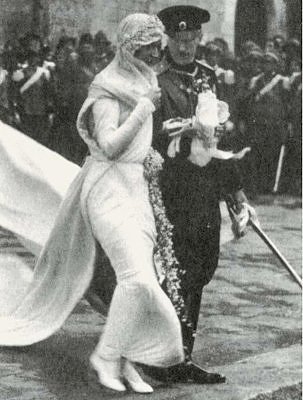
The negotiations had been difficult and at one point talks broke off entirely with Boris III declaring that he would remain a bachelor if he could not marry his beloved Princess Giovanna. The Princess likewise vowed to renounce her royal life and enter a convent if she could not marry the Tsar. So, finally, everything was worked out. The Tsar of Bulgaria and the Princess of Italy were married at the Basilica of St Francis of Assisi on October 25, 1930 amidst a great deal of public celebration. Wedding dresses were simple and conservative and no jewelry was worn but it was still a glittering affair with some 50 royal princes in attendance and, never being one to miss the spotlight, a typically puffed-up Mussolini. After that, the couple departed Italy on the Bulgarian liner “Tsar Ferdinand I” and Giovanna stepped ashore on Bulgarian soil at Burgas. The couple then traveled by train to Sofia where a second, Orthodox, wedding ceremony was held at the St Alexander Nevsky Cathedral where Giovanna took the Bulgarian form of her name and was presented to the public as Tsaritsa Ioanna of Bulgaria.
The new Tsaritsa was a very down-to-earth wife, astonishing the world when she revealed that she personally cooked meals for herself and her husband, saying how the Tsar loved home cooking and that, “The secret of domestic happiness is to be found in the kitchen”. In 1933 the Tsaritsa gave birth to the couple’s first child, Princess Marie-Louise, and despite the promise Boris III had made to the Vatican, she was, as expected, immediately baptized into the Bulgarian Orthodox Church. The Pope was rather upset at what he called “Balkan tricks” but nonetheless refrained from excommunicating the Italian Tsaritsa who remained a devoted Catholic throughout her life but always extremely reverent and respectful toward the Orthodox faith of her new country. In 1937 there were huge public celebrations, complete with torchlight celebrations, in honor of the birth of an heir to the throne, Prince Simeon. However, the happy mood of the Royal Family could not endure for long as the war clouds continued to gather across Europe. When Adolf Hitler invaded Poland, Britain and France declared war and for the second time in the 20th Century the world came apart in a torrent of death and destruction.
Like the rest of her family, Tsaritsa Ioanna hoped to stay out of World War II though she was naturally concerned about her native Kingdom of Italy (where her relatives likewise hoped to stay out of the conflict). Tsar Boris III is supposed to have said that his wife was pro-Italian, his ministers were pro-German and his people were pro-Russian while he was entirely neutral. However, when Axis troops conquered Yugoslavia and Greece with pro-Nazi regimes put in place in Hungary and Romania there was no hope for Bulgaria to remain totally uninvolved. Under great pressure the Tsar agreed to a limited sort of alliance with the main Axis partners of Germany, Italy and Japan. However, the Tsar and Tsaritsa of Bulgaria were anything but sympathetic to Hitler. On the contrary, they were horrified by his actions and refused to take part in any of his schemes. Risking the wrath of the dictator who ruled most of Europe, they refused to cooperate in the deportation of Bulgarian Jews to Nazi Germany -where they would ultimately have been massacred. Tsaritsa Ioanna intervened herself to obtain visas for Bulgarian Jews to escape the danger of Europe to the safety of Argentina.
Hitler was furious at how uncooperative the Bulgarian Royal Family was and when the Tsar suddenly fell ill and died in 1943 after a visit with Hitler (in which the Fuhrer flew into a rage when the Tsar refused to participate in his invasion of Russia) many suspected the Nazi leader of having the Tsar poisoned. Tsaritsa Ioanna was grief-stricken and all the more concerned to see her 6-year-old son proclaimed Tsar Simeon II of Bulgaria with three regents to act for him. If his father had been murdered, what fate might be in store for his son if they aroused the anger of the Nazis? However, the ultimate threat was not to come from Germany. The Nazis lost their war and despite Bulgaria not being involved in the invasion of the Soviet Union, Bulgaria was still invaded by the Red Army and doomed to become a Soviet satellite-state. In 1945 Bulgaria was taken over by the Communists, the three regents were murdered and a referendum was staged in order to justify the abolition of the monarchy. With only 24 hours given to them, Tsaritsa Ioanna gathered her children and fled into exile, first with her father, King Vittorio Emanuele III in Egypt and then finally to Spain where Generalissimo Francisco Franco was welcoming to any victims of communist aggression. Later she moved to Portugal to be near her exiled brother King Umberto II of Italy. However, she never ceased to be a Bulgarian queen, having a Bulgarian Orthodox chapel built alongside her residence.
The communists had destroyed the grave of Tsar Boris III but when the Soviet Union collapsed and the “Iron Curtain” came down, Tsaritsa Ioanna returned to Bulgaria in 1993 to reinter the heart of her beloved husband, which had been buried separately and was thus spared from the communist degradation in 1954. It was her last trip to her adopted homeland and she was very warmly welcomed by the Bulgarian people who never forgot the kindness and compassion she had always displayed toward them. She died in Portugal on February 26, 2000 at the age of 92 and was buried in Italy at the Basilica of St Francis of Assisi where she had first married her beloved husband. Throughout her life she had displayed great humanity, heroic compassion, risking her own life to save others and was always the most devoted wife and mother as well as queen. Her memory deserves to be honored and she will always be one of the brightest stars in the history of the Bulgarian monarchy and the Italian House of Savoy.
Princess Giovanna spent much of her youth at the Villa Savoia, kept under the watchful eye of a notoriously strict governess. The princess was given an impressive education, learning history, literature, French, English and learning to play the piano. All the royal children were quite beloved in Italy and by Italians around the world. A much commented on incident was in 1923 when Princess Giovanna and her sister Princess Mafalda came down with typhoid and the daily reports on their condition were as greatly in demand by Italian-American newspapers in the United States as those in Italy itself. She grew up to be a remarkably compassionate and dutiful young princess and when it came time to find a suitable husband for her, Italian eyes fell on Bulgaria. There had been other possibilities of course. Some suggested the son of the Crown Prince of Bavaria, others one of the Hapsburg Archdukes and for those who could not abide foreigners there was the Marquis de Pinedo, a famous Italian aviator of daring reputation. He died in 1933 in a crash though and again and again attention returned to Bulgaria where a marriage might serve the House of Savoy and the Kingdom of Italy well in the future.
Princess Giovanna and the Bulgarian Tsar Boris III first met in 1927 when the Tsar was touring Europe along with his brother Prince Kyril. According to Princess Giovanna the Bulgarian Tsar barely noticed her on this first occasion but the subject of marriage was later broached between Prince Kyril and the Princess’ sister Princess Mafalda. A few years later, on January 8, 1930, the two met again when they each attended the wedding of Princess Maria Jose of Belgium to Princess Giovanna’s brother Crown Prince Umberto of Italy. A marriage of Italian and Bulgarian royalty was nothing new, Boris’ father, Tsar Ferdinand, had married a princess of the former royal houses of Parma and the Two-Sicilies, however, just as with that marriage, religion was to be a source of difficulty for the staunchly Orthodox Bulgars and the staunchly Catholic Italians. Only recently the Kingdom of Italy and the Roman Catholic Church had been reconciled and the Church was adamant that Tsar Boris III had to agree that any future children be raised in the Catholic faith before they would accept a marriage between him and Princess Giovanna. This was a touchy subject. Boris III himself was supposed to have been a Catholic but, of course, the Bulgarians would have had none of that and he became Orthodox. Pope Pius XI no doubt worried that the same thing would happen again. Once again, a Bulgarian Tsar promised the Pope to raise any future children as Catholics in order to marry an Italian princess (though he refused to sign a contract to that effect) and, again, the Pope agreed and the marriage date was set.
The negotiations had been difficult and at one point talks broke off entirely with Boris III declaring that he would remain a bachelor if he could not marry his beloved Princess Giovanna. The Princess likewise vowed to renounce her royal life and enter a convent if she could not marry the Tsar. So, finally, everything was worked out. The Tsar of Bulgaria and the Princess of Italy were married at the Basilica of St Francis of Assisi on October 25, 1930 amidst a great deal of public celebration. Wedding dresses were simple and conservative and no jewelry was worn but it was still a glittering affair with some 50 royal princes in attendance and, never being one to miss the spotlight, a typically puffed-up Mussolini. After that, the couple departed Italy on the Bulgarian liner “Tsar Ferdinand I” and Giovanna stepped ashore on Bulgarian soil at Burgas. The couple then traveled by train to Sofia where a second, Orthodox, wedding ceremony was held at the St Alexander Nevsky Cathedral where Giovanna took the Bulgarian form of her name and was presented to the public as Tsaritsa Ioanna of Bulgaria.
The new Tsaritsa was a very down-to-earth wife, astonishing the world when she revealed that she personally cooked meals for herself and her husband, saying how the Tsar loved home cooking and that, “The secret of domestic happiness is to be found in the kitchen”. In 1933 the Tsaritsa gave birth to the couple’s first child, Princess Marie-Louise, and despite the promise Boris III had made to the Vatican, she was, as expected, immediately baptized into the Bulgarian Orthodox Church. The Pope was rather upset at what he called “Balkan tricks” but nonetheless refrained from excommunicating the Italian Tsaritsa who remained a devoted Catholic throughout her life but always extremely reverent and respectful toward the Orthodox faith of her new country. In 1937 there were huge public celebrations, complete with torchlight celebrations, in honor of the birth of an heir to the throne, Prince Simeon. However, the happy mood of the Royal Family could not endure for long as the war clouds continued to gather across Europe. When Adolf Hitler invaded Poland, Britain and France declared war and for the second time in the 20th Century the world came apart in a torrent of death and destruction.
Like the rest of her family, Tsaritsa Ioanna hoped to stay out of World War II though she was naturally concerned about her native Kingdom of Italy (where her relatives likewise hoped to stay out of the conflict). Tsar Boris III is supposed to have said that his wife was pro-Italian, his ministers were pro-German and his people were pro-Russian while he was entirely neutral. However, when Axis troops conquered Yugoslavia and Greece with pro-Nazi regimes put in place in Hungary and Romania there was no hope for Bulgaria to remain totally uninvolved. Under great pressure the Tsar agreed to a limited sort of alliance with the main Axis partners of Germany, Italy and Japan. However, the Tsar and Tsaritsa of Bulgaria were anything but sympathetic to Hitler. On the contrary, they were horrified by his actions and refused to take part in any of his schemes. Risking the wrath of the dictator who ruled most of Europe, they refused to cooperate in the deportation of Bulgarian Jews to Nazi Germany -where they would ultimately have been massacred. Tsaritsa Ioanna intervened herself to obtain visas for Bulgarian Jews to escape the danger of Europe to the safety of Argentina.
Hitler was furious at how uncooperative the Bulgarian Royal Family was and when the Tsar suddenly fell ill and died in 1943 after a visit with Hitler (in which the Fuhrer flew into a rage when the Tsar refused to participate in his invasion of Russia) many suspected the Nazi leader of having the Tsar poisoned. Tsaritsa Ioanna was grief-stricken and all the more concerned to see her 6-year-old son proclaimed Tsar Simeon II of Bulgaria with three regents to act for him. If his father had been murdered, what fate might be in store for his son if they aroused the anger of the Nazis? However, the ultimate threat was not to come from Germany. The Nazis lost their war and despite Bulgaria not being involved in the invasion of the Soviet Union, Bulgaria was still invaded by the Red Army and doomed to become a Soviet satellite-state. In 1945 Bulgaria was taken over by the Communists, the three regents were murdered and a referendum was staged in order to justify the abolition of the monarchy. With only 24 hours given to them, Tsaritsa Ioanna gathered her children and fled into exile, first with her father, King Vittorio Emanuele III in Egypt and then finally to Spain where Generalissimo Francisco Franco was welcoming to any victims of communist aggression. Later she moved to Portugal to be near her exiled brother King Umberto II of Italy. However, she never ceased to be a Bulgarian queen, having a Bulgarian Orthodox chapel built alongside her residence.
The communists had destroyed the grave of Tsar Boris III but when the Soviet Union collapsed and the “Iron Curtain” came down, Tsaritsa Ioanna returned to Bulgaria in 1993 to reinter the heart of her beloved husband, which had been buried separately and was thus spared from the communist degradation in 1954. It was her last trip to her adopted homeland and she was very warmly welcomed by the Bulgarian people who never forgot the kindness and compassion she had always displayed toward them. She died in Portugal on February 26, 2000 at the age of 92 and was buried in Italy at the Basilica of St Francis of Assisi where she had first married her beloved husband. Throughout her life she had displayed great humanity, heroic compassion, risking her own life to save others and was always the most devoted wife and mother as well as queen. Her memory deserves to be honored and she will always be one of the brightest stars in the history of the Bulgarian monarchy and the Italian House of Savoy.
Wednesday, April 11, 2012
War of 1812 Wednesday, Part III, 1813 - The Second Year
![]() |
| General Proctor |
Nonetheless, these actions convinced both sides of the need to control the Great Lakes and in particular the Saint Lawrence River. Both sides geared up for a naval confrontation and US forces launched attacks into Canada. Of greatest significance was an attack on April 27 led by General Zebulon Pike. The original goal of US General Dearborn was Kingston across Lake Ontario, but when the British guessed his move and sent in reinforcements the Americans turned toward the capital of Canada, York, present-day Toronto. Roughly 2,000 American troops landed before the Crown forces under General Roger Sheaffe arrived to oppose them. Seeing that the cause was lost, Sheaffe destroyed the gunpowder stockpile as well as HMS Isaac Brock which was being built for battle on the Great Lakes. The explosion of the Isaac Brock killed the US General Pike but Sheaffe retreated to Ft York and the Canadian militia who remained behind were forced to surrender. In an act that was to have far-reaching consequences, after the battle American troops pillaged and burned Toronto. Vital supplies meant for the Great Lakes squadron and Detroit were destroyed, but the Americans also looted private homes and destroyed public buildings, including the Parliament. It was an act of cruelty that would not be soon forgotten. General Dearborn claimed to have conquered Ontario, but without taking Kingston as he had planned the sack of Toronto was meaningless and the US forces soon retreated back to their own soil. Nonetheless, the lack of the supplies that were destroyed was to play a part in deciding control of the Great Lakes.
![]() |
| Laura Secord |
Although there was no contesting British rule of the seas, the Americans decided on a major effort to gain control of the Great Lakes in the hope of stopping any further threat from Canada. On September 10, 1813 American forces attacked the British squadron in Lake Erie under the command of Master-Commandant Oliver Hazard Perry. Perry had two 20-gun brigs, a captured British brig and six schooners with which to attack the six Royal Navy vessels commanded by Commodore Robert Heriot Barclay. The two sides were not evenly matched since the American ships, were more numerous, and while the British ships were of better quality, they were not well equipped due to the destruction of so much of their supplies at Toronto and the crews were poorly trained or prepared for battle. Perry blocked the British into the western end of the lake near Put-in-Bay, Ohio and sailed in to destroy them. The British ships put up a terrific fight and the USS Lawrence, Perry's flagship, was totally wrecked with more than half the crew killed, forcing Perry to transfer his flag to the USS Niagara. He then went on to capture the British flagship, HMS Detroit and ultimately the rest of the British squadron as well, accepting the surrender of Commodore Barclay on the blood-soaked deck of the ruined Lawrence.
![]() |
| General Harrison |
The US had finally won a victory on Canadian soil at the battle of the Thames, but its actual results were mixed. Canada was not conquered and Harrison knew he could not advance any further and retreated back to Detroit. The Northwest Territory was regained for the United States and with the death of Tecumseh the Indian alliance soon dissolved; so it was somewhat significant. The US had gained nothing, but they had taken back the British conquests of General Brock from the previous year. The area was to remain in American hands forever after, a fact more significant to the Indians who had been hoping the war would be an opportunity for them to take this territory back permanently. The strategic situation was not significantly changed and the British continued to make use of the St Lawrence River to supply Ontario. The US had gained enough courage and still harbored enough animosity to keep trying to conquer Canada.
![]() |
| General Prevost |
On October 25, 1813 General Hampton, with 4,000 US regulars and state militiamen, met a small force of about 500 Indians and Canadian militia under the French Canadian lieutenant colonel Charles de Salaberry on the Chateauguay River. Salaberry delayed Hampton and with help from the local populace managed to dupe Hampton into believing he was outnumbered. The battle was light on violence, but heavy on theatrics as the Canadian and Indian troops put on such a show of force that Hampton was totally intimidated and soon retreated. Total American casualties were 250 while the Crown forces lost only about 21 men killed or wounded. Once again overwhelming American numbers had been defeated by clever bluffs and sheer guile. Nonetheless, Wilkinson, with 8,000 men, continued on with the operation until news of the ignominious defeat of Hampton, and the presence of British forces in his rear forced him to make an early landing at Morrisburg, Ontario. Incidentally, one of the British officers pursuing him, Lieutenant Colonel Joseph Morrison was an American, having been born in New York in 1783. On November 11, the rearguard of Wilkinson's army, numbering some 2,500 men, attacked Colonel Morrison, who had only 800 men, at the battle of Crysler's Farm near Cornwall, Ontario. Once again, the American forces were soundly defeated and took heavy losses. Wilkinson was forced to retreat and was eventually court-martialed for neglect of duty.
Continued Next Week with Part IV - The Third Year
Tuesday, April 10, 2012
Remembering a Patriarch
Today The Mad Monarchist remembers HAH Ecumenical Patriarch Gregory V of Constantinople, saint and ethnomartyr who was hanged, in his vestments, from the St Peter Gate in Constantinople in retaliation for the rebellion of the Greeks on the day of Easter in 1821, to the outrage of the Orthodox and civilized world. It was a dark stain on the reign of Sultan Mahmud II and ensured that the great powers of Europe would turn against the Ottoman Empire and support Greek independence. You can read more about his life here. May he always be remembered.
Monday, April 9, 2012
Defending the Papal States
The Papal States fall into that gray area that some have a hard time categorizing. Some monarchists (Catholic as well as Protestant, though I should probably say “Catholic” in such a case) do not consider the Papal States a monarchy and so feel no need to defend them. Most would not expect a Protestant to do so in any case. The Papal States, they say, were a theocracy, not a monarchy and thus are not to be categorized with other monarchies. I, obviously, would say otherwise. I would term the Papal States as a “theocratic monarchy” but a monarchy nonetheless. Popes had traditionally been regarded as monarchial figures by the other crowned heads of Europe, having all the trappings of any other monarchy but with the added role of “Bishop of Rome, Vicar of Christ, Supreme Pontiff, Successor of St Peter” etc. Some have also pointed to the fact that the Pope is elected as a disqualifier. However, the Holy Roman Emperors were elected (technically), the Kings of Poland were elected and so on. Additionally, unlike some other theocracies, the ruler of the Papal States -the Pope- based his authority on being the spiritual (rather than hereditary) successor of St Peter, so there was a legitimate succession that was of immense importance just as Apostolic Succession is paramount in the Catholic Church in general. So, to my mind, there has never been any doubt about the Papal States being a variety of monarchy and having nothing at all in common with, for example, the theocracy in Iran which not only calls itself a republic but goes through the regular ritual of electing a non-clerical president as the (alleged) leader of the government.
When it comes to the Papal States there has been a great deal of misunderstanding on the subject, partly because a great deal of misinformation has been purposely spread in order to discredit the Papal States and the Catholic Church in general. Probably the first and most prominent is the supposedly spurious “Donation of Constantine”. This refers to a document which Catholics long pointed to as the basis for the Papal States in which the Roman Emperor Constantine the Great ceded control of Rome and pretty much the entire Western Roman Empire to the Pope. For many years this was cited as the basis for all papal claims to temporal authority but, as I’m sure everyone knows, historians (including Catholic historians) now believe this to have been a forged document. Some have tried to make a scandal out of this but it really is nothing more than a nuisance and it does not finally matter what sort of arrangement there was between Emperor Constantine and the Pope or if there was no arrangement at all. When the Western Roman Empire began to collapse the Catholic Church assumed many of the temporal responsibilities of the state simply because they were the only stable, surviving institution around capable of doing so. It may for a time have been considered useful by the Church in avoiding the temporal control of the Eastern Roman Empire but, if so, that reason fell along with the Eastern Roman Empire itself in the course of history.
We do know that the Frankish king Pepin the Short made a donation of land to Pope Stephen II, who had earlier named Pepin a Patrician of Rome, and that this was later clarified and solidified under the Emperor Charlemagne, giving the Pope temporal control over the city of Rome and much of central Italy which would be under his exclusive control but which was also at least originally intended to be a sort of protectorate of the Holy Roman Empire, first of the Franks and later of the Germans. Of course, as most know, there was ambiguity about this almost from day one and was part of the reason for the long conflict known as the “Investiture Dispute” and so on as the Pope and the Holy Roman Emperor tried to work out where the powers of each began and ended. It also did not help that the Holy Roman Emperor was always a German, the Pope was usually an Italian and traditionally there was not a great deal of love lost between the Germans and the Italians. Eventually though it became clear and universally accepted that the Papal States were a fully independent and sovereign realm under the exclusive authority of the Roman Pontiff and answerable to no other. Although there was no clear start or “founding” for the Papal States, they certainly had staying power. If one takes the first Donation of Pepin as a starting point they existed from 754 to 1870 or roughly 1,116 years though by the end of that time they had been reduced to the city of Rome itself.
Today the Papal States are rarely looked at with any degree of dispassionate honesty. Personal prejudices almost invariably taint any account of what life was like in the Papal States. On one side there are those who paint the Papal States as a horribly backward place full of oppressed, downtrodden and fearful people held in the merciless grip of corrupt and uncaring clerics. On the other side there are those who paint the Papal States as a veritable paradise on earth with virtually no problems or difficulties, full of happy, devout Catholics tending their fields and saying their prayers watched over with shepherd-like kindness by thoughtful and compassionate priests. Not surprisingly the truth is neither of those, though (unpopular as it may be today to say so) the “paradise on earth” version is probably just slightly closer to reality than the “hell on earth” depiction. Obviously, secularists or anti-Catholics try to make the Papal States look as bad as possible because it fits their agenda. However, some Catholics hesitate to defend them because the idea of the Pope presiding over a temporal government (collecting taxes, putting people in jail and all that goes with it) is so alien to what they are used to today. A dispassionate look at the Papal States show a place that, for much of its history, was not terribly different from most other states in Western Europe and which certainly had plenty of problems and causes for some embarrassment but was also not a place where people were terribly miserable or living in constant fear of the Roman Inquisition.
Starting with the bad news first, it is true that the Papal States had many of the problems enemies of the Church often point to, they simply did not exist in anywhere near the proportion of the exaggerated claims made by these people. In the Papal States, yes, it goes without saying, there was no democracy, no freedom of religion, no freedom of the press, no freedom of speech and so on and so forth. For most of the history of the Papal States no one else had any of those freedoms either, the Papal States simply maintained the traditional, simpler method of government longer than pretty much anyone else in Western Europe. It is also true that, over the many centuries and the many different Pontiffs, things changed considerably from one pontificate to another. Some popes were very strict about maintaining public morality and enforcing Church law to the letter while others were content to more or less let people live as they pleased, offering advice of course, but taking the attitude that ‘it’s your soul to lose’. This also reveals the rather hypocritical double-standard of many of the critics of the Papal States.
It is hardly fair, for example, for someone to point to the licentious and libertine reign of Pope Alexander VI, who was content to let people do as they pleased and largely did as he pleased as well, only to then criticize someone like Pope Gregory XVI for putting people in prison for immoral behavior, writing blasphemous things about the Church or publicly spreading sedition. Yet, that seems to be all too common with the clerical rulers of the Papal States being condemned for hypocrisy if they are lenient or being condemned as theocratic tyrants when they enforce Church teachings. Well, I’m sorry folks but as much as some people today might like to pretend, the fact of the matter is that you cannot have a truly “Christian” government that also gives everyone the freedom to live their lives in any way they choose. And to be more specific, you probably shouldn’t expect a great deal of “liberty” when your Church/State includes a ban on “impure thoughts”. Again, once upon a time, this was nothing special but in the post-revolutionary world it quickly began to stand out as something out of the ordinary. However, it could, perhaps, be taken by the Catholic Church as some sort of compliment that the world continues to be “outraged” at anything less than perfection on the part of Catholics in authority.
There is no doubt that people today would find the Papal States terribly oppressive. If you worked on a feast day, missed confession or spoke out in favor of an elected, secular government you would be hauled off to prison or the Roman Inquisition. Naturally, people used to the world of today would recoil at the very idea but then in the world of today something as simple as a Christmas tree in a public building elicits cries of “theocracy!” so most are probably absolutely incapable at this point of having a mature, dispassionate view of a country where religious doctrines are the law of the land. However, it must be stressed again and again that the people in the Papal States were not living in misery. By modern standards of living, unless you were a prince (secular or spiritual), you would be considered poor. That does not mean that people were starving and living in squalor. The people in the Papal States, on the whole, produced enough to satisfy their needs (they had their ‘daily bread’ if you like), were not terribly concerned with political matters and were largely sincere and devout Catholics who did not view their clerical leaders as oppressive or burdensome. Were there problems? Yes. Were there abuses? Yes. Could the same be said for any country under any sort of government anywhere in the world? Yes.
The people of the Papal States were also, on the whole, fairly content. As the uprising that led to the Roman Republic of 1849 demonstrates, there was enough dissatisfaction to make a considerable number of people susceptible to the rhetoric of revolutionary firebrands. However, it is important to note as well, those firebrands were almost entirely from outside the Papal States and once the initial orgy of violence and sacrilege was over the more moderate majority was quick to reassert their continued attachment to the Catholic Church. The fact is that, while far from perfect, the Papal States were not the terrible place so many today seem to think. No state can function for over a thousand years without being well-run and competently managed. Nor could any state survive for so long if the people were being deprived of the necessities of life. At many points in history, Rome and the Papal States were chaotic (even forcing the Pope to go on an extended vacation in southern France at one point) but at other times Papal Rome was a more magnificent city than existed anywhere in the world. Great works of music, art and architecture were created in the Papal States under the patronage of the Roman Pontiffs. The world would be the worse off without these many and invaluable contributions which would not have been possible without the Papal States.
When it comes to the Papal States there has been a great deal of misunderstanding on the subject, partly because a great deal of misinformation has been purposely spread in order to discredit the Papal States and the Catholic Church in general. Probably the first and most prominent is the supposedly spurious “Donation of Constantine”. This refers to a document which Catholics long pointed to as the basis for the Papal States in which the Roman Emperor Constantine the Great ceded control of Rome and pretty much the entire Western Roman Empire to the Pope. For many years this was cited as the basis for all papal claims to temporal authority but, as I’m sure everyone knows, historians (including Catholic historians) now believe this to have been a forged document. Some have tried to make a scandal out of this but it really is nothing more than a nuisance and it does not finally matter what sort of arrangement there was between Emperor Constantine and the Pope or if there was no arrangement at all. When the Western Roman Empire began to collapse the Catholic Church assumed many of the temporal responsibilities of the state simply because they were the only stable, surviving institution around capable of doing so. It may for a time have been considered useful by the Church in avoiding the temporal control of the Eastern Roman Empire but, if so, that reason fell along with the Eastern Roman Empire itself in the course of history.
We do know that the Frankish king Pepin the Short made a donation of land to Pope Stephen II, who had earlier named Pepin a Patrician of Rome, and that this was later clarified and solidified under the Emperor Charlemagne, giving the Pope temporal control over the city of Rome and much of central Italy which would be under his exclusive control but which was also at least originally intended to be a sort of protectorate of the Holy Roman Empire, first of the Franks and later of the Germans. Of course, as most know, there was ambiguity about this almost from day one and was part of the reason for the long conflict known as the “Investiture Dispute” and so on as the Pope and the Holy Roman Emperor tried to work out where the powers of each began and ended. It also did not help that the Holy Roman Emperor was always a German, the Pope was usually an Italian and traditionally there was not a great deal of love lost between the Germans and the Italians. Eventually though it became clear and universally accepted that the Papal States were a fully independent and sovereign realm under the exclusive authority of the Roman Pontiff and answerable to no other. Although there was no clear start or “founding” for the Papal States, they certainly had staying power. If one takes the first Donation of Pepin as a starting point they existed from 754 to 1870 or roughly 1,116 years though by the end of that time they had been reduced to the city of Rome itself.
Today the Papal States are rarely looked at with any degree of dispassionate honesty. Personal prejudices almost invariably taint any account of what life was like in the Papal States. On one side there are those who paint the Papal States as a horribly backward place full of oppressed, downtrodden and fearful people held in the merciless grip of corrupt and uncaring clerics. On the other side there are those who paint the Papal States as a veritable paradise on earth with virtually no problems or difficulties, full of happy, devout Catholics tending their fields and saying their prayers watched over with shepherd-like kindness by thoughtful and compassionate priests. Not surprisingly the truth is neither of those, though (unpopular as it may be today to say so) the “paradise on earth” version is probably just slightly closer to reality than the “hell on earth” depiction. Obviously, secularists or anti-Catholics try to make the Papal States look as bad as possible because it fits their agenda. However, some Catholics hesitate to defend them because the idea of the Pope presiding over a temporal government (collecting taxes, putting people in jail and all that goes with it) is so alien to what they are used to today. A dispassionate look at the Papal States show a place that, for much of its history, was not terribly different from most other states in Western Europe and which certainly had plenty of problems and causes for some embarrassment but was also not a place where people were terribly miserable or living in constant fear of the Roman Inquisition.
Starting with the bad news first, it is true that the Papal States had many of the problems enemies of the Church often point to, they simply did not exist in anywhere near the proportion of the exaggerated claims made by these people. In the Papal States, yes, it goes without saying, there was no democracy, no freedom of religion, no freedom of the press, no freedom of speech and so on and so forth. For most of the history of the Papal States no one else had any of those freedoms either, the Papal States simply maintained the traditional, simpler method of government longer than pretty much anyone else in Western Europe. It is also true that, over the many centuries and the many different Pontiffs, things changed considerably from one pontificate to another. Some popes were very strict about maintaining public morality and enforcing Church law to the letter while others were content to more or less let people live as they pleased, offering advice of course, but taking the attitude that ‘it’s your soul to lose’. This also reveals the rather hypocritical double-standard of many of the critics of the Papal States.
It is hardly fair, for example, for someone to point to the licentious and libertine reign of Pope Alexander VI, who was content to let people do as they pleased and largely did as he pleased as well, only to then criticize someone like Pope Gregory XVI for putting people in prison for immoral behavior, writing blasphemous things about the Church or publicly spreading sedition. Yet, that seems to be all too common with the clerical rulers of the Papal States being condemned for hypocrisy if they are lenient or being condemned as theocratic tyrants when they enforce Church teachings. Well, I’m sorry folks but as much as some people today might like to pretend, the fact of the matter is that you cannot have a truly “Christian” government that also gives everyone the freedom to live their lives in any way they choose. And to be more specific, you probably shouldn’t expect a great deal of “liberty” when your Church/State includes a ban on “impure thoughts”. Again, once upon a time, this was nothing special but in the post-revolutionary world it quickly began to stand out as something out of the ordinary. However, it could, perhaps, be taken by the Catholic Church as some sort of compliment that the world continues to be “outraged” at anything less than perfection on the part of Catholics in authority.
There is no doubt that people today would find the Papal States terribly oppressive. If you worked on a feast day, missed confession or spoke out in favor of an elected, secular government you would be hauled off to prison or the Roman Inquisition. Naturally, people used to the world of today would recoil at the very idea but then in the world of today something as simple as a Christmas tree in a public building elicits cries of “theocracy!” so most are probably absolutely incapable at this point of having a mature, dispassionate view of a country where religious doctrines are the law of the land. However, it must be stressed again and again that the people in the Papal States were not living in misery. By modern standards of living, unless you were a prince (secular or spiritual), you would be considered poor. That does not mean that people were starving and living in squalor. The people in the Papal States, on the whole, produced enough to satisfy their needs (they had their ‘daily bread’ if you like), were not terribly concerned with political matters and were largely sincere and devout Catholics who did not view their clerical leaders as oppressive or burdensome. Were there problems? Yes. Were there abuses? Yes. Could the same be said for any country under any sort of government anywhere in the world? Yes.
The people of the Papal States were also, on the whole, fairly content. As the uprising that led to the Roman Republic of 1849 demonstrates, there was enough dissatisfaction to make a considerable number of people susceptible to the rhetoric of revolutionary firebrands. However, it is important to note as well, those firebrands were almost entirely from outside the Papal States and once the initial orgy of violence and sacrilege was over the more moderate majority was quick to reassert their continued attachment to the Catholic Church. The fact is that, while far from perfect, the Papal States were not the terrible place so many today seem to think. No state can function for over a thousand years without being well-run and competently managed. Nor could any state survive for so long if the people were being deprived of the necessities of life. At many points in history, Rome and the Papal States were chaotic (even forcing the Pope to go on an extended vacation in southern France at one point) but at other times Papal Rome was a more magnificent city than existed anywhere in the world. Great works of music, art and architecture were created in the Papal States under the patronage of the Roman Pontiffs. The world would be the worse off without these many and invaluable contributions which would not have been possible without the Papal States.
Subscribe to:
Posts (Atom)