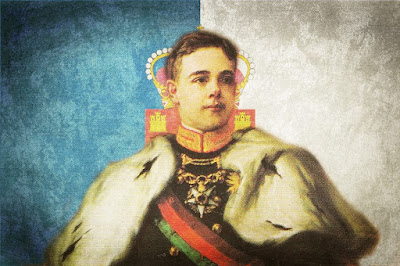
The last reigning Portuguese monarch to date, Manuel II, had a very interesting life, with all of the misfortune that statement implies. Coming to the throne of Portugal before his time, he was young, handsome, widely popular and seemed to embody a real sense of hope that the Kingdom of Portugal could be on the verge of a great revival in prestige and prosperity. Yet, after all too short a reign, he became the first major monarch to lose his throne in the Twentieth Century. Predictably, his country suffered as a result and there was every reason to believe that he could have been restored in his own lifetime. Yet, he was not and would live out his remaining years in exile, leaving behind a very problematic succession dispute. His life, in a way, embodies the problem with what we know as “constitutional monarchy” which looks quite reasonable and has worked very well for certain periods of time yet which always seems to go in the same direction. King Manuel II was probably the most “modern” monarch that Portugal had ever had, yet his position meant that he had great responsibility with very little power and fell victim to a powerful republican faction even though most Portuguese thought well of him.
His Royal Highness Infante Manuel Maria Filipe Carlos Amelio Luis Miguel Rafael Gabriel Gonzaga Francisco de Assis Eugenio de Orleans Savoy and Saxe-Coburg-Gotha Braganza of Portugal was born on November 15, 1889 at Belem Palace in Lisbon, the second son and third child of King Carlos I of Portugal and Queen Amelie of Orleans, daughter of the Count of Paris. As the younger son he was not expected to succeed to the throne and so was not educated with national leadership in mind though he was still given a first-rate education. Indeed, young Manuel proved to be a brilliant boy, becoming literate and fluent at French at only six years old. He was very much the bookish type, inclined to study with a great interest in literature and the arts, particularly music, having a great appreciation for the classics and becoming quite an adept pianist. Athletic activities were required of course but he preferred to spend his time reading and listening to Beethoven and Wagner, a young man of refined tastes. He seemed tailor-made to serve as in intellectual advisor to his handsome, more athletic and outgoing older brother Luis Felipe, when he eventually became king.
While his brother was trained for the army, Prince Manuel was set to enter the Portuguese Naval Academy for his own military career. However, all of those plans came to ruin on the tragic day of February 1, 1908 when a republican terrorist gang assassinated the King, the heir to the throne and wounded Prince Manuel in the arm. He likely would have been killed as well had it not been for the heroic actions of his mother Queen Amelie, instead, he became King Manuel II of Portugal and the Algarves under the most traumatic of circumstances. Although he confessed to being unprepared for such a position and forced to rely on his loyal ministers for advice, the new, young monarch did take some immediate and decisive action, dismissing the prime minister and his government which had presided over such a disaster and replacing it with a new government led by the distinguished Admiral Francisco Joaquin Ferreira do Amaral. It was hoped that this new government would encourage national unity and, in the immediate aftermath of the tragedy, it seemed to work. However, the republican conspiracy was found to be more widespread than any had originally realized.
King Manuel II started his reign greatly loved by the vast majority of his people. He was young, handsome and most felt immense sympathy for him due to the circumstances which had brought him to the throne. He also set a tone that he was to be a more “modern” king than his predecessors. He did away with most of the traditional pomp and ceremony of the royal court and, not surprisingly considering the fate which befell his father, declared that he would “reign” but not “rule” and would not be intervening in political matters as King Carlos had done. He also quickly set about trying to build a personal relationship with his subjects, traveling around the country to see and be seen by as many people as possible. He was highly praised for his frank conversations, sincerity and informal style. Unfortunately, none of this had any impact on the blind hatred of the ideologically driven republicans. As the investigation into the assassinations went forward, it was found that the web of these villains was extensive indeed and their hostility would be unremitting. King Manuel II did not remain unaware of this and decided on a way to try to deal with it but it would mean playing with fire.
The plan of the young monarch was to try to tame the socialist party, which, odd as it seems now had never fared well in Portugal, in order to make them a more palatable alternative to the republican party. Of course, being socialists, they were naturally republicans as well but the hope was that they could be made to work within the existing system of constitutional monarchy and that leftist agitators would abandon the cause of the republicans who had no other goal than the ruination of the kingdom. This would be no small trick as it would require two political miracles; making the republicans go over to the socialists and yet not have the socialists simply replace them as the primary threat to the monarchy. King Manuel II hoped that he could weaken the republicans and, perhaps naively, that the socialists could be a force for good in the country. Unfortunately, though perhaps not surprisingly, this never really worked but nor was it given much of a chance to. The situation was deteriorating faster than anyone would have expected. The efforts to modernize and any moderation on the part of the Crown was the scent of blood in the water for the republicans.
In electoral terms, the supporters of the constitutional monarchy did quite well and the republicans won the least number of seats but, hypocrites as they inevitably are, they never intended to take power democratically anyway and from the start were plotting to seize power by force. The King traveled abroad and reaffirmed the historic alliance with Great Britain but disaster struck when King Edward VII died and without him and with a Liberal government in London the Portuguese Royal Family could expect no help from that quarter in their hour of need. It also did not help that the British alliance and the friendship between the British and Portuguese royal houses was still fairly unpopular with a segment of the population in Portugal over the British seizure of the African territory between Portuguese East and West Africa. From the time King Manuel II came to the throne the Kingdom of Portugal would survive for only 33 months. Of that time, Portugal saw the rise and fall of seven different governments in 24 of those months. As was all too often the case, a splintering of the pro-monarchy parties created a power vacuum that the republicans were only too eager to fill.
The King and royal officials knew something was up and on October 3, 1910 put the soldiers of the Lisbon garrison on the alert and took care to stay at a different location than his uncle and heir-to-the throne, Prince Royal Afonso, in case the worse should happen. Rumors of a coup attempt were thick but republican conspirators nonetheless succeeded, with some of their fellow members serving in the army, in sparking a mutiny first in the Sixteenth Infantry and later First Artillery Regiments. Men from other units joined as well along with a few hundred civilians and, after clashing with police and some municipal guard troops along the way, set themselves up behind barricades in Rotunda Square. By the next morning some naval crews had mutinied as well, one group of rebels even seizing the cruiser Dom Carlos I, the situation in the capital was momentarily deadlocked. The rebels had achieved all of their aims and yet there was no mass uprising of the people as they had expected. They controlled a major city square and Alcantara parish, but little more and they could not remain there indefinitely. With no movement on the part of the public, many rebel leaders gave up and went home. Unfortunately, the firebrand Machado Santos stayed and determined to carry on.
The following days, troops from the palace were sent to dislodge the rebels at Rotunda Square but they were attacked as they came up, fought off their attackers and pressed on only to be repulsed at the rebel barricades. They tried to call for reinforcements but telegraph lines had been cut and railroads smashed to hinder if not prevent just such an occurrence. The monarchist units began to crack under the stress, a rebel cruiser shelled government buildings within sight of a Brazilian battleship which was actually carrying the President of Brazil, a former Portuguese colony which had only recently overthrown its own monarch of the same family as King Manuel II (in fact, Emperor Pedro II of Brazil had been present when the last King of Portugal was born). The King was doing his best to appear confident and relaxed by the morning of October 5 but found his phone lines cut when rebels attacked the Palace of Necessidades where he was staying. When the president of the Council of Ministers finally got in touch with him, he advised him to flee, having heard that the palace was to be bombarded but King Manuel II refused, saying he preferred to die at his post.
The palace did come under fire from ships in the harbor but the King kept his cool and contacted the minister president about what forces needed to be sent to reinforce the position. As the attack on Rotunda had already failed, he was advised again that it would be easier to get him out than to get sufficient loyal troops in. The King agreed to evacuate to a military school at Mafra, dispatching many of the soldiers sent to escort him to fight the rebels. However, when he arrived, he found only a small fraction of the soldiers expected and by that time had not many with him either. It was decided to bring the Queen Mother and Dowager Queen Maria Pia of Savoy to Mafra and then they would all go to Porto to make a proper defense and organize a monarchist counter-offensive to take back control of Lisbon. Fighting was still going on there but it came to end in an odd way, all due to a misunderstanding.
A German diplomat had gone out under a white flag to try to arrange a cease-fire to evacuate foreign diplomats. The royalist general on hand agreed, thinking this would also buy him some time for more reinforcements to come in. However, the sight of the white flag and the royal forces holding their fire, caused many to believe that the King’s troops had surrendered and many of the republicans began celebrating. Now the public made itself known as huge crowds took to the streets. This buoyed the republicans and totally demoralized the loyalist forces which soon collapsed, however, many people had no idea what had actually happened. Some were simply celebrating that the shooting had stopped, others assumed that it was the rebels who must have surrendered. However, the rebels wasted no time and proclaimed the First Portuguese Republic. King Manuel II, still at Mafra, was shocked to receive word from the civic officials that his country was now a republic and he was cut off. The arrival of the royal yacht, which had already picked up his uncle, offered the only chance of escape. The King first hoped to take the ship to Porto and carry on the struggle as planned but was advised this would be too risky and, indeed, as it turned out the city would have been in republican hands by the time they arrived. Instead, they had just enough fuel to make it to Gibraltar.
King Manuel II was extremely civil about the whole ordeal. After landing at Gibraltar he even ordered the yacht to return to Portugal on the grounds that it was government property and not his own. He would live out the rest of his life in exile in Great Britain. For a kingdom that dated back to 1139, with roots stretching back even further, it seemed an anticlimactic end, more like the result of a bizarre accident than a successful conspiracy. King Manuel II still regarded himself as King of Portugal, as did the other crowned heads of Europe and, indeed, there was plenty of reason to hope for a restoration as the First Portuguese Republic proved to be an incoherent, anticlerical, monument to political incompetence from start to finish. In 1911 and 1912 there were efforts at a royal restoration, showing considerable public support for the monarchy but each were unsuccessful. In 1913 the King married Princess Augusta Victoria von Hohenzollern but the two never had any children.
In World War I, starting the following year, the King, living in exile in Middlesex, England, supported the British war effort and approved of Portuguese involvement in the conflict on the Allied side. This put him at odds with many of his supporters who hoped for a German-Austrian victory. However, while intervention was a fiasco, the King’s judgment ultimately proved correct. Portugal would have lost their African empire in the event of a German victory and, as it happened, their colonies were saved by being on the winning team while at the same time the war severely discredited the republican government. They had been unable to maintain the Portuguese Expeditionary Force sent to France and ultimately allowed it to be absorbed into the British military because they could not provide support for their own soldiers. It was in light of this that another, very serious, attempt at a restoration of the monarchy occurred in 1919. Alas, once again, the republic managed to just survive.
There were also, unfortunately but not surprisingly, problems which the monarchists created for themselves. Ever since the Liberal Wars of 1828-1834 between the constitutional and absolute monarchists (basically the Portuguese version of the Spanish Carlist Wars) there had been a faction of the Portuguese Royal Family providing a rival claim to the throne in opposition to the victorious constitutional monarchists. At the time of the overthrow of King Manuel II, the absolutist claimant was Miguel, Duke of Braganza and this division doubtless hurt the overall cause of monarchy. It was also all the more pressing given that Manuel II had no heir to continue the constitutionalist line after the death of his uncle in 1920 with no heirs either.
King Manuel II and the Duke of Braganza met shortly after the revolution in Portugal and supposedly the King agreed that the Duke’s line were part of the family but no more than that and even that remains disputed to this day by some. Later, in 1922, another agreement was supposedly reached in France between the two rival claimants that the Duke’s heir, Duarte Nuno, would succeed Manuel II as claimant to the Portuguese Crown. However, the absolutists refused to accept allegiance to a constitutional monarchy and, as the offer by Manuel II depended on this, it was withdrawn. Maybe. Again, the facts on this are seemingly impossible to obtain as each side has a different version of events. Portuguese succession law also proved very problematic and hard to maneuver around, especially since it could no longer be modified and there were still those absolutists who would never accept a constitutional monarchy and constitutional monarchists who would never accept an absolute one.
As it was, Manuel II, the last King of Portugal to date, died of suffocation from a throat problem on July 2, 1932 which made the Miguelist heir Duarte Nuno the ‘last man standing’ and basically the only option for carrying the monarchist cause forward. By this time the First Portuguese Republic had fallen apart and a corporatist “New State” was in place led by Prime Minister Antonio Oliveira de Salazar who had begun to stabilize things and slowly bring the country back toward prosperity. A devout Catholic and inclined to monarchist sympathies, he allowed the remains of King Manuel II to come to Portugal for burial with full state honors. The sad occasion gathered huge crowds, showing again how much popular support the monarchy still had in Portugal. Salazar talked of restoring the monarchy and seriously considered it in 1951 but, perhaps because of the legal disputes and lingering rivalries within the monarchist community, ultimately never did so. When his regime was brought down by a military coup in 1974 the revived Portuguese republic has had basically only liberal or leftist governments ever since which, of course, have little time for any talk of monarchy.
In the end, King Manuel II had been a monarch with much promise. He was very intelligent, very devoted to his country and hoped to bring about a revival of Portugal by reviving the national pride of the Portuguese themselves as a unique people with a glorious history. A king at eighteen he was, nonetheless, inexperienced and was handed a problem on his first day that had been festering for years and proved worse than anyone then knew. He had so little time to prove himself that he can hardly be faulted for how things turned out. The situation which brought about his downfall was so bizarre as to almost defy belief. For the rest of his life he seemed the ideal exiled monarch and always seemed tantalizingly close to restoration only to never have it quite work out. He may not have always made the right moves, but his heart was always in the right place and Portugal only suffered by his absence. He could have done so much more for his country if only he had been allowed the opportunity.
Showing posts with label Braganza. Show all posts
Friday, October 20, 2017
Wednesday, August 15, 2012
Monarch Profile: King Pedro V of Portugal
Pedro V of Portugal, also called ‘Pedro the Hopeful’ and ‘Pedro the Beloved’ was born in Lisbon on September 16, 1837 to the admirable Queen Maria II and King-consort Fernando II, he was their first child, the first of many. Queen Maria II took great care that he be prepared for his future position and brought up properly. The Royal Prince and Duke of Braganza was given the best education possible and from an early age he displayed a great curiosity, intelligence, kindness and a willingness to study hard and learn as much as possible. He was a serious little boy but also enjoyed artistic pursuits such as painting and music. The Prince read Greek and Roman philosophy, could speak Latin fluently and had a great interest in natural history. The Crown was to come to him swiftly. Doctors had warned Queen Maria II against having child after child is quick succession but she refused to desist, saying that if necessary she would “die at her post”. She did pass away from childbirth complications in 1853 making the 16-year-old Royal Prince the new King Pedro V of Portugal. The loss of his mother was a terrible blow but he had a large support network of siblings, all of whom loved each other and they displayed none of the inter-familial bickering that had scarred Portugal in the past.
For the first two years of his reign King Pedro V was acted for by his father as regent but from the start be began to study statecraft intensely as well as diplomacy and all the necessary subjects for an active sovereign. His first overseas visit was to Great Britain (the oldest Portuguese allies) where he met with Queen Victoria and became especially good friends with the Princess Royal Victoria, the future German Empress. Afterwards he and his party toured Europe, visiting Belgium, The Netherlands, France, Austria, Prussia and other German states. Later he also visited Switzerland and Italy. When he became old enough to take up the direction of the Portuguese state himself, he was warmly welcomed by his people but also faced a nation in considerable trouble. A cholera epidemic had broken out in Lisbon and surrounding areas, costing thousands of lives, but the brave young monarch refused to relocate and preferred to stay and comfort his afflicted people even at the risk of his own life. There had also been crop failures which necessitated the importing of food which caused problems for the economy and government finances.
Through it all, Pedro V took his duties very seriously. He was as conscientious a monarch as one could hope to find. He never took precipitate action but would study all proposals very carefully, weighing the possible benefits and possible detriments, before he would give something his endorsement. He cared deeply for his people and wished no harm to come to them through some hasty action, even if well intentioned. To improve the quality of life of his people, King Pedro V embarked on a program of infrastructure modernization as well as promoting literacy and education. His reign saw a dramatic upsurge in the construction of roads, bridges, railroads and telegraph lines linking the major population centers. He also built new schools, often funded at his own expense, ordered Portuguese translation of the latest books on scientific discoveries and was fond of handing out books to children as royal gifts. He traveled extensively throughout the country to see firsthand what actions were required, where improvements were needed and what the lives of all of his people were like. He preferred to see for himself rather than listen to the reports of others. The King also wrote articles, under an assumed name, on military issues and current events for several popular periodicals.
Matters of the heart were also not neglected. In 1858 he married Princess Stephanie of Hohenzollern-Sigmaringen, first by proxy in Berlin and then in person in Lisbon on May 18. The British had helped to introduce the young couple and they seemed very happy and devoted to each other with all the necessities for a very long and happy marriage. However, unfortunately, tragedy came very quickly and the following year Queen Stephanie died of diphtheria. Queen Stephanie had won over everyone immediately with her warmth and generosity and the King and Portugal as a whole were greatly saddened by her sudden and tragic death. This probably also helped motivate King Pedro V toward the efforts he made throughout his reign to improve public health throughout his reign. The healthcare system improved very much during his reign thanks both to policy and the spread of hospitals and education on sanitation and fighting the spread of diseases. A special hospital for children suffering from mental illness was founded by the King in memory of and named after his late beloved wife.
All of this added to the great affection the Portuguese people had for Pedro V, who took such a great personal interest in their welfare and in being accessible to all his people. He disliked ceremony and was more inclined toward the practical. For example, he abolished the custom of hand-kissing, which he thought gave the impression that the King was a god as well as kneeling in the royal presence, again, something he thought suitable only for Church and the presence of God. Pedro V also had a suggestion box installed at the palace where his subjects could write to him directly about their problems and he took great care in reading and responding to these messages. Also in a very innovative step, the King abolished the death penalty in Portugal which he viewed as cruel and wasteful. Only God gave life and only God could take it in his view and he desired that the handling of prisoners should focus not on punishment but on rehabilitation and returning criminals to a proper sense of right and wrong as productive members of society. The King also continued, throughout his reign, to support a greater understanding of literature and scientific innovations amongst his people and would himself often go to the institutions he set up to listen to the lectures being given.
King Pedro V, who introduced the telegraph and railroad to Portugal, also wished for better communications between Portugal and the wider world. He saw to it that the shipping schedule between Portugal and the Portuguese colonies in Africa were increased and in 1860 agreed to the Peace, Amity and Trade Treaty between Portugal and the Empire of Japan which was signed by his representatives in Tokyo. The first article stated that, “There will be eternal peace and friendship between His Most Faithful Majesty, the King of Portugal, his heirs and successors and His Majesty, the Emperor of Japan, as well as amongst their domains and subjects”. The treaty has remained in effect since that time, the only problem arising over the Japanese occupation of East Timor island but this was done after Dutch and Australian forces had occupied it first and the Japanese later handed the colony back over to Portugal. Pedro V also signed a contract in 1855 to link Portugal and the United States via underwater cable and the year before he emancipated all the slaves belonging to the Portuguese government.
Few monarchs have been so widely loved as King Pedro V and few suffered as many misfortunes. In 1861, possibly after drinking tainted water from a pond while on a hunting trip, the young monarch fell ill with cholera. His brother, Prince Fernando, came down with it as well and the King remained at his side as long as possible. Many other members of the Royal Family were also stricken with the disease. Sadly, after a reign spent trying to eradicate the sorrow caused by such diseases, King Pedro V passed away on November 11, 1861 at the age of only 24. From Britain to America world leaders expressed their sadness at his loss and the Portuguese were so distraught and bewildered by his sudden end that some convinced themselves he must have been the victim of a conspiracy and rebelled. It was, however, simply a tragedy, the life of a promising young king cut all too short. In the time he had been given, he accomplished a great deal and we can confidently assume that, had he been given more time, his achievements could have been greater still for he had all the requisite qualities of a great monarch. He was intelligent, careful, compassionate, devoted to his people, faithful to God and his homeland and thoroughly committed to the ideal of royal service, to improve the lives of his subjects and the standing of his beloved country. Pedro V was a great king who left the world all too soon.
For the first two years of his reign King Pedro V was acted for by his father as regent but from the start be began to study statecraft intensely as well as diplomacy and all the necessary subjects for an active sovereign. His first overseas visit was to Great Britain (the oldest Portuguese allies) where he met with Queen Victoria and became especially good friends with the Princess Royal Victoria, the future German Empress. Afterwards he and his party toured Europe, visiting Belgium, The Netherlands, France, Austria, Prussia and other German states. Later he also visited Switzerland and Italy. When he became old enough to take up the direction of the Portuguese state himself, he was warmly welcomed by his people but also faced a nation in considerable trouble. A cholera epidemic had broken out in Lisbon and surrounding areas, costing thousands of lives, but the brave young monarch refused to relocate and preferred to stay and comfort his afflicted people even at the risk of his own life. There had also been crop failures which necessitated the importing of food which caused problems for the economy and government finances.
Through it all, Pedro V took his duties very seriously. He was as conscientious a monarch as one could hope to find. He never took precipitate action but would study all proposals very carefully, weighing the possible benefits and possible detriments, before he would give something his endorsement. He cared deeply for his people and wished no harm to come to them through some hasty action, even if well intentioned. To improve the quality of life of his people, King Pedro V embarked on a program of infrastructure modernization as well as promoting literacy and education. His reign saw a dramatic upsurge in the construction of roads, bridges, railroads and telegraph lines linking the major population centers. He also built new schools, often funded at his own expense, ordered Portuguese translation of the latest books on scientific discoveries and was fond of handing out books to children as royal gifts. He traveled extensively throughout the country to see firsthand what actions were required, where improvements were needed and what the lives of all of his people were like. He preferred to see for himself rather than listen to the reports of others. The King also wrote articles, under an assumed name, on military issues and current events for several popular periodicals.
Matters of the heart were also not neglected. In 1858 he married Princess Stephanie of Hohenzollern-Sigmaringen, first by proxy in Berlin and then in person in Lisbon on May 18. The British had helped to introduce the young couple and they seemed very happy and devoted to each other with all the necessities for a very long and happy marriage. However, unfortunately, tragedy came very quickly and the following year Queen Stephanie died of diphtheria. Queen Stephanie had won over everyone immediately with her warmth and generosity and the King and Portugal as a whole were greatly saddened by her sudden and tragic death. This probably also helped motivate King Pedro V toward the efforts he made throughout his reign to improve public health throughout his reign. The healthcare system improved very much during his reign thanks both to policy and the spread of hospitals and education on sanitation and fighting the spread of diseases. A special hospital for children suffering from mental illness was founded by the King in memory of and named after his late beloved wife.
All of this added to the great affection the Portuguese people had for Pedro V, who took such a great personal interest in their welfare and in being accessible to all his people. He disliked ceremony and was more inclined toward the practical. For example, he abolished the custom of hand-kissing, which he thought gave the impression that the King was a god as well as kneeling in the royal presence, again, something he thought suitable only for Church and the presence of God. Pedro V also had a suggestion box installed at the palace where his subjects could write to him directly about their problems and he took great care in reading and responding to these messages. Also in a very innovative step, the King abolished the death penalty in Portugal which he viewed as cruel and wasteful. Only God gave life and only God could take it in his view and he desired that the handling of prisoners should focus not on punishment but on rehabilitation and returning criminals to a proper sense of right and wrong as productive members of society. The King also continued, throughout his reign, to support a greater understanding of literature and scientific innovations amongst his people and would himself often go to the institutions he set up to listen to the lectures being given.
King Pedro V, who introduced the telegraph and railroad to Portugal, also wished for better communications between Portugal and the wider world. He saw to it that the shipping schedule between Portugal and the Portuguese colonies in Africa were increased and in 1860 agreed to the Peace, Amity and Trade Treaty between Portugal and the Empire of Japan which was signed by his representatives in Tokyo. The first article stated that, “There will be eternal peace and friendship between His Most Faithful Majesty, the King of Portugal, his heirs and successors and His Majesty, the Emperor of Japan, as well as amongst their domains and subjects”. The treaty has remained in effect since that time, the only problem arising over the Japanese occupation of East Timor island but this was done after Dutch and Australian forces had occupied it first and the Japanese later handed the colony back over to Portugal. Pedro V also signed a contract in 1855 to link Portugal and the United States via underwater cable and the year before he emancipated all the slaves belonging to the Portuguese government.
Few monarchs have been so widely loved as King Pedro V and few suffered as many misfortunes. In 1861, possibly after drinking tainted water from a pond while on a hunting trip, the young monarch fell ill with cholera. His brother, Prince Fernando, came down with it as well and the King remained at his side as long as possible. Many other members of the Royal Family were also stricken with the disease. Sadly, after a reign spent trying to eradicate the sorrow caused by such diseases, King Pedro V passed away on November 11, 1861 at the age of only 24. From Britain to America world leaders expressed their sadness at his loss and the Portuguese were so distraught and bewildered by his sudden end that some convinced themselves he must have been the victim of a conspiracy and rebelled. It was, however, simply a tragedy, the life of a promising young king cut all too short. In the time he had been given, he accomplished a great deal and we can confidently assume that, had he been given more time, his achievements could have been greater still for he had all the requisite qualities of a great monarch. He was intelligent, careful, compassionate, devoted to his people, faithful to God and his homeland and thoroughly committed to the ideal of royal service, to improve the lives of his subjects and the standing of his beloved country. Pedro V was a great king who left the world all too soon.
Thursday, September 22, 2011
Monarch Profile: Emperor Pedro I of Brazil
The story of the first Emperor of Brazil is rather unique amongst those of other founding monarchs. Born under one flag, leader of what was effectively a secessionist movement against his own country, monarch of that, then foreign, country and finally monarch of the country he started out in to begin with. A unique story to say the least, but regardless of the various politicians that are held up today, let there be no misunderstanding that what we know as Brazil would not exist without the man who became the first of her two emperors. He was born on October 12, 1798 in Lisbon, first city of the Kingdom of Portugal, a country which had fallen on hard times but which still possessed an impressive global empire (the first in the world as we know). He was born Dom Pedro de Alcântara Francisco António João Carlos Xavier de Paula Miguel Rafael Joaquim José Gonzaga Pascoal Cipriano Serafim of the House of Braganza. His father was the regent of Portugal, due to become King João VI of Portugal and his mother was the Infanta Carlota Joaquina, daughter of His Catholic Majesty King Carlos IV of Spain. His father ruled as regent on behalf of little Pedro’s grandmother (one of my favorites) the very pious and seemingly quite mad Queen Maria I of Portugal. Pedro was not the first born son but became heir upon the early death of his older brother.
Dom Pedro did not see much of his parents as a child, which was normal for the time and place, and he was only nine when, in 1807, the Portuguese Royal Family was forced to flee the country ahead of the invading French army of Napoleon. The French marched into Lisbon just in time to see them sailing away, bound for the largest and most prized Portuguese colony: Brazil. Being so young when he arrived in Rio de Janeiro it was, perhaps, inevitable that Dom Pedro would be more influenced by the people and atmosphere of Brazil than any other. In fact, it could be argued that, despite the place of his birth, he was a more a product of Brazil than he was of Portugal. While Brazil became a co-kingdom and Rio de Janeiro was elevated to the status of capital of the Portuguese colonial empire due to the presence of the Royal Family and the occupation of Portugal, young Dom Pedro spent his days exploring his new environment, soaking up the local culture, playing with the other children he met and coming to understand their ways until he considered himself one of them. Some have made snide remarks about the detriment this was to his formal education (his parents obviously had other, pressing matters to deal with) but, in a way, associating with what we might call ’street urchins’ gave Pedro a unique perspective on life. His playmates would take him to their homes, where the people, ignorant of who he was, welcomed him with the casual friendliness Brazil has long been known for, and he was able to observe and learn things he never could from a book.
As he grew up, Dom Pedro was known for his military flair, love of horses, music, art and poetry. He was also fond of the ladies though his adventures in this area have, perhaps, been overblown. In 1817, in the usual effort at a royal alliance, he was married to HIH Archduchess Maria Leopoldina of Austria, daughter of the Holy Roman Emperor Francis II. As an arranged marriage, Pedro was never quite so fond of his wife as she was of him but that is not to say he was not fond of her. She was always a trusted and respected confidant and she was much loved by the common people and, like her husband, came to adore the people of Brazil and considered herself finally to be a Brazilian above all. Finally, in 1821, with Napoleon safely defeated and hauled off to exile, King João VI returned to Portugal, leaving Dom Pedro as regent in Rio de Janeiro. However, having tasted ‘first place’ the Brazilians were rather hesitant to return to the subordinate status of a colony. Revolution was spreading across Latin America and it was also in 1821 that Mexico became independent after the King of Spain had refused to consider independence in a personal union.
Seeing Brazilian independence as all but inevitable, it was actually King João VI who advised his son to take the lead in that direction. After all, it would be better for Brazil to become an independent monarchy, staying within the family of the House of Braganza, that to fall victim to some revolutionary dictator. When political troubles arose in Portugal Dom Pedro famously refused to return to the land of his birth and accepted leadership of the independence faction in Brazil. On his birthday, October 12, 1822, he was formally declared Emperor Pedro I of Brazil and on December 1 celebrated his formal coronation as the first Emperor of Brazil. In the establishment of the new country, Emperor Pedro I was somewhat torn between his own liberal personality and the need for strong monarchial leadership to hold the country together and maintain order in the face of extremists from both sides of the political spectrum. In the end, it took stern measures and a more authoritative role than Pedro was comfortable with, to produce the constitution which served throughout the life of the Brazilian Empire. Dom Pedro I was also influenced in this direction by the fate of other countries in South America which were, from the very start, torn by rebellions and civil wars that prevented almost any social stability to say nothing of advancement or strides toward greatness.
There were still problems with rebels and dissidents, but Pedro I was able to prevail against them and further consolidated his position by seeking foreign recognition which came first from the United States (which was always eager to see ties severed between European kingdoms and their American colonies) but also, significantly, from the United Kingdom of Great Britain and Ireland which proved to be a valuable support and trading partner for the new Empire of Brazil. This, however, did anger some Brazilian merchants as did the call by Emperor Pedro I to abolish slavery within three years. Many elites began to oppose the Emperor in the north and in the south there was a costly war with Argentina which resulted in the creation of the Republic of Uruguay. National morale was lowered further with the death of Empress Maria Leopoldina in 1826. Because she was so popular, republican enemies of the Emperor tried to blame Dom Pedro for her death in very ugly and outrageously false propaganda pamphlets they circulated. In March of that same year, King João VI died which made the Emperor of Brazil simultaneously King Pedro IV of Portugal. A couple of months later he abdicated in favor of his young daughter, Queen Maria II, and appointed Dom Miguel regent on the agreement that the two would eventually marry.
However, Dom Miguel claimed his brother had no right to the throne of Portugal for having broken from the mother country and he deposed his niece and proclaimed himself King. Emperor Pedro had earlier put forward a more liberal constitution for Portugal and this add to the civil war as liberals embraced the cause of the little Queen Maria II and conservatives pledged allegiance to Dom Miguel. So it was that, aside from governing Brazil, Emperor Pedro I had to take in hand the issue of getting his daughter restored to the Portuguese throne. Naturally, his enemies in Brazil used this against him as well. Still, the Emperor pressed ahead and in 1829 married Princess Amélie de Beauharnais von Leuchtenberg, granddaughter of the late French Empress Josephine. Pedro I tried to keep a hold on things in Brazil while pressing forward with the fight against his brother on behalf of his daughter but growing economic hardship and increasingly anti-Portuguese feelings finally forced the Emperor to make a choice. With even his support amongst the army wavering he felt he had no choice and on April 7, 1831 he abdicated in favor of his 5-year-old son who became Emperor Pedro II of Brazil. Reverting to the title of Duke of Braganza, Dom Pedro returned to Portugal to devote his entire focus to defeating his brother.
In the war, Dom Pedro proved victorious and was supported by Britain and France which viewed the civil war in Portugal in the same light as that of the Carlist war in Spain, agreeing to banish both the Portuguese Dom Miguel and the Spanish Don Carlos. Dom Miguel was finally defeated and forced to capitulate, which he did, renouncing his rights to the Portuguese throne and accepting exile. Dom Pedro had, at long last, prevailed and his daughter Maria II was formally restored as Queen of Portugal. However, he did not live long to savor his victory as his life was cut short at the young age of 35 when, at the very palace he was born in, Dom Pedro, the first Emperor of Brazil and, for a short time, King of Portugal, died of tuberculosis on September 24, 1834. It was not until 1972 that his remains were finally returned to the country he most felt his own and interred at the Museu Paulista in São Paulo, Brazil near where he had first declared the independence of the Brazilian Empire.
Dom Pedro did not see much of his parents as a child, which was normal for the time and place, and he was only nine when, in 1807, the Portuguese Royal Family was forced to flee the country ahead of the invading French army of Napoleon. The French marched into Lisbon just in time to see them sailing away, bound for the largest and most prized Portuguese colony: Brazil. Being so young when he arrived in Rio de Janeiro it was, perhaps, inevitable that Dom Pedro would be more influenced by the people and atmosphere of Brazil than any other. In fact, it could be argued that, despite the place of his birth, he was a more a product of Brazil than he was of Portugal. While Brazil became a co-kingdom and Rio de Janeiro was elevated to the status of capital of the Portuguese colonial empire due to the presence of the Royal Family and the occupation of Portugal, young Dom Pedro spent his days exploring his new environment, soaking up the local culture, playing with the other children he met and coming to understand their ways until he considered himself one of them. Some have made snide remarks about the detriment this was to his formal education (his parents obviously had other, pressing matters to deal with) but, in a way, associating with what we might call ’street urchins’ gave Pedro a unique perspective on life. His playmates would take him to their homes, where the people, ignorant of who he was, welcomed him with the casual friendliness Brazil has long been known for, and he was able to observe and learn things he never could from a book.
As he grew up, Dom Pedro was known for his military flair, love of horses, music, art and poetry. He was also fond of the ladies though his adventures in this area have, perhaps, been overblown. In 1817, in the usual effort at a royal alliance, he was married to HIH Archduchess Maria Leopoldina of Austria, daughter of the Holy Roman Emperor Francis II. As an arranged marriage, Pedro was never quite so fond of his wife as she was of him but that is not to say he was not fond of her. She was always a trusted and respected confidant and she was much loved by the common people and, like her husband, came to adore the people of Brazil and considered herself finally to be a Brazilian above all. Finally, in 1821, with Napoleon safely defeated and hauled off to exile, King João VI returned to Portugal, leaving Dom Pedro as regent in Rio de Janeiro. However, having tasted ‘first place’ the Brazilians were rather hesitant to return to the subordinate status of a colony. Revolution was spreading across Latin America and it was also in 1821 that Mexico became independent after the King of Spain had refused to consider independence in a personal union.
Seeing Brazilian independence as all but inevitable, it was actually King João VI who advised his son to take the lead in that direction. After all, it would be better for Brazil to become an independent monarchy, staying within the family of the House of Braganza, that to fall victim to some revolutionary dictator. When political troubles arose in Portugal Dom Pedro famously refused to return to the land of his birth and accepted leadership of the independence faction in Brazil. On his birthday, October 12, 1822, he was formally declared Emperor Pedro I of Brazil and on December 1 celebrated his formal coronation as the first Emperor of Brazil. In the establishment of the new country, Emperor Pedro I was somewhat torn between his own liberal personality and the need for strong monarchial leadership to hold the country together and maintain order in the face of extremists from both sides of the political spectrum. In the end, it took stern measures and a more authoritative role than Pedro was comfortable with, to produce the constitution which served throughout the life of the Brazilian Empire. Dom Pedro I was also influenced in this direction by the fate of other countries in South America which were, from the very start, torn by rebellions and civil wars that prevented almost any social stability to say nothing of advancement or strides toward greatness.
There were still problems with rebels and dissidents, but Pedro I was able to prevail against them and further consolidated his position by seeking foreign recognition which came first from the United States (which was always eager to see ties severed between European kingdoms and their American colonies) but also, significantly, from the United Kingdom of Great Britain and Ireland which proved to be a valuable support and trading partner for the new Empire of Brazil. This, however, did anger some Brazilian merchants as did the call by Emperor Pedro I to abolish slavery within three years. Many elites began to oppose the Emperor in the north and in the south there was a costly war with Argentina which resulted in the creation of the Republic of Uruguay. National morale was lowered further with the death of Empress Maria Leopoldina in 1826. Because she was so popular, republican enemies of the Emperor tried to blame Dom Pedro for her death in very ugly and outrageously false propaganda pamphlets they circulated. In March of that same year, King João VI died which made the Emperor of Brazil simultaneously King Pedro IV of Portugal. A couple of months later he abdicated in favor of his young daughter, Queen Maria II, and appointed Dom Miguel regent on the agreement that the two would eventually marry.
However, Dom Miguel claimed his brother had no right to the throne of Portugal for having broken from the mother country and he deposed his niece and proclaimed himself King. Emperor Pedro had earlier put forward a more liberal constitution for Portugal and this add to the civil war as liberals embraced the cause of the little Queen Maria II and conservatives pledged allegiance to Dom Miguel. So it was that, aside from governing Brazil, Emperor Pedro I had to take in hand the issue of getting his daughter restored to the Portuguese throne. Naturally, his enemies in Brazil used this against him as well. Still, the Emperor pressed ahead and in 1829 married Princess Amélie de Beauharnais von Leuchtenberg, granddaughter of the late French Empress Josephine. Pedro I tried to keep a hold on things in Brazil while pressing forward with the fight against his brother on behalf of his daughter but growing economic hardship and increasingly anti-Portuguese feelings finally forced the Emperor to make a choice. With even his support amongst the army wavering he felt he had no choice and on April 7, 1831 he abdicated in favor of his 5-year-old son who became Emperor Pedro II of Brazil. Reverting to the title of Duke of Braganza, Dom Pedro returned to Portugal to devote his entire focus to defeating his brother.
In the war, Dom Pedro proved victorious and was supported by Britain and France which viewed the civil war in Portugal in the same light as that of the Carlist war in Spain, agreeing to banish both the Portuguese Dom Miguel and the Spanish Don Carlos. Dom Miguel was finally defeated and forced to capitulate, which he did, renouncing his rights to the Portuguese throne and accepting exile. Dom Pedro had, at long last, prevailed and his daughter Maria II was formally restored as Queen of Portugal. However, he did not live long to savor his victory as his life was cut short at the young age of 35 when, at the very palace he was born in, Dom Pedro, the first Emperor of Brazil and, for a short time, King of Portugal, died of tuberculosis on September 24, 1834. It was not until 1972 that his remains were finally returned to the country he most felt his own and interred at the Museu Paulista in São Paulo, Brazil near where he had first declared the independence of the Brazilian Empire.
Tuesday, December 1, 2009
HRH Dom Duarte Duke of Braganza, Anniversary Message
a short summary: The republic is messing things up, spending too much money on their own glorification and he favors legal rights for gay couples but not calling it marriage.
Subscribe to:
Posts (Atom)


