Showing posts with label texas friends. Show all posts

Thursday, May 15, 2014

Royal Friends of Texas: Spain

Of all the monarchies in the world, none has deeper ties with the state of Texas than the “Land of the Setting Sun”, the Kingdom of Spain. Texas was, at least nominally, under the Spanish Crown for about 302 years which, of course, is far longer than the roughly 159 years that Texas has been part of the United States of America. Given that, it is no surprise that the cultural impact of Spain on Texas has been immense and the relationship between Texas and Spain has been a long one. It all goes back to the reign of King Carlos I of Spain (Emperor Charles V to most people) in whose name Texas was first claimed by the Spanish explorer Alonso Alvarez de Pineda. In 1528 another Spanish explorer, Alvar Nunez Cabeza de Vaca, became the first Christian to set foot in Texas when he was shipwrecked on the coast. The first major exploration of the interior of Texas was carried out in the reign of King Felipe II by Francisco Coronado who also described a group of natives from whom the area of Texas derived its name (which means “friend”, hence Texas being known as “the friendship state”). However, Spain made little effort to make much of Texas until the French started to take an interest in the region.

When the French explorer La Salle mistakenly landed at Matagorda Bay, he claimed the region for King Louis XIV and established a fort in the area named for St Louis. The French effort did not succeed in establishing a permanent foothold as there was a mutiny and La Salle was killed. A Spanish punitive expedition found that the French had all killed each other or been killed or enslaved by the natives. The natives of the Texas coast were quite a fierce bunch and were the first to ever enjoy French cuisine in Texas -that being the French sailors themselves. Disaster though it was, this made it clear to Spain that Texas was vulnerable to attack and so a campaign began, at the behest of King Carlos II, to establish a string of missions and forts across Texas to guard the frontier with the French territory running down the Mississippi. This led to the first real Spanish presence in Texas and it produced the oldest historic buildings and settlements in Texas that survive to this day. The difference between the missions and the presidios (forts) can sometimes be hard to see since the missions were sometimes built like forts and every fort, of course, had a chapel. It is a mark of the appreciation for history and tradition in Texas that these missions are still standing and mass is still said in them on a regular basis.

The unfortunate King Carlos II was the last Hapsburg to reign over Texas and when the Crown of Spain passed to the Bourbon dynasty there was a marked shift toward greater centralization in government. Texas received a Royal Governor who established himself in San Antonio, the largest settlement at the time, and whose palace is the most lasting remnant of the era of monarchy in the Lone Star State. However, not many people in Mexico were anxious to move to Texas and settle. The relatively few settlers often came from Spain or some Spanish possessions closer to the homeland (such as the Canary Islands) and most of the settlements consisted of those farming Indians who had converted to Catholicism under the instruction of the Franciscan friars and the Spanish soldiers posted at the forts and missions to guard against a French attack and to protect the peaceful Indians from the hostile ones who survived by raiding as well as hunting. Eventually, after being held by Spain for a time, the Louisiana Territory was sold by France to the United States and the threat of a foreign incursion became an American rather than a French one.

Such fears were based in reality as, early on, there were attempts by filibusters (land pirates) from the United States to seize Texas from Spain. None of them succeeded but as revolution began to spread in Mexico, the forces of the Spanish Crown in Texas were suddenly faced by two enemies. In 1812 a Mexican republican made common cause with an ex-Army officer from the United States and invaded Texas with an army of Mexican revolutionaries, Indians, escaped slaves and assorted American criminals called the Republican Army of the North. They seized much of the province but were weakened by in-fighting and finally defeated and wiped out by a Spanish royalist army in 1813 at the battle of Medina, the largest battle ever fought on Texas soil. The reign of King Fernando VII was restored but only for the time being. Events in Spain brought together the left and right, at least temporarily, in Mexico and in 1821 what had been New Spain, including Texas, broke away as the Empire of Mexico under the former General Agustin de Iturbide.

The short-lived reign of Iturbide would be the last time Texas was under a monarch. It was also during the brief rule of the first Mexican Emperor that the first Anglo colonists began to settle in Texas. In fact, negotiations for the settlement were interrupted by the overthrow of Iturbide and had to be concluded with his republican successors. So, 1821 was the last year of unity between Texas and Spain and the unity between Texas and Mexico would be much more short-lived. The Kingdom of Spain never recognized the independence of the Republic of Texas, which is not surprising considering that Texas declared independence on March 2, 1836 and at that time Spain did not even recognize the independence of Mexico (that came later in December of that year). Nor was there much improvement in relations in the decades that followed due to American aggression against the remaining Spanish colonies in the Caribbean, ultimately resulting in the Spanish-American War. However, be it the Alamo, Goliad or San Jacinto, all of the most famous landmarks in Texas, all the places with the greatest historical significance, were part of the Spanish cultural legacy. Given the frequency of civil war in Spain itself, there was little opportunity for much business with Texas and when *the* Spanish Civil War broke out, opinion was divided in the United States as it was in the rest of the world. Most, like Mexico for that matter, favored the Spanish republicans but not quite everyone did as there were bitter condemnations against the Texas Oil Company (modern-day Texaco) for diverting shipping bound for the republican government to the nationalists instead.

During the Franco era the Texans saw Spain as a partner in the struggle against communism and the Generalissimo even marked Spanish-Texan ties by sending a statue of a conquistador to San Antonio where it still stands in front of the old Royal Governor’s Palace. Closer ties were forged after the passing of Franco and the restoration of the Spanish monarchy. King Juan Carlos has always made it a priority to try to encourage amity with the lands of the former Spanish Empire and Texas was not excluded. In 1987 King Juan Carlos and Queen Sophia became the first Spanish royals to visit Texas, receiving a warm welcome. “Spain is also very happy to have contributed in the passage to forge that identity as you today contribute to make this state one of the most prosperous, beautiful…in the United States,” the King said. Their Catholic Majesties received some cowboy hats, were greeted by crowds waving Spanish flags and musicians playing a combination of country-western and mariachi music. They visited the Alamo, took a floating tour of the San Antonio River and heard mass at the historic Spanish mission of San Jose (where the Cross of Burgundy still flies). In the years since, the King, Queen and other members of the Spanish Royal Family have visited the Lone Star State on numerous occasions.

Today Texas and Spain enjoy a close, friendly relationship, based more on culture and history than trade or commerce. Spanish people may not have a major presence in Texas, but the presence of the Spanish legacy is immense. The largest single religious denomination in Texas is the Roman Catholic Church, whose roots in Texas go all the way back to the original Spanish missionaries and the largest ethnic group in Texas is Hispanic with those of Spanish or at least partial Spanish ancestry recently becoming the majority of the population. By far, the most common language spoken in Texas, after English, is the Spanish language, even if it is more similar to that of colonial Mexico than pure, proper Castilian. Music, food and architecture across Texas have been heavily influenced by our Spanish roots and it is not enough to say that Texas and Spain are close, that they have been or will be but more than that, the fact is that Texas would not be Texas at all without the Kingdom of Spain.

Friday, March 21, 2014

Royal Friends of Texas: Belgium

The Kingdom of Belgium has had an impact on the world far out of proportion to its size and it has a long history of association with Texas. The Kingdom of Belgium was among the first powers to recognize the independence of the Republic of Texas but Belgians had been involved in Texas history even back in the colonial period. Much of the exploration of the New World was driven by the Holy Roman Emperor Charles V, who was also King Carlos I of Spain and a Belgian by birth. For a time both Texas and Belgium were part of the same Spanish Hapsburg Empire. The first Belgians to visit Texas were three priests who came with the expedition under Robert de LaSalle in 1685 that claimed Texas for the Kingdom of France and attempted to establish a colony. Born in Hainaut, they were Zenobius Membre, Maximus le Clerq, and Anastasius Douay. When Ft St Louis was attacked by Indians, Membre and le Clerq were killed, but Douay lived to tell Europe about the death of the intrepid French explorer.

Juan Banul
Probably no Belgian Texan is as well remembered as Juan Banul, a master blacksmith from Brussels who for some time was the only blacksmith in all of Texas. Banul made the journey to New Spain and traveled north to Texas in 1719, settling in San Antonio. The French incursion had prompted Spain to settle and fortify Texas and the Marques de Aguayo recruited Banul to accompany him on an expedition to East Texas to build six missions and two presidios (Spanish forts) and Banul stayed until 1723. In San Antonio, Banul did most of the ironwork and much of the woodwork at Mission San Jose, the largest of them all and known as the "Queen of the Missions" as well as Mission San Antonio de Valero, better known to history as the Alamo. In 1730 Banul and Maria Adriana Garcia, a Flemish widow, were married. They lived in the Alamo where Banul worked as a blacksmith and operated the sawmill.  Another Belgian Texan involved with the Alamo arrived in the 1850's. He was a stonemason named Theodore Vander Straten. By this time Texas had joined the United States and Straten helped repair the Alamo walls so the building could be put to use by the U.S. Army. However, the army designers were not interested in an exact restoration and so they added the now-famous curve to the church facade to hide the new roof.

In the 1830's there was almost an effort to establish a Belgian colony in Texas. The Belgians were anxious to establish formal relations with the young Republic of Texas, but since Mexico still refused to recognize Texan independence they feared offending the Mexican government. King Leopold I of the Belgians sent an official to Texas to observe and report back as to the viability of establishing a Belgian colony. Strapped for cash, the Texas government asked Belgium for a large loan as a prerequisite to a diplomatic treaty. The Belgian government refused to grant the loan and so the dream of a colony ended then and there. However, there were many Belgians who accompanied French colonists in La Reunion and they eventually tried to establish their own Belgian colony at Louvain but frequent flooding meant that most of these people moved on to Dallas and Ft Worth.

Dutchover Family
Like all Texans, the Belgian Texans included some very colorful characters. One of these was Anton Diedrick. His story starts in Antwerp where he was walking sometime in the 1840's and came across a murder in progress. Hoping to eliminate the witness, the murderers took Diedrick and sold him as an impressed seaman. When the ship he was on put in at Galveston, Texas Diedrick escaped  just in time for the war that was breaking out over the U.S. annexation of Texas. Poor Diedrick could only speak Flemish, but this did not deter two eager recruiters for the U.S. Army. When asked for his name, Diedrick tried to explain his situation, in Flemish, but was stopped by one of the soldiers who said, "Ah, he's Dutch all over," which is what they decided to call him.

With his new name, Anton Dutchallover fought in the Mexican-American War, surviving unscathed except for the loss of the "all" from his new name and he was known thereafter as Anton Dutchover. He adapted quite well to his new life in Texas and became a frontier scout. He even joined the legendary Texas Ranger Big Foot Wallace as shotgun rider on his runs between San Antonio and El Paso. In spite of the hostile climate of West Texas, along with even more hostile Indians and violent Mexican bandits, Anton Dutchover decided this was the place for him. He settled down and started a sheep ranch at Limpia Canyon and supplied soldiers at nearby Fort Davis with food. Dutchover remained at the fort during the Civil War, carrying on as usual whether under Union or Confederate rule. Dutchover started a family and they, along with four others, hid during a violent attack on the fort by Apache Indians. They stayed on where they were until 1867, when Federal troops reoccupied Fort Davis and stopped all further Indian attacks. The descendants of the Belgian soldier, scout, rancher and Indian fighter still live in West Texas today.

Another famous Belgian who came to Texas was Jean-Charles Houzeau, an astronomer and naturalist. He worked at the Belgian Royal Observatory before his radical liberal opinions brought about his removal and he moved to New Orleans, Louisiana. From there he came to Texas in 1858 and  worked as a surveyor before moving to Uvalde where he lead scientific expeditions. His politics still caused him trouble though. A firm enemy of slavery, when the Civil War broke out he helped prominent Unionists in San Antonio escape the Confederate authorities. Ultimately he was found out and had to escape to Mexico disguised as a peon. Eventually he returned to New Orleans, which had been taken by Union forces and ran a pro-Union newspaper. He also lived on Jamaica for eight years before returning to Europe, where his liberal opinions were no longer out of fashion, and returned to his old job as director of the Royal Observatory in Brussels. Texas continued to call him though, and in December of 1882 Houzeau returned to lead a scientific expedition to San Antonio to observe a locally visible transit of Venus across the face of the sun - in those days a method of measuring time and gravity.

Another wave of Belgian immigration came following dramatic events in Mexico. In 1864 the Austrian Archduke Maximilian became Emperor of Mexico. His wife, the Empress Carlota, was a Belgian princess, the daughter of King Leopold I, and many Belgians accompanied her to Mexico. Some came to settle, others with the Belgian military corps that gained quite a reputation for their victories over vastly superior revolutionary forces. However, by 1866, the French, who had supported Emperor Maximilian, withdrew their troops and with the United States backing the liberal forces, the Mexican Empire soon collapsed and most of the Belgians in Mexico were forced to flee across the Rio Grande to south Texas. In fact, for a time there was hardly a town in the Rio Grande Valley without a Belgian community.

Empress Carlota
In the late 19th and early 20th Centuries many Belgians moved to Galveston and Houston. Some were businessmen, others were farmers, cooks, bakers, candle and soap makers, restaurateurs and musicians. San Antonio though was the center of Belgian settlement in Texas and most there worked as farmers. Their business endeavors were successful as well. The Houston Supply Company, which once provided water for the city of San Antonio sold 90% of its stock to Belgian investors. After taking over the business they expanded it and turned it into a great success. Before 1947 St John Berchmans in San Antonio was the Belgian national parish with all services conducted in Flemish. In 1952 it was remodeled and renamed St Stephen's. Belgian farmers in Texas also made many advances in vegetable cultivation and irrigation techniques. It was the Belgian Texans who first made year-round vegetable production a widespread and successful business. Since the end of the 19th century, Belgian families and their descendants founded the famous vegetable farms in western San Antonio. Year-round growing was pioneered by such Belgian families as Van de Walle, van Daele, Persyn, and Baeten. The Belgian Texans raised common crops and introduced new ones, including cauliflower and kohlrabi. Today, harvests range from flowers to picante sauce.  

King Baudouin in Texas
One of the unique cultural features of the Belgian Texans was the observation of the "Kermess", a national fall harvest festival held in mid-August and in mid-November, if the harvest was good. Belgian Texans also celebrate Belgian independence day on July 21, the day Leopold I, the first King of the Belgians was enthroned. The Belgium Inn, the Belgian Village, and the Flanders Inn, among several other places, provide the settings for many a gathering, traditional or friendly and informal. Until recent years, the Belgian sport of bolling was played and a version of the game is still demonstrated annually at the Texas Folklife Festival in San Antonio. Today, the center of Belgian culture in San Antonio is still the Belgian Inn. Texas has also been proud to play host to Belgian royalty. In 1959 King Baudouin of the Belgians became the first Belgian monarch to visit the Lone Star State, visiting El Paso and Houston. King Baudouin was given a pair of cowboy boots and made an honorary citizen of Texas. King Baudouin may have been a repeat visitor and he may not have been the only Belgian monarch to visit Texas but records are hard to find. A Belgian government website has the King visiting Texas in 1959 and a photo of him with his boots and citizenship certificate (held by a private owner) is dated 1959 but other photos of the King visiting Rice University are dated 1969 or 1970. King Leopold III and Princess Lilian may have visited Texas in 1978 to dedicate a bust at Methodist Hospital in Houston, commissioned by Princess Lilian, of the heart surgeon who had previously operated on the former Belgian monarch. Unfortunately, exact details about that visit have proven hard to find. In any event, Texas and Belgium have had a long history together, will hopefully always remain fast friends and, of course, Texas would be pleased to welcome King Philip and Queen Mathilde anytime they would like to come down for a visit.

Thursday, March 6, 2014

Royal Friends of Texas: Norway

Texas and the Kingdom of Norway have had a relationship that began more recently than some others but which is also quite strong and has grown significantly stronger lately. Norway had little to do with Texas during the colonial period or independence but that changed after Texas joined the United States. Almost immediately at that point, in 1845, the first Norwegian colony in Texas was established when Ole Reiersen bought 1,476 acres of land in Henderson County. Along with his son Johan he recruited fifty families from Norway to come and settle on his land in Texas. At the time, the Kingdom of Norway was in personal union with the Kingdom of Sweden and the colony the Norwegians established was originally known as Normandy, just like the coastal area of France many are familiar with and for the same reason. Normandy (the one in France) was so named because it was settled by Vikings or Northmen, hence the name Normans and their land being known as Normandy. What is less clear is why, after some time, the Norwegian colony in Texas stopped being called Normandy and became known as Brownsboro.

Unfortunately, this original Norwegian colony did not thrive as the Norwegians had a harm time adapting to the harsh Texas climate. They were used to the harsh climate of Norway with its extreme cold but were not prepared for the extreme heat of Texas. Reiersen also claimed to have warned the Norwegian pioneers about where they should and should not settle but that they did not take his advice and settled “in very unhealthy places…in the bottom lands”. Whether this was true or just an effort by Reiersen to explain away the failure of his colonial venture without attaching blame to himself we will never know but the fact is that things were fine until the full force of the Texas summertime heat began to be felt and suddenly everyone got sick. Everyone. The most common ailment was malaria though the Reiersen family was unaffected, living on a hill that put them high above the malarial lowlands. Still, those Norwegians fortunate enough to survive were heartier for it and moved further west, settling in the Four Mile Prairie near Dallas in 1848.

One of the most famous Norwegian-Texans to settle there was Elise Amalie Tvede. She was already a well known journalist and advocate for women in the Kingdom of Norway when, at the age of 32, she came to Texas in 1847. At the Four Mile Prairie Norwegian colony in Van Zandt County she settled down and married Wilhelm Waerenskjold. She became a prolific writer, first simply as a way to help people deal with the loneliness of her fellow Norwegian-Texans. She wrote letters to everyone telling them about the latest news in the community and, being a natural talent, she also began to write articles about life in Texas for publications back in Norway. She would often visit her neighbors who, it was said, treated her “like a bishop” because of her refined, dignified manner as well as her fame because of her literary ability. Long after her death in 1895 her name has lived on for the colorful accounts she left behind about her first-hand experience as one of the early Norwegian pioneers in Texas. Despite the rough start, the Norwegian presence in the Lone Star State was set to grow and expand in the years to come.

There were 105 Norwegian Texans according to the census of 1850 and their presence was expanding. Cleng Peerson came to Texas after exchanging letters with the first known Norwegian settler to Texas, Johannes Nordboe (who settled near Dallas in 1841) and he brought two other men with him named Ole Canuteson and Carl Engebretson Quaestad. They scouted the area around the Bosque River and when Bosque County was established in 1854 they were among the first settlers. More Norwegians came and soon a thriving settlement called Norse was established there. Immigrants from Norway continued to come to Norse until 1872 and Norwegian customs remained the rule rather than the exception into the early years of the Twentieth Century.

In 1909 a land developer in Chicago named Anders L. Mordt sold land in the northernmost reaches of the Texas panhandle in Hansford County to a group of Norwegian immigrants living in the Midwest. That was where most Norwegians had settled in the United States but not all were that impressed with it and were inclined to move to the more wide, open spaces of northern Texas. A new settlement was started that became known as “Oslo on the Plains”. Anders Mordt went to considerable expense to get this new settlement going; building a school to attract families with children and donating land for a church. He also started publishing a local newspaper in the Norwegian language. It became quite a busy, little community for a few years but, unfortunately, did not last long as the settlement was wiped out in a drought in 1912 which caused most families to move away. Still, the Oslo on the Prairie has never been completely forgotten.

Crown Prince Haakon & Governor Rick Perry
By 1900 there were over a thousand Norwegian-Texans but by 1940 the number shrank slightly and, by that time, Norwegian had ceased to be spoken by most people. However, traces of Norwegian architecture and Norwegian names can still be found in the old settlements and an annual smorgasbord is still held at Our Savior’s Lutheran Church near the old town of Norse. In 1975 the Norwegian Society of Texas was established to preserve the cultural heritage of Texans of Norwegian ancestry and by 1990 94,096 Texans described themselves as of Norwegian descent. One of the strongest ties that still bind Texas and the Kingdom of Norway is the Norwegian Church Abroad or the Norwegian Seamen’s Church which was founded in 1864 and has spread all over the world, including, of course, to Texas. These are social and cultural centers as well as religious ones and provide a little taste of ‘home away from home’ for Norwegians with Norwegian food, drink, newspapers and television.

King Harald & Queen Sonja in Houston
A Seamen’s Church was established in Pasadena, near Houston, Texas as well as The Seamen’s Church Institute. HM King Harald V of Norway first visited Texas in 1984 and planted a magnolia tree at the church. In March of 2005 Texas was treated to a follow-up royal visit when Their Majesties King Harald V of Norway and Queen Sonja visited the Seamen’s Church. They were greeted by children in bunads and cowboy outfits and a special recital by the church children’s choir. Hundreds crowded outside to catch a glimpse of the royal couple and the King watered the same magnolia tree he had planted on his earlier visit. Describing the reception, the King said, “Our impression is that it is good to be Norwegian in Texas. Thank you for the warm and impressive welcome”. In 2013 Their Royal Highnesses Crown Prince Haakon and Crown Prince Mette-Marit also visited Texas and again, Houston was on the itinerary as well as Fort Worth. The main purpose of the visit was for the Crown Prince to attend a conference on offshore oil drilling, something which is a major industry in Texas and Norway. The Crown Prince said he could learn a lot from the many years of experience Texas has in the oil business. The visit to Fort Worth was to inspect the facilities of Lockheed Martin from whom Norway had purchased 52 new F35 fighter jets. So, in terms of settlement, royal visits, shared business enterprises and trade, the bonds of friendship between Texas and the Kingdom of Norway go back quite far and have only grown stronger and closer over the years.

Friday, February 14, 2014

Royal Friends of Texas: Canada

The connection between Texas and Canada actually goes back to before either were independent countries. Yet, most Texans and Canadians alike are probably unaware of the long history linking these two distant places. Today, the one part of Canada which most resembles Texas is certainly the Province of Alberta. Home to cowboys, oil wells and a largely conservative population, it is no wonder some have called Alberta the ‘Texas of Canada’. However, Texas and Canada have had a history long before the Province of Alberta was even settled. The list of Canadians who have played a part in Texas history and the list of famous Canadian-Texans is actually a long one. Two of the earliest were the French Canadian brothers Paul and Pierre Antoine Mallet who explored much of what is now northern Texas and New Mexico with their primary expeditions being across the area from Santa Fe, along the Canadian River and Red River to New Orleans, Louisiana. Some say it was these brothers who gave the Canadian River its name, thinking the river reached all the way to Canada. And, speaking of French Canada, thanks to the intrepid explorer La Salle, Texas and Canada shared a monarch for a short time in the person of King Louis XIV of France.

Holland crosses the line
During the War for Independence, a number of Canadians fought for Texas with great distinction. One famous name was Tapley Holland who was actually born in Ohio but whose parents were immigrants from Canada. At the famous battle of the Alamo, when Colonel Travis drew his line in the sand and asked any who would stay and fight to the death alongside him to cross the line, it was Tapley Holland who was the first to cross and offer to give his life for Texas. The year prior, when San Antonio was taken from the Mexican army, a native of Nova Scotia named William Graham (a member of the New Orleans Greys) was twice cited for bravery. Later, he formed his own company of volunteers in the U.S. and returned to serve the Republic of Texas as a member of the elite Texas Rangers. William Silvan Brown was a Canadian native of Montreal who came to Texas, joined the army and served for a time before being taken prisoner by the Mexicans and perishing in the infamous Goliad massacre. He was not the only Canadian to be killed on that tragic Palm Sunday, but, Canadians were also present at the final victory. It was a Canadian, Dr Nicholas Labadie, who patched up General Sam Houston during the battle of San Jacinto when Texas independence was won.

After the Republic of Texas was secured, one early item of business was to settle things with the Catholic Church. Several Canadian churchmen played a leading part in the agreements which saw the restoration of property to the Catholic Church by the Republic of Texas and the establishment of a local Catholic hierarchy. Canadian Catholics also played a major part in reviving Catholicism in the border region of Texas where the faith had lapsed during the period of the early Mexican republic and Texas independence. The founding father of the vital port city of Galveston, Texas was a Canadian and it was a Canadian priest, Father Paul Joseph Foik, a native of Ontario, who became a noted librarian and historian. He later founded the Catholic Archives of Texas. One of the most famous ranchers in Texas history was Henry W. Cresswell, an English-born immigrant to Canada. He was a ranching legend with vast holdings across the Texas panhandle, the western U.S. and Canada. He was also good friends with the famous Charles Goodnight. One that even a few outsiders might have heard of was Bartholomew (Bat) Masterson. He was a U.S. Marshal, born in Ontario who became a noted lawman in the Texas panhandle and eventually a living legend across the American west. He helped construct Adobe Walls on the Canadian River in north Texas, was involved in many a business venture and many a gunfight and had such a colorful life he inspired a popular television series.

In the sad War Between the States, one of the most prominent Texans was a native of Canada. Charles Arden Russell was a Canadian soldier, a veteran of the British army, who came to Texas for a visit and decided to stay. He was a local official and founder of Helena in Karnes County and was a delegate to the Texas secession convention when the state voted to leave the Union. Afterwards, he joined the Confederate army and served with the legendary Texas Ranger Colonel John S. “RIP” Ford (who won the last battle of the war in far south Texas). Another Canadian who rose to prominence in the fratricidal conflict was Margaret (Mother St. Pierre) Harrington. She was the second foundress of the Galveston Ursulines and was known as “the Soldiers’ Friend” during the war for her care of Union and Confederate soldiers during the war. Born in Montreal, Canada she moved to New Orleans and later to Galveston, Texas after joining the Ursuline Convent. Her many acts of compassion and courage during the war earned her a noble and holy reputation by people from both sides, Protestants and Catholics alike. And, there were Texans who also had an impact on Canada such as James Wainwright Flanagan. He was born in Henderson, Texas, left home when he was young and worked in mines and railroads in the U.S., Cuba and Mexico. Eventually he became a businessman, made it to Canada and became president of the Royal Bank of Canada in 1913. A decorated veteran of the Cuban army, he was also named an honorary lieutenant colonel in the First and Second Battalions of the Irish Regiment of Canada in 1940. He earned many honors in his life, including the Order of St Gregory granted by Pope Pius XI. He lived many years in Toronto, Canada before coming home to retire in Houston.

In the early days, when there was little to Canada outside of French Canada, it was the French Canadians who probably had the biggest footprints in Texas. This can even be seen in the number of Frenchmen from Acadia who settled in Texas. Most made their homes in Louisiana of course but some came to Texas and others migrated from Louisiana later and, while most associated with Louisiana, the term “Cajun” has been generally applied to any American southerner of French descent. Today this can seem somewhat strange given that no two places could seem more dissimilar than modern-day Quebec and Texas. However, most recently, Texas has grown ever more closer with the one Canadian province that is most similar to Texas; Alberta. Of course, since the 90’s Texas had increased exposure to Canadians thanks to the North American Free Trade Agreement, and there are always the “snow birds” who come to Texas to escape the harsh Canadian winter but recently Texas and Alberta in particular have to work together more often as Alberta has become a powerhouse in a field Texas has long been famous for: oil production. Texas and Alberta were set to become linked in a much more literal sense with the planned Keystone Pipeline that would carry oil from Alberta to the refineries of East Texas. Unfortunately, and more so for Canada than Texas, President Obama blocked the plan, officially because of environmental concerns in Nebraska [which is ridiculous and this is coming from someone who has a pipeline in practically his front and back yards, the grass, the trees, the cows, horses and rattlesnakes are all fine, the only thing that has changed is the size of my bank account]. Hopefully, one day that obstructionist policy will be reversed and Texas and (especially) Canada can both benefit by being linked more ‘deeply’ than ever before.

Friday, January 31, 2014

Imperial Friends of Texas: Japan

Most would assume that there could be no two places more father removed than Texas and Japan. However, there is, in fact, quite a deeply rooted historic connection between the Lone Star State and the Land of the Rising Sun. The most poignant, yet often overlooked, reminder of this connection dates back to 1914 and can be found in the heart of Texas, in the city of San Antonio and the most sacred spot for all Texans: the Alamo, “shrine of Texas liberty”. In a small courtyard at the Alamo, visitors will see a small monument bearing the following inscription:

Nagashino is the Alamo of Japan;
The Alamo is the Nagashino of America.
Whoever knows the heroes of the Battle of Nagashino
Knows the heroes of the Alamo

Likewise, if one were to travel to Okazaki, Japan to the remains of Nagashino Castle on the Shitaragahara plain in Mikawa province, one will find the exact same monument with the exact same inscription. This came about thanks to the efforts of Dr. Shigetaka Shiga, a professor of geography from Waseda University in Tokyo. Doctor Shiga was studying and noticed striking similarities between the 1836 battle of the Alamo and the 1575 battle of Nagashino in Japan. Both involved a small band of soldiers, barricaded inside a fortress, holding off a vastly superior enemy army, led by a young commander and sending out messengers calling for help. The difference was in the ending. In Japan, the defenders of Nagashino Castle were eventually rescued by the forces of Oda Nobunaga and Tokugawa Ieyasu while, as we know, there was no rescue for the Texans in the Alamo who fought to the death in the Mexican attack on the morning of March 6, 1836. The monument marks the similarities between the two events, telling their stories with exchanged names to highlight this. And, even though the outcomes were different, the fate of the Alamo defenders was also noted by the Japanese scholar as it called to mind the samurai spirit of preferring death before dishonor and, as he wrote:

But their fame, like the blossom’s fragrance, is still in the air.
The custom of the West does not necessarily condemn surrender…

The idea of a group of warriors fighting to the death against hopeless odds was something familiar to Japanese culture at the time and something to be respected. However, the monument had a more peaceful purpose, to encourage friendship and goodwill between the peoples of Japan and Texas, and thus the United States as a whole. When the monument was dedicated in 1914, attended by descendants of the Alamo defenders, Dr. Shiga said his goal was to, “make my people understand the friendliness, generosity, and hospitality of the inhabitants of far-off America”. Because of this shared historical bond, even today, Japanese tourists are a very common sight at the Alamo and the battles of the Alamo and Nagashino hold a special significance for Texas and Japan in relation to each other.

In other fields, although the Japanese presence in Texas has never been a large one, it has had a tremendous impact on Texas, particularly in areas such as agriculture and architecture. Rice cultivation has been common in East Texas ever since it was brought over from Louisiana but it was greatly improved thanks to the efforts of some of the first Japanese-Texans who were interested in finding more efficient ways to grow more rice to benefit both Texas and Japan. In 1903 Seito Saibara and 30 other Japanese colonists arrived in Webster in southern Harris County. Rice seed was sent as a special gift from HM the Emperor of Japan and within three years the rice harvest had almost doubled. Seito Saibara, along with his family, among the first Japanese-Texans, have been credited with establishing the Gulf Coast rice industry in Texas. Today, thanks to those early efforts, Texas is one of the largest rice producers in the United States. Later, other Japanese colonists arrived and joined the rice farming industry in various parts of Texas such as Port Lavaca, Fannett, Terry, Mackay, El Campo and Alvin, Texas. Many Japanese also settled in Mission, San Juan and San Benito in the Rio Grande Valley to grow vegetables and citrus orchards. Later, other Japanese families migrated from California to Texas due to racial bigotry being prevalent in California. Texas, the “Friendship” State, was more welcoming.

Of course, World War II put a strain on relations as with the rest of America and in one of the most shameful pages of American history, Texas was home to several of the concentration camps where Japanese-Americans were interned during the war. However, when it was over, goodwill returned quickly as Japan and America became Allies and even looking back at the war years, both sides were able to have a mutual respect for each other. A particularly beautiful example of this can be found in the hill country town of Fredericksburg, hometown of U.S. Admiral Chester Nimitz who led the naval campaign against Japan in World War II. There is a large museum there covering the admiral and the Pacific War as a whole but also a lovely garden, the Japanese Garden of Peace that was gifted to the museum by the Japanese government in 1976 on the 130th birthday of the town of Fredericksburg. The garden is an exact replica of that of the famous Japanese Admiral Togo. One of the greatest naval leaders in world history, Admiral Togo was greatly admired by Admiral Nimitz. Aside from the small town of Fredericksburg, big Texas cities like Austin, Ft Worth, Houston and San Antonio also have Japanese gardens. The Japanese-Texan who built the garden in Austin had a son, Alan Taniguchi, who trained thousands of architects as the dean of the School of Architecture at the University of Texas and director of the School of Architecture of Rice University.

There are also, of course, numerous Japanese restaurants, tea houses and art galleries in most every major city in Texas. One area in which Japan and Texas have grown quite close in recent years may be overlooked. Texas is known for cattle ranches and oil wells, space exploration and computer development but few probably know that it is a major center for Japanese anime in the United States. Today there are centers in New York and Los Angeles but Texas is still home to the biggest adaptors and distributors of this widely loved area of Japanese pop-culture. The cities of Houston and Dallas-Fort Worth are where much of Japanese anime is sent to be dubbed into English and shared with the American public. Anime Network, Funimation Entertainment, Sentai Filmworks and many other of the biggest names in the industry are based in Texas and they largely employ local talent for their dubbing work so that a great many fans will by now by very used to watching Japanese animation performed by Texan voice-actors. With this industry of rather recent years, combined with the earliest Japanese colonists to East Texas to make rice cultivation a major industry, it is no surprise that Houston, Texas has probably the largest Japanese population in the state. Texas shares many values and interests with Japan and the Japanese have made quite an impact on Texas in business, agriculture, medicine, architecture and even the landscape and in food and entertainment. With great mutual respect and long-lasting ties of friendship, Texas and Japan will certainly only continue to grow stronger in the future.

Friday, January 24, 2014

Royal Friends of Texas: Denmark

The history between Texas and the Kingdom of Denmark goes back quite far. The first Danes to come to Texas that we know of by name came during the colonial period when Texas was still under Mexican rule. Most were sailors who visited the area and decided to stay. Such a man was Peter Johnson, a Danish sea captain who sailed the Gulf of Mexico, visited the Texas coast and began trading in Indianola before deciding to settle there. Another was John Edward Henrichson who moved farther inland and became a rancher near the largely Irish settlement of San Patricio. Others came over from the United States such as the Danish cattleman Christian Hillebrandt who drove his cattle from Louisiana into East Texas and established himself as one of the earliest Texas ranchers. However, the most famous of these early individuals was a Dane who credentials as a “true Texan” would be tough to beat. Not only did he design the first “Lone Star” flag of the war but he later gave his life defending the Alamo. Most history books record his name as Charles Zanco but his real name was Charles Lanco. It was the summer of 1835, the first year of the war, when William Scott announced to the people of Austin’s colony in Lynchburg that he would equip anyone willing to volunteer to fight for Texas independence from Mexico. About 30 men volunteered immediately and one of those brave men was a 28-year old artist from Denmark named Charles Zanco.

These thirty formed a company with William Scott as captain. Later, Captain Scott gave four yards of blue silk to Lieutenant James McGahey with orders to come up with a flag for them. Knowing he had an artist in the ranks, Lt. McGahey took the material to Charles Zano and asked him to paint a design on it. The Danish design was simple but striking, a large, white, lone star in the center along with, at the suggestion of McGahey, the word “Independence” at the bottom. When the Danish-designed flag was first flown at Lynchburg, two boats of armed men coming up from Harrisburg (modern-day Houston) spotted it and began cheering “Hurrah for the Lone Star!” The uplifting effect this had later caused many to mark the occasion as the beginning of the war for independence in southeast Texas. Later, the flag and Charles Zanco saw action with Scott’s company at the battle of Concepcion Mission in October of 1835. The following year, the Danish volunteer gave his last full measure of devotion at the battle of the Alamo, by that time have been promoted to lieutenant in the ordinance department.

Because of Lt. Charles Zanco, the flag of Denmark has and will always have a place of honor in the Alamo, “the Shrine of Texas Liberty”. However, Danish interaction with Texas did not begin on a sizeable scale until after the War Between the States. Two Texans named Travis Shaw and John Hester happened to be visiting the Kingdom of Denmark. Impressed by what they saw, they thought Texas needed some Danes and so they asked if anybody was interested in moving to Texas. A few agreed and were sold land by Shaw and Hester in Lee County. Prices were cheap and at the time, owning property for most any common man in the small countries of Europe was nearly impossible so this was viewed as an opportunity. About 20 families of Danes made the voyage across the ocean first but more came later in the following decade. The first settled in Lee County of course, as did the later arrivals. Most established themselves in an area around eight miles west of the County seat of Lexington. The area came to have such a Danish flavor that it became known as “Little Denmark”. The early settlers were noted for their industriousness and most all were employed in productive occupations such as Paul Paulsen who was a cabinet maker, Niels Thompson who was a bricklayer and Peter Jensen who was a blacksmith.

Lee County courthouse
Danes later settled, in smaller numbers, in diverse parts of Texas and many had a great impact. There was George Henry Trube who founded a mercantile dynasty in Houston and Galveston, Christian Dorbrandt who became a Texas Ranger and Charles Grimur Thorkelin Løvenskiold who came before the Civil War and worked as a schoolmaster, a lawyer and became a colonel in the Confederate army from Corpus Christi during the war. The earliest settlers included many farmers and at first they maintained there own customs such as Danish food, having coffee and pastry every morning and afternoon and observing Danish holidays. However, very rapidly they adopted the ways of their neighbors until they could hardly be distinguished from anyone else. Apart from Lee County, Danes in Texas and those arriving began settling in Gillespie County as well, around Rocky Hill, east of Fredericksburg -undeterred by the heavy German presence there. One Danish Texan by the name of Christian Mathisen even moved to Fredericksburg, worked as a blacksmith and even invented an early wind-powered electric generator as well as coming up with some brilliant, new agricultural methods. Today, Texas is one of the leading producers of “wind energy” in the United States and, you could say, it traces all the way back to that inventive Texan from Denmark.

Most Danes began speaking English exclusively early on, however, Danish survived the longest in the Lutheran churches they founded. Formal Danish was spoken in church services until 1954 and a women’s church group, “Den danske Kvindeforening” spoke Danish or “native Texas Danish” until 1971. The community was once known for celebrating a combination of Danish Constitution Day and United States Independence Day as well as Christmas. Both usually included a circle dance around a community tree and singing at least a few Danish songs. The largest Danish settlement was Danevang, established in 1894 mostly by Danish-Americans moving south from northern states. Although it eventually diminished over time as the locals intermarried with others, moved on to other areas and “assimilated” more in the 1920‘s, there was still a population of 60 in 1990 and the local Danevang Lutheran Church is still open. There is also a Danish Heritage Museum in town. Although not as pronounced as some groups, there are still many thousands of Texans who are of at least partial Danish ancestry. While others may have had a bigger influence on Texas, the Kingdom of Denmark has been a part of Texas history from the beginning and, hopefully, the ties between Denmark and Texas will only grow stronger in the years to come.

Friday, January 10, 2014

Royal Friends of Texas: Sweden

On the face of it, Texas and the Kingdom of Sweden would seem to have very little in common. Sweden has a monarchy, Texas does not. Sweden leans heavily to the left in politics, Texas leans more to the right. Sweden is not very religious these days while Texas still takes faith fairly seriously. Yet, Sweden and Texas do have some things in common such as having an independent streak when it comes to defense issues, taking the art of having fun very seriously and for some reason making many of their neighbors nervous. The Kingdom of Sweden had little to no contact with Texas during the colonial days and the era of the Republic but Swedish immigrants began coming to Texas in 1848, not long after Texas joined the Union. In time, because of immigration from Sweden and the movement of Swedish-Americans from the northern United States, Texas came to have the largest Swedish population of any state in the American south. There were, however, individual Swedes who came to Texas even earlier such as Swante M. Swenson who came to America in 1836. He traveled to Baltimore, Maryland and then to Alabama where he met up with his uncle Swante Palm (Swen Jaensson) in 1844.

S. M. Swenson
Swenson became very prosperous and soon purchased a plantation in Fort Bend County. He became good friends with General Sam Houston, former President of Texas, who urged him to invite more Swedish immigrants to move to Texas and settle the interior of the state. Swenson took his advice and in 1848 brought the first group of 25 Swedes to Texas, mostly from Barkeryd parish in northern Småland and most of whom were relatives of Swenson and Palm. After selling off his assets, he took the new settlers and started a new life in central Texas. More immigrants came later, being forwarded travel money in return for their labor after they arrived. A depression in 1873 slowed things down a bit but by 1878 immigration had resumed. By 1880 there were 364 Swedes listed on the Texas census. During this time Swenson had prospered enough to buy a large amount of property in Northwest Texas on which he established SMS Ranches which were operated by his sons and employed many ranch managers and cowboys from the Swedish immigrant population. They adapted well to life in Texas while adding some Swedish flavor to the Lone Star State. In 1899 the Swensons founded the town of Stamford in Jones County, populated primarily by Swedish immigrant ranchers and farmers.

By 1900 there were more than 4,000 Swedes living in Texas but within the decade, immigration dropped off. However, as mentioned, more Swedish-Americans began arriving from the north, many from Illinois. Even today, the Kingdom of Sweden is known for its many newspapers and the Swedes in Texas were no different, founding a number of them, the most prominent and long-lasting of which was the “Texas-Posten” which was published in Austin from 1896 to 1982. In 1906 Swedish Texans sponsored the establishment of Trinity Lutheran College in Round Rock and in 1912 Methodist Swedish Texans founded Texas Wesleyan College in Austin. Both closed by the 1930’s but Trinity Lutheran College merged with Texas Lutheran College to become Texas Lutheran University in Seguin and the assets of Texas Wesleyan College were sold to the University of Texas with some of the funds going to establish the Texas Wesleyan Foundation which provided scholarships for hundreds of Texas children of Swedish ancestry. By the 1940’s there were large concentrations of Swedish Texans in and around Stamford, Lyford, Melvin, Brady, Dallas-Fort Worth and Waco. Even where there are not large Swedish populations, the Texans of Sweden have left their mark on the map with places like Govalle, Lund, Manda, New Sweden, Hutto, Swedonia, East Sweden, West Sweden, Palm Valley, Swensondale and even Bergstrom Air Force Base. By 1980 almost every major city in Texas had a Swedish population of several thousand.

King Carl XVI Gustaf
Additionally, the Swedes have left their mark on Texas. When most people think of Texas, they think of cattle ranches, cowboys and oil wells and there are plenty of those but they may not realize that Texas is a major center for things like computers, rocketry and space exploration too. The Swedes proved themselves capable of being ranchers and cowboys early on but they also stood out in other fields as well. For example, the co-founder of Texas Instruments which pioneered such developments as silicon transistors, integrated circuits, pocket calculators and semiconductor microprocessors was Swedish Texan Erik Jonsson. Another notable figure was Carl G. Cromwell, former mayor of Dallas who contracted the drilling of the famous Santa Rita oil well and who became drilling superintendent for the Texon Oil & Land Company. Swedish culture can be found in many parts of Texas and the long ties between the Kingdom of Sweden and Texas were celebrated especially in 1988 to mark the anniversary of the arrival of the first Swedish settlers. The festival was called “New Sweden ‘88” and included many cultural events in central Texas but the highlight, of course, was the visit to Texas of HM King Carl XVI Gustaf and Queen Silvia of Sweden, making the King the first Swedish monarch to ever visit Texas. Today there are over 100,000 Texans of Swedish birth or ancestry and hopefully the close friendship between Texas and the Kingdom of Sweden will only grow stronger in the future.

Friday, December 13, 2013

Royal Friends of Texas: The Netherlands

Dutch immigration to the New World has been extensive over the centuries but has mostly been concentrated in areas far removed from Texas. However, Dutch influence in Texas history goes back to the colonial period with the very first Dutchman in Texas being a very prominent figure in Texas history. That man was Felipe Enrique Neri, Baron de Bastrop. He was born Philip Hendrik Nering Bögel in the colony of Dutch Guiana (modern-day Surinam) in South America. He promoted himself to Baron de Bastrop when he moved to New Orleans, Louisiana and adopted the Spanish version of his name after coming to San Antonio, Texas. He had served in the Dutch army (cavalry of course) before marrying, having five children and then working as a tax collector. When he was accused of having sticky fingers he packed up his family and moved to Louisiana (at that time under the Crown of Spain). He made a fortune, lost it and started to make another when he moved to Texas after France received Louisiana and sold it to the United States. Baron de Bastrop moved to San Antonio in 1806 and received a grant from the Spanish government to establish a colony between Bexar and the Trinity River.

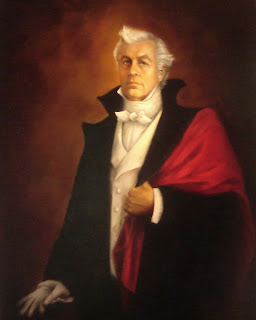
Baron de Bastrop
Baron de Bastrop was an extremely important figure in the development of Texas. He was elected mayor, established good relations and trade with both the Mexicans and the local Caddo Indians as well as helping Moses Austin gain permission to establish the first Anglo colony in Texas which was later carried out by his son Stephen F. Austin, the “Father of Texas”. Baron de Bastrop was trusted and respected by the Spanish and later Mexican governments and his influence brought about the passage of numerous laws that greatly benefited Texas such as the establishment of a port at Galveston island. He was commissioner of colonization for the Austin colony and was later elected to the state legislature of Coahuila y Tejas. He served there up until his death in 1827. A city and a County in Texas are named Bastrop in his honor though it was not until some time after his death that it was learned that his title of Baron de Bastrop had been a fabrication. Nonetheless, because of his great contribution, no one thought that mattered and in Texas he has forever remained Baron de Bastrop. Not long after, came the War for Independence and the establishment of the Republic of Texas.

The Kingdom of The Netherlands was fairly quick to recognize the Republic of Texas and establish full diplomatic relations. When the Kingdom of Belgium did so, the Dutch did not want to be left out and so did the same, opening a Dutch embassy in Austin and welcoming a Texan ambassador to Amsterdam. The Kingdoms of France, Belgium and The Netherlands were the only European countries to fully recognize the Republic of Texas as a sovereign state. Dutch settlers, however, were slow to come to Texas, though there was some trade between Texas and the Netherlands and Dutch colonies in the Caribbean and South America. Dutch settlement in Texas would never be extensive but it did pick up after the end of the American Civil War. One early group was led by Pieter Nieveen and a man named Mr. Roelofs who brought Dutch settlers to establish a farming colony in Denton County. Unfortunately, the enterprise was not a success. Another Dutch colony was attempted at Gothland but met a similar fate. However, in 1895 a group of Dutch businessmen started the Port Arthur Land Company and bought 66,000 acres of prairie land in southeast Texas for resale at $8 per acre. The first Dutch immigrant to buy some of the land was George Rienstra in 1897 and a few months later about fifty Dutch families followed him to start a new life in Texas. To house them while their new homes were built they constructed the Orange Hotel named in honor of the Dutch Royal Family. This little settlement became what is now the town of Nederland east of Houston.

At first the Dutch stuck to what they knew best, making cheese, raising dairy cattle and growing rice. However, not long after oil came bursting out of the ground at nearby Spindletop and an oil processing plant was soon built a mile south of Nederland. This proved beneficial when the local rice industry was wiped out in the 1907 depression, the local Dutch families were able to find work with the oil companies and the town of Nederland prospered. The town of Nederland remains a unique little corner of Texas and eventually the locals built a large, Dutch-style windmill in the center of town to honor the Dutch settlers who founded it. Another little town, less noticeably, has Dutch roots in Texas. That is thanks to Willem Henrik Snyder, later known as “Pete” (for some reason) who was the first settler in Robber’s Roost where he set up a trading post on Deep Creek. He primarily did business with West Texas buffalo hunters who traded hides for supplies, hence the area became known as Hide Town but which was later renamed Snyder, Texas in honor of the Dutch frontiersman who founded the place.

Over the years the Dutch-Texans became known for their religious faith, family ties and uniquely Dutch habits. Unlike other Texans, they saved their horses for plowing and walked everywhere. They saved their money and never bought on credit and whereas most Texans love eating tomatoes raw with a little salt, the Dutch figured that, being a fruit, tomatoes should be eaten stewed with sugar and cornstarch. There were also a number of Dutch natives who became notable throughout Texas history such as David Levi Kokernot who was born in Amsterdam but later moved to New Orleans were he became a pilot and eventually bought his own ship. While hunting smugglers on the Texas coast, he shipwrecked at Anahuac and ended up joining the local Texas forces in the War for Independence. He became good friends with General Sam Houston who, after becoming the first President of the Republic of Texas, gave Kokernot a number of special jobs and he was even the captain of a company of Texas Rangers for eleven years. His sons later grew up to be major cattle ranchers in West Texas. Descendants of his are still working in the cattle business in the area west of Fort Davis. Another Dutch family who came to Texas was that of Maarten and Antje Koelemay who settled with their eight children in Nederland. After having no luck at the cheese business the sons became railroad workers while living at the Orange Hotel which their father managed until 1915 when a storm forced the historic hotel to close.

The Dutch influence on Texas has been considerable for their relatively small numbers. They were pioneers in the hotel business, dairy farms and in the oil business. Dutch settlers were known for maintaining strong ties with their homeland, including the regular marking of ‘Queen’s Day’. John Brands was a noted priest from the Netherlands who was instrumental in the strengthening of the Catholic Church in Galveston in the 1840’s and they introduced things to Texas as varied as coleslaw and doughnuts. Dutch people have played a part in Texas history ever since the days of the famous Baron de Bastrop and the Kingdom of the Netherlands has enjoyed friendly diplomatic relations with Texas ever since the early days of the republic. For a little while, in a very nominal way, Texas and The Netherlands were even under the same monarchy in the days of Emperor Charles V and King Philip II of Spain before Dutch independence was won. Hopefully the close ties and friendship between Texas and the Kingdom of The Netherlands will always continue.

Thursday, November 21, 2013

Royal Friends of Texas: Great Britain

The United Kingdom of Great Britain & Northern Ireland has a very old and strong history with the “Lone Star State” which is all the more interesting for the fact that Texas is one of the (relatively few) parts of the world that was never part of the British Empire. The degree of influence the British have had on Texas has been so great, recounting it all could fill a library. However, here we will touch on some of the basics and look at a few unique incidents for illustration. Part of the reason the British influence on Texas has been so great is due to the fact that it was both direct, in Anglo-Texan relations, and indirect because the majority of the early settlers in Texas were Americans of Anglo-Celtic ancestry. One figure who played a major part in the War for Texas Independence was James Grant who was from Ross-shire, Scotland. He even became, at one time, one of at least four claimants to the position of commander-in-chief of the Texas army. Grant is most known for his effort to lead an offensive against the Mexican city of Matamoros after the successful capture of San Antonio. Many people, such as General Sam Houston (once he found out he would not be in charge) tried to dissuade the volunteers from following Grant on such a hair-brained scheme but no one can say Grant lacked courage because he set off to attack a Mexican city of 12,000 with less than a hundred men, by some counts not much more than fifty. Of course, it all ended in disaster when his tiny band ran headlong into the advancing column of General Jose Urrea and was completely wiped out. He was killed at the battle of Agua Dulce on March 2, 1836 -Independence Day.

Baker's San Felipe flag
At the famous battle of the Alamo, the British Isles were well represented. Out of the tiny garrison, 12 were from England, 4 were from Scotland, 12 were from Ireland and there was even one Welshman present. Probably the most visible of the British volunteers was 27-year old John McGregor, a sergeant in the artillery, who boosted the morale of the troops by playing his bag pipes during the 13-day siege. Numerous British natives fought in almost every major battle of the war. Even for the native Texans, the Anglo-Celtic heritage of the majority was not taken for granted. For example, when the first Anglo colony in Texas, San Felipe de Austin, organized a militia company for the war it flew a flag based on a design by Stephen F. Austin himself which featured the British Union Jack in the canton to represent the British ancestry of the people, along with red and white stripes to represent the United States, a Lone Star which has always been the symbol of Texas and the colors of red, white and green to represent their history with Mexico. This symbolism was not all that unique either. There were two proposals for independence flags which also featured the Union Jack, one in the canton of a reversed Mexican tricolor with a Lone Star in the middle and another, oddly enough, on a red, white and blue tricolor with the face of George Washington in the center.

During the 1820’s six Englishmen were given empresario contracts by the Mexican government to establish colonies in Texas but none did so. Beale’s Rio Grande colony included a number of English families and after independence the Republic of Texas authorized a large grant to the Peters colony in 1841 that settled large areas of north Texas and was named for English immigrant William S. Peters. It is interesting that, due to strong trade ties between Great Britain and Mexico, the Republic of Texas was not immediately recognized by the British government. At least not officially. There was a Texan envoy in London but, while everything worked as though there was official diplomatic recognition, there never was officially because of British fear of offending Mexico. It can, in some ways, be compared with the way countries today deal with the Republic of China on Taiwan without officially recognizing it as such for fear of losing access to the lucrative markets of the People’s Republic of China on the mainland. It was diplomatic recognition in all but name. Also interesting is that, during the war and after, Britain was the primary supplier for the Mexican navy. Because of this, all of the ships the Republic of Texas Navy faced at sea were British ships, some even with British crews and British officers all in the pay of Mexico. What is surprising is that, given that, the Republic of Texas Navy heavily copied the Royal Navy of Great Britain when it came to everything from uniforms to regulations.

An early Texas flag proposal
As the period of independence for the Republic of Texas was drawing to a close and tensions began to increase between the United States and Mexico over the idea of American annexation of Texas, the British found themselves in the middle of the diplomatic bargaining. Originally, this was not by choice. The leadership in Texas, at that time very much in favor of joining the United States, was trying to encourage the U.S. government to annex Texas but Washington was slow to act due to northern opposition over the admittance of another slave-holding southern state. To make America jealous, the Texas officials began to make hints that if the U.S. did not come around to favoring the annexation of Texas, then Texas might decide to join the British Empire instead. America, of course, was not at all pleased by this (probably not entirely serious) threat and the idea of having the British on both their northern and southern borders. So, America came around to favoring annexation pretty quick.

When Britain did choose to get involved on the annexation, it was after America decided to put annexation up for a vote. Mexico, despite losing the War for Texas Independence and losing another campaign to re-take Texas, still claimed that the Republic of Texas was Mexican territory and threatened war if the U.S. annexed Texas. Britain did not want to see a war break out that would be bad for business and was also not pleased with the idea of America growing even stronger by annexing such a large and valuable country. So, the British tried to broker a deal by which Mexico would finally agree to recognize the independence of the Republic of Texas if the Texan and American governments would agree that Texas should stay out of the United States. For Britain, this would be a win-win scenario, avoiding a Mexican-American War that would disrupt trade and giving the United States some competition for dominance of the continent. Unfortunately for Britain, and Mexico as it turned out, the Mexicans refused to ever recognize the loss of Texas under any circumstances and the deal failed before it could even be proposed to Texas or America. The result, of course, was the Mexican-American War in which Mexico ended up losing New Mexico, Arizona, California and even more territory as well as Texas so, in retrospect, they would have been wiser to listen to Britain.

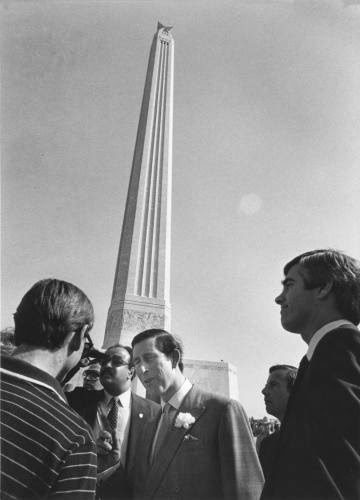
HRH PoW at the San Jacinto Monument
After the war, there was another effort to establish an English presence in Texas, known as the colony of Kent, in the area of Bosque County in 1850. This was part of a much grander scheme envisioned by the Universal Emigration and Colonization Company of London which planned for considerable expansion and development with Kent becoming a “Philadelphia on the Brazos”, selling grain to nearby Ft Graham and becoming a center of manufacturing with access to the Gulf of Mexico and from there to the markets of the world. However, the initial settlers proved unable to adapt to the harsher climate of Texas and by 1851 the project had mostly collapsed. After the War Between the States there was a major cattle boom in Texas and this attracted a great many new immigrants and many came from Great Britain. The list of their contributions would be too numerous to list. However, later on there was one group that did manage to stand out. Between 1880 and 1900 a number of British aristocrats came to Texas looking for wealth and adventure. One of the earliest was Sir Dudley Coutts Marjoribanks (‘Texanized’ by the locals into “Marshbanks”) the first Baron of Tweedsmouth. His syndicate bought 244 square miles of land in Wheeler and Collingsworth Counties in 1883. The English lord referred to his property as a “cattle estate” which he grandly named “Rocking Chair Ranche, Limited” but which was known by the neighbors as “Nobility Ranch”. It was a unique blending of the Texas frontier and English aristocracy with the owners preferring to be known as “proprietors” rather than ranchers and who, rather than hiring cowboys, “engaged cow servants”.

The Queen at the Governor's mansion
Over the years, Texas and Great Britain have only grown closer. Especially after World War II there were many family ties between the two as Texas soldiers stationed in Britain married British wives and brought them home to Texas when the war was over. In 1953 the Anglo-Texan Society was established in London to encourage closer cultural ties between Great Britain and Texas with the famous author Graham Greene serving as the first president. In the following decades, Texas and Britain became close enough to start having a few royal visits. Prince Philip, Duke of Edinburgh visited first, followed by the Prince of Wales in 1986 as part of the sesquicentennial celebration of Texas independence and the Duchess of York visited in 1990. Princess Royal Anne and Princess Margaret also visited Texas. The greatest moment came in 1991 when HM Queen Elizabeth II visited Texas, stopping in at San Antonio, Dallas, Houston and Austin where the Queen addressed a special joint-session of the Texas Legislature. The Queen visited the Alamo in San Antonio, took in a symphony in Dallas and the Johnson Space Center in Houston. It was the first time a British monarch had ever set foot on Texas soil but few would know it. British flags were everywhere, the Salute Battery of the Texas Army Guard fired a 21-gun salute to welcome the monarch along with an honor guard and saber arch leading to the capital building. The Queen was gracious as well, pointing out that the experience of the Texas oil fields had helped in the British development of North Sea oil and she grasped the nature of the Texas attitude pretty well, noting in her speech how “lesser mortals are pitied for their misfortune in not being born Texan” which was met with thunderous applause and a deafening cheer.

The Queen at the Texas Legislature
Today there are over two million Texans of English ancestry and even more when one adds in the Scots and Irish. Every major city in Texas has British specialty shops, tea rooms and the like. Scottish festivals and highland games are held in numerous cities across Texas and there is even an official Texas Lone Star tartan, designed by Lanora Davidson in 2012 and registered with the Scottish Tartan Board (and before you ask, yes I have and yes I do). Texas may have never been part of the British Empire (only flirting with the idea) but Britain and Texas have had close ties ever since the fight for independence. Unlike some other areas of the modern United States, Texas and Great Britain have never been enemies and have fought side-by-side on numerous occasions. You can find a Texas cantina in the heart of London and more than one English pub in the heart of the Alamo City (and most other Texas metropolises). Texas and the United Kingdom are and have always been close friends and allies, the British have added much to the unique flavor that is Texas and hopefully the two will only ever grow closer and their friendship long continue.

God Bless Texas and God Save the Queen!
Related Posts Plugin for WordPress, Blogger...