Showing posts with label South Africa. Show all posts

Saturday, July 16, 2016

Thoughts on the Boer Republics (and their consequences)

I have, from time to time, been asked about my opinion on the Boer Republics and/or the Boer War which saw them fall to the forces of the British Empire. It is a subject I have mixed feelings about considering that I have a great deal of sympathy for both sides of the British-Boer divide. The fact of my own contrariness also plays a part as, during the Boer War, the vast majority of world opinion was on the side of the struggling, little Boer republics and very much against the big, bad British Empire that was at its peak of Victorian splendor and I get very nervous whenever I find myself in agreement with popular opinion. I also dislike the sort of envy-driven hatred that manifests itself against any country or people when they reach the pinnacle of success. It happened to Spain, in happened to Britain more than once, it happened to Germany in the build-up to World War I and it has been happening to the United States and I detest each and every instance of it. The British Empire is dear to my heart and, despite popular opinion today, was inarguably a force for good in the world taken as a whole. However, even Anglophile that I am, I cannot deny that there were occasions in which the British Empire behaved badly as is the case with any country or any people in the world from time to time.

The British Empire had a record of success in Africa that would be difficult to surpass and, again despite what modern detractors would say, it was generally more humane than otherwise. The African lands touched by the British Empire benefited greatly from it with the forces of the British Empire wiping out slavery, introducing modern medicine, agriculture, education and government and they tended to work with traditional native leaders whenever possible. However, no person and no people are totally immune from error and misdeeds and just as the British acted benevolently in India in eradicating certain barbaric practices, the British also acted quite badly such as in forcing opium on the Chinese. The British Empire was a force for good in suppressing the slave trade and yet, in Africa itself there was also instances of Britain acting in a less than altruistic way. The Boer War itself, I think, shows both negative and positive aspects of the character of the British Empire. Greed often seemed to be the driving force behind the start of the conflict and British actions in fighting the war were, sometimes inadvertently though few today would admit it, quite cruel. And yet, the conquered Boer republics were taken into the British Empire and became even more successful still and, after the conflict, the British were generously magnanimous toward their former foes.

For those who complain that I never have anything good to say about any republics, ever (even my own, which is certainly not true), take note that I have no fundamental objection to the Boer republics and moreover that I think the Boer republics had much to recommend them. The Boers were a rough-hewn, rugged, frontier type of people who were excellent horsemen, crack shots with a rifle and devoutly religious -all of which are qualities to admire in my book. Unlike the republics in places such as France or Russia or China, I have no problem with the creation of the Boer republics because of the nature of their birth. They were not born out of any sort of radical, revolutionary upheaval. If France or Russia represent the extreme left in the birth of republics, the United States would be much more to the right but the Boer republics would be even further to the right still. To explain, and for the benefit of those unfamiliar with the story, a brief summary of how the Boer republics came to be is probably in order.

The Dutch arrive on the Cape
Before the British ever arrived in the area, the Cape of Good Hope region of southern Africa was a Dutch colony, part of the very businesslike empire of the United Provinces of the Netherlands. However, then the French Revolution broke out, the French invaded the Netherlands, the Prince of Orange was overthrown and a French puppet state called the Batavian Republic was erected. This meant the ruin of Dutch trade and the loss of most of the Dutch empire with the British swooping in and, after a brief battle, seizing control of the Cape for the British Crown. As many of the locals, mostly Dutch but including some other peoples in the mix, did not desire to live under British rule, they packed up their wagons and left British territory to head deeper into the interior of Africa (the famous “Great Trek”). It was these people who finally established what eventually became known as the Boer republics.

The British became more established in the region and the Boers lived in peace beside them, mostly as farmers and ranchers. They lived simple lives but were accustomed to the hardships of frontier life and were content. However, things began to change when it was found that the Boer republics sat on top of extremely lucrative mineral deposits. They were quite literally ‘sitting on a gold mine’ (and a number of diamond mines too). This, of course, attracted more and more British settlers who moved into Boer territory and that, of course, began to arouse the opposition of the Boers. They began to enact laws to curtail the flow of the British into their territory and the influence they had. That was only natural. It was also then, only natural, for the British to object to their rights being restricted and the British Empire, also not surprisingly, took up the cause of their fellow countrymen against the Boer republics and soon this led to the outbreak of war. Looking back at the overall situation there are few historians who would try to deny that the bottom line was simply this: the Boers had control of vast riches that the British wanted for themselves and they were prepared to fight and conquer the Boer republics in order to obtain control of these mineral deposits. Would any other power, similarly placed, have done otherwise? Probably not. Still, it was hardly Britain’s finest hour.

Boer President Paul Kruger
The world was amazed though by how tenacious the Boers proved to be when confronting the greatest empire in the history of the world. The war, or actually “wars” were long and bitter struggles with the Boers putting up one Hell of a fight. They were not professional soldiers but their way of life had made them a tough and tenacious people and before it was all over you could say that they made the British earn all the gold under Johannesburg the hard way and the payment for all that wealth was in blood. In fighting the war, which eventually devolved into a guerilla conflict with those Boers who refused to surrender, the British resorted to methods that were brutal but effective. The most notorious strategy was to isolate the Boer commandos (a local term the British adopted for their own special forces later on such was their fighting reputation) from their civilian base of support by ‘concentrating’ the Boer population in guarded camps. So it was that the British invented the “concentration camp”.

Today, the unthinking mob tends to think of a “concentration camp” as a “death camp” thanks to the influence of Nazi Germany on the popular imagination. However, this should not be so and the British certainly did not put Boers into camps in order to systematically exterminate the Afrikaner people. Which is also not to say that these were nice places. They were certainly not and large numbers of civilian men, women and children died in these camps from disease, malnutrition and poor sanitation. It was, however, not due to intentional British cruelty but rather to supply shortages, logistical failures and bureaucratic log jam. In fact, it was a British woman who came to the rescue of the imprisoned Boers, raising a public outcry over the conditions in which they were being held and who mounted the effort to relieve their suffering through much more efficient private, charitable channels. Obviously, if the British were a cruel and heartless people, no one would have cared about the concentration camps, there would have been no public outcry and no massive effort to put a stop to it. The British also proved themselves to be gracious victors when the brutal bloodletting was over. Rather than rule the Afrikaners as a conquered people, the British made them partners in the new colonial enterprise that became South Africa and, as a result, many of the men who had fought the hardest against the British became ardent supporters of the British Empire, even taking up arms again to defend it in World War I.

Louis Botha, Boer leader
So, for me, though I am a great admirer of the British Empire, I also see much to admire in the Boer republics, I am not unsympathetic to them and, as republics go, they were acceptable in my book. The important point, for me at least, is that they were foundationally legitimate republics rather than illegitimate revolutionary republics. The Boer republics were, if you like, a ‘creatio ex nihilo’ which did not detract from any existing, established authority to which they should have held allegiance. At the time they were severed from their own, original, mother-country, that (republican) state had been deprived of its own legitimate government. The transfer of territory to the British was not applauded by the Boers but they did nothing to oppose it, preferring to move inland and carve out their own country from the wilderness. The first French Republic, by contrast, was plainly illegitimate but the Boer republics were clearly not and so I have no fundamental problem with them in their origins nor do I know of anything objectionable about their operation when they existed. As such regimes go, they were okay in my book.

Battle of Blood River
There was, it must be mentioned, one aspect to the Boer republics which attracts the most criticism today, given modern, liberal, western sentiments and that was their attitude toward the Black population. I think this deserves to be mentioned, not simply for the sake of full disclosure, but to show that the British Empire was not only hardly as terrible as it is often portrayed but that it acted in a way in which modern-day liberals would have demanded and yet has absolutely nothing to show for such benevolence. First of all, the idea that the Boers should receive no sympathy because, ‘the British stole land from the Boers which the Boers had stolen from the Africans’ is a false, simplistic notion based on current fashionable opinion and not the actual facts. The Boers who made the “Great Trek” came as settlers, not conquerors. They obtained land by peaceful purchase, some Boer families still having the records of such sales from the Black Africans of the time, but most of the land was unoccupied due to the previous wars of conquest by the Zulus who had annihilated much of the previous Black population of the region. There were of course, inevitably going to be clashes, such as the famous Battle of Blood River, by which the Boers fought hard and paid a heavy price for the land they settled but the idea that the whole enterprise was some massive, armed heist is simply not true. The Boers did, however, have a very different attitude toward race in contrast to the British.

The British had long abolished the slave trade and expended a great deal in suppressing it, had abolished slavery long before across the British Empire and even in Victorian times, while certainly not possessing the thinking about race that modern Britons do, tended to look on racism as something terribly uncivilized at the very least. The Boers, on the other hand, took a more old-fashioned and Biblical view of race. They outlawed slavery too though some observers felt that was more in name rather than fact and they certainly viewed Blacks as a people to be kept apart from themselves, people who were different and to be treated differently. Black Africans could not become citizens in the Boer republics, they had fewer rights and freedoms and all the rest of it (any non-Boers and anyone not Protestant also faced degrees of discrimination as well). British society tended to look down on how Blacks were treated in the Boer republics and the inferior position of the Black Africans in the Boer republics was one of the ways that British public opinion was turned in favor of military action against them though it could hardly be argued that this was ever the primary reason for the war. Nonetheless, that was an aspect which enemies of the British Empire today tend to overlook. The vast majority of Black Africans supported the British because the British offered them more rights and more equal treatment than the Boers.

This, of course, eventually culminated in the collapse of the British Empire in Africa as the British government supported granting the franchise to Blacks, effectively handing them total control over South Africa (and other colonies) from the white minority. This led to an ugly stand-off with Rhodesia and British participation in international boycotts against apartheid South Africa, forever alienating the white populations of these countries. Critics of the British Empire today willfully ignore the fact that in South Africa, and other Black-majority countries across the continent, the British government took the side of the Black Africans against the White Africans, their own kith & kin many of them, something unprecedented in the history of all peoples all around the world. This is a fact, yet, from a monarchist perspective, one is forced to conclude that did nothing at all to benefit the Crown, British influence or even goodwill towards the UK.

By taking the side of the Black Africans, another race against those of their own blood in South Africa, the Boers and other White Africans tended to view the British as race-traitors, the people who sold out their own kind and it is easy to find people still today who have never forgiven the British for the part they played in the eradication of the White population in South Africa. The Crown, as usual, does not escape such criticism due to the way people view the monarch as the pinnacle and representation of all British people, society and government. However, while that was to be expected, the actions of Britain have obviously not immunized the British from accusations of racism and upon attaining political power, the Blacks of South Africa did not rush to restore the monarchy and become a Commonwealth Realm again. No, as we all know, the republican form of government was one thing about apartheid South Africa that the new regime wished to retain. Some do still think well of the British in South Africa, but it is not something that can be expressed openly without a severe backlash, even if you are a prominent African chief. And, today, Red China has far more influence in South Africa than Great Britain does. Taken altogether, it is simply a fact that neither Britain nor the British monarchy gained anything tangible nor even in terms of much goodwill and gratitude from its history of pro-Black policies in Africa.

Field Marshal Jan Christiaan Smuts
No one figure better represents the change in attitude towards the British monarchy on the part of Boers than the great Prime Minister and Field Marshal Jan Christiaan Smuts. He fought against the British in the Second Boer War, yet later became pro-British and a staunch monarchist after it was over. When some Boers, during World War I, allied with Germany and tried to instigate a rebellion, Smuts and the loyal Boers suppressed them on their own. He was a major military leader in World War I on the side of the British Empire in Africa and was again one of the most prominent leaders on the Allied side in World War II, fighting for the British Empire against the Axis powers (he was even the favored candidate to become Prime Minister of the United Kingdom if something were to happen to Mr. Churchill). He also supported racial segregation in South Africa and was very popular but later White South Africans came to view him less favorably as Britain took action against the racial policies of the country. When Black rule came to South Africa, Smuts fared no better as was seen in 1994 when the airport in Johannesburg, named in his honor, was renamed to the ‘Johannesburg International Airport’ and in 2006 was renamed again in honor of a prominent Black politician of the African National Congress. The Boers had fought fiercely against the British Empire but most later came to accept it and rose to prominence in South Africa. Many of them fought for the British Empire in World War I and World War II yet they reverted to republicanism due to British opposition to their racial policies and today one would be hard pressed to find a Boer in South Africa with much regard for Britain or the British monarchy. Thus did British opposition to apartheid alienate the Boers while still not garnering enough support among the Black population to restore the monarchy in a post-apartheid South Africa.

Wednesday, March 5, 2014

Monarch Profile: High Chief Mgolombane Sandile of the Rharhabe

Although he is little known today outside of South Africa, Mgolombane Sandile, Chief of the Gaikas and High Chief of the Rharhabe tribe, was a major figure in Nineteenth Century South Africa and one of the most dynamic and successful leaders in the native resistance to European colonization. He was born at Burns Hill sometime in 1820 into the Gaikas or Ngqika clan of the Rharhabe tribe of the Xhosa nation of southern Africa. Not long after, his father died in 1829 and Mgolombane Sandile succeeded to the throne of the Rharhabe, the western Xhosa, with his brother acting as regent until 1872. Nonetheless, as king, he was soon presiding over a people at war. This was not at all uncommon as the Xhosa had been in conflict, intermittently, with European settlers in South Africa since around 1779. The first three wars were fought against the Dutch or the increasingly distinct Boers, and then against the British after Great Britain seized control of the Dutch colonies in South Africa during the Napoleonic Wars. Usually the reason for these wars was disputes over farmland, pasturage and so on.

Mgolombane Sandile (left) meeting officials
In 1846 the seventh war broke out. A drought had driven many Xhosa to launch raids across the border to steal cattle. Tensions increased because of this and a relatively minor dispute over the return of a suspected murder prompted hostilities to resume. Sandile refused to turn the man over and soon came under attack by British troops, colonial forces and Boer commandos. Sandile proved a naturally talented commander, stalling the British advance by a quick strike at their vulnerable wagon train, capturing many British supplies and forcing them to retreat. He brought overwhelming numbers to bear and forced the British to fall back to Ft Peddie where they successfully held off his attacks. However, the British were hard pressed and the worsening drought was being felt by both sides. Boer commandos were summoned to come to the rescue and with their greater mobility and knowledge of the country they were able to win a number of victories, eventually fighting into the heart of Xhosa territory, threatening the village of King Sarhili, the top Xhosa ruler and persuading him to sign a peace treaty.

However, even in those days, relations between the British and the Boers were not always ideal and soon the two sides fell out with the Boers abandoning the British to their fate. By that time, starvation and fever were taking a dreadful toll on both sides. Sandile was in a desperate position but still gained great fame as he evaded all the British patrols sent to capture him as both sides, sick and exhausted, launched small but brutal raids against each other. Finally, a peace was negotiated and Sandile was taken prisoner but only for a short time. Hostilities ceased and more Xhosa territory was annexed by the British. Chief Sandile had lost his first war but had gained great fame nonetheless for his daring attacks and dogged determination. His people were determined that there would be yet another war in which they would make good their loss and take revenge on the British. This idea was fostered when a new prophet appeared, full of prophecies of a Xhosa victory and promises that his magic would protect them from British bullets. In 1850 the local British governor, alarmed at this turn of events, called several chiefs together at Ft Cox with the aim of silencing the prophet. However, Chief Sandile did not answer the summons and so the British governor declared him deposed and sent troops to arrest him. They were ambushed by Sandile’s warriors and forced to make a hasty retreat back to the fort.

Sandile and his warriors resting on a Krans
As Chief Sandile and his men advanced into British territory they were joined by many other natives of various groups who rose up in rebellion, capturing several villages and destroying a British outpost. However, when they came up against British troops in protected forts, it was a different matter and at Forts White, Hare and Beaufort the Africans were repulsed with heavy losses. Once again, the British called in the Boer commandos from Cape Colony and together they relieved the besieged forts and drove Sandile and his warriors back to the mountains. By 1853 the war was over but some Xhosa warriors remained, led by Sandile’s brother Maqoma, who carried out a guerilla war in the area. Raids and retaliation went on for some time. Driven to desperation, some of the Xhosa were taken in by a religious charlatan promising that if they killed their own cattle the spirits would save them and bring them greater prosperity. That didn’t happen of course and it merely strained the already modest forces of Chief Sandile by the waves of starving refugees that came pouring into his territory.

Increasing hardship caused the outbreak of the ninth war in 1877. It started out as an all-African inter-tribal brawl but soon came to involved the British as some of the tribes were allied to them. Frustrated with these continuous conflicts, the British governor was also anxious to get involved and settle matters once and for all by the total conquest and annexation of all Xhosa territory. Chief Sandile seems almost to have sensed that there was more to this situation that most realized and he was very reluctant to join the conflict which, by that time, had come to include a declaration of war against the Cape Colony itself. His older advisors were against it but his young an impetuous warriors wanted to fight. Perhaps seeing that they would be drawn into the conflict regardless of his wishes, Sandile finally agreed to go to war. Unfortunately for him, it was his last conflict as his forces were defeated by the British and their Fingo (or Mfengu) allies with Chief Sandile himself falling in battle against the Fingo on May 29, 1878. He died a few days later in the hands of his enemies and was buried alongside British soldiers. In the aftermath, the Xhosa were defeated and their territory annexed by Great Britain. Still, the name of Chief Mgolombane Sandile is still remembered in South Africa today. Although not always victorious, he is held up as an example of a determined leader who fought fiercely, again and again in defense of his land and people.

Friday, December 20, 2013

Mandela's Kingdom

With the death of Nelson Mandela, many people have been curious as to what, if any “royal” connections Mandela had. It is a somewhat difficult issue to address since the tribal system of South Africa does not translate easily into the royal terms most are familiar with. For example, sometimes a chief is referred to as a king even though there are differences in the status of one chief or another and differences in how chiefs are chosen. A chief of the highest order is often known as “king” and yet there are other chiefs below him, a king may declare someone a chief who he favors, who are not of the same status. It should also be kept in mind that none of these, be they called king or chief, are sovereign rulers like the Prince of Liechtenstein or the Grand Duke of Luxembourg. As we shall see, some have tried to assert sovereignty in the past but were quickly thwarted by the republican government of South Africa which grants them an expense allowance and thus holds them in a large degree of economic dependence on the national government. Some tribal kings have been set up and others deposed, some have gone to the courts to contest the title of the tribal chief or king and sometimes the government has declared people claiming to be chiefs or tribal kings to be invalid. In can become rather confusing. In this case, however, we will be looking particularly at the Thembu people of whom the late Nelson Mandela was a member.

Mandela was a member of the Madiba clan of the Thembu tribe of the Xhosa ethnicity (again, even that can get a little complicated), although as that designation came about during the apartheid era it is now disputed that the Thembu and the Xhosa have anything at all in common. The Thembu claim to be an ancient kingdom, originating in the area of the Congo before moving into southern Africa. However, this is somewhat disputed now as it is being used as a basis for claims to a greater prestige and perhaps even independence (more on that later) which the South African government (the ANC as the country is effectively a one-party state) adamantly opposes. Mandela was related to the local chieftain family but, for reasons which will become clear, most of his devoted adherents prefer not to highlight the relationship. He was the uncle, for example, of Kaiser Matanzima who does not have a very good reputation in South Africa these days. His status is a little unclear as his titles are sometimes royal and sometimes republican in nature, depending on what one is reading. His unpopularity stems from the fact that he worked with the White minority government. This cooperation is often cited as the “price” for his being recognized as the paramount chief (sometimes rendered as king) of the “Emigrant Thembus” which was a separatist group.

Chief/king Kaiser Matanzima supported the Bantu or Black Authorities Act of 1951 by which the apartheid government set up officially recognized homelands for the native people. They called this an effort at genuine cultural preservation for the native African people. Others would say that the government was doing this to have a place to expel Blacks who caused problems in the parts of South Africa where the White minority was most concentrated. Chief/King Kaiser Matanzima claimed that he had his own agenda in mind even though it meant breaking with the African National Congress (the communist-coalition revolutionary group of Mandela). Matanzima had a vision for Black South African liberation coming from the establishment of a federation of all-Black states whereas the ANC was determined to stay within the White-established South Africa while using popular pressure and acts of violence to force the Whites out of power. Matanzima became very unpopular with the radicals because of this, some of whom even tried to assassinate him. Nonetheless, Transkei became the first “independent” Bantustan (as a republic) with Matanzima being elected Prime Minister. However, some at the time accused him of corrupt dealings and ruling like a dictator while he later clashed with the South African government over territorial demands. At one point, Matanzima tried to assert actual independence but was stopped when the South African government threatened to cut off the financial assistance he depended on.

In 1979 King/Chief/Prime Minister Kaiser Matanzima became State President and made his brother prime minister. In 1980 he banned opposition parties including the Democratic Progressive Party led by Sabata Dalindyebo who went into exile in Zambia and joined the ANC. Dalindyebo was also challenging Matanzima for the kingship of the tribal nation. Matanzima continued to keep politics “in the family”. He appointed the father-in-law of Nelson Mandela to his cabinet and when Mandela was arrested he tried to persuade him to leave prison and go into exile in Transkei. Mandela had been arrested, tried and convicted of complicity in 156 acts of public violence, mostly terrorist bombings which took the lives of many men, women and children. Mandela himself pleaded guilty to these charges and the South African government offered to release him if he would only renounce violence but Mandela refused to do so (which is why Amnesty International refused to designate Mandela as a political prisoner). In any event, it seemed to work out for him as his imprisonment was not harsh and Mandela was able to keep in contact with his followers, maintain his leadership and become a very rich man all while in prison. He refused to even speak with his uncle, classifying him as collaborating with the apartheid system which is what the ANC said about anyone that did not go along with their leadership and agenda.

The Thembu King
In the meantime, Matanzima was forced to step down as President over mounting cries of corruption and following a family feud with his former PM, brother and successor as President he was even arrested for a time in 1987. As mentioned earlier, he was effectively deposed as Chief/King by Sabata Jonguhlanga Dalindyebo though this was largely nominal as he died while still in exile in Zambia. Nonetheless, he is a more well regarded figure today because, in backing the ANC, he had picked the winning side. However, the drama did not end there. He was succeeded by his son Buyelekhaya Zwelinbanzi Dalindyebo a Sabata in May of 1989 and he has “reigned” as King of the Thembu ever since. It was this man of whom Nelson Mandela was, in a sense, a subject or at least would have been if the kings in South Africa had actual sovereignty. His official duties are mostly restricted to settling minor disputes between locals and carrying on familiar traditions. However, his time in office or on the throne has been quite controversial. In 2005 he was indicted for fraud, murder, attempted murder, kidnapping and arson stemming from his reaction to what he basically regarded as a village rebellion. He was sentenced to 15 years in jail but is appealing the verdict.

Since that time, the friendly relationship he and his father had with the ANC government came to an abrupt end as King Buyelekhaya blamed President Jacob Zuma for failing to intervene to stop the criminal proceedings against him. He has since pointed out the long list of unsavory things Zuma has done without consequence. Also since that time he has, in a mild way, tried to secede from South Africa and create a Kingdom of Thembuland, taking two-thirds of South Africa with him as “historic territory”. The South African government has pretty much ignored this and the King has said that he is strictly non-violent and will accomplish his goal by educating people on the “true” history of the Thembu which he has said were an ancient and powerful nation that have been unjustly eclipsed in South Africa. In particular he has railed against the most high-profile South African tribal-kingdom of the Zulus, complaining that these were nothing compared to the Thembu people and that they only achieved status by working with the Whites. He has also complained that the Zulu king receives far more government funds (63 million rands a year) than he does because of their undeserved (in his view) notoriety. He has also demanded $124 million in damages from the government and a whopping $10.8 billion for the “humiliation” that his trial caused the Thembu people.

It is a precarious position to take as all the remaining sub-national royals in South Africa exist only at the whim of the ANC government which can usually get them to fall in line by threatening their allowance. For instance, there were originally 13 tribal kingdoms in South Africa, recognized by the government but, after an inquisition by the ANC, six of these were declared to be the illegitimate fruits of the apartheid government and abolished. So far, accusing anyone of having anything to do with the apartheid era is enough to gain a political victory and when King Buyelekhaya had his lawyer give notice of the “independence” of “Thembuland” the ANC responded by saying this was a call for a return to the “homeland” policies of the apartheid government. Most people do not take it seriously at all nor is there any reason to expect that they ever will. It has been a radical turnaround since his early days when he was a member of the armed wing of the ANC. In 2011 he appointed one of Mandela’s grandsons to the position of a village chief, however, despite being his nominal subject, yet actual political superior while President of South Africa, Nelson Mandela refrained from any involvement with his native kingdom, its monarchy or its troubled king. The closest to involvement came when the King ridiculed President Zuma at a prayer service for Mandela, prompting calls for him to be deposed but it is difficult to tell where that has gone. The ANC wanted the family to remove him and the family seems to have wanted the ANC to do it. Anyway you look at it, the situation is far from ideal to say the least of it.

Wednesday, February 15, 2012

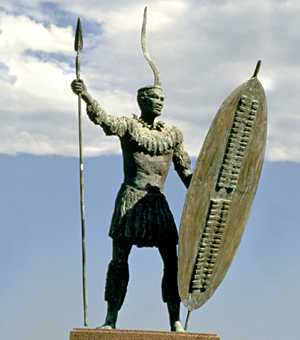
Monarch Profile: King Shaka of the Zulus

Probably no other Zulu monarch is as famous as King Shaka, and with good reason. Through his innovative military tactics and successful wars of conquest he made the Zulus the dominant power in southern Africa during his lifetime. Starting with a tribal nation of 1,500, King Shaka conquered an empire with a population of over 250,000 by the time of his death. Because of his actions, however controversial, Zulu power was maintained for fifty years after his death. Shaka was born in 1787, the firstborn but illegitimate son of Chief Senzangakhona and Nandi by a woman of lower social status. Because of the circumstances of his birth Shaka had a pretty rough life and this is sometimes cited as a possible reason for his harsh policies and ruthlessness later in life. His very name, Shaka, has been translated by some as an insulting term. However, it seems all of this had a profound impact on young Shaka and implanted in him a great ambition, a desire to surpass all others and, it must be said, a degree of insensitivity. Considering how he had been treated in his most vulnerable years it is not surprising that he would become rather insensitive to the suffering of others.

By the time he was in his mid-teens, Shaka joined the warrior corps of Chief Dingiswayo of the Mthethwa and was known for his personal bravery, warrior skill and intelligence. He honed these talents under the guidance of Chief Dingiswayo, becoming an ever better military leader and increasingly ambitious. When Shaka’s father died in 1816 Chief Dingiswayo sent him back to the Zulus to assume power. Shaka succeeded in making himself King of the Zulus and immediately took retribution on all those who had been cruel to him and his low-born mother during his childhood. Also, upon assuming power, King Shaka immediately instituted new and innovative military reforms based on his previous experience with the Mthethwa. He organized his warriors into a regimental system and replaced their light throwing spears with heavier thrusting spears and larger more effective shields made of animal hide. He also trained his warriors to use their shields as offensive weapons to pull aside the shields of their enemies to expose their bodies to a stabbing attack. These new tactics were to serve Shaka quite well in future conflicts.

One of the most important changes Shaka made was in the discipline and training of his warriors. Often harsh methods were used to instill total obedience in his men so that they would follow orders without question and function as an organized team rather than simply a mob of individual warriors. He raised the physical fitness, resilience and stamina of his men by forbidding sandals and training them to run barefoot over fifty miles a day, regardless of the terrain. Years after Shaka was dead, foreign observers would marvel at the absolutely incredible speed and stamina of the Zulu armies who could move faster and more effectively on foot than almost any other soldiers in the world. The Zulu king also made use of young boys to carry supplies and so gain first-hand experience at the art of war so that when they came of age they would be fully prepared to take their place as warriors. King Shaka also developed the famous “buffalo” formation for organized attacks. It should be remembered that this was almost unprecedented in Africa at the time when the wild charge was the standard, time-honored tactic for any battle. King Shaka established his own and very effective strategy and because of the discipline and training he instilled in his men he was able to carry it out. The King could stand off on a hillside to gain an overall view of the battlefield and military situation, controlling the battle via messengers, while his warriors advanced in four ranks. The first would meet the enemy head-on, with a second force in reserve while the third and fourth divisions would fan out (like the horns of a buffalo) to encircle the enemy, thus allowing them to be destroyed completely. He also made sure to keep his reserve force out of sight so they would not became panicked or, alternatively, become too aggressive and join the fight prematurely.

In the initial wars fought by King Shaka these innovative tactics were far more complex than anything the other tribes he confronted could deal with and they were defeated quickly. Once beaten Shaka had no qualms about massacring his enemies, however, he usually gave them the choice of joining his army and any who did so left behind their previous affiliations and became Zulus, accepted in every way as if they had been born to that nationality. They were then trained as the Zulus were and joined the ranks like anyone else. Because of this policy, within only his first year as King, Shaka increased the number of his warriors from 350 to 2,000; quite a respectable force for that time and place. He was soon put to a greater test in 1818 when he joined his old teacher Dingiswayo at the battle of Gqokli Hill, an extremely hard fought defensive battle in which Dingiswayo was killed and King Shaka himself was almost defeated. It was a hard-won victory though and Shaka was sobered enough by the experience that he went back to his previous ways of making war on smaller tribes and clans to increase the size of his army. However, less than a year later he avenged the death of his mentor by inflicting a crushing defeat on the Ndwandwe in a fierce battle at the Mhlatuzi fords which lasted two days. In another new strategy unseen in Africa till that time, King Shaka applied the “scorched earth policy” toward his enemies, totally devastating their territory so as to leave nothing upon which the survivors could sustain themselves.

For the next ten years King Shaka launched numerous wars on almost every neighboring tribal nation in southern Africa, earning a reputation as a frighteningly effective conqueror. His innovative tactics and, it must be said, brutal treatment of his enemies, made him the most powerful monarch in the entire region. At the height of his power King Shaka ruled over a Zulu empire that stretched from Tanzania to the Cape Colony. He gained a domain of about two million square miles and gained a “body count” of about two million dead enemies doing it. He became so powerful that when an English doctor was brought in to treat him after he was wounded in battle he proposed exchanging ambassadors with the British monarch. There would have been no harm in that but he also allowed in British trade and businessmen for which later generations of Zulus might be critical of him. However, at that time, given what he had accomplished, it is understandable that King Shaka might have felt a bit over-confident or even invulnerable. Ultimately, King Shaka was his own worst enemy and while no other power had managed to beat him on the field of battle, his own brutal leadership was to ensure his downfall.

King Shaka was a harsh sovereign and a very superstitious man who was known to have people put to death, in horrible ways, for the seemingly random crime of “smelling” like a witch. His arbitrary cruelty became much worse after the death of his beloved mother in 1827. No one felt safe from his random punishments which might range from the torture and execution of one person to the complete massacre of entire villages. The people began to live in fear of him and the army became more discontented as well as they were kept constantly at war, moving ever farther from their homes and families on behalf of a king who no longer joined them in battle. They also had a big problem with one of the rules King Shaka enforced on his warriors which was to totally abstain from sexual relations. With a frightened population and a frustrated army King Shaka could not hope to survive for long. Finally, on September 23, 1828 Shaka was assassinated by two of his half-brothers at the age of 41. They claimed that he died in a cowardly fashion, begging for his life but, of course, we have only the word of his murderers on that score.

In any event, the place in history for King Shaka was secured long before the day of his death. He was certainly not a kind man but he is not celebrated or remembered for his actions as a ruler. What he is remembered for is his military leadership. Setting aside his character, he was undoubtedly a great warrior, perhaps the greatest and most successful conqueror sub-Saharan Africa has ever known. He took the Zulus from being a small, relatively minor local nation to become the dominant power in all of southern Africa. Even those who killed him knew better than to try to go back to the way things were and the system of organization, the tactics and the strategies he developed, served the Zulus well for many years to come before their final defeat at the hands of the British. Yet, even then, the greatest victory of the Zulus over the British at the battle of Isandlwana, would not have been possible without the earlier innovations and standards for military excellence set by King Shaka.

Sunday, June 7, 2009

Monarchist Profile: Marshal Jan Smuts

Jan Christiaan Smuts is one of those rare individuals who came to fame as a republican fighting against a monarchy to become one of the most staunch monarchists in the world of his time. Smuts was born in 1870 in the Cape Colony of South Africa and grew up to become a lawyer. At one point he even represented the famous British imperialist Cecil Rhodes, which earned him the criticism of many of his fellow Afrikaaners. In time however, the expansion of British power in southern Africa at the expense of the Boer republics turned Smuts into an ardent enemy of Great Britain and a staunch defender of President Paul Kruger of the Transvaal.

At the outset of the Second Boer War Smuts acted as a liason officer for President Kruger as well as stirring up the Afrikaaner population to support the war against Britain. As the war went on Smuts himself became a front-line soldier and led Boer commandos in numerous attacks and raids against the enemy which would forever change the nature of irregular warfare. Finally, however, the losses of the Boers and the horrific suffering of the Boer civilians the British had herded into concentration camps convinced Smuts that the war should be ended. There were problems with the British rule naturally, but overall everyone was surprised by how well the British treated their defeated foes. In time they would prove as generous in peace as they had been harsh at war and a majority of the Boer population was won over to support the British Empire including Jan Smuts.

The loyalty of the Boers was tested in World War I when South African forces were charged with conquering German Southwest Africa (Namibia) but had to deal with a rebellion in their own country first by pro-German, anti-British Boers. In the end, without the help of outside forces, the loyal South Africans defeated the rebel Boers and then went on to make German Southwest Africa their own colony. Smuts, now a general, then went on to lead the war effort against German East Africa and the brilliantly unorthodox General Paul von Lettow-Vorbeck. Smuts emerged as a British war hero and was a major force in the organization of the League of Nations (no one's perfect) and was one of those who foresaw future problems for Britain with Japan.

Smuts got back into politics in the inter-war years and was a close ally of Winston Churchill and a staunch defender of the British Empire. During World War II he returned to service and became the first South African to attain the rank of Field Marshal in the British army. His prestige had reached such heights that some even suggested him as a possible successor to Churchill as Prime Minister of Great Britain. Supposedly even King George VI favored the idea. He returned to politics after the war again, opposed Ireland leaving the British Commonwealth and opposed India remaining after becoming a republic for fear that it would encourage republicans in his own country which was a horrific idea to the firmly monarchist Smuts. He was prominent in the organization of the United Nations and supported the foundation of the State of Israel. He died in 1950 as one of the most famous and widely respected South Africans in history.

Possibly the greatest phrase ever spoken by Marshal Smuts: "If a nation does not want a monarchy, change the nation's mind. If a nation does not need a monarchy, change the nation's needs." Truer words were never spoken Marshal Smuts.
Related Posts Plugin for WordPress, Blogger...