Sunday, August 18, 2013

Saintly Royals Sunday

King St Canute IV of Denmark
The first Dane to be canonized as a saint, he strengthened the Danish monarchy, attempted to conquer England and had many miracles attributed to him after his death. He was canonized in 1101 by Pope Paschal II. His feast day is January 19.

Saturday, August 17, 2013

Royal News Roundup

The most prominent royal news story of this week was, unfortunately, a sad one. On Monday, August 12, HRH Prince Johan Friso of Orange-Nassau, younger brother of HM King Willem-Alexander of The Netherlands, passed away at the age of 44, leaving behind a wife and two daughters. For the past eighteen months the Prince had been mostly comatose, only since November shows signs of semi-consciousness. The second son of HRH Princess Beatrix (formerly Queen) was skiing near Lech, Austria in February of 2012 when he was buried in an avalanche and deprived of oxygen for an extended period of time. Doctors were able to save him but he had suffered extensive brain damage and was treated by specialists at Wellington hospital in London until June when he was taken back to The Netherlands as there was nothing more medical science could do for him. He died at the palace of Huis den Bosch where he was being cared for. The King and Queen were on vacation in Greece at the time and rushed home to be with the rest of the Royal Family.

Prince Johan Friso renounced his place in the Dutch line of succession and became known as Prince Friso of Orange-Nassau rather than a prince of The Netherlands in order to marry Mabel Wisse Smit. The government had refused to consent to the marriage because Princess Mabel (as she was later titled) had been acquainted with a drug lord in the past and government consent is required for the marriages of all Dutch royals in line for the throne. Prince Friso had made it clear since he was a child that he never wanted to be king anyway and was quite happy to renounce his rights to the throne to marry the woman he loved. Good enough as the two were married in 2004 with the rather unusual situation that Princess Mabel became a member of the Dutch Royal Family but not of the Dutch Royal Household. The two had a happy and devoted marriage ever after, producing two lovely daughters; Countess Emma Luana in 2005 and Countess Joanna Zaria in 2006. The family lived and worked in London.

As per the wishes of the Royal Family the funeral arrangements were minimal and strictly private. The Prince was laid to rest on Friday at Lage Vuursche near Drakesteijn Castle, where he had spent his childhood and where HRH Princess Beatrix has chosen as her place of retirement. The government issued a statement and many messages of condolence were sent but no dignitaries attended the funeral which was purely a family affair. The only foreign royal in attendance was HM King Harald V of Norway, the godfather of the late prince. A more open commemoration ceremony is expected to be held later in the year. Of course, I am sure I speak for all readers when I say that our prayers and condolences go out to the Dutch Royal Family, the people of The Netherlands and most especially Princess Mabel and her unfortunate daughters on this most tragic occasion. May God watch over them.

In other news, HRH the Prince of Wales has come under criticism (again) for supposed “meddling” in politics, which in this age of leftist media overreaction means he was talking to cabinet ministers (gasp). How many people, I wonder, can see the blatant hypocrisy of those who claim to champion equal rights for all crying foul whenever a member of the Royal Family exercises even the most basic rights of the most common subject? It is ridiculous, of course, as there is no evidence whatsoever that the Prince attempted to influence or ‘strong-arm’ anyone, only that he met with ministers to discuss issues important to him, which anyone is or should be perfectly free to do. In other news, HRH the Duke of Edinburgh met his new great-grandson for the first time this week and the Duke of Cambridge had his first official engagement since the birth of his son. Sarah Ferguson, ex-wife of HRH the Duke of York, met with HM the Queen in Scotland which has led to rumors that the subject under discussion might have been marriage plans for Princess Beatrice of York. Word has also been about that little Prince George of Cambridge may have his first overseas visit to the Commonwealth of Australia. That, in my view, would be wonderful -a real blow to the sad republican traitors in the land Down Under.

In other royal news, the Swedish royal court launched a new website in preparation for the fortieth anniversary of the enthronement of HM King Carl XVI Gustaf of Sweden coming up on September 15. Princess Isabella of Denmark had her first day of school this week and there was rather embarrassing news this week for the House of Hohenzollern as Princess Irina of Romania (aka Irina Walker) was among a group of people arrested in Oregon and Washington on charges of running a cockfighting ring. Also arrested was Princess Irina’s husband former sheriff’s deputy John Wesley Walker. Princess Irina is the third daughter of HM King Michael of Romania and Queen Anne of Bourbon-Parma. Not long ago we also reported on the legal victory of the daughters of the late Maharaja of Faridkot in India over the extensive estate of their late father. After many years in court the existing will was voided so that the daughters could claim their rightful inheritance. However, new complications arose this week as other royal cousins have started to surface and have made legal claims to a share of the family fortune for themselves. Thankfully, however, we do have a happy note to end on as this week the Kingdom of Thailand celebrated the birthday of HM Queen Sirikit, devoted wife of HM King Bhumibol Adulyadej the Great, who turned 81-years old. We hope Her Majesty had a happy birthday and send our best wishes for many more to come.

Friday, August 16, 2013

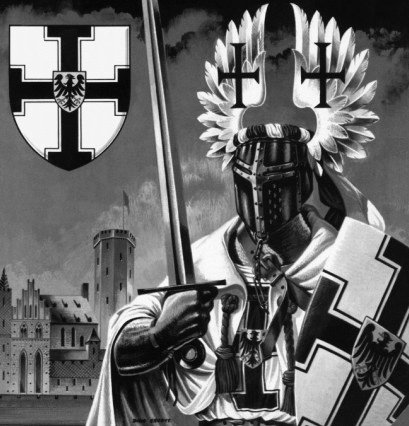
The Teutonic Knights

When one thinks of the old-fashioned image of a knight, one probably first thinks of the Knights Templar or other Crusaders fighting in the bleak lands of the Middle East, most of them being southern Europeans and, early on, even more specifically, predominately French. However, one of the three most famous crusading orders of knighthood had a very pronounced German flavor to it and that was the Teutonic Knights. Rather than fighting bandits and Muslim warriors in the burning sands of the Levant, the Teutonic Knights fought pagan barbarian tribes in the snow, ice and dark forests of the Baltic coast. Still, like the Knights Templar and the Knights of Malta, the origins of the Teutonic Knights can be traced back to the Holy Land as well. The Order of the Teutonic Knights of St Mary’s Hospital in Jerusalem was first formed to protect pilgrims and care for the sick and rose to prominence in Acre protecting the ports there in that last bastion of Christendom in the Middle East. It was recognized by Pope Celestine III in 1192 as an order of hospice monks using the Augustinian Rule and in 1198 it became a military order under the authority of a Grand Master.

Under the Grand Master Hermann von Salza the Teutonic Knights became more prominent as the Holy Roman Emperor (and sometime excommunicate) Frederick II, the “Wonder of the World” made the Grand Master a Prince of the Empire and when Emperor Frederick II came to the Church of the Holy Sepulchre to be crowned King of Jerusalem it was the Teutonic Knights that served as his escort. However, as the Middle East was completely conquered by Muslim forces the Teutonic Knights were forced to relocate, which they did to what might seem an unlikely place; Transylvania. In 1211 King Andrew II of Hungary employed the Teutonic Knights to defend Burzenland from the Cumens, a powerful warrior nation of nomads from the steppes of what is now southern Russia. This they did, bringing numerous German colonists with them, and they stayed until 1225 when their growing power combined with an effort to place themselves under the direct authority of Pope Honorius III caused the King of Hungary to expel them.

The Teutonic Knights wore a white garment with a black cross as their uniform and the black and white colors of the knights and their style of cross would become a long-established symbol in the history of the German and particularly the north German people and it all goes back to the Teutonic Knights. The black and white colors of Prussia, the decoration of the Iron Cross and even the symbol of the Federal German military today can all be traced back to the Teutonic Knights. In 1226 Duke Konrad I of Masovia, in what is now Poland, called upon the knights to defend his land from the pagan Prussians in the Baltic. So, for the next fifty years the Teutonic Knights fought fiercely but successfully in what became known as the conquest of Prussia. It was a long, bitter war that is not very well remembered today but one which was marked by extreme heroism on the part of the Teutonic Knights who fought usually against immense odds, facing the most horrific consequences if they were taken alive. History records knights captured by the pagans being roasted alive in their armor and offered as sacrifices to their pagan gods. They fought in bitter cold and in dark, dense forests and like most knights they built strong castles on this frontier of Christendom that were often islands of safety in a sea of pagan hostility.

Over time, however, the pagan tribes were defeated and the local nobles began to be converted to Christianity. This became the core of what would become the Prussian nobility. The Holy Roman Empire, in agreement with the Pope, eventually bestowed upon the Teutonic Knights political control over the area as a sovereign monastic state under the nominal authority of the Pope. Slowly but steadily these pagans who had practiced everything from polygamy to cannibalism were converted and civilized. Clinging to the Teutonic Knights for protection it was only natural that they grew to become something of a warrior race yet again but from then on of a Christian variety. More than defeating the pagan tribes outright in a climactic clash, these people were gradually assimilated into Christendom under the leadership of the Teutonic Knights. This was also aided by the colonization of the lands of the order by German, Belgian, Dutch and Scandinavian Christians.

Livonia (Estonia) and Lithuania were absorbed into the Teutonic Order as well as were parts of Poland that had not yet become Christian. The expansion into Lithuania, however, came only after a significant setback. Previously, the plan had been to convert/conquer the Russians. However, the Teutonic Knights suffered what was probably their most famous defeat at the “Battle of the Ice” in 1242 at the hands of Prince Alexander Nevsky of Novgorod (today recognized as a saint himself in the Russian Orthodox Church). So, after having their fingers burned by the Russians, the Teutonic Knights turned to Lithuania in a bitter war that lasted for most of two hundred years. Resentment can still be seen today, yet the sizeable minority of Baltic Germans in these countries can be traced back to these original campaigns of the Teutonic Knights. When their focus fell on Poland the Teutonic Knights captured Danzig, driving out the invading Brandenburgers in the process. There were plenty of sad events of great cruelty but few people consider these events in the context of a group of hardened warriors who had spent their lives fighting the most ferocious enemies Christendom had ever faced, peoples far more savage and barbaric than the worst of the Muslim enemies other knights had battled in the Holy Land.

In about the Fourteenth Century the Teutonic Knights reached their peak of power and influence with vast lands stretching across what is today northern Germany and Poland, Lithuania, Estonia and even parts of Sweden. However, the reason for their existence as a religious military order was rather undercut by the first union between Poland and Lithuania at the start of the rise to prominence of the Polish Jagiello dynasty. With that Lithuania became as firmly Christian as Poland and the Teutonic Knights were left with little to do. When the Poles and Lithuanians joined in attacking the order the Teutonic Knights suffered a terrible reverse (the battle of Tannenburg). Their capitol of Marienburg was besieged but successfully defended, nonetheless, the war was a devastating blow to the power and prestige of the order. Later, after the Protestant revolt, the Grand Master Albert of Brandenburg converted to Lutheranism in 1525 and he secularized the Order at which time his uncle, King Sigismund I of Poland, gave him control of the territory of the Teutonic Knights as the Duke of Prussia. This, of course, later became the Kingdom of Prussia which never lost the warrior tradition it had inherited from the Teutonic Order.

The Order of Teutonic Knights continued, of course, but it was never quite the same again. Over time, more and more lands were taken by other local rulers until the order was somewhat reorganized in 1531 under the Holy Roman Emperor Charles V after which a new headquarters was established in Wurttemberg. Protestants gained control of more and more of the lands of the Teutonic Order to the point that it existed almost in name only until it was finally abolished in 1809 by Napoleon Bonaparte who confiscated whatever was left. Some Teutonic Knights remained of course, mostly in Austria and the House of Hapsburg took control of the nominal leadership of the order and it continues to this day but only as a purely religious order with nothing other than the faith of the Catholic Church to connect it to those original warrior-monks who had fought off the pagan tribes of northern Europe on the frontier of Christendom. Nonetheless, they left a lasting legacy of which traces remain to this day in both the Christian presence that remains in the region of the old lands of the Order and in the symbols, colors and warrior traditions of many of the German people, growing out of the Kingdom of Prussia, prior to which was the Duchy of Prussia, prior to which had been the Order of the Teutonic Knights.

Thursday, August 15, 2013

Monarchist Quote

“I cannot conclude without mentioning how sensibly I feel the dismemberment of America from this empire, and that I should be miserable indeed if I did not feel that no blame on that account can be laid at my door, and I did not also know that knavery seems to be so much the striking feature of its inhabitants that it may not in the end be an evil that they will become aliens to this kingdom.”
-King George III of Great Britain & Ireland, 1782

Wednesday, August 14, 2013

Soldier of Monarchy: General Tomoyuki Yamashita

When one thinks of the great military figures of World War II, the names most likely to come to mind are, naturally, those from the winning side; names like General Eisenhower, General Patton, General MacArthur or Field Marshal Montgomery. Some, even at the time, did also point out the military talent employed by the Axis forces and names like Manstein, Model and Rommel are remembered as well. Not as often remembered is the name of General Yamashita of the Japanese Imperial Army. Yet it was General Yamashita, nicknamed the “Tiger of Malaya” who inflicted the most stunning defeat ever suffered by the forces of the British Empire. One would think the man who accomplished what so many at the time considered absolutely impossible, the capture of the British fortress-city of Singapore, would be better known. It was possibly the most astounding single victory of the entire war and yet, while the fall of Singapore has certainly not been forgotten, little is ever said about the man who carried it out. There are presumably a number of reasons for this, but it may also be possible that part of the reason is that the fate of General Yamashita after the war must stand as one of the great injustices of the period which the presiding Allied powers would prefer to be forgotten.

Yamashita Tomoyuki was born on November 8, 1885 in Osugi village (today Otoyo village) in Kochi prefecture on Shikoku. His father was the town doctor but Yamashita was trained for a military career from early in life, his family sacrificing to send him to military school and finally to the Imperial Japanese Army Academy from which he graduated, a respectable eighteenth place in 1905. Promoted in the following years, Yamashita saw his first combat as a junior officer in World War I in the capture of the German colony in Shantung, China in 1914. Promoted to captain, he graduated from the Army War College, sixth in his class, in 1916. That same year he married the daughter of a veteran, retired general. From World War I and into the following years Yamashita became known as an expert on Germany. He was posted to Switzerland and Germany in those years before returning to Japan in 1922, was promoted to major and served at the Staff College and the Imperial high command. He earned further promotion but his career suffered due to the political intrigues within the Imperial Japanese Army.

As part of the “Imperial Way Faction”, Colonel Yamashita was part of the group that wanted to return to ancient Japanese values, eradicate all western influences, socialism, capitalism, bureaucrats and political parties. They imagined having a “Showa Restoration” that would restore the Emperor to total, direct power over the government and then wage a climactic fight to the death against the emerging power of the Soviet Union. However, opposing them was the “Control Faction” led by General Hideki Tojo, composed of more mainstream conservatives who favored a more cautious and defensive approach to national expansion. They also tended to favor more industrialization and technological developments in weaponry over spiritual purity and the samurai warrior code (and the big business capitalists would be key to funding that) while keeping politics centralized and apart from the person of the Emperor. When General Tojo and the “Control Faction” gained ascendancy Colonel Yamashita and his compatriots were moved out of the way and he was transferred to Austria in 1928, though still promoted to full colonel the next year.

Fortunately for Yamashita, his talent continually allowed him to escape from difficult situations brought on by his nationalist political beliefs. In 1930 he was given the very prestigious command of the third infantry regiment of the Imperial Guard. By the summer of 1934 he had achieved the rank of major general. However, on February 26, 1936 a group of young army officers attempted a coup. Part of the plan included the assassination of the prime minister and taking control of the Imperial Palace. They were unsuccessful and Yamashita had no part in it, however, he asked for leniency toward the perpetrators and because of that earned the disapproval of the Emperor who was appalled by such a breakdown of discipline. In the aftermath of this incident, Yamashita changed his politics somewhat and became increasingly alarmed by the belligerency of many of those in power. He opposed expanding the war with China, in fact he favored ending it completely as Yamashita viewed it as a drain on the Japanese army with little to gain from it. He also opposed those in power who advocated a war against the United States and Great Britain. This was not a total break from the past, however, as the Imperial Army in general and the faction Yamashita had been associated with in particular had always focused on the Soviets as the real threat Japan faced while the Imperial Navy tended to favor a focus on southeast Asia which would have meant war with Britain and America.

After good service fighting insurgents in northern China as commander of the Fourth Division, General Yamashita was given command of the 25th Army in November of 1941, part of the Southern Expeditionary Army Group in what was then French Indochina (Vietnam). After the bombing of Pearl Harbor and the outbreak of war between Japan, the United States and Great Britain, General Yamashita launched the invasion of British-held Malaya on December 8, 1941. This would prove to be the high point of his military career and he performed his assigned duties brilliantly, defying the odds and astonishing military experts around the world. Thanks to careful study beforehand and the assistance of Malaysians opposed to British colonial rule, General Yamashita had far more information on his enemy than they had on his forces. Undermanned to begin with, the British forces suffered a setback at the start when Japanese air forces (operating out of French bases in Saigon) managed to destroy most British warplanes on the ground, giving them almost uncontested control of the skies over the battlefield. With initial attacks coming overland from Thailand and from amphibious landings by the sea, the British were pressed on multiple fronts and had to fall back. However, most expected that the rough terrain and dense jungles of the Malaysian peninsula would force the Japanese advance to be painfully slow and that the British would have plenty of time to counter them.

However, General Yamashita surprised everyone with the speed of his advance, making use of light tanks (British forces in the region had none) and most famously bicycles which allowed his men to move quickly through narrow jungle paths. When necessary the Japanese could also be picked up on the coast and moved by sea around impenetrable areas of the jungle. Troops brought in from India were soon defeated by the more experienced Japanese and as the British retreated, moving European residents to safety, many Malaysians felt themselves abandoned and began to turn against the British. On January 11, 1942 the Imperial Japanese Army marched unopposed into the capitol of Kuala Lumpur. This was blitzkrieg Asian style and observers were astonished by the speed and strength of General Yamashita’s advance. The 11th Indian Division offered stout resistance at Kampar, holding up the Japanese advance for a few days, but with control of the coastal seas, General Yamashita was able to outflank them with an amphibious landing and resume his advance southward. British imperial forces (mostly Indian troops) fell back to the Slim River where General Yamashita launched a daring nighttime attack that utterly devastated two Indian brigades and which prompted the top British commander, General Arthur Percival to replace the Indian Division with Australian troops.

At Johor, the British forces made their ‘last stand’ as it were on the Malaysian peninsula and the defending Australian troops made a ferocious and determined defense which held up the Japanese advance and inflicted heavy casualties. Again, General Yamashita moved to outflank the strong point and, unfortunately for the British, the west coast was defended by an Indian brigade that was inexperienced and poorly trained. The Japanese forces easily defeated them and the supporting Australian units also suffered heavy casualties before being cut off and forced to withdraw. However, their determination had bought time for the bulk of the British colonial forces to retreat. However, there was no real safe place for them to retreat to as General Percival had not allowed the construction of any defensive fortifications on the grounds that these would be bad for morale! Such an attitude, not uncommon amongst American forces at the beginning of the war either, can only be attributed to a (probably racist) over-confidence and underestimation of the military prowess of the Japanese. By January 31, 1942 the last of the British forces had left the Malaysian peninsula and blown up the causeway connecting Johor and Singapore. General Yamashita had conquered Malaysia and done it with greater speed and ease than anyone had thought possible.

Singapore was the great British bastion of the region, known as the “Gibraltar of the Far East” it had long been deemed an impregnable fortress by military experts. Yet, the British had never expected an Asian power to attack from the mainland and the fortifications of Singapore were built to withstand an attack from the sea by rival colonial powers from Europe. Still, they were fighting a defensive battle from a fortified base against an enemy they had outnumbered to a considerable extent. Nonetheless, General Yamashita knew he had the momentum of his offensive behind him. Already he was being called the “Tiger of Malaya” for his rapid advance and he kept up the pressure, doing all in his power to give the British the impression of having an irrepressible force. To an extent, the battle came down to nerve and General Yamashita successfully gambled that the British were already beaten in their minds. When the British requested a truce to discuss terms, General Yamashita executed a perfect bluff, giving the impression that Singapore was already at his mercy and that the garrison could be crushed swiftly and easily. The ferocity of his repetitive attacks, combined with his confident attitude made it all work perfectly. General Arthur Percival believed he was totally outmatched and surrendered Singapore and his entire garrison to General Yamashita on February 15, 1942. The most formidable British military base in Asia had fallen to a Japanese force of only about 30,000 that, by that time, were practically out of ammunition. In the whole campaign over 100,000 British and Commonwealth troops had been captured and the fall of Singapore marked the largest mass surrender of British troops in history.

General Yamashita became an instant hero in Japan and British morale suffered with Prime Minister Churchill calling the loss of Singapore the worst disaster in British military history. However, Yamashita still had enemies in high places and his success worked against him. Not long after his greatest triumph, General Hideki Tojo had Yamashita reassigned to a relatively unimportant command in the Empire of Manchukuo. He did not return to front-line duty until 1944 when, after Tojo and his government had fallen due to the worsening war situation, he was assigned to the Japanese forces defending The Philippines. Unfortunately for the general, he had little time to organize things as American forces began landing only ten days after his arrival. The fighting was brutal and ugly but General Yamashita performed with his old brilliance. Against impossible odds he maintained a slow, fighting withdrawal that inflicted heavy losses on the Allies. He was still holding out, his army reduced to around 50,000 men, when the Emperor announced the unconditional surrender of Japan. Upon learning of this, General Yamashita surrendered his army to Allied forces led by U.S. General Wainwright and British General Percival, the same man who had surrendered Singapore to him.

What happened next was a disgraceful display of injustice by the victorious Allied nations. Rather than wait for a full, formal trial, General Yamashita was accused of war crimes and brought before an American military tribunal in Manila. A full re-telling of the complete travesty of justice that was the “trial” of General Yamashita would be extensive but, in brief, he was being held responsible for atrocities carried out without his orders and, indeed, without even his knowledge. Even a number of American personnel were outraged by the treatment of General Yamashita and warned their countrymen to consider the possibility that someday that same measure of justice might be employed against their own generals. Their championing of his case, though futile, was enough to impress General Yamashita who, despite having every justification for feeling nothing but hatred toward the United States, came away impressed with the integrity of those who defended him so vigorously even if unsuccessfully. As expected, he was swiftly condemned and ordered to face execution, yet even at the end, General Yamashita had nothing but kind words for the Americans who had argued his case saying, “I don’t blame my executioner. I’ll pray the gods bless them.”

Just to be clear, not only was General Yamashita not guilty of wrongdoing, he had displayed his honorable and upright attitude as a soldier on many occasions. For example, after the fall of Singapore, a small group of Japanese soldiers massacred most of the staff and patients at Alexandra Hospital. When he learned of this, General Yamashita had the officer in charge executed and he personally apologized to the survivors for what had happened. In the aftermath he had several Japanese soldiers executed for looting and unlawful killings. The larger atrocities for which he was blamed occurred in the Philippines but the truth is that Yamashita had not known of these events, he certainly had not ordered them and he was not even in a position to have stopped them had he known as he was not the senior officer present. It was Rear Admiral Sanji Iwabuchi who had taken command and decided to make a fight in Manila, an operation General Yamashita had opposed as futile and wasteful. However, Admiral Iwabuchi was not available for punishment as he had killed himself with a hand grenade just before Manila fell to the American forces. General Yamashita was made to become a scapegoat and it also helped that he had been responsible for one of the worst defeats the Allies had suffered in World War II.

General Tomoyuki Yamashita was hanged on February 23, 1946 at Laguna Prison Camp, 30 miles south of Manila. His lawyers appealed his case to the U.S. Supreme Court which upheld the decision (not surprisingly as few would even think of sparing so prominent a Japanese general in the aftermath of World War II) but the two justices who dissented from the decision, for the first time, spoke of international human rights and called the entire trial “a miscarriage of justice, an exercise in vengeance, and a denial of human rights”. Nonetheless, the precedent set by the trial of General Yamashita remains in effect to this day. It is only fortunate for the Allies, particularly the Americans, that they have never yet suffered a defeat which placed any of their commanders in the position of being held responsible for the crimes of others even if they had no knowledge of them whatsoever. What should be perfectly clear is that General Yamashita was not a war criminal. He was an honorable man, one of the most successful commanders the Imperial Japanese Army has ever had and a commander who won a campaign and a battle that must stand as one of the most astounding in military history.

Tuesday, August 13, 2013

Monday, August 12, 2013

The Swaziland Situation

It seems amazing how many people around the world have heard of the Kingdom of Swaziland. The fact that so many have heard of this extremely small, African country which, honestly, is rather insignificant even in African or sub-Saharan African affairs much less the grand stage of the world would, one might assume, be considered rather odd. What is unfortunate is that very few people who have ever heard of the Kingdom of Swaziland have ever heard about in anything other than in a negative light, particularly in regards to her current monarch King Mswati III. Now, here at the outset, I have to make a confession. King Mswati III, amongst the currently reigning monarchs of the world, is one that I have very, very little time for. He has certainly given the world and his own people plenty of reasons to dislike him. Amongst the monarchs of the world he is a very hard one to defend. In fact, many monarchists might hold particular anger against him for making their job more difficult than it already is because his behavior has been exactly the sort that republicans have been seizing on for centuries to stir up outrage and hostility against traditional authority all over the world. However, a monarch can be less than ideal and still be treated unfairly and more than the King being treated unfairly, it seems to me that the Kingdom of Swaziland itself is, and has been for some time, treated quite unfairly. Allow me to explain.

The King of Swaziland has been frequently featured in the media, always portrayed negatively, for his numerous wives, particularly his treatment of them with stories of three wives having fled, accusations of abuse and at least one story of a girl being kidnapped to become a royal wife. Those are usually the biggest headline-grabbers when it comes to Swaziland but there have also been plenty of stories criticizing the King for living a lavish lifestyle while most of his people live in poverty and for various human rights abuses, generally revolving around the fact that the King of Swaziland is an absolute monarch and that democracy and political parties are suppressed in the country. That is probably the issue that should be looked at first because many if not most of the stories and accusations about the King being such a cruel tyrant come from outlawed political organizations which are probably not the most unbiased sources of information regarding the King and what goes on in the very removed and secretive royal household. There is, in fact, more than just a hint of bias and prejudice when it comes to world media attention on the King and Kingdom of Swaziland. It makes it no less unfair to consider that things would probably be worse under different circumstances.

To begin, it seems rather suspect that Swaziland is singled out for being un-democratic. There are, just to remind everyone, only three independent monarchies in the whole of Africa (Morocco, Swaziland and Lesotho) and all three have been subject to a level of scrutiny that not many others receive. Yes, Swaziland is an absolute monarchy, there is no democracy and no political freedom in the sense that most people in the world understand the concept. However, there are plenty of other countries (republics) all throughout Africa that are undemocratic but which are simply not prepared to openly admit the fact. You cannot tell me that in the whole continent of Africa that the people of Swaziland are the only people being denied free and democratic multi-party representative government. Perhaps I am a little swayed by the fact that so many republican dictators tend to be embraced one minute and condemned the next by the leftist, mainstream media of the world. In 2011 U.S. Vice-President Joe Biden said that President Hosni Mubarak of Egypt was “not a dictator” only for the U.S. to later support his overthrow on the grounds that he was a dictator. His elected successor was later also labeled as a dictator (despite the democracy part) and the military taking control of the country was cheered. In the nearby republic of South Africa there are elections and representative government yet the same political party has held power since 1994 and no one seems the least bit troubled by that astounding record of electoral success, even as the overall condition of the country has deteriorated rapidly.

Even if we limit our view only to sub-Saharan Africa; does anyone honestly believe that the King of Swaziland is the only one ruling without a popular mandate or who is living too grand a lifestyle compared to the vast majority of his people? Why then is he so often singled out alone for condemnation? Likewise, many of the same people who are quick to criticize Swaziland are the same people who are quick to (whether genuinely or not) moan and groan about Western or European colonialism and cultural imperialism. They show how false they are when it comes to Swaziland because the King is doing no more than ruling in the same fashion and with the same powers as his ancestors have always done. Why did it only recently become a bad thing? Why is he being condemned for continuing to have the powers that Swazi kings have always had rather than embracing a totally foreign political model and system of government? Under colonial rule there had been a move toward constitutional monarchy, but after independence the father of King Mswati III decided to go back to the old way of doing things. These people might also try to look around at the situation the Kingdom of Swaziland finds itself and consider that maybe, just maybe, an absolute monarchy is necessary.

The only other independent monarchy in the neighborhood of Swaziland is the little Kingdom of Lesotho. There, things are rather different. The King, Letsie III, is a British-education Roman Catholic who is quite popular and who is known for staying out of politics even when his people have wished him to intervene. He likes ranching and classical music and he and his (one) wife have charitable foundations to help their people who, though poor, have a literacy rate of over 80% even though education is not universal, a literacy rate higher for females rather than males. Oddly enough, you never seem to hear much about King Letsie III in the international news media. However, despite being a constitutional monarchy with a largely ceremonial sovereign, Lesotho is not without problems. In the recent past the country was troubled with a military that kept taking over the country and even though things have been calmer lately, just like Swaziland poverty remains a pervasive problem and the AIDS epidemic is disastrous. Another problem, which Swaziland does not have, is that some people in Lesotho are using their political freedom to call for the end of their country altogether, campaigning for it to be annexed to the South African republic. Perhaps, in holding on to absolute power, the King of Swaziland is trying to avoid military coups or the total loss of the independence of his country at the hands of political interference from outside her borders? It is a thought that might at least be considered.

We can also see, by comparing Swaziland and Lesotho, that being a constitutional monarchy or an absolute monarchy does not seem to be the decisive factor in fighting poverty or AIDS. It surely does not help, in practical terms or simply in “image management” that the Swazi King lives such a lavish lifestyle but, honestly, even if he did not, his country would be no richer and AIDS would be no less a problem. Plenty of other countries in the region are dealing with the exact same conditions and problems of Swaziland and yet, their republican dictators and politicians never seem to be held up for the same level of criticism and condemnation as the King of Swaziland. For one example, one need look no further than the republican tyrant Robert Mugabe to see a leader who lives in luxury while his people live in poverty and who has done actual harm to far more people within the borders of his country than King Mswati III ever has. Even the worst enemies of the King of Swaziland have so far managed to accuse him of doing actual harm to no one but his wives and even those stories, after time, have started to look rather suspect. After all, the same pro-democracy groups that come forward with these horror stories of royal wives being abused and treated like prisoners are the same ones complaining that the King and his wives and children are all living lavish, luxurious lifestyles, oblivious to the suffering around them. Well, one would be tempted to ask these people to get their stories straight as far as the royal wives are concerned; are they poor, pitiful prisoners or wealthy, pampered snobs being waited on hand-and-foot? Surely they cannot have it both ways.

Again, there are certainly many things in Swaziland that need to be improved and there is much about the King that I wish was different. However, it is still wrong for the country to be held to a different standard to the many republics of the region where things are just as bad and often much worse. There is plenty of room for just criticism but it is also blatantly obvious that the ruler of Swaziland is being singled out both for being a monarch and for being an absolute monarch because there are numerous other national leaders who are far, far worse who are seldom criticized. In fact, when someone does venture to criticize some of those republican leaders of failed or failing countries, they are often met with a backlash from the very same leftist media that is always so quick to point fingers at the King of Swaziland. I hope I have been clear that I am no fan of his, but fair is fair and he should not be treated worse just because he is a monarch.

Sunday, August 11, 2013

Saintly Royals Sunday

St David Komnenos, last Emperor of Trebizond along with his sons Sts Basil, George and Manuel and his nephew St Alexios who were martyred by the Turks in 1463 in Constantinople.

A tug of the forelock to Byzantine Texas for bringing this recent canonization to my attention.

Saturday, August 10, 2013

Royal News Special Report: Monaco

The big royal news this week came from one of the smallest corners of the monarchial world; the Principality of Monaco. To get the least controversial and best established news out of the way first, the Princely Palace has announced that August 31 is the date that has been set for the wedding of Andrea Casiraghi and Tatiana Santo Domingo. The couple will have a small, private ceremony. And it is high time for a wedding, considering that the two have already started their own family with the birth of their baby boy, Sacha, on March 21 of this year in London. Andrea is next in line to the throne in Monaco after Princess Caroline until such time as TSH Prince Albert II and Princess Charlene do their part for the succession. Andrea is the eldest child of HRH Princess Caroline of Hanover and the late Stefano Casiraghi. Tatiana is the daughter of Colombian tycoon Julio Mario Santo Domingo Jr. and Brazilian socialite Vera Rechulski Santo Domingo. The two were first introduced by Andrea’s younger sister Charlotte who is also the one who has stolen most of the royal headlines this week.

About a year and a half ago, Charlotte Casiraghi began dating Gad Elmaleh, a French-Moroccan-Jew actor-comedian. This raised a few eyebrows considering that Gad is 42-years old and Charlotte only just turned 27 last Saturday. He has also been around the block a few times (ironically enough his past relationships have been with women older than himself) and he already has a 12-year old son by a past relationship with a French actress. The two began to be seen more and more together, rumors flew and were later confirmed when Charlotte was spotted staying over with Gad and recently things seem to have become even more serious. Royal watchers began to notice what looked to be the beginnings of a “baby bump” on Charlotte and recently she was spotted shopping for baby clothes. True, she may just be filling out some and she may have been shopping for her little nephew, but that has not stopped many news outlets from declaring that Charlotte is pregnant, Gad is the father and that the two are already engaged and will be married by the end of the year. If that is true, the Palace has certainly not said so.

It is, however, not unreasonable to come to such a conclusion as the two have been more and more visible lately such as when Gad recently escorted Charlotte to the annual Red Cross ball in Monte Carlo. Yours truly will confess to having been less than thrilled with the pairing of Gad and Charlotte, though in all honesty none of the boys Charlotte has attached herself to in the past seemed worthy of her in my book. For a time, back when both were on the covers of all the teen magazines, gossipmongers had fun speculating about a romance between Prince William and Charlotte. That would have been quite impossible of course as Charlotte is (officially at least) a Roman Catholic and it may have been for the best anyway as their children would have probably have been too gorgeous for the world to tolerate. The Princely Family, not surprisingly, have been very welcoming of Charlotte’s much older boyfriend. Things are a bit complicated when it comes to an “official” reaction to these things since none of the children of Princess Caroline (save for young Princess Alexandra of Hanover) have any official position in Monaco or any titles; even Andrea who is only two steps away from the throne itself -so far. In legal terms, Charlotte Casiraghi is a commoner though she is invariably included in coverage of royal figures as a daughter of Princess Caroline and as she holds a place in the Monegasque line of succession. Still, family acceptance is important as Monaco is one of the last 2 or 3 monarchies in Europe where the monarch still rules and has final say on everything that happens inside the narrow borders of Monaco.

The papers seem to be thrilled with this match and the prospect of a new baby and another wedding. Gad has so often been described in print as “dashing” and “witty” and “charming” that one might just forget that he is a father in his forties who has yet to have a successful, long-term relationship. Some have even compared him to the late Stefano Casiraghi, waxing nostalgic that Charlotte’s relationship must bring back memories for her mother Princess Caroline. I wish them every happiness, but honestly, given how much older Gad is than Charlotte and how “experienced” he is, it rather more reminded me of Princess Caroline’s first marriage to the much older playboy Philippe Junot which, as predicted by Prince Rainier III and Princess Grace, was a thankfully short-lived disaster. Last year I made it clear that I did not “get” the Charlotte-Gad match and I still do not. However, as I said then, if Charlotte decides he is the right man for her I will sincerely wish them all the happiness in the world. Keep in mind though, despite all the talk this week, nothing has been officially announced or confirmed. It all seems fairly evident but I prefer not to get too excited about these things until the Palace makes an announcement.

Friday, August 9, 2013

MM Mini View: Kings of Spain (Part III)

House of Bourbon

King Fernando VII: The guerilla war fought against the French was fought in the name of King Fernando VII, the last Spanish absolute monarch of the old style. One cannot help but be supportive of Fernando VII because the alternatives to him were always worse. He made many mistakes, the first of which was, like his father, seeking help from Napoleon who forced his abdication before he had even got the throne warm. Locked up in France, their defeat meant his return but liberalism had taken hold and he was forced to agree to a constitutional monarchy before he would be allowed in. He did so, then tore up the constitution and ruled in the traditional, absolutist fashion. His reign was largely a failure but it is hard to be too harsh with Fernando VII because he walked in to a nearly impossible situation with a divided populace and an empire crumbling in revolt. It is to his credit that he fought the good fight through it all, trying to maintain the traditional Spanish monarchy as he had inherited it. However, he was suspicious of his brother and the support he had with the Church and was often unduly influenced by his domineering wife. Toward the end of his life he made one of the two biggest mistakes of his life and decided, on his own absolute authority, to set aside rule against female succession to allow his daughter, rather than his brother, to succeed him. This resulted, after his death, to a series of civil wars that were positively disastrous for Spain.

Queen Isabella II: A large figure in Spanish history, Isabella II managed to make herself equally hated by both ends of the political spectrum. Oftentimes that speaks well for a person, but in her case, about the best that can be said was that she was not as bad as either side claimed she was, but no more than that. Because the zealous Catholics of Don Carlos opposed having a female ruler at all, it was only natural that the anti-clerical liberals flocked around the banner of Isabella II who started her reign as an infant acted for by her unsavory mother. The problem was that she grew up to be far too conservative and Catholic for the group that had always supported her while those who had followed her uncle Don Carlos into rebellion were never going to accept her no matter what her character or policies. She did fairly well considering the disastrous circumstances that prevailed throughout her reign. Born with many Spaniards opposing her, her core of support eventually declared her a hopelessly superstitious reactionary and in 1868 turned against her and forced her to abdicate and go into exile.

House of Savoy

King Amadeo I: Having turned out their own monarch, and being unwilling to accept the Carlist claimant to the throne, the moderate monarchists and military establishment decided that a foreign monarch might be best to reunite the country and start over fresh. The choice was the Duke of Aosta, second son of King Victor Emmanuel II of Italy. After being duly elected and (at the insistence of his father) accepting the Spanish throne, the Italian prince arrived and became King Amadeo I of Spain. And things started to go wrong from the very start with the death of his chief supporter. A diligent, determined and hard working man who didn’t really want to be King of Spain, he did the best he could but was met by hatred from some and ridicule from many more. Of course the Carlists and the growing group of republicans opposed him and would never be won over but the moderate or liberal monarchists who had supported him soon became so divided by infighting that their support proved insubstantial. To most he had no business being King of Spain at all (a sentiment he might have agreed with actually). He was not a bad man and did the best he could but he was surrounded by people so divided that no one seemed to care about anything but the defeat of their own enemies. He finally declared Spain ungovernable and abdicated, going home to Italy and asking the Pope for forgiveness for ever undertaking such a mission. Traditional Spaniards had no reason to cheer however as the downfall of King Amadeo I also meant the birth of the First Spanish Republic with so many people deciding that monarchy was too divisive.

House of Bourbon

King Alfonso XII: After the fiasco that was the First Spanish Republic, Spain decided to look for a monarch again. However, the old divisions still remained and none were strong enough to totally overcome the others. Neither the Carlist claimant nor the exiled Isabella II would be tolerated but finally enough of the left and center came together to accept the son of Isabella II who came to reign as King Alfonso XII. He defeated the Carlists and managed to make peace between the liberal and conservative factions by arranging a system in which power alternated between the two. For the first time in a long time Spain was stable and at peace with itself. Most people were overjoyed and Alfonso XII became quite popular for his ability to deal with a crisis and his diplomatic skill in coming up with common sense solutions to end the political feuding. He married, secured the succession (though he was not a faithful husband which is a big negative in my book) and the Spanish economy began to finally come back. Not an ideal man but a pretty good, effective monarch. Unfortunately, he died prematurely (he had long suffered from consumption) with much still to be done. However, Spain likely would not have survived the challenges to come if not for all he did in a short time to see the country restored. Overall, a good King who benefited his country.

King Alfonso XIII: King of Spain from the moment of his birth, he was still a boy when Spain was attacked by the United States and lost what little was left of the once grand Spanish empire, thankfully his regent mother provided steady leadership until he reached his majority. He married a British princess but turned to infidelity over anger at her passing on hemophilia to his son -not good. He had the good sense to stay out of World War I, won a minor colonial war in Morocco but the Great Depression hit Spain hard and undid what hard-earned progress had been made thanks to Alfonso XII. Communist republicans became more organized and more of a problem as the old divisions reappeared. Monarchists remained rather divided while the republicans became ever more united. Alfonso XIII foolishly turned to a strong man figure for help, was betrayed by him and was forced to go into exile as the Second Spanish Republic was proclaimed. There is plenty to criticize about Alfonso but what came after him was nothing short of a nightmare.

King Juan Carlos I: After the horrific republic, a bloody, traumatic civil war and the (benevolent) dictatorship of Generalissimo Francisco Franco, Prince Juan Carlos became King of Spain in 1975. He angered many in the military by almost at once dismantling the authoritarian regime Franco had built and transitioning Spain into a constitutional monarchy. Press freedom, civil rights and all the rest were restored and the ban on opposition political parties was lifted (even those like the communists who opposed the monarchy and would continue to do so). Many grumbled but the public at large was overwhelmingly in favor of these changes. In 1981 a military coup was attempted which King Juan Carlos put down, winning even greater prestige and popularity as a champion of freedom. Some on the left still grumbled over minor things; the King’s love of bullfighting or his refusal to ever speak ill of Franco or to allow anyone else to speak ill of him in his presence, but overall the public adored the King and the Royal Family. Media mockery or criticism were absolutely unheard of. Unfortunately, the public has a short memory and recently have begun to use the very freedoms the King gave them to unfairly attack him. I am very fond of King Juan Carlos and I think he takes way too much abuse and not just from the republican crowd one would expect it from. He may regret giving Spaniards their political liberty, but I doubt it. He could see that the traditional Spain could not be maintained indefinitely by force and so, with a constitutional monarchy, put it in the hands of the Spanish people to maintain as no one these days questions decisions reached via the ballot box. Unfortunately, the public let him down -not the reverse.

Thursday, August 8, 2013

MM Mini View: Kings of Spain (Part II)

House of Bourbon

King Felipe V: Formerly the Duke of Anjou, after accepting the Spanish Crown the grandson of Louis XIV of France became King Felipe V and almost immediately had to deal with the War of the Spanish Succession (Queen Anne’s War). Felipe V was a bit of a ‘mixed bag’ as a monarch. The most significant thing he did which fails to impress me was his policy of centralizing power, mostly to the benefit of Castile and detriment of Aragon. This was partly because his grandfather in France (and Richelieu under Louis XIII) had made centralizing power rather fashionable but it was also because many nobles in Aragon opposed his taking the throne and he wanted to concentrate power in the more trustworthy nobles of Castile. He benefited from marrying the great Maria Luisa of Savoy but her tragic death far before her time left him heartbroken. His stripping Spain of her traditional local rights is the biggest detriment to his reign in my book but Felipe V should be given credit for his energy and ambition. A great deal had been lost just securing his throne and he tried very hard to restore Spanish greatness with campaigns to regain land in Italy and even a rather ill-conceived invasion of Scotland. None of it seemed to work out but at least he tried and while I disagree with much of what he did, I admire why he did it and I think he was genuinely trying to do what he thought best.

King Luis I: There is not much to say about Luis I. He was king for only a short time after the abdication of Felipe V before his death when his father again resumed the throne. He was unhappily married to a French princess who was rather crude, rather rude and wanted nothing to do with him. Still, as heir to the throne Luis was fairly popular and a great many hopes rested on his shoulders. After coming to the throne his advisors did their best to keep him away from the influence of his father whose policies they found too ambitious. However, his reign lasted only about seven months and he was only 17-years old when he died of smallpox. His life had been short and rather unhappy altogether with his stepmother making his early years miserable and his wife and courtiers making his teenage years miserable. The public was very disappointed and we can only guess what might have happened had he lived.

King Fernando VI: Since Felipe V resumed the throne after the death of Luis I, when the first Bourbon King of Spain died in 1746 he was succeeded by his younger son Fernando VI. He was shy, withdrawn and likely suffered from depression. His only joys seemed to come from music and the hunt. However, he was intelligent and first took steps to end the hold his stepmother and her Italian clique (Parma) held on the court. He put a halt to the ambitious plans of his father, made peace and remained neutral, trying to stay out of conflict and focus on reviving Spanish fortunes. He tried to improve commerce in the empire in America, came to an agreement with the Church, updated the Spanish navy and was a great patron of the arts, especially music. He tried to save money by cutting subsidies and proposing a progressive tax but finally dropped the plans in the face of the strident opposition of the nobility. He also took the first steps toward the formation of a national bank. Those who stood to lose money from his reforms naturally opposed him and they were not all good ideas but, if nothing else, the peace and stability of his reign helped Spain a great deal. He was a thoughtful monarch who worked hard to restore things without charging into battle at every opportunity.

King Carlos III: There is much to like and much to dislike about Carlos III. As Duke of Parma he conquered Naples and Sicily before becoming King of Spain and was very much of the “Enlightened Despot” trend. On the negative side, he expelled the Jesuits, was harsh with the Church, tried to get out debt by borrowing money (Joe Biden is older than he looks) and worst of all the man banned bull fighting. On the positive side, he built many magnificent palaces, protected natural resources and encouraged local industries in Spain and southern Italy. Seeing Britain tear apart the French empire alarmed him and he went to war with Britain which didn’t turn out to be such a good idea. However, during the American War for Independence he got his revenge. Spain again declared war on Britain and did very well, taking back almost all that had been lost and meeting all of their goals save for the retaking of Gibraltar which Britain managed to hold on to (and still does). Like the King of France he worried about setting a bad example for Spanish colonial subjects by indirectly helping the rebel Americans but, in the short term at least, Spain benefited greatly from the intervention. Education improved a great deal during his reign, power was further centralized and he gave Spain an official national flag, anthem and capitol city. Spain won many great victories under Carlos III, he just wasn’t my taste.

King Carlos IV: The younger son of Carlos III, as his elder brother was severely disabled and excluded from the succession (he died of smallpox at age 30) it was Carlos IV who succeeded to the Spanish throne in 1788. He had a very unfortunate reign. While he took care to maintain the dignity and prestige of the Spanish monarchy, he largely left government to his ministers. A kind man, he was perhaps too trusting and the government of Spain was riddle with intrigue and feuding that allowed the country to deteriorate. He was often dominated by his wife from the Parma branch of the Bourbon tree who was unpopular and the focus of many salacious rumors. He declared war on France because of the revolution and regicide but it was a disaster, gossip buzzed that many at court and even the Queen were really pro-French. Napoleon forced him into an alliance with France and he finally abdicated in favor of his more popular son. It is unfortunate in that Carlos IV was a good man with good intentions but his reign was nothing short of disastrous. What was unforgivable in Spanish eyes was one of his last acts; seeking help from Napoleon to restore himself.

House of Bonaparte

King Jose I: Napoleon took the opportunity of a weak Spain and a feuding royal family to invade the Iberian peninsula and his forces promptly swept aside the dilapidated Spanish army and occupied the capitol. Napoleon forced Carlos IV and his son, Fernando VII, to each abdicate in favor of his elder brother Giuseppe Buonaparte, formerly King of Naples and Sicily. In 1808 he was proclaimed King Jose I of Spain but his rule was never widely recognized and he never even held complete control of the country as guerilla war soon broke out in opposition to the French presence. He tried to end privileges for the nobility and clergy but was not very successful though he did manage to shut down the Spanish Inquisition. The war against the guerillas dominated his government and he was given no real part in that. An idealistic sort, Jose I had many admirable qualities (and many dangerous and terrible ideas) but was not and was never going to be accepted by most Spaniards and he had no desire to be an occupying overlord and tried to abdicate several times but his brother would never allow it. Mockery turned to hatred when French repression began against the rebels even though King Jose had nothing to do with it. It is true though that some Spanish supported him, mostly those of the rabidly anti-clerical variety. Finally driven out by the Allies he ended up in America where some referred to him as the “King of New Jersey”.

Wednesday, August 7, 2013

MM Mini View: Kings of Spain (Part I)

House of Hapsburg

King Carlos I: Better known as Charles V, Holy Roman Emperor of the German nation and all that, Carlos I was a great King of Spain but, more to the point, was a great monarch in general as he had more than one throne and a great many responsibilities far beyond the Spanish lands. For Catholic Christendom, Carlos I was like Atlas; holding up the world on his own. He was altogether an awesome figure. He was courageous, a very skilled warrior, an intelligent and thoughtful man, a cosmopolitan man, a cultured man, a pious son of the Church, a shrewd statesman and a leader willing to take risks. Sometimes that meant doing what had to be done even if it was rather unsavory. The foundations for the great Spanish colonial empire were set down during his reign in Mexico and other areas and his was the first empire upon which, it was said, ‘the sun never set’. The only thing I can fault him for was the war against Pope Clement VII, the invasion of Italy and the utterly horrific sack of Rome. He did not order the atrocity of course, but he ordered the invasion and, as monarch, was ultimately responsible. He was horrified by it, but not too horrified to take advantage of the situation. Still, that aside, his was an epic reign spent in a titanic struggle against enemies on all sides and he usually won. The first monarch to rule all of modern Spain himself, he was one of the greatest of all time.

King Felipe II: One of my favorites, Felipe II had all the courage and determination of his father but even stronger principles. He did not always enjoy the same level of success though his only really major defeat (the “Invincible Armada”) was due more to plain bad luck and the skill of his opponents rather than his own mistakes (though he did make some). Felipe II was an extremely religious man, which today tends to be viewed as a bad thing but it wasn’t of course and he was certainly not the callous villain he is often portrayed as. In fact, he was a very compassionate man, very sensitive and considerate. He saved Malta from the Turks, beat the French at San Quentin, very nearly suppressed the Dutch rebellion but at least held on to Belgium and his forces played the largest part in the defeat of a massive Turkish invasion at Lepanto. The Armada was a fiasco and he did make some mistakes in organizing that endeavor. However, that was one defeat in an otherwise extremely successful reign and his character more than makes up for it. The colonial empire was further expanded and consolidated, religious uniformity was enforced (sparing Spain the civil wars France and Germany would have) and, in many ways, Spanish power reached its zenith under Felipe II. I would even go so far as to say that, in my opinion, he is probably the greatest monarch Spain has ever had.

King Felipe III: It is rather unfortunate that Felipe III seemed to inherit his great piety from his father but little else and his reign is usually identified as the period when the economic rot set in that was to prove so damaging to the Spanish empire. It is hard to be too critical of Felipe III though because he was such a good man, very religious, very devoted to his wife and who wanted to do the right thing. But, for all of his excellent qualities he simply lacked the firm will to rise above the factions at court and lead Spain in the direction he desired. He could be called a victim of being humble to the point of hesitancy. While he prayed other men stepped in and took control of the Spanish government and, unfortunately, they were more concerned with enriching themselves than strengthening and glorifying the Spanish nation. For good or ill he took Spain into the Thirty Years War and Spanish troops under the Count of Tilly had some success before Felipe III died. His reign was not the total disaster most think but he was not as effective as he should have been and it was, on the whole, an opportunity lost.

King Felipe IV: Fortunately, Spanish fortunes improved under Felipe IV. In fact, the Spanish empire reached its peak under Felipe IV in terms of sheer size. Felipe IV was a man of very noble intentions who really tried to be another Felipe II, a Spanish champion of Catholicism in Europe, and it is admirable that he had a very serious correspondence with the mystic Venerable Mary of Agreda who advised him on how to be a true Christian monarch. The trouble was that he would throw himself into his work so much and try so hard that he would quickly burn himself out and would then revert to being an often absent monarch, leaving affairs in the hands of his chief minister. The man was always hot or cold, he had only two speeds. He was a great patron of the arts and left behind a great cultural legacy, his troops won a number of very solid victories and he left Spain a more beautiful, larger and more respected country than he found it. Still, he seems to be often unfairly criticized for not being perfect, even though others who are praised even more suffered greater setbacks than he did -as any ruler invariably will. The biggest lingering problem of his reign was the economy, which was stretched to the breaking point and kept going only by gold and silver imports from America. However, those problems started before his reign and it would have been a tall order for any monarch to reverse such a long-standing trend in one lifetime. Overall, there is more justification than not for his being known as “Philip the Great”.

King Carlos II: Oh the pity. The great, great pity. The Hapsburg reign came to an end with Carlos II and most know that things did not go well for Spain with King Carlos II and most, I am sure, know why. He was certainly not to blame but his bloodline certainly was. Felipe II and Felipe IV had both married nieces, other marriages had overlapping family trees and the result was the unfortunate, pitiable state of Carlos II. The overuse of family intermarriage for political reasons caused him to be born extremely disabled, both mentally and physically. His lower jaw extended so far that he was unable to chew his food (hence the term “Hapsburg jaw”) or even close his mouth. His tongue was so large his speech was barely intelligible and he was constantly sick with various ailments, having an extremely weak immune system. He could barely walk, suffered losses of memory, had epileptic fits and virtually none of his organs or systems functioned properly. He was married (duty first after all) but was, not surprisingly, unable to consummate the marriage and his very depressed wife died young, leaving him heartbroken on top of his many other maladies. Spain declined considerably under his reign, which was the fault of the inept and/or corrupt political figures who held power in his name rather than the monarch himself. Really one can only feel great sorrow and pity for Carlos II. When he finally died the only surprise was that he had somehow lived so long (38 years).

Tuesday, August 6, 2013

Favorite Royal Images: Belgian Royal Siblings

The three children of HM King Leopold III of the Belgians and HM Queen Astrid of Sweden; future King Baudouin of the Belgians, future Grand Duchess Josephine Charlotte of Luxembourg and future King Albert II of the Belgians. And if you don't think that's an adorable picture -there's something wrong with you!

Monday, August 5, 2013

Talking Politics: Japan, Mr. Aso and Who is the Real Threat

Recently, Japanese Finance Minister Aso made some poorly chosen remarks about the need for constitutional reform and rearmament in Japan. There was really nothing at all wrong with what he said, but it was poorly chosen because he should have known that you cannot bring up the name of Adolf Hitler unless you are making a blatant, unequivocal condemnation or comparing a political opponent to the late dictator (I think that’s how it works, but it has to be a conservative). What Minister Aso was talking about was pointing to the example of what Hitler did in Germany in going about changing the constitution and rebuilding the German military. He should have known to stay away from such a comparison because it should be expected that people are going to freak out all over the world (especially in the west) anytime Hitler or the Nazis are mentioned. However, there really was nothing wrong with what he said. He was actually saying that Japan should learn from the example of Hitler about how NOT to change your constitution, but that they should do the opposite, being open and honest about the entire process. However, that fact, the entire point of what he was saying, has been completely ignored by the leftist media that not only goes hysterical anytime Hitler or the Nazis are mentioned by someone other than a communist but which also has a blatant prejudice against Japan and in particular those Japanese who want to strengthen their country and stand up to the aggression of their republican neighbors (mostly Red China and North Korea).

Minister Aso has withdrawn his statement but he has refused to resign from office and the Abe government has said he will not be dismissed from his post. That is all well and good because the man said nothing outrageous at all, the only mistake was in not realizing what a tremendous double standard exists when it comes to Japan (the only remaining monarchy in northeast Asia by the way). As usual, much of the phony outrage over this statement has come from Communist China. You know, that country that still hero-worships Chairman Mao Zedong who actually killed way more people than Hitler and the Nazis did and gets really touchy anytime any foreign country criticizes them for how they do things in their country. The Chinese communists and their bandit government in Peking is, of course, not really upset at what the Japanese Finance Minister said, they could care less, but they are really upset about the idea of constitutional reform in Japan because the last thing they want is to see Japan strengthen itself. It is also convenient to make trouble with Japan anytime the communist dictator of China needs to provide a distraction to the Chinese peasants who occasionally become angry that their Maoist dictatorship has not provided the heaven-on-earth they were promised. Sure, the sons of the Communist Party bosses are all multi-millionaires now, but most Chinese are still as poor as they have ever been.

Because of this, on every occasion like this, the Chinese communists can be counted on to bring up World War II. Part of this is because they are still bitter about the fact that their legitimate Emperor was restored to his ancestral throne for a while and because they were never able to defeat the Japanese on their own. However, it is also to provide a rallying point for their own people and to try to sway world opinion against Japan and in favor of mainland communist China. What is alarming is how successful they have been at this and how many useful idiots go along with the communist Chinese propaganda. They have actually managed to convince some people that modern Japan is a nation full of nationalist, right-wing fanatics who are always only one step away from conquering East Asia all over again. This would come as a surprise to anyone who knows anything at all about Japan, perhaps the only country in the world where something as basic as flying the national flag or playing the national anthem is considered controversial because it might upset the neighbors. Japan is an officially pacifist country, unlike communist China which was born out of a civil war and only exists because of military aggression. Odd that. Yet, I am amazed to see their propaganda continuously parroted by useful idiots in various parts of the world. It is time to cut through the nonsense and look at the facts.

Communist China likes to pretend that they are the perpetual victims and that Japan is always the villain of the story. That is partly why they love to keep bringing up World War II and, usually, grossly exaggerated Japanese misdeeds all those many years ago. However, people need to step back and just look at the basic facts of the situation. If you do, anyone with half a brain will be able to see just how absurd this propaganda line from the bandit government in Peking really is. First, we should look at the historical record to see which government, Japan or Red China, has been the most aggressive throughout history. Both countries as they are today have been around for about the same length of time, so this should be a fair comparison. The People’s Republic of China was proclaimed in 1949 and the current State of Japan came into being in 1947 with the adoption of the post-war constitution, replacing that of the former Empire of Japan. After all, it would not be fair to hold the bandit government in Peking responsible for everything done by the Republic of China and the Qing, Ming and all the previous dynasties of Imperial China just as it would be unfair to hold modern Japan responsible for everything done by the old Empire of Japan (even though many do) since in each case, the values and principles and policies of the countries changed dramatically from what they had been to what they are now.

So, since 1949 the Communist Chinese have invaded Tibet, South Korea, Burma, India, Sikkim (which is today part of India but at the time was still a protectorate of India), Bhutan (yes, even them in 1959), Soviet Russia and Vietnam. That seems a bit lengthy, though to be fair, they never succeeded at much other than when they were fighting populations of Buddhist pacifists. On the other hand, since 1947, Japan has invaded…no one! So, in the same period of time that China launched military attacks into Tibet, South Korea, Burma, India, Sikkim, Bhutan, Russia and Vietnam the Japanese have attacked no one. It seems lopsided doesn’t it? But, the Japanese did adopt a constitution that makes it illegal to use military force to settle disputes so perhaps that gave them an unfair advantage. Perhaps it also helps to make them an inviting target? After all, the Chinese communists have been known to attack people who do not believe in violence; just ask any of the survivors of the massacres in Tibet -if you can find them. Alright, so much for the historical argument; how about current military preparedness? Well, on the one hand you have Japan with a Self-Defense Force of less than 250,000 active duty personnel. On the other you have Communist China, home of the People’s Liberation Army which has a standing force of over 2,200,000 along with the largest air force in the world and an extensive nuclear arsenal. They also have a navy twice the size of the Maritime Self-Defense Force of Japan (though thankfully of a much lower quality).

That, by itself, should be enough to settle this in the minds of most people who actually have the ability to think. There is China, which has attacked numerous countries, has an arsenal of nuclear weapons, the largest air force in the world, a standing army of over 2 million led by a government which has butchered tens of millions of people which is claiming that the other country, Japan, which has attacked no one, has no nuclear weapons, a pacifist constitution and a Self-Defense Force of 250,000 -is the bully looking for trouble. How anyone, even the useful idiots who still think communism sounds “cool” can buy what the Chinese government is selling frankly astounds me. Most of the tensions today between Red China and Japan revolve around the disputed ownership of the Senkaku Islands, which China only suddenly claimed had “always” belonged to them after the U.S. occupation of Japan ended and after it began to seem that there might be oil and gas deposits in the surrounding waters. Isn’t that convenient? It is also worth noting that there is scarcely any neighbor of mainland China that the bandit government in Peking does NOT have a territorial dispute with. The communist Chinese have currently made claims on the territory of the Republic of China on Taiwan (of course), North Korea, South Korea, Tajikistan, Pakistan, India, Bhutan, Japan, The Philippines, Vietnam, Malaysia and even little Brunei. They can scream all they want about World War II, jump on a throw-away line that mentions Hitler (they don’t think freedom of speech should exist in Japan) and they can shriek every time someone visits the Yasukuni Shrine (they don’t think freedom of religion should be allowed in Japan either) but a simple look at the facts should be enough to prove to any intelligent person that it is Communist China that is being belligerent and looking for trouble, NOT the State of Japan.

That’s my two cents. I pray that one day the bandit government in Peking will be overthrown, that China will return to following the Heavenly commands and restore friendly, respectful relations with all their neighbors. Until that time, everyone else must stand strong. God bless the island nation of Japan and long live the Emperor.
Related Posts Plugin for WordPress, Blogger...